






4121
Of your peers have already downloaded this article
10:32 Minutes
The most insightful time you'll spend today!
Trimoz Technologies and Google Cloud-built Vaccination Appointment Scheduler Managed 365,000 Appointments Daily!

3194
Of your peers have already read this article.
2:00 Minutes
The most insightful time you'll spend today!
When public health officials in Quebec set out to provide COVID-19 vaccination services for their 8 million residents in February 2021, they needed an easy-to-use, scalable solution to schedule appointments online. To make it simple for Quebecers to register for vaccines, the goal was to use Clic Santé, a familiar online portal built on Google Cloud and already in use to schedule flu vaccines and other health-related services. Trimoz Technologies, the portal’s creator, prepared to meet high-volumes of traffic by creating a seamless appointment scheduling experience.
To meet demand, Trimoz relied on Google Cloud – optimizing it for the expected surges. As an enterprise solutions provider to the public sector in Canada, Google Cloud scaled to meet the ongoing surges in traffic to the Clic Santé portal, with the stability and reliability the portal needed. At its peak surge, Clic Santé scheduled 365,000 appointment schedules in a single day, and on average, continues to handle a volume of roughly 50,000 appointments per day. Since launching their appointment scheduling service, Clic Sante has been able to deploy up to a over dozen new appointment functionalities each month with no service interruptions, while maintaining up to 3,000 vaccination and 1,500 pharmacies sites to serve the population.
“Thanks to our talented and agile team and the flexibility of Google Cloud, we performed hundreds of new releases and added new features and functionalities, without interrupting our services and while maintaining flawless security. We found extraordinary capacity to resolve complex problems with simple solutions
Stéphane Lajoie
CEO of Trimoz Technologies

Google Cloud services that helped build a more secure, flexible and scalable portal used by millions
The main components of Clic Santé are hosted using different services to give the team at Trimoz more flexibility with their platform functionality. The portal’s user interface, for example, was built using AppEngine, a Platform as a Service (PaaS) solution, that hosts websites and automatically scales up and down based on the load. AppEngine allows the portal to deploy its web interface without having to manage the infrastructure. Trimoz implemented Cloud SQL, another PaaS solution, to run instances of relational-type databases without needing to manage the infrastructure. Changing the number of instances based on active users gave them more freedom to scale as needed without affecting portal users.
Various healthcare organizations (CIUSSS and CISSS) required appointment-level metrics gathered from Clic Santé to track progression towards their vaccination goal. To handle this, Trimoz uses BigQuery, a serverless data warehouse service from Google Cloud. This service handles data storage economically and allows for future analysis as needed so Trimoz can ensure all data, at rest and in motion, is encrypted to protect the platform and its users.
A reliable, user-friendly vaccination experience for Quebec
Through the partnership between Trimoz and Google Cloud, the vaccine appointment-scheduling portal handles 80,000 connections on average per day, with zero service interruptions. It also provides a user-friendly interface that can handle swells of traffic as needed. This reliability of the solution was one factor among many that helped reach the goal of vaccinating “75% of the admissible population” three weeks early., making Quebec’s population one of the most vaccinated populations in the world.
The performance and scalability of the platform will now allow Trimoz Technologies to expand into new markets like pharmacies, other healthcare organizations in other Canadian provinces, U.S. or European markets.
Clic Santé in numbers:
- More than 7,000,000 unique users
- 50,000 appointments set in average per day
- Peak of 365,000 daily appointments
- 80,000 connections per day in average
- 100% uptime of the Clic Santé platform
- 4 to 12 new production releases per month
Google Cloud is already widely available for public sector organizations in Canada. We are actively expanding with new regions and solutions with the highest compliance and standards and are committed to providing Canada with the quality service they need from a public sector cloud provider.
To learn more, visit the Google Cloud for Canada public sector solutions page.
Quick Recap on Google Cloud: Latest News, Launches, Updates, Events and More

12911
Of your peers have already read this article.
2:00 Minutes
The most insightful time you'll spend today!
Want to know the latest from Google Cloud? Find it here in one handy location. Check back regularly for our newest updates, announcements, resources, events, learning opportunities, and more.
Tip: Not sure where to find what you’re looking for on the Google Cloud blog? Start here: Google Cloud blog 101: Full list of topics, links, and resources.
Week of May 24-May 28 2021
- Google Cloud for financial services: driving your transformation cloud journey–As we welcome the industry to our Financial Services Summit, we’re sharing more on how Google Cloud accelerates a financial organization’s digital transformation through app and infrastructure modernization, data democratization, people connections, and trusted transactions. Read more or watch the summit on demand.
- Introducing Datashare solution for financial services–We announced the general availability of Datashare for financial services, a new Google Cloud solution that brings together the entire capital markets ecosystem—data publishers and data consumers—to exchange market data securely and easily. Read more.
- Announcing Datastream in Preview–Datastream, a serverless change data capture (CDC) and replication service, allows enterprises to synchronize data across heterogeneous databases, storage systems, and applications reliably and with minimal latency to support real-time analytics, database replication, and event-driven architectures. Read more.
- Introducing Dataplex: An intelligent data fabric for analytics at scale–Dataplex provides a way to centrally manage, monitor, and govern your data across data lakes, data warehouses and data marts, and make this data securely accessible to a variety of analytics and data science tools. Read more.
- Announcing Dataflow Prime–Available in Preview in Q3 2021, Dataflow Prime is a new platform based on a serverless, no-ops, auto-tuning architecture built to bring unparalleled resource utilization and radical operational simplicity to big data processing. Dataflow Prime builds on Dataflow and brings new user benefits with innovations in resource utilization and distributed diagnostics. The new capabilities in Dataflow significantly reduce the time spent on infrastructure sizing and tuning tasks, as well as time spent diagnosing data freshness problems. Read more.
- Secure and scalable sharing for data and analytics with Analytics Hub–With Analytics Hub, available in Preview in Q3, organizations get a rich data ecosystem by publishing and subscribing to analytics-ready datasets; control and monitoring over how their data is being used; a self-service way to access valuable and trusted data assets; and an easy way to monetize their data assets without the overhead of building and managing the infrastructure. Read more.
- Cloud Spanner trims entry cost by 90%–Coming soon to Preview, granular instance sizing in Spanner lets organizations run workloads at as low as 1/10th the cost of regular instances, equating to approximately $65/month. Read more.
- Cloud Bigtable lifts SLA and adds new security features for regulated industries–Bigtable instances with a multi-cluster routing policy across 3 or more regions are now covered by a 99.999% monthly uptime percentage under the new SLA. In addition, new Data Access audit logs can help determine whether sensitive customer information has been accessed in the event of a security incident, and if so, when, and by whom. Read more.
- Build a no-code journaling app–In honor of Mental Health Awareness Month, Google Cloud’s no-code application development platform, AppSheet, demonstrates how you can build a journaling app complete with titles, time stamps, mood entries, and more. Learn how with this blog and video here.
- New features in Security Command Center—On May 24th, Security Command Center Premium launched the general availability of granular access controls at project- and folder-level and Center for Internet Security (CIS) 1.1 benchmarks for Google Cloud Platform Foundation. These new capabilities enable organizations to improve their security posture and efficiently manage risk for their Google Cloud environment. Learn more.
- Simplified API operations with AI–Google Cloud’s API management platform Apigee applies Google’s industry leading ML and AI to your API metadata. Understand how it works with anomaly detection here.
- This week: Data Cloud and Financial Services Summits–Our Google Cloud Summit series begins this week with the Data Cloud Summit on Wednesday May 26 (Global). At this half-day event, you’ll learn how leading companies like PayPal, Workday, Equifax, and many others are driving competitive differentiation using Google Cloud technologies to build their data clouds and transform data into value that drives innovation. The following day, Thursday May 27 (Global & EMEA) at the Financial Services Summit, discover how Google Cloud is helping financial institutions such as PayPal, Global Payments, HSBC, Credit Suisse, AXA Switzerland and more unlock new possibilities and accelerate business through innovation. Read more and explore the entire summit series.
- Announcing the Google for Games Developer Summit 2021 on July 12th-13th–With a surge of new gamers and an increase in time spent playing games in the last year, it’s more important than ever for game developers to delight and engage players. To help developers with this opportunity, the games teams at Google are back to announce the return of the Google for Games Developer Summit 2021 on July 12th-13th. Hear from experts across Google about new game solutions they’re building to make it easier for you to continue creating great games, connecting with players and scaling your business. Registration is free and open to all game developers. Register for the free online event at g.co/gamedevsummit to get more details in the coming weeks. We can’t wait to share our latest innovations with the developer community. Learn more.
How Kubernetes is enabling digital transformation for retailers

2638
Of your peers have already read this article.
3:30 Minutes
The most insightful time you'll spend today!
Retail organizations constantly face financial pressure to increase sales while maintaining profit margins. Digital commerce creates new opportunities and a more competitive landscape for retailers by allowing them to reach a global customer base online, but it also exposes them to competition from larger online retailers. To be successful in this environment, retailers must not only have a strong online presence to keep up with their competition and gain market share, but also uplift the transactional customer experience to a more experiential one.
In today’s data-driven artificial intelligence-inspired business environment, organizations require complex IT infrastructure to support various functions such as prospecting, product development, marketing, and data analytics. Managing and scaling this infrastructure can be challenging, especially as needs evolve. As a result, many organizations are turning to Google Cloud as a solution for meeting their business goals, rather than simply expanding their in-house IT resources with more equipment and personnel. Specifically, retailers across the globe are betting on Kubernetes on Google Cloud to take advantage of secure, reliable, and scalable infrastructure.
Here are a few examples of worldwide retailers adapting to changing customer expectations using intelligent infrastructure solutions including Google Kubernetes Engine (GKE), the most scalable and automated fully managed Kubernetes from Google Cloud.
Haravan is a Vietnamese ecommerce platform that aims to improve the process of buying and selling products, allowing businesses to focus on creating and selling their products.
By using Google Cloud, Haravan helped small and medium-sized enterprises in Vietnam achieve double-digit growth, consistently met its 99.97% uptime commitment to clients, efficiently managed 5 times the normal amount of ecommerce activity, and facilitated the implementation of artificial intelligence-powered expansion plans.
“We have a guaranteed commitment to enable any volume of sales for clients over all channels, be it social networks, marketplaces, livestream, or website. Only Google Cloud, with the flexible autoscaling of GKE, gives us certainty to meet our guarantees even in the most massive Black Friday surges.” —Hung Le, VP of Software Engineering, Haravan
Loblaw is Canada’s food and pharmacy leader and the nation’s largest retailer. The company operates over 2,500 locations, including corporate, franchised, and associate-owned stores, and employs nearly 200,000 full- and part-time employees.
By using Google Cloud, boosted the performance of the online grocery platform, resulting in higher conversion rates and increased revenue, recovered up to 50% of Site Reliability Engineers’ time for innovation, introduced new, real-time personalization features and shopping conveniences for customers, and enhanced resiliency to protect customers and revenue.
“Moving our online grocery site to Google Cloud gave us a 4x performance increase and the capacity to handle up to three times the traffic; and we can scale up at any time.” —Hesham Fahmy, VP Technology, Loblaw
L.L.Bean is a North American retail company known for its boots and mail-order catalog, which dates back to 1912. The company has a strong online presence, with ecommerce accounting for $1 billion of its annual revenues of $1.6 billion. Like many other retailers, L.L.Bean is adopting an omnichannel sales strategy by interacting with customers through various channels including print, physical stores, its website, app, and social media.
By using Google Cloud, L.L.Bean enhanced customers’ online experience through faster page load times and access to transaction history, allowed for a focus on providing value to customers rather than managing infrastructure, and enabled the rapid release of cross-channel services by reducing development cycles.
“GKE has significantly streamlined the process of upgrading nodes and masters. By comparison, upgrading even minor releases of another container solution that L.L.Bean tested resulted in the need to rebuild that solution’s clusters four times.” —Randy Dyer, Enterprise Architect, L.L.Bean
LPP is a Polish fashion retailer established in 1991 by Lubianiec and Piechocki, whose initials make up the company’s name. LPP currently manages five clothing brands that are popular in 38 countries across Europe, Africa, and Asia, and has over 24,000 employees based in its main offices in Central and Eastern Europe. Growing demand for its ecommerce services led LPP to migrate from an on-premises setup to Google Cloud, harnessing automation to ensure great shopping experiences globally.
By using Google Cloud, LPP promoted a DevOps culture among developers through streamlined deployment of new features, provided 90% more time for engineers to work on innovative solutions instead of managing infrastructure, instantly created and updated new VMs, allowing developers to quickly launch new features, ensured a seamless online shopping experience by automatically adjusting capacity to meet demand.
“GKE enables us to deploy new features for our ecommerce sites very quickly. Previously, it took weeks to launch new instances for each brand. Today, it takes seconds: we simply launch a new machine, deploy the code, and changes are reflected automatically across our environment.” —Marek Maciejewski, Head of IT Service Operations, LPP
Noon.com, based in Riyadh, Saudi Arabia, is a local ecommerce marketplace focused on serving the Middle East. The company aims to become the top online retailer in the region, supporting the growth of a digital economy for both consumers and local businesses.
By using Google Cloud, Noon.com built its ecommerce platform to access self-managed services, allowed developers to establish a fully operational staging environment within two weeks, provided uninterrupted service to nearly four times as many daily users during busy seasons using autoscaling on GKE, used real-time data streaming on BigQuery to inform business decisions and personalize the customer experience, and achieved 99.999% availability with no downtime for planned maintenance or schema changes using a fully managed relational database.
“Google Cloud-managed services are playing a major role in enabling Noon.com customers to get their shopping done whenever they need it, without experiencing any delays or glitches, and without us having to lose sleep at night to ensure our platform is functioning as it should.” —Alex Nadalin, SVP of Engineering, Noon.com
In conclusion, the retail industry is constantly evolving and retailers must stay up-to-date with the latest technology and customer preferences to remain competitive. Digital commerce has changed the landscape of retail, allowing businesses to reach a global customer base but also increasing competition. The use of Kubernetes on Google Cloud can help retailers improve the customer experience, streamline internal processes, and make data-driven and AI-inspired decisions. By embracing these changes, retailers can stay ahead in a constantly evolving industry. Get started today with an exclusive workshop, Unlocking efficiency and innovation with Kubernetes on Google Cloud.

3935
Of your peers have already downloaded this article
1:30 Minutes
The most insightful time you'll spend today!
One of the great opportunities of cloud technology is the ability to combine and integrate different tools, services, and platforms. But, the question of which cloud tools and platforms to use—and how to ensure they work together seamlessly and securely still persists.
According to recent research, 82 percent of enterprises have a hybrid cloud strategy, running applications in an average of 1.5 public clouds and 1.7 private clouds; and IDC predicts increasing adoption of hybrid cloud architectures. As a result, many large organizations already depend on mixed networks composed of multiple cloud service providers, third-party cloud platform vendors, and on-premises systems.
So, how do organizations implement a successful multi-cloud strategy while deriving the full benefits of the cloud?
What enterprises need is an open-source strategy and consistent governance that will help companies use multi-clouds to compete in the digital world. Download this Harvard Business Review whitepaper to know more.
6 Common Errors to Sidestep in RESTful API Design

3203
Of your peers have already read this article.
2:30 Minutes
The most insightful time you'll spend today!
Imagine ordering a “ready-to-assemble” table online, only to find that the delivery package did not include the assembly instructions. You know what the end product looks like, but have little to no clue how to start assembling the individual pieces to get there. A poorly designed API tends to create a similar experience for a consumer developer. Well designed APIs make it easy for consumer developers to find, explore, access, and use them. In some cases, good quality APIs even spark new ideas and open up new use cases for consumer developers.
There are methods to improve API design — like following RESTful practices. But time and again we are seeing customers unknowingly program minor inconveniences into their APIs. To help you avoid these pitfalls, here are six of the most common mistakes we have seen developers make while creating the API — and guidance on how to get it right.
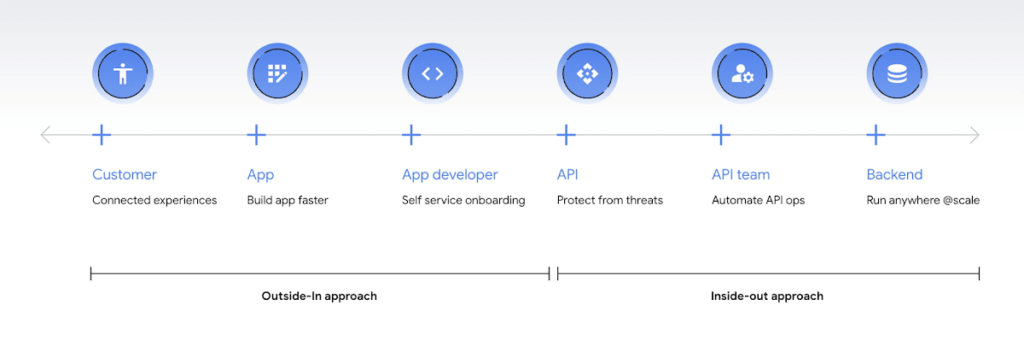
#1 Thinking inside-out vs outside-in
Being everything for everybody often means that nothing you do is the best it could be, and that is just as true for APIs. When customers turn to APIs, they are looking for specific solutions to make their work easier and more productive. If there is an API that better works to their needs, they will choose that one over yours. This is why it’s so important to know what your customers need to do their work better, and then building to fill those needs. In other words, start thinking Outside-in as opposed to Inside-Out. Specifically,
- Inside-out refers to designing APIs around internal systems or services you would like to expose.
- Outside-in refers to designing APIs around customer experiences you want to create. Read more about the Outside-in perspective in the API product mindset.
The first step to this is learning from your customers — be it internal consumer developers or external customers — and their use cases. Ask them about the apps they are building, their pain points, and what would help streamline or simplify their development. Write down their most significant use cases and create a sample API response that only gives them the exact data they need for each case. As you test this, look for overlap between payloads and adapt your designs to genericize them across common or similar use cases.
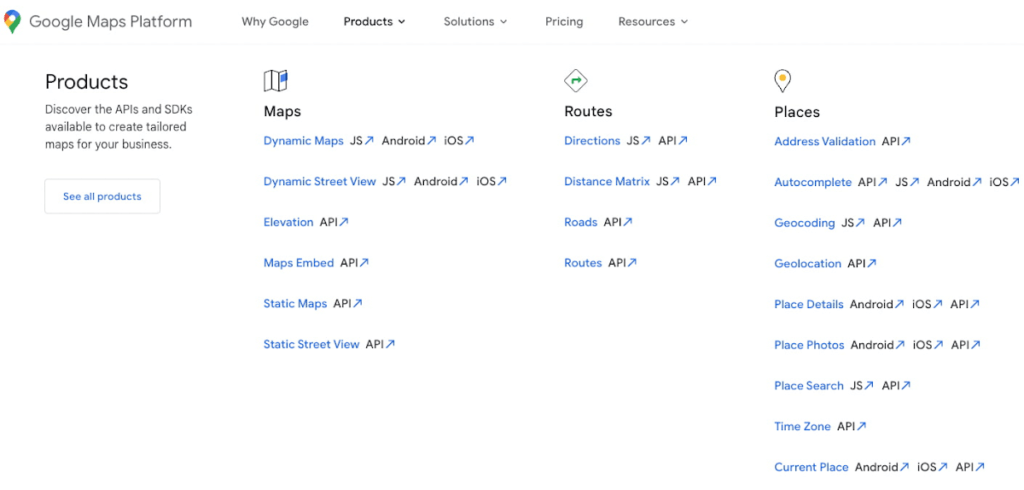
If you can’t connect with your customers — because you don’t have direct access, they don’t have time, or they just don’t know what they want — the best approach is to imagine what you would build with your APIs. Think big and think creatively. While you don’t want to design your APIs for vaporware, thinking about the big picture can make it easier to build non-breaking changes in the future. For example the image below showcases APIs offered by Google Maps. Even without diving into the documentation, looking at the names like “Autocomplete” or “Address Validation” clearly outlines the purposes and potential fit for a customer’s use case.
#2 Making your APIs too complex for users
Customers turn to APIs to bypass complicated programming challenges so they can get to the part they know how to do well. If they feel like using your API means learning a whole new system or language, then it isn’t fitting their needs and they will likely look for something else. It’s up to your team to make an API that is strong and smart enough to do what your customer wants, but also simple enough to hide how complicated the tasks your API solves for really are. For example if you know your customers are using your APIs to present information about recently open restaurants and highly rated pizzeria to their consumers, providing them with a simple API call as below would be of great help:
GET /restaurants?location=Austin&category=Pizzeria&open=true&sort=-priority,created_atTo see if your API design is simple enough, pretend you are building the whole system from scratch — or if you have a trusted customer who is willing to help, ask them to test it and report their results. If you can complete the workflow without having to stop to figure something out, then you’re good to go. On the other hand, if you catch rough edges caused by trying to code around system complexity issues, then keep trying to refactor. The API will be ready when you can say that nothing is confusing and that it either meets your customers’ needs or can easily be updated as needs change.
#3 Creating “chatty” APIs with too many calls
Multiple network calls slow down the process and creates higher connection overhead — which means higher operational costs. This is why it’s so important to minimize the number of API calls.
The key to this is outside-in design: simplify. Look for ways to reduce the number of API calls a customer must make in their application’s workflow. If your customers are building mobile applications, for example, they often need to minimize their network traffic to reduce battery drain, and requiring a couple calls instead of a dozen can make a big difference.
Rather than deciding between building distinct, data-driven microservices and streamlining API usage, consider offering both: fine-grained APIs for specific data types, and “experience APIs” (APIs that are designed to power user experiences. Here is a further theoretical discussion on Experience APIs) around common or customer-specific user interfaces. These experience APIs compose multiple smaller domains into a single endpoint; making it much simpler for your customers — especially those building user interfaces — to render their screens easily and quickly.
Another option here is to use something like GraphQL to allow for this type of customizability. Generally you should avoid building a unique endpoint for every possible screen, but common screens like home pages and user account information can make a world of difference to your API consumers.
#4 Not allowing for flexibility
Even if you’ve followed all of the steps above, you may find that there are edge cases that do not fit under your beautifully designed payloads. Maybe your customer needs more data in a single page of results than usual, or the payload has way more data than their app requires. You can’t create a one-size-fits-all solution, but you also don’t want a reputation for building APIs that are limiting. Here are 3 simple options to make your endpoints more flexible.
Filter out response properties: You can either use query parameters for sorting and pagination, or use GraphQL which provides these types of details natively. By giving customers the option to request only the properties they need, it guarantees that they won’t have to sort through tons of unnecessary data to get what they need. For example, if some of your customers only need the title, author, and bestseller ranking, give them the ability to retrieve only that data with a query string parameter.
GET /books?fields=title,author,ranking- Ability to sort with pagination. Generally, you don’t want to guarantee the order of objects in an API response because minor changes in logic or peculiarities in your data source might change the sort order at some point. In some cases, however, your customers may want to sort by a particular field. Giving them that option, combined with a pagination option, will give them a highly efficient API when they only want the top few results. For example Spotify API utilizes a simple offset and limit parameter set to allow pagination. A sample endpoint as shown in the documentation would look like this
$ curl https://api.spotify.com/v1/artists/1vCWHaC5f2uS3yhpwWbIA6/albums?album_type=SINGLE&offset=20&limit=10- Use mature compositions like GraphQL: Since customer data needs can differ, giving them on-the-fly composites lets them build to the combinations of data they need, rather than being restricted to a single data type or a pre-set combination of data fields. Using GraphQL can even bypass the need to build experience APIs, but when this isn’t an option, you can use query string parameter options like “expand” to create these more complex queries. Here is a sample response that demonstrates a collection of company resources with embedded properties included
"data": [
{
"CompanyUid": "27e9cf71-fca4",
"name": "ABCCo",
"status": "Active",
"_embedded": {
"organization": {
"CompanyUid": "27e9cf71-fca4",
"name": "ABCCo",
"type": "Company",
"taxId": "0123",
"city": "Portland",
"notes": ""
}
}
}
]
#5 Making design unreadable to humans
“K”eep “I”t “S”imply “S”tupid when you are designing your API. While APIs are meant for computer-to-computer interaction, the first client of an API is always a human, and the API contract is the first piece of documentation. Developers are more apt to study your payload design before they dig into your docs. Observation studies suggest that developers spend more than 51% of their time in editor and client as compared to ~18% on reference.
For example, if you skim through the payload below it takes some time to understand because instead of property names it includes an “id”. Even the property name “data” does not suggest anything meaningful aside from just being an artifact of the JSON design. A few extra bytes in the payload can save a lot of early confusion and accelerate adoption of your API. Notice how user-ids appearing on the left of the colon (in the position where other examples of JSON ideally have property names) creates confusion in reading the payload.
"{id-a}":
{ "data":
[
{
"AirportCode": "LAX",
"AirportName": "Los Angeles",
"From": "LAX",
"To": "Austin",
"departure": "2014-07-15T15:11:25+0000",
"arrival": "2014-07-15T16:31:25+0000"
}
… // More data
]
},
We think that JSON like this is more difficult to learn. If you want to eliminate any ambiguity in the words you choose to describe the data, keep the payload simple and if any of those labels could be interpreted in more than one way, adjust them to be more clear. Here is a sample response from Airlines endpoint of aviationstack API. Notice how the property names clearly explain the expected result while maintaining a simple JSON structure.
"data": [
{
"airline_name": "American Airlines",
"iata_code": "AA",
"iata_prefix_accounting": "1",
"icao_code": "AAL",
"callsign": "AMERICAN",
"type": "scheduled",
"status": "active",
"fleet_size": "963",
"fleet_average_age": "10.9",
"date_founded": "1934",
"hub_code": "DFW",
"country_name": "United States",
"country_iso2": "US"
},
[…]
]
#6 Know when you can break the RESTful rules
Being true to the RESTful basics — such as using the correct HTTP verbs, status codes, and stateless resource-based interfaces — can make your customers’ lives easier because they don’t need to learn an all new lexicon, but remember that the goal is just to help them get their job done. If you put RESTful design first over user experience, then it doesn’t really serve its purpose.
Your goal should be helping your customers be successful with your data, as quickly and easily as possible. Occasionally, that may mean breaking some “rules” of REST to offer simpler and more elegant interfaces. Just be consistent in your design choices across all of your APIs, and be very clear in your documentation about anything that might be peculiar or nonstandard.
Conclusion
Beyond these common pitfalls, we have also created a comprehensive guide packaging up our rich experience designing and managing APIs at incredible scale with Google Cloud’s API management product, Apigee.
Apigee — Google Cloud’s native API management platform — helps you build, manage, and secure APIs — for any use case, scale or environment. Get started with Apigee today or check out our documentation for additional information.
More Relevant Stories for Your Company

Wunderkind Leverages Google Cloud to Address the Growing Needs of its Customer Base
Editor’s note: We’re hearing here how martech provider Wunderkind easily met the scaling demands of their growing customer base on multiple use cases with Cloud Bigtable and other Google Cloud data solutions. Wunderkind is a performance marketing channel and we mostly have two kinds of customers: online retailers, and publishers like

Bigbasket: Delivering Groceries Across 25 Cities in India
When Bigbasket was founded in December 2011, it guaranteed to deliver goods within a one-hour delivery slot of its customers' choosing or it would refund them 10 percent of their orders. The company also introduced an express service, delivering groceries within 90 minutes of an order being placed. Bigbasket needed

Announcing reCAPTCHA Enterprise’s Mobile SDK to Help Protect iOS, Android apps
reCAPTCHA Enterprise is Google’s online fraud detection service that leverages more than a decade of experience defending the internet. reCAPTCHA Enterprise can be used to prevent fraud and attacks perpetrated by scripts, bot software, and humans. When installed inside a mobile app at the point of action, such as login,

Google Cloud Helped Digitec Galaxus Personalize Over 2 Million Newsletters in a Week
Digitec Galaxus AG is the biggest online retailer in Switzerland, operating two online stores: Digitec, Switzerland's online market leader for consumer electronics and media products, and Galaxus, the largest Swiss online shop with a steadily growing range of consistently low-priced products for almost all daily needs. Known for its efficient, personalized shopping experiences,
