





Google Cloud Featured at TechCrunch Disrupt 2021

4927
Of your peers have already read this article.
1:30 Minutes
The most insightful time you'll spend today!
Startups need to move quickly and focus their limited resources on areas where they can differentiate. If infrastructure isn’t your differentiator, don’t put a lot of energy into your infrastructure when someone else can do it for you. What’s more, time-to-market matters to startups more now than ever. Successful early stage companies know this, and leverage existing tools, libraries, frameworks and innovations whenever possible.
Next week Google Cloud will be featured at TechCrunch Disrupt, the iconic annual event where “founders and investors shaping the future of disruptive technology” come together to share stories, network, and learn from each other. Google Cloud will host a session and Google Cloud engineers will be available in a virtual booth to answer startup questions.
The session, “Demo Derby – How startups are disrupting the status quo with innovative data analytics, AI and modern app development” will be a fun, fast-paced set of presentations showing short demos of startups and startup projects built with Google Cloud.
Demo Derby Presenters
- Andrea Le Vot, Chief Data Protection Officer with startup BlueZoo will deliver a demo showing how they are revolutionizing the property insurance industry with AI and Cloud – and doing so while actually protecting people’s privacy.
- Dale Markowitz and Zack Akil, Applied AI Engineers, will show how easy it is to use AI for everything from video search to editing to automated translation.
- Vidya Nagarajan, Group Product Manager from Google Cloud will deliver a fast paced demo that shows how startups can drive developer productivity with serverless innovations.
“Disrupt is iconic for its engagement with founders, investors, and the broad community of early stage companies,” said Andrea Le Vot, Chief Data Protection Officer at BlueZoo. “We are thrilled to share our insights with others in our community, and to show how we have partnered with Google Cloud to innovate faster than most of the larger, well funded insurance companies in our market.”
The series of snippet sized demos will be followed by a roundtable discussion with the demo developers focused on lessons learned, best practices, how to reduce time-to-market, and how to focus on where you can most effectively differentiate.
The session will air on Day One of the event: Tuesday September 21, 2021 at 1pm PT and will be available on demand after the event for all Disrupt attendees.

Multi-cloud Adoption Empowers GCCs to be Resilient, Scalable and Future-proof: Whitepaper
DOWNLOAD WHITEPAPER3286
Of your peers have already downloaded this article
1:30 Minutes
The most insightful time you'll spend today!
India has emerged as the Technology capital for the world – there are now at least 55 unicorns in India, nearly 600 funding rounds in just the last 30 months and 200+ GCCs expected in the next 2 years. There has been a rapid acceleration not just in the number of startups being launched, but also in the variety of technologies they are experimenting with.
India GCC’s are leading the transformation agenda for the enterprise and the pandemic has accelerated the inevitable. Technology now underpins every facet of a business: products, services, business processes, and how customers and businesses interact. As organizations are investing and progressing on their digital journey, they are increasingly relying on talent and teams across the globe to help them navigate the changes and build strategic capacity.
How is Cloud enabling this strategic change? This whitepaper compiled by ANSR and Google Cloud aims to expand on the following,
What is the cloud adoption story and how can it empower GCCs to be resilient, scalable and future-proof?
How have global teams or Global Capability Centers enabled the strategic and accelerated adoption of technology?
What are the key Cloud considerations for building an innovative, collaborative ecosystem for a thriving organization?
3191
Of your peers have already watched this video.
12:00 Minutes
The most insightful time you'll spend today!
Google’s Tau VMs Help Nylas Reach New Heights!
Nylas is a leading provider of scalable and secure communications data platform that powers business process and productivity automation and drive digital engagement for its customers that are fast-growing start-ups as well as large enterprises. The company approached Google Cloud with a complex challenge involving its legacy architecture that gave rise to cost and scalability issues. Nylas processed 30 terrabytes of data, billions of messages and hundreds of millions of APIs per day! Moreover, to serve Nylas’ large enterprise customer in the Financial Services industry with stringent security needs and data storage infrastructure requirements to avoid in-memory hacks, they rewrote the entire infrastructure in Go and Kubernetes on top of Google.
Watch the video to learn how Google Cloud has been the best distributed technology and a true partner for Nylas, helping them achieve 40 percent in savings by moving to Tau VMs!
Google Cloud’s Professional Service Organization: How it Accelerates Operational Health Review Cloud Migration

3372
Of your peers have already read this article.
2:00 Minutes
The most insightful time you'll spend today!
Introduction
The Google Cloud Professional Services Organization’s (PSO) mission is to help our customers get the most out of Google products. PSO is responsible for customer success by sharing our technical expertise in order to unlock business value from the cloud by providing cloud strategy and best practice advice, implementation guidance, and training using our proven methodology.
In this blog post, we want to focus specifically on Operational Health Reviews and how PSO engages in a myriad of activities to ensure the overall success and health of a customer engagement while ensuring we are meeting customer expectations and objectives, managing risk, and ultimately delivering value during or after the Google Cloud migration. We will discuss the assets, methodology, and tools that we leverage to ensure this success.
What is an Operational Health Review and what purpose does it serve?
Operational Health Reviews (OHR) are regular reviews to proactively address the below topics:
- A customer’s support experience
- Analysis of trends in key operational metrics
- Analysis of trends in Google Cloud usage
- Status reports for high-priority cloud projects
- Discussion of upcoming events
- Discussion of potential opportunities for training
- Review of feature requests
The core aim of an OHR is to measure progress and advise customers on the overall health of the account and migration progress while providing recommendations as a team on what adjustments should be considered to ensure continued success. During the OHR, we will address any pain points as well as identify and remediate any negative trends in support interfaces and usage metrics.
The intention of the activity is to also perform a blameless reflection for continuous improvement. This supports the effort to maintain common ground and obtain mutual optimism for the next phase of the customer’s journey on Google Cloud.
Let’s dive a little deeper into some of the activities that go into an OHR.
Support experience
One of the Google Cloud’s Support Organization’s goals is to simplify and streamline our customer’s support experience with a scalable and flexible set of offerings built with the customer needs at the center. This includes supporting an ongoing partnership model, with a proactive and collaborative approach. Premium Support is our top-tier support model which is a paid support offering designed for enterprises that run mission critical workloads and require fast response times, platform stability, and increased operational efficiencies. As part of this offering, customers are provided with a Technical Account Manager (TAM) who is in charge of delivering frequent touchpoints, including OHRs.
During the support experience section of an OHR, some of the following topics may be reviewed:
- Case volume by priority
- Case volume by product
- Cases linked to Google Cloud incidents
- Escalated cases or incidents
- Case initial response time (IRT)
- Case IRT SLO Met Rate
- Case total resolution time (TRT) hours
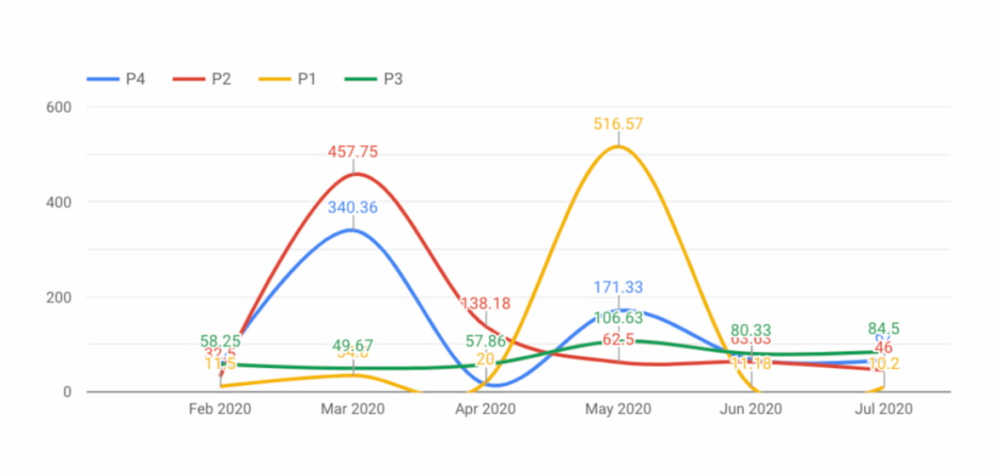
The purpose of this activity is to better understand the efficiency of both the customer’s and Google’s cloud operations from a support trend perspective. The goal is to celebrate any positive trends, but also to identify potential negative trends and proactively determine a remediation strategy.
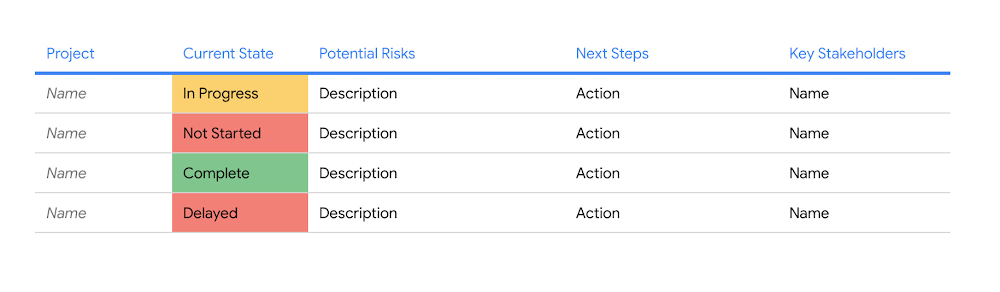
Status reports for high-priority cloud projects
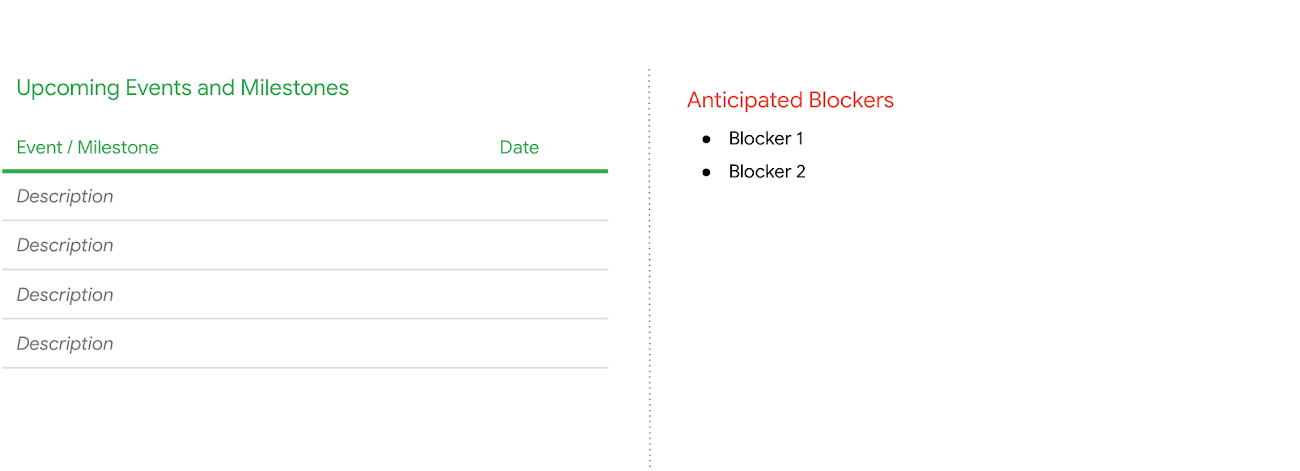
The purpose of this part of the OHR is to ensure the senior management stakeholders have continued visibility into the status of all their high-priority cloud initiatives with an easy-to-read, sometimes color-coded assessment on the status of each project. The assessment [Figure 1] may include, but is not limited to potential identified risks, key next steps, key stakeholders, and a mitigation plan for any high priority issues that may occur during their migration engagement. Additionally, the TAM may also cover any upcoming milestones or events, as well as any potential anticipated future blockers [Figure 2].
Review trends in Google Cloud usage
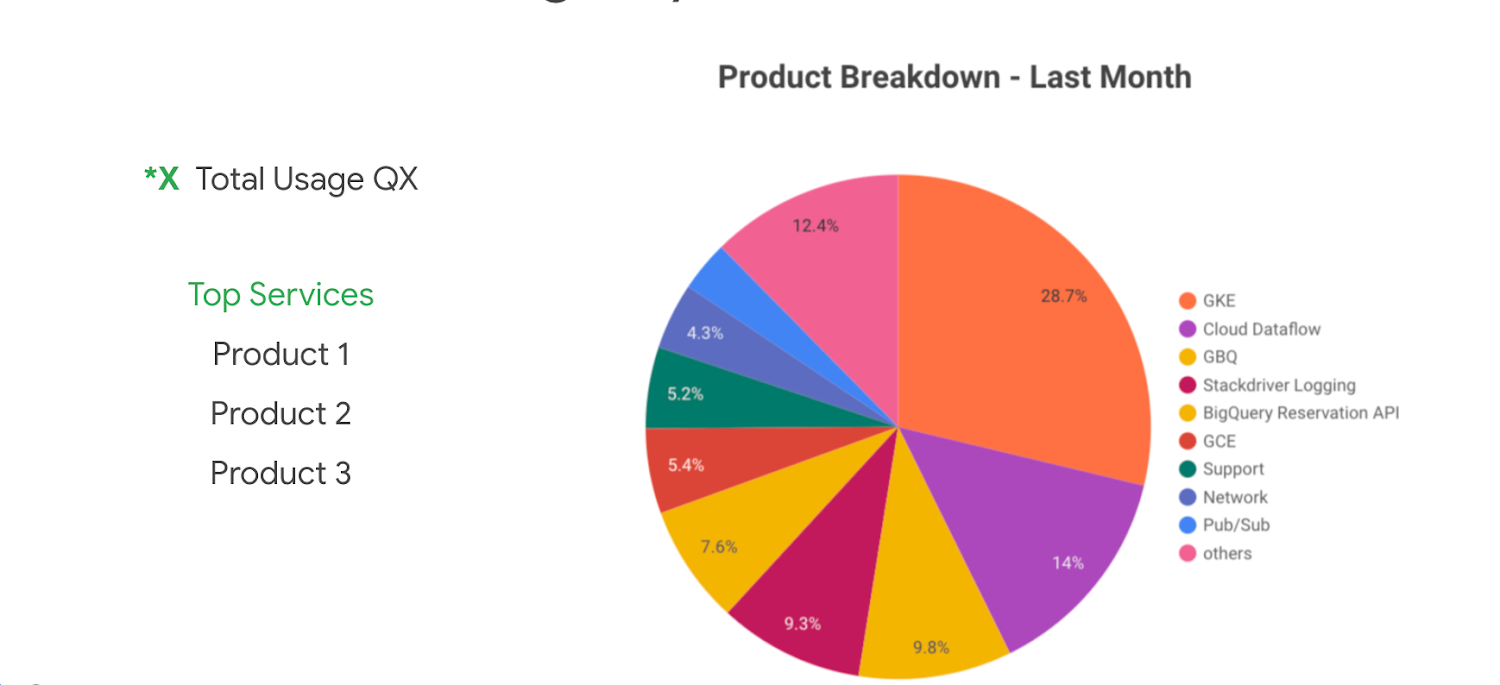
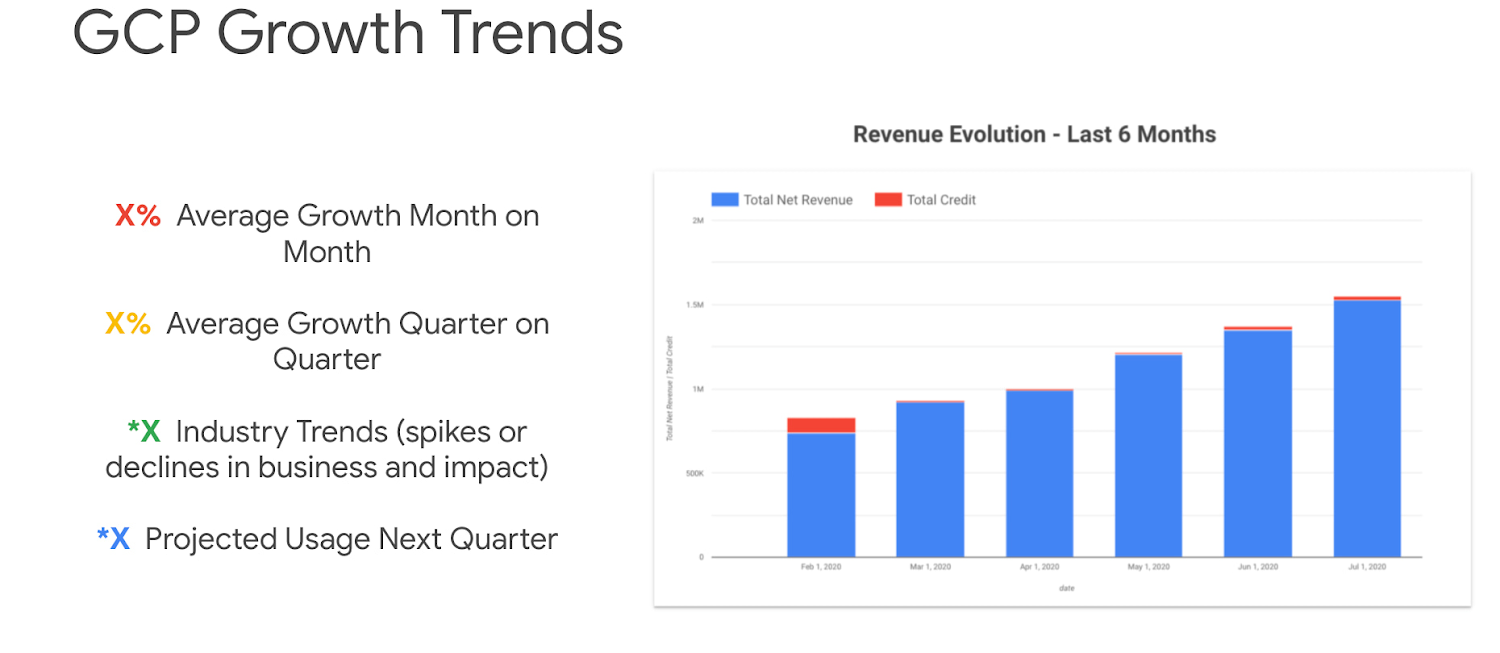
This part of the OHR is meant to provide the customer with a holistic view of their overall Google Cloud usage. The purpose is to provide understanding around what products are being used on Google Cloud and also where cost is generally being allocated for overall cost management and budget tracking purposes. This can help customers with their overall cost optimization efforts. Some of the metrics we may cover in this section are:
- Current Google Cloud usage by service
- Google Cloud growth trends
- Google Cloud growth trends by service
- Google Cloud growth trends by project
- Review of used and available service credits
Feature request review and advocacy
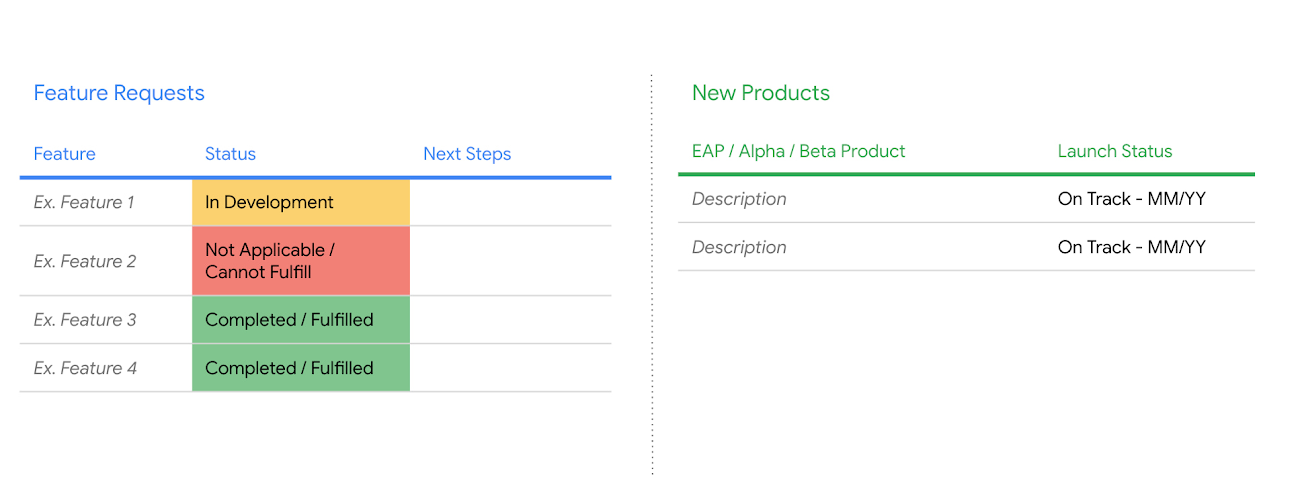
TAMs will work with customers to help identify product needs and advocate for feature requests with Google Product Management and Engineering teams. While feature request advocacy is an ongoing activity, during the OHR, the TAM will review any high priority feature requests that have previously been submitted, providing updates on status including potential release dates.
When a feature is coming up for the release, the TAM can help the customer prepare for implementation (providing early Preview access, coordinating a meeting with the Product Manager to review the feature, etc.) and then continue to provide support until the feature is successfully implemented in the customer environment. Similarly, if a high priority or technical blocking feature is not yet coming available, the TAM can help offer an alternative solution that can unblock the customer in the short term.
The OHR is also a great time for the TAM to work with the customer to ensure they have early access to new and exciting features that are in Alpha or Beta, and that would be beneficial to the customer and their environment.
Training strategy
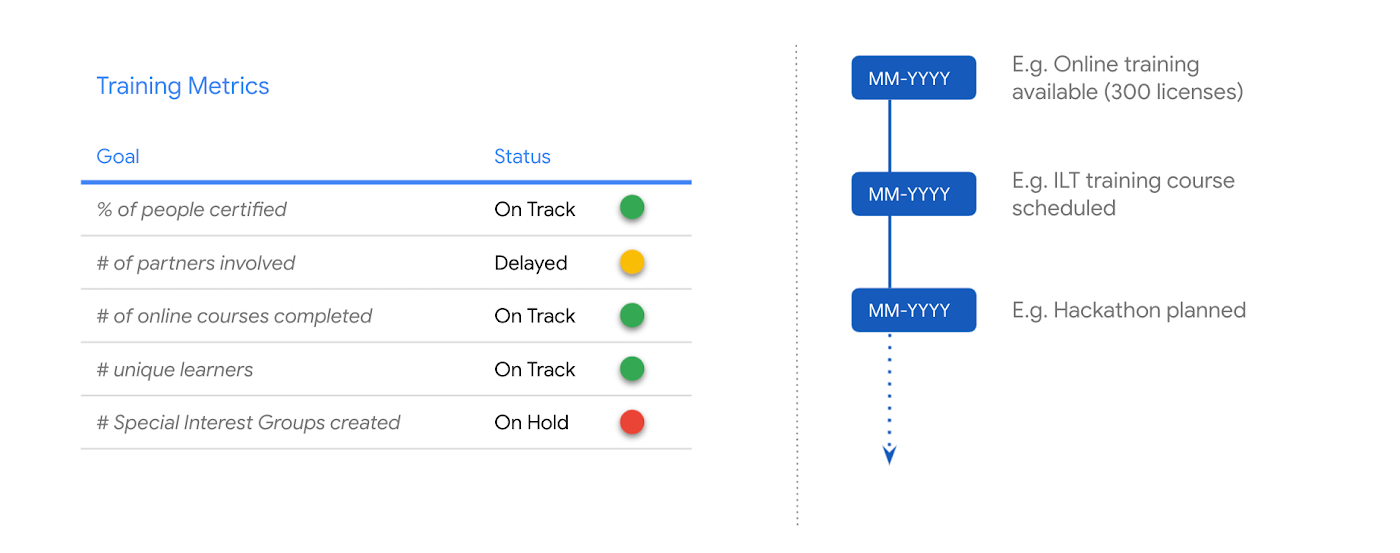
Training is a primary component to ensuring the overall success in adopting Google Cloud. During the OHR, a review of training metrics will be provided. This may include tracking metrics to determine how the customer is tracking towards an initially agreed upon learning plan or coming up with additional upskilling strategies as necessary. Additionally, throughout an engagement, the customer’s TAM will provide opportunities for both free and paid Google Cloud training.
Conclusion
PSO is the voice of customer health, maintaining priority to proactively and strategically guide large enterprise customers to operate effectively and efficiently in the cloud, both during and after the migration process. The OHR is an efficient and effective way to maintain alignment, ensure expectations and objectives are being met, manage risk, and overall ensure the success of the customer.
Learn more about our methodology and get started with Google Cloud by completing a free discovery and assessment of your migration. Alternatively, if you’d like to engage directly with our PSO team on your migration, contact us!
Grofers Turns to Google Cloud for Building Delivery System

4792
Of your peers have already read this article.
2:00 Minutes
The most insightful time you'll spend today!
About Grofers
Grofers is an India-based local mobile e-commerce platform that delivers groceries, fruits and vegetables, cosmetics and electronics. Customers use Grofers’ mobile app to shop for products from local stores in 17 cities in India.

Google Cloud Results
- Scaled from 10,000 orders to more than 70,000 orders a day
- Increased the average number of deliveries per driver from five to nearly 15
- Maintains 100 percent uptime
India-based Grofers is a hyperlocal mobile platform that delivers groceries, fruits and vegetables, cosmetics and electronics. Customers use Grofers’ mobile app to shop for products from local stores in 17 cities in India.
In 2015, the number of deliveries Grofers fulfilled was growing at the rate of 10 times a month, and its delivery system struggled under the stress. When traffic spiked on weekends, its database frequently crashed. Fulfilling and delivering orders depended on manual processes such as telephone calls. Grofers needed a solution that would allow it to quickly scale and improve its delivery process.
Building an entire backend in two weeks
When Grofers launched in 2013, the logistics system was entirely manual. Staff at the headquarters called delivery drivers with order details and delivery addresses. Drivers then decided what order to pick up goods from local merchants. With a small number of customers and orders, that wasn’t a problem. But the manual system couldn’t handle growth. Grofers recognized it had to automate the system.
To do that, it turned to Google Cloud Platform. Grofers built a new backend for its delivery system using Google App Engine. When an order arrives, the new system looks at the status of all drivers — including their current location, the order he’s completing, and the pickup and delivery locations on the route. Based on that information, the system calculates the optimal driver for each order and sends the driver the order via a mobile app.
The system also takes advantage of Google Cloud Endpoints, which generates libraries for Javascript, iOS and Android. Grofers used Google Cloud Endpoints to create mobile apps to communicate with its delivery staff.
Scaling fast, dramatically improving delivery metrics
With the new backend and mobile apps, Grofers can scale quickly to keep up with its rapid growth. Grofers now delivers 70,000 orders per day, up from 10,000 before the GCP deployment, and has had 100 percent uptime. Each driver handles an average of 15 orders per day, compared to only five previously, letting Grofers handle more work with less staff. All this has been accomplished at very low cost: Prakash says that GCP costs account for only two percent of the company’s infrastructure spending. Without GCP, Prakash says the backend would be far more expensive and account for up to 50 percent of the company’s infrastructure expenses.
Google Cloud Platform Gives Us 5x the Processing Power to Analyze Physician Performance at 75% Lower Cost

6733
Of your peers have already read this article.
6:30 Minutes
The most insightful time you'll spend today!
Patients about to undergo a healthcare procedure understandably want the best medical professionals they can get. But how can they know which doctors have had the most experience and the best outcomes with that particular procedure? How can they make an informed decision about which doctor to select when the information they have is limited to the doctor’s practice area and subjective reviews from other patients?
MD Insider is working to solve that problem using machine learning (ML) to objectively analyze doctor performance. By analyzing data from thousands of institutions and millions of doctor-patient interactions and medical events, MD Insider identifies physician performance insights based on their experience and outcomes. Insights are then integrated into a triage engine, that enables consumers to search for and schedule appointments with providers who meet their clinical criteria and convenience preferences, such as insurances accepted, office hours, locations, and language.
MD Insider also offers robust data APIs to help health systems, health plans, and employers reduce costs and improve quality of care. Payers use the APIs to curate high-quality provider networks and manage provider directories. Examples of MD Insider’s data APIs include Provider Experience and Share of Practice metrics, Provider Quality and Outcomes, Network Modeling, Expert Clinical Search Taxonomy, Find a Provider, Acute-Care Hospital Quality, and Provider and Facility Metadata.
“We use Google Cloud Platform the way the cloud was supposed to be used. By comparison, other cloud providers feel like you’re renting somebody else’s data center.”
—Ed Holsinger, Lead Data Engineer and Head of Data Science, MD Insider
MD Insider is continuously ingesting the latest performance data about physicians and analyzing billions of rows of data. Requiring constant scalability, the company was born in the cloud; however, it had difficulty configuring server instances for the optimal balance of memory and CPU, and its Hadoop cluster had to be kept running 24/7. Network performance was often slow for no apparent reason. As a result, failure rates from node timeouts increased, and costs grew along with the data. MD Insider had to estimate its usage and pay up front, and received little financial benefit from sustained use commitments.
Knowing that data would continue to grow, MD Insider decided to move its data services — the most demanding and complex portion of its infrastructure — to Google Cloud Platform (GCP), and took advantage of GCP managed services for container management and big data analytics.
“One of the reasons we decided to move to Google Cloud Platform is because it feels like a unified, well-designed cloud architecture and pricing model,” says Ed Holsinger, Lead Data Engineer and Head of Data Science at MD Insider. “We use Google Cloud Platform the way the cloud was supposed to be used. By comparison, other cloud providers feel like you’re renting somebody else’s data center.”
“Moving to Google Cloud Platform and using Kubernetes Engine gave us 5x the processing power for analyzing physician performance at 75% less cost. Our data scientists have more power than ever before to generate insights for our customers.”
—Ed Holsinger, Lead Data Engineer and Head of Data Science, MD Insider
5x the performance, 75% less cost
MD Insider now uses Kubernetes Engine to automate container management and deploy clusters in minutes with just a few clicks. When hundreds of machines are required to analyze a large dataset, automation in Kubernetes Engine deploys ML models as containers, each of which manages the full lifecycle of its task, including scaling up resources, deploying results, and scaling back down when the task is finished. It’s easy for MD Insider to specify exactly how much CPU and memory each container needs, helping maximize performance while reducing costs.
“Moving to Google Cloud Platform and Kubernetes Engine gave us 5x the processing power for analyzing physician performance at 75% less cost,” says Ed. “Our data scientists have more power than ever before to generate insights for our customers. Data scoring jobs that used to take three business days now take four hours.”
Adds Galen Meurer, Senior Software Engineer at MD Insider: “Even if all Google Cloud Platform had to offer was Kubernetes Engine, I would still want to use it. Previously we spent up to 30% of our time managing our container infrastructure, which we can now use for product development.”
A foundation for data science
MD Insider was happy to find that GCP offers a wide variety of managed services. For example, the company is supplementing its Kubernetes Engine clusters with BigQuery for its big data masters and selection jobs, enabling scientists to analyze new and different types of data as well as analyze larger datasets in less time. MD Insider also uses Cloud Storage for big data staging and Cloud Dataproc to run managed Apache Spark clusters for data processing.
“Google Cloud Platform gives us an incredibly powerful cloud architecture for data engineering and data science,” says Eric Wilson, CEO of MD Insider. “That gives our scientists independence, they can do what they need to do without waiting and with no contention between them.”
A developer-friendly platform
Migrating its data services was such a success that MD Insider decided to move the rest of its infrastructure to GCP, including the front end for its web application. Since the migration, MD Insider has experienced no unplanned downtime on GCP, allowing it to easily meet the 99.5% uptime SLA it promises to customers. It’s also taking advantage of Build Triggers in Kubernetes Engine to automate container builds and reduce build times by more than 40%. Production code can be updated in seconds, with no impact to end users other than making new features available.
“GCP has simplified our workflow in so many ways, from intelligent load balancing to content delivery and automating builds,” says Matthew Frey, Software Engineer. “Everything on GCP is cohesive and developer friendly, with a superior UI and better network performance than other cloud providers.”
Ryan Beaini, Senior Software Engineer at MD Insider, agrees: “Since we moved to GCP, our developers are definitely happier. The pain and the headaches we experienced because of the limitations of our previous toolset all went away.”
“We’re a small company, but what we’re doing is incredibly important. We’re helping people make decisions about healthcare providers that could impact their lives and even be life-saving. Google Cloud Platform is helping us make our mission bigger, better, and brighter.”
—Eric Wilson, CEO, MD Insider
Securing billions of rows of clinical and non-clinical healthcare data
As a healthcare technology company, MD Insider processes billions of rows of clinical and non-clinical healthcare data. To control user access to GCP, it uses Identity & Access Management (IAM) along with Yubico YubiKeys for hardware-based two-factor authentication when logging into Google Workspace. MD Insider takes comfort that GCP encrypts data at rest by default, and encrypts and authenticates data in transit when data moves outside physical boundaries not controlled by Google or on behalf of Google.
“On GCP, everything that we need to be encrypted for compliance purposes is encrypted, which is fantastic,” says Eric. “When I tell our potential clients and partners about the resources that Google has dedicated to security, it gives them the confidence that their data will be protected.”
Transforming how teams work
As a growing company, MD Insider must collaborate seamlessly between offices in California, Colorado, and Illinois. It relies on Google Workspace for communication and productivity, using Docs, Sheets, and Slides to drive the business. Employee and team files are stored in Drive, and meetings are conducted via Google Meet with Chromebox for Meetings videoconferencing hardware kits. Google Workspace also helps MD Insider maintain information security by authenticating email domains with digital signatures in Gmail and scanning outgoing email using Gmail Data Loss Prevention (DLP).
“I use Google Workspace every day, and everyone else here does too,” says Eric. “Team Drives are a big time saver for us. We’ve let our previous office software expire, because there’s no need to pay for those licenses anymore.”
Promoting healthcare transparency
With GCP helping MD Insider increase velocity and momentum, the company is making exciting progress. For example, it has entered into a strategic partnership with Zelis Healthcare, which will use MD Insider’s API to provide insights for a next-gen analytics platform that will give health plans unprecedented transparency around physician performance.
“We’re a small company, but what we’re doing is incredibly important,” says Eric. “We’re helping people make decisions about healthcare providers that could impact their lives and even be life-saving. Google Cloud Platform is helping us make our mission bigger, better, and brighter.”
*Google Workspace was formerly known as G Suite prior to Oct. 6, 2020.
More Relevant Stories for Your Company

Insurer Uses Google Cloud AI to Battle Slow Growth: It Improves Sales by 5% in 8 Weeks
For a business to succeed in the long term, it needs to learn not just to adapt to inevitable change, but to harness it. South Africa-based PPS has been an insurance company since 1941 and today is the biggest mutual insurance provider in the country. As a mutual company, PPS is owned

How TapClicks’ Google Cloud Migration Makes Life Easy for Marketers
Editor’s note: In this blog post we learn how TapClicks migrated to Google Cloud to offer their marketing customers a unified platform for data management, operations, insights, and analysis. TapClicks is a smart marketing cloud, powered by data, that unifies our customer’s marketing. By choosing to migrate our core applications last

Largest Beauty Retailer in the US Powers Digital Transformation with Google Cloud Smart Analytics
Digital technology offers increasing flexibility and choice to consumers. As a result, the retail industry is dramatically shifting toward more tailored and personalized experiences for shoppers, and businesses are rethinking how they deliver value to customers. This couldn’t be more true for the beauty retailing industry where leading companies are

Explore Google Cloud SQL’s 3 Fault Tolerance Mechanism to Ease Data Pro
If you’re managing a crucial application that has to be fully fault-tolerant, you need your system to be able to handle every fault, no matter the type and scope of failure, with minimal downtime and data loss. Protecting against these faults means juggling numerous variables that can impact performance as
