





2988
Of your peers have already watched this video.
17:30 Minutes
The most insightful time you'll spend today!
Signal Generation in the Investment Management Industry
Machine learning is seeing a lot of use cases in the financial sector. One of them is leverage AI to sift signal from noise and create insights or predictions that can give financial planners an edge.
In this video, David Li, Head of Advanced Analytics, BlackRock and Colman Madden, Customer Engineer, Google Cloud, present on how BlackRock leverages NLP on Google Cloud to search for signals in the investment management industry.
“We analyze large volumes of textual news via NLP to classify text into sentiment scores as well as other metrics such as news volume and emotions in these articles,” says David Li.
He also discusses some of the challenges they faced, and the solutions they found, and why they selected Google Cloud to run this project.
Enterprises can Push the Limits of Edge Even Further!

6997
Of your peers have already read this article.
2:30 Minutes
The most insightful time you'll spend today!
Whether with the cloud or within their own data centers, enterprises have undergone a period of remarkable consolidation and centralization of their compute resources. But with the rise of ever more powerful mobile devices, and increasingly capable cellular networks, application architects are starting to think beyond the confines of the data center, and looking out to the edge.
What exactly do we mean by edge? Think of the edge as distributed compute happening on a wide variety of non-traditional devices — mobile phones of course, but also equipment sensors in factories, industrial equipment, or even temperature and reaction monitoring in a remote lab. Edge devices are also connected devices, and can communicate back to the mothership over wireless or cellular networks.
Equipped with increasingly powerful processors, these edge devices are being called upon to perform tasks that have thus far been outside the scope of traditional IT. For enterprises, this could mean pre-processing incoming telemetry in a vehicle, collecting video in kiosks at a mall, gathering quality control data with cameras in a warehouse, or delivering interactive media to retail stores. Enterprises are also relying on edge to ingest data from outposts or devices that have even more intermittent connectivity, e.g., oil rigs or farm equipment, filtering that data to improve quality, reducing it to right-size information load, and processing it in the cloud. New data and models are then pushed back to the edge; in addition, we can also push configuration, software, and media updates and decentralize processing workload.
Edge isn’t all about enabling new use cases – it’s also about right-sizing environments and improving resource utilization. For example, adopting an edge model can also relieve load on existing data centers.
But while edge computing is full of promise for enterprises, there are many pieces that are still works in progress. Further, developing edge workloads is very different from developing traditional applications, which enjoy the benefits of persistent data connections and run on well-resourced hardware platforms. As such, cloud architects are still in the early days of figuring out how to use and implement edge for their organizations.
Fortunately, there are tools you can use to help ease the transition to edge computing — and that likely fit into your organization’s existing computing systems. Kubernetes, of course, but also higher level management tools like Anthos, which provides a consistent control plane across cloud, private data center and edge locations. Other parts of the Anthos family – Anthos Config Management and Anthos Service Mesh — go one step further and provide consistent, centralized management to your edge and cloud deployments. And there’s more to come.
For the remainder of this blog post, we’ll dive deeper into the past and current state of edge computing, and the benefits that architects and developers can expect to see from edge computing. In a next post, we’ll take a deeper look at some of the challenges that designing for edge introduces, and some of the advantages the average enterprise has in adopting the edge model. Finally, we’ll look at the Google Cloud tools that are available today to help you build out your edge environment, and look at some early customer examples that highlight what’s possible today — and that will spark your imagination for what to do tomorrow.
The evolution of edge computing
The edge is not a new concept. In fact, it’s been around for the last two decades, spanning many use cases that are prevalent today. One of the first applications for edge was to use content delivery networks (CDN) to cache and serve daily static website pages near clients, for example, web servers in California data centers serving financial data to European customers.
As connectivity has improved and software evolved, the edge has evolved too, and the focus has shifted towards using edge to distribute services. First, simple services expanded from static HTML to javascript libraries or image repositories. Common functions like image transformation, credit and address validation support services followed. Soon, organizations were deploying more complex cloudlet and clustered microservices installations, as well as distributed and replicated datasets. The term “endpoint” became ubiquitous, and APIs profilerated.
In parallel, there’s been an explosion of creativity in hardware, microcontrollers and dedicated edge devices. Fit-for-purpose products were deployed globally. Services like Google Cloud IoT Core extended our ability to manage and securely connect these dispersed devices, allowing platform managers to register tools and leverage managed services like Pub/Sub and Dataflow for data ingestion. And with Kubernetes, large remote clusters — mini private clouds in and of themselves — operate as self-healing, autoscaling services across the broader internet, opening the door to new models for applications and architectural patterns. In short, both distributed asynchronous systems and economies have blossomed.
What does this mean for enterprises? For the purposes of this series, edge means you can now go beyond the corporate network, beyond cloud VPCs, and beyond hybrid. The modern edge is not sitting at a major remote data center, nor is it a CDN, cloud provider, or in a corporate data center rack — it’s just as likely to look like 100 of these attached to a thousand sensors.
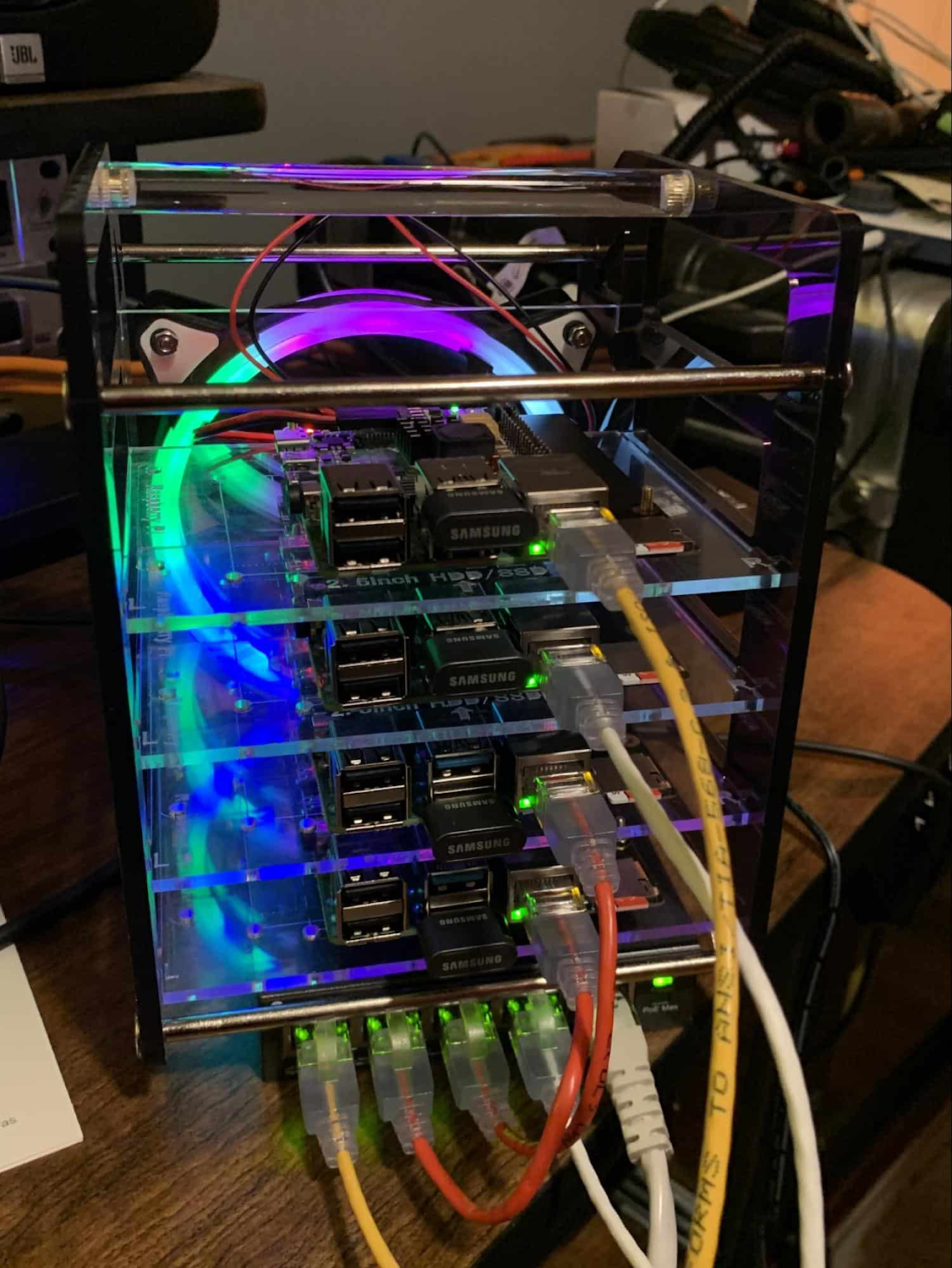
Edge, in short, is about having hardware and devices installed at remote locations that can process and communicate back the information they collect and generate. The edge management challenge, meanwhile, is being able to push configuration and software/model/media updates to these remote locations when they are connected.
Enable new use cases
Today, we have reached a new threshold for edge computing — one where micro-data-processing centers are deployed as the edge of a fractal arm, as it were. Together, they form a broad, geographically distributed, always-on framework for streaming, collecting, processing and serving asynchronous data. This big, loosely coupled application system lives, breathes and grows. Always changing, always learning from the data it collects — and always pushing out updated models when the tendrils are connected.
Right now, the rise of 5G is pushing the limits of edge even further. Devices enabled with 5G can transmit using a mobile network — no ISP required — enabling connectivity anywhere within reach of a cell tower. Granted, these networks have lower bandwidth, but they are often more than adequate for certain types of data, for example fire sensors in forests bordering remote towns that emit temperature or carbon monoxide data periodically. Recently, Google Cloud partnered with AT&T to enhance business use of 5G edge technology but there is so much more that can be done.
Reduce data center investments
In addition to enabling the digitization of a broad range of new use cases, adopting edge can also benefit your existing data center.
Let’s face it: data centers are expensive to maintain. Moving some data center load to edge locations can reduce your data center infrastructure investment, as well as compute time spent there. Edge services tend to have much lower service level objectives (SLOs) than data center services, driving lower levels of hardware investment. Edge installations also tend to tolerate disconnectedness, and thus function perfectly well with lower SLOs — and lower costs.
Let’s look at an example of where edge can really reduce costs: big data. Back in the day, we used to build monolithic serial processors — state machines — that had to keep track of where they were in processing in case of failure. But time and again, we’ve seen that smaller, more distributed processing can break down big, expensive problems into smaller, more cost-effective chunks.
Starting with the explosion of MapReduce almost 20 years ago, big-data workloads were parallelized across clusters on a network, and state management was simplified with intermediate output to share, wait for, or restart processing from checkpoints. Those monolithic systems were replaced by cheaper, smarter, networked clusters and data repositories where parallel work could be executed and rendered into workable datasets.
Flash forward to today, and we are seeing those same concepts applied and distributed to edge data-collection points. In this evolution of big data processing, we are scaling up and out to the point where observation data is so massive that it must first be prefiltered, and then preprocessed down to a manageable size and still be actionable. Only then should it be written back to the main data repositories for more resource-intensive processing and model building.
In short, data collection, cleanup, and potentially initial aggregation happens at the edge location, which reduces the amount of junk data sitting in costly data stores. This increases performance of the core data warehouse, and reduces the size and cost of network transfers and storage!
The edge is a huge opportunity for today’s enterprises. But designing environments that can make effective use of the edge isn’t without its challenges. Stick around for part two of this series, where we look at some of the architectural challenges typically encountered while designing for the edge and how we begin to address them.
Partnering with Google Cloud is the Key Behind Recent Healthcare Innovations

8840
Of your peers have already read this article.
2:00 Minutes
The most insightful time you'll spend today!
It’s simply amazing to witness how some of our systems integrators employ Google Cloud solutions to drive innovation in ways we at Google may never have considered—especially in healthcare. According to analyst firm MarketsandMarkets, the market for the Cloud in healthcare is projected to grow 43% between 2020 and 2025 to nearly $65 billion, fueled by the need for better technology infrastructures and faster digital transformation.
Healthcare and life sciences communities are looking to Google Cloud and its Service engagement model partners to improve collaboration and activate the power of medical data. These transformations deliver robust data analytics and bring a much deeper perspective into health epidemics like COVID-19 to help save lives.
In the healthcare and life sciences industry, our Google Cloud partners and customers provide constant energy and inspiration–and are the magic in some key healthcare innovations globally.
Let me show you how they are solving real-world business challenges.
Improving collaboration in Healthcare
Cloudbakers and Comanche County Memorial Hospital transitioned 2,000 employees to Google Workspace to improve collaboration, reduce costs, and increase security. By implementing a system that requires less maintenance while enabling mobile access to data and true collaboration, Comanche County Memorial Hospital saves $175,000 annually on licenses and helps medical professionals spend more time with patients.
“We chose Google Workspace because it cost a quarter of what we were paying previously, offers the kind of modern features that healthcare facilities need, and gave us data security and peace of mind.” —James Wellman, CIO, Comanche County Memorial Hospital
Accessing previously locked down medical data
Google Cloud and Quantiphi supported advances in cloud-based machine learning services to reduce infrastructure costs, unlock new paths of treatment, and dramatically reduce the amount of time it takes to evaluate scanned imagery following a stroke. John Hopkins University BIOS Division has been working on medical imaging to accelerate insights from scans on approximately 500 patients from 2,500 hours to 90 minutes, and lead to more accurate decision-making for brain injury patients that will ultimately improve medical outcomes.
“We’ve aligned closely with the goal of showing that a cloud-based, AI-driven approach is robust and that it can be performed while protecting personal PHI. In terms of costs, the cloud has definitely reduced some of the traditional financial demands of our research.” —Daniel F. Hanley, Jr., M.D., Director, Johns Hopkins University BIOS Division
Improving data access with the flexibility of Google Cloud
With the help of MediaAgility, TRIARQ migrated to Google Cloud to modernize their platform, build new applications, and expand their global footprint. With BigQuery, TRIARQ can now consolidate all transactional data, past and present, into a single location to report on specific insights and predict future data from e-prescriptions to complex revenue-cycle data and value-base analysis.
“The future of this industry will need to be a global one, and we can no longer be stuck in legacy systems if we want to survive. Having a team that is passionate about supporting us in this journey is definitely a plus point.”—Yaw Kwakye, Co-founder and Chief Architect, TRIARQ
Increasing visibility to COVID-19 outbreaks for actionable insights
As part of its response to the COVID-19 pandemic, HCA Healthcare chose to work with Google Cloud and SADA to create a national portal that increases visibility into outbreaks in 3,100 counties across the country in just 8 weeks. Now, the portal generates 30,000 new analytical views each day that can help inform private and public sector decision making for reopenings, closures, hot spots, and many other population health management activities.
“This project required deep knowledge of AI, and consumer-facing platforms, as well as healthcare. Google brought together the ideal combination of product, people, and partners. Google Cloud’s healthcare-specific products along with SADA’s expertise in the healthcare IT space made this partnership the perfect choice to move quickly and intelligently.”—Dr. Edmund Jackson, Chief Data Officer, HCA Healthcare
We’re committed to building the technology, resources, and services through Partner Advantage to help our partners address this opportunity. Looking for a solution focused partner in your region who has achieved Expertise and/or Specialization in your industry? Search our Global Partner Directory. Not yet a Google Cloud partner? Visit Partner Advantage and learn how to become one today!

3600
Of your peers have already downloaded this article
3:45 Minutes
The most insightful time you'll spend today!
Since 1994, IDOM, Japan’s leading buyer and retailer of used cars, has enjoyed success in the auto industry with a simple yet traditional business model: buy pre-owned vehicles directly from car owners and auction them to third-party dealers, or sell them to other consumers at retail stores.
In an increasingly frugal economy, Japanese consumers are buying fewer new cars. Most young urban workers take public transport, a cheap alternative for getting from point A to point B. Additionally, people who do own cars are keeping them longer: the average period of ownership is 7.5 to 10 years.
Although Japanese consumers are buying fewer new cars, used car sales are steadily on the uptick. Pre-owned car sales in Japan rose by 1.7% in 2015—the first big spike in three years. IDOM dominates this industry with about 40% market share, and it wanted to continue to take advantage of this growing market trend.
To do so, IDOM reinvented its marketing strategy, using Google’s machine-learning technology to make full use of its available customer data. The brand’s main goal was to attract more prospective car sellers to its physical stores because (1) that’s where they could close trade-in deals and (2) sourcing used cars efficiently is integral to the success of its business model.
Secondly, rather than measure marketing success solely on clicks, views, brand awareness, or favorability, IDOM relied on data to determine which advertising techniques—including phone calls and customized ads to prospective sellers—turned a real profit.
After successfully identifying and targeting existing car owners with a high chance of selling their car, it was only natural for IDOM to leverage this approach to identify and target potential customers with a higher chance of buying a car—key for the other side of its business as well. Thus, IDOM also showed customized ads to potential car buyers and prioritized follow-up phone calls to high-value potential car buyers.
Find out how IDOM increased the number of sellers and buyers visiting its stores by a whopping 25% and grew gross profits by 300% in a key market segment. Download now!
Plainsight Vision AI Available for Google Cloud Customers to Unlock Accurate, Actionable Insights
4674
Of your peers have already read this article.
4:00 Minutes
The most insightful time you'll spend today!
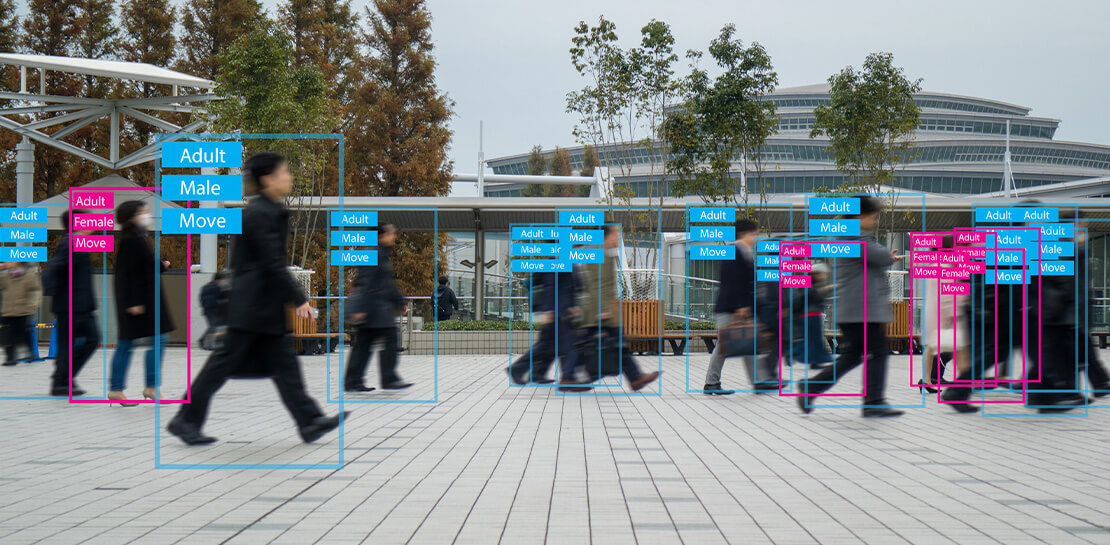
Data-savvy businesses increasingly rely on images and videos for critical functions, and yet are challenged by the sheer mass of information—more than 3.2 billion images and 720,000 hours of video are created daily. This explosion in visual data has paved the way for the growth of computer vision, a form of artificial intelligence (AI) that enables computers to “see” the world similarly to the way people do, but with unblinking consistency, and greater accuracy.
The transformational impact and value of computer vision solutions are significant and has been a guiding objective for companies and AI developers. And yet, even as the applications for computer vision increase dramatically, architecting and implementing vision AI solutions remain highly complex. Visual data, such as images and video, are made up of thousands of pixels of information that represent millions of different patterns and meanings, which can make interpreting even a single image overwhelming from a computational perspective.
Many organizations struggle with deployments and fail to operationalize vision AI solutions due to development delays, machine learning and data science hiring challenges, inaccurate output, a lack of integration with existing infrastructure, difficulty of use, and high cost. Plainsight, with the power of Google Cloud resources, is addressing all these challenges and helping businesses by enabling the deployment of vision AI within enterprise private networks that can be managed easily and scaled economically.
Plainsight has announced availability of its vision AI platform on Google Cloud Marketplace. Businesses can now easily deploy end-to-end vision AI to private clouds to realize the full value of their video and other visual data for accurate, actionable insights across diverse use cases.
Delivering on the Promise of AI: Seeing What’s Hiding In Plain Sight
For organizations to integrate AI and machine learning into their businesses successfully, the technology must be powerful enough to solve real challenges, yet fast, easy, and accessible enough to ensure the innovation potential is realized. Plainsight on Google Cloud delivers the power of enterprise vision AI that’s quick and easy to use with Google Cloud resources that enable global scale, increased security, bolstered privacy, unified billing, and cost savings.
To streamline vision AI workflows, Plainsight facilitates the entire pipeline, from visual data ingestion and annotation, through continuous model training, deployment, and monitoring for easier innovation and faster time-to-production. Our platform accelerates vision AI development in a manner that is complete, accurate, and accessible to non-technical business leaders. We believe that AI should be available and accessible to anyone and everyone—so that teams across entire organizations can reap the benefits.
By integrating Plainsight into their private networks, companies worldwide can now leverage one intuitive platform for centralized control of streamlined vision AI model creation and training with optimized visual data handling for diverse enterprise solutions. These use cases include: social distancing monitoring, medical imaging, drug compound screening, defect detection in manufacturing processes, identifying gas leaks, or even livestock counting and crop health monitoring for agriculture, to name a few.https://www.youtube.com/embed/A7U_0UkjvEg?enablejsapi=1&
We enable customers so they can create successful solutions that enable them to clearly see their business from all angles and to take advantage of the knowledge visual data can reveal by simply and quickly operationalizing practical vision AI applications.
AI-Powered Dataset Creation, Automated Model Training & Easy Deployment Without A Single Line Of Code
For vision AI applications, success is inextricably dependent on the quality and quantity of the datasets required to train the relevant models. To aid enterprises in this vital stage, the Plainsight platform provides built-in data annotation for the fast and easy creation of datasets. This includes AI-powered features that accelerate the speed and quality of labeling such as SmartPoly, for the automated polygon masking of objects, TrackForward, to predict and automatically label objects from frame to frame in video annotations, and AutoLabel for automated object recognition and labeling based on pre-trained machine learning models, to highlight a few.

In addition, to ensure the success of AI integration, we significantly reduce time-intensive processes with Plainsight vision AI’s automated machine learning with continuous model training and easy deployment capabilities. In just a few clicks, users can leverage optimizations for the most reliable model training without endless experimentation cycles. And, models are easily deployed at scale all within one, easy-to-manage model operationalization process for the business.
Growing With Google Cloud
Plainsight is a vision AI innovation leader, developing solutions that address unmet needs for challenger brands and Fortune 500s across vertical markets. As a team recognized for succeeding where others have failed, our expanding partnership with Google Cloud provides a powerful combination that helps customers see and activate the value of their visual data with a suite of services in a secure and private manner.
Our vision AI Platform simplifies building and operationalizing AI to solve business problems enterprises are facing every day—and the demand is increasing. To accelerate our journey to faster, more accessible AI for enterprises, we knew we needed strong support to grow Plainsight and scale our backend tools to match our vision.
Google Cloud delivered everything, and more, in one program. The Startup Program by Google Cloud provided the technology and services for scale and the support we needed to maximize the value the Program provided us. The Startup Program has been a springboard for architecting Plainsight vision AI in the cloud, accelerating our goals and optimizing innovation, efficiency, and growth. The team also helped us optimize Google Ads campaigns, fueling adoption of Plainsight.
After launching the SaaS version of Plainsight Data Annotation in November 2020, we grew our user base by nearly 110x in just three short months. Google Ads has also dramatically increased website traffic, growing new users by nearly 5.75X and page views by over 5X. The Google team helped us identify where Google Cloud offerings could be leveraged instead of developing in-house solutions and offered best practices that enabled us to deliver faster on our initiatives.
Kubernetes was already the underlying component of our platform and leveraging Google Kubernetes Engine (GKE) as a managed service removed a layer of complexity. By combining GKE and Anthos, we were able to standardize our deployments, aligning to how our customers leverage Anthos for enterprise applications in their own organizations. In addition, as a fast-moving, customer-centric company we use Google Workspace to help us centralize and manage our day-to-day work internally. By leveraging multiple products across Google’s ecosystem, we take advantage of a holistic partnership that has helped our business tremendously as we scale.
Leveraging Google’s Partners for Strategic Consultation
To facilitate this expansion of our partnership with Google and to maximize our use of Google Cloud services, we are working with DoiT International, a Google Managed Services Provider and 2020 Global Reseller Partner of the Year. DoiT provides us with ongoing technical consultation for cloud-native architecture, Google Cloud Marketplace integration, production-grade Kubernetes support, Google Cloud cost optimization, and technical support. The DoiT team has been invaluable in compiling best practices, tips, and strategies from their vast experience with various cloud customers to ease our Marketplace integration and is providing input for infrastructure strategy to support our continued rapid growth.
Plainsight Delivers Enterprise Vision AI Through The Google Cloud Platform Marketplace
Plainsight vision AI is now available to Google Cloud Customers on Google Cloud Marketplace enabling organizations across industries to deploy private Plainsight instances within their own environments. Marketplace customers will benefit from Google Cloud privacy, security, scalability and unified billing through their Google Cloud account.
Combining the powerful benefits provided by Google Cloud resources with Plainsight’s vision AI Platform into private networks, enterprises worldwide can now leverage one intuitive platform for centralized control of streamlined vision AI model creation and training with optimized visual data handling for diverse enterprise solutions.
Through our Google partnership, we’re able to leverage a powerful foundation that allows us to rapidly innovate, scale and accelerate delivery on our vision AI platform capabilities. By executing on our vision to make AI easier, faster and more accessible for all users across entire enterprises, we’re helping businesses see more and by seeing more, they’ll have the power to solve more.
If you want to learn more about how Google Cloud can help your startup, visit our page here where you can apply for our Startup Program, and sign up for our monthly startup newsletter to get a peek at our community activities, digital events, special offers, and more.
Enabling Sustainable Agriculture: InstaDeep uses Cloud TPU v4

2648
Of your peers have already read this article.
3:30 Minutes
The most insightful time you'll spend today!
You are what you eat. We’ve all been told this, but the truth is what we eat is often more complex than we are – genetically at least. Take a grain of rice. The plant that produces rice has 40,000 to 50,000 genes, double that of humans, yet we know far more about the composition of the human genome than of plant life. We need to close this knowledge gap quickly if we are to answer the urgent challenge of feeding 8 billion people, especially as food security around the globe is likely to worsen with climate change.
For this reason, AI company InstaDeep has teamed up with Google Cloud to train a large AI model with more than 20 billion parameters on a dataset of reference genomes for cereal crops and edible vegetables, using the latest generation of Google’s Tensor Processing Units (Cloud TPU v4), which is particularly suited for training efficiency at scale. Our aim is to improve food security and sustainable agriculture by creating a tool that can analyze and predict plants’ agronomic traits from genomic sequences. This will help identify which genes make some crops more nutritious, more efficient to grow, and more resilient and resistant to pests, disease and drought.
Genomic language models for sustainable agriculture
Ever since farming began, we have been, directly or indirectly, trying to breed better crops with higher yields, better resilience and, if we’re lucky, better taste too. For thousands of years, this was done by trial and error, growing crops year-on-year while trying to identify and retain only the most beneficial traits as they naturally arise from evolutionary mutations. Now that we have access to the genomic sequences of plants, we hope to directly identify beneficial genes and predict the effect of novel mutations.
However, the complexity of plant genomes often makes it difficult to identify which variants are beneficial. Revolutionary advances in machine learning (ML) can help to understand the link between DNA sequences and molecular phenotypes. This means we now have precise and cost-effective prediction methods to help us close the gap between genetic information and observable traits. These predictions can help identify functional variants and accelerate our understanding of which genes link to which traits – so we can make better crop selections.
Moreover, thanks to the vast library of available crop genetic sequences, training large models on hundreds of plant genomes means we can transfer the knowledge from thoroughly-studied species to those that are less understood but important for food production – especially in developing countries. And by doing this digitally, AI can quickly map and annotate the genomes of both common and rare crop variants.
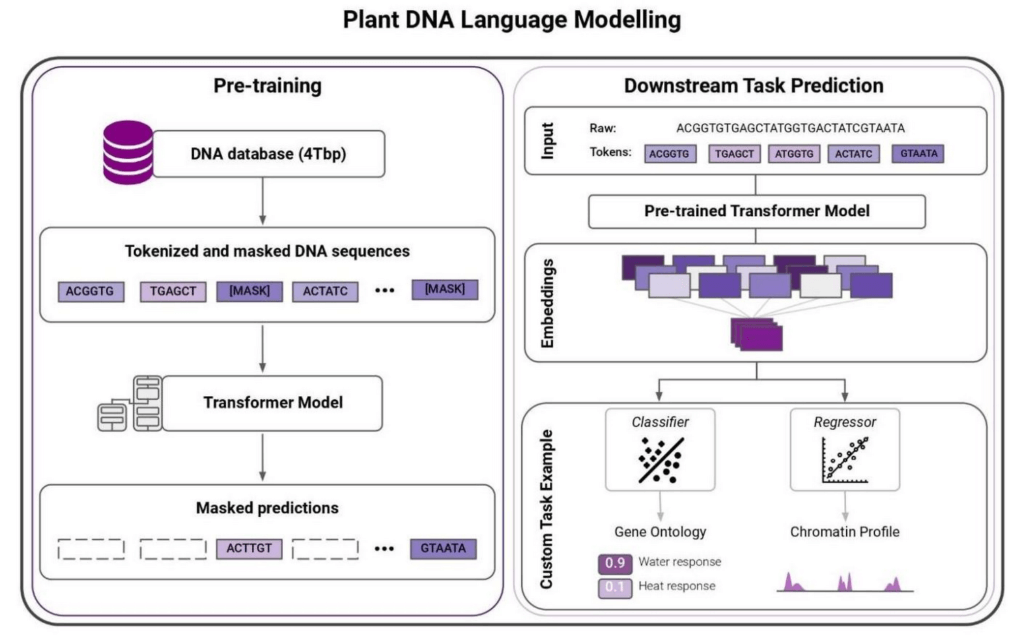
One of the major limitations of traditional ML methods for plant genomics has been they mostly rely on supervised learning techniques. They need labeled data. Such data is scarce and expensive to collect, severely limiting these methods. Recent advances in natural language processing (NLP), such as Transformer architectures and BERT-style training (Bidirectional Encoder Representations from Transformers), allow scientists to train massive language models on raw text data to learn meaningful representations. This unsupervised learning technique changes the game. Once learned, the representations can be leveraged to solve complex regression or classification tasks – even when there is a lack of labeled data.
InstaDeep partners with Google Cloud to train the new generation of AI models for genomics on TPUs
Researchers have demonstrated that large language models can be especially effective in proteomics. To understand how this works, imagine reading amino acids as words and proteins as sentences. The treasure trove of raw genomics data – in sequence form – inspired InstaDeep and Google Cloud to apply similar technologies on nucleotides, this time reading them as words and chunks of genomes as sentences.
Moreover, the representations that the system learned improved in line with the size of the models and datasets, NLP research studies showed. This finding led InstaDeep researchers to train a set of increasingly larger language models on genomics datasets ranging from 1 billion to 20 billion parameters.
- Models of 1 billion and 5 billion parameters were trained on a dataset comprising the reference genomes for several edible plants, including fruit, cereal and vegetables for a total of 75 billion nucleotides.
- The training dataset must increase in the same proportion as the model capacity, recent work has shown. Thus, we created a larger dataset gathering all reference genomes available on the National Center for Biotechnology Information (NCBI) database including human, animal, non-edible plant and bacteria genomes. This dataset, which we used to train a 20-billion-parameter Transformer model, comprised 700 billion tokens, exceeding the size of most datasets typically used for NLP applications, such as the Common Crawl or Wikipedia dataset.
- Both teams announced that the 1 billion-parameter model will be shared with the scientific community to further accelerate plant genomics research.
The compact and meaningful representations of nucleotide sequences learned by these models can be used to tackle molecular phenotype prediction problems. To showcase their ability, we trained a model to predict the gene function and gene ontology (i.e. a gene’s attribute) for different edible plant species.
Early results have demonstrated that this model can predict these characteristics with high accuracy – encouraging us to look deeper at what these models can tell us. Based on these results, we decided to annotate the genomes of three plant species with considerable importance for many developing countries: cassava, sweet potato, and yam. We are working on making these annotations freely available to the scientific community and hope that these will be used to further guide and accelerate new genomic research.
Overcoming scaling challenges with massive models and datasets with Cloud TPUs
The compute requirement for training our 20 billion-parameter model with billions of tokens is massive. While modern accelerators offer impressive peak performance per chip, to utilize this performance often requires tightly coupled hardware and software optimizations. Moreover, maintaining this efficiency when scaling to hundreds of chips presents additional system design challenges. The Cloud TPU’s tightly-coupled hardware and software stack is especially well suited to such challenges. The Cloud TPU software stack is based on the XLA Compiler which offers out-of-the-box optimizations (such as compute and communication overlap) and an easy programming model for expressing parallelism.
We successfully trained our large models for genomics by leveraging Google Tensor Processing Units (TPUv4). Our code is implemented with the JAX framework. JAX provides a functional programming-based approach to express computations as functions that can be easily parallelized using JAX APIs powered by XLA. This helped us to scale from a single host (four chips) configuration to a multi-host configuration without having to tackle any of the system design challenges. The TPU’s cost-effective inter- and intra-communication capabilities led to an almost linear scaling between the number of chips and training time. This allowed us to train the models quickly and efficiently on a grid of 1024 TPUv4 cores (512 chips).
Conclusion
Ultimately, our hope is that the functional characterization of genomic variants predicted by deep learning models will be critical to the next era in agriculture, which will largely depend on genome editing and analysis. We envisage that novel approaches, such as in-silico mutagenesis – the assessment of all possible changes in a genomic region by a computer model – will be invaluable in prioritizing mutations that improve plant fitness and guiding crop improvements. Attempting similar work in wet-lab experiments would be difficult to scale and nearly impossible in nature. By making our current and future annotations available to the research community, we also hope to help democratize breeding technologies so that they can benefit all of global agriculture.
Further Reading
To learn more about the unique features of Cloud TPU v4 hardware and software stack we encourage readers to explore Cloud TPU v4 announcement. To learn more about scaling characteristics, please see this benchmark and finally we recommend reading PJIT Introduction to get started with JAX and SPMD parallelism on Cloud TPU.
This research was made possible thanks to the support of Google’s TPU Research Cloud (TRC) Program which enabled us to use the Cloud TPUv4 chips that were critical to this work.
More Relevant Stories for Your Company


Chronicle Security Analytics: Key to Address Security Data Overload
Google Cloud's Chronicle is a security analytics platform built for modern use cases to combat modern threats. In today's world, enterprises have undergone significant changes in all aspects, and must adapt to their security needs to counter threats and attacks. Watch the video to learn Google Cloud's initiative to help

How AI Can Predict Consumer Demand and Retain Customers
How can AI help you target customers who are looking for products like yours? The challenge: This customer wants to buy the best cat food for her pets. Reach the Right Customers How can AI help you target customers who are looking for products like yours?The challenge: This customer wants

How to Use Machine Learning to Achieve 300% Increase in Gross Profits
Since 1994, IDOM, Japan’s leading buyer and retailer of used cars, has enjoyed success in the auto industry with a simple yet traditional business model: buy pre-owned vehicles directly from car owners and auction them to third-party dealers, or sell them to other consumers at retail stores. In an increasingly

Woolaroo App and Vision AI are Helping Users Explore Native Languages
One of the most vibrant elements of culture is the use of native languages and the time-honored tradition of storytelling. Anthropologists and linguists have been vocal on the role that language plays in the preservation of culture and how it contributes to the appreciation of heritage. Unfortunately, of the more
