





4912
Of your peers have already watched this video.
9:37 Minutes
The most insightful time you'll spend today!
L’Oréal: Managing Big-data Complexity with Google Cloud
L’Oreal is a global company with a presence in 150 countries worldwide. Between managing all of its brands and requirements for different countries, L’Oreal looks to data to make insightful business decisions. How does L’Oreal unify its data across all its systems and databases? How does L’Oreal make the data accessible to thousands of employees? In this video, Antoine Castex, Enterprise Architect at L’Oreal, discusses with Martin Omander how L’Oreal built a serverless, multi-cloud warehouse based on Google Cloud.
Chapters:
0:00 – Intro
0:23 – Why does L’Oreal need a new data warehouse?
0:51 – Who is the L’Oreal group?
1:35 – Which systems does L’Oreal use?
2:14 – How does L’Oreal manage complexity?
3:59 – What is ELT?
4:57 – Who are L’Oreal’s data consumers?
5:41 – How L’Oreal built the data warehouse
8:51 – L’Oreal’s future plans
9:10 – Wrap up
Google Cloud Workflows → https://goo.gle/3q20M1V
Cloud Run → https://goo.gle/3CSWbXG
Eventarc → https://goo.gle/3B7qhFy
BigQuery → https://goo.gle/3KHgyJ3
Looker → https://goo.gle/3Rx4Ind
Checkout more episodes of Serverless Expeditions → https://goo.gle/ServerlessExpeditions
Subscribe to Google Cloud Tech → https://goo.gle/GoogleCloudTech
3361
Of your peers have already watched this video.
24:40 Minutes
The most insightful time you'll spend today!
A Guide to Anthos: the App Modernization Platform for Hybrid and Multi-cloud Deployments
Anthos gives you a consistent platform for all your application deployments, both legacy as well as cloud native, while offering a service-centric view of all your environments.
You can build enterprise-grade containerized applications faster with managed Kubernetes on cloud and on-premises environments. Create a fast, scalable software delivery pipeline with cloud-native tooling and guidance.
It also helps leverage a programmatic, outcome-focused approach to managing policies for apps across environments, and enable greater awareness and control with a unified view of your services’ health and performance.
Tune in to this brief explainer video for an overview of Anthos, deployment examples, and explore options to get started illustrated through a demo with Bradley Wong, Product Manager at Google Cloud. Learn to make the best first step in your journey of application modernization and gain a clear understanding of the value of Anthos for your hybrid and multi-cloud workloads.
The Modernization Imperative (TMI): The Beauty in Boring

912
Of your peers have already read this article.
3:30 Minutes
The most insightful time you'll spend today!
You have something in your pocket right now that possesses more computing power than spacecraft fifteen billion miles away from Earth. No, not your mobile phone — the key fob for your car! Voyager 1 and Voyager 2 launched in 1977, and forty five years later, these little rascals still work and send data back to Earth while moving through cold, empty space at over thirty thousand MPH. Think your key fob will still be going strong in 2068? It’s also amazing that the Romans created a concrete so long-lasting that two thousand years later, structures built with it are still in use. Meanwhile, the roads outside my house develop potholes if a rabbit sneezes on them.
I’m a fan of durability because it allows you to think outside the box. If I know that my foundations are safe, I’ll be more inclined to push the boundaries to innovate outside my comfort zone because the environment can handle it. Durability needs to be a cornerstone of the application modernization conversation, as each application and environment we create for our customers is the first step of their next-generation technology and business strategy. An entire organization’s goals and dreams rests on the shoulders of the technology architectures we are building, and we need to ensure that the foundation has the strength to withstand everything the future can throw at it — and then some.
When it comes to selecting the appropriate foundational technologies for modern applications, it’s crucial to consider the longevity and reliability of the technology. Will an exciting new open-source large language model be around in a year? Or that interesting new database from PayPal? How do I choose something from the ever-growing CNCF landscape diagram? This is where the strength of open-source communities and vendor backing comes into play. For instance, Kubernetes, PostgreSQL, and Java have stood the test of time, thanks to their robust feature sets, dedicated communities, and strong vendor support.
Kubernetes provides a scalable solution for managing and deploying applications, with Google’s strong backing: As of July, we’ve made over 1,000,000 contributions to the k8s project — 2.3 times more than any other contributor. PostgreSQL, meanwhile, is one of the world’s most advanced open-source databases and offers a comprehensive set of features that cater to a wide range of data processing needs, with a vibrant community constantly enhancing its capabilities. And Java, a general-purpose programming language, has been a staple in the development community for decades, providing a reliable platform for building robust applications.
Choosing an established technology not only brings the benefit of a mature feature set but also the assurance of continuity. A new database or language model may be promising, but they lack the track record of these tested technologies. The risk of adopting such new technologies is their potential discontinuation or lack of support, which could jeopardize your application’s stability and longevity.
The Voyager team’s use of aluminum foil is a great illustration of this principle. They chose a simple, reliable, and available solution to protect sensitive instruments during their mission. The choice of aluminum foil might not have been the most cutting-edge or exciting, but it was practical, reliable, and ultimately successful. Similarly, when choosing foundational technologies for your modern applications, sometimes the “boring” choice is the best one. It’s not about chasing the latest trends; it’s about choosing what works and stands the test of time.
Vendor backing is another critical consideration when choosing foundational technologies. A reliable platform provider that runs these technologies ensures a high-uptime Service Level Agreement (SLA). For example, Google Kubernetes Engine (GKE) offers a 99.95% uptime SLA, while Bigtable “just works,” and Cloud Storage doesn’t lose data thanks to a design that supports 99.999999999% annual durability.
Boring doesn’t mean blah
That’s not to say we shouldn’t experiment with new technologies and encourage our customers to do the same. Everyone needs an innovation strategy. The concept of an ‘innovation spectrum’ is helpful here. This spectrum represents different degrees of technological innovation that companies can employ based on their specific needs and capabilities. On one end of the spectrum, there’s incremental innovation, which involves making small improvements or extensions to existing products, services, or processes. On the other end, there’s radical or disruptive innovation, which involves creating entirely new products or services that can potentially disrupt entire industries.
A classic example of balancing cutting-edge technology with “boring” or legacy technology is seen in many financial institutions. They might use AI and ML for fraud detection or predictive analytics while still relying on tried and true technologies for their core banking systems. This blend of newer and older technologies allows them to benefit from the latest advancements without jeopardizing the stability and reliability of their critical operations. However, as the banking industry is finding out, that can also come at a risk of stifling innovation and can cause customers to look elsewhere.
For developers, Google Cloud’s Kubernetes-based platforms present a similar balance between innovation and stability. For example, researchers can leverage cutting-edge GPU sharing in GKE to explore the origins of the universe, while the BBC uses Cloud Run serverless containers to keep up with demands of a very busy news day.
Adopting best practices like platform engineering can provide a robust foundation for rolling out new technologies. Platform engineering focuses on creating a stable, scalable, and secure platform that allows for rapid deployment of applications. GitOps is another important practice that involves using Git as a single source of truth for declarative infrastructure and applications. With Git at the center of the delivery pipelines, developers can use familiar tools to make pull requests. Changes can be rolled out or rolled back easily, making the process of adopting new technologies smoother.
When it comes to modern application development, developers need to be able to trust that the foundational technologies they choose will be reliable and durable. Without this assurance, developers may be hesitant to take risks or explore creative solutions. To give them the confidence they need, an effective platform engineering strategy can provide a strong foundation for rolling out new technologies while ensuring stability and security.
Boring can be beautiful, especially if you’re building for the long haul. Regardless of what you’re developing, from roads and rocketships to microservices or network architecture, the fundamental structure needs to withstand everything the conceivable future can throw at it. A solid, durable foundation offers developers the capabilities they need to push the boundaries, and the reliability they need so their brainchild is still humming along, 15 billion miles away.
Beyond Traditional Learning: AI-based Online Learning Platform and Google Cloud Solutions Push Learners to Get Ahead

10353
Of your peers have already read this article.
1:30 Minutes
The most insightful time you'll spend today!
The combination of a vital need for IT experts among businesses and a digital skills gap is making lifelong learning increasingly critical. Beyond professional development, learning new skills offers additional rewards from building peer connections to boosting your creativity. That’s why in 2020 Krishna Deepak Nallamilli and I launched KIMO.ai to reimagine how people approach learning, especially in developing markets. Our team is building the artificial intelligence needed to generate individual learning paths through a wide range of quality digital learning content.
Google Cloud and its Startup Program have been instrumental in connecting our team with the tools, people, processes, and best practices to grow our business.
Existing learning platforms lack engagement
Outside of traditional education settings, massive open online learning courses (MOOCs)—often modeled after university courses—can provide a flexible and affordable way to upskill or reskill. But the vast majority of people who participate in MOOC programs fail to complete courses. Based on our research, the challenge with existing learning platforms is a lack of engagement, primarily caused by limited direction on which skills to learn, whether AI, fintech, blockchain, or other in-demand disciplines.
We’ve also received feedback that many corporate learning management systems–developed as online training systems to upskill employees–tend to be poorly designed and time-consuming to use.
Overall, a significant challenge with most existing learning platforms is that they’re generic. For example, suppose you’re interested in learning about AI. In that case, you need AI-related coursework that applies to your industry and the job you want because AI in medicine is vastly different from AI in financial services. Today’s online learning options typically take a one-size-fits-all approach and fail to capture the nuances of what learners really need to get ahead.
Building a future-proof learning platform
The commitment to highly personalized, accessible learning inspired KIMO.ai, a platform that we believe is the future of education. Depending on your goals, current skills, location, and other factors, our AI-based platform will identify which coursework (and where to find those classes) to build the skills you need. The more personalized, relevant learning recommendations even take into account people’s preferences for podcasts, MOOCs, books, articles, videos, courses, publications, and more.
In a mix of cooperation and competition we call “coopetition,” KIMO.ai will regularly recommend courses from other established online learning systems if, based on our automated assessment, it’s the best option for a learner. There’s also the option to access free content only.
Google cultural alignment fosters trust
Our platform started with one developer exploring NLP models and Google APIs. As we’ve grown our team and launched our beta to 110,000 users in developing markets, we discovered there is a lot of interest in our platform, and we believe we can make a significant impact. In feedback forums, we also learned that we need to focus our efforts on the mobile experience to improve engagement since 99% of the beta testers use mobile devices.
Beyond our team’s high level of trust in Google Cloud solutions, our team also appreciates the cultural alignment with Google. We value Google’s developer-centric approach and rely on tools like Dataflow for batch data processing and Cloud TPU to reliably run machine learning models with AI services on Google Cloud. We also build all of our deployments on Google Kubernetes Engine (GKE), which makes it easy to manage all our containerized workloads
On the front end, Google App Engine makes it easy to deploy apps and experiment, and it integrates seamlessly with Firebase for authentication and more. BigQuery is our serverless data warehouse that efficiently scales to support the millions of articles, videos, and other learning resources we need to analyze to provide the targeted coursework recommendations our learners require.
As we grow our business having a network of trusted advisors is also extremely valuable. By working closely with DoIT International, the 2020 Google Cloud Global Reseller Partner of the Year, our team has access to their cloud, Kubernetes, and machine learning expertise. DoIT has already helped us quickly resolve IT issues and create analytics dashboards that give us insights to continually enhance our services.
Building for a growing industry
The dynamic edtech market is growing rapidly and estimated to become an $11B industry by 2025. We’re proud to be part of the next wave of personalized education that has the potential to empower people in developing markets and beyond to grow their skills with coursework tailored to their exact needs and how they like to learn. This year, we will deliver our platform to at least 400,000 more people. We’re excited to see how they use it and where it takes them.
If you want to learn more about how Google Cloud can help your startup, visit our Startup Program application page here to get more information about our program, and sign up for our communications to get a look at our community activities, digital events, special offers, and more.
Announcing reCAPTCHA Enterprise’s Mobile SDK to Help Protect iOS, Android apps

4211
Of your peers have already read this article.
2:30 Minutes
The most insightful time you'll spend today!
reCAPTCHA Enterprise is Google’s online fraud detection service that leverages more than a decade of experience defending the internet. reCAPTCHA Enterprise can be used to prevent fraud and attacks perpetrated by scripts, bot software, and humans. When installed inside a mobile app at the point of action, such as login, purchase, or account creation, reCAPTCHA Enterprise can block fake users and bots while allowing legitimate users to proceed.
To provide more complete coverage for native mobile iOS and Android applications, we’re announcing the general availability of the reCAPTCHA Enterprise Mobile SDK. Designed with digital-first and mobile-first organizations in mind, the new Mobile SDK fully integrates reCAPTCHA Enterprise’s frictionless experience on end-users’ mobile devices.
Why should I use the Mobile SDK?
Unlike most web applications, iOS and Android apps run on physical devices that can provide a wealth of device telemetry to help identify fraud and bot activity. By combining both device and network signals, the new mobile SDK can better protect native mobile applications from bot attacks while unlocking the full potential of reCAPTCHA Enterprise. It provides:
- Frictionless customer experience — no picking fire hydrants from a grid
- Easy integration to your native mobile app with support for popular frameworks like Cocoa Pods and Swift Package Manager
- A regularly-updated device threat model to help stay ahead of attack evolution
Protecting against fraud across all your channels
Customers will be able to leverage the new mobile SDK to implement native iOS and Android protection against the OWASP Top 10 automated attacks common on the internet, which include fraudulent account creation, financial hijacking, and credential stuffing. This is particularly important for mobile workforces and end users who use a mobile app to access products and services. Since mobile traffic surpasses web traffic in many industries, it’s even more important to implement a comprehensive mobile app protection strategy to protect against the most prevalent attacks.
Integrating the new Mobile SDK
If you’re interested in learning more about how to integrate the new Mobile SDK, check out the documentation for iOS and Android. Mobile and Web integrations leverage the same easy to understand pricing for Assessments, found here.
Google Cloud’s Suite of DevOps Speeds Up ForgeRock’s Development

5698
Of your peers have already read this article.
3:00 Minutes
The most insightful time you'll spend today!
Editor’s note: Today we hear from ForgeRock, a multinational identity and access management software company with more than 1,100 enterprise customers, including a major public broadcaster. In total, customers use the ForgeRock Identity Platform to authenticate and log in over 45 million users daily, helping them manage identity, governance, and access management across all platforms, including on-premises and multicloud environments.
Operating at that kind of scale isn’t easy. In this blog post, ForgeRock Engineering Director, Warren Strange discusses the three things that help make their developers efficient and productive, and the Google Cloud tools they use along the way.
At ForgeRock, we’ve been an early adopter of Kubernetes, viewing it as a strategic platform. Running on Kubernetes allows us to drive multicloud support across Google Kubernetes Engine (GKE), Amazon (EKS), and Azure (AKS). So no matter which cloud our customers are running on, we are able to seamlessly integrate our products into customers’ environments.
Making it easier for ForgeRock’s developers and operators to build, deploy and manage applications has been crucial in our ability to continually provide high quality solutions for our customers. We’re always looking for tools to improve productivity and keep our developers focused on coding instead of configuration. Google Cloud’s suite of DevOps tools have streamlined three specific practices to help keep our developers productive:
1. Make developers productive within IDEs
Developer productivity is core to the success of any organization, including ForgeRock. Since developers spend most of their time within their IDE of choice, our goal at ForgeRock has been to make it easier for our developers to write Kubernetes applications within the IDEs they know and love. Cloud Code helps us precisely with that: it makes the process of building, deploying, scaling, and managing Kubernetes infrastructure and applications a breeze.
In particular, working with the Kubernetes YAML syntax and schema takes time, and a lot of trial and error to master. Thanks to YAML authoring support within Cloud Code, we can easily avoid the complicated and time consuming task of writing YAML files at ForgeRock. With YAML authoring support, developers save time on every bug. Cloud Code’s inline snippets, completions, and schema validation, a.k.a. “linting,” further streamline working with YAML files.
The benefits of Cloud Code extend to local development as well. Iterating locally on Kubernetes applications often requires multiple manual steps, including building container images, updating Kubernetes manifests, and redeploying applications. Doing these steps over and over again can be a chore. Cloud Code supports Skaffold under the hood, which tracks changes as they come and automatically rebuilds and redeploys—reducing repetitive development tasks.
Finally, developing for Kubernetes usually involves jumping between the IDE, documentation, samples etc. Cloud Code reduces this context switching with Kubernetes code samples. With samples, we can get new developers up and running quickly. They spend less time learning about configuration and management of the application—and spend more time on writing and evolving the code.
2. Drive end-to-end automation
To further improve developer productivity, we’ve focused on end-to-end automation: from writing code within IDEs, to automatically triggering CI/CD pipelines and running the code in production. In particular, Tekton, Cloud Build, Container Registry, and GKE have been critical to Forgerock as we streamline the flow of code, feedback and remediation through the build and deployment processes. The process looks something like this:
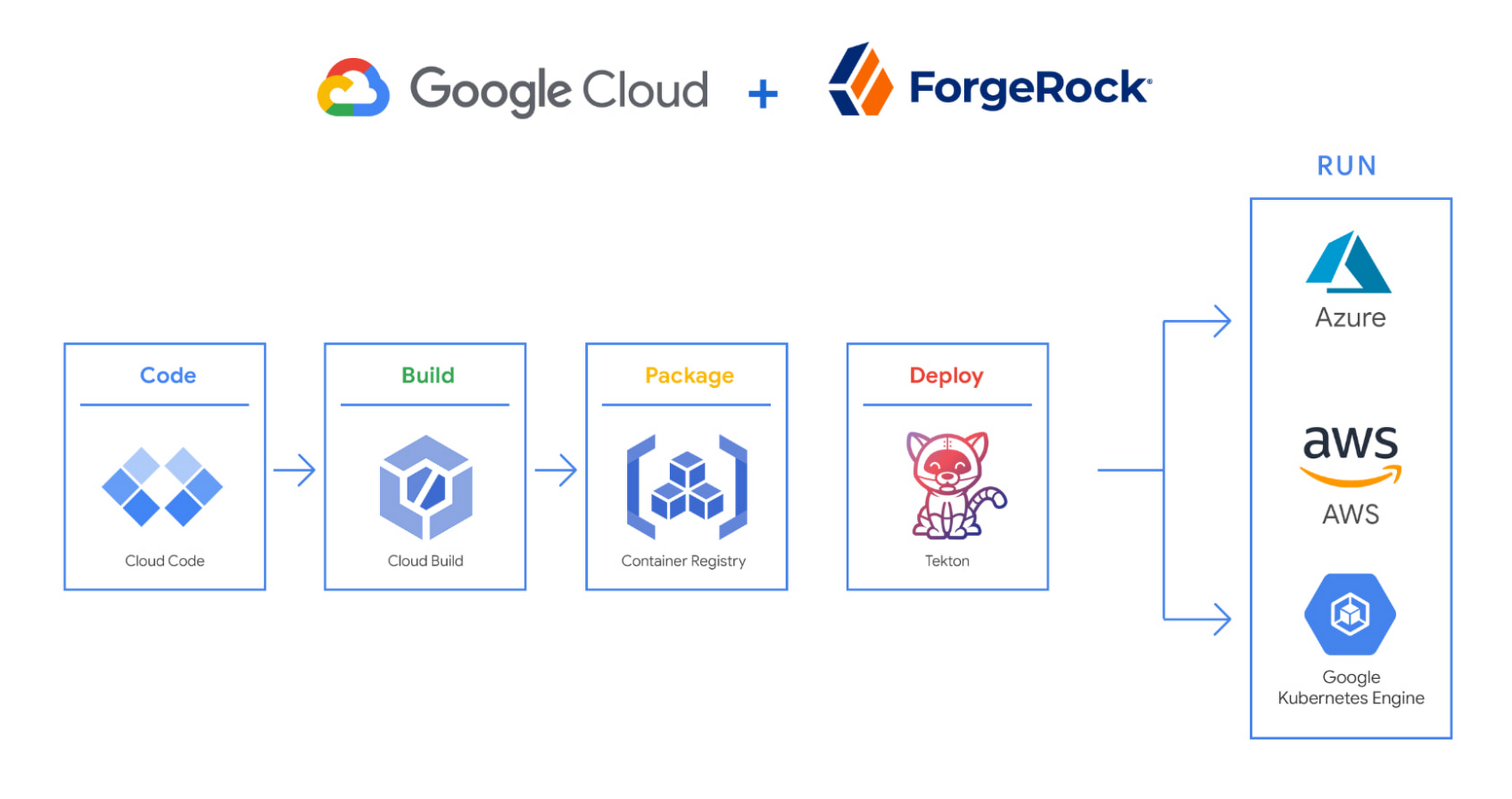
We begin by developing Kubernetes manifests and dockerfiles using Cloud Code. Then we use Skaffold to build containers locally, while Cloud Build helps with continuous integration (CI). The Cloud Build GitHub app allows us to automate builds and tests as part of our GitHub workflow. Cloud Build is differentiated from other continuous integration tools since it is fully serverless. It scales up and scales down in response to load, with no need for us to pre-provision servers or pay in advance for additional capacity. We pay for the exact resources we use.
Once the image is built by Cloud Build, it is stored, managed, and secured in Google’s Container Registry. Just like Cloud Build, Container Registry is serverless, so we only pay for what we use. Additionally, since Container Registry comes with automatic vulnerability scanning, every time we upload a new image to Container Registry, we can also scan it for vulnerabilities.
Next, a Tekton pipeline is triggered, which deploys the docker images stored in Container Registry and Kubernetes manifests to a running GKE cluster. Along with Cloud Build, Tekton is a critical part of our CI/CD process at ForgeRock. Most importantly, since Tekton comes with standardized Kubernetes-native primitives, we can create continuous delivery workflows very quickly.
After deployment, Tekton triggers a functional test suite to ensure that the applications we deploy perform as expected. The test results are posted to our team Slack channel so all developers have instant access and insights about each cluster. From there, we are able to provide our customers with their finished product request.
3. Leverage multicloud patterns and practices
The industry has seen a shift towards multicloud. Organizations have adopted multicloud strategies to minimize vendor lock-in, take advantage of best-in-class solutions, improve cost-efficiencies, and increase flexibility through choice.
At ForgeRock, we’re big proponents of multicloud. Part of that comes from the fact that our identity and access management product works across Google Cloud, AWS, and Azure. Developing products using open-source technologies such as Kubernetes has been particularly helpful in driving this interoperability.
Tekton has been another critical project that has allowed us to prevent vendor lock-in. Thanks to Tekton, our continuous delivery pipelines can deploy across any Kubernetes cluster. Most importantly, since Tekton pipelines run on Kubernetes, these pipelines can be decoupled from the runtime. Like Tekton and Kubernetes, both Cloud Build and Container Registry are based on open technologies. Community-contributed builders and official builder images allow us to connect to a variety of tools as a part of the build process. And finally, with support for open technologies like Google Cloud buildpacks within Cloud Build, we can build containers without even knowing Docker.
Making it easier for developers and operators to build, deploy and manage applications is critical for the success of any organization. Driving developer productivity within IDEs, leveraging end-to-end automation, and support for multi-cloud patterns and practices are just some of the ways we are trying to achieve this at ForgeRock. To learn more about ForgeRock, and to deploy the ForgeRock Identity Platform into your Kubernetes cluster, check out our open-source ForgeOps repository on GitHub.
More Relevant Stories for Your Company

Reactive Programming on Google Maps Platform: Watch Video to Learn
The Google Maps Platform Android SDK supports extensions for reactive programming, which helps you write code to handle asynchronous operations. Write reactive and responsive mapping applications with Google Maps Platform In mobile apps, asynchronous events can happen at any point in time: user touch events, waiting for network calls to complete, or

How to Build A Basic Image Search Utility for Natural Language Queries
This post shows how to build an image search utility using natural language queries. Our aim is to use different GCP services to demonstrate this. At the core of our project is OpenAI's CLIP model. It makes use of two encoders - one for images and one for texts. Each encoder

Latest News: Secure Digital Infrastructure Services with Apigee Advanced API Security for Google Cloud
Organizations in every region and industry are developing APIs to enable easier and more standardized delivery of services and data for digital experiences. This increasing shift to digital experiences has grown API usage and traffic volumes. However, as malicious API attacks also have grown, API security has become an important

How TapClicks’ Google Cloud Migration Makes Life Easy for Marketers
Editor’s note: In this blog post we learn how TapClicks migrated to Google Cloud to offer their marketing customers a unified platform for data management, operations, insights, and analysis. TapClicks is a smart marketing cloud, powered by data, that unifies our customer’s marketing. By choosing to migrate our core applications last
