





3505
Of your peers have already watched this video.
2:30 Minutes
The most insightful time you'll spend today!
Google Cloud Helps DSW Engage Over 28M Shoe Lovers in Real Time
DSW Shoes turned to Google Cloud and Google Cloud Partner – Slalom to develop a realtime, engaging loyalty program that serves more than 28 million active members instantly.
The major move from on premise to a cloud-based, data-driven platform that offers speed, flexibility, and scalability has helped increase DSW’s new customer rate by 9% and allows the company to achieve a best-in-class retention rate.
Watch the video to understand how DSW Shoes did this.
Three Benefits of VPC Network Peering for SAP Managed Apps

3529
Of your peers have already read this article.
3:00 Minutes
The most insightful time you'll spend today!
Over the past year, RISE with SAP has emerged as a valuable solution for SAP customers seeking a faster, simpler, and more affordable path to the cloud. RISE with SAP is a subscription-based offering that typically includes a number of fully managed cloud application options, including SAP S/4HANA Cloud and elements of the SAP Business Technology Platform. It’s a great way to migrate your business to modern cloud ERP applications, while handing off the implementation and management to SAP and freeing your own IT staff to focus on other projects.
As a strategic partner for RISE with SAP, Google Cloud works closely with SAP to ensure reliable, secure, high-performance connectivity between your SAP managed applications and your other Google Cloud applications and services. Today, we’re focusing on a Google Cloud capability that plays a big part in achieving this goal: VPC network peering. If your company uses Google Cloud to host its RISE with SAP managed applications (or any other SAP-managed offering, such as SAP Enterprise Cloud Services), it’s worth learning more about why VPC network peering is an important capability and how your network admin can implement it.
VPC network peering: The critical link for your SAP managed applications
We recently co-authored a white paper with SAP that goes into technical detail about how VPC network peering works and includes step-by-step configuration instructions. But it is useful to understand, at a higher level, why it matters for RISE with SAP subscribers.
When SAP implements your RISE with SAP managed applications on Google Cloud, it also provisions a virtual private cloud (VPC) — a virtualized network that provides the same functionality, performance, and security benefits as a dedicated physical network — for this SAP environment. In fact, a VPC actually gives you some capabilities that a physical network can’t match, such as the ability to increase IP space without downtime.
Using VPC network peering to connect your SAP managed environment with your Google Cloud applications and services gives you three key benefits:
- Network latency: Traffic that remains inside Google’s network enjoys lower latency than connectivity that uses external addresses.
- Network security: Service owners do not need to have their services exposed to the public internet and deal with its associated risks.
- Network cost: Rather than pay egress bandwidth costs for networks using external IPs to communicate, peered networks can use internal IPs to communicate, saving you money on those egress costs. Regular network pricing still applies to all traffic.
Many customers also appreciate the flexibility they get from VPC network peering: It supports the ability to peer your own VPC networks with other VPC networks that reside in different projects and even in different organizations.
Using VPC network peering to strengthen your SAP security posture
Most Google Cloud customers find VPC network peering most useful to ensure seamless connectivity between their SAP managed applications and the rest of their Google Cloud environment. But some companies also rely on VPC network peering to gain greater control over the security of their cloud environments. This can include:
- Implementing additional network security capabilities, such as advanced firewalls, intrusion detection, and network package inspection, that go above and beyond standard SAP security measures.
- Leveraging Google Cloud Interconnect to link your on-premises and Google Cloud environments, including your RISE with SAP managed applications, without sending traffic across the public internet.
Once your company has configured VPC network peering, things get even more interesting. Google Cloud offers plenty of ways to complement and enhance the value of your SAP applications: using Google BigQuery to consolidate and enrich your SAP application data; relying on Google AI/ML capabilities to sharpen your predictive analytics and real-time decision-making; or leveraging Google Kubernetes Engine to jump-start your own cloud-native application development efforts, among many other examples.
Some of the world’s biggest SAP customers, including The Home Depot, and Cardinal Health, have chosen Google Cloud to migrate their business-critical SAP applications. And we’ve seen how useful VPC network peering can be for SAP customers to unlock the full value and potential of Google Cloud. Be sure to download our white paper so you can get VPC network peering configured for your RISE with SAP managed applications, and discover for yourself just what’s possible when you run SAP applications on Google Cloud.
Transform Your Business: Comprehensive Cloud Services and Tailored Pricing Plans

1489
Of your peers have already read this article.
3:30 Minutes
The most insightful time you'll spend today!
As the saying goes, “it’s hard to make predictions, especially about the future.” Some organizations find it challenging to predict what cloud resources they’ll need in months or years ahead. Every organization is on its own unique cloud journey. To help, we’re developing new ways for customers to consume and pay for Google Cloud services. We’re doing this by removing barriers to entry, aligning cost to consumption and providing contractual and product flexibility. Read on to learn how we’re rolling out several new go-to-market programs across these key areas to help our customers purchase and consume Google Cloud services more easily.
Removing barriers to entry with Google Cloud Flex Agreements
Many customers choose multi-year commitments because they provide better line-of-sight into IT spend and budgeting. However, these commitments can create difficulty for those who don’t have clear visibility into their future cloud consumption needs. That’s why today we’re launching Flex Agreements, which enable customers to migrate their workloads to the cloud with no up-front commitments. As part of this new licensing option, Google Cloud customers still get access to unique incentives, such as monthly spend discounts1, committed use discounts, cloud credits, and access to professional services, based on monthly spend and workloads migrated to Google Cloud.
Flex Agreements are just one example of how we are removing barriers to help customers start using Google Cloud. In 2022, we launched the Innovators Plus annual subscription, which gives developers a curated toolkit to accelerate their expertise, including access to live and on-demand training through Google Cloud Skills Boost, Google Cloud credits, and more.
We also recently expanded trials for Google Cloud products. For example, the new Spanner free trial instance is good for 90 days, allowing developers to create Google Standard SQL or PostgreSQL databases, explore Spanner capabilities, and prototype applications—with no commitment or contract needed.
Contractual and feature flexibility
Contractual flexibility has always been one of our core principles. Committed Use Discounts (CUDs), for example, provide discounted prices in exchange for a commitment to use a minimum level of resources for a specified term. Last year, we introduced Flexible CUD, spend-based commitments that offer predictable and simple flat-rate discounts that apply across multiple virtual machine families and regions.
In addition to contractual flexibility, our customers also need the flexibility to choose features and functionality based on their stages of cloud adoption and the complexity of their business requirements. Therefore, over the next few quarters, we will launch new product pricing editions—Standard, Enterprise, and Enterprise Plus—in parts of our cloud portfolio. This new commercial packaging model will help give customers more choice and flexibility to optimize their cloud spend.
For customers running workloads such as those in regulated industries like banking and public sector, the higher-end Enterprise Plus tier will offer compute, storage, networking and analytics services with high availability, multi-region support, regional failover and disaster recovery, advanced security, and a broad range of regulatory compliance support. The Enterprise pricing tier will include a broad range of features designed for customers with workloads that demand a high level of scalability, flexibility, and reliability. The Standard pricing tier will offer cost-efficient and easy-to-use managed services that include all essential capabilities such as autoscaling to meet the core workload requirements of customers.
Align costs to consumption with autoscaling
At Google Cloud, a core requirement for the products we build is providing customers industry-leading capabilities to automatically scale (autoscale) services up and down to match capacity with real-time demand. Autoscaling improves uptime, reduces infrastructure costs, and removes the operational burden of managing resources.
Many Google Cloud products include autoscaling capabilities to help customers manage unplanned variations in demand. For example, Dataflow vertical and horizontal autoscaling, in combination with granular adaptive resource configuration (aka “right-fitting”), has resulted in up to 50% saving in infrastructure costs for streaming by automatically choosing the right number of instances required to run the jobs and dynamically re-allocating more or fewer instances during the runtime of jobs. Bigtable also provides native autoscaling capabilities, and Spanner’s autoscale is an open source tool that works across regional and multi-regional Spanner deployments.
Similarly, we added multiple features such as Cluster Autoscaler, Horizontal Pod Autoscaling, Vertical Pod Autoscaling, and Node Auto-Provisioning to GKE for elasticity and cost efficiency.
For L.L.Bean, the ability to quickly scale capacity to meet changing usage patterns (e.g., during the holidays), as well as to rapidly perform load tests to test capacity, are “night and day” with Google Cloud compared to L.L.Bean’s legacy on-premises IT system.
“We won’t have to pay for peak capacity to have it available during peak shopping times. We just scale capacity up or down as needed.” — Randy Dyer, Enterprise Architect, L.L.Bean
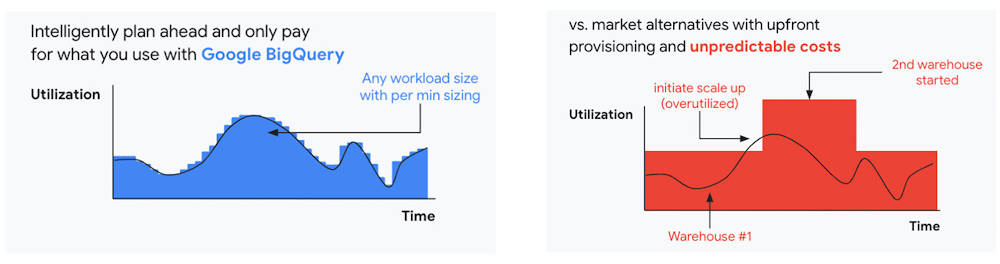
We are now taking these capabilities to the next level by enabling autoscaling in BigQuery at a more granular level so you never pay more than what you use. This allows you to provision additional capacity in smaller increments, so you never overprovision and overpay for underutilized capacity. BigQuery customers can now try the new BigQuery autoscaler (currently in public preview) in their Google Cloud console.
A commitment to flexibility and choice
At Google Cloud, we remain deeply committed to the success of our customers and partners, and we are uniquely positioned to help organizations transform their business. By providing you with more flexibility and choice in how to purchase our products, we are empowering you to be more efficient and resilient.
Join Google Data Cloud & AI Summit to hear the latest announcements around innovations in Google Data Cloud for databases, data analytics, business intelligence, and AI. Gain expert insights, new solutions, and strategies that can help you transform customer experiences with modern apps, boost revenue, and reduce costs.
1. Not available for customers buying through Partner Advantage.
Explore the Complete Startups’ Technical Guide on Google Cloud Tech Channel

3383
Of your peers have already read this article.
1:30 Minutes
The most insightful time you'll spend today!
Bootstrap your Startup with our technical guided series
At Google Cloud, we want to provide you with the access to all the tools you need to grow your business. Through the Google Cloud Technical Guides for Startups, leverage industry leading solutions with how-to video guides and resource handbooks curated for startups.
This multi-series contains 3 chapters: Start, Build and Grow, which matches your startup’s stage of growth:
- The Start Series: Begin by building, deploying and managing new applications on Google Cloud from start to finish.
- The Build Series: Optimize and scale existing deployments to reach your target audiences.
- The Grow Series: Grow and attain scale with deployments on Google Cloud.
Kick off with The Start Series
The Start Series is designed to help your startup begin building, deploying and managing new applications on Google Cloud from start to finish. The series contains 12 videos and is dedicated to those who are starting out their cloud journey with Google Cloud. From setting up your project, to choosing the right compute option, to configuring your networking to managing your databases, and understanding support and billing – the Start Series guides you at every step of the journey.
Check out our website and our Google Cloud Technical Guides for Startups full playlist.
Coming up next – The Build Series
Launch into the next part of the journey continuing from the Start Series, with the upcoming Build Series, where we will be focusing on the optimization and scaling of existing deployments to help your startups reach your target audiences.
Join us by checking out the video series on the Google Cloud Tech channel, and subscribe to stay up to date.
See you in the cloud!
Ulta Beauty: Managing Holiday Surges and Architecting Innovation

2741
Of your peers have already read this article.
3:30 Minutes
The most insightful time you'll spend today!
As we enter the holiday season, retailers are working behind the scenes to ensure they can provide the best experiences for customers, in store and online. Challenges in retail do not begin or end during the holiday season as sudden shifts in customer preferences, supply chain nuances, and overall demand ebbs and flows take place year round and retailers must be prepared to adapt swiftly.
Google Cloud’s retail customers globally, in total, saw more online traffic in the first six months of 2022 than all of 2019. This year, retailers can expect an early launch to holiday shopping activities, as 50% of consumers plan to start purchasing goods before the traditional Black Friday kick-off.
The very same improvements made to automate and improve retail infrastructure can prepare it for holiday surges and support year-round innovation. Let’s take a look at how Ulta Beauty, the largest beauty retailer in the U.S., is partnering with Google Cloud, MongoDB Atlas, commercetools, and HCLTech to cover these two areas and more.
Architecting for innovation
Creating personalized shopping experiences in stores and online is key to Ulta Beauty’s success. This commitment is best demonstrated through Ulta Beauty’s Virtual Beauty Advisor. Built on Google Cloud, this tool enhances shoppers’ experiences with personalized recommendations in addition to the ability to try on makeup virtually with GLAMLab.
As innovators in support of the best possible guest experience, Ulta Beauty needed to re-architect its infrastructure for greater agility and stability.
To start, Ulta Beauty chose to use Google Kubernetes Engine (GKE) as the backbone and orchestrator to build and deploy cloud-native applications. The Google Cloud deployments coincided with an organizational move from end-to-end application development to one that focuses on individual features, specific modules, and micro-applications.
This strategic change allowed Ulta Beauty to fix bugs, experiment with new offerings, and drive customer experiences faster and more efficiently. Thanks to the transformation and GKE, Ulta Beauty’s developer team now accelerates time to market for new products and services, and delivers new ways to engage with customers more quickly. These efforts all ladder to create ‘WOW’ experiences for the retailers’ guests who have emotional and personal connections to beauty and wellness. They can now discover and experience products that are served to them based on individual preferences.
Adapting to the new environment comes with its own set of challenges. “Microservices are not a silver bullet,” says Sethu Madhav Vure, IT Architect, Ulta Beauty. “For Ulta Beauty, the biggest challenge was how to break up a monolithic environment into multiple applications. We had to evolve our core systems—without impacting today’s services—and address what was needed for the future.”
Google Cloud partner HCLTech provided expert guidance throughout the re-architecting process, defining the solution blueprint and cloud-native deployment architecture through cross-functional workshops. HCLTech then assisted with the actual migration and platform setup, paving the way for fully automated, continuous integration and continuous delivery (CI/CD) pipelines to support faster rollouts and deployment architecture to drive higher availability and scalability.
Ulta Beauty took a domain-driven design approach to identify operations that could be grouped together to reduce complexity and improve scalability. Now, the applications are based on multiple domains, such as Commerce, Promotions, Catalog, Order, Customer, and Inventory. The new architecture prompted a fresh look at storage requirements to scale dynamically alongside its modernized applications.
For Ulta Beauty, MongoDB Atlas proved to be the best database solution for dynamic scaling, ease-of-use, and integrations with Google Cloud. The company also leveraged an entry-level plan to prove the value of MongoDB Atlas before investing in the technology.
“MongoDB Atlas offers a free tier that gave us an opportunity to quickly demonstrate tangible benefits of a proof of concept,” says Vure. “Once we proved the value of MongoDB Atlas, we benefited from the straightforward resource allocation supported by Google Cloud and MongoDB.”
Integrations between MongoDB Atlas and Google Cloud allow Ulta Beauty to take an iterative approach to new projects. The company creates new clusters in an existing project, then piggybacks them onto an existing Private Service Connect setup between a MongoDB project and Google Cloud project.
By removing complexities within infrastructure management, Ulta Beauty can manage its incredible amount of data, such as member preferences and purchases, that fuels its event-driven architecture. The much more agile infrastructure enables Ulta Beauty to deploy and scale offerings faster than ever.
“We recently had an unplanned traffic surge that impacted our domain services. It took less than an hour for MongoDB Atlas to scale up to the next level of the cluster and manage that traffic,” says Vure. “The on-demand, dynamic scaling, plus GKE, has saved the day more than once.”
Preparing for a happy holiday season
This holiday season, Ulta Beauty has a stronger technical foundation to manage demand surges and provide customers seamless shopping experiences. Previously, the company used 50 pods in a cluster, each with 6 GB of RAM without domain stores, to handle about 100 transactions each second. With domain stores, the same 6 GB of RAM with just 20 GKE pods was able to scale up to 2,400 transactions per second.
With Google Cloud as its technology foundation, Ulta Beauty partnered with Google Cloud partner commercetools to evolve its application APIs as products and properly separate interfaces and capabilities.
Ulta Beauty uses event-based integrations within commercetools to identify how best to leverage Cloud Pub/Sub middleware on top of MongoDB Atlas integrations. Patterns established here were extended into MongoDB change streams and in turn improved business processes.
“Working with the right technology partners has helped us to avoid analysis paralysis that can happen when developer teams spend a lot of time trying to understand and manage every detail,” says Vure. “Instead, we convert a proof of concept into a working solution, and quickly bring it to market. It’s been a major shift in our IT culture as we try out new things weekly and see incredible support from leadership.”
The improvements enable Ulta Beauty to maintain a high level of innovation, performance, and customer service year-round. Now, when the holiday shopping season begins, Ulta Beauty is prepared to handle surges in traffic through auto-scaling with Google Cloud and MongoDB Atlas. Customers get what they want, when they want, free from the frustrations of outages.
“With these changes, we are ready for a holiday season that everyone–even those of us in IT—gets to enjoy. We’re positioned to continuously focus on new, better ways to serve our guests,” says Vure.
Check out MongoDB and commercetools on Google Cloud Marketplace to learn more about what these partners can do for your business.
Bushel: Empowering Agribusinesses One Step at a Time with Google Cloud

3123
Of your peers have already read this article.
3:00 Minutes
The most insightful time you'll spend today!
Working to put food on all of our tables, today’s farmers are facing a higher amount of instability from input supply chain issues to weather patterns. Adding to this challenge are problems farmers face when trying to correctly time grain purchases, sales and transport. Farmers have always been stewards of the land, but now the demand for sustainable products has them needing to better prove their regenerative practices.
At Bushel, we understand these problems can’t be solved overnight or by a single company. We focus on empowering agribusinesses and farmers to work even more closely together to build a more sustainable agricultural supply chain by rapidly responding to market changes. With Bushel, farmers can track market prices in real time, instantly buy and sell grain, analyze inventory and transactions, and securely share verified information with grain operators and other producers. We provide the digital tools to streamline how farmers buy and sell commodities throughout the agricultural industry’s supply chain to help address market inefficiencies that can lead to waste, and have the information and resources to help them flex and adapt as complexity increases in farming operations.
Approximately 40% to 50% of all U.S. grain transactions now pass through the Bushel platform. As we continue to grow, Bushel continues to focus on what digital tEmpowering Farmers: Bushel Drives 40-50% of US Grain Transactions, Fueling Sustainable Agricultureools can support each point in the supply chain. Many focus on the first mile at the farm or last mile at the store. But Bushel is focused on modernizing the middle where grain purchasing and processing sit. We aim to help local grain industries and stabilize regional agricultural supply chains.
Starting with a simple mobile app; now scaling into an agricultural ecosystem
Bushel began its journey in 2017 as a small-scale platform for farmers that delivered grain contracts, cash bids, and receipts. As Bushel evolved into a comprehensive agricultural ecosystem, we realized we needed knowledgeable technology partners to help us rapidly scale while saving time and administrative costs. That’s why we started partnering with the Google for Startups Cloud Program to get support from Google and work with Google Cloud Managed Services partner, DoiT International to help support our use of GKE and create a multi-regional deployment as well as migrate our CUDs to new Compute Engine families and continue to optimize our footprint. We’ll also use DoiT’s Flexsave technology to reduce the management overhead of CUDs in the future.
In just one year, we expanded to over 1,200 live grain receiving locations and quickly grew our services portfolio with electronic signature capabilities, commodity balances, and web development. Because that relationship between farmer and agribusiness is so important, we provide more than 200 grain companies with white-labled digital experiences so each farmer sees their local grain facility they do business with on both desktop and mobile. To further our extension into the digital infrastructure of agriculture, we subsequently acquired GrainBridge and FarmLogs to help farmers handle specific jobs and tasks, and provide the needed insights to improve their business operations. Over 2,000 grain receiving locations across the United States and Canada now use Bushel products. We accomplished all this on Google Cloud.
We leverage the secure-by-design infrastructure to protect millions of financial transactions and keep sensitive customer data safe. Our data is processed and stored in Google’s secure data centers, which maintain adherence to a number of compliance frameworks. We utilize Google Kubernetes Engine extensively as it reduces operational overhead and offers auto scaling up to 15,000 nodes.
Database provisioning, storage capacity management, and other time-consuming tasks are automated with our Cloud SQL usage. Query Insights for Cloud SQL streamlines database observability and seamlessly integrates with existing apps and Google Cloud services such as GKE and BigQuery.
Empowering farmers and agribusinesses in North America
The Google Cloud Account Team had been instrumental in helping Bushel build an expansive agricultural platform that powers APIs, apps, websites, and digital solutions. Google’s startup experts are incredibly responsive, with deep technical knowledge that can’t be found elsewhere. Google Cloud also has provided us credits to explore new ways of analyzing the vast amounts of data we generate, verify, and transfer with solutions such as BigQuery and Pub/Sub.
With BigQuery, we can run analytics at scale with 26%–34% lower three-year TCO than cloud data warehouse alternatives. BigQuery delivers actionable insights on a highly secure and scalable platform, includes built-in machine learning capabilities, and integrates with Pub/Sub to ingest and stream analytic events via Dataflow.
With Bushel, farmers across North America are rapidly responding to sudden market changes by tracking grain prices in real time and instantly buying and selling crops. We see a future where this business information becomes insights – where a farmer can not just know where to sell their grain, but when to sell. The burden right now to engage with carbon markets is high, full of paper-based binders and verification forms. We see a world where farming practices recorded digitally can be permissioned along the supply chain for a better picture of how our food is grown.
With the Bushel platform, millions of farmers around the world will have the digital tools to modernize local grain industries, build more sustainable agricultural supply chains, and help to address global food inequity.
If you want to learn more about how Google Cloud can help your startup, visit our page here to get more information about our program, and sign up for our communications to get a look at our community activities, digital events, special offers, and more.
More Relevant Stories for Your Company

Takeaways from the Google Cloud Public Sector Summit on Prioritizing Tech Investments
Editor’s note: Today’s post highlights five takeaways from our session at the first ever Google Cloud Public Sector Summit. To watch the full session, check out All the Right Moves: Prioritizing Investments in Technology. Now more than ever, government agencies need to invest in digital services to fulfill their missions and better

Why the C-suite Can No Longer Ignore Cloud Computing
Gone are the days when technology was relegated to the sidelines of a business, only considered essential for industries and professionals directly dealing with it. Today, it is not just a value-add, but an integral part of every enterprise’s operations and ultimately, its success. This has wrought many changes in


HSBC Looks to Google Cloud to Transform Banking
HSBC, a global bank that is a central part of global commerce with a presence in 67 countries, serving 38 million customers ranging from individuals to small businesses to corporations and governments, and having over $2.5 trillion assets in its balance sheet, had a vision of being a cloud first
How Cleartrip.com is leveraging Google Cloud to survive the slump in the travel industry
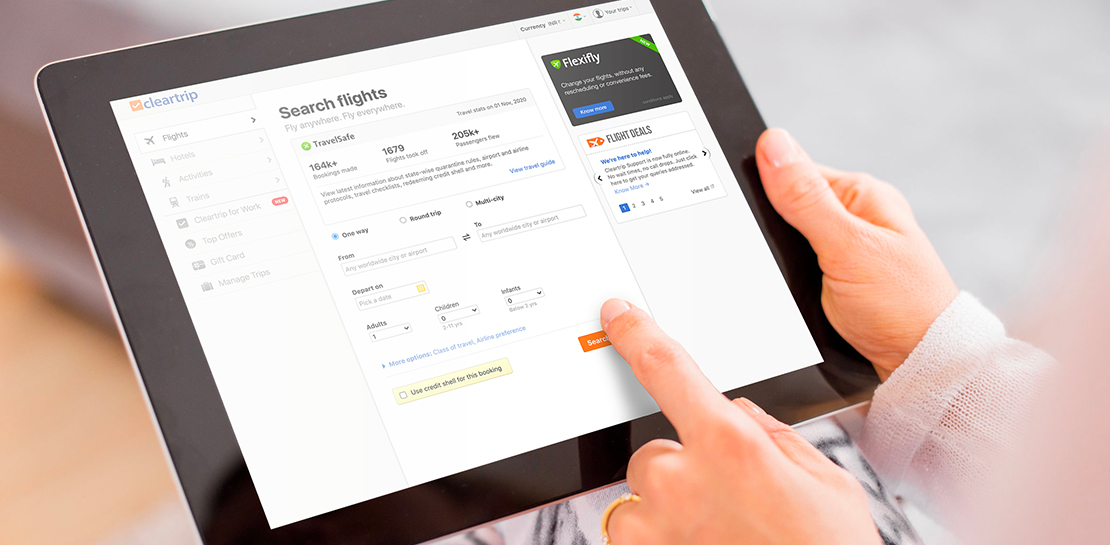
With the novel coronavirus COVID-19 sweeping across continents and fatalities climbing every day, it was only a matter of time before countries closed their borders to contain its spread. In the wake of this decision, travel and tourism, the linchpins of many economies, were among the worst affected. According to
