





4410
Of your peers have already watched this video.
28:30 Minutes
The most insightful time you'll spend today!
Data Leaders in 2021 and Beyond: How to Prepare
As technologies and workplace environments are quickly evolving, how people and businesses leverage data in their day-to-day workflow is also changing.
Data leaders are an emerging force navigating and charting pathways forward towards new horizons for how people and organizations experience data.
In this presentation, Pedro Arellano, Product Marketing Director, Looker, will cover three areas:
- Underline that the value of data within an organization is no longer up for debate. Everybody needs data, and everybody’s job has the potential to be improved with data.
- Three trends that will help put into context how we’ve arrived at this particular moment of such great potential for data.
- Why data leaders, almost regardless of their title, are now in a position to really influence the direction of organization like never before.
Learn what’s guiding the thinking of data leaders in 2021 and beyond.
2841
Of your peers have already watched this video.
22:00 Minutes
The most insightful time you'll spend today!
Deploying Real-time AI: A Walkthrough
Enterprises are increasingly looking to leverage streaming data (customer interactions, sales transactions, machine logs) for building new innovative features, increasing sales, and protecting against risks.
AI/ML (artificial intelligence/machine learning) technologies make it possible to amp up the detection of insights in large volumes of data: insights that otherwise would be impossible to gain with manual inspection.
Learn how Dataflow together with TensorFlow Extended (TFX) and Cloud AI are enabling the extraction of label and classification information from video clips and natural text, predicting probabilities and detecting anomalies, fraud, and patterns in streams of business data.

Upgrade Your Contact Center with Knowlarity’s AI-powered Speech Analytics for Higher CX
DOWNLOAD E-BOOK6208
Of your peers have already downloaded this article
7:00 Minutes
The most insightful time you'll spend today!
Did you know, everyday about 56 million hours worth of phone conversations, equalling to 420 billion spoken words are handled by contact centers? Knowlarity, a renowned cloud business communication service provider with nearly 6,000 customers and over a million virtual users, leverages AI-powered speech analytics that offer insights to gauge customer preferences and emotions, campaign performance, agent’s effectiveness and much more. Knowlarity’s programmatic speech analytics platform is built with Google Cloud to optimize contact center performance by transcribing and analyzing millions of calls to impact savings, operations, CX, customer loyalty and retention, and revenue generation.
Download the e-Book to learn more about Knowlarity’s speech analytics for your business’ contact centers and elevate your agents’ performance by leveraging ML, natural language processing (NLP) and AI capabilities.
4815
Of your peers have already watched this video.
2:30 Minutes
The most insightful time you'll spend today!
Haaretz on Google Cloud Guarantees Faster, Reliable & Responsive Services to its Audience
Israeli centenarian newspaper, Haaretz relied on on-prem infrastructure to serve readers digitally. As the need for scalability, security and business intelligence grew alongside their readership, Haaretz was looking for more than just a cloud-based solution to replace their infrastructure. Inon Gershovitz, CTO, Haaretz takes us through the journey of recreating digital news experience, serving growing reader traffic and keeping up the editorial standards with Google Cloud.
Watch the video to hear from Haaretz’ leaders on delivering personalized content to readers with Google Cloud solutions!
Data-first Digitization Helps Leverage the Cloud for Your Mainframe Assets

6462
Of your peers have already read this article.
2:00 Minutes
The most insightful time you'll spend today!
For many enterprises, the venerable mainframe is home to decades’ worth of data about the company’s customers, processes and operations. And it goes without saying that the business would like access to that mainframe data — to report on it, to analyze it with big data analysis tools, or to use it as the basis of new machine learning and artificial intelligence initiatives.
At Google Cloud, we are eager to work with organizations to help them transform their mainframe assets for the cloud era. Of course, we can help them modernize their mainframe applications by migrating them to the cloud. At the same time, working with partners and customers, we’ve developed another, more lightweight approach that can help them start to leverage the cloud for their mainframe assets much more quickly than performing a full-fledged migration. We call this approach data-first digitization.
In this rapidly evolving digital ecosystem, it’s imperative to understand the difference between ‘modernization’ and ‘digitization.’ With modernization you start with the current state and look forward, and rely on mainframe application migration approaches such as rehosting (emulation), refactoring (automated code transformation), reengineering — or simply replacing a custom application with a commercial package. With digitization, you start with the future state that you want to achieve, and work back to what is required to get there.
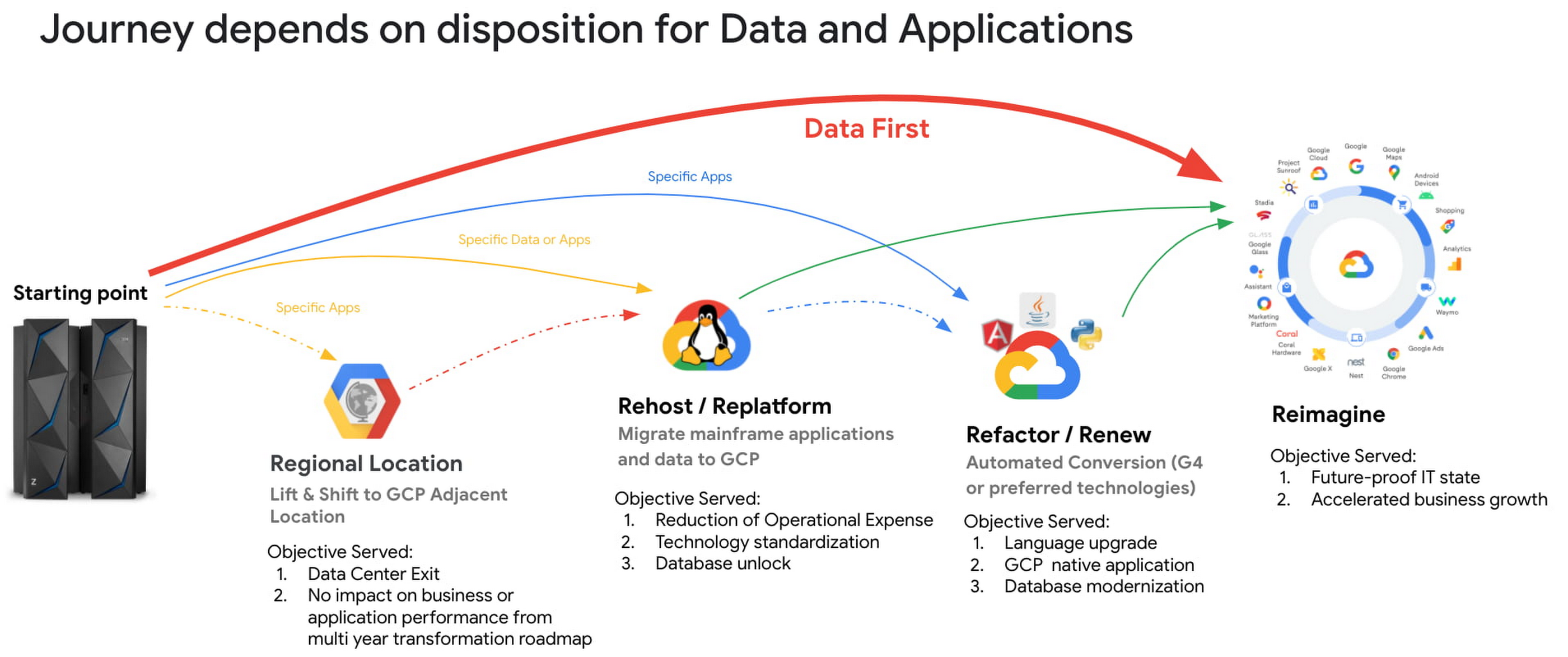
This data-first digitization approach includes a mainframe data-first integration framework comprising in-house and partner products and tools to migrate heterogeneous data sources from the mainframe to Google Cloud Storage. Once mainframe data has been copied to Cloud Storage, it can then be integrated and leveraged by Google Cloud tools such as BigQuery, AI and machine learning prodcuts and Smart and Stream analytics platforms. The integration framework covers both bulk batch data transfers and real-time data replication (change data capture).

Data-first digitization is based on the tenet that ‘applications are transient, data is permanent.’ By bringing data first to Google Cloud instead of traditional ways of modernizing applications (for example, with Gartner’s 7 options to Modernize), this allows organizations to leapfrog to new business models, use cases and innovative ways to serve end customers. For example:
- Making decisions with smart and stream analytics platforms and AI/ML engines. These tools need data to make decisions. Google is a pioneer in extracting information and value from the raw structured and unstructured data, and this approach opens up mainframe data for use by BigQuery and AI/ML models.
- Building new reporting applications. With access to mainframe data, you can use Google cloud products like Looker and Appsheet to build net-new reporting applications, expediting the process of retiring mainframe reporting applications, and accelerating your overall transformation.
In our experience, taking a data-first digitization approach to your mainframe offers a number of benefits:
- Faster time-to-business: Because data-first modernization is built on existing products, the implementation cycle is much shorter.
- Less capital investment: You spend your time integrating products, not developing applications.
- Minimized risk: Data-first integrates with existing, proven and reliable Google Cloud products.
- Faster overall mainframe transformation: When you shift your modernization center of gravity from the application to the data, you look at mainframe applications from a business perspective instead of just “keeping the lights on.” As a result, only the most business-critical applications are modernized and many support applications can be decommissioned, accelerating your transformation journey.
Taking a data-first approach to digitization is still relatively new, but we’re heartened by customers’ early successes. Watch this space for additional insights, reference architectures and technical white papers around data-first. And if you think this approach may be right for you, reach out to mainframe@google.com.
Learn more:
NVIDIA and Google Cloud Pave the Way for Single-cell Genomic Analysis

3000
Of your peers have already read this article.
2:00 Minutes
The most insightful time you'll spend today!
In the past decade, the Healthcare and Life Sciences industry has enjoyed a boon in technological and scientific advancement. New insights and possibilities are revealed almost daily. At Google Cloud, driving innovation in cloud computing is in our DNA. Our team is dedicated to sharing ways Google Cloud can be used to accelerate scientific discovery. For example, the recent announcement of AlphaFold2 showcases a scientific breakthrough, powered by Google Cloud, that will promote a quantum leap in the field of proteomics. In this blog, we’ll review another omics use case, single-cell analysis, and how Google Cloud’s Dataproc and NVIDIA GPUs can help accelerate that analysis.
The Need for Performance in Scientific Analysis
The ability to understand the causal relationship between genotypes and phenotypes is one of the long-standing challenges in biology and medicine. Understanding and drawing insights from the complexity of biological systems abounds from the actual code of life (DNA) through to expression of genes (RNA) to translation of gene transcripts into proteins that function in different pathways, cells, and tissues within an organism. Even the smallest of changes in our DNA can have large impacts on protein expression, structure, and function, which ultimately drives development and response – at both cellular and organism levels. And, as the omics space becomes increasingly data- and compute-intensive, research requires an adequate informatics infrastructure. An infrastructure that scales with growing data demands, enables a diverse range of resource-intensive computational activities, and is affordable and efficient – reducing data bottlenecks and enabling researchers to maximize insight.
But where do all these data and compute challenges come from and what makes scientific study so arduous? The layers of biological complexity begin to be made apparent immediately when looking at not just the genes themselves, but their expression. Although all the cells in our body share nearly identical genotypes, our many diverse cell types (e.g. hepatocytes versus melanocytes) express a unique subset of genes necessary for specific functions, making transcriptomics a more powerful method of analysis by allowing researchers to map gene expression to observable traits. Studies have shown that gene expression is heterogeneous, even in similar cell types. Yet, conventional sequencing methods require DNA or RNA extracted from a cell population. The development of single-cell sequencing was pivotal to the omics field. Single-cell RNA sequencing has been critical in allowing scientists to study transcriptomes across large numbers of individual cells.
Despite its potential, and the increasing availability of single-cell sequencing technology, there are several obstacles: an ever increasing volume of high-dimensionality data, the need to integrate data across different types of measurements (e.g. genetic variants, transcript and protein expression, epigenetics) and across samples or conditions, as well as varying levels of resolution and the granularity needed to map specific cell types or states. These challenges present themselves in a number of ways including background noise, signal dropouts requiring imputation, and limited bioinformatics pipelines that lack statistical flexibility. These and other challenges result in analysis workflows that are very slow, prohibiting the iterative, visual, and interactive analysis required to detect differential gene activity.
Accelerating Performance
Cloud computing can help not only with data challenges, but with some of the biggest obstacles: scalability, performance, and automation of analysis. To address several of the data and infrastructure challenges facing single-cell analysis, NVIDIA developed end-to-end accelerated single-cell RNA sequencing workflows that can be paired with Google Cloud Dataproc, a fully-managed service for running open source frameworks like Spark, Hadoop, and RAPIDS. The Jupyter notebooks that power these workflows include examples using samples like human lung cells and mouse brains cells and demonstrate acceleration between CPU-based processing compared to GPU-based workflows.
Google Cloud Dataproc powers the NVIDIA GPU-based approach and demonstrates data processing capabilities and acceleration, which in turn have the potential of delivering considerable performance gains. When paired with RAPIDS, practitioners can accelerate data science pipelines on NVIDIA GPUs, reducing operations like data loading, processing, and training from hours to seconds. RAPIDS abstracts the complexities of accelerated data science by building upon popular Python and Java libraries effortlessly. When applying RAPIDS and NVIDIA accelerated compute to single-cell genomics use cases, practitioners can churn through analysis of a million cells in only a few minutes.
Give it a Try
The journey to realizing the full potential of omics is long; but through collaboration with industry experts, customers, and partners like NVIDIA, Google Cloud is here to help shine a light on the road ahead. To learn more about the notebook provided for single-cell genomic analysis, please take a look at NVIDIA’s walkthrough. To give this pattern a try on Dataproc, please visit our technical reference guide.
More Relevant Stories for Your Company
Looking for a Cloud Data Warehouse? Find out Why Forrester Thinks Google BigQuery is a Leader
We are thrilled to announce that Google has been named a Leader in The Forrester Wave™: Cloud Data Warehouse, Q1 2021 report. For more than a decade, BigQuery, our petabyte-scale cloud data warehouse, has been in a class of its own. We're excited to share this recognition and we want to thank

Sainsbury’s Uses AI to Figure Out How the World Eats
Retail will forever be an industry that must constantly reinvent itself in response to, and anticipation of, ever-changing consumer demands. Digital transformation is fueling these changes and we've previously spoken about how businesses including Ulta Beauty and Kohl’s are taking advantage of Google Cloud to put data at the center of what they do

How Constellation Brands’ Direct-to-Customer Tech Delivers Economic Impact across Business Portfolio
Editor’s note: Today we’re hearing from Ryan Mason, Director, Head of DTC Growth & Strategy, at alcoholic beverage firm, Constellation Brands on the company’s shift to Direct-to-Consumer (DTC) sales and how Google Cloud’s powerful technology stack helped with this transformation. It’s no secret that consumer businesses have been up-ended in

The Data Scientist Guide to Preparing and Curating Data for AI
To design and implement a successful machine learning (ML) project, you often need to collaborate with multiple teams, including those in business, sales, research, and engineering. Understanding the essentials of gathering and preparing your data is crucial to align teams, and getting a project off the ground. Building an ML
