






The Cloud-First Imperative To Accelerate Digital Transformation In Retail
READ FULL INTRODOWNLOAD AGAIN3459
Of your peers have already downloaded this article
1:30 Minutes
The most insightful time you'll spend today!
Google Cloud Infrastructure: What Changed in the Last One Year and What’s in the Future?
3472
Of your peers have already read this article.
3:00 Minutes
The most insightful time you'll spend today!
This past year brought both new challenges and successes for our customers around the world. We thought life was going to return to normal… and then it didn’t. Despite the uncertainty, it was exciting to see customers make huge transformations in when, where, and how they run their businesses, with cloud infrastructure as a major enabler.
According to IDC, “by 2024, 50% of organizations will use applications built on abstraction provided by managed services including cloud-native technologies to enable consistency in running in any and many locations.”1 Over the past year we were honored to work with so many of you to start to make this prediction a reality.
Let’s take a deeper look at where our infrastructure progressed in 2021, and where we’re headed in the new year.
Google Cloud is recognized by independent experts for its leadership
For the fourth consecutive year, Google Cloud was named a Leader in the Gartner Magic Quadrant for Cloud Infrastructure and Platform Services.
The Forrester Wave for AI infrastructure placed Google at the topmost position, a testament to Google’s investments in tomorrow’s AI-first world.
Google Cloud also won the HPC Wire Editor’s Choice award for the best use of HPC in the cloud.
We made it easier to migrate enterprise applications
To support enterprises in their transformation journeys we focused on expanding our support for enterprise applications in our cloud. The Home Depot just wrote about its successful migration of SAP to Google Cloud, highlighting how crucial it is to have good processes and strong partnerships. For other companies using SAP applications we also launched Filestore Enterprise, which delivers 99.99% regional availability backed by an SLA.
Our partner NetApp deepened its integration with Google Cloud to enable easier and faster Windows-based application migration, and provided flexible deployment options to modernize workloads. We also added new Network Connectivity Center partners to include companies like Cisco, Palo Alto Networks, and VMware, so as you migrate over time you can easily connect all your networking resources together in one place.
For those of you considering migration to cloud, Forrester dove deeper into the economics of migrating enterprise applications to cloud. (Spoiler alert: companies are finding major cost savings and performance benefits!) It’s so important to us that companies trust that their biggest, most complex applications will run smoothly and securely with us, and we’re pleased at the progress we’ve made toward supporting more enterprise applications this year.
We also made it easier for you to migrate VMware workloads to the cloud by expanding Google Cloud VMware Engine to 12 regions worldwide and enabling several new capabilities across networking, compliance, and scale. Customers such as Mitel and Carrefour migrated their VMware estates to Google Cloud to transform their applications with Google services to increase agility, save money (up to 45%) and reduce energy costs (about 35%) compared to running on-premises.
For High Performance Computing (HPC), we continued to add capabilities such as optimized VM images for HPC, enhanced integration with schedulers such as SchedMD, Slurm, and Altair PBSPro.
New cost and performance options
To further support customers doing high performance computing for things like real-time advertising, dynamic e-commerce, and gaming, we launched a new VM family: Tau VMs. Tau VMs offer 56% higher absolute performance and 42% higher price-performance compared to general-purpose VMs from any of the leading public cloud vendors. We are seeing companies such as Nylas switching from other cloud platforms to Google Cloud to make the most of Tau VMs.
That isn’t the only VM advancement we made. For customers with higher levels of fault tolerance and looking for greater cost efficiencies, we launched Spot VMs, which open up access to Google Cloud’s idle capacity so you can run your application at the lowest price possible. With Spot VMs, you save anywhere from 60-91% off the price of on-demand VMs.
We also launched more options for the highest performance ephemeral block storage — 6TB and 9TB Local SSDs, which offer greater IOPS per dollar when attached to general purpose N2 Compute Engine VMs.
Distributed cloud brings us closer to you
For years, the industry has been telling companies, “move to cloud!” but not all workloads can move to the public cloud immediately or entirely. Factors include industry- or region-specific compliance and data sovereignty needs, low latency or local data-processing requirements, or the need to run applications close to other services.
In October, we expanded our distributed cloud strategy and announced Google Distributed Cloud, a portfolio of fully managed hardware and software solutions that extend Google Cloud’s infrastructure and services to data centers and the edge. This is a major step forward in our ability to meet you where you are, in private data centers and at the edge, and we’re excited to see how this helps you as we move into 2022.
Data protection and security that never sleeps
This year we worked hard to help improve your data protection capabilities. We doubled down on our Actifio acquisition by launching several releases that deepened its integration with Google Cloud. For customers with containerized applications, we took a big step forward with the launch of Backup for GKE. We’re particularly excited about how this new option for GKE users allows you to more easily meet your service-level objectives, automate common backup and recovery tasks, and show reporting for compliance and audit purposes.
We also enhanced Cloud Storage with data protection features like custom region selection for dual-region buckets. Previously, Google Cloud assigned dual-region pairs for you to choose from. With this release, you can select your own region pairs that meet your regulatory or compliance requirements, or optimize your app performance. We also launched Turbo Replication for dual-region buckets, which replicates 100% of your data between regions in 15 minutes or less, backed by a Service Level Agreement, a first from a leading cloud provider.
Security is a key area of focus for us and we partnered with Palo Alto Networks to deliver their industry-leading Intrusion Detection System (IDS) solution natively on Google Cloud. With the recent Apache Log4j vulnerability, we automatically updated Cloud IDS to help detect exploit attempts and protect our customers’ environments quickly. We also integrated Cloud Armor with reCAPTCHA Enterprise to deliver a best-in-class bot and fraud management solution to prevent volumetric attacks. Cloud Armor is deployed with our Cloud Load Balancer and Cloud CDN, extending its security benefits at the network edge for traffic coming into Google Cloud.
We made it easier to build and manage applications
Developers want to focus on code, not configuring, managing or scaling infrastructure. To help, we worked on simplifying networking with new services such as Private Service Connect, which allows you to connect VPCs to applications and services securely without configuring all the network underlay. To make it easier to run workloads in hybrid environments, we introduced BYOIP so you don’t need to change your IP address, and we enhanced Cloud Load Balancer with advanced traffic management, regional and hybrid app delivery to load balance traffic between on-prem and cloud workloads. We also introduced IPv6, DNS policy manager, Cloud Domains, GKE Gateway Controller, eBPF data plane, and Service Directory, all with the goal of making networking easier for developers.
We continue to invest in visibility and observability for efficient day 2 operations. Network Intelligence Center now has dynamic reachability within the Connectivity Tests module, interconnect and VPN visualization in Network Topology, and the Firewall Insights module, which provides visibility into firewall rules to ensure they are being used appropriately and as intended.
And while not new this year, developers continue to tell us how much they love the ease of architecting storage using Cloud Storage. See how easy it is to configure a dual-region bucket. As a result, developers can treat a continent like a single bucket, dramatically simplifying the application programming model. Google Cloud is unique in offering this capability among major public cloud vendors.
We continue to be the most sustainable cloud for you
Another area Google has invested in deeply and that is becoming increasingly important to more organizations is sustainability. Many cloud providers have a vision for a sustainable future, and many aim to match their electricity consumption with 100% renewable energy by 2025 or 2030. We accomplished 100% renewable energy in 2017, which means we’re the only hyperscale cloud to do this today and on data centers that are twice as energy efficient as the average data center.
We also announced a number of new features like our new Carbon Footprint tool. Every Google Cloud user — that means you! — can see the gross carbon emissions associated with the services you use in Google Cloud. This means picking the data center that meets your sustainability goals, and reducing the overall emissions tied to your infrastructure and applications. And we have some pretty big goals for the future. For more, don’t miss our full sustainability recap.
A big thank you to our customers
While we were busy building out our infrastructure in 2021, we’d be nowhere without the partnership of our amazing customers. It’s hard to pick from all the exciting stories we heard this year, but here are just a few: Pega migrated its SAP applications to Google Cloud with zero downtime. Paypal exited its non-strategic data centers and achieved major cost savings. And Wix used our network to serve tens of millions of requests per day.
I’m proud to look back at how our cloud infrastructure has evolved this year to support each of our customers on their transformation journey. As we head into 2022 I’m excited to continue to partner with you to solve your most difficult challenges together.
Interested in hearing more about Google’s vision for the future? Listen to Thomas Kurian’s thoughts from Google Cloud Next ‘21.
1. IDC FutureScape: Worldwide Cloud 2022 Predictions
Google Announced Leader in 2021 Gartner Magic Quadrant for Cloud Infrastructure and Platform Services

3552
Of your peers have already read this article.
3:00 Minutes
The most insightful time you'll spend today!
For the fourth consecutive year, Gartner has positioned Google as a Leader in the 2021 Gartner Magic Quadrant for Cloud Infrastructure and Platform Services (formerly titled as Magic Quadrant for Cloud Infrastructure as a Service upto 2014 Infrastructure as a Service, or (IaaS).
With our customers and communities adjusting to new ways of working and doing business, Google Cloud has remained focused on building services and platforms that help you be more resilient and derive even more value from your cloud infrastructure. We believe Gartner’s analysis and recognition gives our customers the confidence needed to choose Google as the platform for customer-centric innovation. Here are just a few recent examples.
Ready for the most demanding, mission-critical workloads
Our enterprise-ready cloud provides you the uptime, performance, and scale to run even your most demanding workloads. Examples of recent launches:
- The largest single-node GPU-enabled VM in the industry with up to 16 NVIDIA A100 instances so that our customers can run their ML workloads
- The only cloud to support scale-out out 96TB SAP HANA so that customers can confidently bring their most critical workloads to GCP
- Strategic partnerships with leading partners like SAP
- Several regions and an expanded global network footprint including new subsea cables, Firmina, Dunant, Blue and Raman
- High bandwidth 50/75/100Gbps networking for VMs
- Persistent Disk Extreme (block storage) with 120K IOPS
- Filestore High Scale scale-out NFS for HPC
Saves you money
Save money with a transparent and innovative approach to pricing and intelligent recommendations. In the past year, we’ve launched several innovations to help you save costs:
- Tau VMs, which offer the best price-performance among leading clouds for scale-out workloads
- Machine-learning-driven predictive auto-scaling for VMs and GKE Autopilot, enabling infrastructure to scale up and down as needed with minimal waste
- Standard network tier which routes traffic over the internet for cost optimization
Open
We have a long history of leadership in open technologies—from projects like Kubernetes, the industry standard in container orchestration and interoperability, to TensorFlow, a platform to help anyone develop and train machine learning models. Here are a few recent improvements we’ve made to ensure your cloud is an open cloud:
- Extended Anthos to bare metal and Microsoft Azure to support customers who want a multi-cloud and hybrid cloud posture.
- Announced a new network dataplane for Google Kubernetes Engine (GKE) and Anthos that supports eBPF, an open-source Linux kernel technology optimized for Kubernetes.
- Google Kubernetes Engine (based on the Kubernetes standard) received the top overall score based on 2021 Gartner Solution Scorecard for Google Kubernetes Engine.
Secure
Google Cloud’s trusted infrastructure uses layers of security to protect your data with advanced technologies and operations, keeping your organization secure and compliant. For example, we offer:
- Confidential VMs and Confidential GKE with in-memory encryption and encryption keys controlled by you, with a single checkbox
- Enhanced security for Cloud Run
- Strong support against DDoS attacks. In 2017, our infrastructure absorbed the largest-known DDoS attack at 2.5Tbps with no impact to customers.
Sustainable
Google Cloud helps customers transform their business sustainably. We operate the cleanest cloud in the industry to make sure your digital footprint doesn’t leave a carbon one. Here are a few proof points:
- Google has been carbon neutral since 2007, and for the past four years has matched 100% of the electricity we consume globally with wind and solar purchases. Everything you run on Google Cloud is net carbon neutral.
- We continue to innovate towards greater energy efficiency in our data centers, and compared with five years ago, now deliver around seven times as much computing power with the same amount of electrical power.
- Recently we announced new features to help customers reduce the carbon footprint of their applications and infrastructure, including a region picker to help with architecture decisions, and low carbon indicators in the Google Cloud Console.
Supporting our customers
Most importantly, our field organizations and partner organizations work with a singular focus to ensure customer success. This has made Google Cloud the fastest growing hyperscaler, with a rapidly expanding customer base across all geos and industries.
Since launching Customer Care last year, we consolidated and simplified the post-sales engagement with customers, increased the support channels, created an API to allow programmatic case creation, and combined product specific support into a single package for all of Google Cloud. Enterprises with Customer Care continue to report high levels of satisfaction with their focused technical account managers (TAMs), helping them get the most business value out of Google Cloud.
We are committed to sustaining and accelerating the pace of customer-centric innovation. You can download a complimentary copy of the 2021 Magic Quadrant for Cloud Infrastructure and Platform Services on our website.
Join us to learn much more about Google Cloud at the upcoming Google Cloud Next ‘21 digital conference.
Gartner, Magic Quadrant for Cloud Infrastructure and Platform Services, Raj Bala | Bob Gill | Dennis Smith | Kevin Ji | David Wright, 27 July 2021
Gartner, Solution Scorecard for Google Kubernetes Engine, Tony Iams | Traverse Clayton | Megan Bain, 12 April 2021
Gartner does not endorse any vendor, product or service depicted in its research publications, and does not advise technology users to select only those vendors with the highest ratings or other designation. Gartner research publications consist of the opinions of Gartner’s research organization and should not be construed as statements of fact. Gartner disclaims all warranties, expressed or implied, with respect to this research, including any warranties of merchantability or fitness for a particular purpose.
Medical Data Breakthrough: Google Aids PicnicHealth’s Growth

4891
Of your peers have already read this article.
3:30 Minutes
The most insightful time you'll spend today!
In the fragmented world of U.S. healthcare, patients often have to wait in line or on hold, navigate multiple patient portals, and fill out numerous request forms—all in pursuit of their own medical history. Healthcare technology startup PicnicHealth is on a mission to put control back with the patient, where it belongs.
PicnicHealth’s growth, from closing successful venture rounds to winning machine learning (ML) competitions, speaks to not only improvements and opportunities in healthcare, but also how startups are leveraging Google Workspace and Google Cloud services to accelerate momentum.
The company does the heavy lifting of collecting records and leverages human-in-the-loop ML to transcribe and validate them with an abstraction team of medical professionals. The records are then structured into a complete medical history that patients can access and share with providers to get better care.
But PicnicHealth helps to improve patient health on more than one front. It allows patients to contribute their data to de-identified medical research, building high-quality, anonymized datasets that researchers and life sciences companies can use to better understand disease progression and treatment in the real world.
Google Workspace has been part of PicnicHealth from day one, helping the founders collaborate and shape the company’s vision using cloud-synced documents and spreadsheets to collaborate and model predictions. “I’ve had a Gmail account since 2006, and in college 100% of people worked out of Google Docs. Workspace continues to be the best choice for online collaboration, and that’s why it’s still the default standard for startups,” said Troy Astorino, CoFounder & CTO of PicnicHealth. “When we started PicnicHealth, my co-founder Noga Leviner was in San Francisco and I was in Southern California, and of course we used Workspace.”
Today, Google Workspace continues to play a central role in the company’s collaboration. “We create design documents in Google Docs, primarily for engineering and product changes, and get really healthy, vibrant discussions through comments,” noted Astorino. “This practice has grown beyond engineering and is used for everything from how the company operates to communication norms.”
Google Workspace offers everything the team needs to collaborate, no matter where employees are. PicnicHealth’s team has spread from San Francisco to being distributed across the country and around the world. Instant collaboration is crucial.
“We work in a complex domain where people need a lot of information to make good decisions,” said Astorino. “Google Workspace allows us to operate in a mode of default transparency, where people can easily get the information they need even if it wasn’t intentionally or directly shared with them. Whether it’s working in Docs or scheduling in Calendar, we can operate much more effectively than we could otherwise.”
By any measure, PicnicHealth’s trajectory is one of record success. The startup is a 2014 alumni of Y Combinator, a program that helped launch household names like Airbnb, DoorDash, and Dropbox. Three years later, the team went on to win the $1 million grand prize at Google’s Machine Learning Competition. And the momentum has continued— PicnicHealth has recently announced a $60 million Series C round, bringing the amount raised to date to over $100 million. With the Series C, PicnicHealth is investing in expanding its reach to more patients across over 30 diseases.
As a healthcare startup, PicnicHealth faced a very particular set of challenges, especially when working with and accessing data. Data fragmentation and interoperability are only some of the challenges of realizing the value of big data in the cloud. The healthcare industry is notoriously difficult to navigate due to sensitive data protection laws and regulations like the Health Insurance Portability and Accountability Act (HIPAA).
PicnicHealth started in the cloud on Amazon Web Services (AWS). However, after migrating over to Kubernetes and facing an expanding list of requirements for HIPAA compliance, the company started to explore alternatives.
“We needed to be HIPAA compliant, which was going to be painful on AWS, and we wanted to get away from managing and operating our own Kubernetes clusters,” recalled Astorino. “We had heard good things about GKE (Google Kubernetes Engine). And particularly valuable for us, — many technical requirements you need for HIPAA compliance are configured by default on Google Cloud.”
PicnicHealth would have had to implement a lot of changes and get specialized instance types to get their existing configuration to work. So, they began experimenting with Google Cloud and discovered a much smoother experience.
“It was a lot easier to manage in terms of product setup and developer experience,” said Astorino. “There is a sane product hierarchy of resources you can access and use through Google Cloud and the relationships between them, from coordinated IAM (identity and access management) to using Google Groups for granting permissions. Overall, it’s cleaner.”
Astorino added that the move has also opened the doors to taking advantage of other services in the Google Cloud ecosystem like Cloud SQL, BigQuery, and Cloud Composer. PicnicHealth also uses Security Command Center because it easily integrates with everything but also helps meet various compliance frameworks’ requirements, providing visibility, near-real-time asset discovery, and security information and event management.
But most importantly, the integrated ecosystem has simplified the work needed for PicnicHealth to create a secure environment for employees to use when working with sensitive medical records while still providing all the tools they need. For example, abstractors not only use Google Workspace but also have Chromebooks because they are easy to manage and secure.
Altogether, Google Cloud helps form a technology stack that has enabled the startup to build a massive labeled dataset containing over 100 million labeled medical data concepts. In turn, it accelerates PicnicHealth’s ability to generate highly-performant AI models and feed other ML pipelines, which has been vital for processing and reviewing data at scale.
To learn more about how Google Workspace and Google Cloud help startups like PicnicHealth accelerate their journey, visit our startups solutions pages for Google Workspace and Google Cloud.
Telehealth Improves Patient and Clinical Experiences across Continuum of Care

4911
Of your peers have already read this article.
1:30 Minutes
The most insightful time you'll spend today!
According to a National Academy of Medicine discussion paper, social determinants of health (SDoH) account for upwards of 80% of a population’s health outcomes. Breaking this down further, 50% come just from socioeconomic and physical environment factors such as education, employment, income, family and social support, community safety, air and water quality, and access to housing and transit. SDoH determine access to and quality of healthcare, and are contributors to a system of disparate access to care.

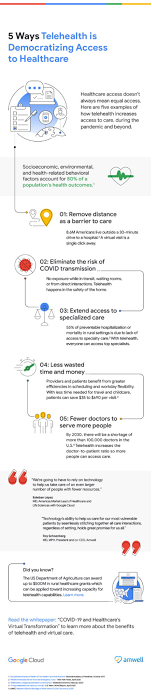
We believe that to more efficiently provide comprehensive healthcare access to more people, providers will leverage technology to blend in-person and virtual modes of care delivery.
In this article, Amwell and Google Cloud examine five ways telehealth – as part of a provider’s overall care model – can help democratize access to healthcare. (graphic url)
Remove distance as a barrier to care
8.6 million Americans live more than 30 minutes from their nearest hospital. Long drives can deter patients from seeking care or maintaining routine visits. On the flip side, 92% of Americans nationwide have access to wired broadband in the home or through mobile broadband. Therefore, having a virtual visit just a click away can help remove barriers to care, like distance.
Eliminate the risk of unnecessary exposure
Virtual care means that patients don’t have to worry about potential exposure in transit, while sitting in waiting rooms, or from direct interactions during in-person health visits. This is particularly relevant when it comes to those with chronic diseases or underlying conditions. Telehealth provides patients who may be more susceptible to diseases with access to continuous healthcare without putting them at higher risk for developing more severe symptoms. Virtual visits can occur in the comfort –and safety– of patients’ homes.
Extend access to specialized care
55% of preventable hospitalization or mortality in rural settings is due to lack of access to specialty care. With telehealth, physical proximity to specialized services–typically in urban areas–can be reduced as a limiting factor. Virtual solutions grant everyone access to top specialists, regardless of location.
Save time and money
By augmenting in-person visits with telehealth applications, providers can benefit from greater efficiencies in scheduling, helping to improve their bottom line, and add more flexibility to their workday. Meanwhile, patients can spend less on travel and childcare, limit time taken off work, and save on other costs associated with in-person visits — for a savings of $35 to $690 per visit. In a survey by the COVID-19 Healthcare Coalition, 76% of the 2,000+ patients surveyed across the US responded that transportation was removed as a barrier, 65% reported they no longer had to take time off from work for an appointment, and 67 percent reporting lower costs than an in-person visit.
Combat physician shortage and fatigue
Research shows there will be a shortage of more than 100,000 doctors by 2030. In the midst of a physician shortage, telehealth can help improve care delivery and make it more efficient, ensuring more people can still have their healthcare needs addressed. Additionally, by integrating intelligence such as case triaging along with telehealth into a virtual care model, providers can help reduce clinician burnout.
Amwell and Google Cloud are partnering to deliver transformative telehealth solutions that will make it easier for more patients to receive care and improve patient and clinician experiences across the continuum of care. One example includes embedding real-time captioning and translation services powered by Google Cloud’s AI and NLP technologies within the Amwell platform to increase health access and understanding for more people.
As physicians, we are excited that the future of healthcare will continue to blend cloud technologies like EHR-integrated telehealth platforms, AI, healthcare-trained virtual agents along with in-person care to create an integrated hybrid care model that will improve patient outcomes and unburden providers, all while expanding access to broader patient populations.
To learn more, download the whitepaper “Healthcare’s Virtual Transformation,” written in conjunction with Becker’s Hospital Review.
1: “Social Determinants of Health 101 for Health Care: Five Plus Five,” National Academy of Medicine, October 2017
Qlik and Google Cloud Combo: Extending Integration of SAP Data on BigQuery
5474
Of your peers have already read this article.
2:00 Minutes
The most insightful time you'll spend today!
If your organization is one of the 52% of SAP customers whose top analytics pain point is data integration1, Google Cloud has got you covered. By working with partners like Qlik, we are expanding our integration options and bringing real-time replication capability for SAP to BigQuery.
Integrated data for accelerated insights
BigQuery—our fully managed, enterprise data warehouse that can scale up to petabytes on demand and execute queries in seconds—allows SAP customers to consolidate enterprise data silos and confidently derive more use and value from their data. Customers can accelerate and simplify the delivery of SAP data on BigQuery with the latest Qlik Data Integration platform offering for Google Cloud which allows data integration using an automated, near real-time data pipeline through Qlik Replicate, whether data originates from legacy SAP environments, SAP HANA, or SAP application servers. Additionally, Qlik Compose for Data Warehouses can be used to easily generate and automate logical data models from SAP directly in BigQuery freeing up more time for data analysts to leverage advanced built-in capabilities such as BigQuery ML to derive greater value and insights using standard SQL without the need for advanced programming expertise.
Delivering faster results with real-time
Traditional extract-transform-load (ETL) solutions operate on a batch basis, pulling data sets from SAP daily, hourly, or every minute. These tools often require manual mapping of multiple data fields so that data flows accurately. Given SAP’s highly complex table relationships, in which a single transaction can result in multiple changes, this can be a time consuming and tedious process. ETL can also increase the burden on your SAP systems.
Qlik Replicate simplifies this with its intuitive user interface where you can set up real-time data replication between SAP and BigQuery, eliminating the need for manual coding. And, to prevent system overhead, as soon as a new transaction is entered into SAP, the resulting data is replicated into BigQuery in a process known as change data capture (CDC) from SAP’s log layer. This means that data transfer can benefit from high performance with minimal impact on the source system’s resources. Read our latest white paper to learn how to extract SAP data into BigQuery leveraging Qlik Replicate.
Solution expertise for all core SAP workloads
It doesn’t matter what database your SAP system runs on, Qlik Replicate supports all core SAP systems. It automates real-time data replication and decodes SAP’s complex, application-specific data structures into formats that flow smoothly into BigQuery. This ensures that anyone who depends on data analytics has the most current and relevant SAP data they need. For its robust solution capabilities Qlik has received a new “SAP on Google Cloud Expertise” designation for supporting:
- Fast onboarding and accelerated replication of SAP data into Google Cloud
- Real-time and continuous data replication from SAP applications to BigQuery
- Support for all core SAP modules and a broad set of data sources
- Automated data integration, which cuts resource requirements for initial delivery and ongoing maintenance
Proven customer results
Many SAP customers have experienced the benefits of leveraging Qlik alongside BigQuery for data analytics and AI at scale, including German luxury department store chain Breuninger. In order to meet its customers’ growing and changing expectations,Breuninger needed to accelerate its time to insight from data sources across a highly dispersed landscape of on-premises databases and systems, including SAP. The company uses Qlik Replicate to feed corporate data from modules in its SAP system into BigQuery and integrate its varying on-premises databases with the Google Cloud environment. This has yielded game-changing, real-time customer insights for the retailer.
What could your business do with faster, more integrated insights? Learn more about BigQuery for SAP customers and also how Qlik and Google Cloud can help you modernize and automate data integration and analytics.
More Relevant Stories for Your Company

End Security Risks with the Unattended Projects Recommender Feature
In fast-moving organizations, it's not uncommon for cloud resources, including entire projects, to occasionally be forgotten about. Not only such unattended resources can be difficult to identify, but they also tend to create a lot of headaches for product teams down the road, including unnecessary waste and security risks. To

Cloud Bigtable Helps Fraud-detection Company Meet Scalability Demands and Secure Customer Data
Editor’s note: Today we are hearing from Jono MacDougall , Principal Software Engineer at Ravelin. Ravelin delivers market-leading online fraud detection and payment acceptance solutions for online retailers. To help us meet the scaling, throughput, and latency demands of our growing roster of large-scale clients, we migrated to Google Cloud and its
More and More Businesses Trust the Cloud. Here’s Why.
What’s behind the rising confidence in cloud security? First hand experience, and careful, systematic assessments that tap multiple sources such as detailed audits and comparisons. The most frequent driver of increased confidence was the direct experience of the quality of security in the cloud versus on-premises. As a result, the

How Retailers Can Beat Inflation Like a Pro With These 5 Tips
Budget concerns and inflation shock are causing noticeable shifts in consumer behavior, a head-spinning turnabout since the pandemic days of 2020. We went from not having access to enough goods to now not having the right goods at the right price points. Heading into the holiday season, retailers will need
