





Google Cloud Leads the Pack Among Data Security Vendors: Forrester
READ FULL INTRODOWNLOAD AGAIN3516
Of your peers have already downloaded this article
10:45 Minutes
The most insightful time you'll spend today!
3347
Of your peers have already watched this video.
43:00 Minutes
The most insightful time you'll spend today!
A Security Practitioners Guide to Best Practice GCP Security
Building secure services using GCP is easy, when you know all the tools available to you. Selecting the right services and configurations to meet your security needs requires you to know your tools.
In this practical session, you will go beyond the theory, and will go through best practices for securing GCP using examples, real-world customer scenarios and practical tips and advice.
The video covers the breadth of offerings available to you, and recommend how you can use them to meet your security needs. We aim for you to leave with new ideas for securing your GCP environment that you can put into practice immediately.
Deep Dive into Google Cloud’s Security Track at the Next 21

3036
Of your peers have already read this article.
4:30 Minutes
The most insightful time you'll spend today!
In every industry, in every part of the world, cybersecurity concerns continue to grow in the wake of attacks on critical infrastructure and the software supply chain. Governments and businesses of all sizes recognize that they must do more to protect their employees, customers and citizens.
But doing more of the same, like putting security band-aids on legacy infrastructure, is no longer helpful or productive. We need an enduring commitment, in products, people and monetary terms, to drive meaningful improvements in our collective security posture. Google recently announced a $10 billion investment to advance the security of governments around the world, and by extension, help enterprises and organizations to do the same.
Over the past year, Google Cloud has been delivering on our vision of Invisible Security for our customers, where capabilities are continuously engineered into both our trusted cloud platform and market-leading products to bring the best of Google’s security to wherever your IT assets are. But being a provider of best-in-class technology is not enough. We want to share our expertise to help organizations with their security transformation and offer even more ways to accelerate these essential improvements. This week, at Google Cloud Next ‘21, we’re sharing the first of what will be many more steps in advancing these efforts.
Introducing our Cybersecurity Action Team
While access to the latest, most advanced security technology is important, the expertise of what it will take to become resilient in the face of today’s risk and threat environment is foundational.
Today, we’re announcing the formation of the Google Cybersecurity Action Team. The Google Cybersecurity Action Team marshals experts from across Google to form what we believe will be the world’s premier security advisory team. It has a singular mission to support the security and digital transformation of governments, critical infrastructure, enterprises and small businesses.
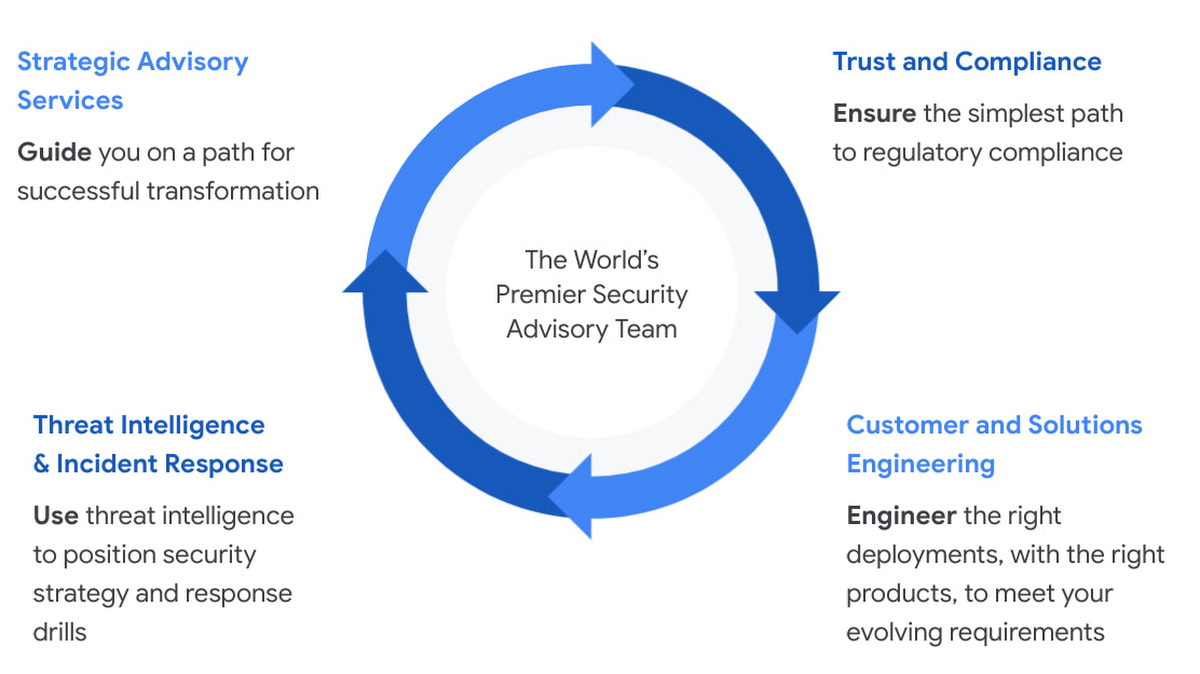
Building on existing security solutions engineering efforts, today the Google Cybersecurity Action Team announced a security and resilience framework that delivers a roadmap for a comprehensive security management program aligned with the National Institute of Standards and Technology’s Cybersecurity Framework using cloud technologies from Google Cloud and our partners.
“Google Cloud has been a critical partner in the BBVA security journey, helping us protect our customers’ sensitive and proprietary data with modern frameworks like zero trust and secure-by-default products like Google Workspace,” said Alvaro Garrido, Chief Security Officer at BBVA. “We look forward to the strategic services and guidance the Google Cybersecurity Action Team will deliver as we continue on our security transformation.”
Learn more about the Cybersecurity Action Team here.
Announcing a safer way to work
Bringing you the expertise and hands-on guidance to help with your security transformation is just one valuable step. We recognize that too many organizations can’t wait any longer to begin their modernization efforts – they need a new baseline, and they need it now.
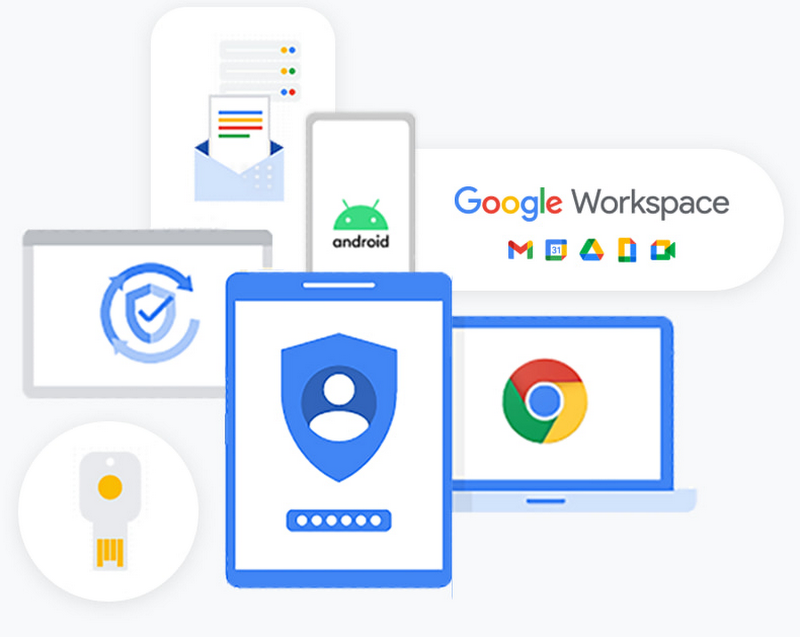
That’s why today, we’re announcing the launch of our Google Work Safer offering, designed to help organizations, their employees, and partners collaborate and communicate securely and privately in today’s hybrid work environment. Work Safer provides companies with access to best-in-class security for email, meetings, messages, documents, and more. It uniquely brings together the cloud-native, zero-trust solutions of Google Workspace with BeyondCorp Enterprise for secure access with integrated threat and data protection. For customers who want secure devices, Work Safer includes Pixel phones managed with Android Enterprise, Chrome Enterprise Upgrade, and HP Chromebooks. Customers can also leverage Google’s Titan Security Keys for account protection, reCAPTCHA Enterprise for website fraud prevention, Chronicle for security analytics, and a variety of migration services for a seamless transition.
The program is designed to meet the needs of all organizations, including small businesses, enterprises and public sector institutions, many of which are reliant on legacy technology and often lack expertise to fully address rising security challenges associated with hybrid work. To learn more, visit our Work Safer homepage.
Advancing our trusted cloud with new security capabilities
Above all, security has been and continues to be the cornerstone of our product strategy. There are three critical areas where Google Cloud’s capabilities can make a meaningful difference for any business’ or government’s digital security transformation:
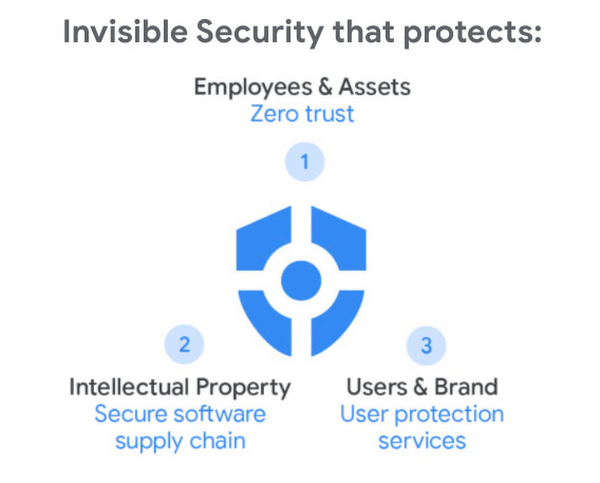
At Next’ 21, we’re introducing new security products and partnerships that will enable you to:
- Protect your employees with new zero trust access capabilities: We’re delivering new features that expand the surface area for our zero trust access solution, BeyondCorp Enterprise, to cover all your apps – both modern and legacy. The new client connector, now in preview, enables identity and context-aware access to non-web applications running in Google Cloud and non-Google Cloud environments. We are also making it easier for admins to diagnose access failure, triage events, and unblock users with the new Policy Troubleshooter feature. You can learn more about both of these new enhancements in the live BeyondCorp Enterprise demo on October 13.
- Improve your detection and response capabilities: We announced a new collaboration with Cybereason for Extended Detection and Response (XDR) across endpoints, networks, cloud and workspaces. The combination of these capabilities delivers a cloud-native XDR solution, Cybereason XDR powered by Chronicle, that automates prevention for common attacks, guides analysts through security operations and incident response, and enables threat hunting with precision at a pace never before achieved. We are also deepening the integration between Chronicle and Security Command Center (SCC) on GCP. New integrations in preview centralize alerts and investigative workflows across the two platforms, and enable threat-specific pivots by enriching SCC alerts with intelligence on associated threat actors and entities.
- Automate and bolster protection of your sensitive data: Automatic DLP, now in preview, is a prime example of how we are making Invisible Security a reality. It’s a game-changing capability that discovers and classifies sensitive data for all the BigQuery projects across your entire organization without you needing to do a single thing. We’re also introducing Ubiquitous Data Encryption, a solution which combines our generally available Confidential Computing, External Key Management, and Cloud Storage products to seamlessly encrypt data as it’s sent to the cloud. Using your External Key Management solution, data can now only be decrypted and run in a confidential VM environment, greatly limiting potential exposure.
- Protect your IP and implement a zero trust software supply chain: Today, we’re building on our zero trust software supply chain with new launches. Cloud Build is SLSA Level -1 compliant by default, with scripted builds and available provenance. With the new Build Integrity feature, Cloud Build automatically generates a verifiable build manifest that includes a signed certificate describing the sources that went into the build, the hashes of artifacts used, and other parameters. Additionally, Binary Authorization’s integration with Cloud Build makes it easy to set up deploy-time constraints. You can also now easily pair Binary Authorization with Cloud Run to ensure only trusted images make it to production. These integrations are now generally available.
- Protect your users and brand: We recently announced the preview of Cloud Armor Bot Management, which integrates Cloud Armor and reCAPTCHA Enterprise. You can enable protection without any server-side changes to your applications, and because detection and enforcement happens in-line, at the edge of Google’s network, you can mitigate threats before they have a chance to impact your applications, whether they run on GCP, on premise, or in a hybrid or multicloud deployment.
- Ensure secure collaboration: Today, Google Workspace is also introducing new security features. Client-side encryption for Google Meet, in beta, gives customers direct control of encryption keys and the identity service used to access keys. Data Loss Prevention (DLP) for Google Chat, in beta, helps prevent sensitive information from leaking outside of your organization. Check out the blog post from Google Workspace to learn more.
As we head into three days of great content and engagements from our security and technology teams across Google Cloud at Next ‘21, we want to leave you with this: You are not alone on your security journey. Our goal is to ensure that every day, you are making your organization safer because you have partnered with us. Please make sure to watch our security experts, customers, and partners in our track sessions to go deep on the topics and products that matter most to you.
3236
Of your peers have already watched this video.
3:00 Minutes
The most insightful time you'll spend today!
Why CISOs Need to Know This to Protect Users From Unsafe Websites
Unsafe web resources include social engineering sites—such as phishing and deceptive sites—and sites that host malware or unwanted software. For CISOs and their teams, this can quickly become an insurmountable challenge if it’s not nipped in the bud.
But there’s a way to enable companies to find unsafe URLs before their users do, identify phishing and deceptive sites, as well as sites that host malware or unwanted software.
Google Cloud’s Web Risk API was built to help admins protect users from unsafe websites. If a URL is known to be unsafe, Web Risk API responds with the threat type and the amount of time during which the website should be considered unsafe.
The Web Risk API can be integrated into both cloud-based and on-premises hosted applications and websites.
Watch this three-minute video to find out how Web Risk APIs can break the chain of malicious attacks and protect the data of your customers and users.
4529
Of your peers have already watched this video.
31:00 Minutes
The most insightful time you'll spend today!
How Google Secures its Data Centers: Watch Video
Security is in the DNA of Google Cloud’s dozens of data centers, complex network and workloads scattered the globe. Take a tour to the nucleus of data center’s six layers of physical security designed to keep unauthorized access at bay, and also learn about Google Cloud’s security fundamentals to leverage the same philosophy on Google Cloud. Watch now!
Investing for Future: Why Shifting Security Left Helps Your Bottom Line

4473
Of your peers have already read this article.
3:30 Minutes
The most insightful time you'll spend today!
The concept of “shifting left” has been widely promoted in the software development lifecycle. The concept is that introducing security earlier, or leftwards, in the development process will lead to fewer software-related security defects later, or rightwards, in production.
Shifting cloud security left can help identify potential misconfigurations earlier in the development cycle, which if unresolved can lead to security defects. Catching those misconfigurations early can improve the security posture of production deployments.
Why shifting security left matters
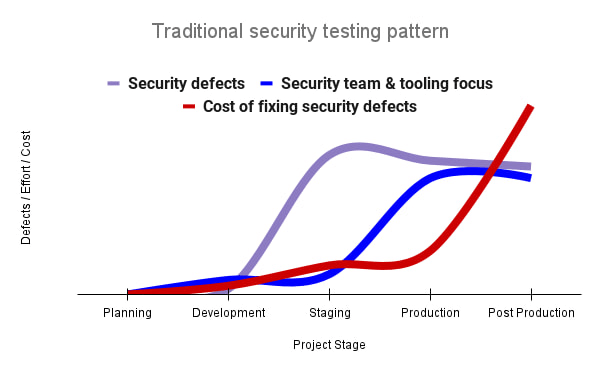
Google’s DevOps Research and Assessment (DORA) highlights the importance of integrating security into DevOps in the 2016 State of DevOps Report. The report discussed the placement of security testing in the software development lifecycle. The survey found that most security testing and tool usage happened after the development of a release, rather than continuously throughout the development lifecycle. This led to increased costs and friction because remediating problems found in testing may involve big architectural changes and additional integration testing, as shown in Figure 1. For example, security defects in production can lead to GDPR violations, which can carry fines up to 4% of global annual revenue.
By inserting security testing into the development phase, we can identify security defects earlier and perform the appropriate remediation sooner. This results in fewer defects post-production and reduces remediation efforts and architectural changes. Figure 2 shows us that integrating security earlier in the SDLC results in overall decreases in security defects and associated remediation costs.
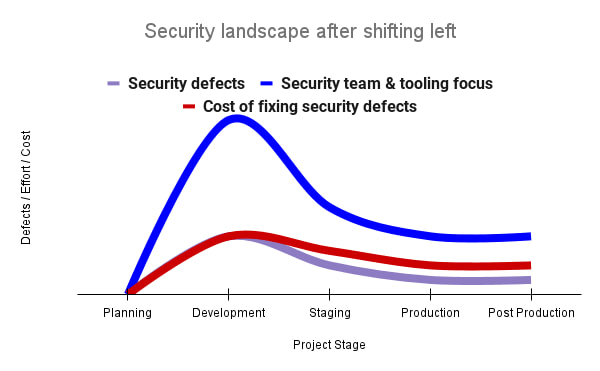
The 2021 State of DevOps Report expands the work of the 2016 report and advocates for integrating automated testing throughout the software development lifecycle. Automated testing is useful for continuously testing development code without the need for additional skills or intervention by the developer. Developers can continue to iterate quickly while other stakeholders can be confident that common defects are being identified and remediated.
From code to cloud
The DORA findings with regard to code security can also be applied to cloud infrastructure security. As more organizations deploy their workloads to the cloud, it’s important to test the security and configurations of cloud infrastructure. Misconfigurations in cloud resources can lead toward security incidents that could lead to data theft. Examples of such misconfigurations include overly permissive firewall rules, public IP addresses for VMs, or excessive Identity and Access Management (IAM) permissions on service accounts and storage buckets.
We can and should leverage different Google Cloud services to identify these misconfigurations early in the development process and prevent such errors from emerging in production to reduce the costs of future remediation, potential legal fines, and compromised customer trust.
The key tools in our toolshed are Security Command Center and Cloud Build. Security Command Center provides visibility into misconfigurations, vulnerabilities, and threats within a Google Cloud organization. This information is critical when protecting your cloud infrastructure (such as virtual machines, containers, web applications) against threats, or identifying potential gaps from compliance frameworks (such as CIS Benchmarks, PCI-DSS, NIST 800-53, or ISO 27001.
Security Command Center further supports shifting security left by allowing visibility of security findings at the cloud project level for individual developers, while still allowing global visibility for Security Operations. Cloud Build provides for the creation of cloud-native CI/CD pipelines. You can insert custom health checks into a pipeline to evaluate certain conditions (such as security metrics) and fail the pipeline when irregularities are detected. We will now explore two use cases that take advantage of these tools.
Security Health Checker
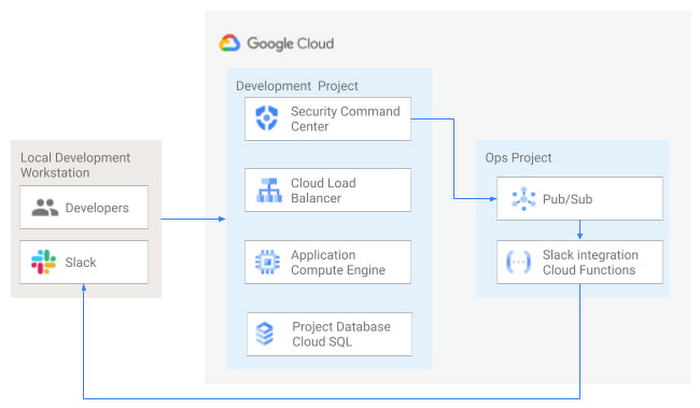
Security Health Checker continuously monitors the security health of a Google Cloud project and promptly notifies project members of security findings. Figure 3 shows developers interacting with a Google Cloud environment with network, compute, and database components. Security Command Center is configured to monitor the health of the project.
When Security Command Center identifies findings, it sends them to a Cloud Pub/Sub topic. A Cloud Function then takes the findings published to that topic and sends them to a Slack channel monitored by infrastructure developers. Just like a spell checker providing quick feedback on misspellings, Security Health Checker provides prompt feedback on security misconfigurations in a Google Cloud project that could lead to deployment failures or post-production compromises. No additional effort is required on the part of developers.
Security Pipeline Checker
In addition to using Security Command Center for timely notification of security concerns during the development process, we can also integrate security checks into the CI/CD pipeline by using Security Command Center along with Cloud Build as shown in Figure 4.
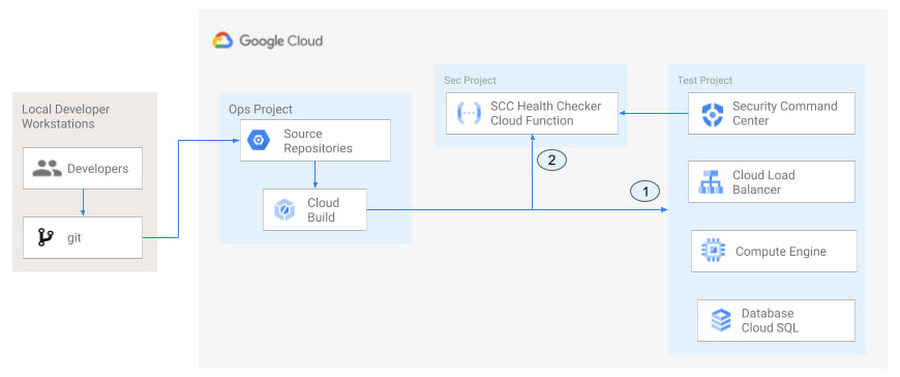
The pipeline begins with a developer checking code into a git repository. This repository is mirrored to Cloud Source Repositories. A build trigger will begin the build process. The build pipeline will include a short waiting period of a few minutes to give Security Command Center a chance to identify security vulnerabilities. A brief delay may appear undesirable at first, but the analysis that takes place during that interval can result in the reduction of security defects post-production.
At the end of the waiting period, a Cloud Function serving as a Security Health Checker will evaluate the findings from Security Command Center (Connector 1 in Figure 4). If the validator determines that unacceptable security findings exist, the validator will inject a failure indication into the pipeline to terminate the build process (Connector 2 in Figure 4). Developers have visibility into the failure triggers and remediate them before successfully deploying code to production. This is in contrast to the findings in the 2016 State of DevOps Report wherein organizations that didn’t integrate security into their DevOps processes spent 50% more time remediating security issues than those who “shifted left” on security.
Closing thoughts
DORA’s 2016 State of DevOps report called out the need for “shifting left” with security, introducing security earlier in the development process to identify security vulnerabilities early to reduce mitigation efforts post-production. The report also advocated for automated testing throughout the software development lifecycle.
We looked at two ways of achieving these objectives in Google Cloud. The Security Health Checker provides feedback to developers using Security Command Center and Slack to notify developers of security findings as they pursue their development activities. The Security Pipeline Checker uses Security Command Center as part of a Cloud Build pipeline to terminate a build pipeline if vulnerabilities are identified during the build process. To implement the Security Heath Checker and the Security Pipeline Checker, check out the GitHub repository. We hope these examples will help you to “shift left” using Google Cloud services. Happy coding!
This article was co-authored with Jason Bisson, Bakh Inamov, Jeff Levne, Lanre Ogunmola, Luis Urena, and Holly Willey, Security & Compliance Specialists at Google Cloud.
More Relevant Stories for Your Company

Three Lesser-Known Ways to Protect Your Customers and Business From Phishing and Fraud
Your users are critical to your business, and you need security controls to keep them — and your business — safe. Built from years of Google Cloud technology and experience, these security features focus on keeping users safe on the web. You can reduce online fraud (chargebacks, hijackings, and abuse)

Groupe Dauphinoise Grows it Customer Base with G Suite and Google Cloud Platform
As a leading French agricultural cooperative, Groupe Dauphinoise places collaboration at the heart of its philosophy. Working with farmers in the Rhone-Alpes region, Groupe Dauphinoise takes on a diverse range of activities from agricultural production to research and development to running retail outlets. As its operations expanded and strained its
Assuring Compliance in the Cloud: Paper by Google Cloud’s Office of the CISO
Cloud transformation and the adoption of modern DevOps technology presents both opportunities and challenges for IT compliance functions. With DevOps style application development, the feedback loop for developers and engineers is much tighter than with traditional application development pipelines, enabling speed and agility of application release cycles. While speedy CI/CD

New ML-Powered API Abuse Detection
API security incidents are increasingly common and disruptive. With the growth of API traffic, enterprises across the world are also experiencing an uptick in malicious API attacks, making API security a heightened priority. According to our latest API Security Research Report, 50% of organizations surveyed have experienced an API security incident
