






Anthos for Manufacturing: Tackle DevOps Complexities and Drive Digital Transformation
READ FULL INTRODOWNLOAD AGAIN6251
Of your peers have already downloaded this article
2:00 Minutes
The most insightful time you'll spend today!
How Macquarie Democratized Digital Banking with APIs

3645
Of your peers have already read this article.
2:30 Minutes
The most insightful time you'll spend today!
Google Cloud Results
- Enables the speed and agility required to build open APIs
- Connects over 1 million customers through Apigee digital touch points
- Helps enable a range of digital banking and commercial partnerships
- 1billion API requests served annually
In 2016, Macquarie launched a new digital banking experience that was based on empowering customers, creating personalized experiences, and developing intuitive technology. Macquarie had the opportunity to build its digital environment from the ground up and looked beyond financial services to digital companies leading in customer experiences.
Following the launch of its digital banking platform in 2016, Macquarie saw providing customers with a secure way to manage their own data as the logical next step. Macquarie looked to transform its existing technology capabilities into a modern architecture that complements the speed and agility demanded of its digital platform. The Apigee API Management Platform plays an important role in helping Macquarie deliver a highly secure and open digital platform.
“The capability to connect to various platforms with a digital, responsive, technology-agnostic platform is vital. As new digital services emerge, it’s important that our digital banking services are future compatible. The most important part of our approach isn’t what we are doing now but what our platform architecture will allow us to do in the future by creating more human experiences with technology that go beyond just banking,” says Rajay Rai, head of Digital Engineering & Applied Innovation, for Macquarie’s Banking and Financial Services group.
Because Macquarie’s banking platform is based on an open API architecture, it is able to grant controlled access to its business services, enabling others to use, innovate, and build on top of them while increasing the prospects of widespread adoption and developer stickiness.
Empowering the developer
“Macquarie’s strategy has been API-first as it has built and improved its digital capabilities, but it won’t be too long until this approach is superseded by citizen-developers-first,” Rajay says. “We believe that co-creation of value is essential because in the future, we won’t be owning the channels for distribution and engagement. In building a leading digital banking platform it’s important that developers are able to open the front door.”
Macquarie’s API strategy grants internal and external developers with access to its rich repository of APIs exposed via the new developer platform, Macquarie devXchange. With Macquarie devXchange, developers have readily available samples, a sandbox, and simplified connections to all of the bank’s services. Developers are able to test APIs and services through the Apigee platform.
“Not only does the platform provide frictionless access, but it’s also poised to modernize and simplify the way we engage the community beyond our own perimeters,” Rajay says. “The Apigee developer portal is helping us seize new opportunities; access has been democratized and it wouldn’t have been possible without APIs.”
Cloud migration
In order to meet future demand for computing capabilities, Macquarie decided to move to the cloud in order to enable an infrastructure with various configurations on demand. This has cut the provisioning time for Macquarie from months to minutes.
Macquarie has created full end-to-end environments on Kubernetes and can flow traffic to a whole new environment in seconds, encouraging experimentation and learning. This was made possible through the flexibility of APIs.
“APIs and microservices are a great match. Microservices with Apigee provide a powerful, agile ecosystem to form various services topologies and evolve services in an isolated manner. This helps us respond to the fast pace of digital innovation today,” Rajay says.
Empowering consumers
Macquarie’s approach is about delivering customers more personalized banking experiences that are driven by how they want to use their information.
“APIs have enabled us to co-create value with our partners, customers, and developers. You can’t live in isolation; open source tells you that,” Rajay says. “APIs have been vital for us and what we can deliver for our customers as we’ve built our leading digital platform.”

4418
Of your peers have already downloaded this article
7:00 Minutes
The most insightful time you'll spend today!
Aspiration is easy, but execution is hard. Few concepts illustrate this as well as digital transformations.
Most businesses today are at some phase of their digital transformation journey. While some are evaluating strategies and solutions, many companies have already embarked on full-scale project implementations. However, one thing is clear. While most business and IT leaders aspire to revamp their businesses, executing a well-defined digital transformation strategy is extremely complicated. The hurdles are both cultural and technological.
This e-Book breaks down the process of creating a digital transformation strategy into ten core dimensions: platform, APIs, outside-in, ecosystem, leadership, funding, metrics, software development lifecycle, talent, and self-service. Read on to understand how companies like Walgreens, Ticketmaster, Magazine Luiza, AccuWeather, and Pitney Bowes, are successfully charting their digital transformation journey with the help of Apigee Compass and evolving their businesses.
Wunderkind Leverages Google Cloud to Address the Growing Needs of its Customer Base

5331
Of your peers have already read this article.
1:30 Minutes
The most insightful time you'll spend today!
Editor’s note: We’re hearing here how martech provider Wunderkind easily met the scaling demands of their growing customer base on multiple use cases with Cloud Bigtable and other Google Cloud data solutions.
Wunderkind is a performance marketing channel and we mostly have two kinds of customers: online retailers, and publishers like Gizmodo Media Group, Reader’s Digest, The New York Post and more. We help retailers boost their e-commerce revenue through real-time messaging solutions designed for email, SMS, onsite, and advertising. Brands want to provide a one-to-one experience to more of their customers, and we use our extensive history with best practices in email marketing and technology to help brands reach more customers through targeted messaging and personalized shopping experiences. With publishers, it’s a different value proposition, we use the same platform to provide a non disruptive and personalized ad experience for their website. For example, if you are on their site and then you left, we might show an ad tailored to you when you come back later – depending on the campaign.
After running into limitations with our legacy database system, we turned to Cloud Bigtable and Google Cloud, which helped us be more flexible and easily scale for high traffic demand – which can be a stable 40,000 requests per second, and meet the needs of our growing number of data use cases.
Three different databases power our core product
In our core offering, companies send us user events from their websites. We store these events and later decide (using our secret sauce) if and how to reach out to those users on behalf of our customers. Because many of our customers are retailers, Black Friday and Cyber Monday are big traffic days for us as. On such days, we can get 31 billion events, sometimes as many as 200K events per second. We show 1.6 billion impressions that have seen close to 1 billion pageviews. And at the end of all this, we securely send about 100 million emails. We noticed the same thing for election time; traffic reached the same high volume. We need scalable solutions to support this level of traffic as well as the elasticity to let us pay only for what we use, and that’s where Google Cloud comes in.
So how does this work? Our externally facing APIs, which are running on Google Kubernetes Engine, receive those user events—up to hundreds of thousand per second. All the components in our architecture need to be able to handle this demand. So from our APIs, those events go to Pub/Sub, Dataflow and from there they are written to Bigtable and BigQuery, Google Cloud’s serverless, and highly scalable data warehouse. This business user activity data underpins almost all our products. Events can be things like product views or additions to shopping carts. When we store this data in Bigtable, we use a combination of email address and the customer ID as the Bigtable key and we record the event details in that record.
What do we do with this information next? It’s important to mention that we also mark the last time we received an event about a user in Memorystore for Redis, Google Cloud’s fully managed Redis service. This is important because we have another service that is periodically checking Memorystore for users that have not been active for a campaign-specific period of time (it can be 30 minutes, for example), then deciding whether to reach out to them.
How we decide when we reach out is an intelligent part of our product offering, based on the channel, message, product, etc. When we do reach out, we use Memorystore for Redis as a rate limiter or token bucket. In order not to overwhelm the email or texting providers we send API requests to, we throttle those requests using Memorystore. (We prefer to preemptively throttle the outgoing API requests as opposed to handling errors later.)
When we do reach out, often we will need details for a specific product—let’s say if the website belongs to a retailer. We usually get that information from the retailer through various channels and we store product information in Cloud SQL for MySQL. We pull that information when we need to send an email with product information, and we use Memorystore for Redis to cache that information, since many of the products are repeatedly called. Our Cloud SQL instance has 16 vCPUs, 60GBs of memory and 0.5TB of disk space and when we perform those product information updates, we have about a thousand write transactions per second. We are also in the process of migrating some tables from a self managed MySQL instance, and we keep those tables synchronized with Cloud SQL using Datastream.
Our user history database was originally stored in AWS DynamoDB, but we were running into problems with how they structured the data, and we’d often get hot shards but with no way to determine how or why. That led to our decision to migrate to Bigtable. We set up the migration first by writing the data to two locations from Pub/Sub, performed some backfill of data until that was up and running, and then started working on the reading. We performed this over a few short months, then switched everything to Bigtable.
So, as mentioned, we are using Bigtable for multiple databases. The instance that stores our user events has about 30 TB with about 50 nodes.
Profile management
A second use case for Bigtable is for user profile management, where we track, for example, user attributes based on subscription activity, whether they’ve opted in or out of various lists, and where we apply list-specific rules that determine which targeted emails we send out to users.
Our very own URL shortener
Our third use case for Bigtable is our URL shortener. When our customers build out campaigns and choose a URL, we append tracking information to the query string of the URLs and they become long. Many times, we are sending them via SMS texts, so the URLs need to be short. We originally used an external solution, but made the determination that they couldn’t support our future demands. Our calls tend to be very bursty in nature, and we needed to plan for a future state of supporting higher throughput. We use a separate table in Bigtable for this shortened URL. We generate the short slug that is 62 bit-encoded and use it as the rowkey. We use the long slug as a Protobuf-encoded data structure in one of the row cells and we also have a cell for counting how many times it was used. We use Bigtable’s atomic increment to increase that counter to track how many times the short slug was used.
When the user receives a text message on their phone, they click the short URL, which goes through to us, and we expand it to the long slug (from Bigtable) and redirect them to the appropriate site location. Obviously, for the URL shortener use case, we need to make the conversion very quickly. Bigtable’s low latency helps us meet that demand and we can scale it up to meet higher throughput demands.
Meeting the future with Google Cloud
Our business has grown considerably, and as we keep signing up new clients, we need to scale up accordingly, and Bigtable has met our scaling demands easily. With Bigtable and other Google Cloud products powering our data architecture, we’ve met the demand of incredibly high traffic days in the last year, including Black Friday and Cyber Monday. Traffic for these events went much higher than expected, and Bigtable was there, helping us easily scale on demand.
We are working on leveraging a more cloud native approach and using Google Cloud managed services like GKE, Dataflow, pub/sub, Cloud SQL , Memorystore, BigQuery and more. Google has those 1st party products and we don’t see the value in rolling out or self managing such solutions ourselves..
Thanks to Google Cloud, we now have reliable and flexible data solutions that will help us meet the needs of our growing customer base, and delight their users with fast, responsive, personalized shopping messaging and experiences.
Learn more about Wunderkind and Cloud Bigtable. Or check out our recent blog exploring the differences between Bigtable and BigQuery.
Enhancing Romi’s Conversations: The Role of BigQuery and LLMs

899
Of your peers have already read this article.
3:30 Minutes
The most insightful time you'll spend today!
MIXI, Inc. (MIXI) is a social networking organization that provides a diverse range of services for friends and family to enjoy together, such as the social-media platform mixi, a mobile game called Monster Strike, and a family photo and video sharing service known as FamilyAlbum. One of our current projects is Romi, a social robot launched in April 2021 that uses Speech-to-Text by Google Cloud as its speech recognition engine.
Since the late 2010s, the social robot market has been booming, with some models becoming increasingly affordable for consumers, from robotic tutors that promote social and cognitive development for children, to companion robots for elderly care. But with Romi, there is a marked difference in the quality of dialogue that makes Romi distinct from most social robots.
The biggest feature of Romi is that the AI developed internally by MIXI can generate natural exchange of communication. The size of a hand-held device, Romi can be placed anywhere in a room and has a screen to demonstrate different facial expressions. It responds to conversation within context. Until now, AI has been used to interpret the intentions behind user speech, but Romi is an AI-powered robot that takes it a step further, generating spoken conversations. After all, Romi was created to offer heartwarming communication to those who are looking for it. This form of speech recognition did not exist before Romi was released. We hope users will enjoy conversing with it, including the occasional unexpected response.

The speech recognition part was one of the most critical aspects of Romi. Most of the infrastructure that makes up Romi uses a main public cloud, which was used for other services then. As for speech recognition, we decided to try out the Speech-to-Text tool by Google Cloud, which was praised for its overwhelmingly high accuracy, and the prototype’s results were very positive. Even though we tried other companies’ services before making the final decision, our conclusion about Speech-to-Text remains the same.
The accuracy and responsiveness of Speech-to-Text made the tool an effective one for a social robot like Romi. Google Cloud also provided a sense of security with its high reliability that has been demonstrated in enabling Romi’s workloads, and will be able to support continuous development of Romi’s services for the long run.
With the rapid development of speech recognition technology, MIXI decided to re-examine the speech recognition engine for Romi in June 2022, about a year after its release. We eventually decided to continue its use of Speech-to-Text. We reviewed about 10 companies’ Japanese-compatible speech recognition engines, and found that Speech-to-Text offered the best results. In addition, Speech-to-Text has several speech recognition transcription models, but we found that the latest short model, which specializes in short utterances, is more suitable for Romi than the default model.
The cost-savings that Speech-to-Text delivers is also impressive. The billing unit was changed from 15 seconds increments rounded up, to one second in November, and huge cost reductions could be expected with Romi. This is important to us because Romi does not have trigger phrases, such as “OK Google,” so as to achieve more natural conversations. As a result, it can recognize and process more speech as compared to other social robots. While this results in a more user-friendly experience, it also requires greater workloads and can incur a higher cost compared to most speech recognition engines. But with the updated billing system that Speech-to-Text delivers, we are able to continue refining Romi’s speech recognition accuracy while keeping costs low.
Improving data analysis with BigQuery
Google Cloud was only used for speech recognition initially, but as Romi’s range of service expanded, more aspects of Romi were hosted on Google Cloud. Among these features, the machine learning platform for AI was moved to Google Cloud at an early stage. To be able to make use of a cloud platform at an affordable cost makes Google Cloud very appealing. Premium Support and technical account management helped us with our cost considerations.
Furthermore, MIXI started migrating the data analysis platform for Romi to BigQuery last year. BigQuery was chosen because it excels at bringing together and analyzing big data in various formats, as in-depth data analysis becomes necessary to improve Romi’s services. What also makes BigQuery an attractive choice was the ability to introduce structured query language (SQL) to BigQuery, a language that the development team from MIXI is familiar with.
In particular, we are grateful for the use of software like Looker. It takes a lot of work, even for engineers, to write complex queries, but with Looker, even non-engineers can intuitively perform fairly complex analysis. About half a year ago, we held regular briefings mainly for employees interested in data analysis, and now they voluntarily conduct analysis, conduct discussions based on the results, and create new projects and ideas. This has become a regular workflow for us.
Currently, what is popular in AI-based communication is the emergence of large-scale language models (LLMs) that learn from huge amounts of data, and generate natural responses on a different level than before.
To improve the conversational experience with Romi, we have been looking into relevant LLM technologies for a while now. It is important to be able to use high performance GPUs as inexpensively as possible in order to run PoC at high speed. We will continue to focus on Google Cloud services, including Compute Engine and VertexAI.
Scaling with Breaking News: BBC’s Serverless Infrastructure on Google Cloud

1267
Of your peers have already read this article.
3:30 Minutes
The most insightful time you'll spend today!
Editors note: Today’s post is from Neil Craig at the British Broadcasting Corporation (BBC), the national broadcaster of the United Kingdom. Neil is part of the BBC’s Digital Distribution team which is responsible for building the services such as the public-facing www bbc.co.uk and .com websites and ensuring they are able to scale and operate reliably.
The BBC’s public-facing websites inform, educate, and entertain over 498 million adults per week across the world. Because breaking news is so unpredictable, we need a core content delivery platform that can easily scale in response to surges in traffic, which can be quite unpredictable.
To this end, we recently rebuilt our log-processing infrastructure on a Google Cloud serverless platform. We’ve found that the new system, based on Cloud Storage, Eventarc, Cloud Run and BigQuery, enables us to provide a reliable and stable service without us having to worry about scaling up during busy times. We’re also able to save license fee payers money by operating the service more cost effectively than our previous architecture. Not having to manually manage the scale of major components of the stack has freed up our time, allowing us to spend it on using, rather than creating the data.
A log in time
To operate the site and ensure our services run smoothly we continually monitor Traffic Manager and CDN access logs. Our websites generate more than 3B log lines per day, and handle large data bursts during major news events; on a busy day our system supports over 26B log lines in a single day.
As initially designed, we stored log data in a Cloud Storage bucket. But every time we needed to access that data, we had to download terabytes of logs down to a virtual machine (VM) with a large amount of attached storage, and use the ‘grep’ tool to search and analyze them. From beginning to end, this took us several hours. On heavy news days, the time lag made it difficult for the engineering team to do their jobs.
We needed a more efficient way to make this log data available, so we designed and deployed a new system that deals with logs and reacts to spikes more efficiently as they arrive, improving the timeliness of critical information significantly.
In this new system, we still leverage Cloud Storage buckets, but on arrival, each log generates an event using EventArc. That event triggers Cloud Run to validate, transform and enrich various pieces of information about the log file such as filename, prefix, and type, then processes it and outputs the processed data as a stream into BigQuery. This event-driven design allows us to process files quickly and frequently — processing a single log file typically takes less than a second. Most of the files that we feed into the system are small, fewer than 100 Megabytes, but for larger files, we automatically split those into multiple files and Cloud Run automatically creates additional parallel instances very quickly, helping the system scale almost instantly.
The nature of running a global website which provides news coverage means we see frequent, unpredictable large spikes of traffic. We learn from these and optimize our systems where necessary so we’re confident in the system’s ability to handle significant traffic. For example, around the time of the announcement of the Queen’s passing in September, we saw some huge traffic spikes. During the largest, within one minute, we went from running 150 – 200 container instances to over 1000…. and the infrastructure just worked. Because we engineered the log processing system to rely on the elasticity of a serverless architecture, we knew from the get-go that it would be able to handle this type of scaling.
Around the time of the announcement of the Queen’s passing in September, we saw some huge traffic spikes. During the largest, within one minute, we went from running 150 – 200 container instances to over 1000…. and the infrastructure just worked
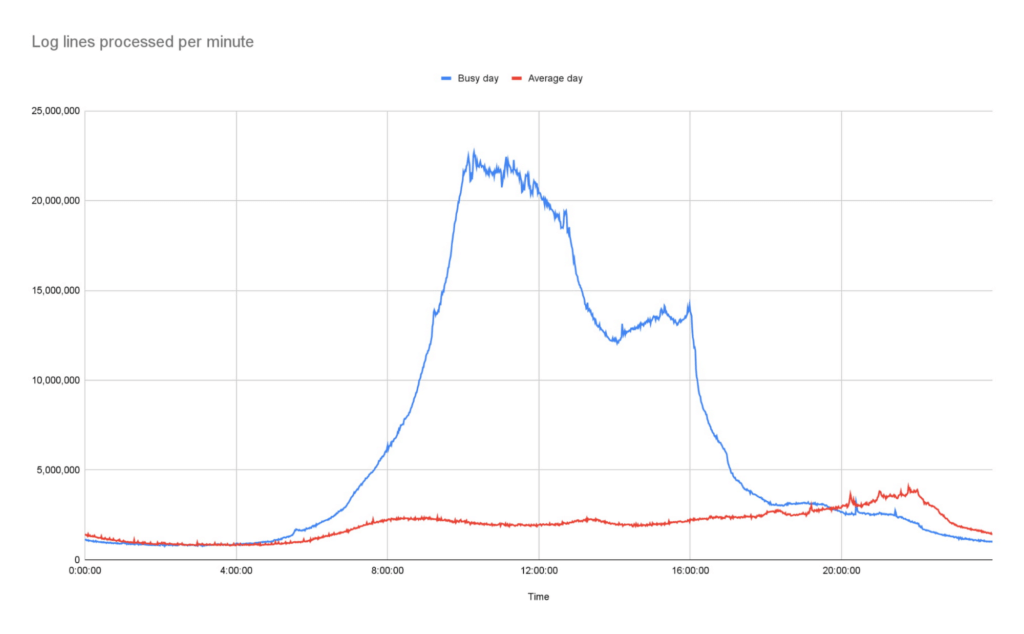
Our initial concern about choosing serverless was cost. It turns out that using Cloud Run is significantly more cost-effective than running the number of VMs we would need for a system that could survive reasonable traffic spikes with a similar level of confidence.
Switching to Cloud Run also allows us to use our time more efficiently, as we no longer need to spend time managing and monitoring VM scaling or resource usage. We picked Cloud Run intentionally because we wanted a system that could scale well without manual intervention. As the digital distribution team, our job is not to do ops work on the underlying components of this system — we leave that to the specialist ops teams at Google.
Another conscious choice we made whilst rebuilding the system was to use the built-in service-to-service authentication in Google Cloud. Rather than implementing and maintaining the authentication mechanism ourselves, we add some simple configuration which instructs the client side to create and send a OIDC token for a service account we define and the server side to authenticate and authorize the client. Another example is pushing events into Cloud Run, where we can configure Cloud Run authorization to only accept events from specific EventArc triggers, so it is fully private.
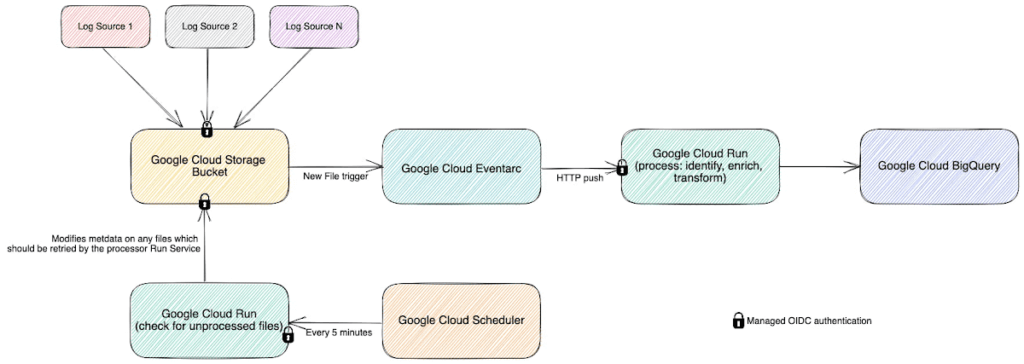
Going forward, the new system has allowed us to make better use of our data safely. For example, BigQuery’s per-column permissions allow us to open up access to our logs to other engineering teams around the organization, without having to worry about sharing PII that’s restricted to approved users.
The goal of our team is to empower all teams within the BBC to get the content they want on the web when they want it, make it reliable, secure, and make sure it can scale. Google Cloud serverless products helped us to achieve these goals with relatively little effort and require significantly less management than previous generations of technology.
More Relevant Stories for Your Company

How The New York Times Increased Speed of Delivery by Using Kubernetes
When New York Times decided a few years ago to move out of its data centers, its first deployments on the public cloud were smaller and less critical applications that were being managed on virtual machines. "We started building more and more tools, and at some point, we realized that

Don’t Just Move to the Cloud, Modernize With Google Cloud
Our customers tell us they don’t just want to migrate their applications from point A to point B, they want to modernize their applications with cloud-native technologies and techniques, wherever those applications may be. Today, we’re excited to tell you about a variety of new customers that are using Anthos to transform

Largest Beauty Retailer in the US Powers Digital Transformation with Google Cloud Smart Analytics
Digital technology offers increasing flexibility and choice to consumers. As a result, the retail industry is dramatically shifting toward more tailored and personalized experiences for shoppers, and businesses are rethinking how they deliver value to customers. This couldn’t be more true for the beauty retailing industry where leading companies are

How This Leading Trading Company Uses APIs to Build Fintech Apps Quickly and Cost-Effectively
Tradier uses the Apigee API management platform from Google to abstract the legacy complexities of capital markets so that developers can build FinTech applications in an agile, nimble, and quick fashion at minimal cost. The company embodies the evolution of what cloud technology can enable in the form of an API-first business delivered
