





A Step-by-Step Guide to Lift-and-Shift a Line of Business Application onto Google Cloud
READ FULL INTRODOWNLOAD AGAIN3803
Of your peers have already downloaded this article
1:30 Minutes
The most insightful time you'll spend today!
Enable Specialized Workloads with Bare Metal Solution from Google Cloud

3852
Of your peers have already read this article.
2:00 Minutes
The most insightful time you'll spend today!
Enterprises want to embrace the pace of innovation and an operational business model of the modern-day cloud, but they don’t want to disrupt their existing IT landscape or upgrade all their legacy applications. This presents a conundrum, as most legacy applications were not designed to run in the cloud, and migrating them can be challenging, risky and cost-prohibitive.
The complexity, cost and risk of cloud migration often stand in the way of a successful digital transformation. At Google Cloud, we work to meet you where you are and help you craft a migration strategy that lets you run what you want, where you want, how you want. This is why we’re excited to introduce Bare Metal Solution: to jumpstart the migration of applications that have been holding back your cloud adoption.
Bare Metal Solution consists of all the infrastructure you need to run your specialized workload such as Oracle Database close to Google Cloud. This infrastructure is connected with a dedicated, low-latency and highly resilient interconnect, and connects to all native Google Cloud services. Bare Metal Solution uses OEM hardware that is certified to run multiple enterprise applications, most of which can be migrated to this infrastructure with little or no change, minimizing the risk of migration while simultaneously increasing its velocity.
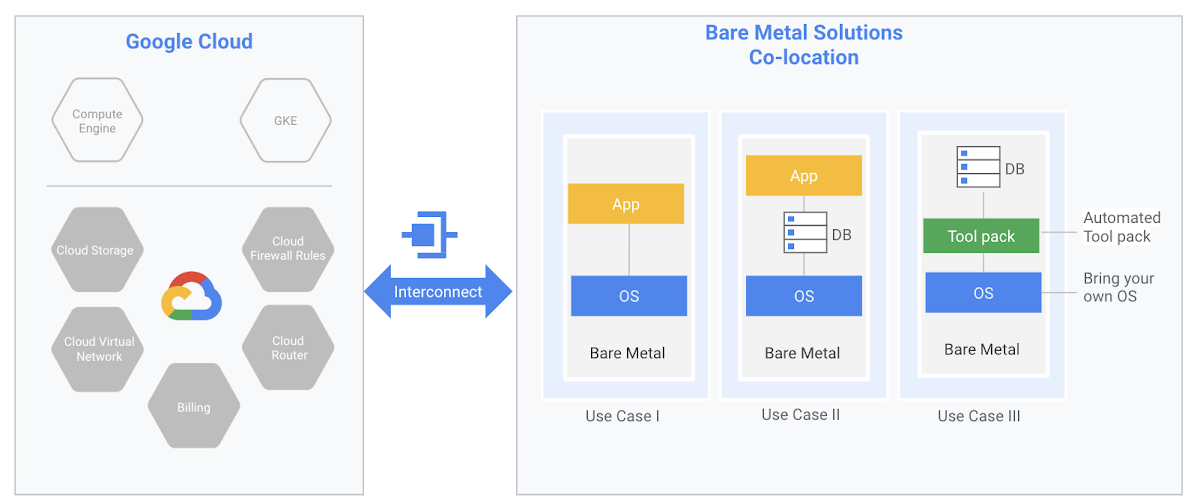
Bare Metal Solution also comes with automation tools to help you onboard your environment quickly—provisioning your applications, relational databases, configuring popular operating systems and setting up services such as backups and monitoring. The management interface will be familiar to your existing IT teams or systems integrator, allowing you to leverage your investments in existing tools, processes and personnel.
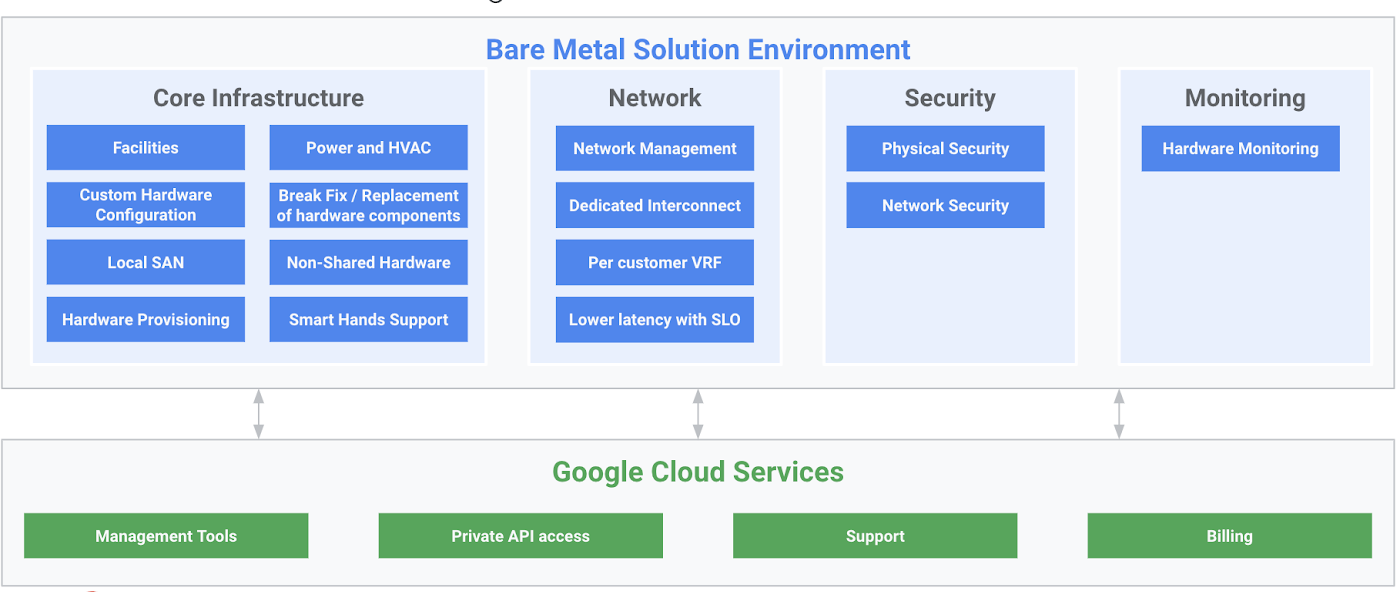
In addition to providing state-of-the-art infrastructure and integrated low-latency access to Google Cloud, Bare Metal Solution also provides the following:
- Completely managed hardware infrastructure: End-to-end infrastructure management such as compute, storage and networking, as well as fully managed and monitored environments such as power, cooling and facilities.
- Google Cloud support and billing: A seamless support experience with support for infrastructure, including defined SLAs for initial response. 24X7 coverage for all Priority 1 and 2 issues. Unified billing across Google Cloud and Bare Metal Solution.
- Service Level Agreements: Defined enterprise-grade SLA for hardware uptime and interconnect availability.
As an integral part of Google Cloud, Bare Metal Solution lets you off-load provisioning, managing and monitoring of your infrastructure to Google, so you can focus on your own data center modernization.
The nitty gritty
Many of the workloads that run on Bare Metal Solution have demanding CPU and I/O requirements. Bare Metal Solution provides a cost-effective and scalable architecture based on state-of-the-art x86 servers and high-performance, resilient storage. The servers are offered in several fixed configurations that support most mainstream enterprise operating systems:
- Dual-socket x86 systems
- 16 core with 384 GB DRAM
- 24 core with 768 GB DRAM
- 56 core with 1536 GB DRAM
- Quad-socket x86 systems
- 56 core with 1536 GB DRAM
- 112 core with 3072 GB DRAM
Bare Metal Solution servers can be used for standalone applications, or configured with application native or database native clustering technologies for high availability. Storage is offered in 1TB volume increments of either hybrid or all-flash disk. For applications that require custom compute shapes or special-purpose hardware, we also offer bespoke hardware configurations.
Bare Metal Solution uses OEM hardware that is certified for many ISV software applications as well as custom built applications, including those built on Oracle Database. These hardware configurations are offered as a subscription, billed monthly with a preferred term length of 36 months. There are no data ingress and egress charges between Bare Metal Solution and Google Cloud in the same region; customers are responsible for provisioning adequate bandwidth for their business needs.
Legacy apps are no barrier to cloud
Google Cloud is the preferred destination for organizations building cloud-native applications as well as migrating existing on-premises applications, bringing reliable infrastructure, leading data analytics capabilities, and a culture of innovation to your IT environment. Whether you’re looking to build new applications in the cloud or to overhaul your infrastructure, we’re here to help you reach your digital transformation goals. And now, with Bare Metal Solution, we’re excited to extend the power of Google Cloud to specialized, legacy workloads. To learn more please visit our website.
6707
Of your peers have already downloaded this article
4:30 Minutes
The most insightful time you'll spend today!
Unlocking the Power of Data and Creativity with
the Cloud: The WPP Story
3601
Of your peers have already watched this video.
10:42 Minutes
The most insightful time you'll spend today!
The Inside Story of How PayPal Became an Innovator in a Competitive Market
PayPal is an American company operating a worldwide online payment system that supports online money transfers and serves as an electronic alternative to traditional paper methods like checks and money orders. The company enables over 29 million payments or transactions on a peak day. in over 200 markets around the world.
PayPal wanted to scale its business. It had achieved a 25% payment growth across the world. It wanted to ensure it’s available wherever its customers are and enable seamless transactions. PayPal also wanted to ensure flexibility. “There are huge variations in the amounts of payment that happen every day of the week or every week of the year. We wanted to ensure our systems are capable of keeping up with these variations,” says Sri Shivananda, SVP and CTO, PayPal.
The company also had to meet regulatory compliance needs across its 200 markets and increase its efficiency. It wanted to get rid of hardware on-premises which it wasn’t using on a regular basis. And above all, the company wanted to innovate quickly to beat the competition.
This is why PayPal turned to Google Cloud. Watch how it made the transition and reaped the benefits.
How the Telegraph is Reimagining Media with Google Cloud

10171
Of your peers have already read this article.
3:30 Minutes
The most insightful time you'll spend today!
Whether they’re reading the newspaper on the way to work, or catching up on the latest headlines on their smartphones, readers expect up-to-the-minute news wherever and whenever makes the most sense for them. As a result, media companies are increasingly looking for ways to improve, expand, and simplify their offerings, and they’re increasingly looking to the cloud to do it.
For more than 160 years The Telegraph has been counted on by readers across the United Kingdom and globally for award-winning news and journalism. An early adopter of cloud technology, it’s been a G Suite customer since 2008 and has already been using Google Cloud Platform to analyze digital behaviors to improve engagement and advertising performance since 2016.
Recently, The Telegraph announced it’s migrating fully to Google Cloud. By migrating all their production and pre-production services, they aim to deliver content faster, provide compelling experiences to readers, and reduce environmental impact.
“We are delighted to announce our newest collaboration with Google Cloud,” said Chris Taylor, Chief Information Officer, The Telegraph. “We have always worked closely with Google as they help us to provide our readers with great experiences on our digital products, collaboration software and internet scale through search. Their continued leadership in projects such as Kubernetes are enabling us to build flexible development environments that truly support DevOps.”
Powering the Digital Publishing Ecosystem
The Telegraph produces large volumes of digital content every day. It was imperative for them to find a cloud provider they could trust to support this ecosystem. By working with Google Cloud they have changed the way they see and engage with data: they can collect new information about their products every second and use that to continually hone their strategy. The Telegraph are placing more confidence and trust in the data captured about their content and now have one of the best available pieces of technology for capturing and analyzing the stories they publish in real-time.
Leveraging AI to support journalists
Time is critical when journalists are on a story, and The Telegraph wants to put important data in the hands of its journalists right when they need it. To do this, it will be using AutoML to classify content for journalists and make it more discoverable. For example, a reporter will be able to bring up relevant assets that link to their stories. It will also apply AutoML to classify Telegraph stock photos to help journalists attach compelling visual content to their stories faster.
Building compelling reader experiences with the help of APIs
Readers have an ever-increasing expectation of personalization. To meet this need, The Telegraph launched My Telegraph, currently live in beta, to offer registered readers personalized news experiences based on their interests or the particular journalists they want to follow. My Telegraph was developed on an API management platform provided by Google Cloud’s Apigee. You can learn more about how it’s applying API management to My Telegraph, in this blog post.
Working for environmental good
The Telegraph is the biggest selling quality newspaper in the UK, an accolade which requires it to print and distribute hundreds of thousands of copies each day. Optimal management of print production is important, and by using a combination of the cloud and machine learning, The Telegraph is better able to predict demand for physical newspapers, maximizing sales and minimizing waste. This makes great business sense for The Telegraph but also has great environmental benefit.
HarbourBridge Schema Assistant Allows Quick, Bulk Migration to Cloud Spanner
5469
Of your peers have already read this article.
1:30 Minutes
The most insightful time you'll spend today!
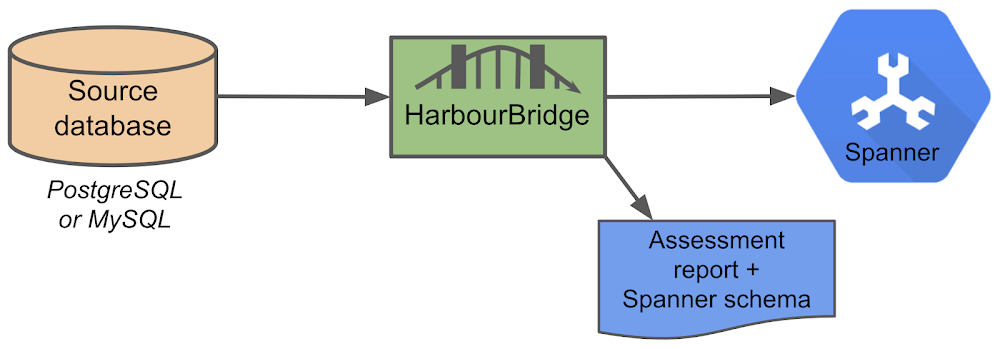
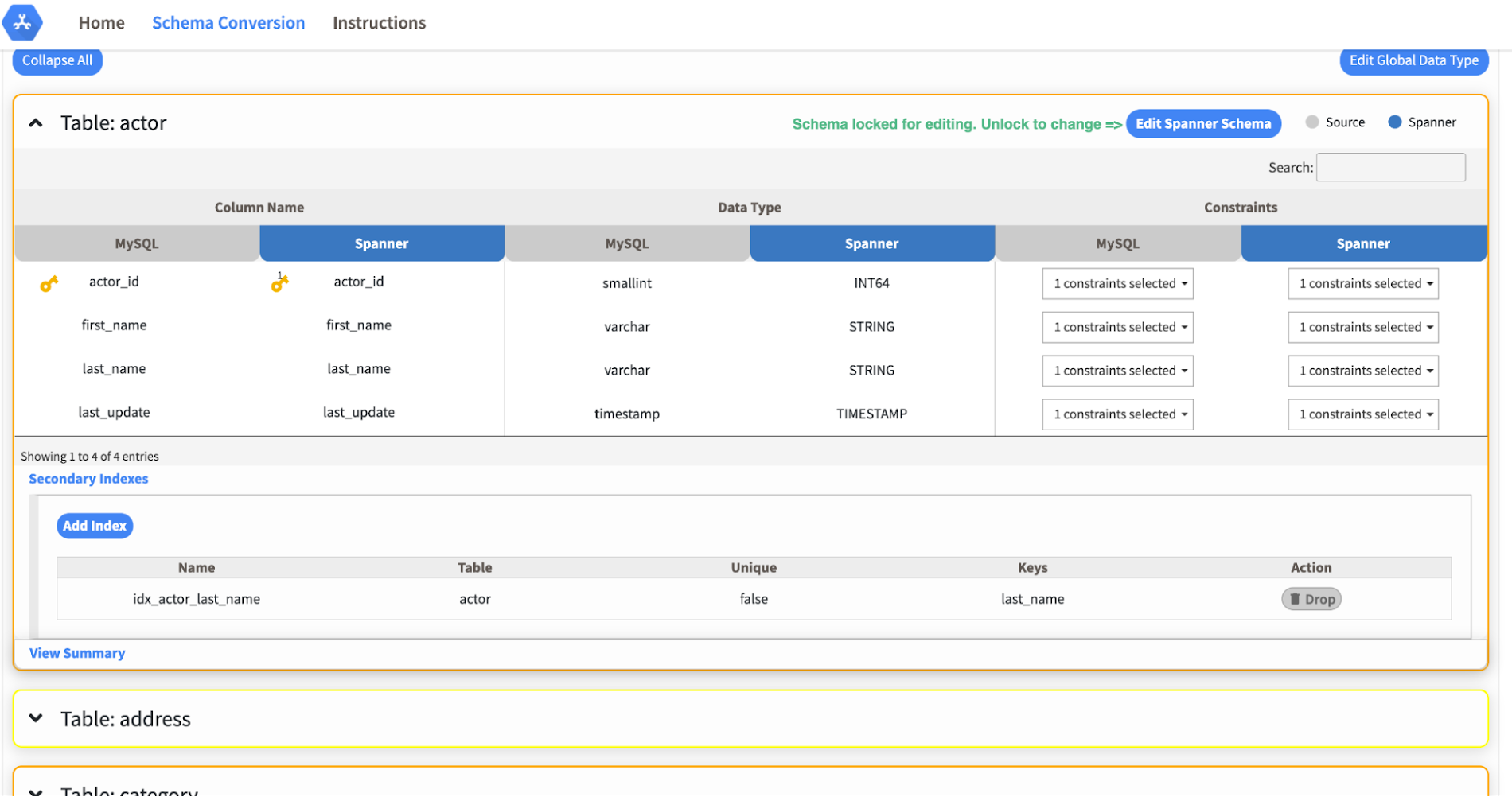
Today we’re announcing the HarbourBridge Schema Assistant, which provides a guided schema-design workflow for migrating from MySQL or PostgreSQL to Spanner. HarbourBridge imports dump files (from mysqldump or pg_dump) or directly connects to your source database, and converts the source database schema to an equivalent Spanner schema. The new Schema Assistant capability displays the source schema and Spanner schema side-by-side, highlights errors and walks you through a series of steps to validate and optimize your Spanner schema. It also produces a browsable assessment report with an overall migration-fitness score for Spanner, a table-by-table detailed analysis of type mappings and a list of features used in the source database that aren’t supported by Spanner. It supports editing of table and column names, column types, primary keys and constraints, as well as dropping of tables, columns, foreign keys and secondary indexes.
The new Schema Assistant complements HarbourBridge’s existing data and schema migration capabilities and is a critical step towards our goal of building a complete open-source migration toolkit. HarbourBridge continues to support command-line schema and data migration and turn-key Spanner evaluation.
Complementing the bulk data migration capabilities of HarbourBridge, we are also announcing the ability to migrate change events from MySQL to Cloud Spanner.
Supported Features in Schema Assistant
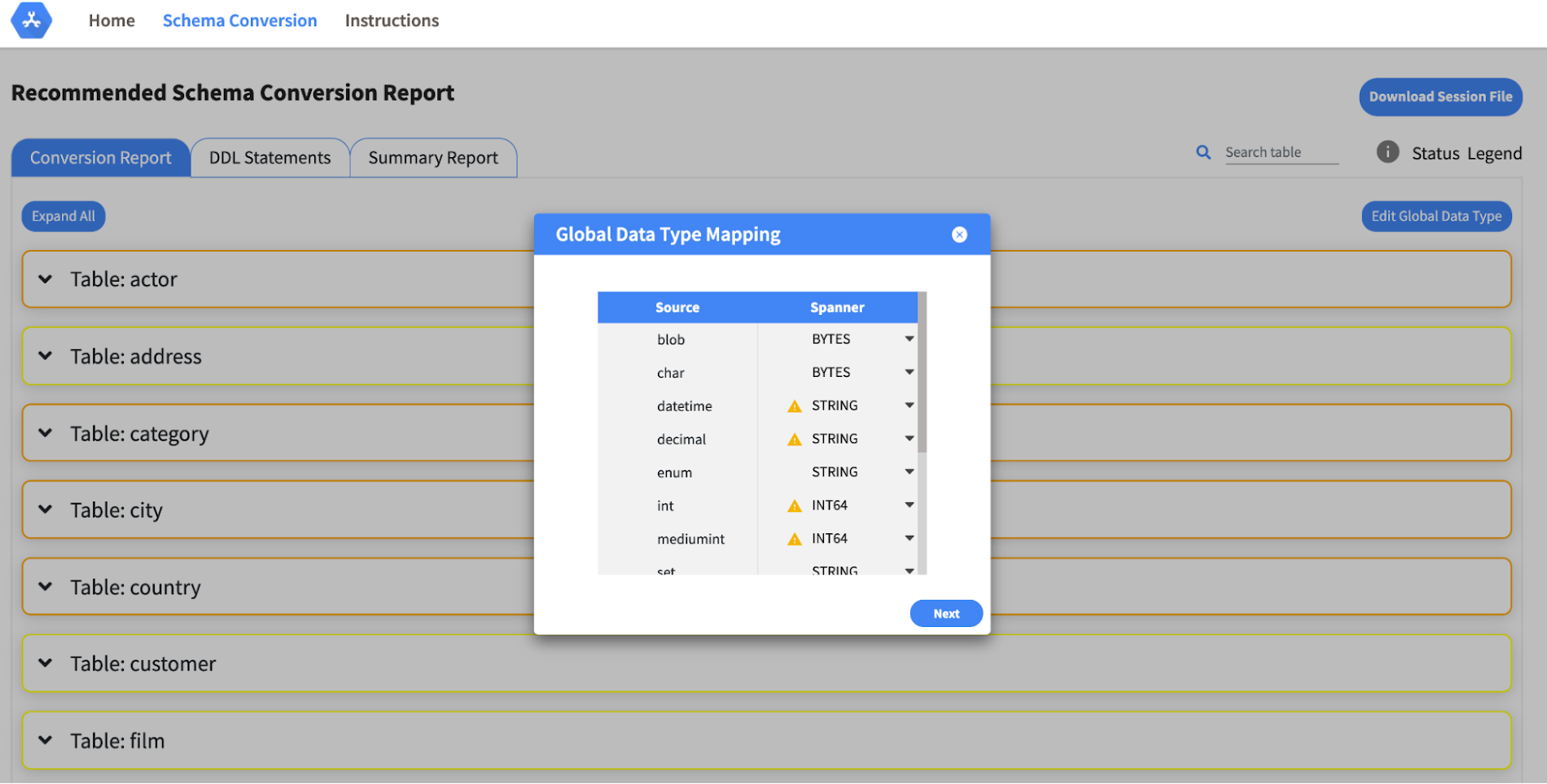
- Global type mapping. Users can customize the global mapping for how types should be mapped to Spanner consistently across the schema. For example, mapping large integers in source schema to Spanner’s NUMERIC.
- Local type mapping. Users can override the custom type mapping for a given table/column.
- Session management. A session keeps track of all the changes made to the schema mapping.
- Customization of secondary indexes. Users can add, edit and delete secondary indexes to optimize their Spanner performance.
- Customization of foreign keys and interleaved tables. Table interleaving is an important design consideration when migrating to Cloud Spanner as explained in more detail in this blog post.
Features in the pipeline
We are already working to further expand the supported set of schema editing features and welcome your feedback. We are particularly excited to expand the Schema Assistant’s design recommendations for optimizing Spanner schemas e.g. in-depth recommendations for primary key design.
HarbourBridge is open source and we gladly accept contributions from the wider community.
More Relevant Stories for Your Company

Transform Your Business: Comprehensive Cloud Services and Tailored Pricing Plans
As the saying goes, “it’s hard to make predictions, especially about the future.” Some organizations find it challenging to predict what cloud resources they’ll need in months or years ahead. Every organization is on its own unique cloud journey. To help, we’re developing new ways for customers to consume and

NVIDIA CloudXR Streaming from Cloud to Transform Gaming and Enterprise AR/VR Experience
The Opportunity for Streamed AR/VR Content What if you could get a high quality AR/VR experience without a dedicated physical computer—or even without a physical tether? In the past, interacting with VR required a dedicated, high-end workstation and, depending on the headset, wall-mounted sensors and a dedicated physical space. Complex

Vizrt’s Story of ‘Lift and Shift’ and Delivering Phenomenal Performance with Google Cloud
When moving software applications from on-premise hardware to the cloud, it often "just works," but it's never guaranteed. This is especially the case for applications that are hardware intensive. This blog post examines what happened when a media company took software for real-time video broadcasts into the cloud. We'll share

Freenome’s Innovative Cancer Detection Technology and Its Integration with Google Cloud
It’s incredible to see how startups across industries are using cloud technology to help address some of our most pressing, important, and life-altering challenges. Startups and high-growth technology companies are choosing Google Cloud and using technologies like Google Compute Engine (GCE), BigQuery, Looker, Firebase and more to help businesses reduce
