





Zeotap Uses Big Data to Enable Personalized, Precision Marketing at Scale

3360
Of your peers have already read this article.
5:30 Minutes
The most insightful time you'll spend today!
Customers today expect brands to know what they want. In fact, Forbes cited that 71% of customers feel frustrated when the shopping experience is impersonal. From interests to purchase habits, companies need to target customers effectively in order to stand out from the plethora of competitors in the online marketplace.
“Our mission is to help brands engage customers with the most appropriate marketing messages at the right place and at the right time while respecting consumer privacy and ensuring regulatory compliance. The experience of Google Cloud in working with large-scale datasets makes the platform an excellent fit for us.”
—Projjol Banerjea, co-founder and Chief Product Officer, Zeotap
Leveraging first-, second-, and third-party data, Zeotap’s Customer Intelligence Platform (CIP)—a CDP with additional identity resolution and third-party data enrichment capabilities—allows brands to engage with their known and unknown users with tailored marketing messages and next best offers or actions. It also offers out-of-box algorithms for standard marketing use cases such as promoting a specific product that will resonate with audiences and custom algorithms for very niche and specific use cases.
“Our mission is to help brands engage customers with the most appropriate marketing messages at the right place and at the right time while respecting consumer privacy and ensuring regulatory compliance. The experience of Google Cloud in working with large-scale datasets makes the platform an excellent fit for us,” says Projjol Banerjea, co-founder and Chief Product Officer at Zeotap.
“With BigQuery, we are able to operate more efficiently, removing 80% of the operation load that we would otherwise have to manage on a different cloud provider. As a result, we get to build and deliver products faster.”
—Sathish K S, VP Engineering, Zeotap
Improving data processing to deliver products faster
The cloud-native company migrated from its previous provider to Google Cloud in October 2019 because it was attracted to the benefits of BigQuery as a serverless cloud data warehouse. This was a feature that wasn’t available with its previous provider.
Sathish K S, Engineering Vice-President at Zeotap says, “With BigQuery, we are able to operate more efficiently, removing 80% of the operation load that we would otherwise have to manage on a different cloud provider. As a result, we get to build and deliver products faster.” Since coming onboard BigQuery, Zeotap has been able to increase the speed of its product delivery by 40%.
BigQuery also offers a much higher query limit, which is helpful because Zeotap can converge all of its previous operation load across different platforms into one data warehouse without worrying about it being overloaded.
One of the key services Zeotap offers is customer relationship management (CRM) platform integration. Using Dataflow, Zeotap can easily stream first-party data into BigQuery at scale.
The data integration capabilities of Cloud Data Fusion also complements Dataflow to help Zeotap enhance its API offerings. To illustrate, an ecommerce company may use Zeotap’s internal API to understand their customer’s cart and check-out habits and add Zeotap’s extra layer of data intelligence to it, so they can improve their marketing efforts. Cloud Data Fusion enables a seamless flow of real-time data so that the company can deliver the relevant ads or suggest products just before they make a purchase, which increases the likelihood of them buying more.
Zeotap uses Dataproc and Pub/Sub to manage the large flow of data that goes in and out of its database. Because many of its customers are pushing data in real time, Pub/Sub acts as a queuing engine that feeds them into Dataflow. Likewise, the data from Dataflow is also being channeled back smoothly to the customer endpoints using Pub/Sub.
Being able to automate all of its processes benefitted the DevOps team, as they now have time to focus on developing and improving Zeotap’s product offerings instead of spending time and energy on operations.

Managing a full migration seamlessly
Today, all of Zeotap’s data is hosted on Google Cloud. The company began its lift and shift migration in October 2019 and was complete by April 2020. “We have close to 405 data pipelines, and even after the migration, we had to verify the right datasets. We had terabytes of data to move, and despite this, our operations were not affected,” says Aditya Chandra, Vice-President of Infrastructure and Security at Zeotap.
Apart from the BigQuery capabilities, there were other major things Zeotap looked out for in its decision to move to a new cloud provider. The functional parity of Google Cloud was important so that it did not have to rebuild many of its existing structures. Zeotap also didn’t want any drop in performance during and after the move to a new cloud provider. Finally, as a multi-region company, it used to have to spot instance problems and run them on demand, which had cost implications. With the move, it no longer had to face such issues.
“Whatever Spark code that was already running on our existing system had to be lifted and shifted into Dataproc without any library changes because 60% of our codebase is out of there. We’re glad that this was possible,” says Ameya Agnihotri, Chief Technology Officer.
Managing business continuity with a trusted partner
Zeotap now works with Rackspace Technology (Rackspace) as it continues to optimize its infrastructure operations. As a marketing and technology company, Zeotap needs niche expertise to manage big data processing issues.
Ameya Agnihotri shares, “Given its global expertise in dealing with on-premises as well as cloud solutions, Rackspace can really add value because they are better equipped to troubleshoot and handle complex data operations.” Zeotap has plans to explore more of Google Cloud’s artificial intelligence (AI) and machine learning (ML) capabilities, so having a partner in this journey will be valuable to the team.
With so much data on hand, security is paramount to Zeotap. It does a lot of internal security assessments daily. This is one of the areas where the team works with Rackspace to ensure that it adopts best practices and stays on top of the latest updates. With its ability to handle big data operations, Rackspace also acts as an extension of the Zeotap team that supports the infrastructure side of the business.
“The level of engagement from Google Cloud has been excellent, particularly the ability to bring in expertise from different parts of the organization. The personal touch meant we could reach product owners and managers of specific products. This kind of support is what we really value and appreciate.”
—Ameya Agnihotri , Chief Technology Officer, Zeotap
Future plans and collaboration with Google Cloud
Zeotap is currently exploring Cloud Bigtable and API Gateway as it continues to grow the business and explore new types of services to offer to its customers. Although it has a software-as-a-service (SaaS) offering for customers to self-serve, some may prefer to do a server-to-server integration so that they do not have to worry about the back end at all. For this reason, Zeotap is exploring the possibility of integrating these customers’ APIs in the back end of its API, using Google Cloud’s API Gateway features that are available out of the box. The company is also looking forward to the new features being released on BigQuery, as well as exploring more of the alerting and monitoring capabilities of Google Cloud.
“The level of engagement from Google Cloud has been excellent, particularly the ability to bring in expertise from different parts of the organization,” says Ameya. He shares that the team has had many fortnightly calls when there were issues to address, and the Google Cloud team would help to fix the problems. “The personal touch meant we could reach product owners and managers of specific products. This kind of support is what we really value and appreciate.”
With big plans ahead for Zeotap that include becoming a Google Cloud Technology Partner in the near future, Swapnasarit Sahu, Chief Data and Analytics Officer, is confident that the company has chosen the right cloud solution. “We see Google as one of the frontrunners in the space of AI and ML solutions, which can really help data scientists in developing new and more innovative products and solutions, and we look forward to building great products with them,” he says.

How TeamSnap Improved Return on Ad Spend Significantly

5621
Of your peers have already read this article.
3:30 Minutes
The most insightful time you'll spend today!
Anyone who has ever coached or played on a sports team, or had a child involved in sports, knows how difficult scheduling and logistics can be. From game and practice schedules, to uniforms and who’s bringing the snacks, it can be a lot for coaches, administrators, parents, and players to manage.
It’s no wonder that TeamSnap, a sports team, club, and tournament management app, has exploded in popularity worldwide. By syncing events to everyone’s personal calendars and providing messaging and payment tracking, TeamSnap makes communication and organization easy.
TeamSnap markets its app to coaches, players, and clubs via targeted YouTube ads. It also uses Google AdWords and DoubleClick to advertise on search results and run programmatic campaigns. These methods have been highly effective, helping TeamSnap grow to millions of users worldwide and become one of the most popular apps in the iOS app store.
As its business and data grew, TeamSnap was challenged to track ROI and measure the customer journey across channels and devices over time. The company’s marketing budget grew quickly, making it even more important to spend wisely. With data in Google Analytics 360, DoubleClick Campaign Manager, Google AdWords, and Salesforce, TeamSnap needed a way to link and correlate those data sources in a scalable, timely, and cost-effective way to understand the true impact of its digital marketing across websites and mobile apps.
To avoid the painstaking manual process of pulling data from multiple sources, TeamSnap began using Google Analytics 360, which integrates with Google BigQuery, to provide a fully managed big data analysis service. TeamSnap analyzes the data using Tableau, which connects directly to Google BigQuery for fast analytics and helps the company share and collaborate on that information with self-service ease.
The combination allows TeamSnap to easily track the activity of millions of users with self-service ease, without worrying about the scalability or availability of the big data platform.
“Before Google Analytics 360, Google BigQuery, and Tableau, tracking our return on ad spend was difficult because we had so much data,” says Ken McDonald, Chief Growth Officer at TeamSnap. “We didn’t always have insights to make the best choices. We don’t have that problem anymore because we’ve moved to real-time reporting. We find additional revenue growth opportunities almost daily.”
Making Ad Dollars Work Harder
TeamSnap now automatically imports unsampled Google Analytics 360 logs into the Google BigQuery data warehouse. To import data from other sources such as Google AdWords, DoubleClick, and YouTube, TeamSnap uses Google BigQuery Data Transfer Service. With all relevant data consolidated in Google BigQuery, TeamSnap can use Tableau to perform advanced analytics on its digital marketing, executing ad-hoc analyses in seconds, while eliminating data sampling issues, to improve accuracy. These analyses can also be reused and shared with internal and external stakeholders via Tableau Online, promoting governed reuse and consistency.
“Using Google Analytics 360 and Google BigQuery with Tableau to track our return on ad spend is ideal,” says Ken. “It’s easy to use SQL to query the data or explore it with drag-and-drop ease.”
With Google BigQuery, Ken and his team can bring all the data from the TeamSnap billing systems, internal CRM, and other Google services into one straightforward dataset that everyone uses. With Tableau, users are able to perform self-service analytics on this data and provision analyses via shared dashboards that communicate the same consistent truth across the company. These dashboards provide a single view of the business to discover new patterns and questions worth analyzing.
All of this results in enormous time savings because no one is re-inventing the wheel. “Using these tools, we immediately reallocated $300,000 of ad spend that was performing poorly, generating 200% ROI in the first two days,” says Ken.
Ken now spends his time analyzing data instead of trying to pull it all together, identifying pockets of inefficient spend in real time and reallocating those marketing dollars toward better performing campaigns.
“Before, we could only focus on the largest campaign-level datasets because it was so time consuming to pull the data,” he says. “With Google BigQuery and Tableau, we can examine our advertising ROI much more granularly and reallocate more than $10 million in ad spend annually to grow the company faster and more efficiently.”
More Effective A/B Testing
To make sure it is delivering the best customer experiences, TeamSnap uses Google Optimize to run A/B tests on its website. It uses Google BigQuery and Tableau to verify and supplement these findings by measuring longer-term customer behavior across devices, spanning both web and mobile apps.
By pulling in data from Google Optimize, Google Analytics 360, Salesforce, and in-house billing and CRM systems, and understanding it with Tableau, TeamSnap has increased the accuracy and effectiveness of its A/B testing, gaining a more complete picture of customer onboarding and activity. In some cases, it found that short-term indicators it previously trusted were actually poor predictors of long-term behavior.
“Integration between Google Analytics 360 and Google BigQuery is seamless, giving us much more confidence in our A/B testing,” says Ken. “We’re constantly finding new and interesting ways to use our digital marketing data. Often, making a simple change can increase revenue by hundreds of thousands of dollars a year.”
Improving Product Quality
TeamSnap also uses Google BigQuery and Tableau to improve its own product, tracking customer activity at such a granular level that usability and functionality issues can be exposed and addressed faster. It’s also increasing customer engagement by verifying that potential customers are coming in through the right onboarding path—for example, a coach versus a player, or a consumer versus a club or other sports business. Using A/B testing to make sure customers are routed to the appropriate flow, TeamSnap drove $4 million in additional customer value each year.
“We initially chose Google BigQuery and Tableau to help with marketing, but we realized quickly that they could help us on the product side as well,” says Ken. “Most of the testing we do is about making things better and easier for our customers, and we’re accelerating that process with Google BigQuery and Tableau.”
3753
Of your peers have already watched this video.
5:00 Minutes
The most insightful time you'll spend today!
What’s BigQuery and Why Should IT Managers Care?
Today it’s impossible for anyone working in IT teams to have a day go by without a discussion about data, analytics, and big data.
Often these conversations veer towards BigQuery. Many IT managers are unsure what BigQuery is and what it does. If you are one of them, you aren’t alone.
Google BigQuery is a fast, highly-scalable, cost-effective, and fully managed cloud data warehouse for analytics, with built-in machine learning.
To better understand what the benefits of BigQuery are, it’s important to grasp some of the challenges that
These are some of the challenges that Google BigQuery fixes. To get a quick snapshot of what Google BigQuery does, watch this short video.
Post-COVID: Times Driven by Data Analytics and Intelligence

4572
Of your peers have already read this article.
1:30 Minutes
The most insightful time you'll spend today!
As we think about economic recovery from COVID-19—both inside Google and outside through working with Google Cloud customers—we’ve made many important observations. Among them is the recognition that the ways software developers and IT practitioners work together will shift in the post COVID-19 world. Our economic recovery today will look different than past recoveries, and on a fundamental level, the way we innovate will be different than it’s ever been before.
Right now, we’re entering a new phase of cloud computing, where businesses have shifted from making tactical infrastructure decisions, to making larger IT decisions with an eye towards enabling transformation throughout the company. Data, and what we can do with that data, is key to this transformation. And how companies put data in the hands of every employee to help catalyze transformation and solve the most important and impactful opportunities in their industries is at the core.
A recent Google-commissioned study by IDG highlighted the role of data analytics and intelligent solutions when it comes to helping businesses separate from their competition. The survey of 2,000 IT leaders across the globe reinforced the notion that the ability to derive insights from data will go a long way towards determining which companies win in this new era.
Data analytics and intelligence were prioritized during COVID-19
The results of the IDG study show a separation amongst those organizations that embrace the capabilities of today’s data analytics and AI/ML tools and those that do not. When COVID-19 hit, many organizations cancelled IT initiatives, with 55% of respondents delaying or cancelling at least one technology project. However, 32% of respondents accelerated or introduced initiatives around building out or improving the use of data analytics and intelligence. IT leaders realize how critical data is to their future success, even when resources are scarce.
Digital-focused companies are faster to embrace advanced intelligence tools
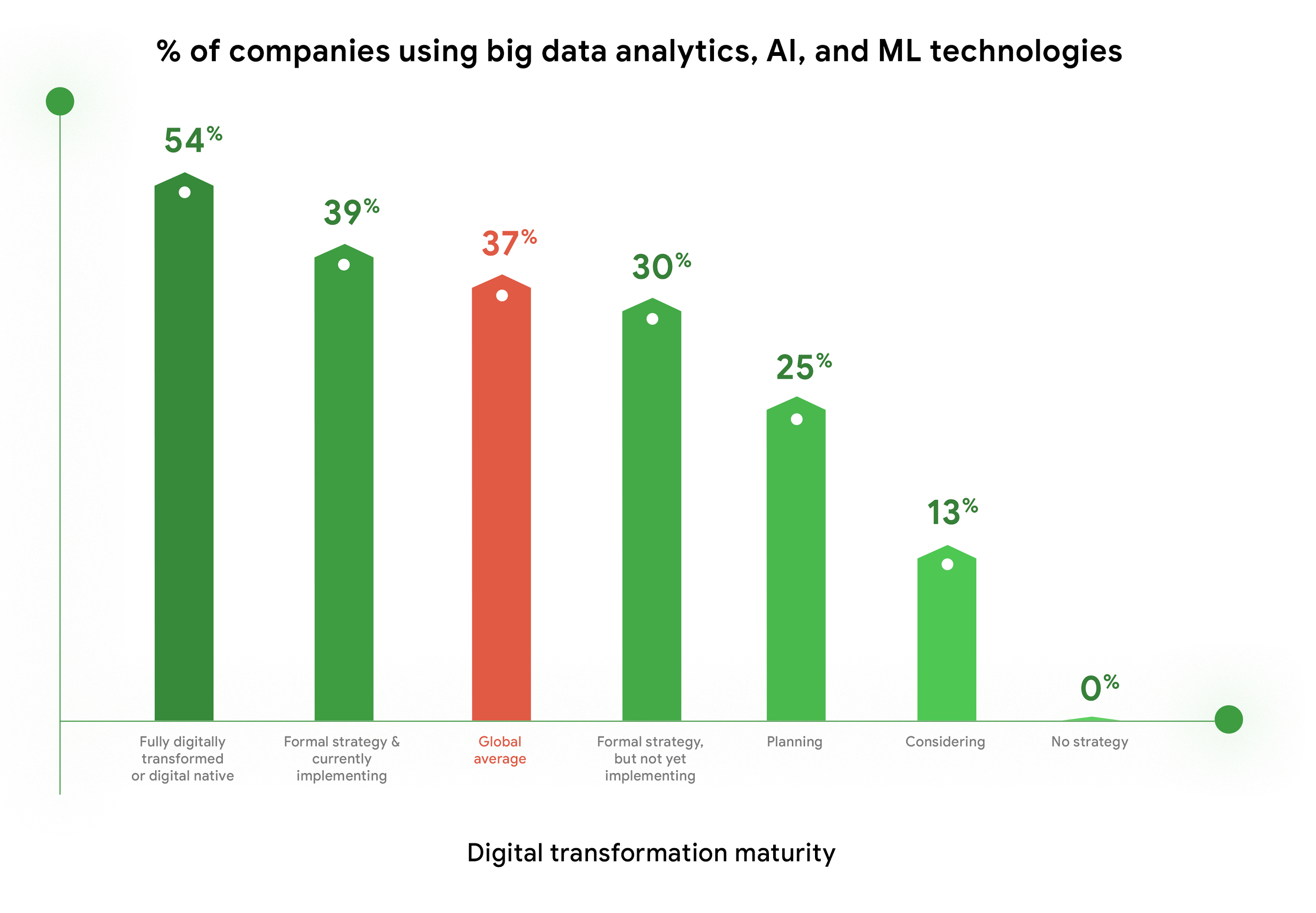
Furthermore, enthusiasm for big data analytics, AI, and ML technologies is highest among companies who are further along in their digital transformation journeys. Fifty-four percent of companies who identify as “Fully digitally transformed” or “Digital native” are using or considering using these tools, vs. the global average of 37%. And, these same organizations are embracing the promise of AI more than their peers. Forty-eight percent felt that “Embedded AI across our full stack of cloud solutions will be critical” vs 39% of digital conservatives. These companies realize these digital tools enable them to be more resilient, agile, and prepared for whatever the future brings.
Companies are turning to cloud to maximize insights from data
As companies tap into the promise of data analytics and AI/ML, they are turning to cloud for help. When considering which cloud providers to work with, 78% of respondents said big data analysis is a “must have” or a “major consideration,” which placed this capability at the top of the list of consideration factors. This is not surprising, as cloud solutions address the most common pain points and barriers to innovation. Three of the respondents’ top four areas impeding innovation are addressed by cloud: Insufficient IT & developer skill sets (1st), security risks and concerns (2nd), and legacy systems and technologies (4th). Plus, cloud makes it easier to quickly launch a project, scale up or scale down, and pay for only what you use.

COVID-19 changed the very nature of business, and of IT. It forced IT leaders to decide where to put their scarce resources and big data analytics and AI/ML were, understandably, at the top of the list. To learn more about the findings, download the IDG report “No turning back: How the pandemic reshaped digital business agendas.”
2918
Of your peers have already watched this video.
36:00 Minutes
The most insightful time you'll spend today!
What’s New in BigQuery, Google Cloud’s Modern Data Warehouse
The demands that today’s enterprise has from data go far beyond the capabilities of traditional data warehousing. For many leaders, the need to digitally transform their businesses is a key driver for data analytics spending.
Businesses want to make real-time decisions from fresh information as well as make predictions from their data in order to remain competitive.
In this video, watch Sudhir Hasbe, Director of Product Management, Data Analytics, Google Cloud and Tino Tereshko, Product Manager, BigQuery, Google Cloud demonstrate what’s new in BigQuery, Google Cloud’s enterprise data warehouse, and hear about all the latest feature innovations and see some amazing demos.
Skyscanner Supercharges Ability to Turn Raw Data into Deep Understanding of Consumer Behaviour, Conversion Jumps 40%

3813
Of your peers have already read this article.
2:30 Minutes
The most insightful time you'll spend today!
Skyscanner is a leading global travel search company covering flights, hotels, and car hire around the world. Founded in 2003, the company helps over 40 million people each month find the best travel options across its portfolio of websites and mobile apps.
Skyscanner wanted to understand the anonymized behaviour of consumers on a more granular level than was possible via standard reports in the Google Analytics Premium web interface or even using the reporting APIs.
“These methods work well for high-level analysis and standard marketing reporting, but we were keen to dig deeper into the data to get more insight and further optimise our products,” explains Mark Shilton, Principal Analyst in the Skyscanner Data Team.
For example, the company wanted to create detailed cohorts to understand how users interacted with Skyscanner over time. Also, different teams in the business were keen to understand the performance of individual pieces of functionality that fell within their remit.
To do this, they needed to understand not just the overall conversion rate, but how users who interact with a given piece of functionality convert compared to those who do not. Skyscanner also wanted drill down into specific markets, devices types, and marketing channels.
Mapping a plan for deeper insights
Skyscanner opted to address all of these needs by integrating Google Analytics Premium with BigQuery. The integration has become the starting point for many detailed investigations across the business.
For example, analysts and engineers now run cohort analyses to understand how frequently users return to Skyscanner and which channels are most effective at which part of the customer journey.
“This type of analysis is allowing a much deeper understanding of our marketing activity and is informing our future strategy and spend,” Mark says.
He reveals that using BigQuery in conjunction with other tools such as Tableau and Python also helps Skyscanner execute analysis much more quickly and efficiently than before.
“While in the past it was tricky to get a fully unsampled report based on specific segments of users flowing directly from Google Analytics Premium into a Tableau dashboard, now it is simply a matter of writing the query, creating a connection in Tableau to automatically refresh the data daily, and publishing this dashboard to the rest of the company.”
Another key benefit of using a flexible combination of tools is the ability to keep an eye on costs.
“Where the aggregations and segments of data are required on a regular basis, we have to consider the potential cost of querying the entire BigQuery dataset multiple times for the same data,” Mark explains. “To minimise this, we use Python scripts to automate these aggregations into new, smaller tables that are much more cost efficient to query.”
Excellent visibility and a clear path ahead
Combining Google Analytics Premium with BigQuery has supercharged Skyscanner’s ability to turn raw data into deep understanding of consumer behaviour.
“We have been using BigQuery for various pieces of analysis, from one-off investigations to powering daily dashboards,” Mark affirms. “In all cases it has speeded up our workflow and enabled us to gain greater insight more quickly. In a fast moving internet economy, this is key. Instead of setting up and scheduling one or more unsampled API reports, analysts can now write a query against BigQuery and have results almost instantly.”
“BigQuery has also allowed us to more easily isolate the effects of marketing from the effects of site changes,” Mark says. “By writing queries that focus on the conversion rate from specific pages in the funnel, we can better segment our traffic. We can separate traffic from various sources, including: specific marketing campaigns, users who make it to specific parts of the funnel, or users who interact with new functionality. This greater understanding has played a key role in improving overall conversion rates on our websites, particularly on mobile where we’ve achieved conversion rate improvements of 30 to 40% on smartphone and tablet devices in the last six months.”
Looking to the future, Skyscanner’s next steps include exploring how this data can be used to segment, cluster, and classify users for machine learning analyses, which would not have been possible using standard reporting functionality.
More Relevant Stories for Your Company


Setting up Data Pipelines Easily for Streaming and Non-Streaming Data
We live in a world of incessant data. Our phones, factory equipment, smart watches, health devices, and other IoT devices are constantly streaming data. Some of the most popular uses of machine learning and AI are also based on streaming data. Think real-time credit card fraud detection, or software that


The Strange Phenomenon AI Revealed at Ride-Hailing Company Go-Jek
Go-Jek, Indonesia’s first billion-dollar startup, has seen an incredible amount of growth in both users and data over the past two years. Many of the ride-hailing company's services are backed by machine learning models hosted on Google Cloud Platform. Models range from driver allocation, to dynamic surge pricing, to food

3 AI Tools You Can Deploy Immediately
AI has the power to revolutionize every industry—from retail to agriculture, and education to healthcare. Yet many businesses still haven’t begun to adopt AI. There are a number of factors, including the need for specialized talent and hardware, the right types and quantities of data for training and refining machine

Google Dataflow Named Leader in The 2021 Forrester Wave™: Streaming Analytics
We are excited to announce that Google has been named a Leader in The Forrester Wave™: Streaming Analytics, Q2 2021 report. Thank you to our strong community of customers and partners for working with us to deliver a customer focused product. We believe Forrester’s recognition is an acknowledgement of our leadership
