





Towards Superior Cybersecurity: How SLSA and SBOM Help Build a Resilient Healthcare Industry

2937
Of your peers have already read this article.
3:30 Minutes
The most insightful time you'll spend today!
Taking prescription medication at the direction of anyone other than a trained physician is very risky—and the same could be said for selecting technology used to run a hospital, to manage a drug manufacturing facility and, increasingly, to treat a patient for a medical condition.
To pick the right medication, physicians need to carefully consider its ingredients, the therapeutic value they collectively provide, and the patient’s condition. Healthcare cybersecurity leaders similarly need to know what goes into the technology their organization’s use to manage patient medical records, manufacture compound drugs, and treat patients in order to keep them safe from cybersecurity threats.
Just like prescription medication, careful vetting and selection of the technology is required to ensure patient safety and establish visibility and awareness into the technology modern healthcare depends on to create a resilient healthcare system.
In this and our next blog, we focus on two topics critical to building resilience – software bill of materials (SBOM) and Google’s Supply chain Levels for Software Artifacts (SLSA) framework – and how to use them to make technology safe. Securing the software supply chain, or where the software we depend comes from, is a critical security priority for defenders and something Google is committed to helping organizations do.
Diving deeper into the technology we rely on
Cybersecurity priorities for securing healthcare systems usually focus only on protecting sensitive healthcare information, like Protected Health Information (PHI). Maintaining the privacy of patient records is an important objective and securing data and systems plays a big role in this regard.
Healthcare system leadership and other decision makers often depend on cybersecurity experts to select technologies and service providers that can meet regulatory rules for protecting data as a first (and sometimes only) priority. Trust is often placed on the reputations and compliance programs of the vendors who manufacture the technology they buy without much further inspection. Decision makers need to approach every key healthcare and life science technology or service provider choice as a high-risk, high-consequence decision, but few healthcare organizations have the skills, resources, and time to “go deep” in vetting the security built into the technology they buy before it enters a care setting.
Vetting needs to include penetrating analysis of all aspects of software and hardware, their architecture and engineering quality, the provenance of all parts that they’re made of, and assessing each component for risk. Doing this can sometimes require deep technical skills and advanced knowledge of medical equipment threats that may not be easy to acquire. Instead of making additional investments to help secure their networks and systems, many organizations choose simpler paths.
The failure to properly assess technological susceptibility to risk has exposed healthcare organizations and their patients to a variety of safety and security issues that may have been preventable. PTC (formerly Parametric Technology Corporation, which makes medical device software) disclosed seven vulnerabilities in March that impacted equipment used for robotic radiosurgery. In October 2019, the VxWorks Urgent 11 series of vulnerabilities was announced, affecting more than 1 billion connected devices, many used throughout healthcare and life sciences. More examples of medical devices and software found to have vulnerable components can be found on the FDAs cybersecurity website and in its recall database.
How a physician understands, selects, and prescribes medication parallels how we address these concerns when selecting technology. Recent FDA guidance suggests manufacturers must soon provide increased levels of visibility into the technologies they market and sell in the healthcare industry. Here’s where the SBOM, a key visibility mechanism, comes in.
What SBOMs do well, and how Google is helping make them better
The National Telecommunications and Information Administration defines the SBOM as a “nested inventory for software, a list of ingredients that make up software components.”
The concept of a SBOM appears to have found its start in enabling software makers back in the 1990s, although it originally stems from ideas popularized by visionary engineer and professor W. Edwards Deming. SBOM as a concept has advanced since then, with multiple standards for generating and sharing them now in use.
Thanks to the continued focus on improving and using SBOMs, we expect it will be much easier for defenders to use SBOMs to track software and its components, where they come from, what security vulnerabilities they contain, and equip protectors with their ability to stop those vulnerabilities from being exploited, at scale, and before they impact patient care.
“Software bills of materials help to bridge the knowledge gap created by running unknown, unpatched software and components as too many healthcare organizations currently do,” says Dan Walsh, chief information security officer at VillageMD, a tech-driven primary-care provider. “For security leaders, SBOM should be an extension of their asset inventory and management capability, regardless of whether that software was bought or built. At VillageMD, we are asking our vendors that store, transmit, receive or process PHI for an SBOM as part of our third-party vendor assessment program.”
Today’s SBOMs are most often basic text files generated by a software developer when the creation of software is complete and a product is assembled (or application is created from source code.) The text file contains information about the product’s software components and subcomponents, where those components and subcomponents came from, and who owns them. But unlike a recipe used to make a pharmaceutical, for example, an SBOM also tracks the software versions of components and subcomponents. SBOMs often capture:
- Supplier Name
- Component Name
- Version of the Component
- Other Unique Identifiers
- Dependency Relationship
- Author of SBOM Data
- Timestamp
Here’s the format of a SBOM generated using the SPDX v2.2.1 standard:
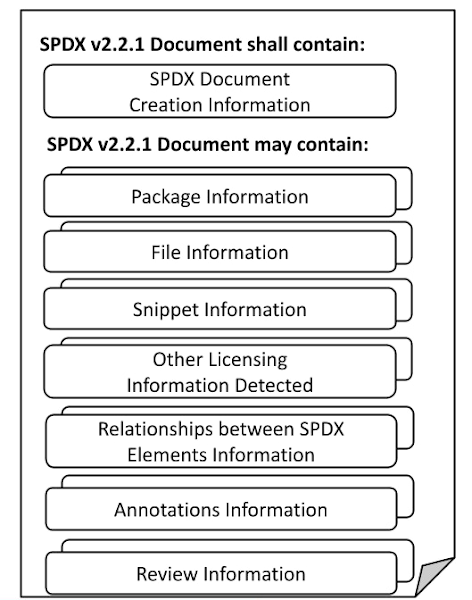
Technology producers, decision makers, and operators in any industry can use this information to deeply understand the risks the products pose to patients and the health system. An SBOM, for example, can show a reader if the software used on a medical device is merely out of date, or vulnerable to a cyber attack that could affect its safe use.
Google sponsors a number of initiatives focused on securing the software supply chain, including how to use SBOMs, through our work with U.S. government agencies, the Open Source Security Foundation, and Linux Foundation, including a project focused on building and distributing SBOMs. Learn about the SPDX project and Cyclone DX, read the ISO/IEC 5962:2021 standard (for SPDX), ISO ISO/IEC 19770-2:2015 (for SWID; another artifact that provides a SBOM), and other training resources from the Linux Foundation.
As an additional measure, healthcare organizations which use SBOM need to make sure they can trust that the SBOMs they rely on haven’t been changed since the manufacturer produced it. To defend against this, software makers can cryptographically sign their SBOMs making it easier to identify if a SBOM has been maliciously altered since it was first published.
While U.S. Executive Order 14028 created a federal mandate for the SBOM, and although many organizations have begun to incorporate that mandate into their software production workflows, many issues and roadblocks remain unresolved. At Google, we think the use of SBOM will help organization’s gain important visibility into the technologies that are entering our healthcare facilities and enable defenders to more capably protect both patient safety and patient data privacy.
Digging into the SLSA
We believe resilient organizations have resilient software supply chains. Sadly no single mechanism, like SBOM, can achieve this outcome. It’s why we created the SLSA framework, and services like Assured Open Source Software. SLSA was developed following Google’s own practices for securing its software supply chain.
SLSA is guidance for securing software supply chains using a set of incremental, enforceable security guidelines that can automatically create auditable metadata. This metadata will then result in a “SLSA certification” to a particular package or build platform. It’s a verifiable way to assure consumers that the software they use hasn’t been tampered with, something which doesn’t exist broadly today. We’ve recently explained more about how the SLSA works in blog posts on SLSA basics and more in-depth SLSA details.
Similarly, Assured Open Source Software gives organizations the ability to use the same regularly tested and secured software packages Google uses to build its software. Used in combination with a SBOM, technology makers can build reliable, safe, and verifiable products. Most technology buyers, such as those who run your local healthcare system, can use those same mechanisms to gain visibility into a technologies’ safety and fitness for use.
Where do we go from here?
Visibility into the components that make up the technology we use to care for patients is critically necessary. We can’t build a resilient healthcare system if our only priority is privacy of data. We must add resilience and safety to the list of our top priorities. Gaining deep visibility into the technology that decorates health system networks is a critical shift we must make. SBOM and SLSA help us make this shift. But remember, it’s not one or the other. As Dan Walsh from VillageMD says, the SBOM has a way to go:.
“It won’t solve all of your problems,” he cautions, but adds that when used correctly, “SBOM will help you improve visibility into the software that runs on the critical systems that keep societies safe and we’re excited to see it get traction.”
But when complemented with SLSA and topics we’ll cover next, such as a Vulnerability eXploitability Exchange (VEX), we are on a path to greater resilience.

6557
Of your peers have already downloaded this article
5:30 Minutes
The most insightful time you'll spend today!
What’s behind the rising confidence in cloud security? First hand experience, and careful, systematic assessments that tap multiple sources such as detailed audits and comparisons. The most frequent driver of increased confidence was the direct experience of the quality of security in the cloud versus on-premises.
As a result, the use of Cloud is expected to rise to 65 percent of workloads by 2019, according to a recent survey of more than 500 global CIOs conducted on behalf of Google Cloud in association with MIT SMR Custom Studio. Increased confidence in cloud security along with the increased need for agility and speed are driving this growth in cloud adoption.
Download this exclusive report and understand why CIOs have a growing confidence in cloud security, how they are basing their hosting decisions on the flexibility and integration offered by the cloud, and their plans to use the cloud for future workloads.
4662
Of your peers have already watched this video.
1:30 Minutes
The most insightful time you'll spend today!
Best Practices to Protect APIs against 6 Common Threats
APIs are exposed to a set of vulnerabilities that are both, unique and similar to that of software and web apps. Watch the video to learn six common API threats and best practices to protect from unwanted attacks.
Building a Stronger Software Supply Chain: Five Essential Steps

2853
Of your peers have already read this article.
2:30 Minutes
The most insightful time you'll spend today!
Today, we published a new Google research report on software supply chain security because we’ve seen a sharp rise in software supply chain attacks across almost every sector —and expect these trends to continue for the foreseeable future. We urge all organizations to act now to improve their software supply chain security.
Among the report’s conclusions, there are two key findings we want to highlight. First, the lessons we’ve learned from various security events call for a more holistic approach to strengthen defenses against software supply chain attacks. Second, we have worked with the security community to develop and deploy a common Supply-chain Levels for Software Artifacts (SLSA) framework that can mitigate threats across the entire software supply chain ecosystem. These frameworks can help organizations securely build and verify the integrity of software. You can find more information on the report’s conclusions here.
We know that modern day software supply chains continue to grow deeper, wider, and more complex. That complexity can make it challenging for customers to even know where to begin analyzing their supply chains for security issues. Our research shows that organizations must deal with these same complex issues regardless of which environments they operate in.
At Google Cloud, we’re deeply committed to working with our customers to help ensure that they have the support they need to evaluate their security posture, resiliency, and hygiene. Below, we suggest five steps to protect software across processes and systems, and tap into relevant Google Cloud products and services. These recommendations can enable customers to benefit from Google’s extensive security experience and reduce their need to develop, maintain, and operate complex processes to secure their open source dependencies.
Implementing best practices with Google Cloud
Customers who are interested in improving their software supply chain security can take immediate steps to implement best practices.
- Enhance your existing Google Cloud security features with the Google Cloud security foundation guide. The guide can help you weigh important considerations including organizational structure, authentication and authorization, resource hierarchy, networking, logging, and detective controls. You can further engage Mandiant experts to assess your readiness.
You can also view centralized information about vulnerabilities and possible risks using Google Cloud services like Security Command Center, and get information about your service usage with Recommender, including recommendations that can help you to reduce risk. For example, you can identify IAM principals with excess permissions or unattended Google Cloud projects. You can also find additional resources from the Google Cybersecurity Action Team (GCAT), our premier security advisory team, here.
- Explore fast software delivery and reliable and secure software with Google Cloud’s DevOps capabilities. You also should review foundational practices for designing, developing, and testing code that apply to most programming languages.
We strongly recommend you evaluate how you distribute software and the terms of software licenses in all of your dependencies. For more information on Google’s approach to helping organizations address vulnerabilities in open source software, see Appendix B in the research report.
- Document the policies for your organization and incorporate validation of policies into your development, build, and deployment processes as you implement best practices. For example, your organization’s policies might include criteria for deployment that you implement with Binary Authorization. GCAT has published additional information on security policies and other cloud security transformation tips for CISOs here.
You can also explore Minimum Viable Secure Product, a security checklist of controls to establish a baseline security posture for a product. You can use the checklist to establish your minimum security control requirements and to evaluate software by third-party vendors.
Tapping into new Google product and service offerings
At Google Cloud, we continue to focus on delivering new and innovative security capabilities to help customers address the latest security threats. From the attack on SolarWinds to the community response to open source vulnerabilities such as Log4j, we’re seeing a spike in demand from customers on what we can do to help them manage software supply chain risk. We’ve made several recent announcements on that front that can help customers get started with Google Cloud today.
- Use Google Cloud’s Software Delivery Shield. It provides a fully managed software supply chain security solution that offers a modular set of capabilities to help equip developers, DevOps, and security teams with the tools they need to build secure cloud applications. Software Delivery Shield spans across a family of Google Cloud services from developer tooling to runtimes including GKE, Cloud Code, Cloud Build, Cloud Deploy, Artifact Registry, and Binary Authorization. To learn more about Software Delivery Shield, check out the solution page, or watch this Google Cloud Next session to get a quick overview of Software Delivery Shield.
- Enable our Assured Open Source Software (OSS) service, which can help enterprise and public sector open source software users to easily incorporate the same OSS packages that we use at Google into their own developer workflows. Packages curated by the Assured OSS service:
- are regularly scanned, analyzed, and fuzz-tested for vulnerabilities;
- have corresponding enriched metadata incorporating Container/Artifact Analysis data;
- are built with Cloud Build including evidence of verifiable Supply chain Levels for Software Artifacts (SLSA)-compliance;
- are verifiably signed by Google;
- and are distributed from an Artifact Registry that is secured and protected by Google.
If you are interested in learning more about software supply chain security in general, please contact us or reach out to your sales representative to schedule a software supply chain security workshop.
End Security Risks with the Unattended Projects Recommender Feature

6119
Of your peers have already read this article.
3:00 Minutes
The most insightful time you'll spend today!
In fast-moving organizations, it’s not uncommon for cloud resources, including entire projects, to occasionally be forgotten about. Not only such unattended resources can be difficult to identify, but they also tend to create a lot of headaches for product teams down the road, including unnecessary waste and security risks.
To help you prune your idle cloud resources, we’re excited to introduce Unattended Project Recommender. It’s a new feature of Active Assist that provides you with a one-stop shop for discovering, reclaiming, and shutting down unattended projects. With actionable and automatic recommendations, you no longer have to worry about wasting money or mitigating security risks presented by your idle resources. Unattended Project Recommender uses machine learning to identify, with a high degree of confidence, projects that are likely abandoned based on API and networking activity, billing, usage of cloud services, and other signals. This feature is available via the Recommender API today, making it easy for you to integrate with your company’s existing workflow management and communication tools, or export results to a BigQuery table for custom analysis.
Thousands of projects can be unattended in large organizations, presenting major security risks
Your cloud projects can go abandoned or unattended for a number of reasons — ranging from a test environment that’s no longer needed, to project cancellation, to project owner switching jobs, and more. Not only can such projects contribute to your cloud bill (waste) but they may contain security issues such as open firewalls or privileged service account keys that attackers can exploit to get a hold of your cloud resources for cryptocurrency mining or, worse, compromise your company’s sensitive data. These security risks tend to grow over time because the latest best practices and patches are usually not applied to unattended projects.
We experience this issue here at Google, too… In fact, it has been on Google’s internal security team’s radar for some time now, so we joined forces and looked into this problem together, starting with our very own “google.com” organization cloud projects. We quickly found some projects that were unattended, but remediating this issue was easier said than done due to challenges in several areas:
- Detection: With lots of signals available to you via sources like Cloud Monitoring, what are the right ones you should look at (e.g. API, networking, user activity)? How can you tell the difference between an unattended project and a project that has a low level of activity by design (e.g. a “shell” project that holds an auth token)?
- Remediation: Once you have identified a project that seems abandoned, how do you go about ensuring that it’s indeed an unattended project? How do you reduce the risk of deleting something that might be essential to a production workload, causing irreversible data loss? How do you solve this at the scale of your entire organization, beyond a one-time cleanup?
Over the course of 2021 we built and tested a Google-internal prototype first, cleaning up many of our internal unattended projects, and then worked with a number of Google Cloud customers to build and tune this feature based on real-life data (thank you to all of our early adopters for working with us and your generous feedback that helped us shape this feature!) It was not uncommon for us to come across organizations with thousands of unattended projects, and we’re very excited to bring Unattended Project Recommender to all customers, in public preview.
Discovering and acting on unattended project recommendations
Unattended Project Recommender analyzes usage activity across all projects under your organization, including the following data:
- API activity (e.g. service accounts with authentication activity, API calls consumed)
- Networking activity (ingress and egress)
- Billing activity (e.g. services with billable usage)
- User activity (e.g. active project owners)
- Cloud services usage (e.g. number of active VMs, BigQuery jobs, storage requests)
Based on these signals, it can generate recommendations to clean up projects that have low usage activity (where “low usage” is defined using a machine learning model that ranks projects in your organization by level of usage), or recommendations to reclaim projects that have high usage activity but no active project owners. Here’s what an example post-processed summary list of recommendations can look like for the “foobar” organization that has 3 projects:
Project ID: demo-project-307815Recommendation: CLEANUP_PROJECTProject ID: new-projectRecommendation: N/AProject ID: bobs-playground-projectRecommendation: RECLAIM_PROJECT
In addition to the recommendations, you can also examine the underlying project activity insights that the recommendations are based upon. The insights provide additional information that can be useful for integration with your organization’s existing workflows and automation (e.g. send an auto-generated email or chat message to project owners based on the list provided by the owners field). Here’s an example insight payload:
content:activeAppengineInstanceDailyCount: 0activeCloudsqlInstanceDailyCount: 0activeGceInstanceDailyCount: 3activeServiceAccountDailyCount: 1apiClientDailyCount: 18922 // Daily average API calls producedbigqueryInflightJobDailyCount: 0bigqueryInflightQueryDailyCount: 0bigqueryStorageDailyBytes: 0bigqueryTableDailyCount: 0consumedApiDailyCount: 0 // Daily average API calls consumeddatastoreApiDailyCount: 0gcsObjectDailyCount: 11gcsRequestDailyCount: 0gcsStorageDailyBytes: 2663548hasActiveOauthTokens: false // OAuth tokens used in the last 180 dayshasBillingAccount: truenumActiveUserOwners: 1owners: // List of project owners- activeOnProject: falsemember: user:user1@example.com- activeOnProject: truemember: user:user2@example.comserviceWithBillableUsage:– Cloud Storage- Compute EnginevpcEgressDailyBytes: 264456938 // Daily average VPC egress bytesvpcIngressDailyBytes: 392435047 // Daily average VPC ingress bytesusagePercentile: 20 // Level of usage relative to other projects
GCP projects are used in many different ways and for many different purposes. In case you get a recommendation to delete a project that’s being used in a way that’s out of the scope for this feature, you can dismiss the recommendation and it will stop showing up for the given project.
Restoring deleted projects
When you choose to shut down a project using the projects.delete() method, it gets marked for deletion. After a project is marked for deletion, it becomes unusable, all resources within that project are shut down, and a 30-day wait period for the project and all of its data to get fully deleted begins.
In case a useful project is accidentally shut down, you have the option to restore the project within that 30-day wait period. Since restoring allows you to recover most but not necessarily all of your project data and resources, we recommend carefully examining the utilization insights associated with a project and considering any additional utilization signals that may not be captured by the Unattended Project Recommender before taking the cleanup action.
Early customer success stories
A number of enterprise customers are already using Unattended Project Recommender to keep their organizations clean of unattended projects and resources.
Decathlon, a French sporting goods retailer, is excited for the insight Unattended Project Recommender will bring to their environment, and are already deploying it as a part of their latest cloud security initiatives.
“After a thorough test of this feature and the validation of our CISO, we ended up deleting our first 775 projects, and no one complained! A great help to improve our security. The next step for us will be to operationalize it at scale, and implement a company wide policy for unattended resource management.” —Adeline Villette, Cloud Security Officer
For Veolia, one of the world’s largest water, waste and energy management companies, not only does this feature reduce security risks and waste, but also helps drive cultural shift and alignment with its ecological transformation strategy.
“This feature allows us to reduce our costs and security debt on assets that are no longer in use, and is also fully in line with Veolia’s philosophy of limiting its carbon footprint. After having tested Unattended Project Recommender on more than 3,000 projects throughout our organization, we are looking to bring it as proactive alerts to our project owners at scale.”—Thomas Meriadec, Product Manager
Box, a secure cloud content management provider, views it as a foundation for building a repeatable process to remediate unused resources.
“Unattended Project Recommender is a great fit for us. It gives us a unified view of project usage across our entire organization and enables us to address security risks of legacy projects in a systematic and organized manner, ensuring an even safer environment.” —Matt Bowes, Staff Security Engineer
Getting started with the Unattended Project Recommender
To help you get started, we’ve prepared a Cloud Shell tutorial (source code) that you can use to find unattended project recommendations within your own Projects/Folders/Organization. Click this button to clone the tutorial from GitHub and run in your Cloud Shell environment:

As you can see, listing recommendations for your projects only takes a few clicks with the tutorial (special thanks to Lanre Ogunmola, Security & Compliance Specialist, for making this look so easy)! For additional detail on using the gcloud CLI or API to discover unattended project recommendations, please refer to the documentation page.
You can also automatically export all recommendations from your Organization to BigQuery and then investigate the recommendations with DataStudio or Looker, or use Connected Sheets that let you use Google Workspace Sheets to interact with the data stored in BigQuery without having to write SQL queries.
As with any other Recommender, you can choose to opt out of data processing at any time by disabling the appropriate data groups in the Transparency & control tab under Privacy & Security settings.
We hope that you can leverage Unattended Project Recommender to improve your cloud security posture and reduce cost, and can’t wait to hear your feedback and thoughts about this feature! Please feel free to reach us at active-assist-feedback@google.com and we also invite you to sign up for our Active Assist Trusted Tester Group if you would like to get early access to the newest features as they are developed.
How to overcome the 5 most common SecOps challenges

3018
Of your peers have already read this article.
3:00 Minutes
The most insightful time you'll spend today!
The success of the modern security operations center, despite the infusion of automation, machine learning, and artificial intelligence, remains heavily dependent on people. This is largely due to the vast amounts of data a security operations center must ingest—a product of an ever-expanding attack surface and the borderless enterprise brought on by the rapid rise of cloud adoption.
All those alerts coming in mean proactive and reactive human decision making remains critical.
Perhaps it should come as no surprise that the information security analyst now ranks as No. 1 News’ 100 Best Jobs Rankings, “determined by identifying careers with the largest projected number and percentage of openings through 2030, according to the U.S. Bureau of Labor Statistics.” Security, and specifically detection and response, is not only a business imperative—it is arguably the top worry on the minds of CEOs.
However, the security analyst is also one of the most likely professionals to want to leave their jobs, according to a newly released “Voice of the SOC Analyst” study conducted by Tines.
What gives? Turnover woes are attributable to several key SecOps challenges that never seem to budge.
1) Alert fatigue and false positives: Have you ever received so much spam or junk mail that you end up ignoring your new messages entirely, leading you to miss an important one? The same can happen for alerts. Too much noise is unsustainable and can lead to the real threats being missed, especially as perimeters expand and cloud adoption increases.
2) Disparate tools: Already in the company of too many point-detection tools, security operations professionals are saying hello to a few more in the era of remote work and increased cloud demands. The latest count is north of 75 security tools that need to be managed by the average enterprise.
3) Manual processes: Use case procedures that result in inconsistent, unrepeatable processes can bottleneck response times and frustrate SecOps teams. Not everything in the SOC needs to—or should be—automated, but much can be, which then frees up analysts and engineers to concentrate on higher-order tasks and be able to more easily train new employees.
4) Talent shortage: Death, taxes, and the cybersecurity skills shortage. As sure as the sun will rise tomorrow, so will the need for skilled individuals to wage the cybersecurity fight. But what happens when not enough talent is filling the seats? Teams must compensate to fill the gap.
5) Lack of visibility: Security operations metrics are critical for improving productivity and attracting executive buy-in and support, but SecOps success can be difficult to track, as reports can require a significant amount of work to pull together.
The caveat of course is that it would be rare to find a SecOps team working without the above challenges. As such, some of the immediate steps you can take to push back against these constraints focus on people-powered processes and technologies to remedy the issues.
According to a recent paper co-authored by Google Cloud and Deloitte:
Humans are—and will be—needed to both perform final triage on the most obtuse security signals (similar to conventional SOC Level 3+) and to conduct a form of threat hunting (i.e. looking for what didn’t trigger that alert).
Machines will be needed to deliver better data to humans, both in a more organized form (stories made of alerts) and in improved quality detections using rules and algorithms— all while covering more emerging IT environments.
Both humans and machines will need to work together on mixed manual and automated workflows.
So, what does this ultimately mean you must do to improve your security operations? Here are five practical suggestions:
Detect Threats More Efficiently
Efficiencies within the SOC can be realized from a SIEM solution that automatically detects threats in real-time and at scale. The right platform will support massive data ingestion and storage, relieve traditional cost and scaling limitations, and broaden the lens for anomaly and machine learning/AI-based detection. With data stored and analyzed in one place, security teams can investigate and detect threats more effectively.
Respond to Threats Automatically
SOAR can be a game-changer in terms of caseload reduction and faster (and smarter, especially when integrated with threat intelligence) response times. But before rushing headfirst into automation, you should consider your processes, review outcomes you are trying to achieve (such as reduced MTTD)–and then decide exactly what you want to automate (which can be a lot with SOAR). Once clear processes are determined where automation can contribute, SOC personnel are freed up to be more creative in their work.
Prioritize Logs
Many teams lack a strategy for collecting, analyzing and prioritizing logs, despite the fact that these sources of insight often hold the clues of an ongoing attack. To help, here are two cheat sheets featuring essential logs to monitor.
Outsource What You Can’t Do Yourself
Process improvements may help you compensate for perceived personnel shortages (for example, perhaps fixing a misconfigured monitoring tool will reduce alert noise). Of course, many organizations need additional human hands to help them perform tasks like round-the-clock monitoring and more specialized functions like threat hunting. Here is where a managed security services provider or managed detection provider can be helpful. Be realistic about your budget, however, as you may be able to introduce some solutions in-house.
Institute Career Models
Lack of management support is cited as the fourth-biggest obstacle to a fully functioning SOC model, according to the 2022 SANS Security Operations Center Survey. To overcome this, SecOps leaders must help improve workflow processes, protect innovation, keep teams absorbed in inspiring and impactful work versus mundane tasks, remain flexible with staff, and endorse training and career development. Because at the end of the day, the SOC is still distinctly human–and that is who will be the difference maker between success and failure.
More Relevant Stories for Your Company

New Certificate Manager Helps Leverage Google’s Network Security and Performance
We’re excited to announce the public preview of Certificate Manager and its integration with External HTTPS Load Balancing. Certificate Manager enables you to use External HTTPS Load Balancing with as many certificates or domains as you need. You can bring your own TLS certificates and keys if you have an

Deep Dive into Google Cloud’s Security Track at the Next 21
In every industry, in every part of the world, cybersecurity concerns continue to grow in the wake of attacks on critical infrastructure and the software supply chain. Governments and businesses of all sizes recognize that they must do more to protect their employees, customers and citizens. But doing more of

Google Cloud to Implement European Commission’s New Privacy Clauses to Safeguard Cross-border Data Transfer
The European Commission (EC) has recently published new Standard Contractual Clauses (SCCs, also known as Model Contractual Clauses) to help safeguard European personal data. Following the applicable transition period, these new SCCs will replace the SCCs previously adopted by the EC. Google Cloud plans to incorporate the new SCCs into our contracts

Security Talks: Addressing the Toughest SOC Challenges with SolarWinds, Chrome, Zero Trust, and More
Security operations teams are facing a “perfect storm” of challenges from nation-state actors turning their attention to financial crime, to rising uncertainty and potential complexities because of rapidly advancing cloud migration and IoT adoption, to the long-lamented skills shortage. Now imagine having to face this trifecta without visibility into your IT and security infrastructure because
