





Start-up Paves Way for More Inclusive Clinical Research: Honoring Black Founders of Acclinate with Google Cloud

8413
Of your peers have already read this article.
4:00 Minutes
The most insightful time you'll spend today!
Editor’s note: February is Black History Month—a time for us to come together to celebrate the diverse set of experiences, perspectives and identities that make up the Black experience. Over the next few weeks, we will highlight Black-led startups and how they use Google Cloud to grow their businesses. Today’s feature highlights Acclinate and its founders, Del and Tiffany.
As patients, as caregivers, and as parents taking our own children to the doctor, we want recommended medications to be safe and effective. It’s a right everyone deserves.
It’s known that certain medications don’t work in the same way in all populations. For example, Albuterol, a medication often prescribed for asthma, is less effective in 67% of all Puerto Ricans and 47% of Black Americans. These problems—which can have deadly consequences—result from historically limited diversity in pharmaceutical clinical trials.
We founded our startup Acclinate to integrate culture and technology to achieve more inclusive clinical research. Help pharmaceutical companies and healthcare organizations access and engage communities of color so research is more inclusive.

Bridging the health equity gap by building trust
It’s important that health research organizations access and engage communities of color so their efforts reflect all the people they serve. Take a disease like diabetes, which affects a significantly higher proportion of Black Americans. When you look at even recent clinical trials for diabetic drugs, the representation of Black Americans among participants is only in the low single digits, despite comprising 13 percent of the U.S. population and more than 40 percent of diabetes patients in this country. Industry leaders have been aware of the lack of diversity issue, but some have chosen to ignore it or brush it aside. The biggest problem, in our opinion, is that there have been no penalties for not achieving higher diversity figures in clinical trials, and only minor financial repercussions to pharma/biotech companies when their treatments either do not work across all groups once approved, or there is a lack of uptake by all groups due to the lack of testing in those groups. The lack of clinical trial diversity has adversely impacted the reputation of the industry and the ability to recruit diverse populations in the future.
Acclinate integrates culture and technology to promote diverse patient representation in medical research. Our approach is not transactional. We build trust through our #NOWINCLUDED community, which is an ongoing, ever-expanding digital platform that educates and engages with communities of color on health issues.
#NOWINCLUDED includes a website app, and social media presence where members can learn information about diseases, particularly those with greater negative impacts on people of color, such as cancer, diabetes, and cardiovascular diseases. Members can share stories and ask questions. By providing access to trusted resources about these health issues and the latest clinical research, we empower Black people to take control of their health and consider participating in research that is shaping the future of healthcare.
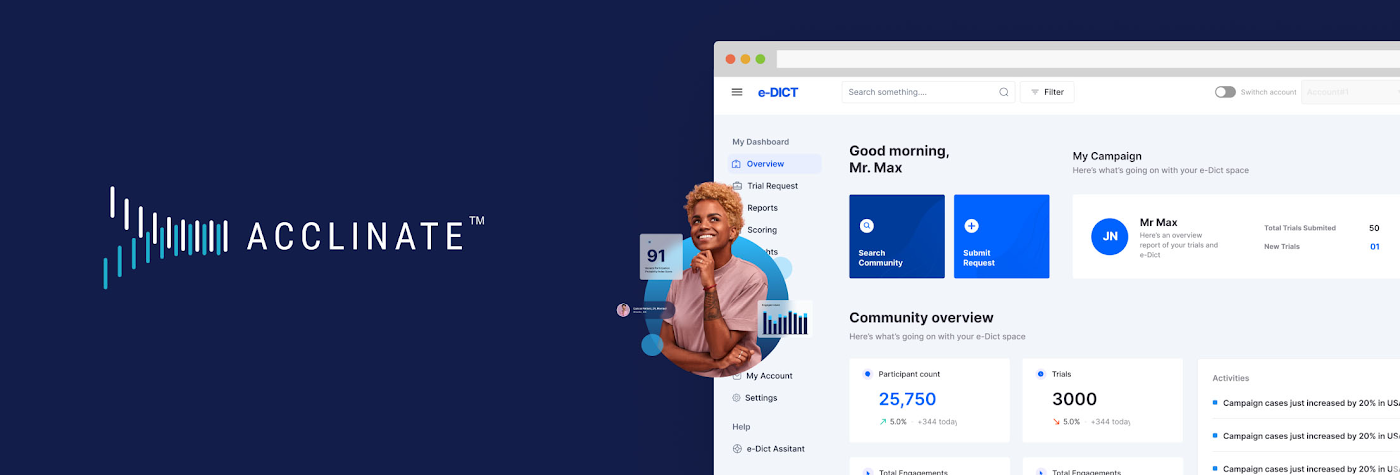
For healthcare-related organizations, we offer the opportunity to better understand the attitudes, aspirations, and unmet needs of underrepresented minority communities. Data from #NOWINCLUDED feeds our HIPAA-compliant SaaS platform, e-DICT™ (Enhanced Diversity in Clinical Trials), which uses predictive analytics and machine learning to identify individuals matching the requirements and most likely to be receptive to participation in a particular clinical trial.
Acclinate scales its platform with Google Cloud
We rely on Google Cloud services, including Vertex AI, to know whom to ask, when to ask, and how to ask for clinical trial participation. With Vertex AI, we enjoy a unified platform for developing our artificial intelligence models, including tools for preparing and storing our datasets. We can easily train and compare models using AutoML, which requires minimal ML expertise or effort with its intuitive graphical interface. This allows us to leverage more than ten ordinal and categorical data points to determine in real time a community member’s likelihood to enroll, which we call our Participation Probability Index (PPI). Our models evolve in an iterative process the more we interact with, and learn about, our community members.
We follow the pay-per-use Google Cloud Platform architecture model using serverless technology, which helps reduce infrastructure management costs and lets us focus on product development and engaging with communities across the U.S.
CloudSQL, a fully managed relational database service, integrates easily with BigQuery so we can glean insights for our clients in real time, all with Google Cloud’s robust security, governance, and reliability controls. Virtual Private Cloud (VPC) gives us scalable and flexible networking for our cloud-based resources and services. We also use Identity and Access Management (IAM) to simplify oversight of Google Cloud resource permissions for different user groups and roles, with appropriate security protections.
API Gateway manages our APIs using Cloud Functions, which both use consumption-based pricing, plus give our developers consistent and highly secure access to our services through a well-defined REST API. We use Memorystore for Redis to reduce platform latency. This is done with a fully managed service powered by the Redis in-memory data store, which builds application caches for fast data access. All of this comes together to provide an outstanding experience for our platform’s users and contributors.
- DSC00049.JPG
- DSC00010 (2).JPG
- pitch del tiff.jpg
Expanding influence with the Google for Startups Accelerator for Black Founders
Three months of one-on-one Google support and mentorship as part of the most recent Google for Startups Accelerator : Black Founders cohort not only helped us build our product, but also helped us earn external credibility. People use Google every day, so whether we’re trying to engage in conversations with industry experts or with somebody in a rural community, it is helpful to have the buy-in of a globally-recognized brand as we take on a historically difficult, systemic issue with challenges around trust. Getting access to the products, best practices, and people we need to build and grow through the Accelerator program has been priceless. For example, working with the Google AdWords team helped us generate important traffic from people interested in learning more about #NOWINCLUDED or sharing their story with us. Jason Scott, who leads the Google for Startups Accelerator: Black Founders program, is still connecting us to people in his network and identifying key opportunities for us months after the program wrapped. He continues to demonstrate that he is invested in seeing us succeed.
Our company has made great progress against our goals, in part thanks to receiving capital from the Google for Startups Black Founders Fund. We received $100K in non-dilutive funding along with Google Cloud credits, Google.org Ads grants, and hands-on support. We used the funds to pay for the transition and development costs associated with moving to Google Cloud. The Google support and accountability has been incredible. After receiving the Google for Startups Black Founders Fund award, we’ve gone on to raise another $1M and moved our cloud from Salesforce to Google Cloud.
We also had the amazing opportunity to be selected as one of six companies to take part in a face-to-face web conference with Sundar Pichai, Google’s CEO. We were thrilled to hear him explain his vision around health equity and the role Google plays. Ultimately, for us, it’s not just about the funding we get, but we are also gratified to receive support from an entity that truly believes in addressing this issue. We know Google is aligned with our mission of health and racial equity.
Championing diversity in clinical trials
Our 2022 looks bright. We expanded our presence to Washington, D.C. as part of the Johnson & Johnson Innovation JLABS ecosystem. We were also selected to take part in the BLUE KNIGHT initiative created between Johnson & Johnson Innovation and the Biomedical Advanced Research and Development Authority (BARDA) under the U.S. Department of Health and Human Services.
Acclinate is also on track to have contracts with five of the top 25 largest biopharmaceutical companies in the U.S this year. They’ve taken note, as has the Food and Drug Administration (FDA), that the lack of diversity in clinical trials represents a significant health concern—to the extent that the FDA has provided strong guidance for pharmaceutical companies to diversify their clinical trials. At the same time, the industry is also responding to pressure from communities of people of color to make equitable representation a priority.
Today, we are in the fortunate but challenging position to have significant inbound opportunities coming our way. In response, we continue to recruit and hire talented people to join our team. On the technology side, we are happy to be aligned with Google Cloud to have powerful cloud infrastructure that will scale with us, as well as high-caliber champions united in partnership. With people’s lives at stake, we are passionate in our commitment to helping ensure medications do what they are supposed to do: heal and improve the quality of life for everyone who takes them.
Hear Acclinate cofounders Del Smith and Tiffany Whitlow chat with Google’s Head of Startup Developer Ecosystem Jason Scott and fellow Black Founders Fund recipient Bobby Bryant about building on Google Cloud in a recent Google for Startups Instagram Live.
If you want to learn more about how Google Cloud can help your startup, visit our page here to get more information about our program, and sign up for our communications to get a look at our community activities, digital events, special offers, and more
AL/ML and Data Products Delivered through Google Cloud Makes them Leader of Gartner 2022 Magic Quadrant

4871
Of your peers have already read this article.
2:00 Minutes
The most insightful time you'll spend today!
Gartner® named Google as a Leader in the 2022 Magic Quadrant™ for Cloud AI Developer Services report. This evaluation covered Google’s language, vision and structured data products including AutoML, all of which we deliver through Google Cloud. We believe this recognition is a reflection of the confidence and satisfaction that customers have in our language, vision, and AutoML products for developers. Google remains a Leader for the third year in a row, based upon the completeness of our vision and our ability to execute.
Developers benefit in many ways by using Cloud AI services and solutions. Customers recognize the advantages of Google’s AI and ML services for developers, such as Vertex AI, BigQuery ML, AutoML and AI APIs. In addition, customers benefit from the pace of progress in the field of Responsible AI and actionable ethics processes applied to all customer and partner solutions leveraging Google Cloud technology, as well as our core architecture including the Vertex AI platform, vision, conversational AI, language and structured data, and optimization services and key vertical industry solutions.
We believe that our ‘Leader’ placement validates this vision for AI developer tools. Let’s take a closer look at some of the report findings.
ML tools purpose-built for developers
Google’s machine learning tools have been built by developers, for developers, based on the groundbreaking research generated from Google Research and DeepMind. This developer empathy drives product development, which supports the developer community to achieve deep value from Google’s AI and ML services. An example of this is the unification of all of the tools needed for building, deploying and managing ML models into one ML platform, Vertex AI, resulting in accelerated time to production. They also cite BigQuery ML, AutoML for language, vision video and tabular data) and prebuilt ML APIs (such as speech and translation) as having high utility for developers at all levels of ML expertise to build custom AI and quickly infuse AI into their applications.
Leading organizations like OTOY, Allen Institute for AI and DeepMind (an Alphabet subsidiary) choose Google for ML, and enterprises like Twitter, Wayfair and The Home Depot shared more about their partnership with Google in their recent sessions at Google Next 2021.
Responsible AI principles and practices
Responsible AI is a critical component of successful AI. A 2020 study commissioned by Google Cloud and the Economic Intelligence Unit highlighted that ethical AI does not only prevent organizations from making egregious mistakes, but that the value of responsible AI practices for competitive edge, as well as talent acquisition and retention are notable. At Google, we not only apply our ethics review process to first party platforms and solutions, to ensure that our services design-in responsible AI from the outset, we also consult with customers and partners based on AI principles to deliver accountability and avoid unfair biases. In addition, our best-in-class tools provide developers with the functionality they need to evaluate fairness and biases in datasets and models. Our Explainable AI tools such as model cards provide model transparency in a structured, accessible way, and the What-If Tool is essential for developers and data scientists to evaluate, debug and improve their ML models.
Clear and understandable product architecture
Google Cloud’s investment in our ML product portfolio has led to a comprehensive, integrated and open offering that spans breadth (across vision, conversational AI, language and structured data, and optimization services) and depth (core AI services, with features such as Vertex AI Pipelines and Vertex Explainable AI built on top). Industry-specific solutions tailored by Google for retail, financial services, manufacturing, media and healthcare customers, such as Recommendations AI, Visual Inspection AI, Media Translation, Healthcare Data Engine, add another layer leveraging this foundational platform to help organizations and users adopt machine learning solutions more easily.
At Google Cloud, we refuse to make developers jump through hoops to derive value out of our technology; instead, we bring the value directly to them by ensuring that all of our AI and ML products and solutions work seamlessly together. To download the full report, click here. Get started on Vertex AI and talk with our sales team.
Disclaimer:
Gartner, Magic Quadrant for Cloud AI Developer Services, Van Baker, Arun Batchu, Erick Brethenoux, Svetlana Sicular, Mike Fang, May 23, 2022.
Gartner and Magic Quadrant are registered trademarks of Gartner, Inc. and/or its affiliates in the U.S. and internationally and is used herein with permission. All rights reserved.
Gartner does not endorse any vendor, product or service depicted in its research publications, and does not advise technology users to select only those vendors with the highest ratings or other designation. Gartner research publications consist of the opinions of Gartner’s research organization and should not be construed as statements of fact. Gartner disclaims all warranties, expressed or implied, with respect to this research, including any warranties of merchantability or fitness for a particular purpose.
3251
Of your peers have already watched this video.
24:00 Minutes
The most insightful time you'll spend today!
An Introduction to MLOps on Google Cloud
The enterprise machine learning life cycle is expanding as firms increasingly look to automate their production ML systems.
MLOps is an ML engineering culture and practice that aims at unifying ML system development and ML system operation enabling shorter development cycles, increased deployment velocity, and more dependable releases in close alignment with business objectives.
In this video, Nate Keating, Product Manager, Google Cloud, will define and give an overview of MLOps and the discuss the challenges at play. He then shares where data science teams are today and where Google Cloud sees them going. Finally he will demonstrate a simple framework for MLOps based on real processes that he has seen in practice.
Learn how to construct your systems to standardize and manage the life cycle of machine learning in production with MLOps on Google Cloud.
Johnson & Johnson Increases it’s Ability to Find Highly Qualified Staffers for Business Critical Roles by 41% with Easy-to-Use AI

5124
Of your peers have already read this article.
3:30 Minutes
The most insightful time you'll spend today!
Job seekers can often feel lost or disconnected—like the right opportunity is out there, but they don’t know where or how to look. Employers face a similar challenge when trying to attract the right candidates. Many companies, especially large enterprises, face a talent shortage across a range of critical roles.
For global companies like Johnson & Johnson (J&J), their online career website is an important recruiting tool. It’s the “front door” for talent that could make a vital difference in the company’s future and drive innovation for years to come.
However, career sites are often underutilized. If a job seeker doesn’t find a good job match with a quick search, they will likely move on. Too often, that represents a lost opportunity for both the company and the job seeker that could have been avoided with better search results.
“Partnering with Jibe and using Cloud Talent Solution for our career site allows us to do a much better job matching opportunity to talent on a very large scale.”
—Sjoerd Gehring, Global VP of Talent Acquisition, Johnson & Johnson
While J&J receives approximately 1 million applications for 25,000 positions each year, the percent of applicants that were highly qualified for open positions was low.
Although the company always has a variety of open jobs on its career site, it noticed that even when strong matches existed between online job seekers and available positions, search results often didn’t highlight or even display the right opportunities. The user interface wasn’t intuitive enough, and job seekers couldn’t easily find their ideal positions.
As J&J began to reevaluate recruiting to take a more relationship-centric and digitally-driven approach, the company began working with Jibe, a career-site solutions provider.
Jibe introduced J&J to Cloud Talent Solution, which uses machine learning to better match job listings with job seekers’ interests and qualifications. Using Cloud Talent Solution, companies can build a compelling career-site search experience that helps candidates easily find the jobs most relevant to them. With smarter job searches and recommendations, J&J improved the effectiveness of its career site in just a few weeks.
“Jibe and Google make it easy for a large company to make a real difference in the candidate experience without investing a lot of time, money, or internal resources,” says Sjoerd Gehring, Global VP of Talent Acquisition at Johnson & Johnson. “Now that we’re using Cloud Talent Solution, our career site search results are exponentially better.”
Transforming job searches with better matches
Cloud Talent Solution better connects job seekers with jobs, because it understands the nuances of job titles, descriptions, industry jargon, and skills, matching job seeker preferences with relevant listings based on sophisticated classifications and relational models. It helps decipher job seeker queries and employer job postings, removing the manual effort of optimizing job content for search.
By using the Jibe platform to integrate Cloud Talent Solution with its career site, job seekers are more easily finding what they’re looking for and J&J is filling business critical roles more efficiently.
Since integrating Cloud Talent Solution, J&J has seen a 41% increase in high-quality job applicants per search and a nearly 45% increase in click-through rate on its career site.
“Partnering with Jibe and using Cloud Talent Solution for our career site allows us to do a much better job matching opportunity to talent on a very large scale,” adds Sjoerd. “We’re able to take a more personal approach and really connect with job seekers, which is a win.”
“Today’s job seekers expect a prospective employer’s career site to work like the other cloud services they use. Using Google’s machine learning and artificial intelligence, we can help customers like J&J get better search results and return jobs that candidates are more likely to apply to.”
—Joe Essenfeld, Founder & CEO, Jibe
Connecting people with opportunities
J&J is now offering job seekers experiences in line with what they have come to expect as consumers—searching for a job should be as easy as searching for flights, restaurants, products, and other services. Because candidates are familiar with the experience, their level of interaction and engagement goes up, creating a larger pipeline of qualified candidates and filling jobs faster.
“Today’s job seekers expect a prospective employer’s career site to work like the other cloud services they use,” says Joe Essenfeld, Founder & CEO at Jibe. “Using Google’s machine learning and artificial intelligence, we can help customers like J&J get better search results and return jobs that candidates are more likely to apply to.”
A new digital revolution for recruiting
J&J continues to work with Jibe and Google to offer new features which make its career site even more effective. By offering job seekers a transformative, engaging experience, J&J is a more attractive and visible employer, increasing the value of its brand. It’s also continuously improving its recruiting process with end-to-end visibility and feedback from interactions with a million people every year.
“Transforming our career site with Jibe and Cloud Talent Solution directly impacts our ability to attract high-quality talent and hire those candidates faster,” adds Sjoerd. “Lots of people are looking for their dream job, and if it’s here at J&J, we want them to find it quickly and easily.”
Global Communication Made Easy with Translation Hub

2498
Of your peers have already read this article.
3:30 Minutes
The most insightful time you'll spend today!
Hello! ¡Hola! 你好! नमस्ते! Bonjour! Being greeted in your own language can instantly put a smile on your face, and organizations around the world recognize that messages become more inclusive and powerful when translated into many languages.
As the Head of Product Management for Translation AI at Google Cloud, I am always looking to make our user’s lives easier when it comes to language tools—like Google Cloud’s Document Translation API, which has been used to translate over 2.5 billion documents across Google Translate and our Cloud customers.
But during my time working on translation products, I have seen enterprise users making compromises, like sacrificing cost and speed of translation for quality, or paying much more for high-quality translations and making peace with the slow turnaround times and high costs. That’s why we are excited to see momentum building behind Translation Hub, which launched earlier this year. Built to address organizations’ localization and translation challenges and delight users with an incredibly intuitive and administratively simple offering, Translation Hub makes it easy to translate content at scale—users just need to select the files to be translated, choose the output languages, and then they’re off and running.
In this article, we’ll take a closer look at Translation Hub’s powerful features, and the ways it is helping customers do more with their content.
Enterprise translation, reimagined: fast, lean, and intuitive
Translation Hub is a fully-managed, self-serve translation offering, powered by Google AI and built for the enterprise. With Translation Hub, businesses can instantaneously translate content into 135 languages with a single click, via an intuitive interface that integrates human reviews (i.e., a “human in the loop”) where required.
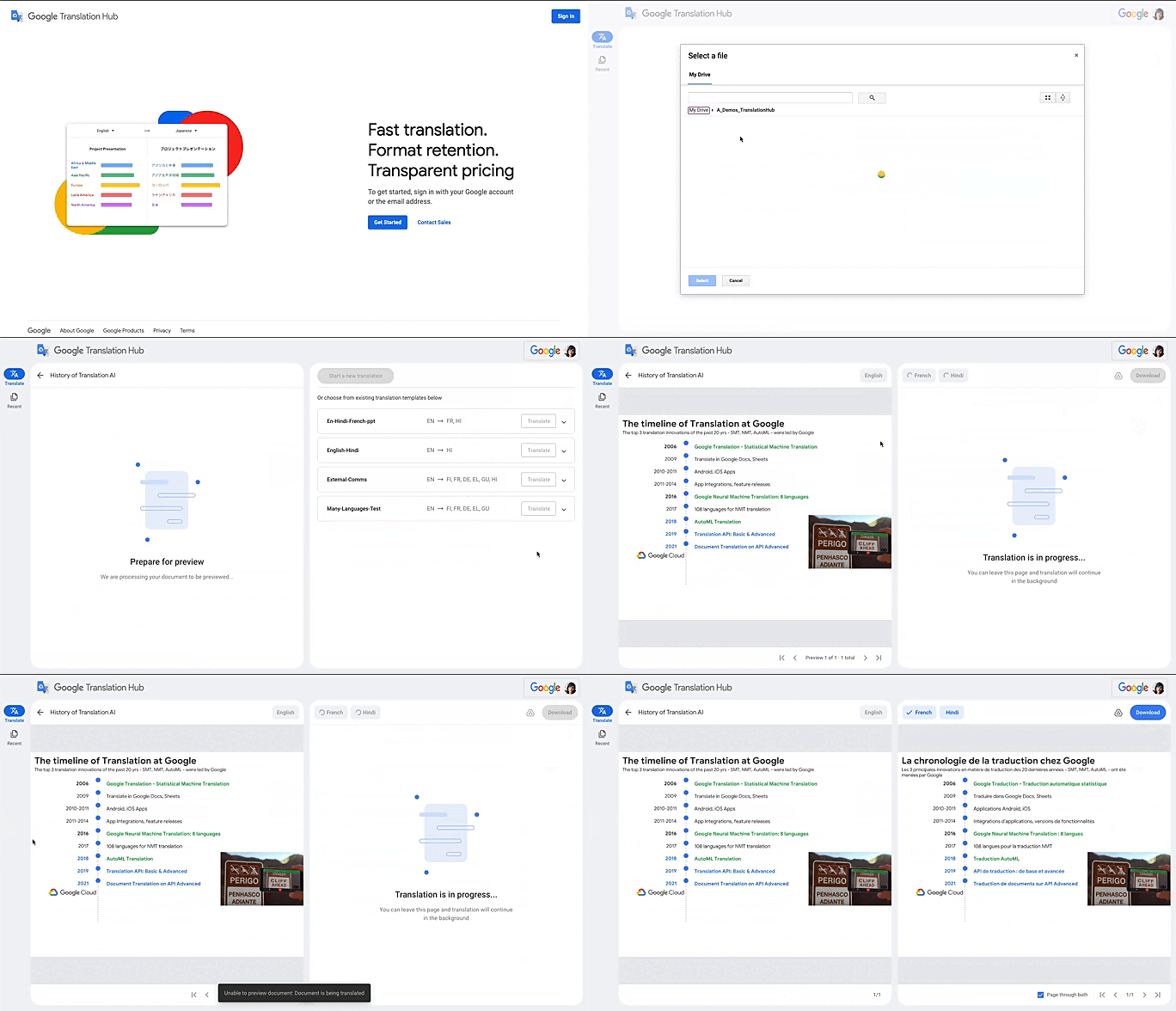
Translation Hub is designed to be both easy to manage and use. Each organization’s Translation Hub administrator uses the Google Cloud console to onboard and manage business users, typically by adding their email, which triggers an invite to the business user. Once a business user is added, they can sign in and start requesting translations and post-editing reviews.
With advanced features like “Glossary” and “Custom Translation Models (AutoML Translation),” Translation Hub makes it easy for enterprises to control the terminology and inject domain-specific context to meet their unique needs. Furthermore, Translation Hub ensures that organizations own their Translation Memory, for use in future translations or to leverage as a rich, human-validated source of training data for custom translation models (e.g., AutoML Translation). For example, when a user edits a phrase or segment through Translation Hub, this is immediately captured and used in the next translation for all future users who initiate translation where the same content or segment appears.
One of my favorite features is that Translation Hub preserves the layout and format of documents, saving both time and money. And while Translation Hub works with Google Drive (you can ingest and export documents to Drive) and is compatible with all our Google Workspace content sources (e.g., Slides, Docs etc.), it also supports many of the most commonly used formats, like documents and presentations created in Microsoft Office, and scanned and native PDFs.
Organizations need to be able to share the output of AI-powered translation with localization teams or agencies, for review. They need to save time by leveraging glossaries or customer machine learning (ML) models. They need these capabilities in one cohesive platform—and they need all of this to be user-friendly for all kinds of business users. It’s the difference between being able to automate translations in a few scenarios and being able to translate at scale. Google Cloud’s mission is to accelerate every organization’s ability to digitally transform, and with Translation Hub, our customers can leverage the best of AI for their content translations without sacrificing speed, quality or cost.
All of Google’s Translation Innovations within a single product
Translation Hub uses Google Cloud’s Translation API, AutoML Translation, and innovations in Neural Machine Translation Quality Prediction and Translation Memory—all technologies we’ve put to good use inside Google. For example, our localization teams have realized more than $80 million in cost avoidance and savings since 2021, using Google Cloud AutoML Translation and localization expertise.
“In just three months of using Translation Hub and AutoML translation models, we saw our translated page count go up by 700% and translation cost reduced by 90%,” said Murali Nathan, digital innovation and employee experience lead, at materials science company Avery Dennison. “Beyond numbers, Google’s enterprise translation technology is driving a feeling of inclusion among our employees. Every Avery Dennison employee has access to on-demand, general purpose, and company-specific translations. English language fluency is no longer a barrier, and our employees are beginning to broadly express themselves right in their native language.”
To get started with Translation Hub, visit our solution page, and for a deep dive, check out this Google Next ‘22 session, including more details about Avery Dennison’s use case.
Google Cloud expands availability of enterprise-ready generative AI

1071
Of your peers have already read this article.
1:30 Minutes
The most insightful time you'll spend today!
Generative AI continues to develop at a blistering pace, making it more important than ever that organizations have access to enterprise-ready capabilities to help them leverage this disruptive technology.
Harnessing the power of decades of Google’s research, innovation, and investment in AI, Google Cloud continues to make generative AI available with baked-in security, data governance, and scalability across the board.
To this end, last month, we announced the general availability of Generative AI support on Vertex AI, giving our customers the ability to access powerful foundation models from Google Research and tools for customizing and applying them.
Today we are announcing the general availability (GA) of four important foundation models for Vertex AI. These include Imagen, PaLM 2 for Chat, Codey, and Chirp. For each of these models, organizations can access APIs on Model Garden and do prompt design and tuning on Generative AI Studio.
- Imagen includes four key features:
- Image generation for creating studio-grade images at scale
- Image editing to edit generated or existing images via text prompts
- Image captioning for creating captions of images at scale
- Visual Question & Answering (VQA) for interacting with, analyzing, and explaining images
- PaLM 2 for Chat follows the general availability of PaLM 2 for Text in June
- Codey supports code generation, completion, and code chat
- Chirp supports multilingual Speech AI
We’re also announcing Multimodal Embeddings API in preview, which lets customers combine the power of Vertex AI’s generative AI models with their proprietary data, to generate embeddings, or interchangeable vector representations, of their text and image data. These capabilities can enable data science teams to deliver a variety of downstream tasks such as image classification, content recommendations, and visual search.
In this blog post, we’ll explore what your organization can do with these powerful models and how Vertex AI provides the enterprise-ready capabilities you can use to get up and running with generative AI.
Helping to drive enterprise value from Generative AI models
Powerful models are the foundation of generative AI, but the software, tools, and infrastructure that surround these models are equally important for enterprise adoption. Organizations face challenges not only accessing these models, but also integrating AI while maintaining protection over intellectual property, adhering to regulations around data security and privacy, and ensuring models and applications are safe to use. Many organizations also want to use generative AI without incurring large costs or managing huge clusters.
We help address these challenges head-on with Vertex AI’s platform capabilities for scalable application integration, purpose-built AI infrastructure, secure and private data customization, and responsible use of this technology.
Let’s see how each of these pillars can help your organization.
Access models to build production-ready generative applications
Vertex AI can make it easy to access foundation models, as today’s model announcements attest. While models are an inextricable part of generative AI, the software that helps enterprises use this technology is equally important—which is why Vertex AI also offers a range of tools for tuning, deploying, monitoring, and maintaining models, so you can build differentiated applications using your own data.
Turning to today’s announcements, in May we announced Imagen, our foundation model for image generation. Now, we are excited to announce Imagen is generally available with an allowlist (i.e., approved access via your sales representative), letting onboarded customers start using image generation and editing capabilities. Visual Q&A and Captioning for production workloads are also generally available for all customers. Visual Q&A provides new ways to engage with image-based data like retail products or image libraries. This new capability can give you answers to questions about an image, helping you analyze large amounts of data quickly, and it can even help the visually impaired understand images or graphs that they wouldn’t be able to otherwise. Captioning, meanwhile, can make it easy to generate relevant descriptions for your images. Captions can help with indexing and searching, as well as assigning image descriptions to product listings on eCommerce websites.
“Imagen is beginning to power key capabilities within Omni, Omnicom’s open operating system, that will enable 17,000+ trained and certified users to create audience-driven customized images in minutes. Imagen has been instrumental in offering a scalable platform for image generation and customization. Integrating it into our platform allows us to expand the scope of audience-powered creative inspiration, at a scale that wasn’t previously possible,” said Art Schram, Annalect Chief Product Officer at Omnicom. “We’re starting to adopt the latest features like styles and fine tuning, and engineering data-driven prompts. We look forward to continuing to provide our users relevant visual inspiration in a responsible way.”
“The latest improvements in Imagen’s product preservation capabilities are a perfect match for Typeface’s focus on personalized AI for brands,” explained Vishal Sood, Head of Product at Typeface. “By combining Google Vertex AI’s Imagen with Typeface’s brand-personalized AI, we are able to help enterprises to create 10x personalized content in a fraction of time.”
Google Shopping recently built an application called Product Studio using Imagen on Vertex AI. Product Studio can enable merchants to create rich product images quickly and easily, at a fraction of the time it takes to do professional product photo shoots. “We’re excited about the feedback we’re getting from merchants in our early pilots, who say that Product Studio, which leverages Imagen on Vertex AI, helps them generate and publish lifestyle product photos directly to their product catalogs,” says Jeff Harrell, Google’s Senior Director of Product Management for Merchant Shopping.
Announced in May, PaLM 2 is a family of models that power dozens of Google products, including Bard and Duet AI in Google Cloud. With the PaLM 2 for Chat model, now generally available, you can leverage Google’s PaLM’s variety of abilities for multi-turn chat applications, such as shopping assistants, customer support agents, and more.
ThoughtSpot, provider of a widely-adopted business intelligence platform, is using PaLM 2 to build a new feature in ThoughtSpot for Google Sheets called “AI Explain,” which can instantly generate explanations of charts, visuals, and anomalies, and will launch new conversational AI and ML-enabled predictive forecasting capabilities into its analytics platform.
With Codey, your organization’s developers can accelerate a wide variety of coding tasks, helping to empower them to work efficiently and close skills gaps. The model enables not only code completion and code generation capabilities, but also chat to help with debugging, documentation, learning new concepts, and more. Since launching in preview in May, we’ve added additional programming languages including Go, Google Standard SQL, Java, Javascript, Python, and Typescript. We’ve also improved the quality of code responses and increased serving capacity, enabling your developers with the right tools to enter the era of generative engineering.
“Security and privacy are key to incorporating AI into the software development lifecycle,” said David DeSanto, Chief Product Officer at GitLab. “GitLab leverages Vertex AI to deliver new, AI-powered features with a privacy-first approach, including the ability to run our own models and leverage Codey foundation models built on top of PaLM 2. The GitLab DevSecOps platform empowers organizations to harness the benefits of AI for faster software delivery, while ensuring their data, intellectual property, and source code are protected.”
Originally released in May in preview, Chirp is a version of our 2 billion-parameter speech model, which was trained on millions of hours of audio and supports over 100 languages. Chirp achieves 98% accuracy on English and relative improvement of up to 300% in languages with less than 10 million speakers. Whether the use case involves customer support, transcriptions, or voice control, Chirp can help your organization communicate with customers and constituents inclusively, by engaging audiences in their native languages.
Last but not least, our Multimodal Embeddings API, now in preview, can unlock an array of new applications, such as image and text-based recommendations, by enabling the processing of text and images interchangeably. This capability complements our Text Embeddings API, which became generally available in June, and remains a recommended choice for those with fully text-based use cases. Multimodal Embeddings API makes it possible to categorize images and text together and can be crucial for use cases like retail recommendation systems that can provide relevant outputs from both images of products and text descriptions.
Match generative AI with infrastructure
Beyond access to models and tools for building generative AI apps, you need infrastructure to make sure your apps can scale and reliably perform — ideally without running into daunting compute costs or management overhead that distracts your technical talent from building innovative products. Google Cloud offers the choice and power to run smaller models running finite tasks at the lowest latency levels, as well as to run large models capable of cutting-edge experiments.
As our large language model customers are looking to scale up their projects and applications using our models, they often need assurances that their requests will be serviced with acceptable performance. This is especially critical for delivering real-time applications where customer service is paramount. Starting in August, Vertex AI will support provisioned, dedicated generative AI capacity that can deliver guaranteed throughput. This feature can be especially beneficial to customers who have a high volume of sustained workloads.
Leverage generative AI while protecting data and privacy
One capability enabled by Google Cloud is the ability to customize models using your own data. Vertex AI can help customers keep their data protected, secure, and private. When a company tunes a foundation model in Vertex AI, private data, model outputs, and prompts can be kept private, and they are never used in the foundation model training corpus. We recently published a whitepaper, “Adaptation of Large Foundation Models,” which outlines how we help protect customer data.
Auditability and compliance are essential to helping ensure the security and privacy of customer data. We also engage in comprehensive GDPR privacy efforts, including our transparency commitments for customer data usage and the support for our customer’s Data Protection Impact Assessments (DPIAs). Now, we’re excited to support HIPAA compliance for many of our generally available models on Vertex AI, so that healthcare and life science customers with whom we have a Business Associate Agreement can run workloads with Protected Health Information (PHI) data on Google Cloud.
Innovate responsibly
Our AI Principles put beneficial use, user safety, and avoidance of harms above business outcomes and are embedded in how we develop our AI products. We’ve conducted extensive reviews on our generative AI products to identify potential risks and have developed guardrails to mitigate these impacts. For example, to address concerns around safety, we’ve implemented safety filters for bias, toxicity, and other harmful content. We also equip our customers with the tools they need to help reduce risk within their applications and provide recommendations to help navigate responsible AI.
Bring the power of generative AI to your organization
With both a wide selection of foundation models and extensive, enterprise-grade platform capabilities, Vertex AI continues to unlock ways for your business or organization to access foundation models, tune them on your proprietary data, and leverage them for differentiated apps and digital experiences. To take the next step, visit our product page or reach out to our sales representatives to gain access to our latest capabilities.
More Relevant Stories for Your Company

What Swiggy and You Can Learn From This Company’s Use of ML to Engage Customers
The app economy has enabled a huge range of unique business models to flourish. One such model is online food ordering and delivery services, in which apps leverage geo-location data to aggregate local food choices and offer personalized options to consumers. A leading company in this space is Just Eat.

Customer Voices: How Firms from Across Industries Leverage Google Cloud
From powering everyday operations and accelerating application innovation, to providing tools for specific business needs and executing on big ideas, to advancing the security of technology solutions, companies from across industries have leveraged Google Cloud for business benefits. Companies from across industries have turned to Google Cloud for transforming their

Transforming the Contact Center Experience with Artificial Intelligence
We meet daily with contact center owners and customer experience (CX) execs across all industries, geographies, and business sizes. Looking back at these conversations, it’s crystal clear that 2022 was a high-stakes year for call centers, with three primary challenges trending across all customers and continuing in 2023: Many organizations

The Data Scientist Guide to Preparing and Curating Data for AI
To design and implement a successful machine learning (ML) project, you often need to collaborate with multiple teams, including those in business, sales, research, and engineering. Understanding the essentials of gathering and preparing your data is crucial to align teams, and getting a project off the ground. Building an ML
