





Serverless for Startups, the Best Way to Succeed: Expert Says

7056
Of your peers have already read this article.
1:30 Minutes
The most insightful time you'll spend today!
As Google Cloud has become a choice for more startups, I’ve experienced an increase in founders asking how they should think about cloud services. Though each startup is different and requirements may vary across industries and regions, I’ve seen a few core best practices that help startups to succeed—as well as several traps to avoid.
For example, If you go with a public cloud provider, you’re ideally not starting from ground zero like you would running your own data center, but it’s important not to introduce similar complexity in a virtualized environment. Just because you’re using public cloud infrastructure doesn’t mean you want to manage it.
Instead, you want to leverage platforms that abstract away complexity so your team can focus on delivering value to customers. That’s where serverless comes in. Serverless platforms are fully managed by the provider, offering automatic scaling for workloads, as well as provisioning, configuring, patching, and management of servers and clusters. Freed from these resource-intensive tasks, your technical talent can focus on the things that differentiate your business, not on IT curation.
This applies to not only running stateless applications, but also managing and analyzing data. You should be collecting data points about which features are most popular on your platform, what people are buying, the types of activities that help your customers get their jobs done, and so on. This information is essential to building and executing on a product roadmap that will serve your customers. However, it’s not enough to collect this data, you need to make your data accessible, secure, and easy for your team to analyze—so where do you run and host it?
On Google Cloud, this is where options like Spanner and Cloud SQL can play a large role, as can BigQuery for analysis. You won’t have to worry about standing up infrastructure or patching servers—you can just stream your data to our data management platforms, where it’s available whenever someone needs to run a query. By leveraging a serverless architecture, your startup can be data-driven without having to invest in the traditional complexity of database administration and management—and that can significantly change your playing field.
Serverless is just one of the factors you should consider as you build out your tech stack. To hear my thoughts on a range of other topics relevant to startups — such as security, cloud credits, and the differences among managed services — check out the below video or visit our Build and Grow page.
Navigating the Next Wave of B2B Digital Commerce: Trends and Insights for 2023

1464
Of your peers have already read this article.
1:30 Minutes
The most insightful time you'll spend today!
Editor’s note: Google Cloud partner commercetools shares how modern technologies like composable commerce, cloud-native infrastructure and artificial intelligence/machine learning (AI/ML) will lead the way in business-to-business (B2B) digital commerce this year.
Digital commerce in B2B has been predicted as the next big thing for years; yet, at the start of COVID-19, 60% of B2B companies had zero or limited eCommerce capabilities. The pandemic accelerated digitization and eCommerce has finally taken off: As of February 2022, 65% of B2B companies offered eCommerce capabilities.
The behavior of B2B buyers is also changing: Consumer-like expectations are at the heart of successful B2B commerce, and this is how manufacturers, distributors and wholesalers will shape their customer experiences. Today, 73% of B2B buyers want a personalized business-to-consumer or B2C-like experience. 83% prefer ordering or paying through digital commerce and 72% are eager to purchase across channels.
With digital commerce dictating how B2Bs will grow in 2023 and beyond, what trends will spur digital transformations across this business model? Here’s what the team at commercetools expects to unfold in B2B eCommerce this year.
#1 B2B firms are switching to cloud-native, composable commerce
B2B players still plagued with manual processes and siloed backend systems will move away from monolithic platforms and choose composable commerce. In a nutshell, composability enables businesses to select best-of-breed components, such as search, cart or checkout, and “compose” them into a custom application.
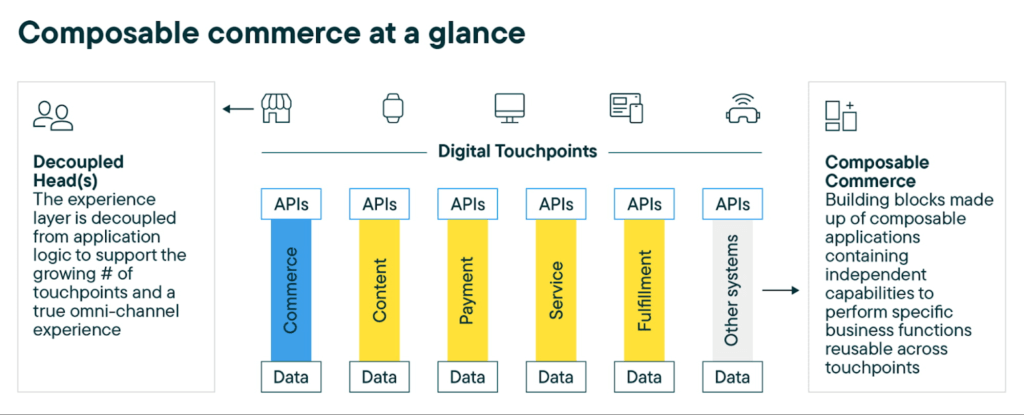
B2B firms will modernize their commerce backend, interoperating siloed systems like Configure Price Quote solutions (CPQs) for sales and enterprise resource planning solutions (ERPs) for order entry with an API-first and composable commerce stack. They will also pivot from on-premise deployments to cloud-native architectures as the baseline for auto-scaling capabilities instead of pre-provisioning online capacity during traffic peaks. That way, B2Bs can customize customer-centric experiences to boost revenue while reducing the complexity and cost of in-house IT infrastructure, as well as gaining operational efficiencies
B2Bs will maximize the cross-section of composable commerce and cloud-native infrastructure by leveraging a commerce backend like commercetools Composable Commerce hosted on Google Cloud. This combined solution provides commercetools’ ready-to-use components built as microservices and exposed as APIs, such as product information management (PIM) and unified cart, integrated through the Google Cloud Marketplace.
#2 Strong focus on data quality and personalization
Focusing on data quality continues to be a big trend in 2023. B2B buyers expect product, pricing, inventory and shipping data points to be accurate across every touchpoint so they can make better purchasing decisions, such as when to order products and calculate quantities.
With so many data points to capture throughout the customer journey — product, inventory, pricing and customer data — we’ll see more B2B companies reorganizing their vast information pools to elevate customer experiences. They will pivot to modular and API-first solutions, plus flexible data models, so they can break data silos from legacy monolithic platforms and access such data when needed.
We also expect to see more customer analytics to unlock data on buyer behavior. By understanding what customers see, click and add to their shopping lists, B2B businesses get valuable insights into how buyers behave, using this data in the shopping journey according to product interests. That way, it’s possible to offer personalized experiences across touchpoints without hassle.
“It is important for B2B companies to look at their data as if it is one of their products; invest in its upkeep and integrity while finding ways to continuously improve it. Using advanced analytics powered by AI and ML to identify patterns from large amounts of data, B2B companies can activate insights into customer decision journeys to maintain loyalty, personalize experiences to improve satisfaction and boost revenue, while also finding ways to optimize costs. For example, with analytics, enterprises can streamline spend to focus on the highest-performing channels and reduce waste.” — Carrie Tharp, Google Cloud VP of Retail and Consumer
With data-driven tools coming into play like Google Cloud’s Discovery AI, Recommendations AI and Vision Product Search connected with composable commerce, B2B players can boost customer analytics to personalize experiences, improve customer satisfaction and reduce churn.
#3 The B2B customer experience will be redesigned
B2B players are taking a page out of the B2C playbook to elevate experiences throughout the customer journey. While intense work needs to happen in the backend commerce engine, B2B players will also redesign their digital frontends. That means boosting website performance, while mobile responsiveness and personalization will be at the forefront of these advanced digital initiatives.
More than ever, B2B companies are looking for digital storefronts delivered as progressive web applications (PWAs) for optimized performance and responsiveness across devices, as well as fast-loading and responsive experiences to boost your digital presence, SEO rankings and conversion rate. B2Bs can further streamline frontend development with solutions natively connecting to Google Cloud Marketplace, which supports a variety of storefront providers, including commercetools Frontend.
Leveraging Google Cloud’s unique capabilities, such as PWA web app development, Google Cloud Discovery AI solutions that include Retail Search and Vision API Product Search, among many others, B2B companies are well positioned to boost digital commerce in the years to come.
What’s next in 2023?
2022 was already a turbulent year; for better or worse, 2023 is expected to have a similar fate. For B2Bs, even the ones with tight budgets, investing in digital commerce can help future-proof businesses for whatever’s happening this year. To dive deeper into all predictions and insights by commercetools in collaboration with Google Cloud, read the guide Pivotal Trends and Predictions in B2B Digital Commerce in 2023.

APAC’s Retail Digital Pulse by Google Cloud and IDC Retail Index
DOWNLOAD TREND ANALYSIS3429
Of your peers have already downloaded this article
15:00 Minutes
The most insightful time you'll spend today!
In the post COVID-19 pandemic world, some retail businesses have aced digital transformation while others are still lagging behind. The Google Cloud commissioned IDC Retail Insights analyzed over 1, 108 retailers across seven nations in the Asia Pacific region and across eight different segments (online, drugstores, speciality shops, convenience stores, department stores, restaurants, supermarkets and hypermarkets/big box stores) to develop Google Cloud Retail Digital Index. The digital maturity was reviewed in five dimensions that define the digital pulse like strategy, people, data, technology and process.
Apart from empowering retail brands to live up to customer expectations, technology is the backbone to back-office operations and still ranks low in the digital pulse. Download the Google-ODC InfoBrief to catch up on the latest, detailed insights on Asia Pacific’s Retail Digital Index along with essential guidance on driving digital transformation, use cases and more!
How a Mid-Sized Firm is Shrinking Inventory Carryovers 50% with AI

7461
Of your peers have already read this article.
5:30 Minutes
The most insightful time you'll spend today!
For more than 10 years, NMK Textile Mills has manufactured bed linens for major retailers in the United States and Canada. As e-commerce exploded, the company’s co-founder saw an opportunity to grow the business. So, in addition to manufacturing bed linens wholesale for retail customers, NMK Textile Mills reworked its complete supply chain to manufacture products for California Design Den, which became an e-commerce retailer selling its own fashion-forward products directly to consumers online.
With California Design Den’s push into e-commerce, it became apparent the SMB company (with about 250 global employees) faced the same tough supply chain questions as large retail customers, including maintaining enough inventory to meet customer demand in a timely, efficient way.
California Design Den depended upon a myriad of systems to track its complex forecasting and reordering processes. Team members typically planned inventory manually using desktop spreadsheet software, which could lead to excess inventory. Accurately forecasting demand and supply was essential to the company’s financial success—but it was also a challenge.
A couple years ago, California Design Den partnered with Pluto7, a technology solutions provider that offers a software as a service (SaaS) called Planning In A Box. Leveraging Google Cloud Platform machine learning and artificial intelligence, Planning In A Box intelligently helps predict demand and balances it with supply.
But that was just the beginning. “Along the way, we realized that to compete with larger retailers, make quicker decisions, and move faster, we needed to go further,” says Deepak Mehrotra, Co-founder and Chief Adventurer at California Design Den.
With guidance from Pluto7, California Design Den began migrating its database to Google Cloud Platform. Using Google BigQuery, Google Compute Engine, Google Cloud SQL, and Google Cloud Storage, and experimenting with Google Cloud Vision and Google Cloud AutoML, the company is reducing inventory carryovers by more than 50%, improving the accuracy of demand planning quarter over quarter, and gaining granular insights into how individual SKUs are performing.
“We would need an army of data scientists to make faster decisions on pricing and inventory levels. With Google Cloud Platform machine learning and artificial intelligence, we don’t need that. We can make much faster pricing decisions to optimize profitability and move inventory.”
—Deepak Mehrotra, Co-founder and Chief Adventurer, California Design Den
No need for army of data scientists
“Using Google Cloud Platform machine learning and AI was essential for California Design Den if it was to compete successfully with larger retailers,” Deepak says.
For example, tastes and fashions in bed linens can change quickly and consumer prices fluctuate. With more than 2,500 SKUs, it wasn’t possible for California Design Den’s team to continuously monitor product demand and experiment with competitive pricing in real time.
“We would need an army of data scientists to make faster decisions on pricing and inventory levels,” says Deepak. “With Google Cloud Platform machine learning and artificial intelligence, we don’t need that. We can make much faster pricing decisions to optimize profitability and move inventory.”
By integrating all its data onto Google Cloud Platform, California Design Den’s team gains deeper insights into product sales over time, which in turn helps the company improve demand planning by better determining which styles to manufacture and sell in the future.
“When experienced employees leave, their knowledge leaves with them. By having all data in one place, and with machine learning and AI, California Design Den can go back in its history, look at products made or sold years ago, and analyze product performance.”
—Deepak Mehrotra, Co-founder and Chief Adventurer, California Design Den
Merging visuals with data
Before Google Cloud Platform, team members had to dig through spreadsheets and run scenarios to get a sense of how particular products had sold. The next step was to perform keyword searches across the company’s photo library in the cloud to find each product’s image. From there, a team member would insert the product images into a presentation, along with relevant data points, to provide a report for stakeholders on how particular styles performed.
Today, California Design Den, with the help of Pluto7, is integrating its entire product image library with its database on Google Cloud Platform. Experimenting with Google Cloud Vision and Google Cloud AutoML, California Design Den is moving towards a day when team members can run sales scenarios and get deep background data on individual product performance while viewing images of the relevant products.
Merging product visuals with data will help designers and team members better understand sales patterns over time and in context. In the past, making correlations between things like which sheet colors sold well in California, compared to how the same sheet colors performed on the East Coast, was something that California Design Den employees primarily did in their heads.
“When experienced employees leave, their knowledge goes with them,” says Manjunath Devadas, Founder and CEO at Pluto7. “By having all data in one place, and with machine learning and AI, California Design Den can go back in its history, look at products made or sold years ago, and analyze product performance.”
“We are literally growing the complexity of our business on all levels, including designing, manufacturing, selling, reordering, inventory holding—everything.”
—Deepak Mehrotra, Co-founder and Chief Adventurer, California Design Den
Reimagining supply-demand balancing
Pluto7’s mission statement is to democratize supply demand balancing with machine learning and AI. California Design Den is a case in point, as the combination of Planning In A Box and Google Cloud Platform gives the company greater control over its destiny.
“Big retailers used to tell us what to manufacture and how much they would pay for it,” says Deepak. “That was our primary business, and if we didn’t accept the terms, a competitor would.” Today, in addition to continuing to make products for retailers, California Design Den can design, make, and sell a variety of designs for itself, including custom and limited-edition products, thanks to Google Cloud Platform and Pluto7 software offerings. The payoff is not only in having a more diversified business. California Design Den also receives more favorable profit margins by selling its own products.
“We are literally growing the complexity of our business on all levels, including designing, manufacturing, selling, reordering, inventory holding—everything,” Deepak says. “We can make smaller batches. We can connect directly with consumers. We can identify the missing pieces—what should we produce next, when, and how much? We otherwise couldn’t afford the level of talent it would take to do this.”
Cutting through the noise
Google and Pluto7 software helped California Design Den reduce inventory carryovers by more than 50%. Inventory tracking and distribution, along with insights and visibility into product sales, are faster, more efficient, and accurate. Google Cloud Platform flexible pricing, speed, reliability, security, and scalability enable California Design Den to stay relevant and be more competitive.
In addition to benefiting from Google Cloud Platform, California Design Den relies on G Suite—also part of Google Cloud—to enhance collaboration among its global teams. Previously, the company’s email server would sometimes crash, due to the heavy load of sharing product photos and other data. “Gmail and Google Drive handle the everyday demands on the business effortlessly and reliably,” Deepak says.
“Google machine learning and AI enable us to cut through all the noise from raw data, so we can see what’s important. We can focus on analytics to guide us to success today and in the future.”
—Deepak Mehrotra, Co-founder and Chief Adventurer, California Design Den
The company is exploring additional ways to leverage Google Cloud Platform in the near future. For example, one possibility is to import customer reviews from sites where products are sold into Google BigQuery, and to use that data to perform sentiment analysis via Google Cloud Natural Language. It could provide another valuable data source to help California Design Den’s team decide where to focus future designs.
“Google machine learning and AI enable us to cut through all the noise from raw data, so we can see what’s important,” Deepak says. “We can focus on analytics to guide us to success today and in the future.”

3828
Of your peers have already downloaded this article
4:30 Minutes
The most insightful time you'll spend today!
Moving to the cloud offers enormous benefits for businesses. Yet there are risks as well. The challenge is multidimensional, with far reaching implications not just for the solutions that will run in the cloud, but also for the technologies that support them, the people who need to implement them, and the processes that govern them.
The rubric of people, process, and technology is a familiar one. But how do you harness it to move forward?
The Google Cloud Adoption Framework builds a structure on the rubric of people, process, and technology that you can work with, providing a solid assessment of where you are in your journey to the cloud and actionable programs that get you to where you want to be. It’s informed by Google’s own evolution in the cloud and many years of experience helping customers.
You can use the framework yourself to make an assessment of your organization’s readiness for the cloud and what you’ll need to do to fill in the gaps and develop new competencies.This framework can help you find your way, from your first project all the way to becoming a cloud-first organization.
Earth Week: Google Cloud at the Heart of Sustainability

3479
Of your peers have already read this article.
1:30 Minutes
The most insightful time you'll spend today!
Today’s Google Doodle reminds us of the enormous changes our planet is experiencing due to climate change. Everyone, from businesses to governments to technologists, has the opportunity to meet this challenge — transforming themselves and their organizations to be more sustainable. For this Earth Day 2022, and indeed Earth Week, Google Cloud celebrates the organizations and individuals who are fighting climate change with innovative technology. We don’t want you to miss a thing, so here’s a recap of all our news in one handy location.
We asked global CEOs: what is it going to take to make progress on sustainability in your org?
In a survey of 1,500 CXOs across 16 countries, many executives say they are willing to do what it takes to have more sustainable practices. But despite their ambition, real measures of impact are lacking. To see what will change that, check out the blog.
We announced a new innovation challenge supporting climate science and research…
Our blog on Monday announced the Climate Innovation Challenge Research Credits program, to support researchers as they work to better understand climate change, increase climate resilience and develop new, promising solutions to urgent climate challenges. You can apply for research credits here.
…and shared stories of researchers making a difference
We interviewed Dr. Richard Fernandes from Natural Resources Canada, who built the LEAF toolbox that maps and assesses vegetation with satellite data from Google Earth Engine. You can read our Q&A here.
Canada has approximately 10 million square kilometers of land and the annual data volume of these maps is equivalent to streaming HD movies for over 750 hours non-stop. Cloud computing allows us to manage all this data in a useful and accessible way.Dr. Fernandes, Research Scientist
We also published a story about the U.S. Department of Agriculture’s Forest Service, and how they use Google Cloud processing and analysis tools to help sustainably manage 193 million acres of land.
We turned the lights on at new clean energy projects in four countries…
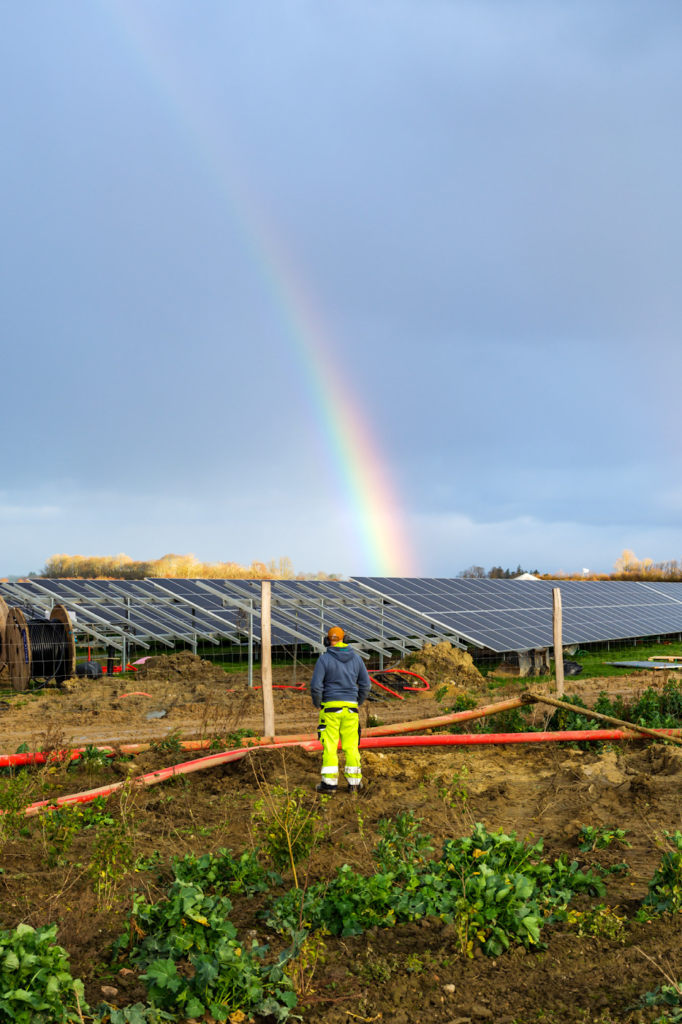
We shared details of our battery project in Belgium, solar projects in Denmark, and wind projects in Chile and Finland. Our battery project in Belgium is the first of its kind, enabling us to switch from diesel generators to a cleaner backup solution that will keep the internet up and running in the event of a power disruption. These will all help us continue to operate the cleanest cloud in the industry.
…and made it easier to learn how to build applications more sustainably
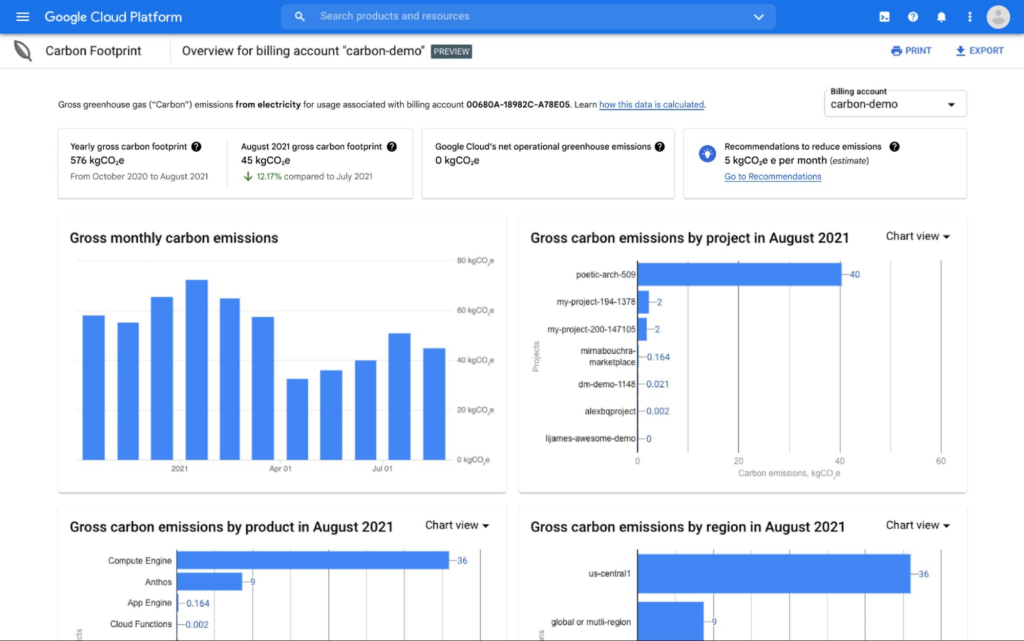
We launched a new lab that walks users through our Carbon Sense suite of products. From using our region picker app to make low-carbon architecture decisions, to analyzing the carbon footprint of your Google Cloud app with Carbon Footprint, we’re building sustainability into the tools you use every day. You can also find Carbon Footprint training in the new Data Warehouse Cloud On-Board.
We formed an ecosystem of partners to help accelerate sustainability projects…
The Google Cloud partner ecosystem is critical to helping our customers act sustainably today. A new whitepaper produced in partnership with Enterprise Strategy Group shares real-world solutions that could make an immediate impact — not in the next decade, but right now.
…and shared stories of innovative startups changing the game with Google Cloud.
Take Enexor and its partners, who are producing clean and sustainable energy from discarded plastics and agro-waste. The blog from Lee Jestings, Enexor Founder & CEO, shares how Google for Startups got them started, and which Google Cloud tools help them build predictive models. Check out their story.
Or Nuuly, the rental and resale business created by the URBN portfolio, which also includes Urban Outfitters, Anthropologie, and Free People. In the blog you can read how Nuuly is using technology to provide a sustainable experience to employees and customers — from upcycling clothing, to recyclable and reusable packaging.
Whether you’re a startup, scientist, executive or developer, at Google Cloud we’ll continue to work hard to help make your digital transformation a sustainable one.
Learn more about our sustainability work here, and don’t miss the inaugural Cloud Sustainability Summit this June. Register now.
More Relevant Stories for Your Company

Held Back by Database Scalability, This Financial Services Company Switches to Google Cloud and Cloud Spanner
Azimut Group operates an international network of companies handling investment and asset management, mutual funds, hedge funds, and insurance. Founded in Milan, Italy in 1988, Azimut Group today has branches in fifteen countries, including Brazil, China, and the USA. “We have subsidiaries and manage funds all over the world,” explains Simone
Forrester and IDC’s Research Confirms Quantifiable Benefits of Running SAP on Google Cloud
Cloud migration is top of mind for most companies with SAP applications. While the advantages of the cloud for SAP customers is generally understood, the move itself can be complicated and disruptive. So what actually are the business benefits and cost savings? How long will it take to recoup such
How Google Cloud’s Scalable Data Storage and High Compute Resources Fuel Investment Research
Investment management is a heavily data-driven industry—portfolio managers and investment researchers require a large number of data sources to guide them in shaping their investment strategies. New cloud capabilities and technologies enable investment managers to process data faster than ever before and iterate on ideas quickly to fuel innovation in

Vimeo Looks to Google Cloud for High-Quality Video Delivery Service
Vimeo is a video-sharing platform that’s home to imaginative video creators and hundreds of millions of viewers. Sixty million people create, host, and sell high-quality videos on Vimeo, including more than 800,000 who subscribe to the service’s premium tools. Over 240 million people in more than 150 countries watch videos
