





Quilkin: How the Open-source UDP Proxy Enables High-performance Multiplayer Gaming

3343
Of your peers have already read this article.
4:00 Minutes
The most insightful time you'll spend today!
Traditionally, dedicated game servers for real time multiplayer games have used bespoke UDP protocols for communication and synchronization of gameplay among the players within a game. This communication is most often bundled into monolithic game servers and clients, pairing the technical functionality of communication protocols, such as custom network physics synchronisation, security, access control, telemetry and metrics, with the extremely high computational requirements of physics simulations, AI computation and more.
Developed in collaboration with Embark Studios, Quilkin is a UDP proxy, tailor-made for high performance real-time multiplayer games. Its aim is twofold:
- Pull common functionality, such as security, access control, telemetry and metrics out of monolithic dedicated game servers and clients.
- Provide this common functionality in a composable and configurable way, such that it can be reused across a wide set of multiplayer games.
This reusable foundation then allows game developers to spend more of their time focusing on building the game-specific aspects of building their multiplayer communication protocols, rather than these common aspects.
Challenges with multiplayer Game Server communication
In fast-paced, multiplayer games, the full simulation of a session of gameplay generally occurs within the memory of a monolithic dedicated game server, whose responsibility covers everything from network physics and AI simulation to communications from client back to server and more.
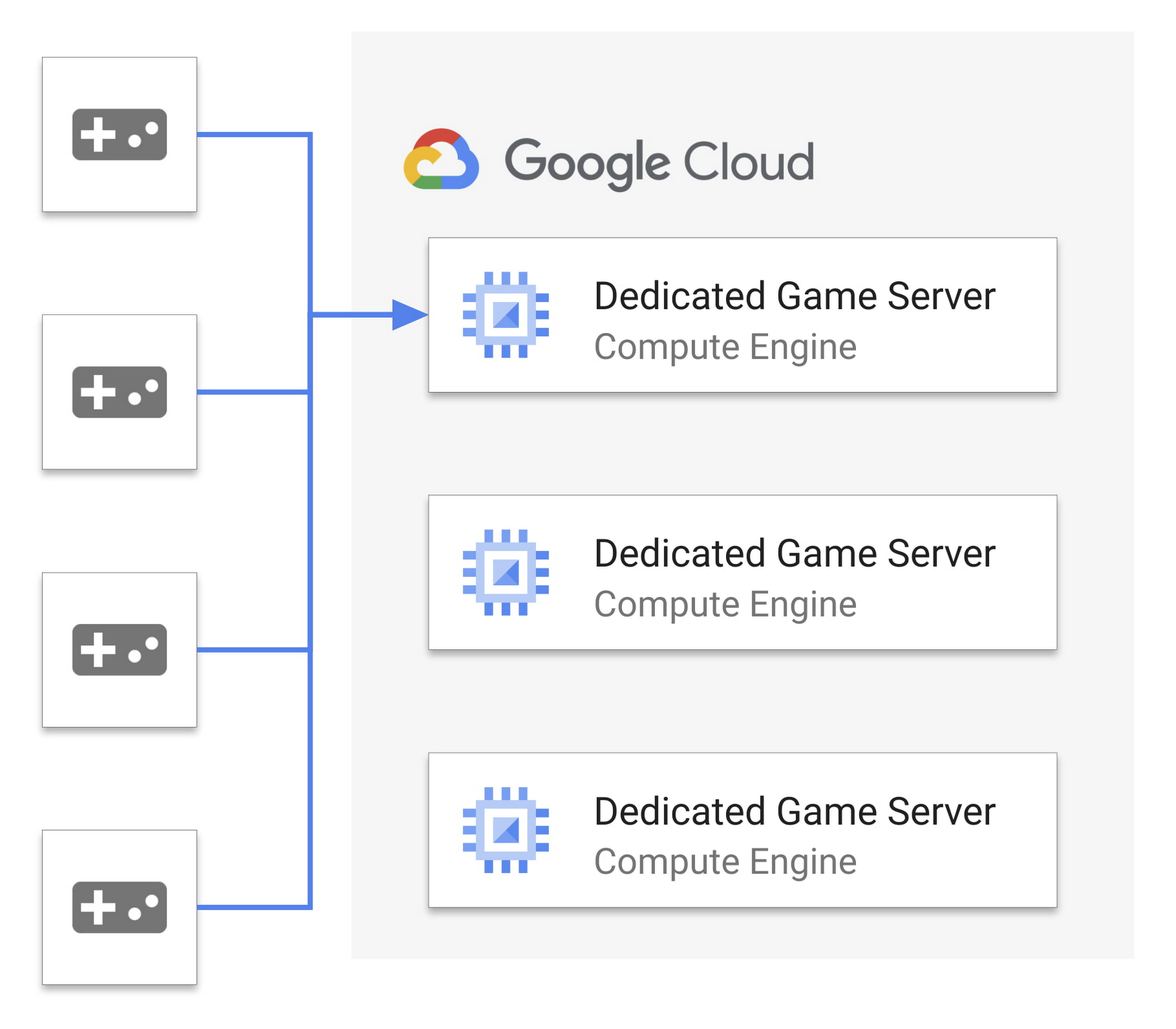
Since the entire state of the game is memory resident, each client connects directly to the dedicated game server the player is playing on, which presents several challenges:
- Each dedicated game server is a single point of failure. If it goes down, then the whole game session (or sometimes multiple sessions) fails. This makes it a target for malicious actors.
- The IP and port of connection to the game server is public, and exposed to the game client, making it easy to discover and target.
- Multiple aspects of game server simulation and network communication are tightly coupled in the same process, making reuse and modularity more difficult, and expanding risk of performance issues.
If we look at both web and mobile technologies over the past several years, some of these challenges start to look very familiar. Thankfully, one of the solutions to help drive dedicated server workloads to more redundant and distributed orchestration is the utilisation of traffic proxies!
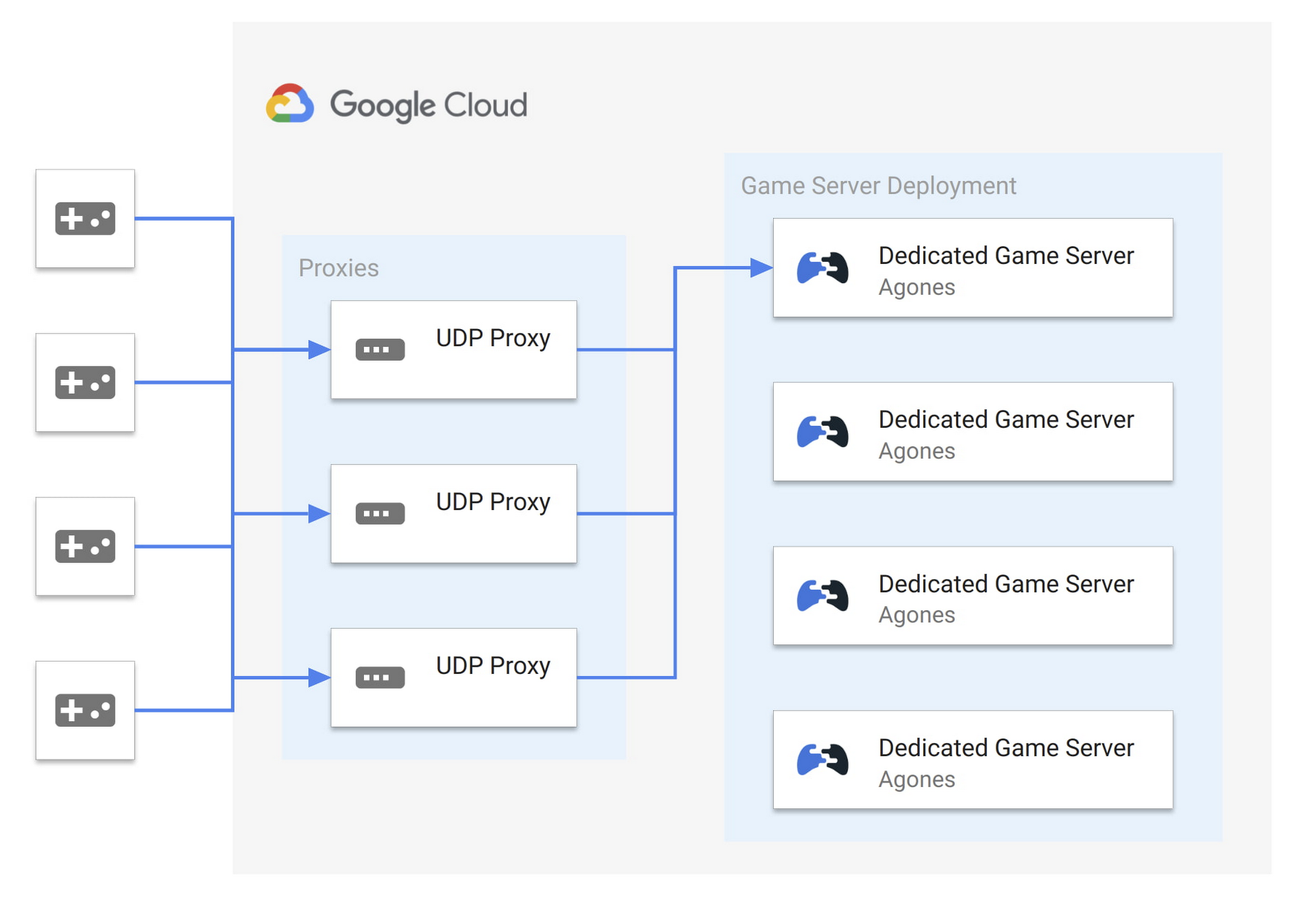
By using a proxy for multiplayer UDP traffic, in front of our dedicated games servers within a low latency network such as what is available on Google Cloud, we can address these key challenges as follows:
- Greater reliability. Proxies provide redundant points of communication entry. UDP packets can be sent to any number of proxies and routed to the dedicated game server. While a dedicated game server will still generally be a single point of failure, proxies improve redundancy and potential failover at the communication layer.
- Greater security. The IP and port of the dedicated game server is no longer public. Game clients may only have visibility into a subset of the proxy pool, limiting a potential attack surface.
- Greater scalability. We start to break apart the single process, as we can move aspects of the communication protocol, metrics, communication security and access control into the proxy. This removes the non-game specific computation out of your game server’s processing loop.
As a result, the entire system is now more resilient as proxies can be scaled independently, not only for performance reasons but also to distribute load in case of malicious actors.
Introducing Quilkin: The UDP proxy for Game Servers
Embark Studios and Google Cloud came together and built Quilkin, to provide a standard, open source solution. Based out of Stockholm, Embark Studios is a (relatively) new studio made up of seasoned industry veterans. They were the perfect collaboration partner to create Quilkin with, given their team’s experience with large scale real time multiplayer games.
Quilkin is an open-source, non-transparent UDP proxy specifically designed for use with large scale multiplayer dedicated game server deployments, to ensure security, access control, telemetry data, metrics and more.
Quilkin is designed to be used behind game clients as well as in front of dedicated game servers, and offers the following major benefits:
- Obfuscation. Non-transparent proxying of UDP data, making the internal state of your game architecture less visible to bad actors.
- Out of the box metrics. For UDP packet traffic and communication.
- Visibility. A composable set of processing filters that can be applied for routing, access control, rate limiting, and more.
- Flexibility. Ability to to be utilised as a standalone binary, with no client/server changes required or as a Rust library, depending on how deep an integration you wish for your system and/or custom processing Filters you wish to build.
- Compatibility. Can be integrated with existing C/C++ code bases via Rust FFI, if required.
- Onboarding. Multiple integration patterns, allowing you to choose the level of integration that makes sense for your architecture and existing platform.
Until now, these sorts of capabilities are only available to large game studios with resources to build their own proprietary technology.
We think leveling the playing field for everyone in the games industry is an important and worthy endeavor. That’s why we collaborated with Google Cloud and initiated this project together.
At Embark, we believe open source is the future of the games industry and that open, cross-company collaboration is the way forward, so that all studios, regardless of size, are able to achieve the same level of technical capabilities. —Luna Duclos, Tech Lead, Embark Studios
Google Cloud is excited to announce Quilkin as the latest entry in our portfolio of open-source solutions for gaming. Quilkin complements our existing OSS solutions including Agones for game servers, Open Match for matchmaking, and Open Saves for persistence. These are designed to work together as an open and integrated ecosystem for gaming. We’re proud to include Embark Studios as our latest open source collaborator for gaming along with Ubisoft, Unity, and 2K Games. Google Cloud will continue to work closely with our partners in industry and the community to offer planet-scale solutions to power the world’s largest games. —Rob Martin, Chief Architect, Google Cloud for Games
Getting started with Quilkin
While Quilkin can support more advanced deployment scenarios like above, the easiest way to get started with Quilkin is to deploy it as a sidecar to your existing dedicated game server. This may initially limit some of the benefits, but it’s an easy path to getting metrics and telemetry data about your UDP communication, with a very low barrier to entry and the ability to expand over time.
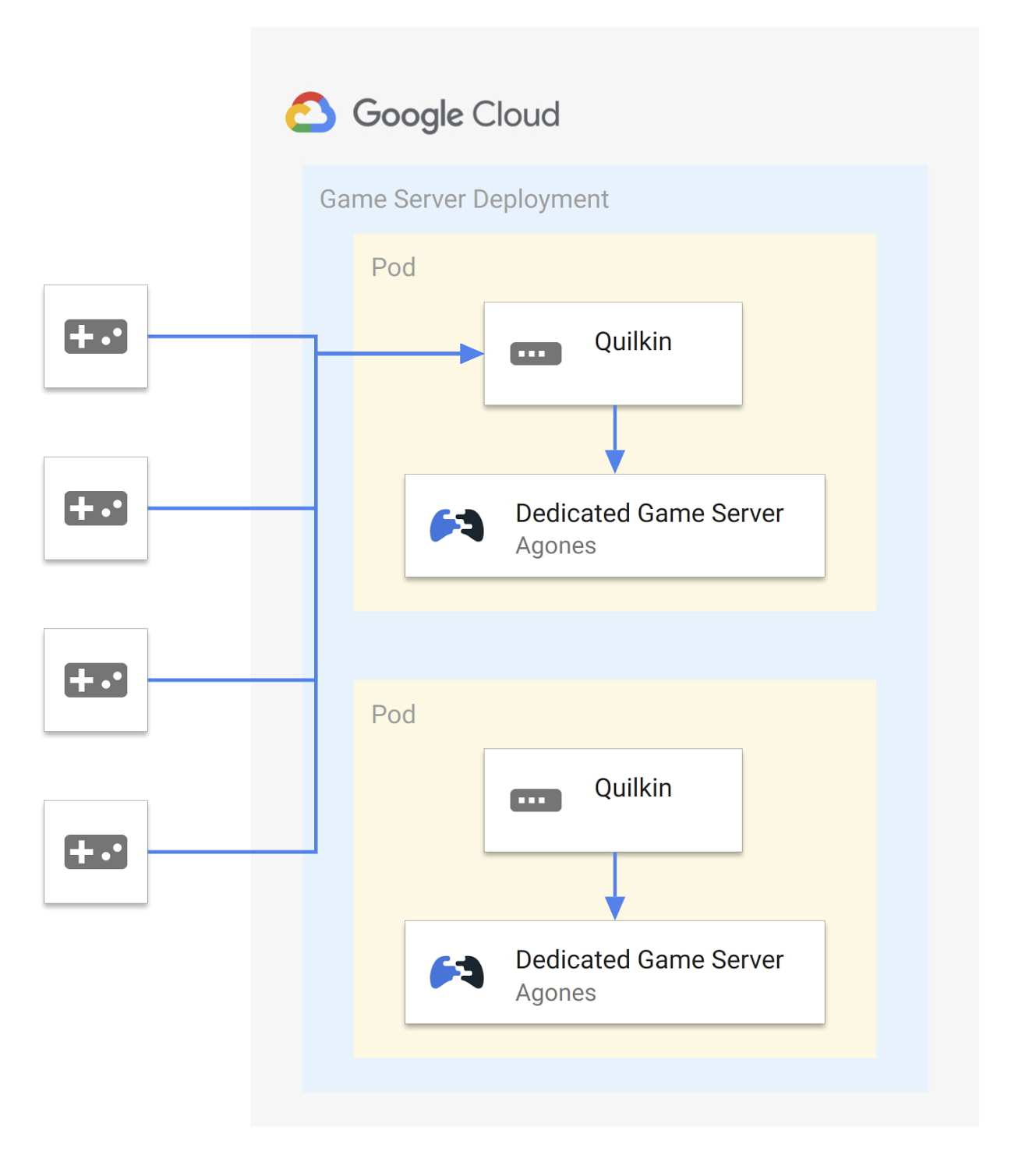
While Quilkin is released as both binaries and container images, and is not tied to any specific hosting platform, we’ll use Agones and Google Cloud Game Servers as our game server hosting platform for this example.
First we will create a ConfigMap to store the yaml for a static configuration for Quilkin that will accept connections on port 26001 and route then to the Xonotic (an open source, multiplayer FPS game) dedicated game server on port 26000:
apiVersion: v1kind: ConfigMapmetadata:name: quilkin-configdata:quilkin.yaml: | # quilkin configurationversion: v1alpha1proxy:port: 26001static:endpoints:- address: 127.0.0.1:26000
Second, we’ll take the example container that Agones provides for the Xonotic dedicated game server, and run Quilkin alongside each dedicated game server as a sidecar, in an Agones Fleet of game servers like so:
apiVersion: "agones.dev/v1"kind: Fleetmetadata:name: xonotic-sidecarspec:replicas: 2template:spec:container: xonoticports:- name: defaultcontainerPort: 26001container: quilkinhealth:initialDelaySeconds: 30periodSeconds: 60template:spec:containers:- name: xonoticimage: gcr.io/agones-images/xonotic-example:0.8- name: quilkin # quilkin sidecarimage: us-docker.pkg.dev/quilkin/release/quilkin:0.1.0volumeMounts:- name: configmountPath: "/etc/quilkin"livenessProbe:httpGet:path: /liveport: 9091initialDelaySeconds: 3periodSeconds: 2volumes:- name: configconfigMap:name: quilkin-config
Once applied, when we query the cluster for the running GameServers, everything looks the same as it would without Quilkin! Nothing else in our system needs to be aware that the traffic is being intercepted, and we can freely take advantage of the functionality of Quilkin without adjusting either client or server code.
$ kubectl get gameserversNAME STATE ADDRESS PORT NODE AGExonotic-sidecar-gdpgn-2pfkc Ready 34.95.106.201 7929 gke-0f7d8adc 25mxonotic-sidecar-gdpgn-c8bds Ready 34.95.106.201 7028 gke-0f7d8adc 25m
If this has piqued your interest, make sure to have a look at the walkthrough, where we step through this same scenario and then extend it to compress UDP packets from the game client to server, without having to change either programs.
This just scratches the surface, however: there’s even more to Quilkin, including an xDS compliant admin API, a variety of existing Filters to manipulate and route UDP packets and more.
What’s next for Quilkin
Quilkin is still in its early stages, with this 0.1.0 alpha release, but we’re very happy with the foundation that has been laid.
There are a variety of features in the roadmap, from enhanced metrics and telemetry, new filters and filter types, and more.
If you would like to try out this release, you can grab the binaries or container images from our releases page, step through our quickstarts and review different integration options with your dedicated game servers.
To get involved with the project, please:
- Check out our Github repository
- Join our Discord community
- Join the quilkin-discuss mailing list
- Follow us on Twitter
Embark Studios has also released their own announcement blog post, going deeper into the plans they have for their own production game backend infrastructure, and where Quilkin fits in.
Thanks to everyone who has been involved with this project across Google Cloud and Embark Studios, and we look forward to the future for Quilkin!
Simplify Your Modernization Journey from Windows

4269
Of your peers have already read this article.
1:30 Minutes
The most insightful time you'll spend today!
Microsoft and Windows on Google Cloud provides a first-class experience for Windows workloads. You can self-manage workloads or leverage managed services and use license-included images or bring your own licenses. Now, easily migrate, optimize, and modernize your Windows workloads for agility and scalability.
Start with migration
Migrate to increase IT agility and reduce on-premises footprint. Tools like Migrate for Compute and Migrate for Anthos can help migrate and upgrade.
Optimize license usage to reduce cost
Optimize VM usage. Managed SQL Server and Active Directory reduce total cost of ownership. Move .NET to .NET core. Move SQL Server to Linux.
Modernize to reduce single-vendor dependency
Create an open path to modernization—containerization of Windows server, cloud-native development, and multi-cloud readiness with Anthos.
Drive a strategy for migration, optimization, and modernization
Plan for the future while reducing your Microsoft licensing dependency. Get all you need to migrate, optimize, and modernize your legacy platform.
Bring your own licenses
In addition to on-demand licenses, Google Cloud provides you with flexibility for bringing your existing licenses and running them on Compute Engine. Use Sole-Tenant Nodes to run on dedicated hardware with configurable maintenance policies to support your on-premises licenses while maintaining workload uptime and security through host-level live migration.
License-included VM images
You can deploy your Windows applications (including SQL Server) on our fully tested images with bundled licenses on Compute Engine and take advantage of many benefits available to virtual machine instances such as reliable storage options, the speed of the Google network, and autoscaling.
Fully managed SQL Server and Active Directory
Use an easy-to-manage and compatible relational database service in the cloud to reduce operational overhead. Use a highly available, hardened service to manage authentication and authorization for your AD-dependent workloads, automate AD server maintenance and security configuration, and connect your on-premises AD domain to the cloud.
Windows on Kubernetes
Running your Windows Server containers on GKE can save you on licensing costs, as you can pack many Windows Server containers on each Windows node.
Google Cloud Infrastructure: What Changed in the Last One Year and What’s in the Future?
3465
Of your peers have already read this article.
3:00 Minutes
The most insightful time you'll spend today!
This past year brought both new challenges and successes for our customers around the world. We thought life was going to return to normal… and then it didn’t. Despite the uncertainty, it was exciting to see customers make huge transformations in when, where, and how they run their businesses, with cloud infrastructure as a major enabler.
According to IDC, “by 2024, 50% of organizations will use applications built on abstraction provided by managed services including cloud-native technologies to enable consistency in running in any and many locations.”1 Over the past year we were honored to work with so many of you to start to make this prediction a reality.
Let’s take a deeper look at where our infrastructure progressed in 2021, and where we’re headed in the new year.
Google Cloud is recognized by independent experts for its leadership
For the fourth consecutive year, Google Cloud was named a Leader in the Gartner Magic Quadrant for Cloud Infrastructure and Platform Services.
The Forrester Wave for AI infrastructure placed Google at the topmost position, a testament to Google’s investments in tomorrow’s AI-first world.
Google Cloud also won the HPC Wire Editor’s Choice award for the best use of HPC in the cloud.
We made it easier to migrate enterprise applications
To support enterprises in their transformation journeys we focused on expanding our support for enterprise applications in our cloud. The Home Depot just wrote about its successful migration of SAP to Google Cloud, highlighting how crucial it is to have good processes and strong partnerships. For other companies using SAP applications we also launched Filestore Enterprise, which delivers 99.99% regional availability backed by an SLA.
Our partner NetApp deepened its integration with Google Cloud to enable easier and faster Windows-based application migration, and provided flexible deployment options to modernize workloads. We also added new Network Connectivity Center partners to include companies like Cisco, Palo Alto Networks, and VMware, so as you migrate over time you can easily connect all your networking resources together in one place.
For those of you considering migration to cloud, Forrester dove deeper into the economics of migrating enterprise applications to cloud. (Spoiler alert: companies are finding major cost savings and performance benefits!) It’s so important to us that companies trust that their biggest, most complex applications will run smoothly and securely with us, and we’re pleased at the progress we’ve made toward supporting more enterprise applications this year.
We also made it easier for you to migrate VMware workloads to the cloud by expanding Google Cloud VMware Engine to 12 regions worldwide and enabling several new capabilities across networking, compliance, and scale. Customers such as Mitel and Carrefour migrated their VMware estates to Google Cloud to transform their applications with Google services to increase agility, save money (up to 45%) and reduce energy costs (about 35%) compared to running on-premises.
For High Performance Computing (HPC), we continued to add capabilities such as optimized VM images for HPC, enhanced integration with schedulers such as SchedMD, Slurm, and Altair PBSPro.
New cost and performance options
To further support customers doing high performance computing for things like real-time advertising, dynamic e-commerce, and gaming, we launched a new VM family: Tau VMs. Tau VMs offer 56% higher absolute performance and 42% higher price-performance compared to general-purpose VMs from any of the leading public cloud vendors. We are seeing companies such as Nylas switching from other cloud platforms to Google Cloud to make the most of Tau VMs.
That isn’t the only VM advancement we made. For customers with higher levels of fault tolerance and looking for greater cost efficiencies, we launched Spot VMs, which open up access to Google Cloud’s idle capacity so you can run your application at the lowest price possible. With Spot VMs, you save anywhere from 60-91% off the price of on-demand VMs.
We also launched more options for the highest performance ephemeral block storage — 6TB and 9TB Local SSDs, which offer greater IOPS per dollar when attached to general purpose N2 Compute Engine VMs.
Distributed cloud brings us closer to you
For years, the industry has been telling companies, “move to cloud!” but not all workloads can move to the public cloud immediately or entirely. Factors include industry- or region-specific compliance and data sovereignty needs, low latency or local data-processing requirements, or the need to run applications close to other services.
In October, we expanded our distributed cloud strategy and announced Google Distributed Cloud, a portfolio of fully managed hardware and software solutions that extend Google Cloud’s infrastructure and services to data centers and the edge. This is a major step forward in our ability to meet you where you are, in private data centers and at the edge, and we’re excited to see how this helps you as we move into 2022.
Data protection and security that never sleeps
This year we worked hard to help improve your data protection capabilities. We doubled down on our Actifio acquisition by launching several releases that deepened its integration with Google Cloud. For customers with containerized applications, we took a big step forward with the launch of Backup for GKE. We’re particularly excited about how this new option for GKE users allows you to more easily meet your service-level objectives, automate common backup and recovery tasks, and show reporting for compliance and audit purposes.
We also enhanced Cloud Storage with data protection features like custom region selection for dual-region buckets. Previously, Google Cloud assigned dual-region pairs for you to choose from. With this release, you can select your own region pairs that meet your regulatory or compliance requirements, or optimize your app performance. We also launched Turbo Replication for dual-region buckets, which replicates 100% of your data between regions in 15 minutes or less, backed by a Service Level Agreement, a first from a leading cloud provider.
Security is a key area of focus for us and we partnered with Palo Alto Networks to deliver their industry-leading Intrusion Detection System (IDS) solution natively on Google Cloud. With the recent Apache Log4j vulnerability, we automatically updated Cloud IDS to help detect exploit attempts and protect our customers’ environments quickly. We also integrated Cloud Armor with reCAPTCHA Enterprise to deliver a best-in-class bot and fraud management solution to prevent volumetric attacks. Cloud Armor is deployed with our Cloud Load Balancer and Cloud CDN, extending its security benefits at the network edge for traffic coming into Google Cloud.
We made it easier to build and manage applications
Developers want to focus on code, not configuring, managing or scaling infrastructure. To help, we worked on simplifying networking with new services such as Private Service Connect, which allows you to connect VPCs to applications and services securely without configuring all the network underlay. To make it easier to run workloads in hybrid environments, we introduced BYOIP so you don’t need to change your IP address, and we enhanced Cloud Load Balancer with advanced traffic management, regional and hybrid app delivery to load balance traffic between on-prem and cloud workloads. We also introduced IPv6, DNS policy manager, Cloud Domains, GKE Gateway Controller, eBPF data plane, and Service Directory, all with the goal of making networking easier for developers.
We continue to invest in visibility and observability for efficient day 2 operations. Network Intelligence Center now has dynamic reachability within the Connectivity Tests module, interconnect and VPN visualization in Network Topology, and the Firewall Insights module, which provides visibility into firewall rules to ensure they are being used appropriately and as intended.
And while not new this year, developers continue to tell us how much they love the ease of architecting storage using Cloud Storage. See how easy it is to configure a dual-region bucket. As a result, developers can treat a continent like a single bucket, dramatically simplifying the application programming model. Google Cloud is unique in offering this capability among major public cloud vendors.
We continue to be the most sustainable cloud for you
Another area Google has invested in deeply and that is becoming increasingly important to more organizations is sustainability. Many cloud providers have a vision for a sustainable future, and many aim to match their electricity consumption with 100% renewable energy by 2025 or 2030. We accomplished 100% renewable energy in 2017, which means we’re the only hyperscale cloud to do this today and on data centers that are twice as energy efficient as the average data center.
We also announced a number of new features like our new Carbon Footprint tool. Every Google Cloud user — that means you! — can see the gross carbon emissions associated with the services you use in Google Cloud. This means picking the data center that meets your sustainability goals, and reducing the overall emissions tied to your infrastructure and applications. And we have some pretty big goals for the future. For more, don’t miss our full sustainability recap.
A big thank you to our customers
While we were busy building out our infrastructure in 2021, we’d be nowhere without the partnership of our amazing customers. It’s hard to pick from all the exciting stories we heard this year, but here are just a few: Pega migrated its SAP applications to Google Cloud with zero downtime. Paypal exited its non-strategic data centers and achieved major cost savings. And Wix used our network to serve tens of millions of requests per day.
I’m proud to look back at how our cloud infrastructure has evolved this year to support each of our customers on their transformation journey. As we head into 2022 I’m excited to continue to partner with you to solve your most difficult challenges together.
Interested in hearing more about Google’s vision for the future? Listen to Thomas Kurian’s thoughts from Google Cloud Next ‘21.
1. IDC FutureScape: Worldwide Cloud 2022 Predictions
VM End-to-end: Series Transcript on Conversation on VMs and their Role to Cloud-native Future

3288
Of your peers have already read this article.
1:30 Minutes
The most insightful time you'll spend today!
VMs and their relevance to a cloud-native future: A conversation
Last week, we published the first episode of VM End-to-End, a series of curated conversations between a “VM skeptic” and a “VM enthusiast”. Join Brian and Carter as they explore why VMs are some of Google’s most trusted and reliable offerings, and how VMs benefit companies operating at scale in the cloud. Here’s a transcript of the first episode:
Carter Morgan (VM skeptic): My team asked me to research VMs and see how they compare to other cloud-native approaches, like microservices, containers, and serverless. And to be honest with you, I am not excited about it at all. So I’ve brought in someone who is, Brian, resident VM expert. Welcome, Brian!
Brian Dorsey (VM enthusiast): Hello. I’m super happy to be here, because I am really excited about VMs.
Carter: How? See this is why I wanted to bring you here. I don’t understand how you can be so excited about VMs, already?
Brian: How can you not? It is like the best of both worlds. You’ve got a stable, reliable system you can run anything on, and you’re in the cloud, close to all of the new features, and you get new automation tooling.
Carter: See, that’s what I’m kind of skeptical about. When I think about the features of a modern system, I’m not sure that a VM can provide me with those.
Brian: Okay. Well, let’s be kind of specific there. What do you mean by a modern system?
Carter: When I think about a modern system, I think about things like modularity. I think about scalability and reliability. I want automation. I don’t want to have to do everything manually. I even think about portability and being able to move my workloads wherever they need to go. I also don’t want to implement everything by hand. I don’t want to have to do everything myself. Is that something I can get with a VM?
Brian: Yeah. Great, because I actually think we can get most of that, and I wonder, why not? Let’s go one level deeper and then we’ll come back out. In your mind, what is a VM?
Carter: Oh, you’re putting me on the spot, Brian?!
Brian: Yep.
Carter: Okay. A VM, it’s a computer, but it’s a virtualization. It’s a slice of a computer. And so, what it lets you do is it lets you run multiple operating systems on one machine, so it looks like you have multiple machines running on one physical machine.
Brian: Yep. Absolutely. And in the cloud kind of not.
Carter: Oh, what?
Brian: Yeah. So here’s why I say not. The obstructions are all there, so you’ve got memory CPU, disk, networking. And instead of from one computer, in the cloud, that’s coming from all of the computers in a data center. So the CPU is coming from a lot of machines. The networking is from the whole data center. And so, I like to think about it as instead of a slice of a computer, it’s a slice of the data center
Carter: Instead of a slice of a computer, it’s a slice of a data center. That sounds interesting. Impressive, even. But also abstract. Do you have some examples of features that you can get from a cloud VM that you can’t get from a traditional VM on one machine?
Brian: My turn to be specific. Yeah. I think one example is like bin packing. You talk about these VMs, and their different shapes. So you have one that needs a lot of CPU and another that needs a lot of memory. Maybe you’ve got a bunch of them that need a lot of CPU and they don’t fit so well in the same box without orphaning some of the memory or CPU. And if you’re running those in a whole data center, or you can basically just leave it to Google to solve that problem, you can just have whatever shape machine you want and we’ll figure out where to put it. Basically, that lets you customize your machines to exactly what you need.
Carter: Okay. That’s very interesting, because that’s a hard problem. And so, if you can just let Google handle where your workloads are going to go, that’s a good benefit. If that’s the only benefit of cloud VMs though, I’m not sure I’m sold on them over other approaches. Is there anything else we got?
Brian: Absolutely. There’s a ton of stuff we could talk about in terms of automation and other things. But I think another really concrete example is disks, and it’s kind of my favorite there, because you think about a physical disk and you read and write blocks from it, right? It’s a block device. In the data center level, those blocks could be on hundreds or thousands of different machines, and so all of them are working together to give you more reliability and make things smoother, more predictable in terms of performance. So what you get out of it is something that looks a lot like a SAN, you can take backups of disks that are running even, or if you’ve run out of space, like I think almost all of us have, you can just make the disk bigger. So, things like that.
Carter: That’s impressive, especially like you’re saying being able to run and just scale up, scale down or resize. Okay. Then another very targeted question. It’s going to sound like a dig. I don’t mean it to you. Google’s putting a lot of effort and resources into Google Kubernetes Engine (GKE). And so, is Google even still investing in VMs?
Brian: Absolutely. Where do you think these containers run? Every Kubernetes cluster is running on top of a whole bunch of VMs. And so, everything you learned about VMs applies to those clusters that you’re running. Also, another example is our managed databases, so Cloud SQL. So if you’re running Postgres or MySQL on a Cloud SQL, that’s running on VMs. And there’s a bunch of other examples, too.
Carter: I can’t get away from VMs, even if I tried, it sounds like.
Brian: Nope.
Carter: Okay. The way you’re saying that is making me think that maybe I need to rethink my idea that VMs are just old, dusty pieces of technology. So I want to be clear, definitively, are you saying that VMs have a place in a cloud-native future?
Brian: Absolutely. I want to take old and dusty and turn that into mature and reliable. Then the future part, all these things are built on top of it and we’re building new things over time. So we’ve got tools for scaling clusters of machines up and down. That’s using Kubernetes, but you can use it directly. And we keep investing and doing more and more things there. So, absolutely, part of the future as well.
Carter: Okay. Then what about if I wanted to switch to them? I’m pretty familiar with Kubernetes. It’s fairly easy to get started. What about with VM? Is it going to take me years to get started on these?
Brian: No. It’s just a computer. Basically, anything that’s already running on a computer somewhere, even if you don’t have the team who built it nearby, you can run that on a VM and in turn you can run it on a cloud VM and get a bunch of the cloud benefits as well.
Carter: All right. I must admit that you’ve swayed me a little bit. I’m still skeptical, but what you said made a lot of sense. I still have a lot of questions. I want to know about keeping costs down. I want to know how to update VMs. I have this idea in my head that they’re really slow to start and stop. Stateful data, I’m curious about that.
Brian: Awesome. How much time do you have?
Carter: All right. You know what, let’s have this convo another day, and maybe, just maybe we can agree that VMs do matter in a cloud-native future.

3594
Of your peers have already downloaded this article
1:30 Minutes
The most insightful time you'll spend today!
Through customer interviews, a survey, and data aggregation, Forrester concluded that migrating and running SAP on Google Cloud has a number of benefits, including financial benefits.
Download this Forrester infographic to understand the 3-year financial impact it can have on your organization.
Macy’s Uses Google Cloud to Streamline Retail Operations

3607
Of your peers have already read this article.
2:15 Minutes
The most insightful time you'll spend today!
As retailers strive to meet the growing expectations of shoppers, they are turning to Google Cloud to transform their businesses and tackle opportunities in an increasingly challenging industry. From optimizing inventory management to increasing collaboration between employees across locations and roles, to helping build omnichannel experiences for their customers, we are working together with retailers to help make the shopping experience as seamless and personalized as possible.
A standout Google Cloud customer is Macy’s, one of the world’s largest retailers. Founded in 1858, Macy’s operates approximately 680 Macy’s and Bloomingdale’s, and 190 specialty stores including Bloomingdale’s The Outlet, Bluemercury and Macy’s Backstage. And through macys.com, bloomingdales.com, and bluemercury.com, it also serves millions of customers across more than 100 countries.
By moving its infrastructure to the cloud, and taking advantage of Google Cloud data warehousing and analytics solutions, Macy’s is streamlining retail operational functions across its network.
With the opening of its new approximately 675,000 square-foot distribution center in Columbus, Ohio, Macy’s is leveraging the scalability of Google Cloud to ensure that merchandise is accurately and efficiently received, sorted, ticketed, picked, packed and shipped from the distribution center to the stores—even during peak retail seasons like back to school and the holidays.
“Powered by software developed at Macy’s technology, this new distribution center is a fantastic first step in our cloud journey. Working with Google Cloud allows us to be more nimble, efficient and flexible in how we utilize our warehouses,”
Naveen Krishna, CTO, Macy’s
Leveraging Google Cloud’s data management and analytics solutions, Macy’s new warehouse management system will initially service 200+ Macy’s Backstage off-price stores at launch. Macy’s will begin rolling out this software solution to additional distribution centers that service its nationwide fleet of Macy’s and Bloomingdale’s department stores, as well as Macys.com and Bloomingdales.com direct-to-customer orders.
Our continued work with Macy’s reflects their investment in technology to improve digital and mobile experiences, site stability, store technology, fulfillment, and logistics, and integrate its front line and back office to reinvent retail. I look forward to deepening our partnership with Naveen and his team to help them achieve these goals.
More Relevant Stories for Your Company

Google Cloud and Ericsson to Deliver 5G and Edge Cloud Solutions
Editor’s note: 5G is much more than a network—it’s a platform for innovation with the ability to provide immediate global scale and enable use cases that we haven’t even dreamed of yet. But to achieve this, industry players must come together to drive this growing ecosystem. Today, Erik Ekudden, CTO
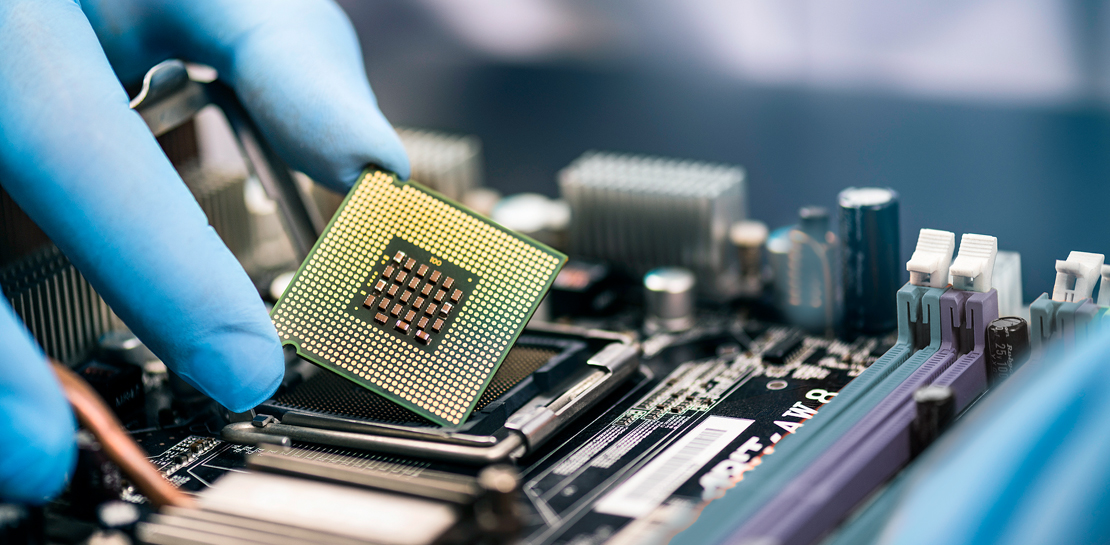
Towards The Next Wave of Google Cloud Infrastructure Innovation: New C3 VM and Hyperdisk
Meeting the rapidly growing demands of our customers’ high performance computing and data-intensive workloads requires deep innovation — at Google Cloud, we know we can’t rely on ever-faster CPUs alone, like Moore’s Law has enabled in the past. Customers can either optimize their workloads for a given platform, or we

Dataflow Guarantees 50+% Increase in Developer Productivity and Infrastructure Cost Savings: Read More
In our conversations with technology leaders about data-driven transformation using Google Data Cloud - industry’s leading unified data and AI solution - , one important topic is incorporating continuous intelligence to move from answering questions such as “What has happened? to questions like “What is happening?” and “What might happen?”.

Innovation in the Clouds: Sky’s Blue-Sky Approach to FinOps
Google Cloud’s partnership with Sky Group, one of Europe’s largest media and entertainment companies, dates back more than four years to when Sky first became a Google Cloud customer moving diagnostic data from millions of its Sky Q TV boxes to its Google Cloud data platform. In June 2019, a
