





Navigating the Next Wave of B2B Digital Commerce: Trends and Insights for 2023

1467
Of your peers have already read this article.
1:30 Minutes
The most insightful time you'll spend today!
Editor’s note: Google Cloud partner commercetools shares how modern technologies like composable commerce, cloud-native infrastructure and artificial intelligence/machine learning (AI/ML) will lead the way in business-to-business (B2B) digital commerce this year.
Digital commerce in B2B has been predicted as the next big thing for years; yet, at the start of COVID-19, 60% of B2B companies had zero or limited eCommerce capabilities. The pandemic accelerated digitization and eCommerce has finally taken off: As of February 2022, 65% of B2B companies offered eCommerce capabilities.
The behavior of B2B buyers is also changing: Consumer-like expectations are at the heart of successful B2B commerce, and this is how manufacturers, distributors and wholesalers will shape their customer experiences. Today, 73% of B2B buyers want a personalized business-to-consumer or B2C-like experience. 83% prefer ordering or paying through digital commerce and 72% are eager to purchase across channels.
With digital commerce dictating how B2Bs will grow in 2023 and beyond, what trends will spur digital transformations across this business model? Here’s what the team at commercetools expects to unfold in B2B eCommerce this year.
#1 B2B firms are switching to cloud-native, composable commerce
B2B players still plagued with manual processes and siloed backend systems will move away from monolithic platforms and choose composable commerce. In a nutshell, composability enables businesses to select best-of-breed components, such as search, cart or checkout, and “compose” them into a custom application.
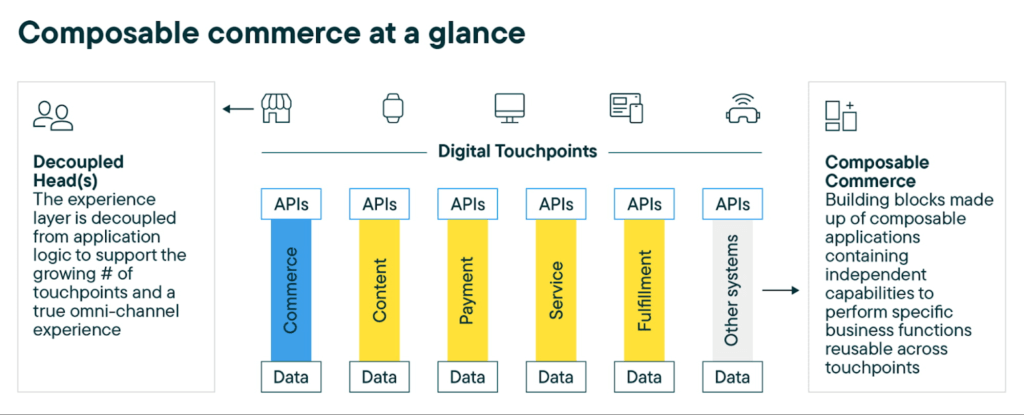
B2B firms will modernize their commerce backend, interoperating siloed systems like Configure Price Quote solutions (CPQs) for sales and enterprise resource planning solutions (ERPs) for order entry with an API-first and composable commerce stack. They will also pivot from on-premise deployments to cloud-native architectures as the baseline for auto-scaling capabilities instead of pre-provisioning online capacity during traffic peaks. That way, B2Bs can customize customer-centric experiences to boost revenue while reducing the complexity and cost of in-house IT infrastructure, as well as gaining operational efficiencies
B2Bs will maximize the cross-section of composable commerce and cloud-native infrastructure by leveraging a commerce backend like commercetools Composable Commerce hosted on Google Cloud. This combined solution provides commercetools’ ready-to-use components built as microservices and exposed as APIs, such as product information management (PIM) and unified cart, integrated through the Google Cloud Marketplace.
#2 Strong focus on data quality and personalization
Focusing on data quality continues to be a big trend in 2023. B2B buyers expect product, pricing, inventory and shipping data points to be accurate across every touchpoint so they can make better purchasing decisions, such as when to order products and calculate quantities.
With so many data points to capture throughout the customer journey — product, inventory, pricing and customer data — we’ll see more B2B companies reorganizing their vast information pools to elevate customer experiences. They will pivot to modular and API-first solutions, plus flexible data models, so they can break data silos from legacy monolithic platforms and access such data when needed.
We also expect to see more customer analytics to unlock data on buyer behavior. By understanding what customers see, click and add to their shopping lists, B2B businesses get valuable insights into how buyers behave, using this data in the shopping journey according to product interests. That way, it’s possible to offer personalized experiences across touchpoints without hassle.
“It is important for B2B companies to look at their data as if it is one of their products; invest in its upkeep and integrity while finding ways to continuously improve it. Using advanced analytics powered by AI and ML to identify patterns from large amounts of data, B2B companies can activate insights into customer decision journeys to maintain loyalty, personalize experiences to improve satisfaction and boost revenue, while also finding ways to optimize costs. For example, with analytics, enterprises can streamline spend to focus on the highest-performing channels and reduce waste.” — Carrie Tharp, Google Cloud VP of Retail and Consumer
With data-driven tools coming into play like Google Cloud’s Discovery AI, Recommendations AI and Vision Product Search connected with composable commerce, B2B players can boost customer analytics to personalize experiences, improve customer satisfaction and reduce churn.
#3 The B2B customer experience will be redesigned
B2B players are taking a page out of the B2C playbook to elevate experiences throughout the customer journey. While intense work needs to happen in the backend commerce engine, B2B players will also redesign their digital frontends. That means boosting website performance, while mobile responsiveness and personalization will be at the forefront of these advanced digital initiatives.
More than ever, B2B companies are looking for digital storefronts delivered as progressive web applications (PWAs) for optimized performance and responsiveness across devices, as well as fast-loading and responsive experiences to boost your digital presence, SEO rankings and conversion rate. B2Bs can further streamline frontend development with solutions natively connecting to Google Cloud Marketplace, which supports a variety of storefront providers, including commercetools Frontend.
Leveraging Google Cloud’s unique capabilities, such as PWA web app development, Google Cloud Discovery AI solutions that include Retail Search and Vision API Product Search, among many others, B2B companies are well positioned to boost digital commerce in the years to come.
What’s next in 2023?
2022 was already a turbulent year; for better or worse, 2023 is expected to have a similar fate. For B2Bs, even the ones with tight budgets, investing in digital commerce can help future-proof businesses for whatever’s happening this year. To dive deeper into all predictions and insights by commercetools in collaboration with Google Cloud, read the guide Pivotal Trends and Predictions in B2B Digital Commerce in 2023.
Titanium: A Robust Foundation for Workload-optimized Cloud Computing

946
Of your peers have already read this article.
3:30 Minutes
The most insightful time you'll spend today!
Google Cloud is built on world-class technical infrastructure that supports services that are loved and relied on by billions of people across the globe: Google Search, YouTube, Gmail, Google Maps and more. A core tenet at Google Cloud is to leverage Google’s experience building and operating highly available and highly reliable planetary-scale compute, storage and networking systems and data centers.
Google takes a workload-optimized approach to building its infrastructure, employing a combination of dedicated hardware and software components to meet its workloads’ ever-growing demands. Underpinning this infrastructure is Titanium, a system of purpose-built, custom silicon and multiple tiers of scale-out offloads that together power improvements in the performance, reliability, and security of our customers’ workloads (for example, 25% faster block storage IOPS/instance compared to the other two leading hyperscalers). Unveiled today at Google Cloud Next, you’ll find Titanium technology in many of Google Cloud’s recent infrastructure offerings.
10x demands of tomorrow
Meeting the growing performance, reliability, and security demands of both legacy and emerging workloads is a constant challenge for cloud infrastructure providers. And now, these demands are multiplying with the heightened adoption of generative AI across almost every industry. Meanwhile, the benefits of Moore’s law have been declining in recent years. We can’t rely on silicon advances alone to meet tomorrow’s needs.
As just one example, this chart shows the exponential computing demands of large language models.
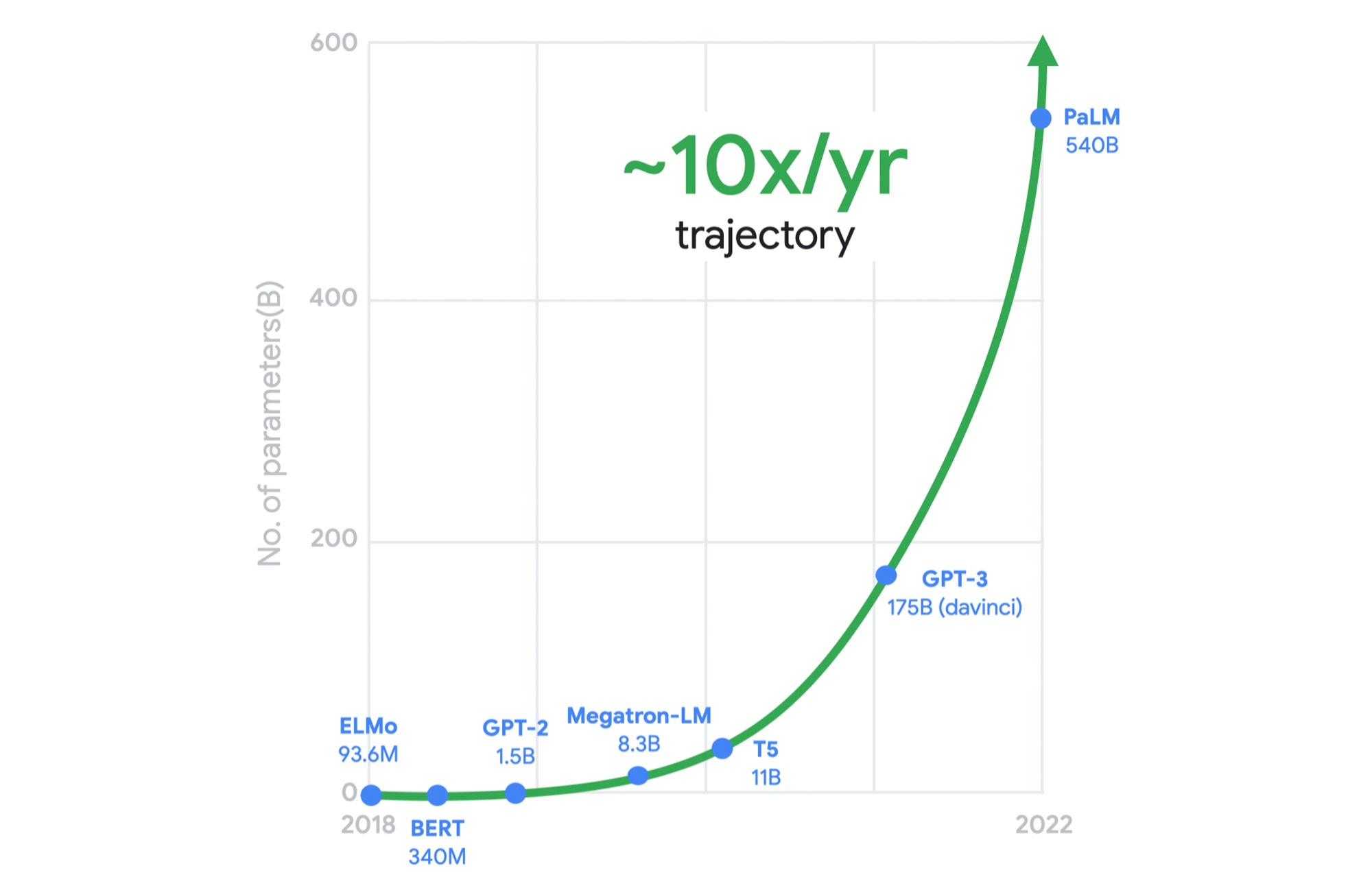
It was clear to us a long time ago that we needed to rethink our infrastructure designs to meet these demands. This is why, for several years, we’ve adopted workload-optimization and intentional design as central principles for our infrastructure platform. We engineer golden paths from silicon to the customer workload, using a combination of purpose-built infrastructure, prescriptive architectures, and an open ecosystem to deliver workload-optimized infrastructure.
Offloads play a pivotal role
Central to this strategy are offload technologies. Traditionally, the CPU wears many hats: It runs the hypervisor, the virtualization stack to enable your workloads, and manages storage and networking I/O; it’s responsible for security isolation for virtual interfaces and physical hardware, etc. In this model, customer workloads running on the CPU contend for resources with these platform tasks.
Offloads on dedicated hardware perform behind-the-scenes security, networking, and storage functions that were previously performed by the host CPU, allowing the CPU to focus on maximizing performance for customer workloads.

A recent example of an on-host offload or accelerator is the Infrastructure Processing Unit (IPU), a system-on-chip that we co-designed with Intel to enable better security isolation and performance on our 3rd gen compute instances. The IPU enables:
- Predictable and efficient compute
- Programmable packet processing for low latency, 200 Gbps networking with 3x the packets per second compared to our previous-generation compute instances
- In-transit encryption with the PSP protocol
Another important example of Google’s on-host hardware is Titan, a secure, low-power microcontroller that helps ensure that every machine in Google Cloud boots from a trusted state.
But we did not stop there. To meet tomorrow’s demands, we knew we needed to go past the performance that could be achieved using the host’s dedicated offload hardware.
A tiered system of offloads
A key component of Titanium is its modern offload architecture, which combines capabilities whose scale and performance are well-established within Google, as well as new capabilities tailored for cloud use cases.
Just as modern workloads scale out horizontally in the cloud, with Titanium, we’ve extended the architecture to augment on-host offloads with an additional tier of scale-out offloads that run outside the host. This system of offloads is deployed fleet-wide and dynamically adjusts to changing workload needs to continually deliver the best performance.

Example 1: Block storage
Titanium scale-out offload enables Hyperdisk block storage to deliver stellar I/O performance. Hyperdisk’s Titanium offload on the host IPU works in tandem with the Titanium scale-out offload tier that distributes I/O across Google’s massive cluster-level filesystem, Colossus.

With traditional offload architectures, higher block storage IOPS requires purchasing larger compute instances. For example, you may need to deploy a data-intensive workload on a compute instance with many more vCPUs than the workload needs just to get sufficient storage performance. This tight coupling results in wasted resources and higher costs for customers. Further, even with large instances, storage performance in the cloud may be inadequate relative to what customers are used to with on-prem storage systems.
With our new block storage, Hyperdisk powered by Titanium, we have decoupled compute-instance size from storage performance. Hyperdisk uses a tier of offloads in our cloud fabric to offload storage I/O from the customer hosts to achieve higher storage performance even with a general-purpose VM.
In fact, today we are announcing that Titanium-powered C3 VMs with Hyperdisk Extreme now support 500K IOPS per compute instance in preview to meet the needs of the most demanding workloads. This is 25% faster IOPS/instance compared to the other two leading hyperscalers, courtesy of the Titanium system.
Example 2: Network routing
Virtual network routing is another example of using a second tier of scale-out offloads (“hoverboards”). With Titanium, Google’s Andromeda virtual networking stack on the IPU offload device sends all packets for which it does not have a route to Hoverboard gateways, which have forwarding information for all virtual networks. Hoverboards are standalone software switches that act as default routers for some flows.

Unlike the traditional gateway model, the control plane dynamically detects flows that exceed a specified usage threshold and programs them to be direct host-to-host flows, bypassing the hoverboards allowing hoverboards to focus on the long tail of less frequent flows. Typically, only a small subset of possible VM pairs in a network communicate with one another, so the VMs only have to store and process a small fraction of the usual network configuration on an individual VM host, improving per-server memory utilization and control-plane CPU scalability.
Titanium already powers your workloads
The Titanium journey began years ago with the component technologies described above. Many of our products already benefit from this architecture, and the newest elements of this architecture are now available with our 3rd gen Compute Engine instances such as C3 and the new Hyperdisk block storage.
Going forward, look for the Titanium architecture to underpin all future generations of our infrastructure offerings, in the process enabling new classes of infrastructure capabilities that move well beyond the confines of a single server.
How Can Brands Evolve in Post-pandemic Era amid Changing Consumer Behavior Patterns

3659
Of your peers have already read this article.
1:30 Minutes
The most insightful time you'll spend today!
2020 saw an unprecedented change in consumer behaviour around the world, with shoppers finding new ways of discovering, evaluating and buying products. This has created fresh expectations for both brands and retailers to drive consumer closeness, embrace the digital moment and transform their operations to be more agile and sustainable. These themes have been top of mind in my conversations with our CPG customers, and set the tone at Google Cloud Summit for Retail and Consumer Goods, which concluded this week. I couldn’t be more proud of our team and thankful for our customers that supported us by participating in our sessions and attending the event.
I joined Google Cloud in January 2021 after a long career in the CPG industry, and as I shared in my CPG keynote at the summit, I am thrilled to be helping bring the power of Google to drive industry innovation in CPG. At Google we call this ‘new normal’ the transformation cloud era, where we’re working with customers who want to not just save money on storage or compute, but to use cloud and digital technologies to drive agility across their business. I also call it the era of ‘consumer switching’, because Covid-19 has accelerated the likelihood of consumers to switch brands or the way they shop. Some of these changes are still happening; over 40% shoppers in a recent Google survey reported that in March 2021 they changed brands or shopped online for something they were previously buying in store.
At Google, we have an amazing team of strategists who have been researching, observing, and analyzing the many facets of consumer behavior over the last few years. In the opening keynote at the Summit Capturing the Hearts and Minds of Today’s Consumers, Google’s Human Truths Team kicked off the Retail & Consumer Goods summit by sharing some of their consumer insights, including what behavior patterns they think will “stick” as we move into a post-pandemic world. I think these insights are especially relevant for brands, as they speak to some of our latest findings on the CPG shopper’s mindset.
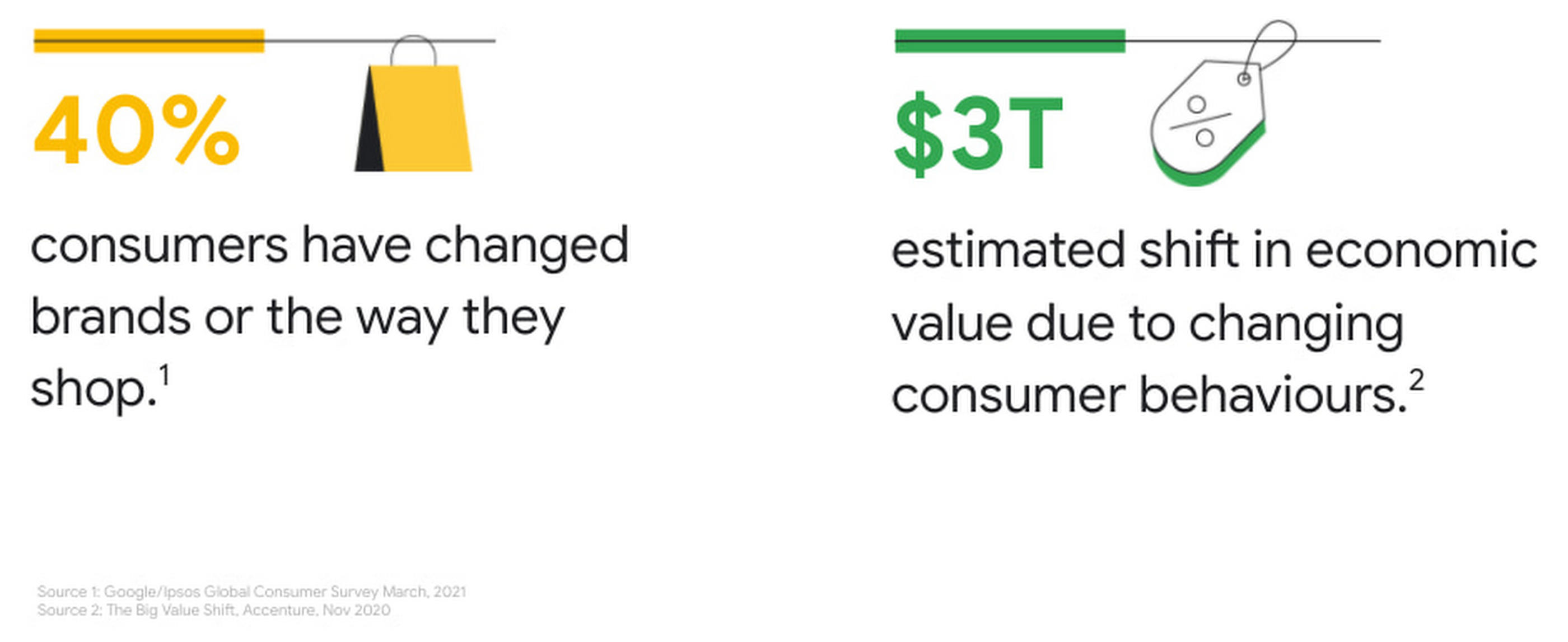
Accenture estimates that there could be a 3 trillion dollar shift in value between companies as a result of consumers shifting brands and behaviours. While it is not known who the winners of the shift will be, one thing is certain – those who will be able to leverage data and analytics fastest will benefit the most from these times of rapid change. I shared some of the implications for the CPG industry in my keynote How to grow brands in times of rapid change along with the three key areas in which Google cloud is helping CPG companies drive brand success:
- Unlocking consumer growth with data powered insights
- Transforming go-to-market in the omnichannel ecosystem
- Driving connected, efficient, and sustainable operations
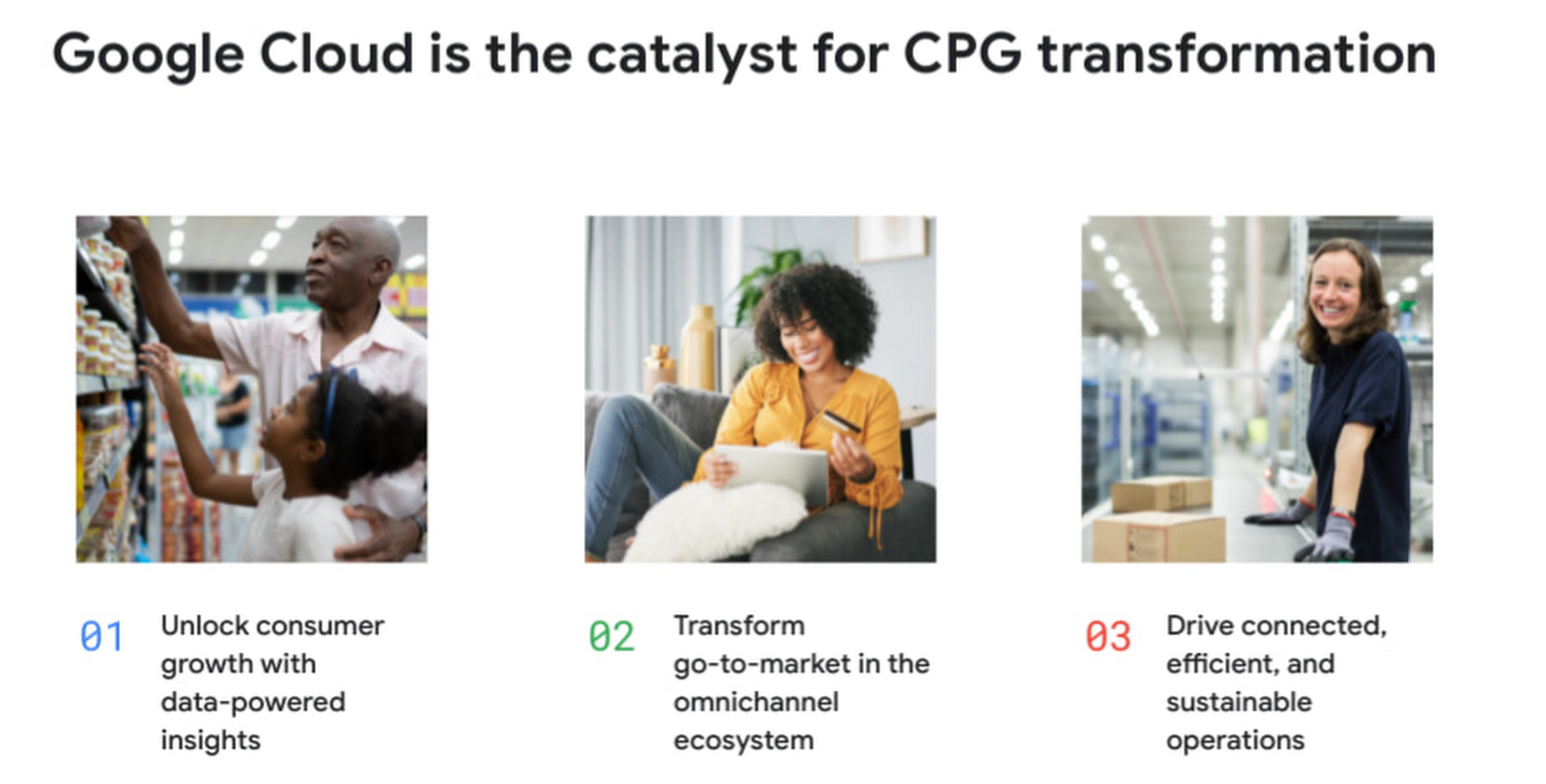
Let’s take a quick look at each of them:
Unlocking consumer growth with data-powered insights
The digital marketing ecosystem is transforming for a privacy centric world, and brands are seeing a direct impact in marketing effectiveness. As the CPG industry becomes more consumer-centric and shifts more toward direct-to-consumer (D2C) business models, acquiring and activating consented first-party consumer data presents a clear opportunity to capitalize on new consumer demands.
As a result, CPGs are turning to consumer data platforms (CDPs) to help them unify, manage, enrich, and secure all of their disparate data from different marketing tools, website analytics, email campaigns, loyalty programs, and more. Google Cloud and our ecosystem of partners can help CPGs build a privacy-centric CDP which brings together all their customer and marketing data into a modern data warehouse, with built-in predictive data visualization tools and models. With a CDP built on Google Cloud, you can integrate data from Google Marketing Platform to drive predictive marketing and media effectiveness. And with pre-built connectors you can also easily integrate non-Google media and data from other enterprise platforms like SAP and Oracle to leverage consumer data for more integrated decision making. Democratize access to data across the organization with our Business Intelligence tool Looker to enable faster decisions in real-time from marketing to supply chain to product innovation.
At the Retail & CPG Summit we shared how retailers and brands can drive consumer closeness in a privacy-centric world featuring Procter & Gamble’s experience building and activating consumer data in a privacy-safe way to serve consumers better and maximize marketing effectiveness and drive growth across their business. And in a demo, Constellation Brands shared how they’re leveraging real-time data from several commercial sources using Looker to unpack insights and develop action plans.
Transforming go-to-market in the omnichannel ecosystem
Amidst COVID-19 restrictions and rolling lockdowns, ecommerce activity has surged past a point of no return. Direct to consumer (D2C) or digitally native brands were able to minimize consumers switching during the pandemic by offering a great online experience. While in-person shopping remains important, consumers are expecting more digital and omnichannel experiences and many will continue to explore new brands and purchase online. CPGs that want to maintain their market leadership can no longer afford to ignore the key role omnichannel capabilities will play in capturing the attention of both retailers and consumers. Even if D2C sales are not a big portion of your business, you will benefit from first-party data that can help you drive insights and product innovation.
CPG brands want to transform their older, clunky ordering processes into modern digital shopping experiences. Re-platforming legacy solutions on Google Cloud not only accelerates application innovation, but also makes it easier to quickly launch new features and products. At Google Cloud we have transformed ecommerce for large D2C brands and traditional retailers, so we know what a best in class D2C experience looks like. And we can bring it to your brands. We already help some of the biggest brands in retail modernize ecommerce and enhance product discovery with solutions like Visual Search and Recommendations AI. All of these can help you build a best in class omni channel presence for your brands.
We had several sessions on improving your omni channel experience, including
Why search abandonment is the metric that matters featuring Macy’s and Conversational Commerce with Google with Albertsons, where we shared how Google’s conversational experiences can help consumers message businesses from wherever they are, and whenever they need them.
Driving connected, efficient, and sustainable operations
The superpowers of AI/ML are not just for marketing. Did you know that research from MIT and Google Cloud has found companies that use AI/ML can drive 2x more data-driven decisions, 5x faster decision making, and 3x faster execution? By connecting your operations in real time with demand signals like search, trends, weather, mobility and supercharging this data with AI and ML, you can make smarter and quicker business decisions. For example, you can use search trends to drive demand forecasting and ramp up manufacturing for popular products.
Google Cloud can help you modernize legacy business applications by migrating them to the cloud and using AI/ML and smart analytics to drive business outcomes. Take SAP for example – a Forrester study found that modernizing SAP with Google not only resulted in 56% more efficient IT teams – it also generated 160% 3-year ROI.
SAP data on Google Cloud breaks down silos across SAP, marketing, manufacturing systems, and external data sources for next-level intelligent operations. For example, with SAP and Google Cloud, you can combine product, media, CRM, digital commerce and site data from SAP and non-SAP sources to uncover stronger consumer insights and fuel product discovery along the path to purchase. You can merge SAP product and sales data with consumer, market data and Google geo trends to drive targeted promotion outcomes, maximizing the ROI of promotional dollars across retail channels. You can also integrate supply chain and manufacturing data from SAP systems with consumer, marketing and Google geo market data to improve demand forecasting and optimize supply chain logistics. The possibilities are endless. This is why we describe SAP modernization as The Gift That Keeps On Giving. Check out the session on SAP from the Summit and hear from Rodan + Fields on their experience of modernizing SAP on Google Cloud.
Another solution that excites me is Vertex AI, which transforms the demand forecasting process. Traditional demand forecasting accuracy is a challenge for most CPGs. Current forecasting methods do not take into account granular factors that impact demand, like local weather, demographics, or unforeseen events. With our recently launched Vertex Forecast, Google is making it much easier to start using cutting-edge machine learning models for demand forecasting. In our session Demand Forecasting: Time for Intelligence, Not Intuition featuring American Eagle Outfitters, we share how you can adopt a data science approach to demand forecasting that’s customized to your unique needs.
CPG organizations come to Google for help solving their toughest problems, whether it be driving new consumer growth, unlocking new routes to market, or building connected, sustainable operations. And we bring the best of Google: innovation, culture, infrastructure, AI/ML, and a deep understanding of consumer behaviour to help them build best-in-class brands.
I’d like to end with a topic that’s very close to my heart. This is around Solving for Sustainability in Retail and Consumer Goods. Our research shows that 62% of shoppers cared about at least one sustainability aspect when purchasing online in 2020. In addition, the events of the past year have triggered consumers to re-evaluate their relationships with brands and prioritize those that are more sustainable in the context of the pandemic. Watch this session to learn more about how retailers and consumer goods companies can leverage technology, data, and machine learning to help make sustainability a core part of the recovery.
All our session content is available on demand. Ready to learn more about how we’re helping CPG brands and manufacturers drive results? Learn more about Google Cloud’s consumer packaged good solutions and reach out to your Google Cloud sales executive to set up a deeper conversation on how we can help you grow your brands today and in the future.
Cloud Computing at Sea: Google Public Sector Boosts U.S. Navy Collaboration

3062
Of your peers have already read this article.
2:00 Minutes
The most insightful time you'll spend today!
With a global, always-on workforce, the U.S. Navy requires secure collaboration between teams across countries and time zones. This is especially relevant for the 50,000 U.S. Navy sailors deployed aboard approximately 100 ships at any given time, who need to connect with personnel at regional shipyards for everything from routine maintenance, to more serious ship repairs.
Google Public Sector directly assists Naval Sea Systems Command (NAVSEA), the largest of the U.S. Navy’s five “systems commands,” by providing support to the U.S. Naval Ship Repair Facility and Japan Regional Maintenance Center (SRF-JRMC) in Yokosuka and Sasebo, Japan. NAVSEA is using Google Workspace, which harnesses Google’s threat protection and zero trust capabilities, to enable effective, secure, and compliant collaboration between the SRF-JRMC and Navy stakeholders around the world.
The workforce in the SRF-JRMC facility had two unique challenges. The first was around ineffective collaboration and communication channels. Before deploying Google Workspace, a Navy officer in Japan would need to be on-base to communicate over a secure connection, and calls were typically late at night given the time difference. This challenge was even further magnified when the COVID-19 pandemic hit, further restricting staff mobility.
The second challenge was a language barrier. With more than 3,000 Japanese Master Labor Contract (MLC) employees providing critical support to SRF-JRMC’s shipyard, Navy leadership needed an easier way to communicate with their Japanese-speaking counterparts. Breaking down this barrier would ensure work could be completed faster and more effectively, facilitating a more collaborative environment.
Enabling secure collaboration
The Navy partnered with Google Public Sector to enable Google Workspace for SRF-JRMC. Today, Google Workspace assists the Navy’s shipyards by enabling Google Voice for secure voice over Internet Protocol (VoIP) calling options, so personnel can join calls and sessions on-site or at-home to communicate securely and reliably across continents. In addition, early access to solutions like English to Japanese translated captions in Google Meet help break down the language barrier by providing instant translation during meetings. The platform also saves the U.S. Navy thousands of dollars a month in phone bills by providing country-specific dial-in numbers for interviews.
Moreover, Google Workspace tools like Google Drive and Docs also help to simplify human resource workflows by streamlining the hiring for onboarding local Japanese employees for the shipyard. Having a shared Google Drive eliminates the need to send multiple files back and forth among the NAVSEA team, allowing them to minimize on-premises storage space. In addition, Google Docs enables Navy employees to communicate and collaborate with each other and with potential candidates securely, and across any device.
“As the largest overseas ship repair facility of the U.S. Navy, operational readiness and continuity of operations is our top priority,” said Peter Guo, chief information officer at SRF-JRMC. “Cloud collaboration capabilities provide us seamless and secure connectivity across continents and break down language barriers with our colleagues across the globe. We’ve improved our ability to operate anytime, and anywhere and have increased our ability to securely communicate and coordinate especially during network outages and natural disasters.”
Providing pandemic assistance
Google for Government’s Workspace solutions also became useful to the SRF-JRMC during the pandemic, providing valuable communication and collaboration tools during a time of uncertainty. In addition to deploying Google Workspace, SRF-JRMC’s IT department created a COVID-19 Pandemic Dashboard, a Google-based site that consolidated Japanese and international open-source data on COVID-19 outbreaks and provided updated guidance. The Dashboard was built in less than two hours, using Looker Studio, and it leveraged an automated data collection process to track local hospitalization numbers. Before building the site, it took the NAVSEA team hours to compile this information; now, the team can access this information in real-time.
“This Dashboard drastically reduced redundant weekly meetings centered on COVID-19 updates, and saved more than 10 hours per week manually gathering data and presenting it via slide decks,” said Guo. “Additionally, this capability enabled our leadership to make real-time, data-driven decisions and put necessary risk mitigations in place. It empowered supervisors across the shipyard to reference this website at any time and put additional health measures in place to minimize the transmission of COVID-19. Every minute counts at our two shipyards in Japan, so this made a tremendous impact on our operational efficiency and ensured the safety of our sailors.”
Delivering the best possible tools means making life better and work more fulfilling for millions of people, inside and outside of government. To help government agencies maintain access to communications and collaboration tools that they need during and after an incident to keep work going, we are also offering workshops for federal, state and local governments. Learn more about Google for Government solutions for the Department of Defense, and Google Workspace for Government.
An Expert’s Opinion on What Early-stage Startups Must Know

6466
Of your peers have already read this article.
3:00 Minutes
The most insightful time you'll spend today!
As lead for analytics and AI solutions at Google Cloud, my team works with startups building on Google Cloud. This puts us in the fortunate position to learn from founders and engineers about how early-stage startups’ investments can either constrain them or position them for success, even at the seed level. In this post, I want to share a few of the best practices to keep in mind as you’re building.
Understand your value proposition before diving into a technology stack
If you’re launching a startup in the cloud, you’re no doubt thinking about a technology stack, but it’s important to step back a bit and think carefully about the major value proposition that your startup offers to your customers. That value proposition is going to fundamentally drive the kind of technology that you should pick.
For example, does your system need processing in real time, or can it be done in a batch mode? Can you rely on once-a-day insights or do the insights have to come in as events happen?
Additionally, what kind of latency will your customers face? That latency makes your value proposition either usable or unusable. Early on in Google’s development, leaders realized that no one was going to wait more than a few hundred milliseconds for a web page to show them their results, and that realization drove the technology decisions that have allowed Google to scale from being a startup in a garage to being a trillion dollar company. Your startup needs to define its value to customers with this level of specificity before it can build a technology stack suited to its needs.
Focus on customer interactions
A few companies have gracefully pulled off big IT pivots that reshaped their value proposition. Netflix, for example, moved from mostly sending DVDs through the mail to becoming a streaming service and major content producer. That’s a huge shift in the user experience and the technology stack necessary to support it, even if the underlying value proposition (i.e., get content to customers) was broadly the same. But it’s also an outlier. If you’re planning for potential changes of this magnitude, rather than focused on getting your value proposition to users, you probably need to sharpen what that value proposition is.
Specifically, you need a clear vision of how customers will access and interact with your business. Typically, they’ll do so over a website or a mobile app, but there are still so many variables.
Are customers going to transmit documents? If so, in what format? Is handwriting supported or is input limited to typing? Can they use images for optical character recognition? Will it mostly be forms? Will the data be structured or unstructured? If all that sounds a little overwhelming, don’t worry, it’ll seem simpler by the end of this article—but also be aware: we’re just getting warmed up.
Imagine that most of your customers will access your business via voice, so you know you’ll want to prioritize conversational workflows. That’s a start—but dig deeper. Even if we suppose you’re usingDialogflow, a Google Cloud conversational AI platform that lets you build and deploy virtual agents, we’re still not really seeing the value proposition. How will all this work, from the beginning of a typical full customer interaction to the resolution? How many interactions will have to be facilitated over low-bandwidth connections, for example? When it comes to user interactions, make sure you can see an end-to-end use case.
Another example: you’re building a retail website, and one of your end-to-end use cases involves the customer asking if a certain amount of a given product is in stock, whether it’s one unit of the product, ten or hundreds. If the product is not sufficiently stocked, you want your app to offer similar items that are. Will your technology stack support this end-to-end use case?
These considerations are not an argument for premature optimization. There’s value in moving fast, getting minimum viable products to users, and then iterating. But in the early stages, you only get one chance to start on the right foot—and how you navigate that chance will influence a lot of dollars and effort down the road. You need to make sure you have business use cases, not just an idea, before you can start designing a technology stack.
Here’s how to get in the right frame of mind. Pick three use cases: two that are “bread and butter” and one that is technologically complex. Make sure your proposed technology stack can support all three, end to end.
Default toward higher levels of abstraction
Now that we’re in the right frame of mind, we’re ready to think about the technology stack more directly.
As a startup, you’ll need to conserve resources, and to do that, you’ll want to build at the highest level of abstraction possible for your value proposition. For example, you probably don’t want your people setting up clusters. You don’t want them configuring things if they can use a fully managed service. You want them focused on building your prototype, not managing infrastructure.
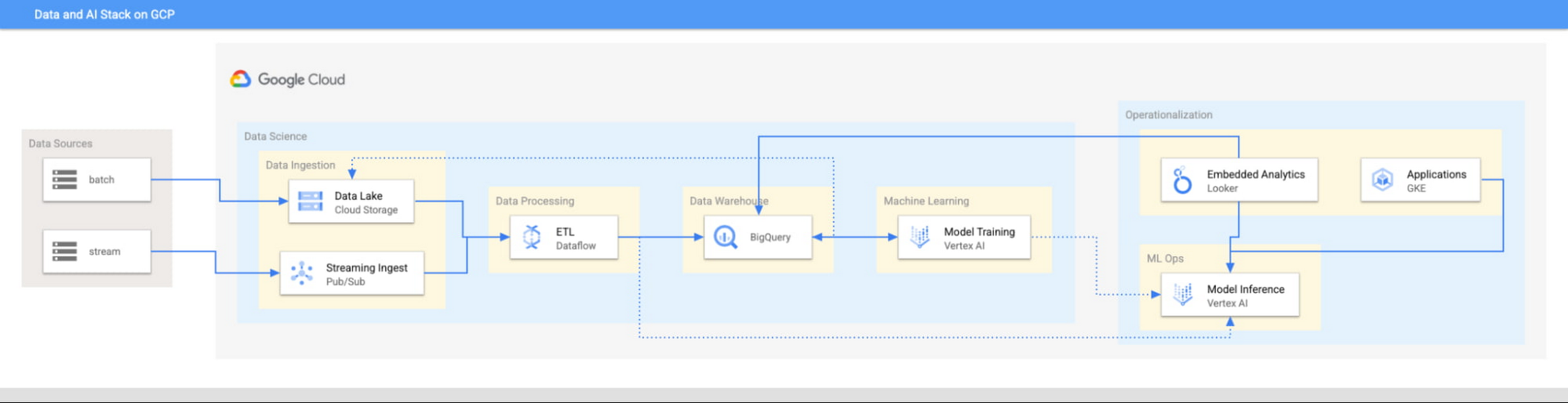
This focus has definitely informed how we create products at Google Cloud, as our canonical data stack—Pub/Sub, Dataflow, BigQuery, and Vertex AI—consists of auto-scaling and serverless products.
But management of infrastructure is not the only place where you should err toward a less-is-more philosophy.
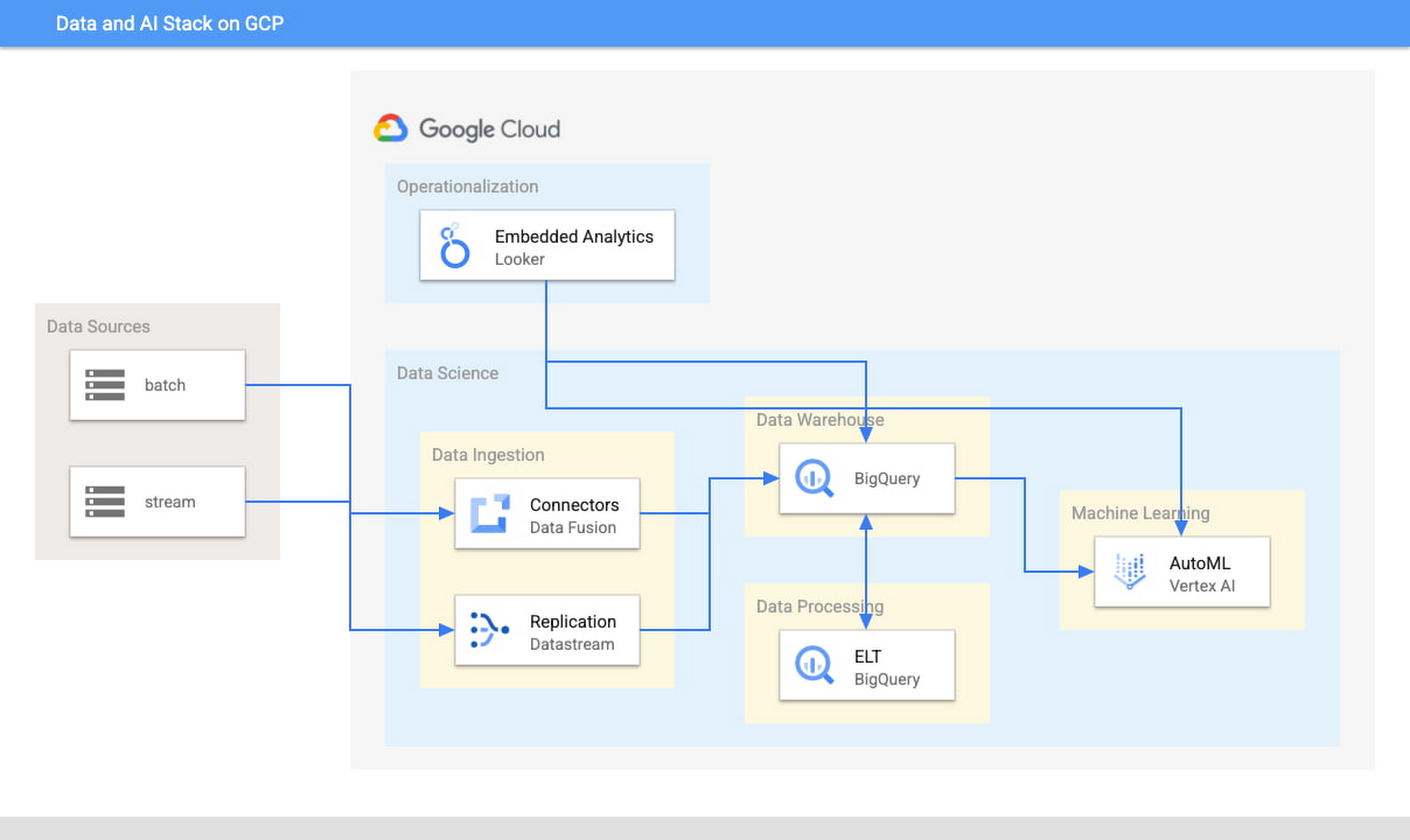
When it comes to architecture, choose no-code over low-code and low-code over writing custom code. For example, rather than writing ETL pipelines to transform the data you need before you land it into BigQuery, you could use pre-built connectors to directly land the raw data into BigQuery. That’s no code right there. Then, transform the data into the form you need using SQL views directly in the data warehouse. This is called ELT, and it is low code. You will be a lot more agile if you choose an ELT approach over an ETL approach.
Another place is when you choose your ML modeling framework. Don’t start with custom TensorFlow models. Start with AutoML. That’s no-code. You can invoke AutoML directly from BigQuery, avoiding the need to build complex data and ML pipelines. If necessary, move on to pre-built models from TensorFlow Hub, HuggingFace, etc. That’s low-code. Build your own custom ML models only as a last resort.
Focus on getting your vision to market, not chasing technology hype
The goal is to pick the right technology stack for bringing your vision to market, generating value for customers, conserving resources, and maintaining flexibility for growth. Early IT investments should usually gravitate toward things that preserve flexibility, such as managed services built on standard protocols or open APIs, but they needn’t always rush to the flashiest technologies. The answer isn’t always ML, for example. The answer might be heuristics to start, with a path to ML once you have collected enough data. You want to make sure that your intelligence layer has enough abstraction so you can mark it up with simple rules at first, but then replace it with a more robust system as you go along.
Launch and iterate fast with these principles
The preceding discussion is a reminder that your most expensive resource is your people—and that you really want them to be focused on building your prototype, minimum viable product or production app You want to launch fast and iterate fast, and the only way you can do that is by focusing on the things that differentiate you.
But regardless of the technologies you use, the bottom line is the same: follow these four principles.
- Figure out your major value proposition and design your tech stack around it.
- Be very careful about user interactions. User experience is super important; you need to make sure you deliver the kind of experience that your customers have grown to expect.
- When you’re building, pick the highest possible level of abstraction possible—the most fully managed tools and no-code/low-code frameworks that give you the functionality that you need.
- Instead of choosing new or flashy technologies, consider if you can build a “good enough” minimum viable product quickly and come back to a better implementation later.
To learn more about why startups are choosing Google Cloud, click here.
Innovation in the Clouds: Sky’s Blue-Sky Approach to FinOps

2923
Of your peers have already read this article.
2:30 Minutes
The most insightful time you'll spend today!
Google Cloud’s partnership with Sky Group, one of Europe’s largest media and entertainment companies, dates back more than four years to when Sky first became a Google Cloud customer moving diagnostic data from millions of its Sky Q TV boxes to its Google Cloud data platform.
In June 2019, a few years into their cloud adoption journey, Sky was faced with a challenge they had anticipated from the start. Their recent bill across all major cloud providers had been increasing rapidly, reaching their planned yearly budget after only six months. Sky wasn’t sure if they’d undershot their forecasts, if they were overspending, or both.
“In the beginning, we were given a brief to investigate internal cloud spend with the aim of finding out where we could make savings, but in reality we didn’t know what we would expect to find,” said Nathan King, a cloud architect in the Cloud Enablement Center and now Head of Cloud Financial Management (FinOps) at Sky since the start of 2020.
Nathan assembled a small team who started to explore Google Cloud spend using the Cloud Billing tool. At first, they drilled into their biggest Google Cloud cost categories and discovered some immediate cost optimizations with BigQuery, Compute Engine and Cloud Storage. Over the course of the next six months, through careful analysis, they managed to find over $1.5m in immediate savings, exceeding expectations.
Yet they soon realized this was just the tip of the iceberg—it was clear there were millions of pounds more savings to be made, but actually achieving them at scale would require careful planning. “We formed a FinOps function to target these savings, but with 600 to 700 projects for Google Cloud alone, spanning four Google Cloud organizations, it would have been a manual process and difficult for teams to digest our recommendations,” Nathan said.
After attending a Google-led FinOps workshop and shaping their FinOps strategy, Nathan’s team focused on iterating through the FinOps lifecycle phases of Inform, Optimize, Operate and generating savings over time. Here’s how they did it:
Inform: Make Information Visible
The first step was focused on developing a clear vision for cost allocation and recharge, which required partnering closely with the finance, procurement and tax teams (particularly for international and affiliates) to understand the supporting business logic and processes. With a lot of hard work, the team managed to break down barriers to implement and embed new processes into broader business functions like finance.
WIth the recharge model in place, the team ran a number of pilots to find the right FinOps tooling to meet their needs. They ran a number of pilots, including using Data Studio and visualizing BigQuery exports. Given their ambitions to scale across the enterprise globally, the team chose Google Cloud’s Looker to realize their vision, building intuitive dashboards to visualize spend and recommendations across all cloud providers. “We wanted one view across all clouds, where customers can dynamically see cloud spend and intelligent optimization recommendations in just one place,” Nathan said.
After less than three weeks of development, the Looker dashboards were ready to go and have been a game changer ever since. “The moment our leadership and different departments started seeing the Looker dashboards, the value we were adding as a FinOps team became immediately clear,” Nathan said.
There are different report pages for each stakeholder group, each custom developed and automated using Looker and BigQuery. The BigQuery Optimization page, for example, provides insights on Slots consumed across the organization, down to granular query data like the cost of each query, how it was written, who submitted it and number of slots utilized. The dashboards also highlight potential areas of optimization, like BigQuery datasets without retention policies set or where data isn’t partitioned.
A recent breakthrough has been building pages for business teams, showing the related cloud spend contributing to a business unit of value, such as the cost per live stream or per subscriber in Sky’s case. Although this is an inherently difficult metric to capture, the opportunity has been made possible with the FinOps team’s progress and is starting to drive business investment decisions.
Optimize: Drive Cloud Efficiency
The second stage of the FinOps lifecycle focuses on delivering optimizations. As Sky’s FinOps dashboards were operationalized and highlighted savings opportunities, they enabled users to generate more than $3 million in Google Cloud savings alone in 2020 and over $800,000 in other cloud providers.
The team began with focusing on the top four products by spend: BigQuery, Compute Engine, Cloud Dataflow and Cloud Storage. Working with their Google account team and studying Google whitepapers and blog posts like Cloud cost optimization: principles for lasting success, they developed their own best practice guidance and embedded recommendations into the dashboards.
Creating their own recommenders and leveraging Google Cloud’s recommenders, the team discovered a plethora of cost optimization opportunities. “Key examples were overly expensive queries, storage buckets set without retention policies, and VMs without autoscaling enabled,” Nathan said. Teams were then empowered to make their own savings, like the NowTV business unit that had been forecast to overspend for the year until they received their dashboard with thousands of optimization recommendations. After just three weeks, the team had implemented more than 90% of recommendations and brought their spend under budget for the year, saving more than 50%.
The FinOps team still searches for new recommendations every day and have been collaborating with Google product managers to take their insights to the next level. “We’ve loved partnering with Google product managers, who encourage us to give feedback on new features before they go to market. We’ve also shared some of our in-house recommenders to influence the features being developed by Google, including the Idle VM and Idle Persistent Disk Recommenders as part of Active Assist,” Nathan said.
Operate: Embed FinOps & Drive Self-Sufficiency
Now that teams could visualize their cloud spend and make real-time decisions based on cost optimization recommendations, the FinOps team has begun working on embedding processes, leveraging machine learning, and improving efficiency in their own ways of working.
Looker’s extensive capabilities continue to play a role in this. “Before we started using Looker, our most popular report was an electricity bill showing customers’ detailed monthly cloud spend, previous month comparisons and forecasts for months ahead,” Nathan said. “This report took days, sometimes weeks to run. With Looker, we’ve automated the entire process and brought that time down to just minutes.”
More teams are embedding the dashboards into their own processes, like finance, which now uses the interactive dashboards in meetings instead of static report snapshots, or in-house Google Cloud architects, who use the recommendations to optimize their cloud spend before deploying any technology.
As the FinOps team continues to operate like a product function, designing with CX/UX in mind and iteratively releasing new features like anomaly reporting, budget alerts, and forecasting based on machine learning, it’s becoming clear that Cloud Financial Management is a key capability and mindset that can impact wide-reaching parts of the business at scale.
Elevating Sky’s FinOps journey to the next level
Indeed, as more business teams collaborate with the FinOps function, the opportunities are growing. “The FinOps team has changed the way we view and manage cloud spend, enabling us to partner with finance and show digestible reports to the CFO. We’re now looking further to broaden our range of insights, like elevating our dashboards to understand how using Google Cloud is supporting Sky’s Net carbon zero ambitions by incorporating Google’s data center sustainability metrics,” says Vince Marco, Architecture Manager at Sky.
So, after being unsure of drivers for their increasing cloud spend in 2019, 18 months later Sky is far more confident about its investment decisions. The team knows that every dollar spent is being used optimally and driving maximum value for its investment.
If you’re an enterprise using cloud, but want to better manage cloud costs, consider setting up a FinOps capability and creating a FinOps mindset. Looker can help you get started by providing reporting and insights into cloud expenditures to identify initial savings. As you learn more and scale, empower teams to make their own savings utilizing built-in actionality for monitoring and customizing for business billing activity nuances and department-specific chargebacks. Reimagine how cloud finances can be managed and optimized as Sky is doing.
To learn more about Looker’s Cloud Cost Management Block visit Looker Marketplace.
More Relevant Stories for Your Company

What is a Digital Business?
Every business is a digital business. That’s what you’ll hear from technology folks these days. But, what exactly is a digital business? How does one define it? Simply put, digital businesses are those that have thoroughly capitalized on the opportunity to connect people with technology. There are four parts to

Managing Change in the Cloud
When moving to the cloud, many organizations concentrate their focus on the change in technology and overlook an area just as complex and impactful: cultural change. Having your people ready to embrace the change — supporting them with the right processes, equipping them with the right skills — is as

Rethinking retail with Google Cloud Retail Search
Cloud Retail Search, part of Discovery Solutions For Retail portfolio, helps retailers significantly improve the shopping experience on their digital platform with ‘Google-quality’ search. Cloud Retail Search offers advanced search capabilities such as better understanding user intent and self-learning ranking models that help retailers unlock the full potential of their
5 Features IT Departments Love About Google Cloud
Throughout the past couple of years, I have helped a good number of companies, big and small, migrate their systems to the Google Cloud Platform (aka GCP). During the course of these migrations, there are always a few of those moments where people look at a specific Google Cloud feature and say,
