





KLM’s Doubles Bookings With the Same Spend With Machine Learning

3946
Of your peers have already read this article.
4:30 Minutes
The most insightful time you'll spend today!
GOALS
- Develop smarter, more effective media buying models through data
- Drive relevant advertising
- Scale predictive modelling across all touchpoints in the customer journey
APPROACH
Combined contextual data to create a predictive model with granular layers
Activated data in real-time
RESULTS
- 40% lower cost per booking
- More than twice as many bookings at same spend
- 1.4 times higher click-through rate for test group than control
KLM partnered with Relay42, whose data management platform (DMP) empowers marketers to achieve data-driven personalisation at scale.
The Relay42 DMP works by stitching together all touchpoints and data sources (including all Google solutions), orchestrating customer journeys in real-time and then activating the unified data to drive business and user experience results.

Relay42 and KLM created a data flow setup with the Relay42 DMP at the core. Thanks to Relay42’s tag management system, all customer interactions on KLM’s website and app, as well as relevant indicators from other channels and data sources such as email, social, CRM, call center and affiliates can be tracked and synced in Google Analytics 360.
Data gathered via Relay42’s own tags and DoubleClick Floodlight tags can also be sent from the DMP to the DoubleClick platform so that relevant ads can be targeted to appropriate audiences.
In order to perform deep-dive analyses, KLM simply exports raw-level data (from DoubleClick using Data Transfer and from Google Analytics 360 through seamless integration) to BigQuery. BigQuery can then correlate site behaviour with ad impressions, which enables Relay42 to activate the data and inform the build of predictive models.
“We believe that data in combination with technological innovation is bound to make advertising smarter and more relevant on every touchpoint. By combining data sources, leveraging first-party data and activating this in real-time, advertising can turn into a personal dialogue, a rewarding one-to-one interaction instead of one-to-many push messaging.”
– Kevin Duijndam, Cross Channel Marketing Manager, KLM
A Predictive Model to Improve Display Remarketing
KLM decided to test a new approach to remarketing.
“Our goal was to get rid of irrelevant ads, as they are simply annoying”, explains Kevin Duijndam, the airline’s Cross Channel Marketing Manager.
“Our assumption was that people who fly with us often already know us, so it would be irrelevant to tell them about flying with us again. However, we were wondering when exactly someone is a ‘frequent flyer’. The more we thought about it, the more complex the set of business rules became, so in the end we realized we couldn’t just focus on frequent flyers, but instead should use machine learning to understand when ads are irrelevant.”
KLM developed a real-time buying setup to include predictive modelling. In this setup, website and app interactions are tracked in the DMP thanks to the Relay42 tag management system.
Relevant consumer behaviour can be streamed in real-time to a prediction engine developed by KLM in the Google Cloud Platform, with the outputs then streamed straight back to the DMP. From here, the DMP can activate rule-based segments based on the prediction outcome. And by syncing this with DoubleClick, ads can be served and targeted to maximise relevance.

The team tested their new predictive model to assess any gains in performance. KLM deliberately chose to measure the results in an A/B setup within a defined period rather than measuring the differences year over year or month over month. Such comparisons are less reliable due to rapid changes relating to seasonality, internal capacities and external factors caused by competitors.
Business Gains and Customer Experience Wins
In the test, KLM linked the Relay42 DMP customer interaction data to their predictive model to predict how relevant their ads would be. The setup enabled a decision to be made in real-time whether or not to serve a specific ad to a user.
Through the A/B tests it became clear that the new model in fact did generate a significant uplift in bookings. With the cost per booking 40% lower during the test period, KLM was able to achieve more than twice as many bookings at the same spend.
The test produced wins in terms of customer experience, too. The click-through rate for the test group was more than 1.4 times higher than for the control group, indicating that the new model was successfully reaching users with messages they found to be relevant rather than annoying.
The success goes beyond improving KLM’s display remarketing efforts, though.
“Even more importantly, we’ve laid the IT data flow foundation in such a way that KLM is now able to execute on our data through all of our digital marketing channels and apply our prediction models at scale”, Kevin says. “So we can be flexible to plug in other models but can also now scale through other online media channels like search or video.”
Enhancing SAP Build Process Automation with Google Document AI and Google Workspace

4158
Of your peers have already read this article.
4:00 Minutes
The most insightful time you'll spend today!
SAP Build Process Automation is designed to optimize business processes and boost efficiency. The platform helps both business users and developers alike digitize core workflows and incorporate artificial intelligence (AI) into time consuming and error-prone manual tasks.
All digital paths can benefit from automation. The pandemic, supply chain shortages, and other disruptive events have upped the pressure on businesses and their workers to perform in more efficient and flexible ways.
Google Cloud and SAP have responded by providing an integrated toolbox that can fundamentally change the way businesses operate — all while creating value for their customers.
With a focus on taking process automation to an even more advanced level and removing inefficiencies from workflows, SAP has introduced integrations with Google Cloud Document AI, and Google Workspace for SAP Build Process Automation customers. This integration can reduce or eliminate many repetitive and error-prone tasks, so that companies can help save money, operate more productively, and scale more easily.
AI unleashes innovation
Continuous advances in digital systems and advanced technology introduce new opportunities to rethink workflows. SAP recognizes the role that AI-powered automation can play in transforming workflows, and that the benefits of doing so extend beyond basic time savings and cost cutting. By plugging Google Cloud Document AI into the application, SAP Build Process Automation’s low-code, no-code platform enables SAP to help its customers in lines of business and IT integrate multiple applications while democratizing access to governed machine learning technology.
Machine learning and process automation can drive efficiency with SAP S/4HANA
Customers using SAP S/4HANA can build workflow improvements into all major core processes, such as order entry, invoice creation, asset posting, and many others, helping them to be faster and more efficient in the process. Google Cloud Document AI extracts key elements — including addresses, article numbers, price, quantity, and more — within emails, PDFs, handwritten notes, and other formats.
Integrated automation can drive results for invoice and purchase order processing
An example of the improvements these integrations have made to SAP Build Process Automation is the use of AI, productivity tools, and automation for processing purchase orders. In the past, workers had to manually select relevant orders in their Gmail accounts and extract key data from large PDF files, including the order date, supplier details, article numbers, quantity, unit price, and the total amount. Then, workers would have to enter all of the individual line items one by one into the SAP S/4HANA system.
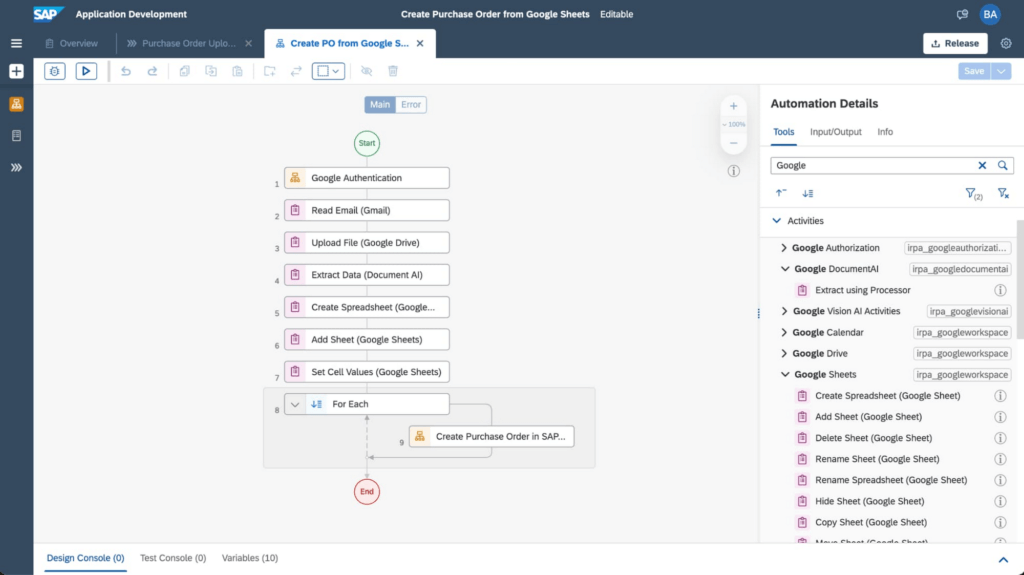
Today, through SAP’s integrated automation platform, customers can automatically extract and organize data by Google Workspace (Google Sheets, Google Drive, and Gmail) and Document AI. This works by extracting data contained in Gmail attachments, downloading it into Google Drive and extracting fields using Document AI’s pretrained models. The tool then enters the consolidated order information from Google Sheets into SAP S/4HANA. For example, the Canton of Zurich in Switzerland experienced a significant reduction of workload to process compensation forms once the organization implemented this automation. Furthermore, implementing the automation can avoid audit and compliance issues, and improve data quality.
The screenshot below shows how a workflow operates within the SAP Build Process Automation software.
Sales, procurement, finance, and other functions are also able to handle more strategic work that delivers greater value to customers with these SAP and Google Cloud integrations. They’ve also boosted both security and regulatory compliance for customers, including those in the financial services space.
For example, the Google Cloud Document AI technology can process thousands of supply chain invoices, validates and systematically approves them. And, over time, the machine learning and AI components improve the analysis process and ensure that data processed with SAP Build Process Automation is adhering to a company’s best practices and essential regulatory requirements.
SAP and Google Cloud put automation to work
Achieving the most accurate, efficient business processes is possible with an automation framework that embeds collaboration and productivity applications while giving lines of business and IT users access to machine learning technology. SAP Build Process Automation combined with Google Cloud Document AI, and Google Workspace has proven to be a catalyst in driving innovation and business transformation for customers across multiple industries, leading to an average of 22% to 30% faster time to market, and significant financial gains, including up to 20% accounts payable savings potential. An example of these improvements includes those experienced by TasNetworks, which had a 25% reduction in back-office processing efforts after implementing these technologies.
To learn more about how Google Cloud and SAP are building solutions for accelerating business value, visit cloud.google.com/solutions/sap. You can find more information about SAP Build Process Automation at sap.com/build-automation.
To start your transformation journey today, choose the SAP Business Technology Platform region that’s best for you. We’re also happy to announce that Google Cloud offers the first and only option to run BTP in the cloud in India — learn more here: Google Cloud’s newest SAP Business Technology Platform Region.
Improving Patient Outcomes with SAVI and Google Cloud’s Innovative Surgical Instrument Tracking

2490
Of your peers have already read this article.
2:30 Minutes
The most insightful time you'll spend today!
Powered by Vertex AI (Google Cloud’s platform for accelerating development and deployment of machine learning models into production), SAVI (Semi Automated Vision Inspection)1 is transforming surgical instrument identification and cataloging, leading to fewer canceled surgeries and easing pressure on surgery waitlists.
Max Kelsen, an analytics and software agency that specializes in machine learning, has worked closely with Google Cloud and Johnson & Johnson MedTech to create a system that can manage tens of thousands of individual devices, their characteristics, and how they apply to each set or tray used by a surgeon. SAVI does this while delivering a one in 10,000 real-world error rate, much faster and more accurately than manual processes currently in use across the industry. Implementing SAVI can also unlock end-to-end visibility and traceability across the surgical set supply chain and provide advanced analytics and insights.
Eliminating time-consuming manual processes
Surgeons need a large number of specialist instruments and devices to complete complex, delicate procedures. Because each tray of these instruments can typically cost more than $350,000, and having every type of set on shelf at every surgical facility is not feasible, manufacturers generally loan them to hospitals for procedures, such as inserting one of the manufacturers’ implants into a patient’s knee. Once a procedure is complete, the hospital returns the instrument tray to the manufacturer for storage and re-distribution to other hospitals as needed.
Each time a hospital returns a tray, the manufacturer needs to check that each instrument is there, correctly placed, cleaned, and fit for the purpose of the next procedure. As each set may hold more than 400 instruments, completing this process manually is complex and time-consuming. While each tray is checked before and after surgery at the hospital, and again when it arrives and leaves the manufacturer’s facility, Max Kelsen finds that 5% of surgeries can still be affected by missing, broken or bent instruments. This has a severe downstream impact on private hospitals in particular, directly affecting patient safety and outcomes; in Australia, for example, around 60% of surgeries are performed in private hospitals.
Johnson & Johnson MedTech has 60,000 surgical trays across the Asia-Pacific, and loans these trays out about 100,000 times per month. The manufacturer approached Max Kelsen to help design and develop a solution to make the supply chain more efficient, and to give more visibility into asset movement. As a Google Cloud Partner specializing in applying machine learning at scale in healthcare contexts, Max Kelsen had the expertise and track record to meet Johnson & Johnson MedTech’s need for a globally scalable solution that was engineered for quality and performance.
The first step was to establish a baseline for the project by determining how long the manufacturer’s team took to process each tray, and to set an efficiency number. We then spent six months determining and evaluating how to deliver a robust, accurate solution that outperformed current manual and labor-intensive methods in processing instruments and trays, globally. Our work included extensive technical feasibility research involving a representative sample for the variety and complexity of sets, trays, and devices needed for different types of surgery, including orthopedics, spinal trauma, and maxillofacial groups.
Working with Google Cloud to accelerate and de-risk the project
This is a familiar problem that is industry-wide. The issue has been widely explored and tried with a number of technologies over several years without producing the scalability and performance results required to make this an appropriate and feasible solution. Google Cloud partnered with Max Kelsen to accelerate and de-risk this large and strategic project for a mutual customer.
Technical feasibility took four months, prior to a year-long production pilot of SAVl in a distribution center in Queensland that services over 100 hospitals. After obtaining enough real-world data and experience to validate that the solution was as scalable and as accurate as needed, an Asia-Pacific rollout of the system commenced. SAVI is now live across Johnson & Johnson MedTech’s operations in Australia, New Zealand, and Japan, garnering recognition with a JAISA excellence award.
Google Cloud machine learning is integral to SAVI. Google Cloud’s technologies were a big differentiator for Max Kelsen’s engineering team in delivering the breakthroughs needed at scale, and in production, to meet Johnson & Johnson MedTech’s needs.
Reducing checking and documentation time
Running SAVI in Google Cloud has reduced the time Johnson & Johnson MedTech needs to check and document inspections of these surgical instrument sets by over 40%. The application also delivers consistent measurable quality that is often hard to measure at scale when using manual processes. During the pandemic, the application enabled Johnson & Johnson MedTech to operate with a lower headcount for the same volume output, enabling the organization to quickly service a backlog of waiting list surgeries.
In addition, the automation delivered with SAVI has reduced the time required to bring technicians up to speed on quality control processes, from eight to 12 months down to just three months, enhancing productivity and performance while delivering a more robust workforce.
So how does SAVI work in a real-world context? SAVI is deployed via a tablet and a web-based application incorporates an API to photograph the medical device trays, as shown below. Max Kelsen captures the photograph and sends it to a range of different services, via an API endpoint hosted on Google Cloud:
- Image information is stored in Cloud Storage
- Data relating to the trays is stored in Cloud SQL for PostgreSQL
- APIs and web UI components run in CloudRun
- Analytics data is stored within BigQuery
Once this tray and device onboarding stage is completed, the next step is to perform inferences from the images and data. By hosting online models with Kubeflow model serving on GKE, we enable a model to identify all the instruments in a tray at low latency.
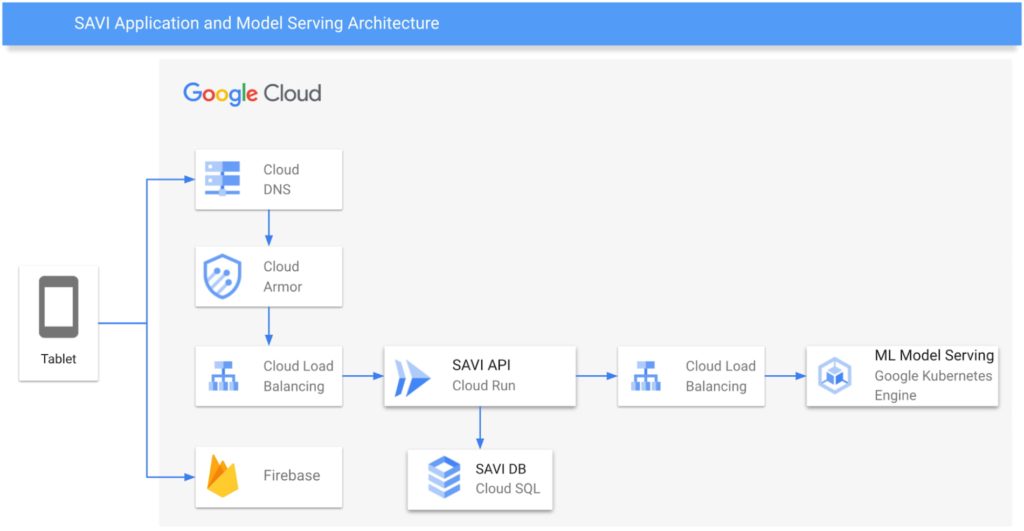
Vertex AI Workbench notebooks are used for data exploration and modeling. Kubeflow training pipelines hosted on GKE are executed to produce machine learning models for specific surgical instrument sets. Several hundred machine learning models are then hosted with Kubeflow model serving on GKE, with state and analytics managed using Firebase. Using machine learning to infer from images whether any devices are incorrectly placed, dirty, or otherwise not fit for purpose, the data is then returned to the tablet for the user to respond accordingly.
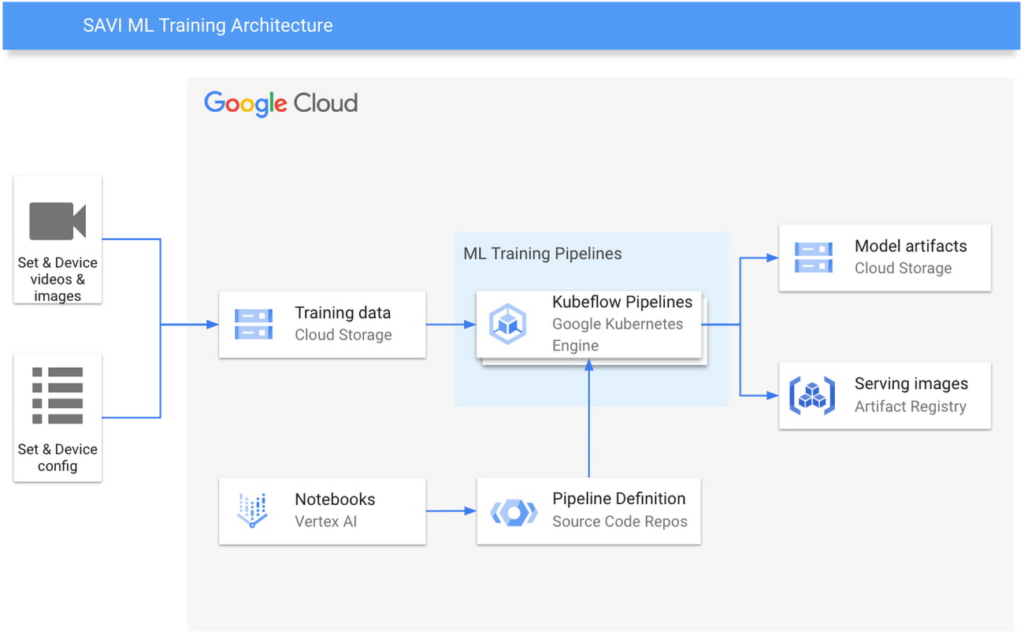
Based on our success to date with SAVI, it is now available on Google Cloud Marketplace to help healthcare organizations achieve machine learning-powered efficiencies across a range of use cases, and ultimately improve patient safety and outcomes.
Not to be confused with the usage of Visual Inspection Model (Assembly) available in Vertex AI Vision
3091
Of your peers have already watched this video.
20:30 Minutes
The most insightful time you'll spend today!
How Visual Inspection AI Transforms the Manufacturing Industry
The pandemic has created demand volatility and has placed lots of pressure on manufacturers. Decreased demand for new products, the disruption of retail channels, and interruptions to supply chain operations have made it very challenging for manufacturers to operate profitable businesses.
This has left manufacturers keen to decrease costs and improve work efficiency by automating many of their work processes.
And many are discovering that visual inspection utilizing AI can help.
This video, hosted by Ying Fei, Product manager, Google Cloud and Sudhindra K Ghanathe, Industry Solutions Lead of Accenutre Google Business Group, Accenture, showcases how world-leading manufacturing companies use visual inspection AI to transform their business. Customers such as Siemens share how they use Google visual inspection AI to automate quality control process, achieve cost savings, and improve work efficiency.
3317
Of your peers have already watched this video.
44:14 Minutes
The most insightful time you'll spend today!
Supercharge Marketing with Ready-Made, Centralized Smart Analytics
Your company has lots of valuable marketing data, but it’s spread across many systems and teams. That’s a problem. In fact, only 13% of organisations feel like they’re making the most out of their available customer data today.
And the reason is that data–marketing and customer data–is spread across many different places.
With Cloud, you can bring this data together in one place so you can better analyze and activate it.
Find out how new GCP tools for marketers and hear directly from brands, including Rituals and Waitrose, who are using them to solve use cases like audience segmentation, purchase prediction, and measuring lifetime value.
You’ll learn how Google Cloud is helping IT and marketing teams accelerate digital transformation within their organizations, to be data-driven, and customer-centric.
You’ll walk away with an understanding of how to adopt technology that transforms the way your company delivers marketing campaigns and customer experiences.
4 Methods How AI/ML Boosts Innovation and Reduces Costs

2936
Of your peers have already read this article.
2:30 Minutes
The most insightful time you'll spend today!
“Cloud Wisdom Weekly: for tech companies and startups” is a new blog series we’re running this fall to answer common questions our tech and startup customers ask us about how to build apps faster, smarter, and cheaper. In this installment, we explore how to leverage artificial intelligence (AI) and machine learning (ML) for faster innovation and efficient operational growth.
Whether they’re trying to extract insights from data, create faster and more efficient workflows via intelligent automation, or build innovative customer experiences, leaders at today’s tech companies and startups know that proficiency in AI and ML is more important than ever.
AI and ML technologies are often expensive and time-consuming to develop, and the demand for AI and ML experts still largely outpaces the existing talent pool. These factors put pressure on tech companies and startups to allocate resources carefully when considering bringing AI/ML into their business strategy. In this article, we’ll explore four tips to help tech companies and startups accelerate innovation and reduce costs with AI and ML.
4 tips to accelerate innovation and reduces costs with AI and ML
Many of today’s most innovative companies are creating services or products that couldn’t exist without AI—but that doesn’t mean they’re building their AI and ML infrastructure and pipelines from scratch. Even for startups whose businesses don’t directly revolve around AI, injecting AI into operational processes can help manage costs as the company grows. By relying on a cloud provider for AI services, organizations can unlock opportunities to energize development, automate processes, and reduce costs.
1. Leverage pre-trained ML APIs to jumpstart product development
Tech companies and startups want their technical talent focused on proprietary projects that will make a difference to the business. This often involves the development of new applications for an AI technology, but not necessarily the development of the AI technology itself. In such scenarios, pre-trained APIs help organizations quickly and cost-effectively establish a foundation on which higher-value, more differentiated work can be layered.
For example, many companies building conversational AI into their products and services leverage Google Cloud APIs such as Speech-to-Text and Natural Language. With these APIs, developers can easily integrate capabilities like transcription, sentiment analysis, content classification, profanity filtering, speaker diarization, and more. These powerful technologies help organizations focus on creating products rather than having to build the base technologies.
See this article for examples of why tech companies and startups have chosen Google Cloud’s Speech APIs for use cases that range from deriving customer insights to giving robots empathetic personalities. For an even deeper dive, see
- our AI product page to explore other APIs, including Translation, Vision, and more;
- and the Google Cloud Skills Boost for ML APIs.
2. Use managed services to scale ML development and accelerate deployment of models to production
Pre-trained models are extremely useful, but in many cases, tech companies and startups need to create custom models to either derive insights from their own data or to apply new use cases to public data. Regardless of whether they’re building data-driven products or generating forecasting models from customer data, companies need ways to accelerate the building and deployment of models into their production environments.
A data scientist typically starts a new ML project in a notebook, experimenting with data stored on the local machine. Moving these efforts into a production environment requires additional tooling and resources, including more complicated infrastructure management. This is one reason many organizations struggle to bring models into production and burn through time and resources without moving the revenue needle.
Managed cloud platforms can help organizations transition from projects to automated experimentation at scale or the routine deployment and retraining of production models. Strong platforms offer flexible frameworks, fewer lines of code required for model training, unified environments across tools and datasets, and user-friendly infrastructure management and deployment pipelines.
At Google Cloud, we’ve seen customers with these needs embrace Vertex AI, our platform for accelerating ML development, in increasing numbers since it launched last year. Accelerating time to production by up to 80% compared to competing approaches, Vertex AI provides advanced end-to-end ML Ops capabilities so that data scientists, ML engineers, and developers can contribute to ML acceleration. It includes low-code features, like AutoML, that make it possible to train high performing models without ML expertise.
Over the first half of 2022, our performance tests found that the number of customers utilizing AI Workbench increased by 25x. It’s exciting to see the impact and value customers are gaining with Vertex AI Workbench, including seeing it help companies speed up large model training jobs by 10x and helping data science teams improve modeling precision from the 70-80% range to 98%.
If you are new to Vertex AI, check out this video series to learn how to take models from prototype to production. For deeper dives, see
- this article about Vertex AI’s role in an ambitious project to measure climate change with AI;
- BigQuery has built-in Machine Learning (ML) and Analytics that you can use to create no-code predictions using just SQL queries.
- this blog about how Vertex AI and BigQuery work together to make data analysis easier and more powerful;
- and this blog about Example-based explanations, one of our most recent updates to make model iteration more intuitive and efficient.
3. Harness the cloud to match hardware to use cases while minimizing costs and management overhead
ML infrastructure is generally expensive to build, and depending on the use case, specific hardware requirements and software integrations can make projects costly and complicated at scale. To solve for this, many tech companies and startups look to cloud services for compute and storage needs, attracted by the ability to pay only for resources they use while scaling up and down according to changing business needs.
At Google Cloud, customers share that they need the ability to optimize around a variety of infrastructure approaches for diverse ML workloads. Some use Central Processing Units (CPUs) for flexible prototyping. Others leverage our support for NVIDIA Graphics Processing Units (GPUs) for image-oriented projects and larger models, especially those with custom TensorFlow operations that must run partially on CPUs. Some choose to run on the same custom ML processors that power Google applications—Tensor Processing Units (TPUs). And many use different combinations of all of the preceding.
Beyond matching use cases to the right hardware and benefiting from the scale and operational simplicity of a managed service, tech companies and startups should explore configuration features that help further control costs. For example, Google Cloud features like time-sharing and multi-instance capabilities for GPUs — as well as features like Vertex AI Training Reduction Server — are built to optimize GPU costs and usage.
Vertex AI Workbench also integrates with the NVIDIA NGC catalog for deploying frameworks, software development kits and Jupyter Notebooks with a single click—another feature that, like Reduction Server, speaks to the ways organizations can make AI more efficient and less costly via managed services.
4. Implement AI for operations
Besides using pre-trained APIs and ML model development to develop and deliver products, startup and tech companies can improve operational efficiency, especially as they scale, by leveraging AI solutions built for specific business and operational needs, like contract processing or customer service.
Google Cloud’s DocumentAI products, for instance, apply ML to text for use cases ranging from contract lifecycle management to mortgage processing. For businesses whose customer support needs are growing, there’s Contact Center AI, which helps organizations build intelligent virtual agents, facilitate handoffs as appropriate between virtual agents and human agents, and generate insights from call center interactions. By leveraging AI to help manage operational processes, startups and tech companies can allocate more resources to innovation and growth.
Next steps toward an intelligent future
The tips in this article can help any tech company or startup find ways to save money and boost efficiency with AI and ML. You can learn more about these topics by registering for Google Cloud Next, kicking off October 11, where you’ll hear Google Cloud’s latest AI news, discussions, and perspectives—in the meantime, you can also dive into our Vertex AI quickstarts and BigQuery ML tutorials. And for the latest on our work with tech companies and startups, be sure to visit our Startups page.
More Relevant Stories for Your Company

Contact Center AI & Automation Anywhere Help Virtual Agents Deliver Next Level CX
With the advent of the pandemic, contact center traffic has increased by as much as 300%, taxing center capabilities. To help handle the surge, and keep up with heightened customer demands, many customer experience providers have deployed automation in the form of virtual agents that serve as the first—and, sometimes the

The Future of Language Processing: Google Cloud’s Enhanced NLP Models
Natural language understanding (NLU) is getting increasingly better at solving complex problems and these language breakthroughs are creating big waves in Artificial Intelligence. For example, new language models are enabling Everyday Robots to create more helpful robots that can break down user instructions and have even enabled people to generate imaginative visuals from

New Technology: The Projected Total Economic Impact™ Of Google Cloud Contact Center AI
According to Forrester Research, customers expect easy and effective customer service that builds positive emotional connections every time they interact with a brand or organization. Additionally, 40% of surveyed business leaders say that improving their organization’s customer experience (CX) is a high priority, ahead of initiatives like improving products and

Google’s Intelligent Products Essentials Assist Manufacturers in Product Development Journey
Expectations for both consumer and commercial products have changed. Consumers want products that evolve with their needs, adapt to their preferences, and stay up-to-date over time. Manufacturers, in turn, need to create products that provide engaging customer experiences not only to better compete in the marketplace, but also to provide
