





Incorporating Custom Holidays into Your Time-Series Models with BigQuery ML

1130
Of your peers have already read this article.
4:30 Minutes
The most insightful time you'll spend today!
About three years ago, JCB, one of the biggest Japanese payment companies, launched a project to develop new high-value services with agility. We set up a policy of starting small from scratch without using the existing system, which we call the concept of “Dejima”, where we focused on improving various aspects such as team structure, risk management, and application and platform development process.
Until now, large Japanese enterprises have built decision-making systems focused on eliminating unnecessary business processes and efficiently increasing quarterly profits. As a result, we are seeing more organizational structures that make it difficult to take on new challenges or experiments with trial and error. We wanted to breathe a new life into this situation, and that is how the concept of Dejima came up. In the Edo period, Japan closed its national border to other countries under its national isolation policy. At the time, Dejima was the only area where special rules were applied and allowed people from different cultures to come and go, and trade. This special rule generated the culture of inclusion and led to Dejima’s prosperity. Like Dejima, we believe that creating an organization that is independent from other business practices can be effective in enabling digital transformation for the organization.
We have been able to make this transformation with the direct help of the Google Cloud and its products such as Google Kubernetes Engine (GKE), Cloud Spanner and Anthos Service Mesh, applying domain-driven design and microservice architecture. We named this the “JCB Digital Enablement Platform (JDEP),” which now hosts multiple business critical production services.
A key benefit of GKE is that the team can easily add resources and release them when they are finished, allowing them to be flexible to accommodate busy periods and off-seasons. Meanwhile, Anthos Service Mesh helps us manage complex environments easily. With containerization and managed services, we are prepared for the future for when more services go into production, as it would be easy to maintain and provide version upgrade support. At the same time, Cloud Spanner ensures that we maintain a 99.99% availability at all times.
Our initial motivation for introducing SRE practices was to break proverbial walls between business, development and operations, which was a success. Now we are focused on ensuring its reliability and maintaining customer satisfaction with our SRE practices.
To ensure the success of SRE practices that we implemented, there were a few categories we needed to address, from defining the organizational culture and practices to ensuring the policies attached to the new models created were practical enough to be implemented on the ground level. This is so that the Dejima concept remains sustainable for the long run.
Instilling a culture of measurement
Here, “appropriate” reliability is the key. According to the conventional way of thinking at JCB, “service failure must not occur” and “SLA should be maintained as high as possible.” We started by discussing what was the “appropriate reliability” that our customers really needed, but it was not as easy as we thought because the level of reliability for user satisfaction differed from application to application.
Eventually, the business, development and operations teams formulated specific SLIs and SLOs together, something we would never have been able to do if we discussed separately. This is because the business is required to compromise on lower service levels, since our reliability standard used to be too high. The collaboration of development and operations teams is necessary to understand how our system works upon our users’ interactions.
After Google Cloud helped us run a series of workshops where all teams participated, we saw change within the organization. The business team started evangelizing SRE to other members in the business department, and the development and operations teams started collaborating autonomously. We felt like we were working at Google speed, accomplishing so much in a short amount of time.
Understanding SRE as an entire company is necessary to progress. We are now working on creating internal training materials to spread the SRE concept throughout the company.
Eliminating ambiguity
With the cooperation of Google Cloud, we have created a Team Charter that defines the team’s mission, values and engagement models. We also created policy documents that include Incident Response Policy, Postmortem Policy, On-call Policy, Toil Policy and Error Budget Policy, to eliminate ambiguity in day-to-day operations.
For example, when an incident occurs, we can identify exactly the level of importance, the roles that are assigned to each person, and in what order they need to follow. When to do a postmortem, who owns it? What to do if the error budget is exhausted? How do other teams reach out to SRE when they have problems? The written policy documents will dramatically improve efficiency and motivate teams to adopt a culture of learning from failures.
The format for such policies are written in Google’s SRE book, but when we adopt it, it needs to take into account the circumstances specific to our company. Simply copying an existing policy won’t work, which is why it’s important to formulate a policy that fits the situation each team is in.
Reformalizing teams
Based on these policies, JCB’s SRE team has two sub-teams. One is called Sheriff which works as the platform SRE, and provides infrastructure services for the application team. The other is called the Diplomat which works as the embedded SRE, and participates in the application team to lead productionisation. There is also a team called Architecture that is separate from the SRE teams whose role is to consult SRE on system design and review architecture.
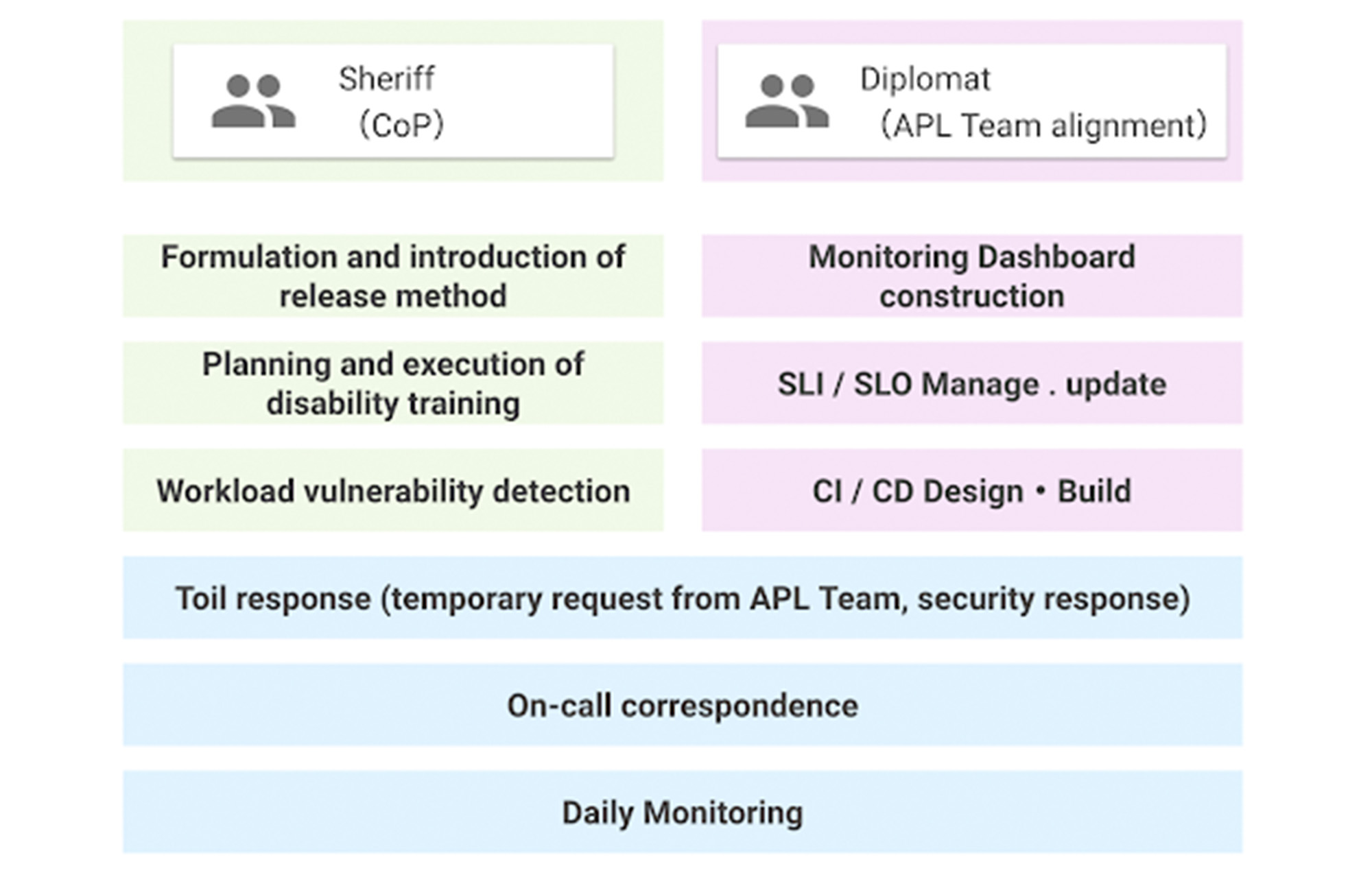
The SRE team was a single role when it was first launched, but now has two sub-teams. This is because as the number of application teams increases, the number of support tasks for the teams also increases, which can result in a shortage of resources to work on overall improvement. Securing people who are not interrupted from day-to-day support tasks and focusing on the main task improves efficiency.
Whereas both sub-teams share the on-call duty, some engineers are not allowed to do it by contract as they are not allowed to get paged. For those who cannot participate in on-call duties, we created what’s called a Toil Shift, which allows them to focus on resolving tickets in our backlogs instead.
This works well so far, but we will keep evolving as our business grows.
Being Cloud-native Means Sustainability and Growth-native for Nuuly!
3422
Of your peers have already read this article.
3:00 Minutes
The most insightful time you'll spend today!
They say black never goes out of style. It’s something the team at Nuuly, URBN’s digital rental and resale business, know well. And it’s not just true of the company’s garments but their gadgets, too.
“I was having an offhand conversation with a UX designer recently,” Rebecca Sandercock, Nuuly’s strategy and insights manager, recalled in a recent interview from the company’s sunny, South Philly headquarters. “The designer was talking about how we had chosen dark mode for a number of interfaces internally because it actually saves so much on electrical output. They had the data to back that decision up, but more importantly, it’s just the kind of thing everyone is thinking about all the time here.”
Of course most every business is thinking about sustainability in some way these days. What makes Nuuly stand out is how quickly it can act, thanks in large part to the technology platform that’s made the entire enterprise possible.
“We’re kind of sustainable by our very nature,” Kim Gallagher, Nuuly’s director of marketing and customer success, said.
While she meant the rental and resale business, which helps customers buy fewer clothes and sees Nuuly items worn many times by many people—Gallagher could just as well have been referring to the sustainability inherent in, and enabled by, cloud computing.

There are the obvious, and oft-cited, advantages, such as how centralized data centers can operate more efficiently (some have been carbon neutral since the beginning). Yet there are even more subtle yet substantial benefits. In a marketplace and climate that are both changing faster and faster, sustainability requires a certain amount of agility. Such adaptability and scalability are intrinsic to the cloud technology that threads its way throughout Nuuly.
It turns out that being cloud native also means being sustainability native—as well as growth native. Since its 2019 launch, Nuuly’s net sales have risen roughly 6x over the first three fiscal years.
Cloud fits any situation
When URBN was developing Nuuly—launching in just 10 months—it chose to create everything from scratch on Google Cloud. Despite being part of a larger organization with decades of history and expertise, the company recognized the limitations presented by legacy systems and, more importantly, the necessity of building a wholly new platform that could be fully responsive.
The company has to react not only to new fashion trends but, crucially, the changing behaviors of customers. And not just their evolving tastes but also shopping habits, delivery preferences, unexpected customer service requests—is this a pattern, or a stain?—and social media chatter.
The pressure for a successful launch was high. The URBN portfolio, which also includes Urban Outfitters, Anthropologie, and Free People, had to keep evolving to satisfy a new generation of shopper who exists in an increasingly crowded and demanding digital marketplace.
The cloud’s responsiveness has thus proven its worth in creating a financially sustainable business as well as an environmentally sustainable one. Those even go hand in hand, as Gallagher points out: “Every customer who keeps renting is one who isn’t buying more occasion-specific clothes that go unworn most of the time.”
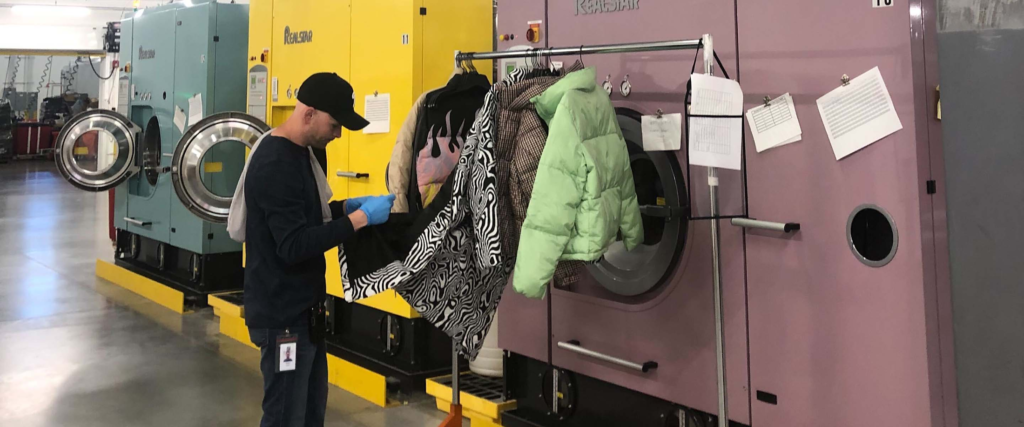
Dr. Alan Rosenwinkel, director of data science at URBN, had heard from his team about one garment that has become an emblem for the power of the platform. “It had been rented 25 different times before someone loved it enough to buy it and keep it forever,” he explained. (It’s also an emblem of the power of the cloud, that they would have the data awareness to track a single item so closely.)
It’s a new way of shopping made possible by a new way of computing. As one writer for Business Insider cheered, Nuuly “completely cured my addiction to fast-fashion.”
It makes for a healthy business, too. Sales for fiscal year 2019 exceeded $8 million and surpassed $24 million in 2020—one of the few URBN segments to grow during a tough year for fashion—and reached $47 million in 2021. The subscriber base had grown to 51,000 at the end of January.
Agility drives sustainability drives agility
For digital retailers to achieve such customer enthusiasm often relies as much on how the clothes get there as how they look. And those deliveries turn out to be a prime example of where Nuuly’s sustainability and technology meet.
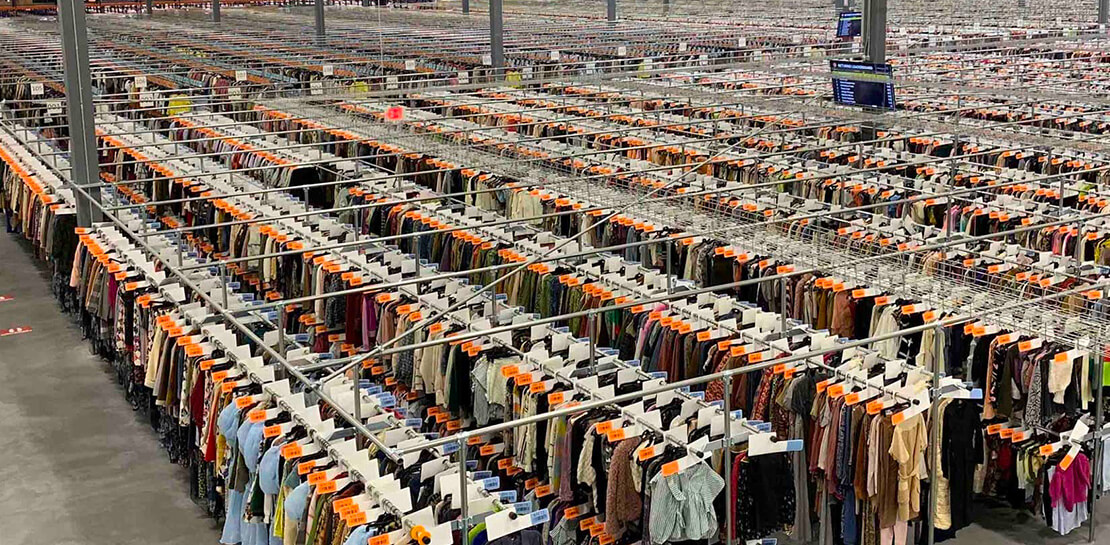
For now, all shipping is handled through a state-of-the-art distribution center in Bucks County on the Philadelphia outskirts. Garments are shipped six-at-a-time, in fully reusable packaging, using ground transportation to keep the carbon footprint to a minimum. In certain limited geographic areas, shipments were sometimes taking longer than the two to five days most members would find acceptable.

“If we were an older company or weren’t set up from a technology perspective to be agile, we might have just said, ‘All right, we’re going to just go to three-day shipping for everyone,’” Rosenwinkel said. “That would drive up the cost, and the environmental impact. But we were able to be more strategic and more targeted about it.”
By regularly analyzing customer sentiment and retention data through BigQuery and Cloud Composer, and tying those to historical shipping times, Nuuly has been able to understand how shipping speed impacts its customers. Using a custom-built order management system, deliveries can be automatically adjusted to arrive more quickly, particularly when certain regions or days of the week are proving difficult to reach customers in time. These accelerated deliveries, like all Nuuly shipments, are made via UPS’s Carbon Offset program.
“Because we have the data, and the platforms to analyze it all,” Rosenwinkel said, “we’re delivering faster with the bare minimum impact on cost and emissions.”
It’s just one example of how modern retailers must juggle so many demands from consumers, workers, suppliers, and even regulators. Adding sustainability to that mix could be seen as a burden, but Nuuly shows how the right technology can lead to a holistic approach that makes all those interests work together even better.
And it allows for more opportunities and more kinds of sustainability, reaching from the designer’s atelier to the customer’s doorstep.
Sustainable details at every level
Back at the distribution center, workers can experience sustainability in a different way, as data is leveraged to enhance their well-being.
All workers are equipped with customized Android devices that help guide order tracking and fulfillment, plus cleaning, repairs, and reselling of garments as needs change throughout their lifecycle. Yet the insights go even deeper. The data science team has closely analyzed routes and repetitive motions for workers to keep their strenuous jobs as low-impact as the company’s broader environmental footprint.
“Through machine learning, we estimate we’ll be able to save our workers over 300,000 miles of steps over a five year period,” Rosenwinkel said. That’s enough walking to circumnavigate the globe 12.5 times.

The company has also applied ingenuity to one of the most notorious aspects of digital retail: packaging. Made from 100% post-consumer recycled materials like plastic bottles, Nuuly’s reusable carriers require no disposable bags or hangers to send goods back and forth. And once the packages have reached their end of life, the team is working with designers on ways to repurpose them into items that can then be offered for rental or sale on Nuuly.
“We’re really looking at the circular economy from every angle,” Gallagher said. “It’s built into the business.”
That includes not just the research the team did on-site at the Dry Cleaning & Laundry Institute—”We went to laundry school,” Gallagher jokes—but the digital tools that take those lessons even further. The team is always looking for ways to optimize fabric care, both to cut down on chemicals and water usage and extend the life of a garment. By analyzing the lifespan of every item, Nuuly not only makes them last longer but can identify problems faster. Employees even use custom apps to mark stains and damage so repair teams can more easily identify and fix the issues.
With its meticulous inventory tracking, Nuuly can even take marginal items, like a white gown or jeans with a small stain, and turn them into a custom dye job or an upcycling opportunity with a partner. These reworked items are then inserted back into the Nuuly Rent inventory as part of a growing collection of one-of-a-kind pieces, called Re_Nuuly.
Other services have launched quickly and easily thanks to the company’s cloud-enabled backend. Wanting to encourage more community and more reuse, the company created Nuuly Thrift. Debuting last fall after just a year in development, the team built everything from new interfaces to an evolved point of sale system.

It’s enabled Nuuly to offer many garments for rent or sale simultaneously, with “truly real-time inventories,” Rosenwinkel said. “So when it’s gone on one site, it shows up as gone on every site—no more surprises.”
Except for the good kind.
“I like to think we’re helping our customers think about ownership in a completely new way,” Sandercock said. “Once they run out of a use for a garment, they can offer it back, and sell it, and someone else will get to enjoy it and give it a new life. And Nuuly, we get to keep it in the community and keep it in the ecosystem, which is really cool—we’re taking extended responsibility over what happens to the clothing we create.”
Efficient, Safe and Dynamic Gaming Experience: Aristocrat’s Digital Journey on Google Cloud

4791
Of your peers have already read this article.
2:00 Minutes
The most insightful time you'll spend today!
Since Aristocrat’s founding in 1953, technology has constantly transformed gaming and the digital demands on our gaming business are a far cry from challenges we faced when we started. As we continue to expand globally, security and compliance are top priorities.
Managing IT security for several gaming subsidiaries and our core business became more complex as we entered into new markets and scaled up our number of users. We needed a centralized platform that could give us full visibility into all of our systems and efficient monitoring capabilities to keep data and applications secure. We also needed the ability to secure our systems without compromising user experiences.
We turned to Google Cloud and Splunk to better manage complexity and support highly efficient, secure, and more dynamic gaming experiences for everyone. We are committed to using today’s modern technologies to give players more optimal experiences.
Bringing our digital footprint into the cloud
When we set out on our digital transformation, we looked to address many business requirements.
These requirements included:
- Regulation: We wanted a platform that could efficiently address our industry’s stringent and global regulatory compliance requirements.
- Player experience: Our IT environment must support smooth gaming experiences to keep users engaged and satisfied.
- Scalability: As we grow and diversify, meeting the changing demands of an increasingly global gaming community, we need an easily scalable platform to align with our current and future needs.
Google Cloud offered us the perfect foundation through solutions such as Compute Engine, Google Kubernetes Engine, BigQuery, and Google Cloud Storage. These acted as the right infrastructure components for us for the following reasons:
- Google Cloud is globally accessible and supports compliance, helping to streamline security and regulatory processes for our team.
- With Google Cloud, we can manage our entire development and delivery processes globally with fast and efficient reconciliation of regional compliance requirements.
- When we need to adjust existing infrastructure or deliver new capabilities, Google Cloud accelerates the process and takes the heavy lifting off of our team.
- Google Cloud allows us to support tens of thousands of players on each of our apps while experiencing minimal downtime and low latency. The importance of this support can’t be underestimated in an industry where players have little to no patience if lags in games occur.
We migrated our back-office IT stack alongside our consumer-facing production applications to Google Cloud given our positive experiences with compliance, security, scalability, and process management. This migration has significantly accelerated our digital transformation while streamlining our infrastructure for faster and more cost-effective performance.
In many ways, Google Cloud has been, with maybe a pun intended, a game-changer for us. For instance, when we suddenly had to support a lot of remote work during the COVID-19 pandemic, native identity and access management tools in Google Cloud allowed us to retire costly VPNs used for backend access and quickly adopt a more easily managed, cost-effective zero-trust security posture.
Accessing vital third-party partners and managed services
Aristocrat has many IT needs best addressed in a multi-cloud environment. Google Cloud is particularly attractive given its strong cloud interoperability, as well as the many products and services available on Google Cloud Marketplace. The marketplace accelerated our deployment of key third-party apps including Splunk and Qualys.
Given the personal information we store and the global regulatory compliance statutes we must oblige, security lies at the heart of our business. Splunk is a critical component of our digital transformation because it offers solutions that provide the enhanced monitoring capabilities and visibility we need. The integration between Splunk and Google Cloud gives us confidence that our data is secure. We know our data can be secure in Google Cloud, while simplified billing through Google Cloud Marketplace makes payments and license tracking easier for our procurement team.
As part of our protected environment, we use the Splunk platform as our security information and event management system, leveraging the InfoSec app for Splunk that provides continuous monitoring and advanced threat detection to significantly improve our security.
We can manipulate and present data in Splunk in a way that provides us with a single pane-of-glass for our hybrid, multi-cloud environment and our third-party apps and systems. Splunk observability tools have likewise helped us to track browser-based applications like our online gaming apps to monitor details related to security and performance.
Splunk and Google Cloud have transformed how we operate. We can now quickly ingest and analyze data at scale within our refined approach to security management by offloading software management to Splunk and Google Cloud. This ability enables us to approach security more strategically, and positions us to integrate more AI/ML capabilities into our products for even greater governance and performance.
This is just the beginning of our journey with Splunk and Google Cloud. We’re excited to see the innovation we can continue bringing to the gaming community worldwide.
Synopsys & Google Cloud: Helping Semiconductor Companies Drive Electronic Design Automation Innovation

2866
Of your peers have already read this article.
2:30 Minutes
The most insightful time you'll spend today!
Google Cloud and Synopsys Inc are partnering to help semiconductor companies drive Electronic Design Automation (EDA) innovation in the cloud to accelerate time to market, and lower costs across the entire semiconductor product life cycle. Synopsys is the industry’s largest provider of EDA technology used in the design and verification of integrated circuits, or semiconductor chips. Bringing Synopsys technology onto Google Cloud enables customers to benefit from scalable cloud bursting and complementary licensing models to help them quickly deploy and scale Synopsys’ EDA tools. Semiconductor companies can significantly accelerate chip design and production, increase designer productivity, and empower innovation in power-performance-area optimization.
Google Cloud Platform has enabled high performance computing workloads, such as those used by today’s semiconductor chip designers, to deliver exceptionally fast results and reduce prototyping from years to months. Google Cloud’s HPC services have delivered highly scalable solutions across multiple industries – from scientific research to autonomous vehicle testing and simulation.
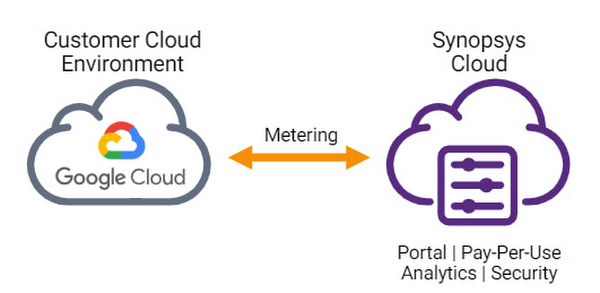
EDA software is a large consumer of high performance computing capacity in the cloud. With the release of Synopsys Cloud bring-your-own-cloud (BYOC) solution on Google Cloud, chip designers can now scale their Google Cloud infrastructure with Synopsys’s leading EDA tools under the flexible FlexEDA pay-per-use model and access unlimited EDA software license availability on-demand by the hour or minute.
The Synopsys Cloud BYOC deployment architecture on Google Cloud is enabled through their unique cloud metering service which uses Google Cloud regional MIGs (Managed Instance Groups) for autoscaling and multi-zone deployment. This enables the service to scale up to meet customer workload demands and scale down to optimize costs. Secrets used by Synopsys Cloud are securely stored in Google Secret Manager and usage data is encrypted using Google Cloud key management, providing customers with a highly secure design environment.
Synopsys Cloud also leverages Google Cloud’s Ops Agent and Operations Suite Dashboards are used to show metric data, alerting policies, and log entries, providing customers with detailed analytics visibility to make better chip design project lifecycle management decisions. The Synopsys Cloud BYOC solution has been validated with EDA workloads scaling out to thousands of cores on Google Cloud, using Google Filestore network file storage during validation to provide the highest throughput performance.
Vikram Bhatia, Head, Synopsys Cloud Product Management, Synopsys said, “With the release of Synopsys Cloud BYOC solution on Google Cloud, we are transforming the way our mutual semiconductor customers can design the chips of the future. Google Cloud has been leading the innovation wave for semiconductors in the cloud and we are excited about being an early adopter in leveraging those innovations for our unique EDA offerings on the cloud.” Customers can evaluate a full featured Synopsys Cloud BYOC environment on Google Cloud for free by signing up at: synopsys.com/cloud.
“Combined with GCP’s unique platform services for AI, security, and shared storage, the Synopsys Cloud BYOC solution creates a compelling package for semiconductor designers who will create the next generation of chips for the world’s insatiable needs” says Simon Floyd, Industry Director, Manufacturing & Transportation, Google Cloud.
Google Cloud provides everything you need, including free Google Cloud credits to get you up and running. Click here to learn more about Semiconductors on Google Cloud.

3163
Of your peers have already downloaded this article
10:00 Minutes
The most insightful time you'll spend today!
FinOps is a concept similar to DevOps, but with a different set of goals. Cloud FinOps is an operational framework and cultural shift that brings together technology, finance and business to drive financial accountability and accelerate business value realization. In layman terms, FinOps aims to help companies achieve most out of every dollar invested on cloud technology. It includes a broad set of existing and net-new processes or frameworks that breaks silos across functions, and build a better working model to achieve collaboration, agility, ownership and value.
Rest your anxieties about the changes in mindset and organizational behavior around current financial management practices while taking full flexibility benefits of cloud. Ease your cloud migration journey and value realization as experts at Google Cloud have shared best-practices, insights and action items to implement FinOps on Google Cloud in this whitepaper. Download now!
Freenome’s Innovative Cancer Detection Technology and Its Integration with Google Cloud

1507
Of your peers have already read this article.
3:30 Minutes
The most insightful time you'll spend today!
It’s incredible to see how startups across industries are using cloud technology to help address some of our most pressing, important, and life-altering challenges. Startups and high-growth technology companies are choosing Google Cloud and using technologies like Google Compute Engine (GCE), BigQuery, Looker, Firebase and more to help businesses reduce energy consumption, build more inclusive and sustainable workforces, and in the case of high-growth biotech company Freenome, are creating diagnostic tests that will help detect life-threatening diseases like cancer in the earliest, most-treatable stages.
Freenome is driven by its mission to develop high-quality diagnostic tests to detect and treat diseases like cancer from a simple blood draw. In 2022, Freenome significantly accelerated its growth on Google Cloud to support the business as it began the clinical trials of its diagnostic blood testing technology. Today, the high-growth biotech is further deepening its partnership with Google Cloud in order to support its rapid growth and scale as it concludes clinical validation, takes its tests through FDA approvals, and prepares to bring its product to market.
When detected early, data shows that there is a higher probability for cancer to be beaten, yet not everyone has access to early detection measures. By creating a way to detect the earliest warning signs of cancer with a standard blood test, Freenome is helping bridge the gap between accessibility and early cancer detection. To do this, Freenome built a multiomics platform capable of analyzing and detecting disease-associated patterns in the blood using molecular biology, advanced biology, and machine learning. By applying machine learning models trained to scan for tumor and non-tumor biomarkers to the diagnostic process, Freenome’s tests can identify suspicious molecular patterns in a patient’s blood, which will ultimately help more people detect cancer at its earliest stages in the body.
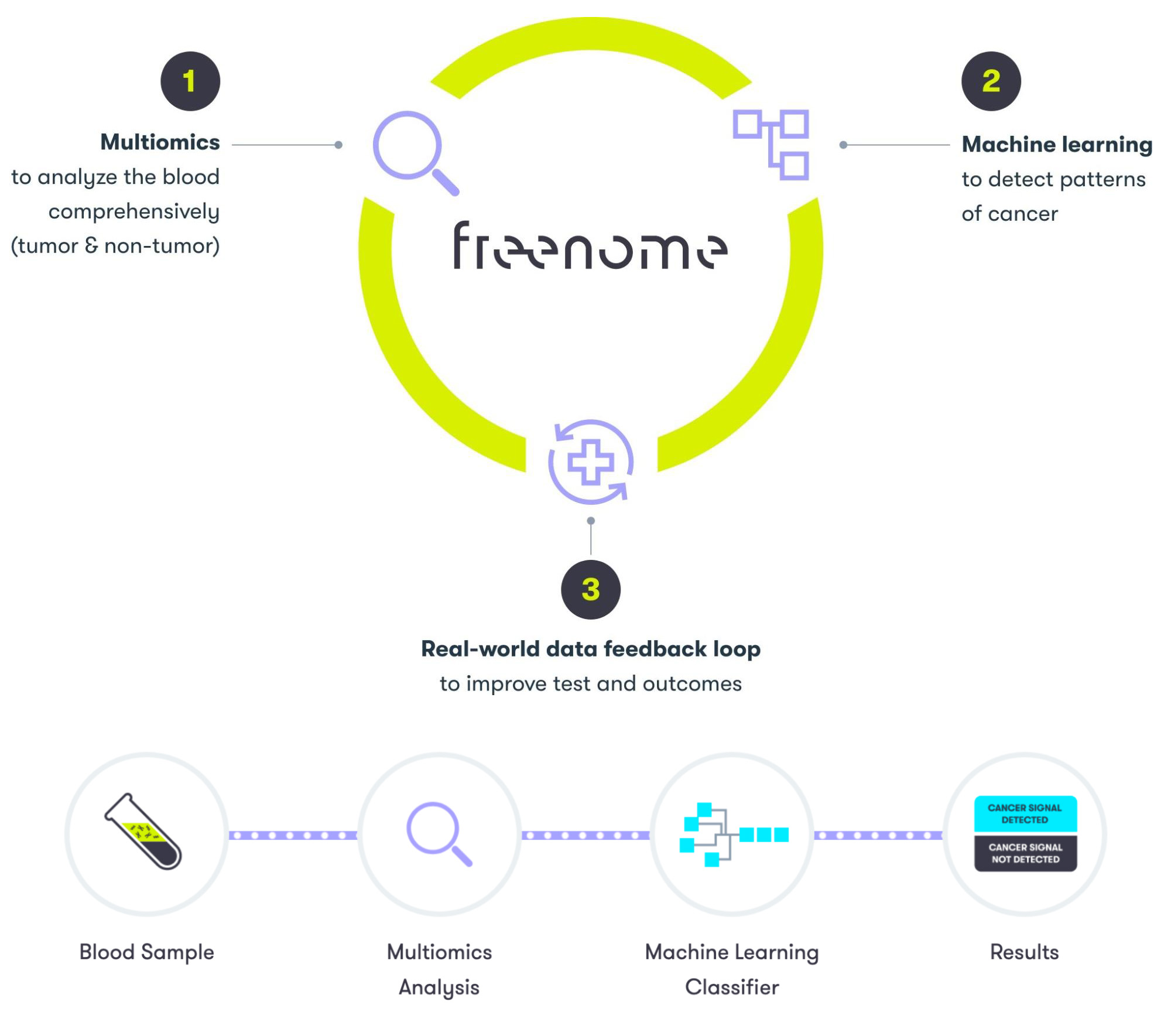
The amount of molecular data extracted from blood samples can quickly add up to hundreds of terabytes worth of data, so it was clear early on that Freenome would need infrastructure that could support the fast sequencing and processing of large amounts of data. In addition, Freenome’s collaboration technology needed to provide flexibility, security, and proper identity management safeguards, given the nature of its business. To meet these needs and support the company’s plans for growth and innovation, Freenome selected Google Cloud as its primary cloud provider, utilizing services like Google Cloud Storage and Google Kubernetes Engine (GKE), along with Google Workspace as its collaboration platform.
Using Cloud Storage alongside GKE gives Freenome the computing power needed to sequence and process mass amounts of blood sample data with high-performance, speed, and at scale. Cloud Storage also makes it easy for Freenome to leverage other Google Cloud capabilities like BigQuery for analytics with built-in query acceleration. Additionally, the built-in cluster management capabilities of GKE make it easy for Freenome’s engineering and IT teams to manage and deploy new workflows to the high-performance computing clusters used by the machine learning components of its multiomics platform to speed up cancer detection. Freenome also uses Google Cloud technologies like Artifact Registry and Cloud SQL, which help the company ensure a managed and secure software supply chain of containers and other artifacts.
Today, as a part of its expanded partnership with Google Cloud, Freenome is significantly increasing its use of Cloud Storage and GKE as it works to complete the clinical trials related to its diagnostic test. By expanding its use of GKE and Cloud Storage, Freenome will be equipped to perform the compute-intensive analytical work required for running its research workflow and diagnostic classifier algorithms. In addition, Freenome teams will continue leveraging Google Workspace products across the company so they can securely manage and collaborate on business-critical content.
Besides using Cloud Storage, GKE, and Google Workspace to support the company’s rapid growth, Freenome plans to leverage Google Cloud technologies like BigQuery to support the research and development of new products. The company is also testing security technologies like BeyondCorp to keep its growing workforce secure and productive at scale.
As the future of disease detection continues to evolve, Google Cloud is proud to support the growth of innovative companies like Freenome with infrastructure and cloud technologies so they can help empower more people with early disease detection solutions and ultimately, change more lives for the better.
More Relevant Stories for Your Company

What Swiggy and You Can Learn From This Company’s Use of ML to Engage Customers
The app economy has enabled a huge range of unique business models to flourish. One such model is online food ordering and delivery services, in which apps leverage geo-location data to aggregate local food choices and offer personalized options to consumers. A leading company in this space is Just Eat.

World’s Largest Online-only Grocery Retailer Uses AI to Figure Which Customers Need Most Attention
In the United Kingdom, the popularity of online grocery shopping is expected to surge from about 6% of the market today to 9% by 2021, according to market research firm Mintel. One of the pioneers of online-only grocery retailing is Ocado, based in Hatfield, Hertfordshire in the U.K. Since starting commercial deliveries

New Capabilities in Cloud Asset Inventory Allow Better Visibility into Google Cloud Environments
Businesses that operate in complex cloud environments, large fleets, or sophisticated security operations all require visibility into their cloud assets in order to keep their teams nimble and their data secure. Cloud Asset Inventory (CAI) helps these teams understand their Google Cloud and Anthos environments by providing complete visibility, real-time monitoring, and
Recapping Google Cloud VMware Engine’s Latest Milestones
We’ve made several updates to Google Cloud VMware Engine in recent weeks—today’s post provides a recap of our latest milestones. Google Cloud VMware Engine delivers an enterprise-grade VMware stack running natively in Google Cloud. This cloud service is one of the fastest paths to the cloud for VMware workloads without making changes
