





Google Invests 1 Billion Euros on Germany to Support Growing Businesses

3547
Of your peers have already read this article.
2:00 Minutes
The most insightful time you'll spend today!
In September 2001, the first-ever German Google employee switched on their computer in Hamburg. Since then, we’ve grown to more than 2,500 employees in four offices across Germany. Berlin, Frankfurt, Hamburg and Munich have long been our home, and we continue to invest in the growth of the local economy.
Today, 20 years after the start of “Google Germany”, we are pleased to present one of our most important investment programs to date in this country. With the expansion of our Cloud Region in Frankfurt in a new Google-owned Hanau facility, a new Google Cloud region in Berlin-Brandenburg, and a broad investment plan in renewable energy, our commitment is clear: Google is investing in Germany’s potential and supporting the transition to a digital and sustainable economy. Between now (2021) and 2030, this investment in digital infrastructure and clean energy will total approximately 1 billion euros.
Expanding our Frankfurt cloud region to support growing demand from German businesses and organizations
In Hanau, only 20 kilometers from the DE-CIX Internet hub in Frankfurt, Google is proud to be nearing completion of an additional cloud facility that will be fully operational in 2022. This expansion of our existing Frankfurt Google Cloud region will serve the growing demand for Google Cloud services in Germany.
The 4-story building is 10,000 square meters and was sustainably constructed with energy efficient infrastructure and adherence to our circular economy model for waste. The symbolic handover of the keys from developer NDC-Garbe, together with local government officials, took place on site yesterday.
A new cloud region in Berlin-Brandenburg
In addition to the Hanau expansion of our Google Cloud region in Frankfurt, we are pleased to announce that a new Google Cloud region will be located in Berlin-Brandenburg, further extending our ability to meet growing demand for cloud services in the country. When open, this will be our second Google Cloud region in Germany, providing enterprise customers with faster access to secure infrastructure, smart analytics tools and an open platform. Designed and dedicated to providing enterprise services and products for Google Cloud customers of all sizes and industries in Germany, the Berlin-Brandenburg region will have three zones to protect against service disruptions and join the existing network of 27 Google Cloud regions connected via our high-performance network.
One of the cleanest clouds in the industry becomes even cleaner
Since 2017, Google has matched 100% of our global, annual electricity use with renewable energy. Last year, we set out to run our business on carbon-free energy everywhere and at all times by 2030, enabling us to offer cloud customers one of the cleanest clouds in the industry, while helping Europe achieve its ambitious climate goals.
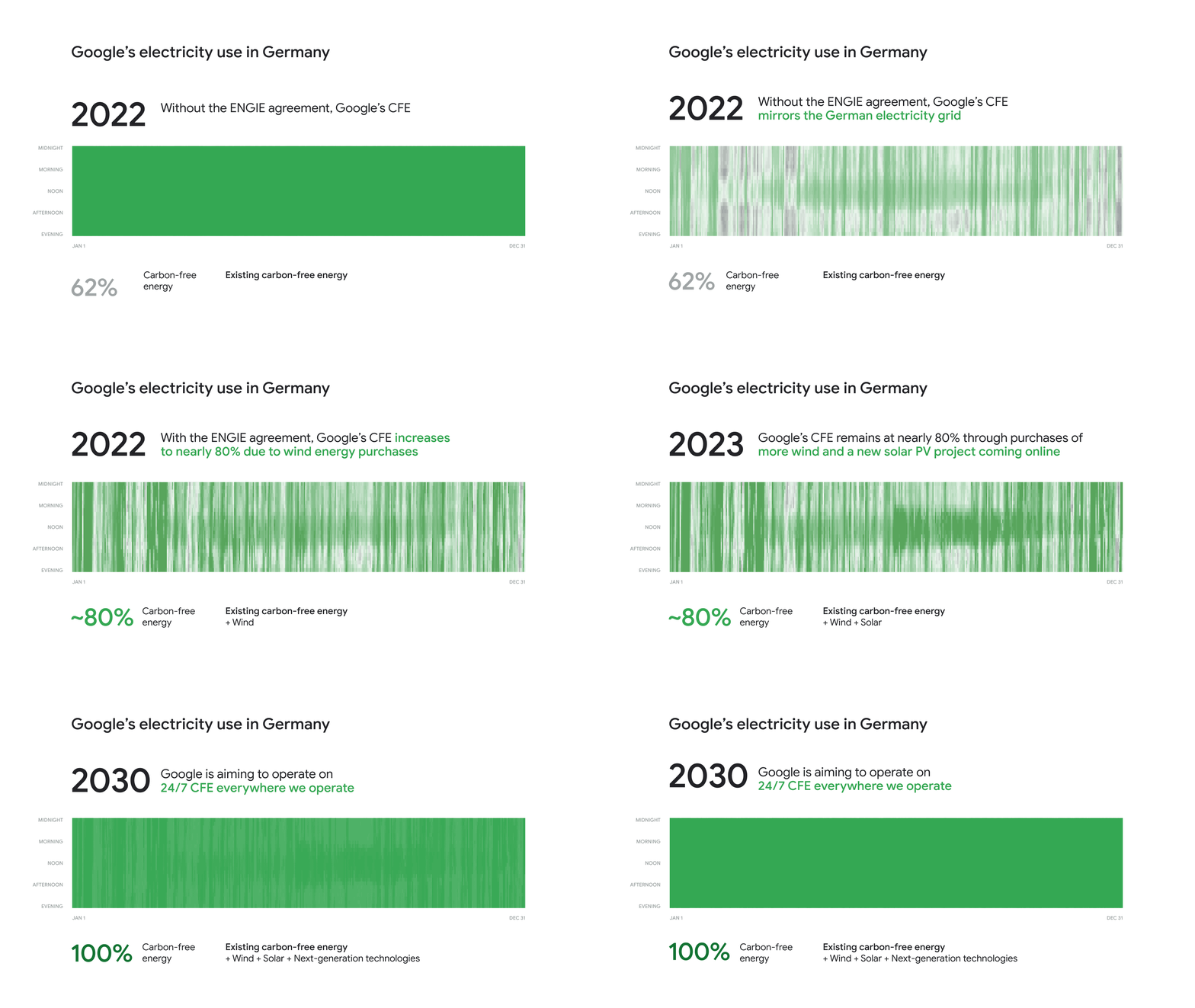
Today, we’re excited to announce that ENGIE Deutschland has been selected as Google’s carbon-free energy supplier in Germany. Under the terms of the agreement, ENGIE will assemble and develop, on Google’s behalf, a 140 megawatt (MW) carbon-free energy portfolio in Germany that has the ability to flex and grow with us as our needs change. This includes a new 39MW solar Photovoltaic system, and 22 wind parks in five federal states that will see their lives extended so they continue to produce electricity instead of being dismantled. This portfolio will ensure that the energy delivered to Google’s German facilities will be nearly 80% carbon-free by 2022 when measured on an hourly basis. This is a first but important step on Google’s journey to reach our goal of full electricity decarbonization by 2030.
This is the first energy supply of its kind in Europe, with a focus on sourcing carbon-free energy for every hour of Google’s operations. Not only will this new agreement draw the roadmap for the industry and more 24/7 carbon-free energy contracts in Europe, but it provides our cloud customers with two more regions where they can lower their carbon footprint. And importantly, by working with our energy suppliers to transform how clean energy is delivered to customers, Google is supporting the broader decarbonization of the German electricity grid.
What customers and partners are saying
As companies continue to grapple with changing customer demands, technology has played a critical role, and we’ve been fortunate to partner with and serve people, companies, and government institutions in Germany and around the world to help them adapt. The Google Cloud region in Berlin-Brandenburg and the expansion of our Google Cloud region in Hanau will help our customers — such as BMG, Delivery Hero, and Deutsche Bank — adapt to new requirements, new opportunities and new ways of working.
“We are very pleased about the symbolic handover of the keys to the building here in Hanau to Google Cloud,” said Hanau Mayor Claus Kaminsky. “With Google, we have a strong partner at our side who is supporting us in setting up Hanau’s economic future, both digitally and sustainably. The data center facility of Google Cloud embodies this transformation: We bring the cloud to us in Hanau and thus support the digital transformation of companies and public authorities. Not only in our city and Hesse, but throughout Germany and Europe. The new building meets high sustainability standards and the clean energy initiative presented today by Google is in line with our aspirations for sustainable digitalization.”
“Sustainability is a central pillar of Deutsche Bank’s strategy and we have made strong public commitments to be part of the solution,” said Bernd Leukert, Chief Technology, Data and Innovation Officer and Member of the Management Board at Deutsche Bank. “We welcome the new Google Cloud region in Germany, which will enable us to deliver additional resilience and performance for our German client base.”
Ralf Bernhard, Senior Originator Renewables, ENGIE, said: “ENGIE is excited to collaborate with Google based on a first-of-a-kind agreement which will support the company with its sustainability goals and ambitious carbon-free energy target. Thanks to our expertise in energy and risk management, we can seamlessly integrate renewable energy from existing plants and develop new assets to design a tailor made product that meets Google’s needs and plans to go even greener.”
20 years since Google first touched down in Germany, our commitment to helping Germany continue to lead in technical innovation is stronger than ever. We are excited to continue working with our partners in Hesse, Berlin and Brandenburg and across Germany to advance infrastructure and clean energy projects, help accelerate digital transformation, and secure a sustainable future for German and European companies and organizations.
6712
Of your peers have already downloaded this article
4:30 Minutes
The most insightful time you'll spend today!
Unlocking the Power of Data and Creativity with
the Cloud: The WPP Story
3473
Of your peers have already watched this video.
1:30 Minutes
The most insightful time you'll spend today!
Pharma Firm Drives 80% Improvement in Speed with SAP on Google Cloud
FFF Enterprises is a leading supplier of critical-care biopharmaceuticals, plasma products, and vaccines. Their passion for patient safety and product efficacy drives their mission of Helping Healthcare Care.
For FFF Enterprises if they have to focus on ERP infrastructure, that takes away from getting products to patents. Learn why FFF Enterprises chose to deploy SAP on Google Cloud and drove an 80% improvement in speed for their SAP environment at a lower cost.
What Swiggy and You Can Learn From This Company’s Use of ML to Engage Customers

9656
Of your peers have already read this article.
1:45 Minutes
The most insightful time you'll spend today!
The app economy has enabled a huge range of unique business models to flourish. One such model is online food ordering and delivery services, in which apps leverage geo-location data to aggregate local food choices and offer personalized options to consumers.
A leading company in this space is Just Eat. Launched in the UK in 2001 with a vision of ‘serving the world’s greatest menu. Brilliantly.’ The company has capitalized on the popularity of online food delivery and grown its presence across 12 markets.
Just Eat acts as an intermediary between take-out food outlets and hungry customers, giving local restaurants access to a broader base of potential diners, while providing consumers with an easy and secure way to order and pay for food from their favourite restaurants.
Today the company helps 27 million customers find food from more than 112,000 restaurants—everything from homemade Italian pasta, to Chinese noodle bowls, to fish-and-chips.
Data is the fuel of Just Eat’s rapid growth, but it wasn’t always looked at that way. In its early days, Just Eat struggled with the deluge of information and faced fragmentation across its systems. In fact, the company realized its legacy data vendor wasn’t capable of ingesting 90 percent of the data produced by its food platform. This was incredibly frustrating for Just Eat’s analysts and data scientists, who had to waste time cleaning up sources instead of leveraging the data to create a better user experience.
Just Eat turned to Google Cloud, and now uses machine learning (ML) to power sophisticated consumer recommendations on both its app and website. It also makes heavy use of features offered by Google Cloud Platform, including BigQuery for running analytics on its customer data set and Cloud Pub/Sub for messaging app users with relevant offers in real-time.
Having all of Just Eat’s data in one platform has translated into real value for its customers. With Google Cloud tools, Just Eat has created its own proprietary Customer Ontology framework, which today contains 5.5 billion features that better understand consumers’ behavior and food habits, and provides insights into previous visits.
Just Eat recently created an “Adventurous Index” to map its customers according to their ordering habits, enabling them to tailor their marketing and user experiences. For example, mid-adventurous customers are shown a choice of restaurants that serve their most ordered cuisine, while adventurous customers can choose from restaurants that serve a wider variety. This not only has prompted consumers to be more adventurous with their choices, but also has led to more business at a more diverse set of restaurants.
Matt Cresswell, Director of Customer Platforms at Just Eat said that Google Cloud has become integral to its product delivery: “Consumer food choice is a hugely nuanced topic. We know that individuals have their own unique journeys when they use Just Eat. We’ve sought to create a truly one-to-one relationship with every customer. The changes we’ve made to the platform mean they can access the dishes they enjoy at the touch of a fingertip, and find inspiration to discover new dishes they’ll love. We’re grateful to Google Cloud for helping us support our customers on their culinary explorations.”
Media CDN to Intelligently Deliver Streaming Experiences to Viewers around the World!

3302
Of your peers have already read this article.
3:00 Minutes
The most insightful time you'll spend today!
The digital media and entertainment industry is experiencing dramatic growth, as audiences migrate to online experiences and content providers seek to deliver new and innovative content. According to The Global Internet Phenomena Report, streaming video accounted for 53.7% of internet bandwidth traffic, up by 4.8% from a year ago. This rapid growth of over-the-top content is straining existing infrastructure, fueling media companies’ shift to the public clouds with their global presence and greater distribution capacities. In addition, other use cases such as gaming, social networks, AR/VR experiences, and education continue to fuel the need for intelligent media services and operations.
Today, at the 2022 NAB Show Streaming Summit, we’re excited to announce the general availability of Media CDN — a modern, extensible platform for delivering immersive experiences with unparalleled scale and intelligence. Media CDN will enable media and entertainment customers to efficiently and intelligently deliver streaming experiences to viewers anywhere in the world. The same infrastructure that Google has built over the last decade to serve YouTube content to over 2 billion users is now being leveraged to deliver media at scale to Google Cloud customers with Media CDN.
Unparalleled planet-scale reach and scale
Media CDN’s foundational advantage is the Google network. We have invested decades of resources to build tremendous capacity and reach in over 200 countries and more than 1,300 cities around the globe. Modern video applications are sensitive to fluctuations in latency, so getting content closer to users enables higher bitrates and reduces rebuffers, resulting in a superior experience for the end user. Media CDN builds on the success of the existing Cloud CDN portfolio for web and API acceleration and complements it by enabling delivery of immersive media experiences.
In addition to running on planet-scale infrastructure, Media CDN tailors delivery protocols to individual users and network conditions. Media CDN includes out-of-the-box support for QUIC (HTTP/3), TLS 1.3, and BBR, optimizing for last-mile delivery . When the Chrome team rolled out widespread support for QUIC, video rebuffer time decreased by more than 9% and mobile throughput increased by over 7%.
Media CDN also achieves industry-leading offload rates. With multiple tiers of caching, we minimize calls to origin — even for infrequently accessed content. This alleviates performance or capacity stress in the content origin and saves costs. These features are built into the product and seamlessly support customer content hosted on Google Cloud, on-premises, or on a third-party cloud.
“We are excited to leverage Media CDN to continue to deliver an exceptional streaming experience for Stan users across Australia. With Google’s massive network, and a deep reach into the ISPs, we are able to deliver the highest quality video for our users, no matter where they are”—John Hogan, Chief Technology Officer, Stan
“Our mission at U-NEXT is to deliver the highest quality and most entertaining content to our users. Google Cloud’s Media CDN helps us efficiently scale our infrastructure, which is challenging with a vast library of content. Media CDN offloaded 98.3% of requests from our origin server while delivering consistent great quality.”—Rutong Li, Chief Technology Officer, U-NEXT
Broader platform for monetization and immersive experiences
While global distribution is critical for a high-quality end-user experience, it’s only one piece of delivering a world-class platform for immersive experiences. Media CDN offers additional capabilities to enable this transformation — ad insertion, ecosystem integrations and platform extensibility, and powerful AI/ML analytics for interactive experiences.
Streaming providers can improve monetization through integrated ad serving via the Video Stitcher API, which allows manipulation of video content to dynamically insert ads.
Through extensible ecosystem integrations, Media CDN connects customers to key capabilities to simplify their operations. For example, the Transcoder API supports custom streaming formats, while the Live Stream API transcodes mezzanine live signals into direct-to-consumer streaming formats, for multiple device platforms.
Media CDN is built with AI/ML that will give viewers more control over how they see, experience, and even interact with content. For example, sports fans watching a game can obtain real-time stats and analytics, viewers can purchase items from virtual billboards, etc.
Cloud-native and developer-friendly operations
Media companies are under pressure to develop and deploy innovative experiences at a furious pace. Media CDN was built by developers, for developers, with automation and observability built in, giving media providers the speed and flexibility they need to integrate delivery provisioning and management into their content release processes.
Media CDN offers comprehensive APIs and automation tools such as Terraform. Detailed, pre-aggregated metrics and playback tracing make it easy to diagnose performance across the entire infrastructure stack. Real-time visibility is provided via Google Cloud’s operations suite, and integrates with tools that developers already use such as Grafana and ElasticSearch.
“Leveraging the same infrastructure as YouTube, Google Cloud’s Media CDN combines geographic reach, API-first architecture and integration with the Cloud operations suite. This is a transformative move that is aligned with the future of the CDN industry.”— Ghassan Abdo, Research Vice President, WW Telecom, Virtualization and CDN, IDC
“Viewers around the world are demanding best-in-class video quality and performance across modes of consumption. A video-first delivery network can be a game changer in this space. We’re excited to partner with Google Cloud and to leverage Media CDN to enable premium video experiences and customer engagements.”—Juan Martin, Founder and CTO, Firstlight Media
Planet-scale advanced security
Media CDN lets streaming media providers take advantage of Google’s decades-long experience delivering video safely, securely, and reliably. The platform includes deep integration with Google Cloud Armor for planet-scale DDoS protection and a rich set of capabilities to detect and mitigate attacks, prevent abuse, manage risk, and comply with regulatory or licensing requirements.
If you want to deliver rich, immersive experiences to global audiences with an extensible, modern delivery platform, we’d love to hear from you. For more information, including technical specifications and platform architecture, please visit cloud.google.com/media-cdn. To get started with Media CDN, contact your sales team.
How Retailers Can Beat Inflation Like a Pro With These 5 Tips

2845
Of your peers have already read this article.
3:30 Minutes
The most insightful time you'll spend today!
Budget concerns and inflation shock are causing noticeable shifts in consumer behavior, a head-spinning turnabout since the pandemic days of 2020. We went from not having access to enough goods to now not having the right goods at the right price points. Heading into the holiday season, retailers will need to look sharp and be able to deliver value to the increasingly cost-conscious consumer — with frictionless product discovery and digital shopping experiences, relevant inventory, and personalization.
Those are a few of the insights gleaned from a recent eMarketer webcast on how retailers can better combat the effects of inflation, with pragmatic recommendations from experts including Amy Eschliman, managing director of retail solutions strategy and industry engagement at Google Cloud; Alexis Hoopes, vice president and head of e-commerce and direct-to-consumer (DTC) at Mattel Inc; and Elissa Quinby, head of retail insights at Quantum Metric. We’d like to share five key takeaways that retailers can adopt.
1. Be prepared for earlier holiday planning. Budget-conscious buyers are planning their purchases earlier than ever. According to our partner Quantum Metric’s latest Retail Benchmarks research, 40% of U.S. consumers and 30% in the UK have already started their holiday shopping1. At Mattel, Alexis noted, “We’ve learned to be nimble and early for our consumers, and to have products available for them when they’re ready to shop.” With higher prices, she added, “Consumers are preplanning and researching more, viewing product detail pages multiple times to check a higher-price item before adding it to their basket.”
Quantum Metric’s same research also shows that while average cart values grew between January to July 2022 — larger than they were at the same time last year1 — consumers were shopping less frequently. Because of higher prices, 37% of shoppers are now pre-planning and purchasing items all at once to help keep to their budget1. Amy observed. “That means retailers need to make it super easy for customers to find what they want to avoid shopping-cart abandonment.”
Retailers who make it easier for shoppers to find the right products, by providing Google-quality search and recommendations, can help reduce cart abandonment and increase conversions.
2. Get a handle on out-of-stock issues. While many of the supply-chain issues that surfaced during the pandemic have cleared up, inventory continues to be a challenge in retail. During the 2021 holiday season, Google/Ipsos research shows that consumers saw a 253% increase in “out of stock” messages versus pre-pandemic2. Elissa further pointed out that a great majority of both U.S. and UK consumers experience out-of-stock issues several times a month. It’s a fluid situation, however, with retailers facing bloated inventory as consumer demands quickly pivot from, for example, branded goods to generic or white-label items. “In the next six months or so, you really need to make sure you have the right inventory to meet consumer demands,” she advised.
The need for end-to-end visibility and the ability to act in real-time across the supply chain has never been more pressing. Google Cloud and our partners are tackling the top supply chain issues head on with solutions that enable end-to-end visibility, analytics and alert-driven event management as well as AI solutions and automation to streamline processes like procurement, fulfillment, and delivery.
3. Introduce value: communicate the quality of the product and the experience. While rising prices are paramount for many shoppers, it’s a common misconception that consumers are making purchase decisions based solely on price. Alexis remarked, “In e-commerce, we talk about price, product, service, and experience. Price is only one of the pillars for consumers. At Mattel, we are fully focused on product and experience. What makes this special? How do we connect directly in new ways to the consumer? Create ‘wow’ moments and deeper connections. When we think about value for our consumers, it’s the strength of the products that will drive the purchase.”
Elissa also noted that while consumers are doing a lot of comparison shopping, it’s really about value, whether a high-quality product or a high-quality experience. Quantum Metric’s Continuous Product Design solution, which is built with BigQuery, ingests data across multiple digital touchpoints, including from mobile and web applications, and connects customer signals to every stage of the product lifecycle to help deliver the products and experiences that customers actually want.

4. Ensure consistent experiences across channels. Today, consumers crave the cross-channel shopping experience. “The channel experience has gone from online to in-store to now everywhere,” Amy commented. “We call it ubiquitous digital shopping.” Elissa added that 75% of consumers do most of their shopping digitally. However, mobile drives 67% of digital traffic, but just 49% of sales.1 “Recent trends in traffic and conversion rates by device show that we can expect the most traffic for the big sale days on mobile,” she said. “People are looking for discovery and awareness, maybe even adding items to the cart as a placeholder or reminder. But they prefer to complete a sale on a desktop. It will be critical for retailers to offer a consistent experience, especially on major sale days like Black Friday and Cyber Monday.” Elissa also advised wrapping up any experiments with product and site design early, making sure to understand the customer experience holistically across the organization and prioritizing efforts to eliminate friction.
Consumers now expect to be able to shop wherever and whenever best fits their needs, whether in a store, on your website, through your app, or from within a social media ad, and have it be a consistently good experience no matter how they first entered or exited your commerce site. Google’s 2022 Retail Marketing Guide provides useful insights and tips on how to grow your online and in-app sales.
5. Personalize touchpoints to build loyalty. Connecting with your customer base and making sure they understand the value of your offering is essential. Alexis noted that the key is to keep your messages fresh as the holiday shopping season expands, providing new messages as they keep coming back to your store. “We need to engage them by helping them find what they are looking for at the right time,” she said. “Recognize that they are doing more planning and wish-list building early, then buying last-minute gifts at lower prices towards the end. Make sure those are front and center.”
Alexis also pointed out that today, consumers are providing more data points with the products they view or the items sitting in their carts. “What’s so great about e-commerce is that we can use all of this to create more personalized, direct messages targeted to those consumers,” she commented.
Amy recommended continuing to focus on conversion with product discovery and personalization, harnessing customer data to drive insights and action. “Any company’s biggest asset is their data. Using it in as many ways possible and activating it across the company is incredibly important,” she remarked. “Take advantage of your first-party data to activate everything from marketing campaigns to a more efficient supply chain. For every customer who comes to one of your digital properties, make sure your product discovery is as easy as possible. Pay attention to your recommendations, driving personalization to make that experience as unique and fruitful for the customer as possible.”
Achieving these objectives requires a modern cloud data warehouse and activation of a customer data platform. Retailers can explore how Google Cloud’s advanced data capabilities and our ecosystem of partners can power a customer data platform that supports more personalized marketing, shopping experience, and customer service.
While these are our key takeaways, we invite you to register to watch the on-demand webinar, “5 Ways Retailers Can Combat the Effects of Inflation,” for even more insights.
- Quantum Metric Retail Benchmarks, “Adjusting for Inflation.” The report is based on aggregated browsing behavior from January to July 2022, paired with a survey of 3,400 consumers in the U.S. and UK.
- Google/Ipsos, Holiday Shopping Study, Oct 2021 – Jan 2022, Online survey, US, n=7,253, Americans 18+ who conducted holiday shopping activities in past two days
More Relevant Stories for Your Company

FNM Group Migrates SAP HANA to Google Cloud: Tips for CIOs
Founded in 1877, the FNM Group is Italy’s second largest railway company, operating in the Lombardy region. With 700,000 passengers a day, the core business remains with railway operations, but in recent years the FNM Group has redefined itself as a mobility service provider rather than just a public transport
MIT Cloud Security Confidence Report: An Evolution Worth Noting
The age of unthinking fears about cloud security is over. Not only is cloud adoption rising steadily across geographies, industries and job functions, but confidence in cloud security is rising as well — to the point where increased security is a major reason enterprises opt for cloud solutions. Gone are

Why Moving SAP Workloads to Google Cloud is Beneficial for the Consumer Goods Industry
Even before the COVID-19 pandemic struck, the consumer packaged goods (CPG) industry was facing disruption. Consumers have come to expect personalized and seamless experiences at every point in their relationship with a brand. Additionally, consumers are expecting CPG brands to meet rising standards for sustainability, social responsibility, and transparency. Business

7 Common Myths About Cloud Computing That Must Be Banished
No discussion about the emerging technologies that are shaping our future is complete without a mention of cloud computing. Unfortunately, too many of these discussions are filled with misinformation and fear-mongering. And while it’s always advisable to approach new technologies with a degree of healthy skepticism, this should always be
