





Partnering for Stronger Security: Google and Mandiant Join Forces

2797
Of your peers have already read this article.
2:30 Minutes
The most insightful time you'll spend today!
Over the past two decades, Google has innovated to build some of the largest and most secure computing systems in the world. This scale requires us to deliver pioneering approaches to cloud security, which we pass on to our Google Cloud customers. We are committed to solving hard security problems like only Google can, as the tip of the spear of innovation and threat intelligence.
Today we’re excited to share the next step in this journey with the completion of our acquisition of Mandiant, a leader in dynamic cyber defense, threat intelligence and incident response services. Mandiant shares our cybersecurity vision and will join Google Cloud to help organizations improve their threat, incident and exposure management.
Combining Google Cloud’s existing security portfolio with Mandiant’s leading cyber threat intelligence will allow us to deliver a security operations suite to help enterprises globally stay protected at every stage of the security lifecycle. With the scale of Google’s data processing, novel analytics approaches with AI and machine learning, and a focus on eliminating entire classes of threats, Google Cloud and Mandiant will help organizations reinvent security to meet the requirements of our rapidly changing world.
We will retain the Mandiant brand and continue Mandiant’s mission to make every organization secure from cyber threats and confident in their readiness.
Context and threat intelligence from the frontlines
Our goal is to democratize security operations with access to the best threat intelligence and built-in threat detections and responses. Ultimately, we hope to shift the industry to a more proactive approach focused on modernizing Security Operations workflows, personnel, and underlying technologies to achieve an autonomic state of existence – where threat management functions can scale as customers’ needs change and as threats evolve.
Today Google Cloud security customers use our cloud infrastructure to ingest, analyze and retain all their security telemetry across multicloud and on-premise environments. By leveraging our sub-second search across petabytes of information combined with security orchestration, automation and response capabilities, our customers can spend more time defending their organizations.
The addition of Mandiant Threat Intelligence—which is compiled by their team of security and intelligence individuals spread across 22 countries, who serve customers located in 80 countries—will give security practitioners greater visibility and expertise from the frontlines. Mandiant’s experience detecting and responding to sophisticated cyber threat actors will offer Google Cloud customers actionable insights into the threats that matter to their businesses right now. We will continue to share groundbreaking Mandiant threat research to help support organizations, even for those who don’t run on Google Cloud.
Advancing shared fate for security operations
Google Cloud operates in a shared fate model, taking an active stake in the security posture of our customers. For security operations that means helping organizations find and validate potential security issues before they become an incident.
Detecting, investigating and responding to threats is only part of better cyber risk management. It’s also crucial to understand what an organization looks like from an attacker’s perspective and if an organization’s cybersecurity controls are as effective as expected.
By adding Mandiant’s attack surface management capabilities to Google Cloud’s portfolio, organizations will be able to continually monitor assets for exposures, enabling intelligence and red teams to move security programs from reactive to proactive to understand what’s vulnerable, misconfigured and exposed.
Once an organization’s attack surface is understood, validating existing security controls is critical. With Mandiant Security Validation, organizations will be able to continuously validate and measure the effectiveness of their cybersecurity controls across cloud and on-premise environments.
Transforming security operations and incident response
Security leaders and their teams often lack the resources and expertise required to keep pace with today’s ever changing threats. Organizations already harness Google’s security tools, expert advice and rich partner ecosystem to evolve their security program. Google’s Autonomic Security Operations also serves as a prescriptive solution to guide our customers through this modernization journey.
With the addition of Mandiant to the Google Cloud family, we can now offer proven global expertise in comprehensive incident response, strategic readiness and technical assurance to help organizations mitigate threats and reduce business risk before, during and after an incident.
In addition, Google Cloud’s security operations suite will continue to provide a central point of intelligence, analysis and operations across on-premise environments, Google Cloud and other cloud providers. Google Cloud is also deeply committed to supporting our technology and solution partners, and this acquisition will enable system integrators, resellers and managed security service providers to offer broader solutions to customers.
Comments on the news
“The power of stronger partnerships across the cybersecurity ecosystem is critical to driving value for clients and protecting industries around the globe. The combination of Google Cloud and Mandiant and their commitment to multicloud will further support increased collaboration, driving innovation across the cybersecurity industry and augmenting threat research capabilities. We look forward to working with them on this mission.” – Paolo Dal Cin, Global Lead, Accenture Security
“Google’s acquisition of Mandiant, a leader in security advisory, consulting and incident response services will allow Google Cloud to deliver an end-to-end security operations suite with even greater capabilities and services to support customers in their security transformation across cloud and on-premise environments.” – Craig Robinson, Research VP, Security Services, IDC
“Bringing together Mandiant and Google Cloud, two long-time cybersecurity leaders, will advance how companies identify and defend against threats. We look forward to the impact of this acquisition, both for the security industry and the protection of our customers.” – Andy Schworer, Director, Cyber Defense Engineering, Uber
We welcome Mandiant to the Google Cloud team, and together we look forward to helping security teams achieve so much more in defense of their organizations. You can read our release and Kevin Mandia’s blog for more on this exciting news.
Tips and Best Practices: Ensuring Cloud Configuration Compliance

2676
Of your peers have already read this article.
2:30 Minutes
The most insightful time you'll spend today!
Security is often seen as a zero-sum game between “go fast” or “stay secure.” We would like to challenge this school of thought and introduce a framework to change that paradigm to a “win-win game,” so you can do both—“go fast” and “stay secure.”
Historically, application security tools have been implemented much like a gate at a parking lot. The parking lot has perimeter-based ingress and egress boom gates. The boom gates let one car through at a time, and vehicles often are backed up at the gates during busy hours. However, there are few controls once you get inside. You can access nearly any space on any level and easily move between levels.
When you apply this analogy to application development, AppSec tools are often implemented as “toll gates” within waterfall-native workflows. Developers are required to get in line, submit to a security scan, and wait to see the results. When the results are produced, developers spend significant time and energy investigating red flags raised by security. This process is slow and, not surprisingly, not very popular with developers. It’s why they often view traditional security programs as inhibitors to innovation.
Guardrails not gates
We suggest a workflow that’s less like a parking lot gate and more like a freeway with common-sense safety measures. Freeways have directive rules for all users. Speed limits, single direction of travel, and mandatory speed reduction zones when exiting contribute to freeway safety. Some freeways implement preventative measures based on these rules, such as physical walls dividing opposite flows of traffic and protective guardrails to reduce collisions and keep vehicles from veering off the road. While driving on a freeway comes with its own complications, there are no boom-style gates blocking your path.
Following the same directive rules, there are detective and responsive controls, such as speed detectors, cameras, signs reminding drivers which direction they are going, and how fast they are traveling. Some freeways have deployed rumble strips to remind a dozing driver to stay in their lane.
Applying lessons from freeways to application development and compliance in the cloud represents the perfect opportunity to build software more securely.
Modern application security tools should be fully automated, largely invisible to developers, and minimize friction within the DevOps pipeline. To do this, these security tools should work the way developers want to work. Security controls should integrate into the development lifecycle early and everywhere. These controls should live within the developer’s preferred tools and create rapid feedback loops so mistakes can be remediated as soon as possible.
A typical compliance cycle looks like this:
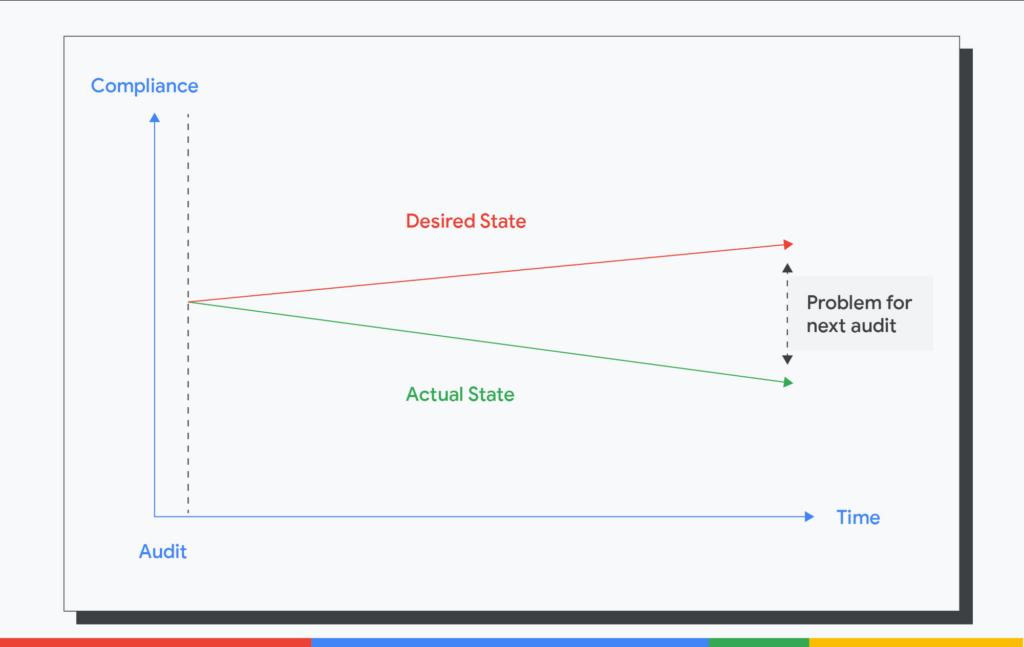
Here, we highlight the gap between the desired state and the actual state that becomes problematic when audit times come. This increases the overall cost of the audit and the time spent in generating the evidence of controls.
Instead, this is what we need.
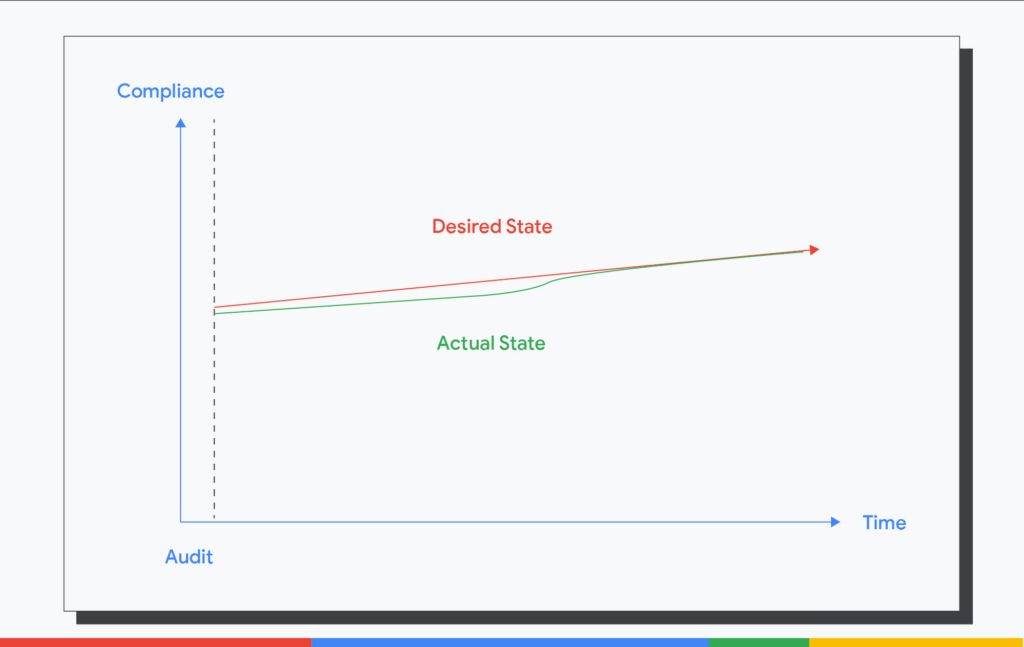
We need the actual state to track the desired state continuously. We need continuous preventative controls to stop insecure resources from being introduced. We need detective controls to find non-compliant resources promptly and constantly. We need responsive controls to fix non-compliant resources automatically. In all, we need continuous compliance.
Infrastructure continuous compliance reference architecture
How do we get started with continuous compliance? Here is the reference architecture that enables you to develop this capability.
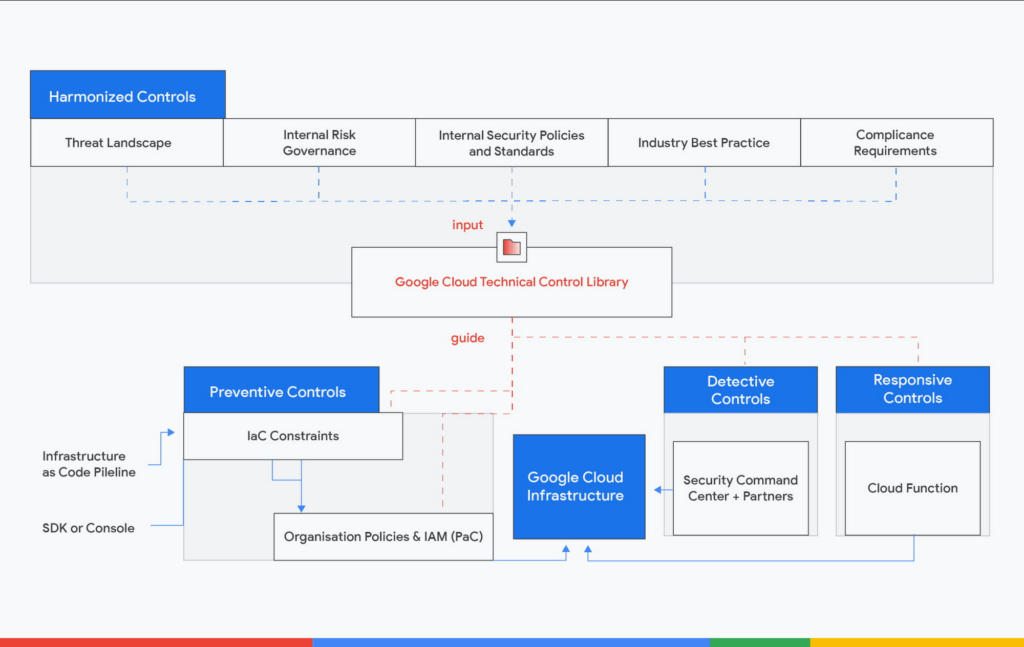
The architecture is centered on building a close-loop of directive, preventative, detective and responsive controls. It is also open and extensible. Although we reference Google Cloud architectures in this blog, you can use them for other cloud service platforms or even on-premise
The National Institute of Standards and Technology’s Open Security Controls Assessment Language (OSCAL) is a helpful resource to express your control library in a machine-readable format. OSCAL can allow organizations to define a set of security and privacy requirements, which are represented as controls, which then can be grouped together as a control catalog. Organizations can use these catalogs to establish security and privacy control baselines through a process that may aggregate and tailor controls from multiple source catalogs. Using the OSCAL profile model to express a baseline makes the mappings between the control catalog and the profile explicit and machine-readable.
Directive controls
The starting point of the close-loop is the directive and harmonized controls. Next, you should have control mappings rationalized to the technical controls against your compliance requirements. These requirements can come from various sources, such as the threat landscape of your industry, your internal security policies and standards, your external regulatory compliance, and industry best practice frameworks.
Control mappings will form a Technical Control Library. The library is a dataset mapping out harmonized controls to requirements written in different compliance frameworks. The control mapping justifies the security controls. It builds the linkage between security and compliance and helps you reduce your compliance audit cost. This dataset should be a living document.
An easy first step in building such as library is to begin with the CIS Google Cloud Platform Foundation Benchmark. The benchmark is lightweight and it constitutes foundational security any entity should get right on Google Cloud. In addition, Security Command Center Premium’s Security Health Analytics can help you to monitor your Google Cloud environment against these benchmarks on a continuous basis across all the projects within your organization.
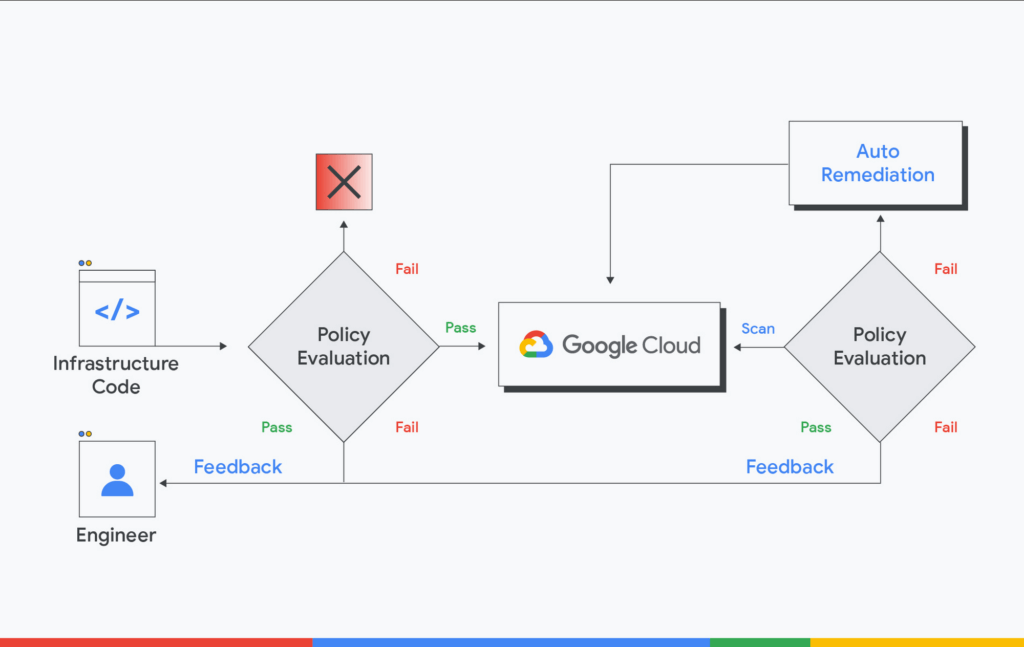
The Technical Control Library will guide the rest of the closed-loop. For every directive control, you should have corresponding preventative control to stop non-compliant resources from being deployed. You should have the detective control to look over the entire environment seeking non-compliant resources. And you should have the responsive control remedying non-compliant resources automatically or kicking off responsive workflow with your Security Operations function. Finally, every policy evaluation point should have a feedback loop to the engineers. A prompt and meaningful feedback loop provides a better engineering experience and increases development velocity in the short run. These feedback loops will breed good behaviors to write better and more secure code in the long run.
Preventive controls
Almost every action on the Google Cloud is an API call, such as when creating, configuring, or deleting resources, so preventative controls are all about API call constraints. There are different wrappers for these API calls, including Infrastructure-as-Code (IaC) solutions such as Terraform or Google Cloud Deployment Manager, the Cloud Console interface, Cloud Shell SDK, Python, or GO SDK.
As with any other application code deployment, the IaC solutions should use a Continuous Integration (CI) solution. On the CI, you could orchestrate IaC constraints, similar to writing unit tests for application code. Since all IaC solutions come in or can be converted to JSON format, you can use Open Policy Agent (OPA) as the IaC constraint solution. OPA’s Rego policy language is declarative and flexible, which allows you to construct almost any policy in Rego.
For the input sources that are not IaC, you could fall back to the organization policies and IAM as these two controls have the closest proximity to Google Cloud. That said, it’s considered a best practice to restrict non-IaC inputs for higher environments such as production-like or production, so you could codify your infrastructure, apply controls and workflows in the source repository.
Detective and responsive controls
Even if you’ve nailed the preventive controls, and the cloud environment is sterile, we still need detective and responsive controls. Here’s why.
For one, not all the controls can be safely implemented as preventative controls in the real world. For instance, we may not fail all the Google Compute Engine deployments at the CI if these VMs have external IP addresses because external IP addresses may be required for a specific software or use cases. Another reason is that we want to produce time-stamped compliance status for audit purposes. Taking the CIS compliance as an example, we could have enforced all the CIS check on the CI and set IaC as the only deployment source for cloud infrastructure.
However, we will still need to demonstrate the runtime CIS compliance report using Security Command Center. Security responsive controls are not limited to remediation actions. They can also take the form of notifications via email, messaging tools, or integration with ITSM systems. If you use Terraform to deploy the infrastructure and use Cloud Function for auto-remediation, you need to pay attention to the Terraform state. Since auto-remediation actions performed by Cloud Function are not recorded in the Terraform state file, you will need to inform the engineers to update the source Terraform code.
The future
The fact that manual processes around security and compliance don’t scale points to automation as the next enabler. The economics of automation require a systemic discipline and holistic enterprise-wide approach to regulatory compliance and cloud risk management.
By defining a data model of the compliance process, the aforementioned OSCAL represents a game-changer for automation in risk management and regulatory compliance. While we realize that adopting “as code” practices is a long-term investment for most of our customers, Risk and Compliance as Code (RCaC) has a number of building blocks to get you started. By adopting the RCaC tenets you shift towards codified policies and infrastructure for a secure cloud transformation. Stay tuned as we introduce exciting new capabilities and features to Google Cloud Risk and Compliance as Code in the months to come.
IT Leaders are Prioritizing Organizations’ Sustainability Goals: Study Finds

5147
Of your peers have already read this article.
2:00 Minutes
The most insightful time you'll spend today!
The global-wide interruptions of the coronavirus pandemic provided the opportunity for businesses to take a closer look at how we work, learn, live, and consume. With work stoppages and quarantine orders in place, carbon emissions and pollution levels saw significant reductions, highlighting how business and environmental sustainability are linked. As the world returns to work, businesses need to adjust to the new reality and make decisions that will ensure the continuing sustainability of our planet.
Understanding the need for sustainability
A recent Google-commissioned study by IDG, based on a global survey of more than 2,000 IT decision-makers, illustrated the importance of sustainability for organizations’ IT departments while also revealing that significant work is needed before businesses meet their sustainability goals. The good news is that ninety percent say that sustainability is a priority of their IT department and as more organizations consider the benefits of digital transformation and cloud migration, 75% report that sustainability is a “must-have” or “major consideration” when evaluating cloud providers.LEARN MOREIT Leaders Research ReportWhat are the biggest IT priorities in 2021? Explore insights from a survey of 2,000 Senior IT leaders conducted by IDG, in collaboration with Google Cloud.
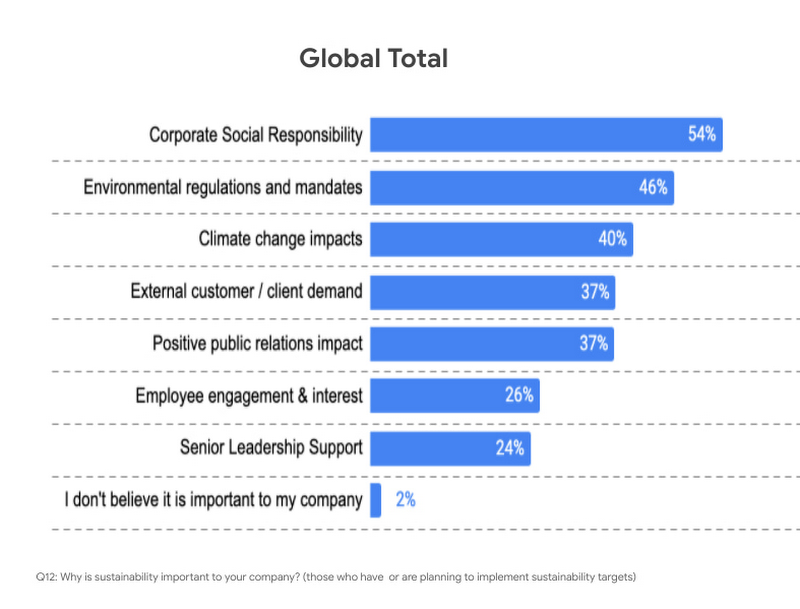
Businesses face both internal and external pressures to reform their practices and processes to meet new targets around sustainability, and IT leaders have an important role to play in that effort. Specifically, 54% said sustainability initiatives were important to their companies because of corporate social responsibility, 46% said it was because of environmental regulations and mandates, and 40% said it was due to the climate change impacts.
The research also examined the areas where IT leaders are looking to make positive changes for sustainability in their organizations. Not surprisingly, 62% said in their IT infrastructure and data centers, 53% their supply chain, and 46% in their facilities and building operations.
Facing the obstacles to progress
However, for many organizations, behaviors lag intent. Only 67% actually have environmental sustainability targets in place. The gap between behavior and intent widens when looking at digitally forward vs. digitally conservative organizations. For the purposes of the study, digitally forward companies were defined as either digital natives or those with a digital strategy and implementation in place. Digitally conservative organizations either have no strategy in place, or are in the process of considering or planning digital transformations, but haven’t reached the stage of implementation.
The study revealed that digital natives embracing cloud solutions were more likely than more conservative organizations to demonstrate a commitment to sustainability. Twenty percent of digital natives are implementing IT initiatives to reduce emissions to become more environmentally sustainable, while only 10% of digitally conservative organizations have done so.
When considering the effects of the COVID-10 pandemic, 20% of respondents from digital conservative organizations delayed or cancelled initiatives around reducing emissions to become more environmentally sustainable compared to only 12% for digitally forward respondents.
Sustainability is in our DNA
Sustainability has been a core value for Google since our inception. We were the first major company to become carbon neutral in 2007 and we were the first major company to match our energy use with 100 percent renewable energy in 2017 — and have continued to do so every year since. We are proud to operate the cleanest global cloud in the industry, and we’re the world’s largest corporate purchaser of renewable energy. It is this commitment that makes Google the leading choice for organizations with sustainability initiatives.
To learn more about the IDG findings and how IT leaders are implementing sustainable solutions, download the full report.
Interested in how Google Cloud’s commitment to providing sustainable solutions can help IT leaders and their organizations meet their own sustainability targets?
Google is focused on enhancing our products to help billions of people take action to reduce their environmental footprint.
- Google creates tools and invests in technology that will foster a carbon-free future for everyone and reduce carbon footprints.
- Google Cloud is the only major cloud provider to purchase enough renewable energy to cover our entire operations, enabling us to operate the cleanest cloud in the industry.
- When running on Google Cloud, an organization’s usage is net carbon neutral, and the electricity used to power workloads is matched 100% with renewable energy.
Looking for more? Check out our blog that introduces the Google Cloud Region Picker, which helps organizations choose a Google Cloud region based on carbon footprint, price, and latency.
4884
Of your peers have already watched this video.
1:30 Minutes
The most insightful time you'll spend today!
How does Google Pick its Data Center ?
Google is well known for its sustainable tech and hardware initiatives. Did you know alongside its environmental friendly designs of its data centers, it takes into account various factors such as redundant power supplies, data replication, network connectivity, etc. Watch the video to learn more.
2022’s First Cloud CISO Perspectives: Recap of the Megatrends, Releases and News
9370
Of your peers have already read this article.
3:00 Minutes
The most insightful time you'll spend today!
I’m excited to share our first Cloud CISO Perspectives post of 2022. It’s already shaping up to be an eventful year for our industry and we’re only in month one. There’s a lot to recap in this post, including the U.S. government’s recent efforts to address critical security issues, like open source software security and zero trust architectures. We’ve also released new resources from our Google Cybersecurity Action Team like the Cloud Security Megatrends and the Boards of Directors whitepaper on cloud risk governance.
Cloud Security Megatrends
We’re often asked if the cloud is more secure than on-prem (and why) so we shared our answer in a recent blog post. At Google Cloud, security by design is our priority. We’ve long adopted zero-trust principles for our baseline security architectures and built a global network that relies on defense in depth layers to protect against configuration errors and attacks. But security is always evolving and that is why we also take advantage of the following megatrends:
- Economy of scale: Decreasing the marginal cost of security raises the baseline level of security.
- Shared fate: A flywheel of increasing trust drives more transition to the cloud, which compels even higher security and even more skin-in-the-game from the cloud provider.
- Healthy competition: The race by deep-pocketed cloud providers to create and implement leading security technologies is the tip of the spear of innovation.
- Cloud as the digital immune system: Every security update the cloud gives the customer is informed by some threat, vulnerability, or new attack technique often identified by someone else’s experience. Enterprise IT leaders use this accelerating feedback loop to get better protection.
- Software-defined infrastructure: Cloud is software defined, so it can be dynamically configured without customers having to manage hardware placement or cope with administrative toil. From a security standpoint, that means specifying security policies as code, and continuously monitoring their effectiveness.
- Increasing deployment velocity: Because of cloud’s vast scale, providers have had to automate software deployments and updates, usually with automated continuous integration/continuous deployment (CI/CD) systems. That same automation delivers security enhancements, resulting in more frequent security updates.
- Simplicity: Cloud becomes an abstraction-generating machine for identifying, creating and deploying simpler default modes of operating securely and autonomically.
- Sovereignty meets sustainability: The cloud’s global scale and ability to operate in localized and distributed ways creates three pillars of sovereignty. This global scale can also be leveraged to improve energy efficiency.
If you’re an IT decision maker, pay attention to these megatrends that will continue to drive and reinforce cloud security and will outpace the security of on-prem infrastructure well into the future.
U.S. Federal government cybersecurity momentum
- Open source software security: Earlier this month, Google participated in the White House Summit on open source software security. The meeting came at a critical time for the industry following December’s Log4j vulnerabilities and was both a recognition of the challenge and an important first step towards addressing it. The open source software ecosystem is not homogenous, despite the fact that the industry often thinks of or treats it this way. Some of it, like Linux, is highly curated, while other critical software is supported through diffuse communities including technology companies and other stakeholders. There is also a long tail of many other critical projects driven by a dedicated community of maintainers around the world, including Googlers. In light of this reality, we welcomed the chance to share our recommendations to advance the future of open source software security. Some work we’ve done includes founding the Open Source Security Foundation, which has been instrumental already in making security improvements. We’ve also helped drive a number of key security initiatives within the open source community including security scorecards, the SLSA framework to improve the security and integrity of open source packages, and Secure Open Source Rewards to financially incentivize improvements to critical open source security projects.
- OMB’s Federal zero trust strategy: The publication of the Office of Management and Budget’s zero trust architecture strategy marks an important step for the U.S. federal government’s efforts to modernize under Executive Order 14028. Google Cloud supports this approach, which recognizes the immense security benefits offered by modern computing architectures. For the past decade, Google has successfully applied zero trust principles through our BeyondCorp and BeyondProd frameworks for providing end-user access and securing our cloud workloads. And we’ve brought these best practices from our own journey to global governments and businesses of any size through solutions like BeyondCorp Enterprise and capabilities like Binary Authorization and Anthos Service Mesh, which are embedded in Anthos, our managed application platform. For Federal agencies embarking on this zero trust journey, the Google Cybersecurity Action Team will offer our expertise by conducting Zero Trust Foundations strategy workshops, which can help organizations in the public and private sectors develop actionable and achievable strategies and plans for zero trust implementation.
Google Cybersecurity Action Team Highlights
Here are the latest updates, products, services and resources across our security teams this month:
Security
- Democratizing security operations: We recently announced that Siemplify, a leading security orchestration, automation and response (SOAR) provider, is joining Google Cloud to help companies better manage their threat response. Providing a proven SOAR capability with Chronicle’s approach to security analytics is an important step forward in our vision to advance invisible security and democratize security operations for every organization.
- Security by design: The Highmark Health security team is using “secure-by-design” techniques to address the security, privacy, and compliance aspects of its Living Health solution with Google Cloud’s Professional Services Organization (PSO). Google has long advocated for and followed security by design principles, which is why we’re continuously building enhanced security, controls, resiliency and more into our cloud products and services.
- Secure collaboration for hybrid work environments: The Google Workspace team shared its recommendations for businesses as they prepare for the future of work, where the hybrid/flexible work model is becoming standard practice and a new approach to security is essential.
- Anthos Policy Controller CIS Benchmark enforcement: A big part of our shared fate philosophy is to build secure products and not just security products. A recent example of this in action is embedding CIS benchmark policy conformance in the Anthos Policy Controller. We believe the more we embed approaches like this into our products, the more application and infrastructure teams can intrinsically embed security at the start and reduce toil for the security team.
- DevOps for technology-driven organizations and startups: A key success factor for many security programs is the partnership and integration with development teams, and there are some great resources and lessons in our DORA research.
- Security by design with Chrome OS: ABN AMRO’s Asia-Pacific region team recently shared how they are using Chrome OS and CloudReady to work securely in the cloud, reduce total cost of ownership, and add flexibility for employees. This is a great example of secure by design principles in the use of Chromium.
Risk & Compliance
- Boards of Directors summary guide to cloud risk governance: The latest whitepaper from the Google Cybersecurity Action Team outlines how boards of directors can prioritize safe, secure, and compliant adoption processes for cloud technologies within their organizations.
- TruSight Risk Assessment of Google Cloud: TruSight recently released a comprehensive
risk assessment report on Google Cloud. Our Enterprise Trust team collaborated on this robust assessment of Google Cloud services to validate the design and implementation of controls. TruSight’s risk assessment of our security controls will help customers accelerate and complete their risk management due diligence. - Data governance: Check out this new blog series on data governance where our teams explain the role of data governance, its importance, and the necessary processes to run an effective data governance program. Implementing data governance will help maximize value derived from business data, build user trust, and ensure compliance with required security measures.
Controls and Products
- Encrypting Data Fusion: To help meet the security, privacy and compliance requirements of customers in regulated industries like finance or public sector, we announced the general availability of Customer Managed Encryption Keys (CMEK) integration for Cloud Data Fusion, which enables encryption of both user data and metadata at rest with a key that customers can control through our Cloud Key Management Service (KMS).
Don’t forget to sign-up for our newsletter if you’d like to have our Cloud CISO Perspectives post delivered every month to your inbox. We’ll be back next month with more updates and security-related news.
3340
Of your peers have already watched this video.
3:30 Minutes
The most insightful time you'll spend today!
How to Retrace the Steps of a Potential Phishing Attack with Threat Analytics
The majority of cyber attacks begin with phishing emails and websites. Attackers use many tricks, including by leveraging enterprise brand assets, such as company names and logos, to develop phishing websites that appear authentic and lure internet users to enter valuable information such as user names and passwords.
Experts say that today’s CISOs need to treat a potential phishing email like a crime scene. We need to use the evidence that we have to carry out the investigation. A common phishing email will sound like this: “Hello! Your security software has expired. Please click this link to renew it.”
This is where Google’s Backstory makes an entry. Find out how it can help trace the steps of what happened to conduct a thorough threat analysis of your network.
More Relevant Stories for Your Company

Customer Voices: How Firms from Across Industries Leverage Google Cloud
From powering everyday operations and accelerating application innovation, to providing tools for specific business needs and executing on big ideas, to advancing the security of technology solutions, companies from across industries have leveraged Google Cloud for business benefits. Companies from across industries have turned to Google Cloud for transforming their

Application Development with Kpt
Learn how to create and customize configuration packages with Kpt to build applications and adhere to configuration-as-data philosophy.
Google Cloud’s Invisible Security Vision: Key Highlights
Yesterday we held our final Google Cloud Security Talks event of 2021. Our event focused on zero trust and covered everything from Google’s history with BeyondCorp to our strategic thinking when it comes to applying zero trust principles to production environments. We shared product updates across the portfolio and talked about how

Utilizing Google Cloud’s PII Security Features
BigQuery is a leading data warehouse solution in the market today, and is valued by customers who need to gather insights and advanced analytics on their data. Many common BigQuery use cases involve the storage and processing of Personal Identifiable Information (PII)—data that needs to be protected within Google Cloud
