





Google Announced Leader in 2021 Gartner Magic Quadrant for Cloud Infrastructure and Platform Services

3555
Of your peers have already read this article.
3:00 Minutes
The most insightful time you'll spend today!
For the fourth consecutive year, Gartner has positioned Google as a Leader in the 2021 Gartner Magic Quadrant for Cloud Infrastructure and Platform Services (formerly titled as Magic Quadrant for Cloud Infrastructure as a Service upto 2014 Infrastructure as a Service, or (IaaS).
With our customers and communities adjusting to new ways of working and doing business, Google Cloud has remained focused on building services and platforms that help you be more resilient and derive even more value from your cloud infrastructure. We believe Gartner’s analysis and recognition gives our customers the confidence needed to choose Google as the platform for customer-centric innovation. Here are just a few recent examples.
Ready for the most demanding, mission-critical workloads
Our enterprise-ready cloud provides you the uptime, performance, and scale to run even your most demanding workloads. Examples of recent launches:
- The largest single-node GPU-enabled VM in the industry with up to 16 NVIDIA A100 instances so that our customers can run their ML workloads
- The only cloud to support scale-out out 96TB SAP HANA so that customers can confidently bring their most critical workloads to GCP
- Strategic partnerships with leading partners like SAP
- Several regions and an expanded global network footprint including new subsea cables, Firmina, Dunant, Blue and Raman
- High bandwidth 50/75/100Gbps networking for VMs
- Persistent Disk Extreme (block storage) with 120K IOPS
- Filestore High Scale scale-out NFS for HPC
Saves you money
Save money with a transparent and innovative approach to pricing and intelligent recommendations. In the past year, we’ve launched several innovations to help you save costs:
- Tau VMs, which offer the best price-performance among leading clouds for scale-out workloads
- Machine-learning-driven predictive auto-scaling for VMs and GKE Autopilot, enabling infrastructure to scale up and down as needed with minimal waste
- Standard network tier which routes traffic over the internet for cost optimization
Open
We have a long history of leadership in open technologies—from projects like Kubernetes, the industry standard in container orchestration and interoperability, to TensorFlow, a platform to help anyone develop and train machine learning models. Here are a few recent improvements we’ve made to ensure your cloud is an open cloud:
- Extended Anthos to bare metal and Microsoft Azure to support customers who want a multi-cloud and hybrid cloud posture.
- Announced a new network dataplane for Google Kubernetes Engine (GKE) and Anthos that supports eBPF, an open-source Linux kernel technology optimized for Kubernetes.
- Google Kubernetes Engine (based on the Kubernetes standard) received the top overall score based on 2021 Gartner Solution Scorecard for Google Kubernetes Engine.
Secure
Google Cloud’s trusted infrastructure uses layers of security to protect your data with advanced technologies and operations, keeping your organization secure and compliant. For example, we offer:
- Confidential VMs and Confidential GKE with in-memory encryption and encryption keys controlled by you, with a single checkbox
- Enhanced security for Cloud Run
- Strong support against DDoS attacks. In 2017, our infrastructure absorbed the largest-known DDoS attack at 2.5Tbps with no impact to customers.
Sustainable
Google Cloud helps customers transform their business sustainably. We operate the cleanest cloud in the industry to make sure your digital footprint doesn’t leave a carbon one. Here are a few proof points:
- Google has been carbon neutral since 2007, and for the past four years has matched 100% of the electricity we consume globally with wind and solar purchases. Everything you run on Google Cloud is net carbon neutral.
- We continue to innovate towards greater energy efficiency in our data centers, and compared with five years ago, now deliver around seven times as much computing power with the same amount of electrical power.
- Recently we announced new features to help customers reduce the carbon footprint of their applications and infrastructure, including a region picker to help with architecture decisions, and low carbon indicators in the Google Cloud Console.
Supporting our customers
Most importantly, our field organizations and partner organizations work with a singular focus to ensure customer success. This has made Google Cloud the fastest growing hyperscaler, with a rapidly expanding customer base across all geos and industries.
Since launching Customer Care last year, we consolidated and simplified the post-sales engagement with customers, increased the support channels, created an API to allow programmatic case creation, and combined product specific support into a single package for all of Google Cloud. Enterprises with Customer Care continue to report high levels of satisfaction with their focused technical account managers (TAMs), helping them get the most business value out of Google Cloud.
We are committed to sustaining and accelerating the pace of customer-centric innovation. You can download a complimentary copy of the 2021 Magic Quadrant for Cloud Infrastructure and Platform Services on our website.
Join us to learn much more about Google Cloud at the upcoming Google Cloud Next ‘21 digital conference.
Gartner, Magic Quadrant for Cloud Infrastructure and Platform Services, Raj Bala | Bob Gill | Dennis Smith | Kevin Ji | David Wright, 27 July 2021
Gartner, Solution Scorecard for Google Kubernetes Engine, Tony Iams | Traverse Clayton | Megan Bain, 12 April 2021
Gartner does not endorse any vendor, product or service depicted in its research publications, and does not advise technology users to select only those vendors with the highest ratings or other designation. Gartner research publications consist of the opinions of Gartner’s research organization and should not be construed as statements of fact. Gartner disclaims all warranties, expressed or implied, with respect to this research, including any warranties of merchantability or fitness for a particular purpose.
Google Cloud Region in Columbus to Accelerate Ohioan Businesses and Tech Transformation

3214
Of your peers have already read this article.
1:30 Minutes
The most insightful time you'll spend today!
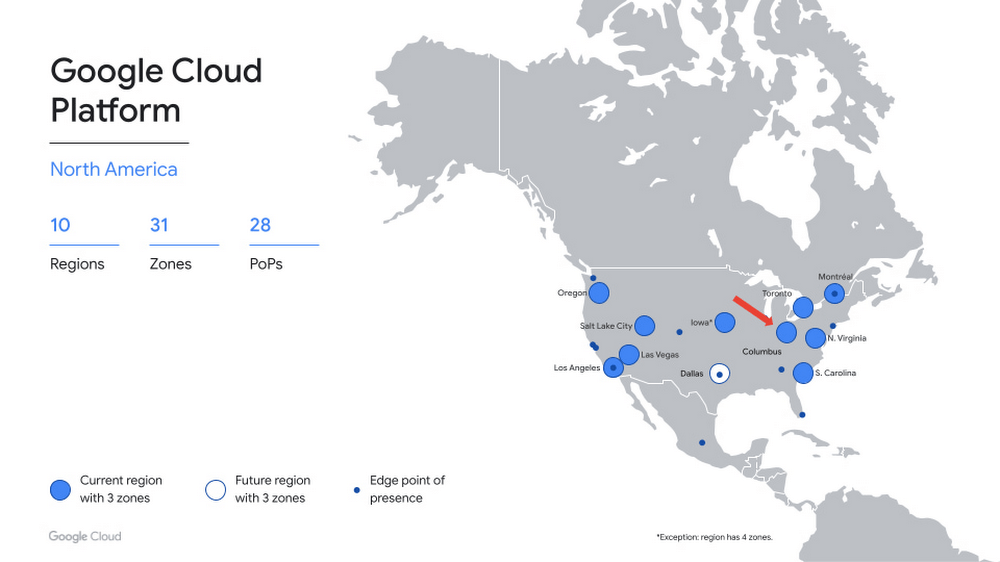
Digital tools such as cloud computing are fueling economic transformation across the US, including Ohio. Google continues to invest across cities and communities in Ohio, bringing over 200 jobs to the state, and helping provide $12.85 billion of economic activity for tens of thousands of Ohio businesses, nonprofits, publishers, creators and developers. To further accelerate the transformation of all Ohioan businesses and technologists, we’re thrilled to announce our newest Google Cloud region in Columbus, Ohio is open. The Columbus cloud region brings a second region to the Midwest, the 10th region to North America, and grows our global cloud region count to 33.
A region for the Buckeye State
Now open to Google Cloud customers, the Columbus region (us-east5) provides you with the speed and availability you need to innovate faster, build high-performing applications, and serve local customers — all on the cleanest cloud in the industry. Additionally, the region gives you added flexibility to distribute your workloads across the central, midwest, and eastern US.
The Columbus region offers immediate access to three zones, for high availability workloads, and our standard set of products, including Compute Engine, Google Kubernetes Engine, Cloud Storage, Persistent Disk, CloudSQL, and Cloud Identity. Our private backbone connects Columbus to our global network more quickly and securely. In addition, you can integrate your on-premises workloads with our new region using Cloud Interconnect. This means that Columbus-based customers can expand globally from their front door, and those based outside the region can more easily reach their users in the Midwest.
What customers are saying
Industries including retail, financial services, and IT are investing in Columbus. Organizations across these verticals have turned to the Google Cloud to innovate faster and help solve their most complex challenges
“As Wendy’s continues to innovate in new ways to create fast, frictionless, and fun interactions that redefine the way customers visit and enjoy our restaurants, our partnership with Google Cloud is a key enabler to delivering on our AI/ML and data analytics strategies. The proximity of the new Google Cloud region to Wendy’s headquarters provides the ability for us to move and scale quickly as business needs evolve. Additionally, Google Cloud’s investment in Columbus positions central Ohio as a true technology hub, which further boosts Wendy’s and other regional employers’ ability to recruit innovative talent,” said Kevin Vasconi, Chief Information Officer, Wendy’s.
“Huntington National Bank’s API Architecture is a central component to our growth and technology strategy. As our business segments grow from an offering and geographic perspective, we must evolve our technology to provide the optimal experience for our customers and our partners. Collaborating directly with Google Cloud on the build out of their cloud region in Central Ohio, provides the access our technology teams need to innovatively scale our infrastructure to meet the demands of our business with increased availability, lower latency, and greater resiliency,” said Geoff Preston, Chief Architect, Huntington National Bank.
“Google Cloud has been instrumental in our ability to scale and optimize data management and compute resources. We prioritize scale, elasticity and resilience in cloud services and Google Cloud delivers all three globally and locally. With Google Cloud security, we can efficiently process the quantities of application data required to accelerate alert detection and reduce response times for the critical infrastructure our customers depend on to enable the continuity of their vital applications.” said Sheryl Haislet, Chief Information Officer at Vertiv, a global provider of critical digital infrastructure and continuity systems headquartered in Columbus, Ohio, that leverages Google Cloud solutions to provide resilience for its operations and to better support customers.
“The addition of the new cloud region in Ohio continues to demonstrate Google Cloud’s commitment to the enterprise space and their presence in the region,” said Chris Delong, Chief Technology Officer, Designer Brands Inc. / DSW
What’s next
We are thrilled to welcome you to our new cloud region in Columbus, and eagerly await to see what you build with our platform. Register here for our Cloud Study Jam in June – an event for local developers to get hands-on training with Google Cloud. Stay tuned for more region announcements and launches this year, including our next U.S. region in Dallas, TX. And for more information, contact sales to get started with Google Cloud today.
Your DW Need Scaling Up? Try What This Company Did: It Can Run 25,000 Events a Second
5073
Of your peers have already read this article.
7:30 Minutes
The most insightful time you'll spend today!
With access to more data than ever before, companies have never been better positioned to adopt precision marketing methods and target the right customers at the right time. Emarsys, a digital marketing platform, enables its clients to collect, analyze, and act on a wide variety of data. From websites to mobile apps to emails, Emarsys’ customers can handle data from all its digital channels on a single, easy-to-use platform. Emarsys also makes sure that customers receive the highest quality data possible, making for smarter decisions and better business practices.
“We were close to the limits of our internal data warehouse, scalability-wise. We didn’t want to get to the point where we’d have to delete data or cancel projects. In Google Cloud we saw a platform that could scale with our ambitions and be optimized for AI and real-time solutions.”
—Levente Otti, Head of Data, Emarsys
Since launching as an email solutions provider in 2000, Emarsys has grown into the world’s largest independent digital marketing platform, with more than 2,500 clients worldwide and reaching more than 1.4 billion people. By 2016, the company felt that its existing data warehouse platform was close to its limits, affecting not just day-to-day operations but also important strategic goals.
“We were close to the limits of our internal data warehouse, scalability-wise. We didn’t want to get to the point where we’d have to delete data or cancel projects,” says Levente Otti, Head of Data at Emarsys. “In Google Cloud, we saw a platform that could scale with our ambitions and be optimized for AI and real-time solutions.”
Minimal maintenance, unlimited scale with Google Cloud
Digital marketing is a highly competitive environment. Emarsys works alongside big players with a huge market share on the one hand and smaller, specialist companies on the other. It has thrived by successfully combining the all-inclusive offerings of the former with the agility of the latter, constantly looking for ways to innovate and improve. In recent years, the company had started to feel that the ability to handle large quantities of data was no longer enough. The next challenge was speed. “We truly believe that in the future, everything will be done in real time, including data processing, analytics, and AI predictive models,” Levente says.
At the start of 2016, Emarsys’ existing data warehouse was a software-as-a-service solution running on-premises, which required hardware and software maintenance in order to keep up with the company’s growing appetite for data-heavy use cases such as prediction and analytics. The existing platform had proven its worth processing large amounts of data in batches, but its real-time capabilities were limited. Moreover, Emarsys had begun to experiment with AI technology, but found that its data warehouse couldn’t scale to accommodate some of the more resource-intensive processes, such as training the predictive models. The company decided that it needed a new, cloud-based data platform.
After evaluating some of the leading cloud providers, Emarsys chose Google Cloud for its mature AI capabilities and its ease of use. “With the other solutions, we still had to rent virtual machines and hardware and be responsible for maintenance. At the time, Google Cloud was the only provider that could take that management overhead away from us, while keeping customers accounted for on every query level,” Levente says.
To implement its new data platform, Emarsys teamed up with Google Cloud Partner Aliz. Over a series of meetings, workshops, and architecture reviews, Aliz helped Emarsys navigate the Google Cloud ecosystem to find the right products for the solution it was looking for. “Aliz really helped us set off in the right direction,” explains Levente.
With Google BigQuery, we can run queries which process terabytes of data, in seconds. We can also develop our own user-defined functions, incorporating Bayesian statistics into our predictive algorithms. That means we can take into account historical data, resulting in much more accurate predictions in a scalable way within seconds.”
—Levente Otti, Head of Data, Emarsys
Emarsys’ new data platform would actually be two: one platform for batch processing data and one for real-time analysis and interactions. Firstly, a proprietary publishing component gathered all the data points from Emarsys’ various channels including the website, mobile, emails, and custom events. With Cloud Pub/Sub and Cloud Dataflow, Emarsys transported and processed the data into BigQuery, which allows for further work and reviews that take into account errors or delayed events. After this, the data was exported to the main batch processing platform, which ran on BigQuery. For the real-time analytics, Emarsys used Cloud Bigtable to access data and Cloud Dataflow to pipeline it into the real-time platform, which could communicate with AI components or interaction components via an API to deliver real-time interactions with customers.
On top of the overall data infrastructure, Emarsys built a new AI platform with Google Cloud components. Training the predictive models had been an issue in the past due to the large number of resources required, so Emarsys chose to use Google Kubernetes Engine clusters, which can scale up and down on demand, without the need for hardware configuration or management. The trained models were held securely in Cloud Storage. From here, they were integrated with BigQuery for power and flexibility, allowing Emarsys to improve not just the speed of its AI predictions but also the quality.
“With Google BigQuery, we can run queries which process terabytes of data, in seconds,” shares Levente. “We can also develop our own user-defined functions incorporating Bayesian statistics into our predictive algorithms. That means we can take into account historical data, resulting in much more accurate predictions in a scalable way within seconds.”
Real-time insight, long-term satisfaction
Google Cloud enabled Emarsys to build a scalable data and AI platform that delivers powerful, actionable insights in real time. According to Levente, the company wanted to spend less time managing overload and more time considering how it should handle data. An immediate result of the new platform has been that data is now available in a scalable way, without hardware additions and management.
“With Google Cloud, we’ve been able to build a truly real-time data platform. The norm used to be daily batch processing of data. Now, if an event happens, marketing actions can be executed within seconds, and customers can react immediately. That makes us very competitive in our market.”
—Levente Otti, Head of Data, Emarsys
The clear and innovative pricing schemes of Google Cloud have also brought a new level of accountability to Emarsys’ costs in a way that wasn’t possible with its on-premises infrastructure. “Now that we only pay for what we use, we can assign costs to specific customers or queries, which has a huge impact on our pricing and product development strategies,” says Levente.
Thanks to the power of BigQuery and the scale at which it can handle data, Emarsys can now apply its analytics and AI tools to their full potential. “It’s very important to enable our clients to create the best possible experience for customers,” says Levente. At the same time, the company has cut its AI platform costs by 70% with Kubernetes while increasing scalability compared to the previous solution. The whole data platform was built to be scalable, and its first big test came during the retail peak of Black Friday, when it comfortably handled 250,000 events per second. “Perhaps the biggest impact on the business came with the real-time nature of the new platform,” says Levente.
“With Google Cloud, we’ve been able to build a truly real-time data platform,” he explains. “The norm used to be daily batch processing of data. Now, if an event happens, marketing actions can be executed within seconds, and customers can react immediately. That makes us very competitive in our market.”
Since implementing the new platform, Emarsys has continued to innovate with it and is about to release a new Real-Time Decision Framework, which will provide customers with even more real-time products and tools. The company continues to work with Aliz and Google Cloud, exploring other products such as Google BigQuery ML and TensorFlow to improve its AI processes. “We had a problem that we wanted to tackle now, and for us, Google Cloud was the best way of doing that,” says Levente. “But it was also about looking ahead. We felt that Google Cloud offered us the best way of future-proofing our platform.”

withVR Uses the Power of VR to Prep People with Speech Disorders for Real-life Speaking Situations

3278
Of your peers have already read this article.
1:30 Minutes
The most insightful time you'll spend today!
Editor’s note: Meet Gareth Walkom, an entrepreneur dedicated to helping others with speech disorders.
Turning life experience into innovation
Did you know that 3% of Americans have a speech disorder, while 1% of the world’s population have a stutter? Just getting what they need in everyday interactions can be stressful, which intensifies when the stakes are raised during job interviews, presentations, public speaking, and other activities. As a result, some people with speech disorders may avoid conversations and relationships, and risk being denied jobs because of a difference in how they speak.
As a person who stutters, I know firsthand the ableism that people with a speech disorder can encounter in wanting to use their voice in a judgemental world: the frustration of sometimes not being able to say exactly what you want to say and therefore speaking less in speaking situations. And the educational and career opportunities are lost when doors remain closed to us, especially when employers advertise their jobs as requiring someone who speaks the language ‘fluently’.
While researchers still don’t definitively know what causes stuttering, emerging technologies are giving us new and promising pathways for improving the quality of life of people with speech disorders.
That’s why after years of researching and testing potential therapeutic uses of virtual reality, and with the support of the Google for Startups Cloud Program, I founded withVR on International Stuttering Awareness Day (October 22) in 2020. The mission of withVR is to prepare people with speech disorders for real-life speaking situations by utilizing the power of virtual reality.
Working through it
One of the difficulties in adapting to any disability is the opportunity to work through it in a safe and nonjudgmental environment. withVR provides a virtual space for individuals, in collaboration with their speech therapists, to practice real-world speaking scenarios in safe, controlled environments.
Imagine being able to raise your hand in class and give your opinion without hesitation, ordering the meal you want rather than something that’s easier to say, or sit across the table from an avatar of an employer and explain why you are the right person for your dream job. Then further customize the speaking situation and its surroundings to challenge yourself and be ready for anything. That’s what withVR offers individuals and their speech therapists.
Making VR come to life
To bring the withVR vision to life, we are developing applications using the Unity game engine on Google Cloud with integrated Firebase services including authentication, web hosting, storage, and database. It’s a powerful combination that’s enabled us to build industrial-strength applications that we’ve rapidly deployed on a global basis. Today we are already collaborating with 80+ labs, clinics, and hospitals in more than 20 different countries worldwide.
These organizations help us to test and refine a virtual reality application to support people in achieving their speech goals and build comfort through immersive VR experiences using easily available viewers like Google Cardboard.
The application works in conjunction with a web app through which speech therapists configure customized VR scenarios for their patients to use. As no real-life speaking situation is ever exactly the same, customization of VR scenarios is vital. They can construct different scenes, create and script avatars, and through the Google Text-to-Speech API can even choose from hundreds of different voices in a variety of languages. This gives them the flexibility to create many unique speaking situations for their clients no matter where they are in the world.
Progress from the practice sessions is presented through a dashboard that provides therapists with a tool to monitor their clients’ progress and provide feedback and encouragement.
No shortage of support
My founder’s journey has been supported by many passionate people. The Google for Startups Cloud Program has been instrumental in helping us come so far in the first year, and we’ve only scratched the surface of what’s possible. There are many capabilities in Firebase and Google Cloud that we have yet to explore, and through the startup program I now have a Google Mentor who can help guide that exploration.
We also joined the 2Gether-International (2GI) Tech Cohort, which is supported by Google for Startups and is built for and run by entrepreneurs with disabilities. At the end of the 10-week cohort, we finished with a pitch competition, where I was one of six selected founders to pitch in just three minutes. I was very fortunate to win the Best Overall Pitch Award, gaining 10,000 USD in seed funding. This award not only highlights the potential of withVR, but also showcases that anyone can pitch their idea in a short amount of time no matter their difference.
Working with 2GI also gave me the opportunity to collaborate and learn from other founders who have disabilities. It’s a safe space where I don’t have to explain my everyday challenges and can focus on the all-important task of advancing the vision of withVR, while seeing how others use technology in their domain.
Building on a strong foundation
I’m amazed to look back and see what we’ve accomplished in just one year and humbled by the thousands of lives we’ve touched. Every day we receive valuable real-life feedback from people in the field—both clinicians and those with speech differences who benefit from VR therapy. That knowledge tells us that we are heading in the right direction and opening our eyes to new possibilities for where to take withVR. And inspiring us to keep moving ahead.
If you’d like to participate in testing or if you are speech therapist or researcher, please feel free to reach out to us. We’d love to show you how you can contribute to a world where anyone with a speech disorder can truly use their voice in any situation. If you’d like to take part, contact us at hello@withvr.app.
If you want to learn more about how Google Cloud can help your startup, visit our page here to get more information about our program, and sign up for our communications to get a look at our community activities, digital events, special offers, and more.
3728
Of your peers have already downloaded this article
5:00 Minutes
The most insightful time you'll spend today!
Organizations need to modernize their applications for a variety of reasons including the need to reduce cost and complexity, increase organizational agility, lower the barrier to innovation, and building new features.
However, lifting critical business technologies off legacy implementations and refactoring them to take advantage of modern technologies and services is a process that takes time and can’t be achieved overnight.
At the same time, as competitors adopt new technologies to streamline processes and attract customers, CIOs are under increased pressure to ensure that their organizations remain competitive by enabling their IT to develop and iterate faster than their competition.
Hence, IT leaders and their teams need to come up with the right game plan, the right foundation, and the right tools for their application modernization journey. They need to create a plan, iterate on it, and keep moving forward.
Download this whitepaper to learn how you can easily modernize your applications for the cloud.
5 Features IT Departments Love About Google Cloud
3662
Of your peers have already read this article.
5:30 Minutes
The most insightful time you'll spend today!
Throughout the past couple of years, I have helped a good number of companies, big and small, migrate their systems to the Google Cloud Platform (aka GCP). During the course of these migrations, there are always a few of those moments where people look at a specific Google Cloud feature and say, “now, that’s cool!”.
More often than not, it is because, coming from other platforms, they have gotten used to some features requiring multiple steps, or some operations being complicated, etc. And often they find out that in GCP you can do this specific operation in a couple of clicks, or by setting up a simple text-based configuration. Then you see that light bulb turning on in their head, and there you go… happy customer.
A few of these happen so often that I compiled them in a list to share with others who might also benefit from these “aha!” moments. You could say these are the five things I wish they told me when I started using Google Cloud.
Projects: Naturally Group Resources Together
A project is a namespace where resources live. Every resource you instantiate in GCP, from load balancers to Kubernetes clusters to virtual machines, belongs to a single project, and has no access (by default) to resources in other projects. User roles and authorisations can be defined per-project and trickle down to everything in it. This has two immediate benefits: you can group things that belong together in neat logical units, and things that don’t belong together are isolated from each other (and isolation is a Good Thing)
This is powerful and quite simple, but it often takes new users off-guard. I’ve had many clients call me and ask me “How can I make sure my developers cannot access the production machines? What’s the best way to create access policies? ”
The answer to this is actually super-simple:
- have a project for development where your developers have rights,
- have a project for production where they don’t.
- That’s it.
Every machine/other resource in the production project won’t be accessible to developers.
Of course there is a lot more to it, and you can refine roles and permissions to a much greater degree using Organizations, Folders, etc. Not to mention all the crazy things you can do with per-project billing. But at least you can say “hey, if it’s a machine in the staging environment then it can be found in the “staging” project”.
Global Virtual Networks Are *Truly* Global
Imagine you are using a Cloud provider and that you have servers in the US, and servers in Singapore, and that they need to communicate.
So you create a VPC (Virtual Private Cloud) network in the US data center, another one in the Singapore data center, and then you will connect them by setting up inter-region VPC peering or a VPN (Virtual Private Network) or a transit VPC or other routing magic.
Lots of work, right? And many moving parts, so lots of opportunities for things to break.
With GCP, however, what makes my clients go “aha!” is when they realize that in GCP a single VPC network covers the entire planet. Only subnets are attached to a geographic location, and virtual machines communicate between subnets on private IPs (good old RFC1918 addresses) — no extra routing needed.
So, to make your server communicate across continents on GCP, here are the steps:
- create a VPC network
- create a subnet in the US, put your US servers in it
- create a subnet in Singapore, put your Singapore servers in it
That’s all there is to it. Your VPC network spanning 2 continents is ready to use. Below is a screenshot of how it looks on my account, for a VPC network called ‘my-global-network’ with 2 subnets. The first column (“us-central1” and “asia-southeast1”) contains the name of the GCP regions (read: data centers). The second column is the subnet name that I picked when I created them.

A machine in the US (on the “us-central” subnet) with IP 10.0.0.5 can communicate directly with a machine in Singapore (on the “singapore”) subnet with IP 10.10.0.8.
Nothing else to set up.
And thanks to the way these networks work, the Google Cloud Load Balancer can present a single IP to the world, and forward traffic to the instances that are the closest to you geographically without having to setup a tedious DNS-based load balancing. But that’s worth an entire blog. I’ll save it for another day.
Firewalls with Tags and (Almost) No IP Addresses
There is no network security without a firewall so unsurprisingly GCP comes with one built-in.
Now, I don’t know about you, but nothing makes my brain hurt like a list of firewall rules displaying IP ranges and addresses and ‘Allow/Deny’ directives. It looks a bit like this:
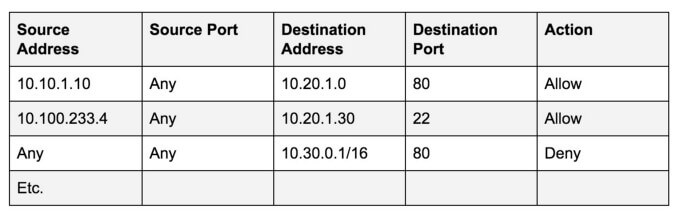
If you imagine a normal network with a few dozen (hundred?) servers, you can quickly see how this can get out of control. You’d better have a solid printout of your network layout to refer to when you start adding and changing rules. And good luck debugging things!
Wouldn’t it be nice if, instead, you could just tell the firewall: “the HTTP traffic from outside can only reach the HTTP servers and the MySQL database is only reachable by the HTTP server(s) on the same network?”
Turns out it’s pretty simple on GCP by using a little thing called network tags. As the documentation says:
“Network tags are text attributes you can add to Compute Engine virtual machine (VM) instances. Tags allow you to make firewall rules and routes applicable to specific VM instances.”
So let’s see how it works. Firewall rules in GCP are defined in terms of source and target (the traffic flows from the source to the target). You can define filtering rules that apply to the source or the target, and in both cases you can use tags.
This is simpler shown with an example. The rule below states that on the default network, the traffic to the VMs with the tag mysql-server can come from the VMs with the tag http-appserver. Any other traffic is “Deny”-ed by default.

All you have to do is to tag your machines properly, and they will automatically be covered by the rule. You don’t need to enter their IP range.
That’s neat if you ask me. It makes it a lot simpler to grasp what’s happening.
Of course, there’s a TON more to firewalls in GCP. Tags also apply to routes and you can mix and match IP-based rules with tag-based rules. Not to mention that thing called service accounts, but I’ll leave those for another day.
The bottom line is that you can create most rules by just expressing a business need and not having to remember complicated network layouts. I have no hard stats, but I’m pretty sure this has saved me hours of work.
Console Access to VMs from the Browser
Easily access virtual machines (VMs) from the Google Cloud console was one of my first “aha!” moments when I started using GCP.
This is a screen capture of my Google Cloud console, with a virtual machine and its internal IP.

The last column has a header that says “Connect” and when you click on the word “SSH” a separate windows pops up. You wait for a few seconds, and… this is what you get. Your personal shell access — in a browser popup no less.
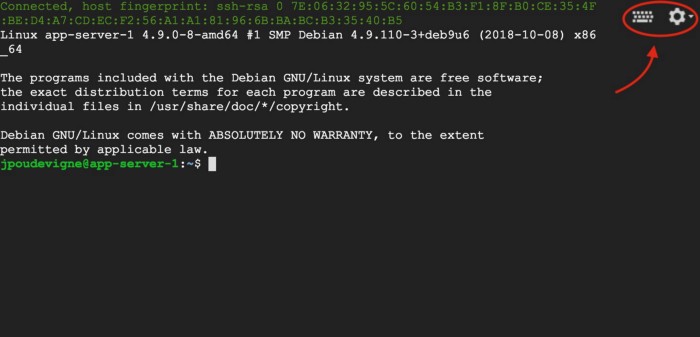
You are connected through ssh to the virtual machine of your choice. You did not have to download ssh keys and put them in the ~/.ssh directory, do the correct chmod command and run a long-winded ssh -i ~/.ssh/somekey me@<it-took-me-forever-to-copy-paste-the-address-here>
In addition, you have access to a few nifty features such as uploading and downloading files, changing the user etc. Just use the menu behind the cog icon at the top right.
In truth, you should not need to connect directly that often, but when you have to, this is a godsend.
Your Personal Jumphost from the Google Cloud Console
The Google Cloud console has a cool trick: you can actually connect to a virtual environment that is managed by the Google Cloud console itself. It serves a bit as a jump host. You can access most resources from the projects from it, and you can activate it directly from the top menu with, no particular setup on your side. It’s called the Cloud Shell.
This is how it looks at the top right of the console:

When you activate the Cloud Shell, the session opens at the bottom of the console. You get a command line prompt and it’s fully configured with the gcloud command line tool (the jack-of-all-trades of Google Cloud scripting).
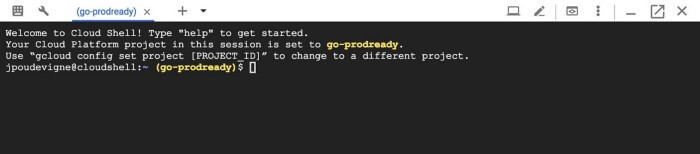
You can do a great many things from there, and this even includes uploading and downloading files, editing code or deploying it, a web preview for your AppEngine application, and more.
So you can get access to a fully configured shell environment in your project from any laptop where you can connect with your credentials. On top of this, it persists between connections so you can fine-tune it to your needs and have these changes available the next time you re-connect.
This has saved me many times during my previous life as a traveling consultant!
Live migration
Did I say 5 “Aha!” moments ? Well, you’ve been patient reading all the way to here, so here’s one more for free.
Google Cloud has an amazing way to literally “teleport” a running virtual machine between physical hosts without stopping it. It’s called Live Migration. It allows Google to move your virtual machine away from a defective host, or a host that needs a patch or an upgrade, or for any other infrastructure related reason.
It’s all done in the background, and is totally transparent, so you never really see it happening. Unless you look VERY closely. I once did a demo to a client, where a machine was live migrated while he was simulating a solid network load — and we did not lose a single packet, with no noticeable degradation in latency.
And that’s a wrap!
So there you go. These are 5+1 things that made me go “Aha!” when I became more familiar with the Google Cloud Platform, and that still make my clients do the same.
There is a lot of depth to the platform, and my examples above only scratch the surface of our features. I encourage you to try it yourself. There is a generous free tier, and when you are ready to take the plunge and create that new company, please contact us at Google Cloud for Startups. We’ll get you up and running in no time.
Jerome is a Startup Architect at Google Cloud. Based in Singapore, he helps startups make the most of the Google Cloud Platform.
More Relevant Stories for Your Company

What Swiggy and You Can Learn From This Company’s Use of ML to Engage Customers
The app economy has enabled a huge range of unique business models to flourish. One such model is online food ordering and delivery services, in which apps leverage geo-location data to aggregate local food choices and offer personalized options to consumers. A leading company in this space is Just Eat.

TELUS and Google Cloud Partner to Move Towards a More Sustainable Future
Environmental sustainability is a key priority for TELUS, a world-leading communications technology company. It continues to rank in the top 100 most sustainably managed companies in the world, and seeks to make a healthier planet for all by leveraging its global-leading technology, compassion to drive social change and reduce our

STAC-M3 Tick History Analytics in Google Cloud Benchmark Results Reveals it is 18X Faster than Previous Version
The Securities Technology Analysis Center (STAC®), an organization that improves technology discovery and assessment in the finance industry through dialog and research, recently audited the STAC-M3™ benchmark suite on Google Cloud (SUT ID KDB211210). These enterprise tick-analytics benchmarks assess the ability of a solution stack such as database software, servers,

ShareChat Builds its Diverse, Hyperlocal Social Network. Thanks to Google Cloud
Editor’s note: Today’s guest post comes from Indian social media platform ShareChat. Here’s the story of how they improved performance, app development, and analytics for serving regional content to millions of users using Google Cloud. How do you create a social network when your country has 22 major official languages and
