





Explore The New Era of Flexibility: Streamlined AWS-to-Google Cloud Migration

1338
Of your peers have already read this article.
3:30 Minutes
The most insightful time you'll spend today!
As an IT leader, you’re asked to do it all: innovate and optimize your tech stack for business outcomes — all while being secure and compliant. It takes heroic efforts to achieve innovation and progress while also tightening budgets and teams. This is why many of you are considering migrating applications to Google Cloud, for benefits like scalability and flexibility, security and compliance, disaster recovery and business continuity, and cutting-edge technologies at lower costs.
To help you do this, we suggest using Google Cloud’s Migrate to Virtual Machines – part of Migration Center. This managed cloud service lets you lift and shift workloads at scale to Google Cloud Compute Engine with minimal changes and risk.
And recently, we rolled out our latest release which introduces support for workload migration from AWS to Google Compute Engine. With this addition, you can now migrate both your on-prem and AWS workloads at scale. This means centralized management for your end to end workload migration journey from both sources via Cloud Console or APIs.
Simple and easy migrations from AWS and VMware sources to Google Cloud
Migration of AWS EC2 instances directly to Google Compute Engine using Migrate to Virtual Machines follows a well established and easy journey, which means a minimal learning curve for users who are already migrating workloads from VMware. Workload migration is agent-less, which means you do not need to access or alter workloads as a prerequisite for migration, allowing you to execute zero-touch migrations. Migrate instance data with no interruptions to the running workload at the source for a fast cutover to Google Cloud. In addition, our end-to-end cloud console interface surfaces your AWS EC2 inventory, migrations, and groups so you can execute migrations without ever leaving the cloud console interface.
Large-scale migrations
Completing a large-scale migration project in a timely manner calls for careful planning and streamlined migration sprints. The Migrate to Virtual Machines’ Groups construct enables you to group source VMs together in the planning phase. When it’s time to execute the planned migration, VM Groups let you execute migration operations on a group level, or on a subset of the group, streamlining the process at scale.
Minimal downtime and risk
Application uptime is key to keeping your business running. Every migration with this latest release of the service periodically replicates data from the source workload to the destination without manual steps or interruptions to the running workload, minimizing workload downtime and enabling fast cutover to Google Cloud. You can also launch non-disruptive migration tests — referred to as test-clones — to help you validate that these workloads will work properly in the cloud before cutting over. This helps avoid issues that might have otherwise been costly or disruptive to your business.
How the service works
Migrations simply work, at scale, in a managed service fashion. With Migrate to Virtual Machines, there’s no requirement to provision or manage migration-specific resources in the cloud. The service uses replication-based migration technology to lift and shift workloads from source environments to Google Cloud. The Migrate Connection replicates source VM disk snapshots in the background with no interruption to the source workload. Replicated data is encrypted in transit and at rest, and when you instantiate a migrating VM using a test-clone or cut-over, the service seamlessly adapts your source VM operating system to boot and run natively in the cloud — including configuring network settings and deploying Google Cloud guest packages.
The migration journey of an EC2 instance — or VMware VM — to Google Cloud is comprised of the following steps:
1. Onboarding a source VM for migration: Onboard one or more VMs for migration from the source environment fleet.
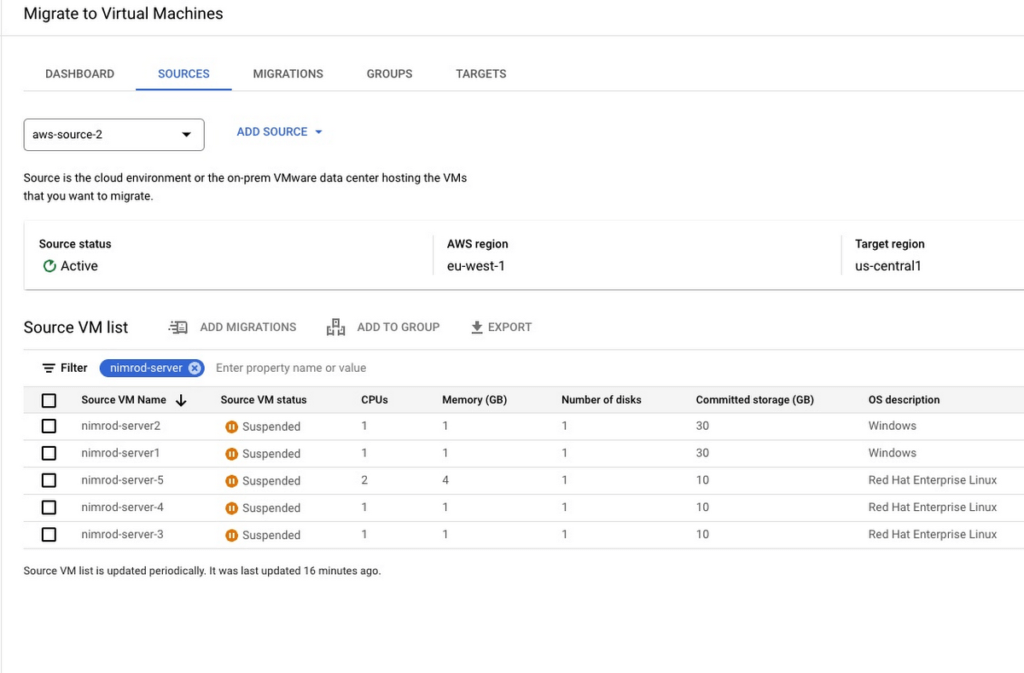
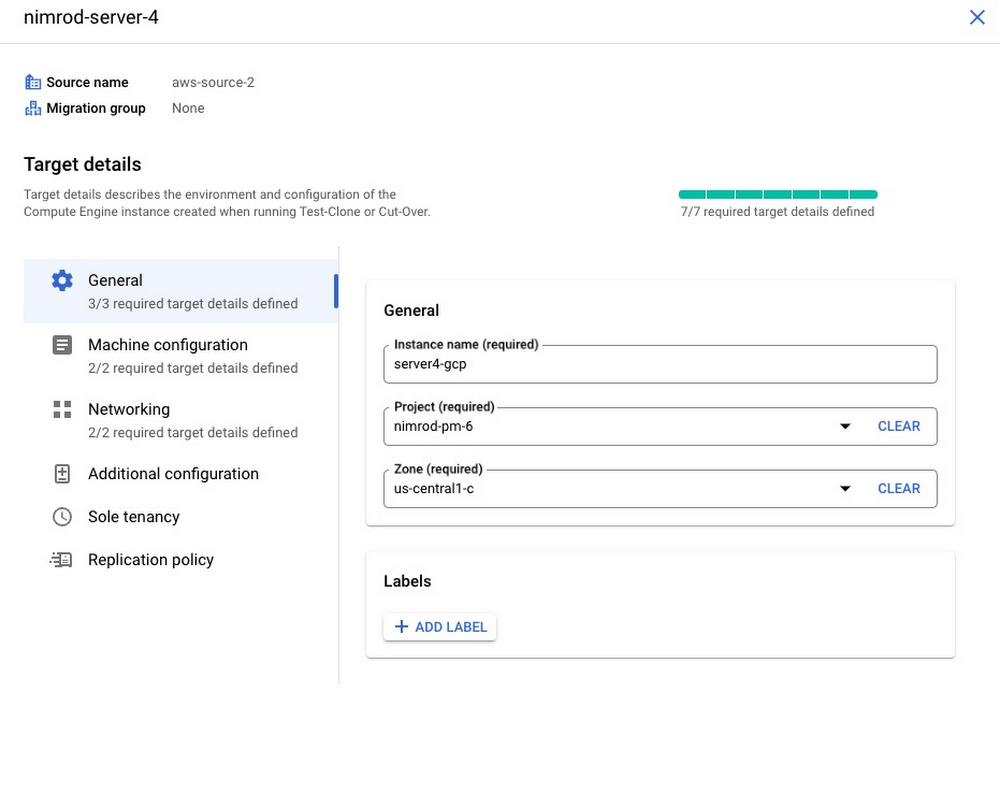
2. Configure landing zone target: You can migrate an instance to any Google Cloud project in your environment and update landing zone details at any time before executing a test-clone or cutover.
3. Initiate VM data replication of source workload: Migrate to Virtual Machines periodically replicates instance disks to the cloud with no interruption to the source instance. You can control replication frequently and pause or resume at any point in time.
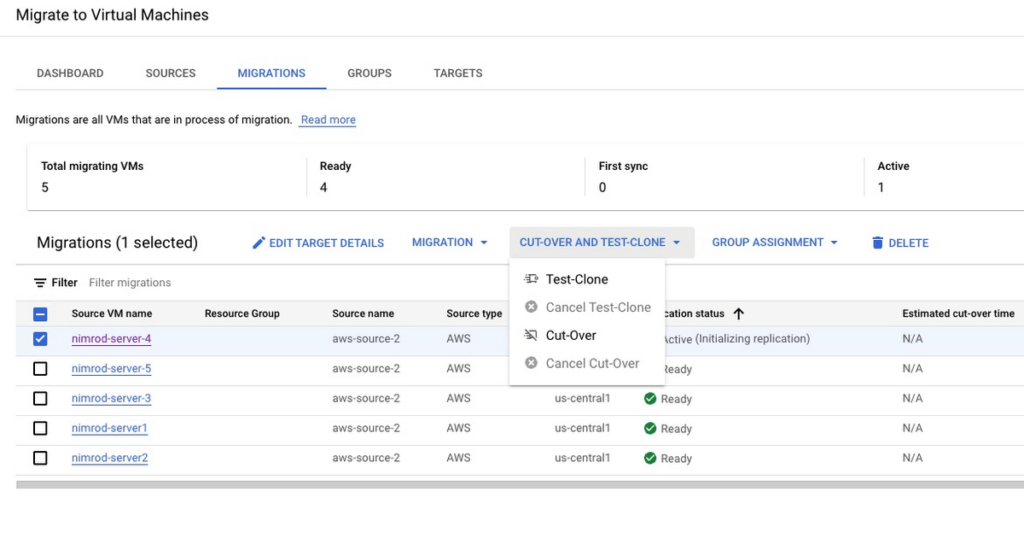
4. Test migrating instance: Test-clone creates a copy of your source instance in the defined landing zone to validate the migrating instance in the cloud before executing a cut-over. You can repeat the test-clone multiple times to multiple landing zones for thorough validation
5. Cutover migrating instance: Cutover operation shuts down your source instance and then performs the short final sync to Google Cloud. Migrated VM is instantiated in the target landing zone.
Getting started with Migrate to Virtual Machines
It’s quick and easy to start migrating your AWS EC2 instances and on-premises VMs today:
- Enable the vmmigration API in a Google Cloud project
- Create an AWS source in your environment
- Onboard and initiate replication of instance data from source
- Set migrating instance target details.
- Perform non-disruptive tests of your migrating instance using test-clone
- Cutover your instance to the cloud with minimal down time
You can also visit our website to learn more about Migrate to Virtual Machines. If you know you have to migrate in 2023 but aren’t sure how to get started, you can sign up for a free discovery and assessment of your current IT landscape so we can help craft the ideal migration plan for you and your business.
6385
Of your peers have already watched this video.
2:00 Minutes
The most insightful time you'll spend today!
CCAI Insights: Answer Customers’ Queries & Understand Them Better with Conversation Data
With CCAI Insights, businesses can drive contact center efficiency, solve customer problems and leverage data from customer interactions to understand them better!
CCAI Insights, a core piece of the Google Cloud’s Contact Center AI product suite is built to help contact center management dive into data to adjust business needs, preempt problems with timely analysis of customer conversations and keep agents prepared. Additionally, businesses can automatically feed data into Insights from other areas of CCAI like Dialogflow CX or another product sources. Watch the video to find out more benefits and capabilities of CCAI Insights in elevating CX.
Google’s New Climate Innovation Challenge to Fight Energy Crisis and Build Climate Resilience

3413
Of your peers have already read this article.
1:30 Minutes
The most insightful time you'll spend today!
At Google, we believe that when it comes to solving a problem as big and urgent as climate change, we get more done when we collaborate. From beekeepers in Germany to urban foresters in Los Angeles, we support the work of nonprofits, scientists, and organizations that are working to mitigate the impact of climate change globally, and increase communities’ resilience to its effects.
To this end, we are proud to launch the Climate Innovation Challenge, which will provide Google Cloud research credits to advance a better understanding of climate resilience and promising solutions to address urgent climate challenges. I’m excited about this launch. We need to get smarter about the inevitable impact of our changing climate and how it will reshape our lives, supply chains, and business. Sustainability is a business-critical agenda, and we need intelligent technologies, leadership, and collaboration to drive industry transformations and reach a net-zero world.
The innovation and scale required to solve the toughest climate challenges will come from technology. At Google Cloud, we’re working across industries to increase climate resilience, applying cloud technology to help solve key challenges in the fight against climate change. Nonprofits, scientists, and organizations will be key in developing new research and innovations that will help us better understand how we can accelerate action on climate.
Through the new program, individual climate researchers in higher education and not-for-profit research organizations can apply for Google Cloud credit grants of up to $100,000 to accelerate their projects with Google’s state-of-the-art, data analytics and artificial intelligence (AI) cloud services, from Google Earth Engine (EE) to Google Public Datasets like the one from the National Oceanographic and Atmospheric Administration (NOAA). We will work with specialist partners in environmental organizations, agriculture, and carbon reduction to help evaluate proposals and select participants. Our first partner is the National Science Foundation (NSF) AI Institute for Research on Trustworthy AI in Weather, Climate, and Coastal Oceanography (AI2ES). Alongside the cloud credits, we will also provide researchers with access to technical training and mentoring, to help jumpstart their work.
From idea to insight to impact
In 2021, researchers at 500 universities in 47 countries received Google Cloud research credit grants. Others received funding through the Google Cloud Research Innovators Program, which promotes collaboration among a global cohort of scientists and provides them with professional opportunities and technical expertise. Here are some of the Research Innovators who have already advanced their climate research with Google Cloud:
- At CalTech Tapio Schneider and his team built Climate Machine, a next-generation open-source Earth System Model that will integrate more earth and atmospheric data than ever before.
- At UCLA, Bo Zhou uses EE for remote sensor modeling to help bureaus of land management make conservation decisions.
- At the University of New England, James Brinkhoff conducts spatial and temporal analysis for agriculture crop modeling and water use with data from EE.
- At Natural Resources Canada (NRCan), Richard Fernandes is developing the LEAF toolbox to map and assess vegetation with satellite data from EE.
- At the University of Toronto, Yuhong He uses EE to map changes occurring in natural and managed ecosystems systems using remote sensing, machine learning, and ecosystem modelings.
- At UCLA, Henry Houskeeper uses machine learning with EE’s satellite imagery to automate detection of kelp forests.
- At the University of Hawaii at Manoa, Jonghyun Lee conducts numerical modeling for water resources with Google Colab.
- At Technical University in Dublin, Santos Fernández Noguerol runs functions to collect weather data from governmental agencies, then automatically stores them in Google Cloud Storage buckets for future spatial analysis.
- At the University of Colorado at Denver, Farnoush Banaei-Kashani conducts data science projects with applications for Intelligent Transportation and Earth Sciences.
To apply for a Climate Innovation Challenge grant, click here and include “Climate Innovation Challenge” as the first line of your proposal. We will announce additional focus areas, partnerships, and recipients throughout the year. Click here to learn more about Google Cloud sustainability.
8 Must-Have Google Cloud Products for Startups

3173
Of your peers have already read this article.
2:30 Minutes
The most insightful time you'll spend today!
Startups worldwide turn to Google Cloud tools to build fast on a strong and easy to use platform that helps them get to market and launch products faster, all while building on the cleanest cloud in the industry. Startups leverage Google Cloud and our Google for Startups Cloud Program to go from idea to IPO, and there are a variety of products on Google Cloud that can help them.
Here are the 8 top products that startups use on Google Cloud to innovate and grow:
Firebase for app development
Speed up innovation with Firebase, a mobile development platform that’s fully integrated with Google Cloud. Work in a simpler cloud environment, easily pull in products or services, and build your apps faster.
Cloud SQL for database needs
Build your startup’s foundation with Cloud SQL, a fully managed relational database solution that integrates with Google Cloud services. Create and connect to your first database in minutes and scale with a single API call.
AI and machine learning products
Solve tough problems with AI and machine learning products, built with the best of Google’s technology. Train deep learning and machine learning models cost-effectively so you can iterate and innovate faster.
BigQuery for data analytics
Drive agility with BigQuery, a serverless, cost-effective, multi-cloud data warehouse. Query streaming data in real time, predict business outcomes with built-in machine learning, and share analytics with just a few clicks.
Google Kubernetes Engine (GKE) for containers
Unlock faster, more secure app development with GKE, the most scalable Kubernetes platform. Streamline operations with release channels that fit your business needs and leave cluster monitoring to Google engineers.
Looker for data visualization
Get more from your data to keep moving ahead of the competition with Looker, a trusted business intelligence and data platform. Generate real-time reports and get insights at the right time with proactive alerts.
Cloud Run for serverless computing
Create scalable containerized apps in any programming language on Cloud Run, a fully managed compute platform. Pair it with container tools like Cloud Build and Docker, and only pay when your code is running.
Cloud Armor for security
Protect your startup from Web attacks with Cloud Armor, a leading Distributed Denial-of-Service (DDOS) defense service. Use it with an HTTP Load Balancer for Managed Instance Groups across regions to keep your workloads highly available and secure.
To learn more about products best-suited to the unique demands of startups, check out our startups solution page. Our team is looking forward to discussing how these products can help you. If you’re not already in the program, you can get started here.
If you want to learn more about how Google Cloud can help your startup, visit our page here to get more information about our program, and sign up for our communications to get a look at our community activities, digital events, special offers, and more.
Why the C-suite Can No Longer Ignore Cloud Computing

3545
Of your peers have already read this article.
2:30 Minutes
The most insightful time you'll spend today!
Gone are the days when technology was relegated to the sidelines of a business, only considered essential for industries and professionals directly dealing with it. Today, it is not just a value-add, but an integral part of every enterprise’s operations and ultimately, its success. This has wrought many changes in the way we work, the most noteworthy of which is creating the necessity for every executive – not just the CIO & CTO – to familiarise themselves with the technologies of the future.
Among these is cloud computing, which is essential to doing business in the 21st century. As the IT infrastructure needs of enterprises grow, and we inch closer to true mobility, it’s no surprise that cloud adoption is increasing by leaps and bounds. Unfortunately, too many C-suite executives dismiss cloud computing as being outside of their area of expertise. And while ignoring the technology aspect may have been possible for CEOs and CFOs in the past, it has now infiltrated every aspect of work, and arguably life itself. This makes it essential for executives across different functions and departments to familiarise themselves with at least the very basics of up-and-coming innovations.
One myth that has followed cloud computing is that it is a one-size-fits-all solution that businesses can merely install and use for storage. And while cookie-cutter solutions do exist, they end up doing more harm than good in the long term. To avoid this pitfall, it’s important for enterprises to understand the range of offerings at their disposal, and pick the one that most closely aligns with their needs.
Most people associate cloud deployment with subscribing to a third-party cloud service provider, which owns and manages all the resources that a firm might require. Known as the public cloud, this is the most popular option, especially for small and medium businesses that cannot bear the cost of IT infrastructure. Cost-effectiveness isn’t the only upside of this technology, though, since public clouds offer the added benefits of increased security, greater scalability, maximum uptime and ease of setting up.
Though the public cloud is the most widely used, it’s far from the only option that a business has. Enterprises seeking an added degree of customisation might find private cloud solutions to their liking. These offer an added layer of privacy, which may be mandated by the industry or jurisdiction that they operate in. Moreover, private clouds can allow access even in cases where geography or connectivity is unreliable. One of the factors that has held people back from switching to the private cloud has been the fact that they might need to buy and maintain the requisite infrastructure. In such cases, the Virtual Private Cloud (VPC) lets businesses tap into resources stored on a public cloud, within an isolated environment, with more granular control over virtual networks.
A fourth solution, known as the hybrid cloud, also offers the best of two worlds by utilising resources that are on-prem as well as on the public cloud. It is ideal for companies that already have money invested in IT infrastructure, but still want to make the most of the emerging technology. It can also serve as a stepping stone for ventures that are looking to make the switch, but have their reservations about the public cloud.
Each of these offerings comes with its own set of advantages and disadvantages. The key lies in evaluating your needs against the options at your
3457
Of your peers have already watched this video.
20:00 Minutes
The most insightful time you'll spend today!
Managing Change in an SAP World
Change is a constant for SAP customers. Now more than ever, SAP customers need solutions that provide them business agility, rock solid availability, enhanced security, and true economic value.
Learn how Google Cloud can guide your SAP journey to the cloud with simple and no cost migrations, powerful infrastructure, and innovation technologies that you can take advantage of today. Hear examples of SAP customers who have deployed on Google Cloud and the game changing results they are realizing.
More Relevant Stories for Your Company

Cloud FinOps Breaks Down Gaps in Finance, Tech and Business Teams, Accelerating Digital Transformation!
Accelerating digital transformation Digital transformation is what propels businesses and industries forward. Organizations of all sizes—from startups to global enterprises—focus on digital transformation not only to make scaled improvements, but also to drive significant change and fully embrace the digital age. The pandemic has jump started and pushed many organizations

Takeaways from the Google Cloud Public Sector Summit on Prioritizing Tech Investments
Editor’s note: Today’s post highlights five takeaways from our session at the first ever Google Cloud Public Sector Summit. To watch the full session, check out All the Right Moves: Prioritizing Investments in Technology. Now more than ever, government agencies need to invest in digital services to fulfill their missions and better

IDC Retail Insights: The Digital Pulse of Retail
Google partnered with IDC Retail Insights to conduct a survey of retailers across the globe to assess the state of transformation and develop an index of digital maturity. Learn more about the changes in digital resilience over the last year and the areas of innovation over the next 12 months.

Beyond Traditional Learning: AI-based Online Learning Platform and Google Cloud Solutions Push Learners to Get Ahead
The combination of a vital need for IT experts among businesses and a digital skills gap is making lifelong learning increasingly critical. Beyond professional development, learning new skills offers additional rewards from building peer connections to boosting your creativity. That’s why in 2020 Krishna Deepak Nallamilli and I launched KIMO.ai to reimagine how people
