





Artifact Registry: An Extension Capabilities of Container Registry

3560
Of your peers have already read this article.
1:30 Minutes
The most insightful time you'll spend today!
Enterprise application teams need to manage more than just containers in their software supply chain. That’s why we created Artifact Registry, a fully-managed service with support for both container images and non-container artifacts.
Artifact Registry improves and extends upon the existing capabilities of Container Registry, such as customer-managed encryption keys, VPC-SC support, Pub/Sub notifications, and more, providing a foundation for major upgrades in security, scalability and control. While Container Registry is still available and will continue to be supported as a Google Enterprise API, going forward new features will only be available in Artifact Registry, and Container Registry will only receive critical security fixes.
Below, we’ll highlight the key improvements Artifact Registry provides over Container Registry, as well as the steps to start using it today.
A unified control plane for container, OS and language repositories
Artifact Registry includes more than just container images: as a developer, you can store multiple artifact formats, including OS packages for Debian and RPM, as well as language packages for popular languages like Python, Java, and Node. In addition, you can manage them all from a single, unified interface.
A more granular permission model with Cloud IAM
Artifact Registry comes with fine-grained access control via Cloud IAM. Unlike Container Registry, this allows you to control access on a per-repository basis, rather than all images stored in a project. This enables you to scope permissions as granularly as possible, for example to specific regions or environments as necessary.
Repositories in the region of your choice
Artifact Registry supports the creation of regional repositories, which allows you to put your artifacts and data directly in the location that they’ll be used, allowing for higher availability and speed. In Container Registry, you’re limited to “multi-regions”: for example, the closest multi-region for Australia is Asia. However, with Artifact Registry’s regional support, you can create a repository directly in the Sydney data center.
A pricing model that respects your region
While Artifact Registry’s pricing is still based on a combination of network egress and storage usage, support for regional repositories means that you can choose in what region to host your container repositories. Although per unit storage costs are higher for Artifact Registry, optimizing the locations of your repositories to be hosted in the same region where they are used can result in cost savings, because any network traffic within the same region is not considered egress and is thus free.
Part of a secure supply chain
Artifact Registry was designed from the ground up to integrate into our suite of secure supply chain products. This means that it can optionally use Container Analysis to scan your container images for vulnerabilities as they’re uploaded to Artifact Registry, and works directly with Binary Authorization to secure your deployments.
We’re here to help you migrate
If you already use Container Registry, you can take advantage of all the current and upcoming features of container image storage with Artifact Registry by migrating to it. To help, we’ve prepared the following guides:
- Transitioning from Container Registry provides an overview of how to use Artifact Registry instead of Container Registry in a backwards-compatible way
- Copying images from Container Registry guide you to move container images from an existing repository to an Artifact Registry repository
If you’re currently hosting your container images with a third party, you can begin using Artifact Registry directly, by following the instructions in our guide, Migrating containers from a third-party registry, which shows you how to avoid rate limits on image pulls or third-party outages which can disrupt your builds and deployments.
And if you’re just getting started storing container images, you can begin using Artifact Registry as your image repository right away. To learn how, check out Artifact Registry quickstart for Docker, a guide to using Artifact Registry as a single location for managing private packages and Docker container images.
Join our community
Our Artifact Registry communities are also great resources to help answer your questions and for guidance on best practices:
- Ask questions on Stack Overflow using the google-artifact-registry tag
- Visit the Google Cloud Slack community and ask a question in the #artifact-registry channel. If you haven’t already joined the Slack community, use this form to sign up.
Regulatory-induced Challenges Create Hurdles to Cloud Adoption for Financial Services Firms

3345
Of your peers have already read this article.
2:30 Minutes
The most insightful time you'll spend today!
The financial services industry is evolving at a rapid pace, with shifting consumer expectations, new technologies, and developing regulatory requirements. Financial services firms need the right technology to help them stay agile and prepare for the future.
The cloud is a key point of leverage for firms looking to improve performance across a broad range of activities. Moving to the public cloud can advance operational resiliency, improve staff productivity, increase regulatory compliance and enhance business model innovation.
However, there are a number of financial services companies that are still hesitant in their cloud journeys. The barriers to adoption vary, from the complexity of legacy systems, to trust and skills gaps, regulatory uncertainty, and fragmentation of compliance requirements. Although many companies have embraced the benefits of cloud technology, more robust cloud adoption—especially around core back-office functions—will require additional facilitation, including through regulatory harmonization and streamlining.
A new comprehensive study on cloud adoption in financial services
To better understand the challenges and opportunities of cloud adoption in financial services Google Cloud, together with the Harris Poll, surveyed more than 1,300 leaders from the financial services industry across the United States, Canada, France, Germany, United Kingdom, Hong Kong, Japan, Singapore and Australia.
There were five noteworthy takeaways from the study:
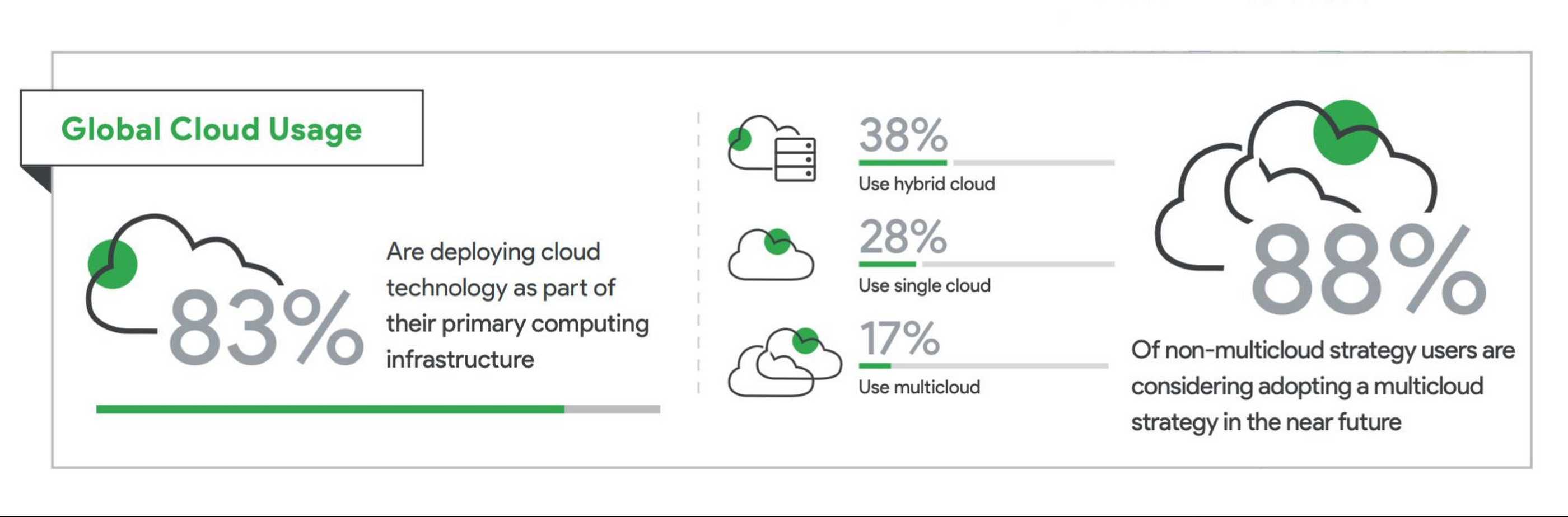
1. A vast majority of financial services companies are already using some form of public cloud. A large number of surveyed financial services companies (83%) report they are deploying cloud technology as part of their primary computing infrastructures. Of those using cloud technology, the most popular architecture of choice is hybrid cloud (38%), followed by single cloud (28%), and multicloud (17%). Notably, of respondents without a multicloud deployment, 88% reported they are considering adopting a multicloud strategy in the next 12 months.
2. Financial services institutions in North America are leading in cloud adoption. Of the financial services companies who are implementing a cloud strategy, the highest levels of cloud workload adoption were reported in North America, with institutions in the U.S. (54%) and Canada (52%) leading the way. The lowest level of cloud adoption was reported in Japan (42%).
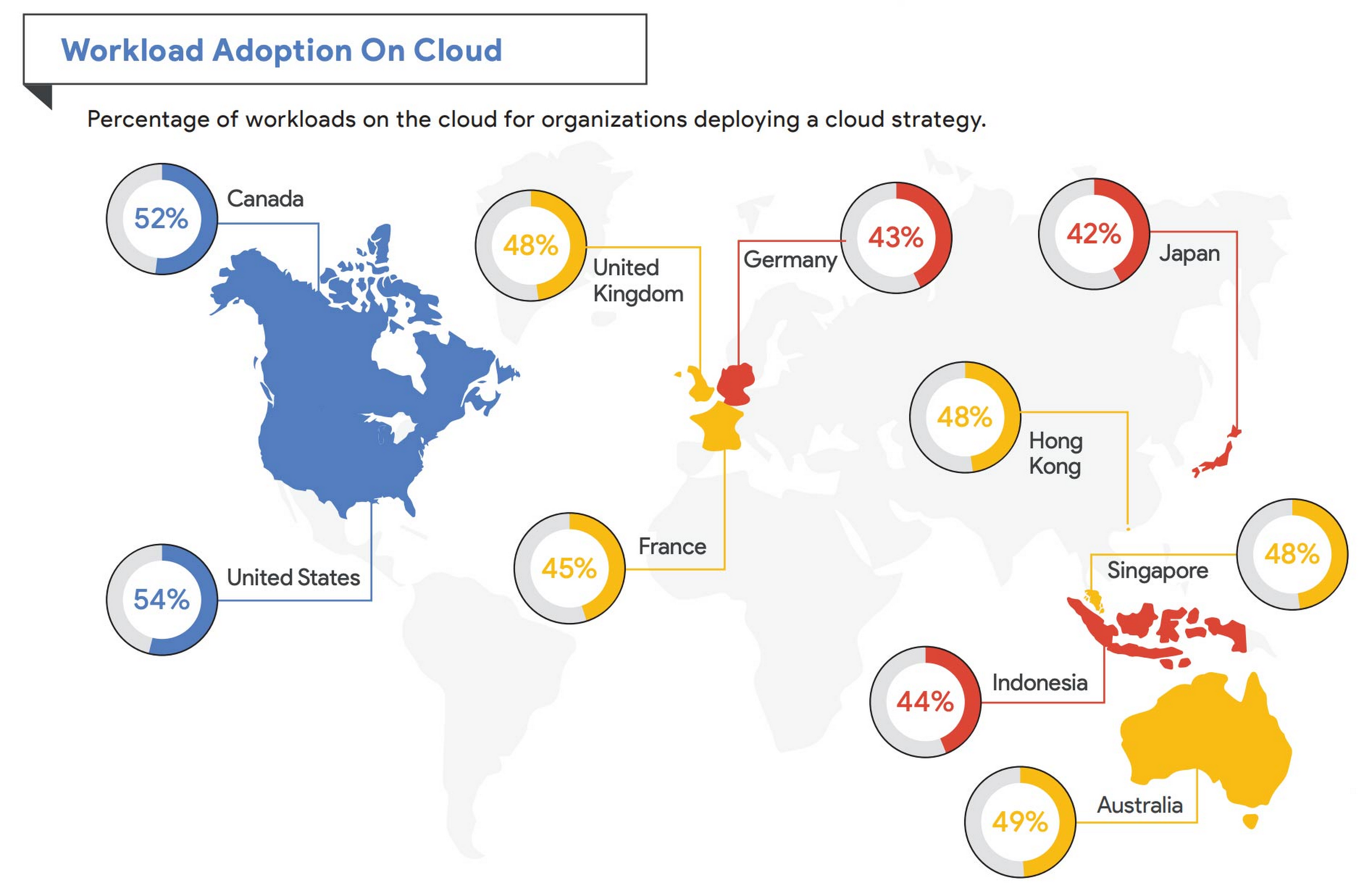
3. As financial services companies continue to use the cloud, more core functionalities can and will be migrated. While many financial services companies have migrated substantial workloads to the cloud, the industry is far from full adoption when it comes to core, back-office workloads. Of financial services companies currently using a majority cloud strategy in the United States, for example, only half (54%) of their workloads are fully deployed in the cloud. Data and IT security (74%), regulatory reporting (57%), and fraud detection and prevention (57%) rank among the highest workload adoption. Core underwriting activity (40%) and data reconciliation (48%) ranked lowest. Across Europe, cloud usage for core activities like underwriting also scored low with the UK listing only 30% adoption.
4. Among respondents, there is a very strong positive perception of the potential for cloud technology to assist in business operations and regulatory compliance. Nearly all respondents (>88%) agreed that cloud adoption can:
- help adapt to changing customer behaviors and expectations,
- enhance operational resilience,
- support the creation of innovative new products and services,
- enhance financial services institutions’ data security capabilities, and
- better connect siloed legacy software infrastructure within financial services institutions.
5. Certain regulator-induced challenges, including the complexity of sectorial compliance frameworks and fragmentation, create hurdles to cloud adoption for financial services companies. While 88% of respondents had a positive view of current regulatory efforts to provide guidance and clarity for cloud implementation, the results showed that more needs to be done to facilitate adoption. Most respondents (84%) agree that regulatory reviews and approvals take too long because of regulatory fragmentation across regulatory bodies. And 78% say that regulatory uncertainty over the use of public cloud prevents their organizations from adopting cloud technologies that would otherwise provide benefit to them. Additionally, a third of all on-premises respondents (38%) say that the large investment of resources for the regulatory approval process is a reason why they’re not using cloud services.
“While many banks have already deployed hybrid cloud environments, others are still in various stages of planning and deploying,” said Jerry Silva, research vice president for IDC Financial Insights. “Clearly, hybrid infrastructure is a reality, and financial institutions must focus not only on leveraging the modern infrastructure model to gain efficiencies, resilience and agility, but also on taking the necessary steps to manage such environments, including the security and compliance of cloud services.”
Future recommendations for financial services regulators
Financial services firms should continue to maximize the potential of technology by migrating more core workloads to the cloud, and actively considering multicloud and hybrid-cloud strategies. Such strategies enhance resiliency of existing IT infrastructure and reduce concerns over vendor lock-in.
The research also points to steps that regulators could take to provide additional clarity and guidance, such as aligning regulatory reviews across agencies to avoid fragmentation; developing regulatory “safe harbors” for cloud adopters based on adherence to accepted standards and best practices; training regulatory staff on emerging tech; and advancing data reporting requirements via cloud and related technologies.
In the past few years, many regulators across the globe have taken a robust approach to rationalizing rules and guidance to cloud adoption in the financial sector, which has helped significantly stimulate adoption. But further assurances and harmonization of best practices around supervision is needed to advance risk-based and secure digital innovation.
At Google Cloud, we’re committed to working with financial services customers and regulators to provide them with controls and assurances on risk management, data locality, transparency, and compliance. We are constantly engaging with regulators to share information, respond to their considerations and concerns, and address questions in the interest of transparency and building trust.
To learn more about these findings and more, download our infographic and our full report.
Research methodology
The survey was conducted online by the Harris Poll on behalf of Google Cloud, from December 7, 2020, to January 4, 2021, among 1,363 senior executives in France (n=113), Germany (n=178), the UK (n=192), Hong Kong (n=99), Indonesia (n=100), Japan (n=142), Singapore (n=71), Australia (n=134), Canada (134), and the United States (n=200) who are employed full-time, part-time, or self-employed whose main functional role is in risk/compliance or IT at a company in the banking, finance, or financial services industry with a title of director level or higher. The data in each country were weighted by the number of employees to bring them into line with actual company size proportions in the population. A global post-weight was applied to ensure equal weight of each country in the global total.
Tau VMs Joins Google Cloud to Offer Cost-effective Performance of Scale-out Workloads

5621
Of your peers have already read this article.
2:00 Minutes
The most insightful time you'll spend today!
Scale-out workloads demand the best combination of performance and price to bring down the cost of delivering applications, all while providing an excellent user experience. We are excited to announce a new virtual machine (VM) family, Tau VMs, coming to Google Cloud. Tau VMs extend Compute Engine’s VM offerings with a new option optimized for cost-effective performance of scale-out workloads.
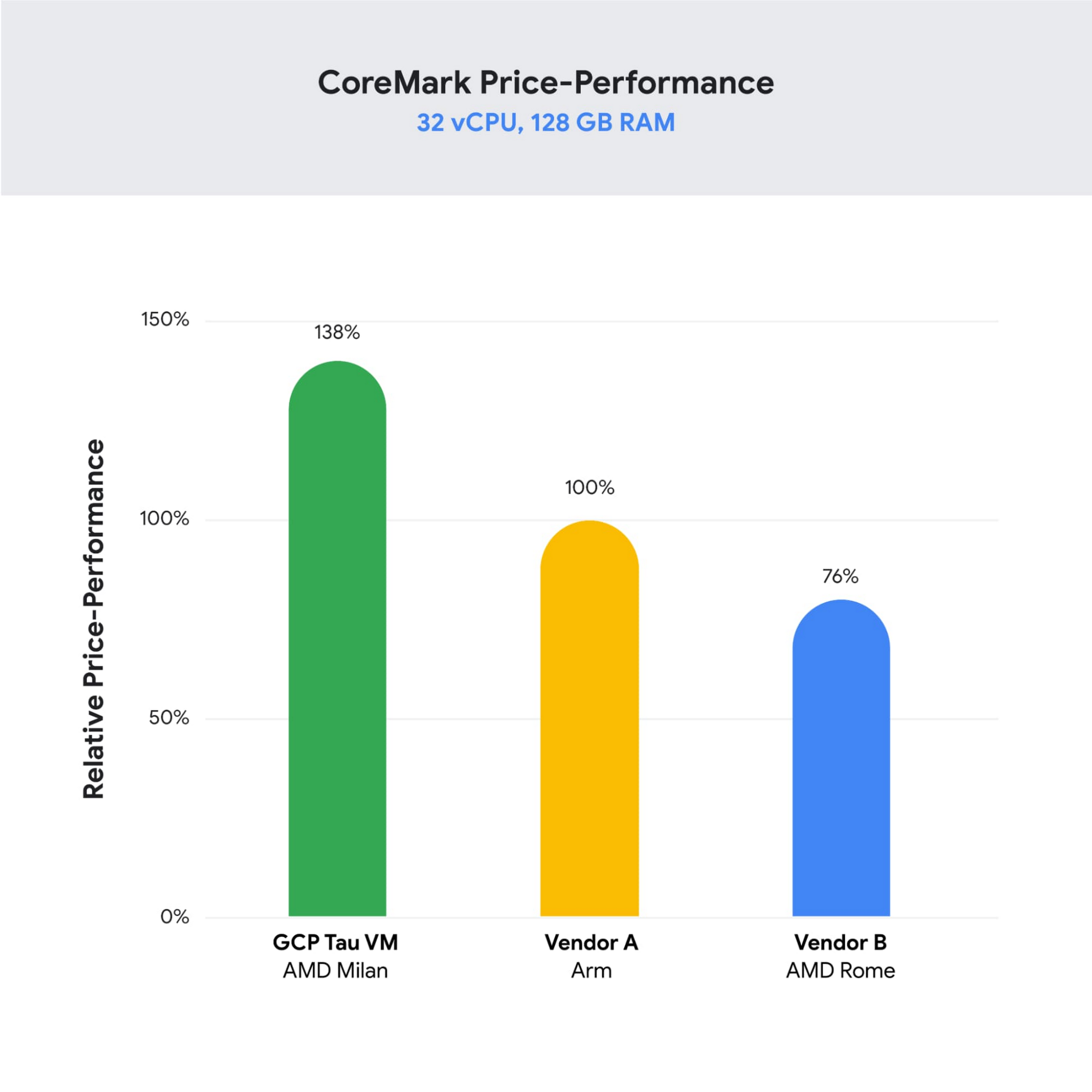
T2D, the first instance type in the Tau VM family, is based on 3rd Gen AMD EPYCTM processors and leapfrogs the VMs for scale-out workloads of any leading public cloud provider available today, both in terms of performance and workload total cost of ownership (TCO). The x86 compatibility provided by these AMD EPYC processor-based VMs gives you market-leading performance improvements and cost savings, without having to port your applications to a new processor architecture.
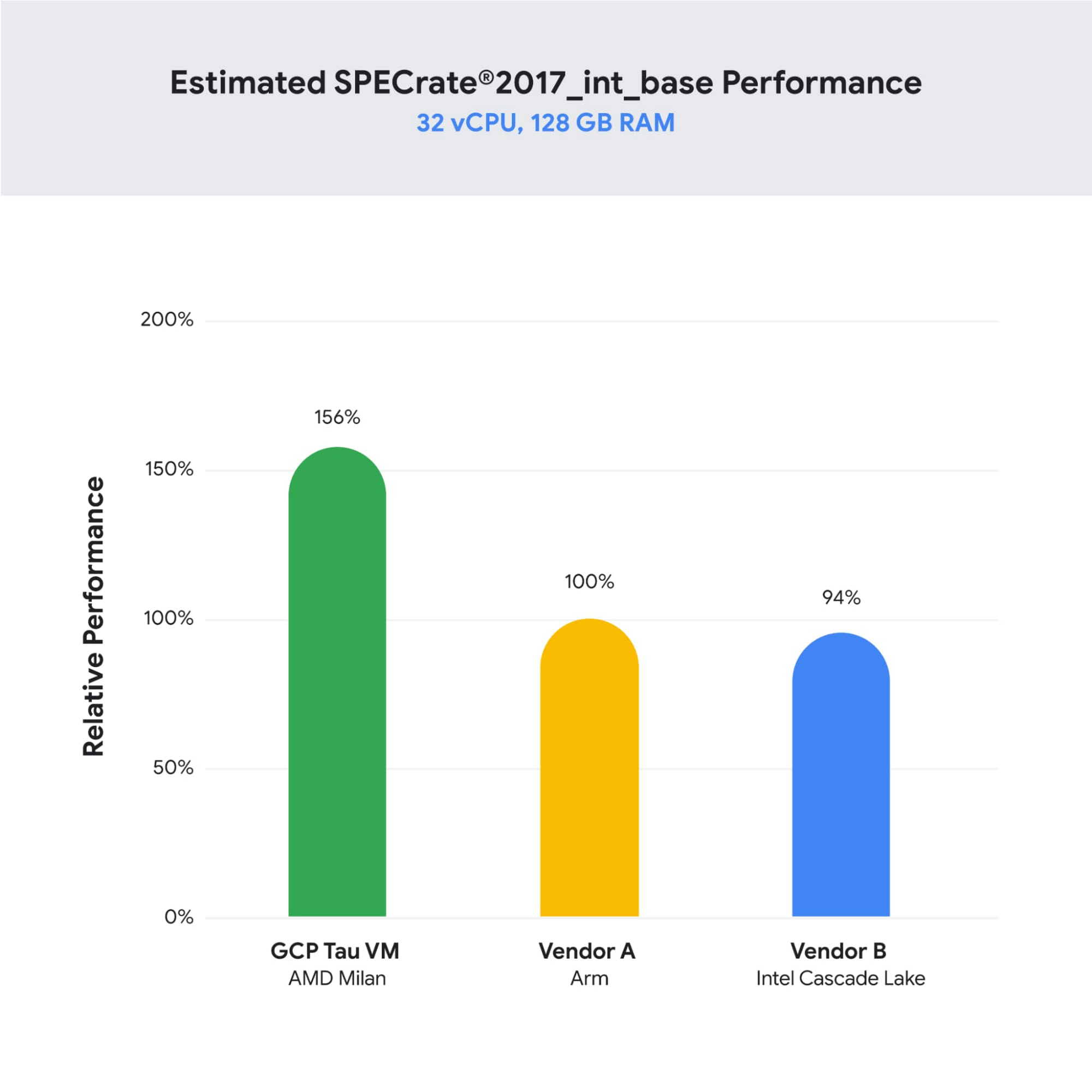
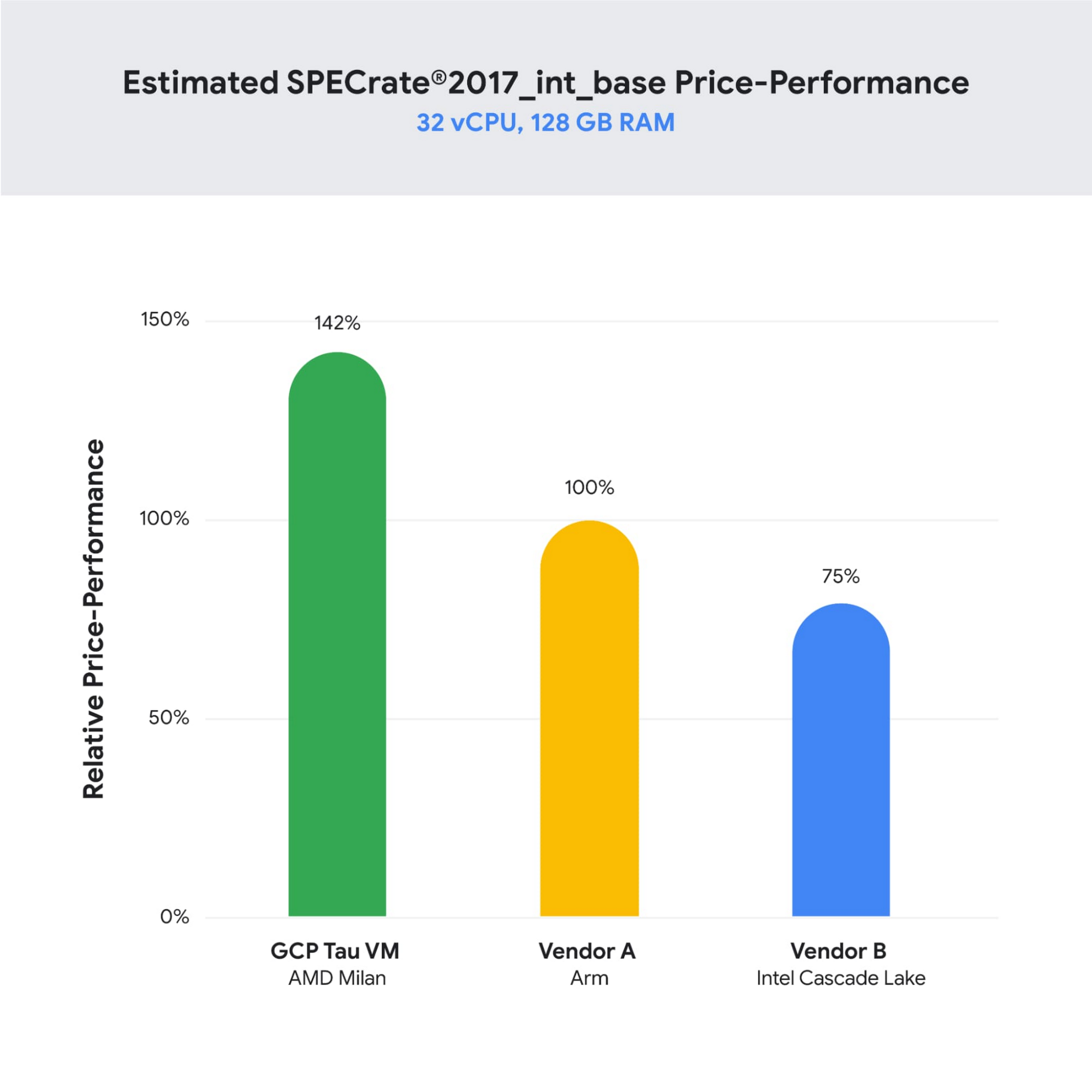
As illustrated below, Tau VMs offer 56% higher absolute performance and 42% higher price-performance (est. SPECrate2017_int_base) compared to general-purpose VMs from any of the leading public cloud vendors.
SPECrate is a trademark of the Standard Performance Evaluation Corporation. More information available at www.spec.org
What our customers and partners are saying
Snap
“At Snap, it is critical for our business to continue improving our scale-out compute infrastructure for key Snapchat capabilities like AR, Lenses, Spotlight and Maps,” said Cody Powell, Senior Engineering Manager, Snap Inc. “We were impressed when we tested Google Cloud’s new Tau VMs with Google Kubernetes Engine. While it’s early days, we believe we can gain double digits in infrastructure performance improvements for key workloads—enabling us to do more with less and invest even more in new features for our amazing Snapchat community.”
Twitter
“High performance at the right price point is a critical consideration as we work to serve the global public conversation,” said Nick Tornow, Platform Lead, Twitter. “We are excited by initial tests that show potential for double digit performance improvement. We are collaborating with Google Cloud to more deeply evaluate benefits on price and performance for specific compute workloads that we can realize through use of the new Tau VM family.”
DoiT
“DoiT partners with leading cloud vendors who are focused on growth and cost optimization,” said Yoav Toussia-Cohen, CEO, DoiT International. “In our preliminary testing of Google’s new Tau VMs with the Coremark benchmark, we were thrilled to see the incredible performance at 50% better than a comparable ARM-based offering from another leading public cloud. With Tau VMs, Google Cloud has set a new bar for price-performance, making the cloud even more accessible to digital-native companies. We are excited to bring Google’s Tau VMs to our joint customers.”
Designed for demanding scale-out workloads
Tau VMs bring the benefit of Google’s long-standing experience engineering platforms for scale-out workloads to our customers. They come in multiple predefined VM shapes, with up to 60vCPUs per VM, and 4GB of memory per vCPU. They offer up to 32 Gbps networking bandwidth and a wide range of network attached storage options, making Tau VMs ideal for scale-out workloads including web servers, containerized microservices, data-logging processing, media transcoding, and large-scale Java applications.
Google Kubernetes Engine support
Google Kubernetes Engine (GKE) is the de facto standard for organizations looking for advanced container orchestration, delivering the highest levels of reliability, security, and scalability. GKE supports Tau VMs on day 1, helping you optimize price-performance for your containerized workloads. You can add Tau VMs to your GKE clusters by specifying the T2D machine type in your GKE node-pools.
Pricing
Tau VMs will be priced to support significant TCO and price-performance improvements for your cloud applications. A 32vCPU VM with 128GB RAM will be priced at $1.3520 per hour for on-demand usage in us-central1.
Coming soon to a Google Cloud region near you
If you are interested in trying out T2D VMs when they become available in Q3 2021 please sign-up here.
Dassana: Choosing Google Workspace and Google Cloud to accelerate growth and reach goals

3039
Of your peers have already read this article.
2:30 Minutes
The most insightful time you'll spend today!
When Dassana co-founders Gaurav Kumar and Parth Shah, formerly founder and founding engineer at RedLock (now Prisma Cloud by Palo Alto Networks), set out on a new startup journey in 2020, they knew exactly where to start: sign up for Google Workspace.
“Every startup I’ve been at, we used Google Workspace,” said Kumar. “We’ve been using it for so long, and we’re all used to it. It’s like drinking water—you don’t think about it.”
“We’re big on user experience,” explained Shah. “Google is one of the few companies out there that is all about building the right kind of user experience that’s easy to follow. The sharing capabilities are amazing and, of course, easy to use. Docs, Sheets, Slides—we use all of it.”
Dassana, which emerged from stealth with $5 million in seed funding earlier this year, is a next-generation security data lake. It provides a holistic picture of security risk across an organization and its business units by ingesting large volumes of structured data in a schema-less fashion. Their success is a great testament to why startups are choosing not only Google Workspace, but a range of Google Cloud products.
Though the Dassana team was comfortable with Workspace from the start, not all their early technology choices were the best fit for the company, and Google Cloud services became more crucial as the startup evolved. For example, the team opted to use Amazon Web Services (AWS) to start their cloud journey, but ultimately started to explore other cloud options when they decided to run their technology platform on Kubernetes.
“We started looking into which cloud platforms provide the best Kubernetes experience,” said Kumar. “Hands-down, Google Kubernetes Engine (GKE) had the best experience. If you look at product velocity and how GKE has evolved over time, from its early days to GKE Autopilot and all the features and other native integrations—nothing even comes close.”
In particular, Kumar noted that the native integration between Google Workspace and GKE was particularly unique and useful. “When I go to Google Workspace and then go to GKE, my identity is already there,” he said. “I don’t have to integrate or manage anything. If I disable an account in Workspace, it’s also disabled on GKE.”
Another advantage is that GKE allows you to set up Google Groups to work with Kubernetes role-based access control (RBAC) for GKE clusters. This lets administrators maintain users and groups outside of GKE and assign RBAC permissions directly to Groups in Workspace without any extra engineering work or overhead management.
“I can actually use my Workspace identity to give granular controls to my GKE workloads. The integration of Google Groups in GKE and Kubernetes is a lifesaver. It’s saved us a lot of hassles,” said Kumar. Kumar also noted that the platform delivers better performance compared to other solutions thanks to the low latency of Google Cloud’s global network.
Like many startups, Dassana has found a powerful combination in Google Workspace and GKE on Google Cloud that lets them connect technologies, easily collaborate with their teams, and rapidly build their product. The team also recognizes the necessity of continued innovation, and is exploring additional Google Cloud products to help them accelerate their momentum. For example, Dassana plans to use the performance and scale of Cloud Storage buckets to store the company’s data. The team is also investigating how to save time by using Pub/Sub to integrate data directly from Google Workspace and other sources for security analytics.
To learn more about why startups like Dassana are choosing Google Workspace and Google Cloud to accelerate their growth and reach their goals, visit our startup solutions pages for Google Workspace and Google Cloud.
Cloud Migration and Modernization is ‘Easier Done than Said’ with Google Cloud RAMP!
DOWNLOAD INFOGRAPHIC3254
Of your peers have already downloaded this article
3:00 Minutes
The most insightful time you'll spend today!
The reliance on cloud compute, storage and network has accelerated with the growing usage of digital products and services. To keep up with the customer demands and deliver digital solutions, many companies are struggling through their cloud migration and modernization journeys. But not anymore, says Google Cloud with the Rapid Assessment & Migration Program (RAMP)!
Download the infographic to have succinct view of what cloud migration and modernization would look like by RAMPing up! Bid Adieu to delays and budget overspend with the tools, resources, partners and fundings with RAMP.
3475
Of your peers have already watched this video.
1:30 Minutes
The most insightful time you'll spend today!
Pharma Firm Drives 80% Improvement in Speed with SAP on Google Cloud
FFF Enterprises is a leading supplier of critical-care biopharmaceuticals, plasma products, and vaccines. Their passion for patient safety and product efficacy drives their mission of Helping Healthcare Care.
For FFF Enterprises if they have to focus on ERP infrastructure, that takes away from getting products to patents. Learn why FFF Enterprises chose to deploy SAP on Google Cloud and drove an 80% improvement in speed for their SAP environment at a lower cost.
More Relevant Stories for Your Company

Google Cloud Leads the Landscape for Unstructured Data Security Platform: Forrester
As organizations expand their use of cloud computing services, more of their sensitive data inevitably moves to and lives in the cloud. Much of this sensitive data is unstructured and can be challenging to secure. Despite this potential challenge, the usefulness of cloud for data storage and processing is too
The Total Economic Impact of SAP on Google Cloud Gives Businesses a Transformation Accelerator: Forrester
By using Google Cloud, organizations can quickly and easily migrate their SAP applications and data to Google Cloud with minimal disruption to the business, reduce hardware and maintenance costs, and eliminate the complexities and risks of managing SAP applications on-premises. Because of Google Cloud’s pure-cloud infrastructure, organizations can host large
What Are India’s Biggest Companies Doing on Google Cloud?
In the last year, there’s been an upward trend in cloud adoption in India. In fact, NASSCOM finds that cloud spending in India is estimated to grow at 30% per annum to cross the US$7 billion mark by 2022. At Google, in our conversations with customers, discussions have evolved beyond cost savings

Security at Scale: A Peek into the Life of Google
Defending the world’s largest network against persistent and constantly evolving cyber threats has driven Google to architect, automate, and develop advanced tools to help keep it ahead. Understanding how Google has built and evolved it’s defenses can help you make smart architectural decisions of your own as you move forward.
