





A Road to Possibilities: Google Maps Platform Website

7250
Of your peers have already read this article.
2:00 Minutes
The most insightful time you'll spend today!
For more than 15 years, developers have used Google Maps Platform to deliver location-based experiences to their end users and used location intelligence to optimize their businesses. Along this journey, we’ve made a variety of changes to better support our community as needs have changed and new industries and technologies have emerged. We started rolling out a new website experience, at https://mapsplatform.google.com, to help you better understand the products and solutions best suited to address your objectives. Plus, now you can directly connect to the developer documentation for each product to get started quickly, and you can visualize usage and associated costs to have a better idea of what to expect before getting started.
Getting to your solution faster
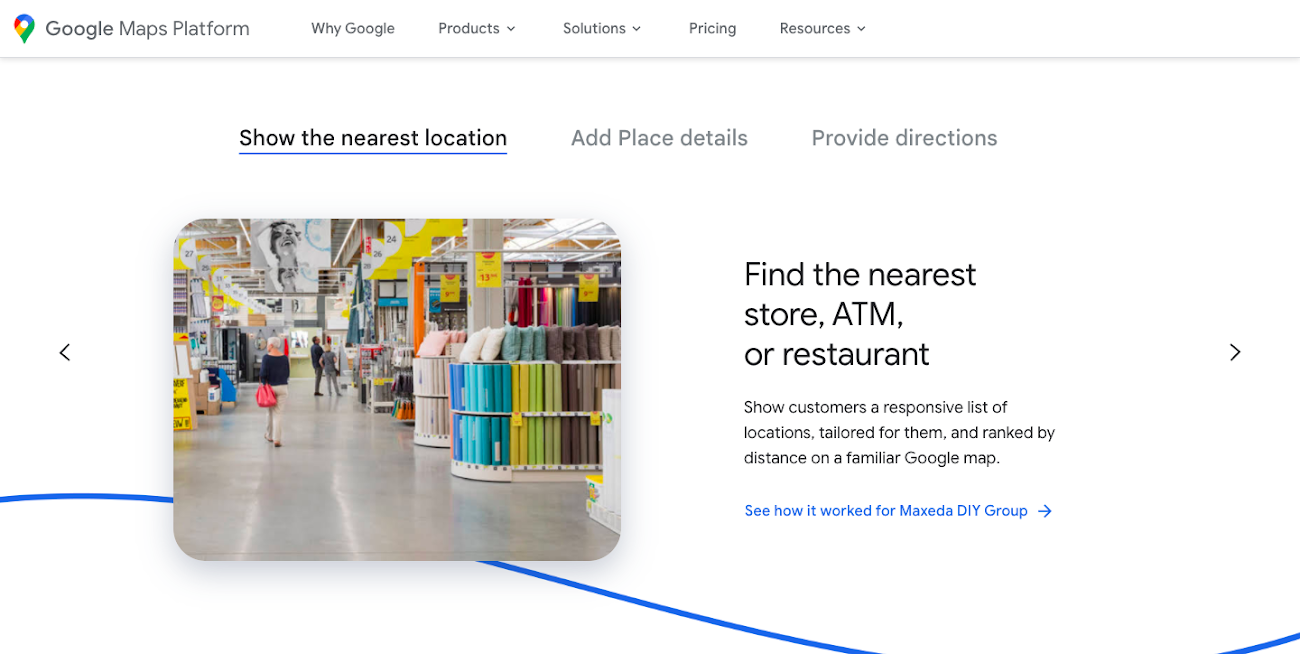
Maps, Routes, Places are building blocks that let you develop implementations for any use case. Building for specific use cases, however, typically requires using a combination of APIs and SDKs. To help you quickly understand what’s possible and what you need to build for your use case, you can now visit the solutions tab to select from a list of popular use cases or industries. Once you’ve selected a use case or industry, you’re taken to a page where you can explore relevant products, read helpful blog posts, see how other customers have deployed for similar use cases, and more.
Direct access to developer documentation
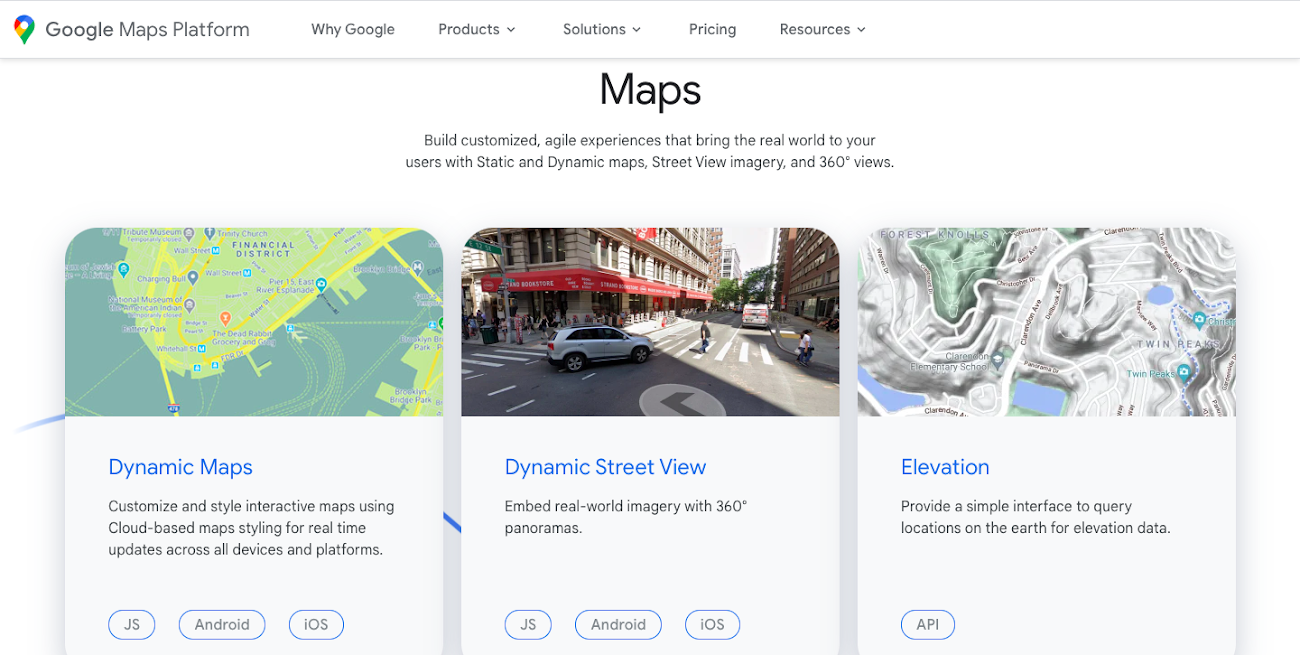
Did you know there are more than a thousand pages of developer documentation created to help you get started, unblock you when you’re stuck, and share best practices? Now when you explore a product or solution from the Google Maps Platform website, you can easily navigate back and forth between our website and documentation. Just tap on JS, iOS, Android or API under the product name to get to the documentation you need.
Budgeting for your project
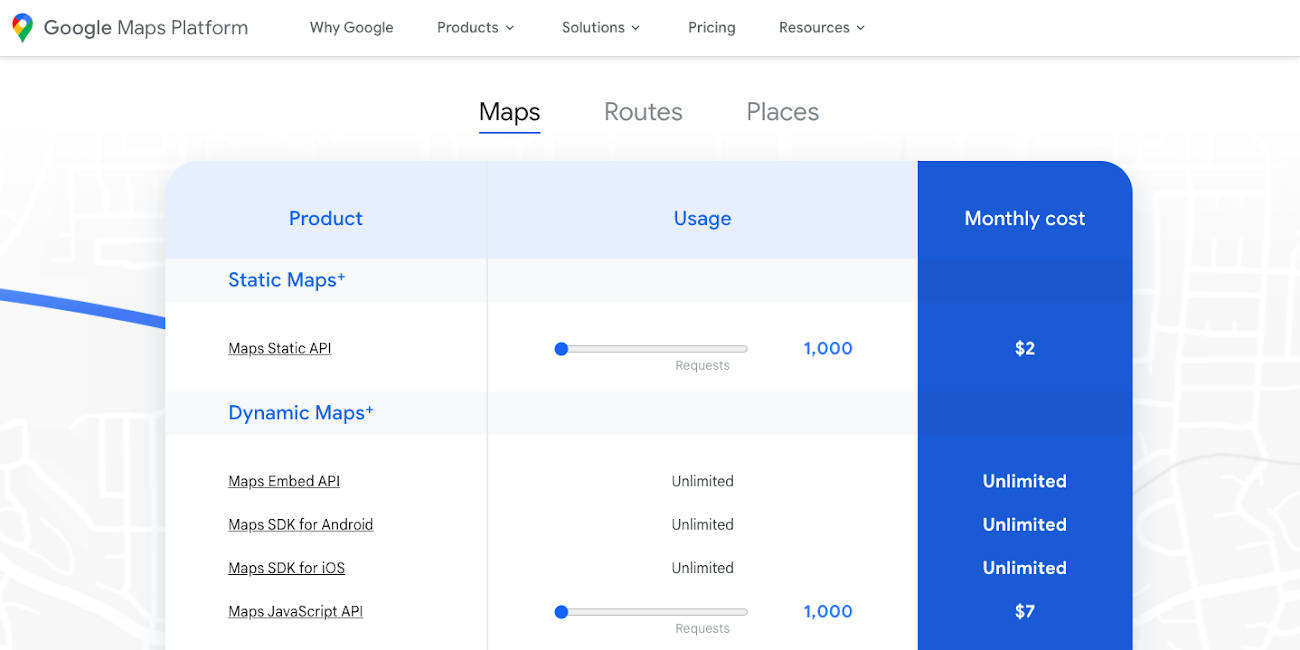
To help you calculate pricing for your project, we’ve introduced a new pricing calculator. Once you find the product and API or SDK you plan to use, pull the slider to reflect your estimated number of monthly requests. This will automatically update the “monthly cost” column for each product and API or SDK you plan to use. If your estimated monthly requests exceed the slider limit, contact our sales team to learn about volume discounts that start at 20% off.
We hope our new website makes it easier to discover our products and solutions, estimate your budget, and start building with our documentation so you can deliver helpful experiences to your users and optimize your business.
For more information on Google Maps Platform, visit https://mapsplatform.google.com.
Don’t Just Move to the Cloud, Modernize With Google Cloud

3492
Of your peers have already read this article.
2:00 Minutes
The most insightful time you'll spend today!
Our customers tell us they don’t just want to migrate their applications from point A to point B, they want to modernize their applications with cloud-native technologies and techniques, wherever those applications may be.
Today, we’re excited to tell you about a variety of new customers that are using Anthos to transform their application portfolio, as well as new cloud migration, API management, and application development offerings:
- New customers leveraging Anthos for a variety of on-prem, cloud and edge use cases
- The general availability of Migrate for Anthos
- Apigee hybrid in general availability
- The general availability of Cloud Code
Accelerating app modernization with Anthos
Anthos was the first open app modernization platform to offer a unified control plane and service delivery across diverse cloud environments—managed cloud, on-premises and edge. Since it became generally available in the spring, organizations across a variety of industries and geographies have turned to Anthos to bring the benefits of cloud, containers and microservices to their applications.
According to the findings from Forrester’s Total Economic Impact study, customers adopting Anthos have seen up to 5x return on investment based on the savings from ongoing license and support costs, and the incremental savings from operations and developer productivity. For one customer in the financial services industry, rolling out new features and updates to their core banking application used to take at least a quarter. Now with Anthos, they were able to eliminate months long development and release cycles, and roll out on a weekly basis. That’s a 13x improvement on time to market.
This week, several new European Anthos customers will take the stage at Next UK to talk about how they’re using Anthos to transform their IT operations.
Kaeser Kompressoren SE of Coburg, Germany, is a provider of compressed air products and services. The company needed a consistent platform to deploy and manage existing on-prem SAP workloads, like SAP Data Hub, and also wanted to be able to tap into other services running in Google Cloud to get more value from those environments.
“Application modernization is enabling business innovation for Kaeser,” said Falko Lameter, CIO. “To gain better insights from data, we knew we needed to incorporate advanced machine learning and data analytics in all our applications. We chose Google Cloud’s Anthos because it offered the flexibility to incrementally modernize our legacy application on-premises without business disruption, while allowing us to run other applications on Anthos in Google Cloud and take advantage of its managed data analytics and ML/AI services.”
Then there’s Denizbank. Based in Turkey, Denizbank provides a variety of commercial banking services, and established the first Digital Banking Department in Turkey in 2012. Denizbank turned to Anthos for an open application modernization platform to help it develop its next-generation mobile banking applications.
“We operate in 11 different countries and have to comply with various regulatory requirements like data locality and sovereignty, which mandates some or all applications to reside on premises in certain countries, while the rest of the apps can move to the cloud in other countries,” said Dilek Duman, COO of DenizBank. “We chose Google Cloud’s Anthos for its flexibility to modernize our existing application investments with ease, and to deliver AI/ML powered software faster while improving operational security and governance. Anthos gives us the ability to have a unified management view of our hybrid deployments, giving us a consistent platform to run our banking workloads across environments.”
Anthos is even starting to be deployed to edge locations, where, thanks to its 100% software-based design, it can run on any number of hardware form factors. We’re in advanced discussions with customers in telecommunications, retail, manufacturing and entertainment about using Anthos for edge use cases, as well as with global hardware OEMs.
Move and modernize with Migrate for Anthos
In addition to leveraging cloud technology for their on-premises environments with Anthos, customers also want to simultaneously migrate to the cloud and modernize with containers. That’s why we’re happy to announce the general availability of Migrate for Anthos, which provides a fast, low-friction path to convert physical servers or virtual machines from a variety of sources (on-prem, Amazon AWS, Microsoft Azure, or Google Compute Engine) directly into containers in Anthos GKE.
Migrate for Anthos makes it easy to modernize your applications without a lot of manual effort or specialized training. After upgrading your on-prem systems to containers with Migrate for Anthos, you’ll benefit from a reduction in OS-level management and maintenance, more efficient resource utilization, and easy integration with Google Cloud services for data analytics, AI and ML, and more.
DevFactory aims to offload repetitive tasks in software development so that dev teams can focus on coding and productivity. As advocates for optimization through containers, they found Migrate for Anthos a key way to help deliver on their goals:
“We usually see less than 1% resource utilization in data centers. Migrate for Anthos is a remarkable tool that allows us to migrate data center workloads to the cloud in a few simple steps,” said Rahul Subramaniam, CEO, Devfactory. “By automatically converting servers and virtual machines into containers with Migrate for Anthos, we get better resource utilization and dramatically reduced costs along with managed infrastructure in the end state, which makes this a very exciting and much-needed solution.”
Migrate for Anthos is available at no additional cost, and can be used with or without an Anthos subscription.
API-first, everywhere, with Apigee hybrid
To drive modernization and innovation, enterprises are increasingly adopting API-first approaches to connecting services across hybrid and multi-cloud environments. To address the need for hybrid API management, we’re announcing the general availability of Apigee hybrid, giving you the flexibility to deploy your API runtimes in a hybrid environment, while using cloud-based Apigee capabilities such as developer portals, API monitoring, and analytics. Apigee hybrid can be deployed as a workload on Anthos, giving you the benefits of an integrated Google Cloud stack, with Anthos’ automation and security benefits.
Gap Inc. uses Apigee to publish, secure, and analyze APIs and easily onboard the development teams working with those APIs. Apigee hybrid will help Gap Inc. overcome the traditional tradeoffs between on-premises and cloud, providing the best of both worlds.
“With Apigee hybrid, we can have an easy to manage, localized runtime for scenarios where latency or data sensitivity require it. At the same time, we can continue to enjoy all the benefits of Apigee such as Apigee’s developer portal and its rich API-lifecycle management capabilities,” said Patrick McMichael, Enterprise Architect at Gap Inc.
Simplifying the developer experience
Google Cloud application development tools are designed to help you simplify creating apps for containers and Kubernetes, incorporate security and compliance into your pipelines, and scale up or down depending on demand, so you only pay for what you use.
With these goals in mind, last week, we announced the general availability of Cloud Run and Cloud Run for Anthos. Cloud Run is a managed compute platform on Google Cloud that lets you run serverless containers on on a fully managed environment or on Anthos. With Cloud Run fully managed, you can easily deploy and run stateless containers written in any language, and enjoy serverless benefits such as automatic scale up and scale down and pay-for-use—without having to manage the underlying infrastructure.
Cloud Run for Anthos, meanwhile, brings those same serverless developer experience to Anthos managed clusters, giving developers access to a modern, serverless compute platform while their organization modernizes its on-prem environment with Kubernetes.
Easier Kubernetes development with Cloud Code
Today, we’re excited to announce the general availability of another important member of the Google Cloud application development stack: Cloud Code, which lets developers write, debug and deploy code to Google Cloud or any Kubernetes cluster through extensions to popular Integrated Developer Environments (IDEs) such as Visual Studio Code and IntelliJ.
Developers are most productive while working in their favorite IDE. By embracing developers’ existing workflow and tools, Cloud Code makes working with Kubernetes feel like you are working with a local application, while preserving the investment you’ve made to configure your tools to your own specific needs. Cloud Code dramatically simplifies the creation and maintenance of Kubernetes applications.
In addition, Cloud Code speeds up development against Kubernetes by extending the edit-debug-review “inner loop” to the cloud. You get rapid feedback on your changes, ensuring that they’re of high quality. And when it comes to moving code to the production environment, Cloud Code supports popular continuous integration and delivery (CI/CD) tools like Cloud Build.
Finally, with Cloud Code, diagnosing issues does not require a deep understanding of Kubernetes, thanks to connected debuggers and cluster-wide logging that help you address issues all from the context of your favorite tool.
Toward modern, efficient applications
Application modernization means a lot of things to a lot of people. Depending on your environment, it can mean updating VMs to containers and Kubernetes, it can mean moving them to the cloud, or it can mean distributing them to edge locations and unifying workloads with consistent API and service management. For others, application modernization means using cloud-native tools and concepts like serverless and CI/CD. Whatever your definition, we can help you realize your business and modernization goals, achieving greater agility while improving overall governance.
Report on API-led Digital Transformations in 2020 and the Future

6795
Of your peers have already read this article.
1:30 Minutes
The most insightful time you'll spend today!
In 2020, many businesses across industries turned their focus and investments towards digital strategies. APIs being an integral part of every organization’s digital disruption, will grow in relevance throughout 2021. Read the report to gain more insights on driving API-led digital transformations and in-depth analysis of Google Cloud’s Apigee API Management Platform usage data, case studies and third-party surveys conducted with tech leaders.
Cutting Costs and Accelerating Development with API Management

3506
Of your peers have already read this article.
3:00 Minutes
The most insightful time you'll spend today!
Google Cloud Results
- Reduced API management costs 34%
- Develops new features in days versus months
- Fixes issues quickly by writing code
- Manages 15B API calls per month without outages
Austin, Texas-based Bazaarvoice switched to Apigee for its API platform because of its competitive pricing and feature set. But another benefit soon became apparent to Bazaarvoice engineers: the ability to write code on the Apigee platform and “own our destiny,” says Kurtis White, Senior Development Manager in Research and Development for Bazaarvoice.
Bazaarvoice specializes in consumer-generated content marketing solutions that connect brands, retailers, and consumers. APIs do the heavy lifting in making those connections. For example, the Conversations API, the heart of the Bazaarvoice platform, lets the company’s retail clients aggregate and leverage users’ product reviews and ratings. With the Conversations API, API keys are passed along in each query string and enable Bazaarvoice customers to access the relevant customer data.
APIs are essential to the Bazaarvoice platform. During its early days the company didn’t use APIs, relying instead on direct communication links to connect its customers to what consumers were saying about them. “That approach just didn’t scale,” says White. “Without reliable APIs, it would be almost impossible for us to be in business today.”
Eight years ago, Bazaarvoice switched to APIs. From about 2013 to 2017, the company relied upon the same API management SaaS solutions provider. But the company was growing. The call volume that its APIs generated was expanding at a rapid pace, too—especially during the busy year-end shopping season. For example, in early October 2016, Bazaarvoice APIs generated nearly 9 billion calls, compared to about 12 billion calls in early December 2016.
Unfortunately, along with the pace of API calls, the costs associated with Bazaarvoice’s existing API solutions provider were also escalating—increasing 74% from early 2016 to early 2017. To keep rising expenses from stifling its own growth, and to continue offering its reliable, high-performing SaaS solution, the company’s IT team decided it was to time to find a different API solutions provider.
In April 2017, Bazaarvoice migrated to the Apigee API platform because of its feature set and, in particular, its competitive pricing. By switching to Apigee, Bazaarvoice reduced its API spend by 34%, White says.
A ticking clock
Migrating from its previous API provider to Apigee involved importing 66,000 API keys—an arduous task. Apigee engineers and business leaders worked directly with their Bazaarvoice counterparts to help ensure a successful transition. “Everyone at Apigee was very responsive to our needs,” White says. “If a problem came up, the Apigee team owned it and worked through it to give us a great experience.”
During the migration, there was a clock ticking in the background. Bazaarvoice wanted to shift 100% of its API calls to Apigee before the contract with its existing API provider came up for renewal. “I wasn’t sure we could make the deadline,” says White. “But we did, and I give a big credit to the Apigee technical team. They provided 24-hour support to our team. And once we went live, our platform was handling 15 billion API calls a month with no outages.”
Following the migration, Apigee support continues to “knock it out of the park,” he added. “Apigee is a great partner to have.”
Controlling destiny
The Bazaarvoice IT team didn’t specifically choose Apigee because of the ability to write code on the platform—but they quickly came to appreciate the feature.
“Our previous API provider was like a black box to us,” says White. “They had written some custom code for us that we depended upon. But we didn’t own that code. And if we needed changes, we had to pay them to do it for us.”
“Apigee allows us to write our own code that runs on the platform and looks at all of the API calls,” White continues. “We can put the code into a virtual control system. We can update it whenever we want to add a feature. Because of how important APIs are to our business, the ability to write code on Apigee lets us control our own destiny. It’s the Apigee number one benefit, in my opinion.” This also accelerates the time it takes Bazaarvoice to bring new features to market.
“Apigee gives us the flexibility to do things we wouldn’t have even tried before,” says White. “We can test new things easily, without getting locked into a service agreement with an external party. Before, it might have taken months to develop new product functionalities. Now it takes days.”
In addition, writing code on the Apigee platform enables the IT team to quickly address any problems that may arise. “If someone notices a problem, we can write the code to fix it right away,” White says.
“Because Apigee lets us iterate and fix problems quickly, our innovation has gone to the next level,” White added. “Before, if you had an idea, you’d wonder if you really wanted to invest $30,000 and three months in it. Probably not. Now, with Apigee, the investment is maybe one day and zero dollars.”
Experimentation pays off for Bazaarvoice and its customers. For example, during the 2017 holiday season, Bazaarvoice was able to give all its customers the capacity to handle twice the number of API calls.
“With our previous API solutions provider, it would have been such a long process to make that happen, it wouldn’t have been worth it,” says White. “But it was really easy to write the code in Apigee. Plus, we made our customers happy and kept them running smoothly during the peak holiday season—with little effort on our part.”
Personalization and monetization
Apigee has played a key role in enabling Bazaarvoice to develop new products, too. In March 2018, Bazaarvoice released a new personalization data product for its customers, built on top of an Apigee-powered API. The new product enables Bazaarvoice retail customers to recommend relevant products to their online shoppers. The products are personalized to the shoppers’ interests, based on their past behavior and what they’re shopping for.
Apigee is also serving as a strategic business advisor, helping Bazaarvoice determine the best way to price its offerings as its API call volumes continue to increase.
“We’re working with Apigee to build an industry-leading model for monetizing our APIs,” says White. “Apigee is the ideal advisor in this regard. We’re handling such large volume, the volume is continuing to grow, and Apigee enables us to power it.”
Release of Go 1.18 is A New Milestone for Development of Secure Apps

3197
Of your peers have already read this article.
1:30 Minutes
The most insightful time you'll spend today!
On March 15th, the Go team announced Go 1.18 GA, the latest release of the Go programming language. The culmination of over a decade of design delivers the features our developers demanded: generics, fuzzing, and module workspaces. With this release, Go becomes the first major language to integrate fuzz testing into its core toolchain without using third-party support, further establishing Go as a preferred language for developing secure applications.
Go was created at Google in 2007, designed to help developers build fast, reliable, and secure software. Unlike traditional languages, Go was built for the modern multi-core computing world. Go has emerged as a modern language for developing cloud applications, services, and infrastructure. Today Go powers several of Google’s largest products, and is used by many customers to scale their businesses. Organizations big and small love Go and the community of Go developers, known as “gophers” has grown into a global network with over 2 million users worldwide.
Using the power of Go in the Cloud
When looking at the public repos, over 75% of CNCF projects including Kubernetes are written in Go and 10% of developers are writing in Go worldwide (as of May 2021). Google delivers high performance infrastructure to run key, cloud native, Open Source projects. Our modern cloud infrastructure is based on Kubernetes at its core and our strong support for Istio and Knative have formed the base of some of our leading services like Google Kubernetes Engine (GKE), our managed application platform with Anthos, Cloud Functions, and Cloud Run. Google uses Go extensively for a wide range of applications from our indexing platform that powers Google Search, to the server side optimizations that power Chrome’s 1B+ users, to the infrastructure on which Google cloud is built.
Release Highlights
With this new release of Go 1.18, Generics are the biggest change to Go since the language was created. Go developers told us that they feel that Go lacks critical features, with generics being the main missing piece. With Go 1.18, new and existing Go developers can take advantage of the productivity, performance, and maintenance benefits that generics can bring. We’ve already begun to see the new kinds of libraries and projects gophers are building with generics in its short beta period, and expect this creativity to grow as time goes on.
This Go release also brings native support for fuzzing. Fuzzing is a type of vulnerability testing that throws arbitrary data at a piece of software to expose unknown errors and is emerging as a common testing scheme in enterprise development. Go is now the first major language to provide fuzzing support with no third-party integrations necessary, allowing developers to start building secure software with minimal additional cost. Go’s innovative approach to fuzzing can provide not only security for the current code but also ongoing protection as code and dependencies evolve. With attacks on software becoming more common and complex, vulnerability detection can be a critical part of the enterprise development lifecycle, and Go’s fuzzing capabilities catch vulnerabilities earlier in the lifecycle.
Build securely using Go
At Google we are helping to make Open Source software secure. Open source software is a connective tissue for much of the online world. At Google, we’ve been working to raise awareness of the state of open source security and are committed to helping secure the software supply chain for organizations. Go has been designed to create secure applications, helping to minimize risk as much as possible. Go applications compile down to a single binary without local dependencies. It’s not uncommon to see an application built using only the standard library, or only a couple well-vetted Go dependencies. Go’s dependency management uses tamper-evident transparency log, with built in tooling that helps ensure your dependencies are what you can expect. Go has native encryption, which is used across much of the internet, including key components of Google. Go even supports distroless containers, where there are zero local dependencies to worry about. Google Cloud products like Cloud Build, for CI/CDand Artifact Registry, for container management, and have direct access to Go’s vulnerability database and can provide you instant warnings about security threats.
“At Google we are committed to helping to secure the online infrastructure and applications upon which the world depends. A critical aspect of this mission is being able to understand and verify the security of open source dependency chains. The 1.18 release of Go is an important step towards helping to ensure that developers are able to build secure applications, understand risk when vulnerabilities are discovered, and reduce the impact of cybersecurity attacks” said Eric Brewer, VP Infrastructure, Google Fellow
This launch is a significant milestone for Go that helps developers from around the world build more performant and secure applications that run on any infrastructure. For more information on this release and how to get started with Go, please visit.
Are Open Banking Regulations an Effective Entry into the API Economy?

4280
Of your peers have already read this article.
3:30 Minutes
The most insightful time you'll spend today!
With stated goals of increasing competition, innovation, and financial inclusion, bank regulators across the world are mandating that banks open their systems, enabling consumers to share their financial data with third parties.
One touted benefit of this sharing is that it may create digital banking ecosystems that offer consumers more services than ever, provide banking information and capabilities in more useful and convenient contexts, expand the market reach of ecosystem participants, and boost financial participation among the unbanked and underbanked.
These benefits involve requiring that banks produce application programming interfaces (APIs) to make data and functionality easy to share with partners in a standardized way and to give consumers control over the services with which their data is shared. Because APIs enable developers to leverage and reuse software for new services and digital experiences, including by combining APIs from multiple providers, tech pundits and commentators often refer to the “API economy” — that is, to digital ecosystems in which companies symbiotically share and combine their software to create richer offerings, to complement their proprietary strengths with offerings from other organizations, to share innovation across enterprises, and to expand into new sectors.
Rather than being able to access and act on financial data only through specific channels, for example, consumers in an Open Banking world would theoretically be able to use their money across a constantly-expanding array of apps and digital experiences. Likewise, rather than being confined to one bank’s specific digital services, consumers would be able to opt into a range of services, such as better loan matching or debt reduction advice, to help them do more with their money. Banks, meanwhile, would not have to create all aspects of digital experiences themselves but could rely on external partners, which they can add at unprecedented scale via APIs, to shoulder some of the burden of attracting and creating value for customers.
The envisioned disruption is sweeping, but key questions for bank leaders and bank investors remain, notably the extent to which the Open Banking movement will exert significant, durable impacts on market dynamics — and the extent to which Open Banking compliance constitutes an effective market entry into digital ecosystems and the celebrated benefits of the API economy.
Put simply, is complying with Open Banking regulations adequate to advance a bank’s digital strategy?
Building compliant APIs vs. entering the API economy
Individual regulators are fundamentally constrained in their ability to give banks detailed instructions on how to behave in digital ecosystems. Mandatory regulations can be originally conceived with only one or two business models in mind, not the many thousands of business models that could be partially or fully enabled by the API economy. Detailed rules and specifications may threaten the functionality of services, as regulatory interventions that give highly specific guidance may not be system- and business model-agnostic.
In terms of policy, the willingness of regulators to force banks to adopt APIs is highly significant, but because these regulatory interventions do not offer a meaningful and durable market entry roadmap for banks to follow, the regulations may be an initial catalyst to prompt financial market evolution rather than a natural and enduring end-state for business activity.
Aside from the constraints at the level of the individual bank regulator, there is limited consistency among Open Banking regulations across the globe. Europe’s PSD2 was the regulatory intervention that kicked off this global wave, but there are small but significant variations in the ripple of regulatory actions around the world.
In Australia, Open Banking is part of the Consumer Data Right, an initiative to give customers the right to access their data in a machine-readable form — a right the country does not confine to banking. In Singapore, the Monetary Authority of Singapore is pushing for a lightweight regulatory framework regime. Japan’s Amended Banking Act introduced a registration system for third party providers. Korea’s Financial Services Commission has launched a Fintech Open Platform. Mexico’s recent law to regulate financial technology institutions lays groundwork for an Open Banking regime. The Central Bank of Brazil is aiming to implement the relevant regulatory reforms by the end of 2019. For the largest, internationally diversified banks, these regional differences further complicate any effort to regard mere compliance with these interventions as an effective and coherent market entry strategy.
Despite these complexities and ambiguities, I’ve observed in my work consulting with financial institutions that some banks nevertheless treat Open Banking compliance projects as a means of market entry into the API economy. This mindset could be a costly mistake and may leave these banks at a significant competitive disadvantage as we continue to accelerate into the era of digital ecosystems. In addition to compliance, banks should view a commercial entry into a foreign country as a useful reference for entering the API economy.
Entering the API economy is like entering a foreign market
Banks executing a commercial entry into a foreign country will encounter cultural differences, whether in the form of language, ethnicity, religion, social networks, values or norms. When these cultural differences are large, market entry into a foreign market is more difficult.
The practical implications of administering new business activity in a foreign country also impact the level of difficulty. The physical distance between the home country and the foreign country has to be managed. Border hardness, time zones, and climate also impact the administrative challenges posed by the foreign country. Additionally, the market landscape is foreign. New countries can significantly differ in their natural, financial, and human resources. Staff sent to build up a new division in a new country will have to cope with different levels of market Infrastructure, information, and knowledge. Finally, the economics of entering a foreign country can be heavily influenced by historical and political factors such as a shared colonial history, common memberships of trading blocs, and shared currency zones.
These patterns of differences and similarities can likewise be observed when a bank tries to enter the API economy.
Like entry into a new territory, entry into the API economy may pose sharp cultural and operational differences for banks to grapple with. In this world of APIs and software ecosystems, an API provider’s commercial aim is to make third-parties the dominant force for innovation — that is, to securely share data and services with external contributors who build new connected experiences that generate value for the provider, much as ridesharing companies have generated value by leveraging APIs such as Google Maps. Enterprises focused on ecosystem development market their APIs as products for developers so that new innovation can emerge organically, without necessarily being pre-planned. Investment decisions in the API economy are driven by a desire to help preferred ecosystems to evolve fastest. All of this may be a very sharp change in culture for many banks that historically have sought to be the dominant innovator shaping customer experiences.
The established approach to innovation in banks is highly deliberate, aiming to match bank financial products to specific customer needs and to beat the financial product offerings of peer banks. Compared to modern digital ecosystems, these legacy banks’ resources for, scope of, and receptivity to innovation may be considerably constrained. Banks that actively treat the culture of the API economy as very foreign to their traditional corporate culture have a far greater chance of acknowledging these challenges and making a successful market entry into the API economy.
Many banks may also face challenges transitioning to ecosystem administration models. In traditional banking models, the C-suite commands and controls the bank staff that distributes products. Typically, very few external business partners are involved, and those that are have generally been deliberately, if not laboriously, selected. In contrast, the API economy requires the orchestration of very large numbers of third parties that add value to a bank’s innovation and distribution capabilities. Literally thousands of partners may access a bank’s APIs to build services atop banking data, extend a bank’s functionality or insert the bank’s APIs into new business contexts. In many ways, the whole point is that partnerships don’t have to occur in slow-moving, methodically planned formal partnerships but rather can be achieved at Internet scale while preserving control over and visibility into customer data. This shift in strategy is no small departure for many banks — so again, thinking of the endeavor as entry into a foreign market, rather than something that can be jumpstarted via regulations, is wise.
Crucially, the market landscape in the API economy is also very different from what legacy financial institutions are used to. Traditionally, banks have segmented the market into very large market segments (e.g. consumer banking, corporate banking, private banking etc.). In sharp contrast, the API economy sees partners working together to serve market micro-segments that would not be reachable and profitable by each individual enterprise working in isolation. Simply put, addressing all customer needs, from mainstream use cases to niche applications, is beyond the capabilities of any single enterprise and can generally only be achieved through ecosystems and partnerships. Because partners working together in the API economy seek to serve the customer through the customer’s preferred digital interface (which may be different than bank’s preferred digital interface), ecosystem partnerships represent a massive shift in marketing management, with major implications for a bank’s business architecture, technical architecture, governance, and risk management.
Additionally, in the API economy, pricing decisions are generally driven by a desire for ecosystem growth. Partners work together to extend the customization and value that customers experience when consuming services. By design, the intellectual property in an ecosystem becomes dispersed. Banks have traditionally sought to protect the exclusivity of their intellectual property, and they have often sought economic returns via cost-plus pricing and minimal customization of financial products. Just as with other aspects of the API economy, these ecosystem dynamics and economic relationships typically fall outside a bank’s status quo operations and strategies — more akin to entering a foreign market than to simply satisfying regulatory requirements.
The C-suite should be involved
To approach entry into the API economy as they would approach market entry into a foreign country, banks should consider focusing on a small number of products or segments. They should seek complementary partners who can help them adapt their skills to the API economy and extend the reach of their core differentiating strengths. Just like entry into a foreign market requires combining elements of the home country business model with new local elements, banks will have to transform to increase the effectiveness of their ecosystem participation.
Because an Open Banking compliance project involves regulators specifying the scope and schedule for mandatory APIs, the C-suite may feel relegated to the role of budget provider, which may tempt executives to delegate the sponsorship and steering of the project. Such delegation is not an option for a foreign market entry, where all decisions on scope, cost and timetable are strategic and entirely in the hands of the bank itself — and the C-suite should not consider it an option for entry into the API economy. Bank leaders need to be involved, as the organization likely will not be able to make the necessary strategic and operational transformations if the vision is not defined and driven from the top.
More Relevant Stories for Your Company

How The New York Times Increased Speed of Delivery by Using Kubernetes
When New York Times decided a few years ago to move out of its data centers, its first deployments on the public cloud were smaller and less critical applications that were being managed on virtual machines. "We started building more and more tools, and at some point, we realized that

The Digital Transformation Journey
Aspiration is easy, but execution is hard. Few concepts illustrate this as well as digital transformations. Most businesses today are at some phase of their digital transformation journey. While some are evaluating strategies and solutions, many companies have already embarked on full-scale project implementations. However, one thing is clear. While



Simplified Document Processing with AppSheet Automation
Move over legacy, time-consuming systems and processes to update data from documents and invoices into disparate data systems. AppSheet integrates no-code development with Google Cloud's state-of-the-art Document AI to automate the data extraction and validation from invoices, documents, receipts, etc. You can end all 'guesstimates' and rely on the accuracy

Memorystore for Redis Read Replicas to Scale App Read Requests by 6X
Modern applications need to process large-scale data at millisecond latency to provide experiences like instant gaming leaderboards, fast analysis of streaming data from millions of IoT sensors, or real-time threat detection of malicious websites. In-memory datastores are a critical component to deliver the scale, performance, and availability required by these
