





ShareChat Builds its Diverse, Hyperlocal Social Network. Thanks to Google Cloud

9266
Of your peers have already read this article.
3:00 Minutes
The most insightful time you'll spend today!
Editor’s note: Today’s guest post comes from Indian social media platform ShareChat. Here’s the story of how they improved performance, app development, and analytics for serving regional content to millions of users using Google Cloud.
How do you create a social network when your country has 22 major official languages and countless active regional dialects? At ShareChat, we serve more than 160 million monthly active users who share and view videos, images, GIFs, songs, and more in 15 different Indian languages. We also launched a short video platform in 2020, Moj, which already supports over 80 million monthly active users.
Connecting with people in the language they understand
As mobile data and smartphones have become more affordable in India, we noticed a large new segment of people, many in rural areas, being welcomed onto the internet. However, many of them didn’t speak English, and when it comes to accessing content and information—language plays a significant role. Instead of joining other social media sites where English reigned supreme, new internet users chose to join language or dialect-specific Whatsapp groups where they felt more comfortable instead.
So, we set out to build a platform where people can share their opinions, document their lives, and make new friends, all in their native language. ShareChat simplifies content and people discovery by using a personalized content newsfeed to deliver language-specific content to the right audience.
Given the high-intensity data and high volume of content and traffic, we rely heavily on IT infrastructure. On top of that, a large number of our users rely on 2G networks to post, like, view, or follow each other. Our platform needs to deliver great experiences to people who are spread out across the country and different networks without any reduction in performance.
The right cloud partner to support future growth
ShareChat was born in the cloud—we already knew how to scale systems to serve a large customer base with our existing cloud provider. But like many companies, we struggled with over-provisioning compute and storage to accommodate unpredictable traffic and avoid running out of storage. With demand rising for local language content and an increase in online interactions in response to the COVID-19 crisis, we realized that we would need a more efficient way to scale dynamically and allocate resources as needed.
Google Cloud was a natural choice for us. We wanted to partner with a technology-first company that would make it easy (and cost-effective) to manage a strong technology portfolio that would allow us to build whatever we wanted. Google is at the forefront of technology innovation and provided everything we needed to build, run, and manage our applications (including creating an efficient DevOps pipeline to fix and release new features quickly).
We had a few issues in mind at the start of discussions with the Google Cloud team, but over time, as we got information and support from them, we realized that these were the partners we wanted in our corner when it came time to tackle our most challenging problems. In the end, we decided to take our entire infrastructure to Google Cloud.
To support millions of users, we deploy and scale using Google Kubernetes Engine. While we analyze our data using a combination of managed data cloud services, such as Pub/Sub for data pipelines, BigQuery for analytics, Cloud Spanner for real-time app serving workloads, and Cloud Bigtable for less-indexed databases. We also rely on Cloud CDN to help us distribute high-quality and reliable content delivery at low latency to our users.
We now use just half the total core consumption of our legacy environment to run ShareChat’s existing workloads.
Google Cloud delivers better outcomes at every level
By moving to Google Cloud, we saw major benefits in several key areas:
Zero-downtime migration for users
At the time of migration, we had over 70 terabytes of data, consisting of 220 tables—some of which were up to 14 terabytes with nearly 50 billion rows. Due to our data’s interdependencies, moving services over one at a time wasn’t an option for us.
Even though we were migrating such large volumes of data, we didn’t want to impact any of our customers. Latency spikes for out-of-sync data might affect message delivery. For instance, if a message or notification was delayed, we didn’t want to risk a bad user experience causing someone to abandon ShareChat.
To prepare for the move, we ran a proof-of-concept cluster for over four months to test database performance in a real-world scenario for handling more than a million queries per second. Using an open-source API gateway, we replicated our legacy data environment into Google Cloud for performance testing and capacity analysis. As soon as we were confident Google Cloud could handle the same traffic as our previous cloud environment, we were ready to execute.
Using wrappers, we were able to migrate without having to change anything in our existing application code. The entire migration of 60 million users to Google Cloud took five hours—without any data loss or downtime. Today, ShareChat has grown to 160 million users, and Google Cloud continues to give us the support we need.
Scaling globally to meet unexpected demand
We rely on real-time data to drive everything on ShareChat by tracking everything that goes on in our app—from messages and new groups to content people like or who they follow. Our users create more than a million posts per day, so it’s critical that our systems can process massive amounts of data efficiently.
We chose to migrate to Spanner for its global consistency and secondary index. Unlike our legacy NoSQL database, we could scale without having to rethink existing tables or schema definitions and keep our data systems in sync across multiple locations. It’s also cost-effective for us—moving over 120 tables with 17 indexes into Cloud Spanner reduced our costs by 30%.
Spanner also replicates data seamlessly in multiple locations in real time, enabling us to retrieve documents if one region fails. For instance, when our traffic unexpectedly grew by 500% over just a few days, we were able to scale horizontally with zero lines of code change. We were also launching our Moj video app simultaneously, and we were able to move it to another region without a single issue.
Simplifying development and deployment
On average, we experience about 80,000 requests per second (RPS) –nearly 7 billion RPS per day. That means daily push notifications sent out to the entire user base about daily trending topics can often result in a spike of 130,000 RPS in just a few seconds.
Instead of over-provisioning, Google Kubernetes Engine (GKE) enables us to pre-scale for traffic spikes around scheduled events, such as holidays like Diwali, when millions of Indians send each other greetings.
Migrating to GKE has also enabled us to adopt more agile ways of work, such as automating deployment and saving time with writing scripts. Even though we were already using container-based solutions, they lacked transparency and coverage across the entire deployment funnel.
Kubernetes features, such as sidecar proxy, allows us to attach peripheral tasks like logging into the application without requiring us to make code changes. Kubernetes upgrades are managed by default, so we don’t have to worry about maintenance and stay focused on more valuable work. Clusters and nodes automatically upgrade to run the latest version, minimizing security risks and ensuring we always have access to the latest features.
Low latency and real-time ML predictions
Even though many of our users may be accessing ShareChat outside of metropolitan areas, it doesn’t mean they’re more patient if the app loads slowly or their messages are delayed. We strive to deliver a high-performance experience, regardless of where our users are.
We use Cloud CDN to cache data in five Google Cloud Point of Presence (PoP) locations at the edge in India, allowing us to bring content as close as possible to people and speeding up load time. Since moving to Cloud CDN, our cache hit ratio has improved from 90% to 98.5%—meaning our cache can handle 98.5% of content requests.
As we expand globally, we’d like to use machine learning to reach new people with content in different languages. We want to build new algorithms to process real-time datasets in regional languages and accurately predict what people want to see. Google Cloud gives us an infrastructure optimized to handle compute-intensive workloads that will be useful to us both now—and in the future.
The confidence to build the best platform
Our current system now performs better than before we migrated, but we are continuously building new features on top of it. Google’s data cloud has provided us with an elegant ecosystem of services that allows us to build whatever we want, more easily and faster than ever before.
Perhaps the biggest advantage of partnering with Google Cloud has been the connection we have with the engineers at Google. If we’re working to solve a specific problem statement and find a specific solution in a library or a piece of code, we have the ability to immediately connect with the team responsible for it.
As a result, we have experienced a massive boost in our confidence. We know that we can build a really good system because we not only have a good process in place to solve problems—we have the right support behind us.
Revolutionizing Cloud Computing: Introducing G2 VMs with NVIDIA L4 GPUs

1572
Of your peers have already read this article.
2:30 Minutes
The most insightful time you'll spend today!
Organizations across industries are looking to AI to turn troves of data into intelligence, powered by the latest advances in generative AI. Yet for many organizations, there is a barrier to adopting the latest models because they can be costly to train or serve. A new class of cloud GPUs is needed to lower the cost of entry for businesses that want to tap the power of AI.
Today, we’re introducing G2, the newest addition to the Compute Engine GPU family in Google Cloud. G2 is the industry’s first cloud VM powered by the newly announced NVIDIA L4 Tensor Core GPU, and is purpose-built for large inference AI workloads like generative AI. G2 delivers cutting-edge performance-per-dollar for AI inference workloads that run on GPUs in the cloud. By switching from NVIDIA A10G GPUs to G2 instances with L4 GPUs, organizations can lower their production infrastructure costs up to 40%. We also found that customers switching from NVIDIA T4 GPUs to L4 GPUs can achieve 2x-4x better performance. As a universal GPU offering, G2 instances also help accelerate other workloads, offering significant performance improvements on HPC, graphics, and video transcoding. Currently in private preview, G2 VMs are both powerful and flexible, and scale easily from one up to eight GPUs.
Currently organizations require end-to-end enterprise ready infrastructure that will future proof their AI and HPC initiatives for a new era. G2s will be ready to be deployed on Vertex AI, GKE, and GCE, giving customers the freedom to architect their own custom software stack to meet their performance requirements and budget. With optimized Vertex AI support for G2 VMs, AI users can tap the latest generative AI models and technologies. With an easy to use UI and automated workflows, customers can access, tune and serve modern models for video, text, images, and audio without the toil of manual optimizations. The combination of these services with the power of G2 will help customers harness the power of complex machine models for their business.
NVIDIA L4 GPUs with Ada Lovelace Architecture
G2 machine families enable machine learning customers to run their production infrastructure in the cloud for a variety of applications such as language models, image classification, object detection, automated speech recognition, and language translation. Built on the Ada Lovelace architecture with fourth-generation Tensor Cores, the NVIDIA L4 GPU provides up to 30 TFLOPS of performance for FP32, and 242 TFLOPs for FP16. Newly added FP8 support, on top of existing INT8, BFLOAT16 and TF32 capabilities, makes the L4 ideal for ML inference.
With the latest third-generation RT Cores and DLSS 3.0 technology, G2 instances are also great for graphics-intensive workloads such as rendering and remote workstations when paired with NVIDIA RTX Virtual Workstation. NVIDIA L4 provides 3x video encoding and decoding performance, and adds new AV1 hardware-encoding capabilities. For example, G2 can enable gaming customers running game engines such as Unreal and Unity with modern graphics cards to run real-time applications. Likewise, media and entertainment customers that need GPU-enabled virtual workstations can use the L4 to create photo-realistic, high-resolution 3D content for movies, games, and AR/VR experiences using applications such as Autodesk Maya or 3D Studio Max.
What customers are saying
A handful of early customers have been testing G2 and have seen great results in real-world applications. Here are what some of them have to say about the benefits that G2 with NVIDIA L4 GPUs bring:

AppLovin
AppLovin enables developers and marketers to grow with market leading technologies. Businesses rely on AppLovin to solve their mission-critical functions with a powerful, full stack solution including user acquisition, retention, monetization and measurement.
“AppLovin serves billions of AI powered recommendations per day, so scalability and value are essential to our business,” said Omer Hasan, Vice President, Operations at AppLovin. “With Google Cloud’s G2 we’re seeing that NVIDIA L4 GPUs offer a significant increase in the scalability of our business, giving us the power to grow faster than ever before.”

WOMBO
WOMBO aims to unleash everyone’s creativity through the magic of AI, transforming the way content is created, consumed, and distributed.
“WOMBO relies upon the latest AI technology for people to create immersive digital artwork from users’ prompts, letting them create high-quality, realistic art in any style with just an idea,” said Ben-Zion Benkhin, Co-Founder and CEO of WOMBO. “Google Cloud’s G2 instances powered by NVIDIA’s L4 GPUs will enable us to offer a better, more efficient image-generation experience for users seeking to create and share unique artwork.”

Descript
Descript’s AI-powered features and intuitive interface fuel YouTube and TikTok channels, top podcasts, and businesses using video for marketing, sales, and internal training and collaboration. Descript aims to make video a staple of every communicator’s toolkit, alongside docs and slides.
“G2 with L4’s AI Video capabilities allow us to deploy new features augmented by natural-language processing and generative AI to create studio-quality media with excellent performance and energy efficiency” said Kundan Kumar, Head of Artificial Intelligence at Descript.

Workspot
Workspot believes that the software-as-a-service (SaaS) model is the most secure, accessible and cost-effective way to deliver an enterprise desktop and should be central to accelerating the digital transformation of the modern enterprise.
“The Workspot team looks forward to continuing to evolve our partnership with Google Cloud and NVIDIA. Our customers have been seeing incredible performance leveraging NVIDIA’s T4 GPUs. The new G2 instances with L4 GPUS through Workspot’s remote Cloud PC workstations provide 2x and higher frame rates at 1280×711 and higher resolutions” said Jimmy Chang, Chief Product Officer at Workspot.
Pricing and availability
G2 instances are currently in private preview in the following regions: us-central1, asia-southeast1 and europe-west4. Submit your request here to join the private preview, or to receive a notification as when the public preview begins. Support will be coming to Google Kubernetes Engine (GKE), Vertex AI, and other Google Cloud services as well. We’ll share G2 public availability and pricing information later in the year.
Casper on Google Cloud: Revolutionizing Web3 Development with Flexibility & Security

1440
Of your peers have already read this article.
1:30 Minutes
The most insightful time you'll spend today!
Casper Labs announced a collaboration with Google Cloud that will allow developers to launch public and/or private Casper nodes directly from Google Cloud. This enables a much more seamless and highly secure process for the millions of developers who want to build in blockchain environments without having to learn new, highly specialized programming languages. Additionally, Google Cloud will provide its scalable and reliable infrastructure to developers building on the Casper Protocol.
Blockchain technology is maturing
As blockchain technology matures, a growing number of businesses are embracing it as a key way to drive new efficiencies and realize cost savings.
According to a recent Casper Labs study, 87% of executives polled in the United States, United Kingdom and China reported plans to invest in a blockchain solution in 2023. This is due in no small part due to recent innovations that help organizations overcome the so-called Blockchain Adoption Trilemma, which previously held that it was impossible for any blockchain to be simultaneously a) decentralized, b) scalable, and c) secure.
Thanks to the rise of proof-of-stake blockchains like Casper, new models have emerged that enable a more scalable and secure architecture that no longer forces a compromise on decentralization.
Another trend facilitating these growing adoption rates is the rise of WebAssembly (WASM) as a baseline technology for newer blockchains, including Casper. WASM (created by W3C) makes application development in blockchain environments far more accessible and interoperable to the millions of developers worldwide who specialize in languages like Java, Javascript, C++ and Rust. Previously, any blockchain-based build required a high degree of specialized developer knowledge, which made it a much more challenging option for most organizations.
Meet Casper
Casper is a permissionless, decentralized public blockchain based on WASM that was built explicitly to foster enterprise adoption of blockchain technology. Beyond its more accessible model, Casper is the first and only blockchain to offer native upgradable smart contracts. This means that organizations can have the option to securely and consistently update software code even after it is running on Casper. This gives organizations the control and flexibility to use industry best practices, such as continuous deployment and continuous integration, which are already in use in their IT departments. Casper is also highly configurable and allows organizations to support public, private, and/or hybrid deployments.
Casper is also noteworthy for the presence of Casper Labs, a software development and professional services firm that supports organizations building on the Casper network. Unlike most blockchains that follow a more traditional open-source project, Casper Labs provides around-the-clock support and bespoke software development for enterprise organizations. Recently, Casper Labs helped patent management company IPwe execute the largest-ever blockchain deployment, featuring more than 25 million patents being added as custom NFTs to the Casper Blockchain.
How to get started with Casper on Google Cloud
Developers who want to start building on Casper can find a comprehensive series of tutorials here.
The Casper Association also recently announced a $25 million grant program to support projects and developers building on Casper. Interested participants can apply here.
Navigating the Next Wave of B2B Digital Commerce: Trends and Insights for 2023

1470
Of your peers have already read this article.
1:30 Minutes
The most insightful time you'll spend today!
Editor’s note: Google Cloud partner commercetools shares how modern technologies like composable commerce, cloud-native infrastructure and artificial intelligence/machine learning (AI/ML) will lead the way in business-to-business (B2B) digital commerce this year.
Digital commerce in B2B has been predicted as the next big thing for years; yet, at the start of COVID-19, 60% of B2B companies had zero or limited eCommerce capabilities. The pandemic accelerated digitization and eCommerce has finally taken off: As of February 2022, 65% of B2B companies offered eCommerce capabilities.
The behavior of B2B buyers is also changing: Consumer-like expectations are at the heart of successful B2B commerce, and this is how manufacturers, distributors and wholesalers will shape their customer experiences. Today, 73% of B2B buyers want a personalized business-to-consumer or B2C-like experience. 83% prefer ordering or paying through digital commerce and 72% are eager to purchase across channels.
With digital commerce dictating how B2Bs will grow in 2023 and beyond, what trends will spur digital transformations across this business model? Here’s what the team at commercetools expects to unfold in B2B eCommerce this year.
#1 B2B firms are switching to cloud-native, composable commerce
B2B players still plagued with manual processes and siloed backend systems will move away from monolithic platforms and choose composable commerce. In a nutshell, composability enables businesses to select best-of-breed components, such as search, cart or checkout, and “compose” them into a custom application.
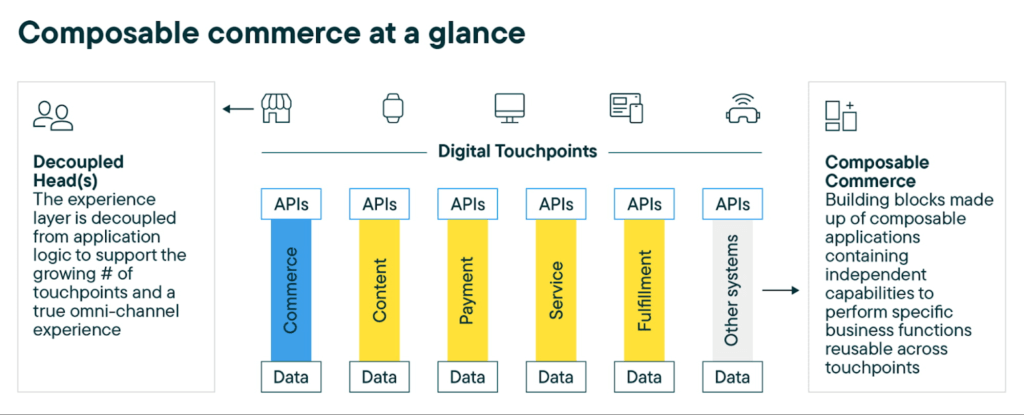
B2B firms will modernize their commerce backend, interoperating siloed systems like Configure Price Quote solutions (CPQs) for sales and enterprise resource planning solutions (ERPs) for order entry with an API-first and composable commerce stack. They will also pivot from on-premise deployments to cloud-native architectures as the baseline for auto-scaling capabilities instead of pre-provisioning online capacity during traffic peaks. That way, B2Bs can customize customer-centric experiences to boost revenue while reducing the complexity and cost of in-house IT infrastructure, as well as gaining operational efficiencies
B2Bs will maximize the cross-section of composable commerce and cloud-native infrastructure by leveraging a commerce backend like commercetools Composable Commerce hosted on Google Cloud. This combined solution provides commercetools’ ready-to-use components built as microservices and exposed as APIs, such as product information management (PIM) and unified cart, integrated through the Google Cloud Marketplace.
#2 Strong focus on data quality and personalization
Focusing on data quality continues to be a big trend in 2023. B2B buyers expect product, pricing, inventory and shipping data points to be accurate across every touchpoint so they can make better purchasing decisions, such as when to order products and calculate quantities.
With so many data points to capture throughout the customer journey — product, inventory, pricing and customer data — we’ll see more B2B companies reorganizing their vast information pools to elevate customer experiences. They will pivot to modular and API-first solutions, plus flexible data models, so they can break data silos from legacy monolithic platforms and access such data when needed.
We also expect to see more customer analytics to unlock data on buyer behavior. By understanding what customers see, click and add to their shopping lists, B2B businesses get valuable insights into how buyers behave, using this data in the shopping journey according to product interests. That way, it’s possible to offer personalized experiences across touchpoints without hassle.
“It is important for B2B companies to look at their data as if it is one of their products; invest in its upkeep and integrity while finding ways to continuously improve it. Using advanced analytics powered by AI and ML to identify patterns from large amounts of data, B2B companies can activate insights into customer decision journeys to maintain loyalty, personalize experiences to improve satisfaction and boost revenue, while also finding ways to optimize costs. For example, with analytics, enterprises can streamline spend to focus on the highest-performing channels and reduce waste.” — Carrie Tharp, Google Cloud VP of Retail and Consumer
With data-driven tools coming into play like Google Cloud’s Discovery AI, Recommendations AI and Vision Product Search connected with composable commerce, B2B players can boost customer analytics to personalize experiences, improve customer satisfaction and reduce churn.
#3 The B2B customer experience will be redesigned
B2B players are taking a page out of the B2C playbook to elevate experiences throughout the customer journey. While intense work needs to happen in the backend commerce engine, B2B players will also redesign their digital frontends. That means boosting website performance, while mobile responsiveness and personalization will be at the forefront of these advanced digital initiatives.
More than ever, B2B companies are looking for digital storefronts delivered as progressive web applications (PWAs) for optimized performance and responsiveness across devices, as well as fast-loading and responsive experiences to boost your digital presence, SEO rankings and conversion rate. B2Bs can further streamline frontend development with solutions natively connecting to Google Cloud Marketplace, which supports a variety of storefront providers, including commercetools Frontend.
Leveraging Google Cloud’s unique capabilities, such as PWA web app development, Google Cloud Discovery AI solutions that include Retail Search and Vision API Product Search, among many others, B2B companies are well positioned to boost digital commerce in the years to come.
What’s next in 2023?
2022 was already a turbulent year; for better or worse, 2023 is expected to have a similar fate. For B2Bs, even the ones with tight budgets, investing in digital commerce can help future-proof businesses for whatever’s happening this year. To dive deeper into all predictions and insights by commercetools in collaboration with Google Cloud, read the guide Pivotal Trends and Predictions in B2B Digital Commerce in 2023.
How Can Brands Evolve in Post-pandemic Era amid Changing Consumer Behavior Patterns

3663
Of your peers have already read this article.
1:30 Minutes
The most insightful time you'll spend today!
2020 saw an unprecedented change in consumer behaviour around the world, with shoppers finding new ways of discovering, evaluating and buying products. This has created fresh expectations for both brands and retailers to drive consumer closeness, embrace the digital moment and transform their operations to be more agile and sustainable. These themes have been top of mind in my conversations with our CPG customers, and set the tone at Google Cloud Summit for Retail and Consumer Goods, which concluded this week. I couldn’t be more proud of our team and thankful for our customers that supported us by participating in our sessions and attending the event.
I joined Google Cloud in January 2021 after a long career in the CPG industry, and as I shared in my CPG keynote at the summit, I am thrilled to be helping bring the power of Google to drive industry innovation in CPG. At Google we call this ‘new normal’ the transformation cloud era, where we’re working with customers who want to not just save money on storage or compute, but to use cloud and digital technologies to drive agility across their business. I also call it the era of ‘consumer switching’, because Covid-19 has accelerated the likelihood of consumers to switch brands or the way they shop. Some of these changes are still happening; over 40% shoppers in a recent Google survey reported that in March 2021 they changed brands or shopped online for something they were previously buying in store.
At Google, we have an amazing team of strategists who have been researching, observing, and analyzing the many facets of consumer behavior over the last few years. In the opening keynote at the Summit Capturing the Hearts and Minds of Today’s Consumers, Google’s Human Truths Team kicked off the Retail & Consumer Goods summit by sharing some of their consumer insights, including what behavior patterns they think will “stick” as we move into a post-pandemic world. I think these insights are especially relevant for brands, as they speak to some of our latest findings on the CPG shopper’s mindset.
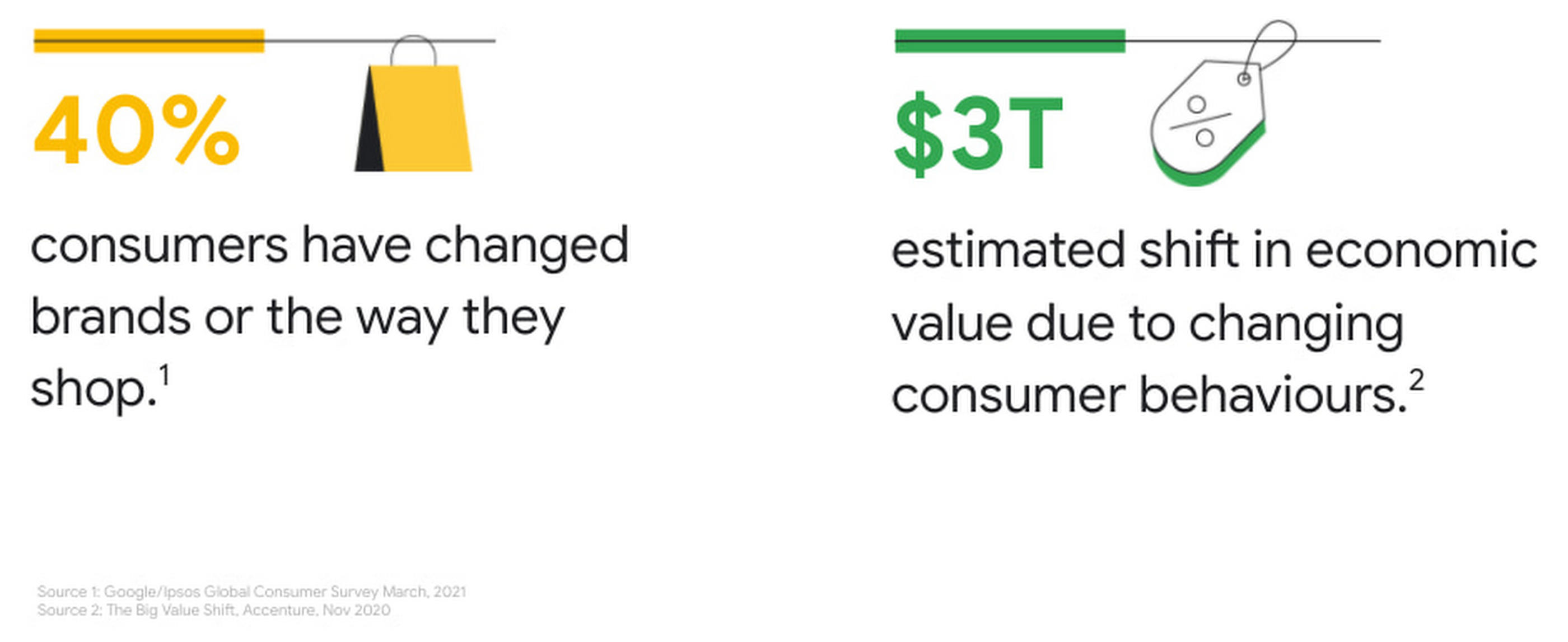
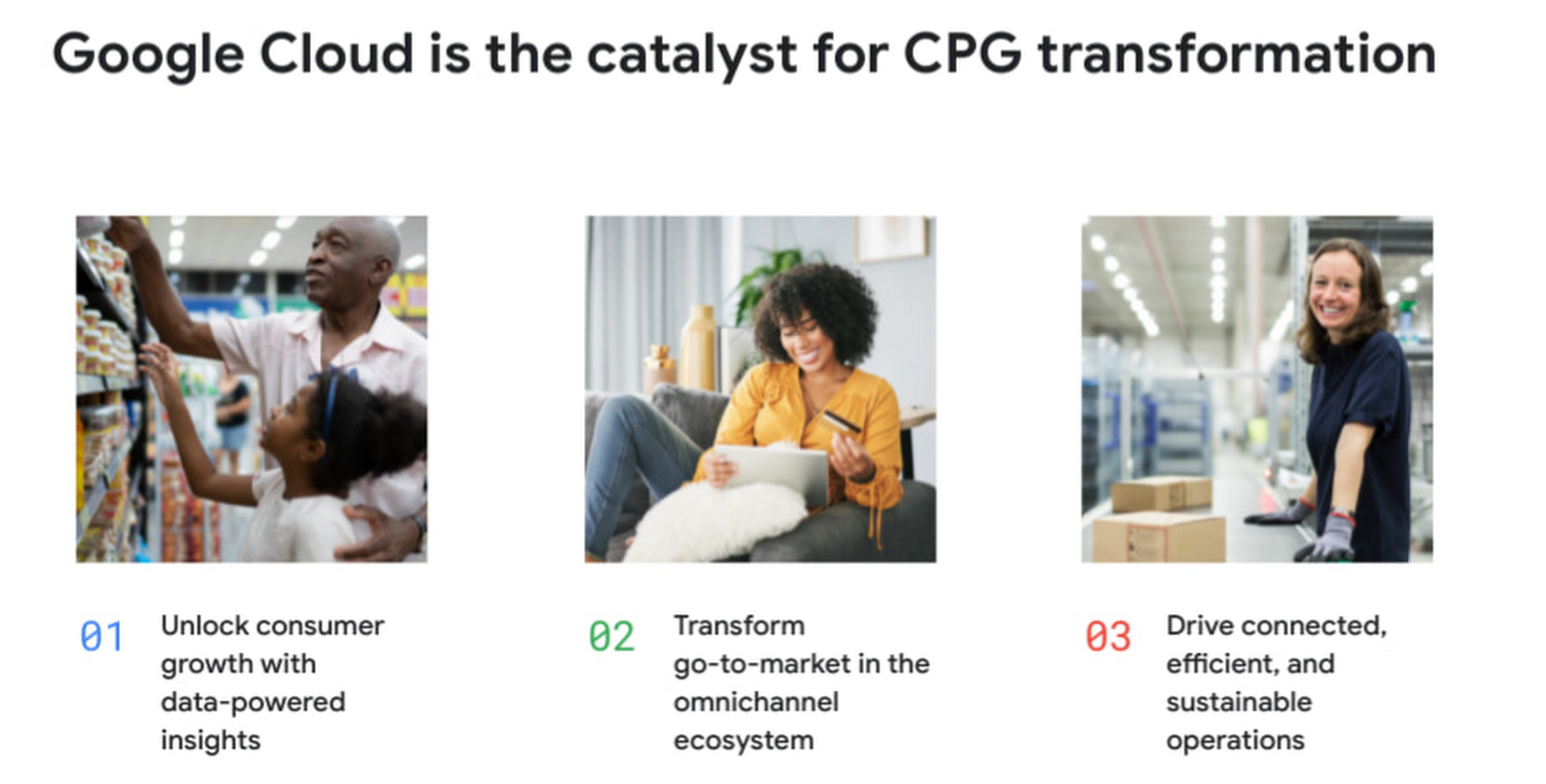
Accenture estimates that there could be a 3 trillion dollar shift in value between companies as a result of consumers shifting brands and behaviours. While it is not known who the winners of the shift will be, one thing is certain – those who will be able to leverage data and analytics fastest will benefit the most from these times of rapid change. I shared some of the implications for the CPG industry in my keynote How to grow brands in times of rapid change along with the three key areas in which Google cloud is helping CPG companies drive brand success:
- Unlocking consumer growth with data powered insights
- Transforming go-to-market in the omnichannel ecosystem
- Driving connected, efficient, and sustainable operations
Let’s take a quick look at each of them:
Unlocking consumer growth with data-powered insights
The digital marketing ecosystem is transforming for a privacy centric world, and brands are seeing a direct impact in marketing effectiveness. As the CPG industry becomes more consumer-centric and shifts more toward direct-to-consumer (D2C) business models, acquiring and activating consented first-party consumer data presents a clear opportunity to capitalize on new consumer demands.
As a result, CPGs are turning to consumer data platforms (CDPs) to help them unify, manage, enrich, and secure all of their disparate data from different marketing tools, website analytics, email campaigns, loyalty programs, and more. Google Cloud and our ecosystem of partners can help CPGs build a privacy-centric CDP which brings together all their customer and marketing data into a modern data warehouse, with built-in predictive data visualization tools and models. With a CDP built on Google Cloud, you can integrate data from Google Marketing Platform to drive predictive marketing and media effectiveness. And with pre-built connectors you can also easily integrate non-Google media and data from other enterprise platforms like SAP and Oracle to leverage consumer data for more integrated decision making. Democratize access to data across the organization with our Business Intelligence tool Looker to enable faster decisions in real-time from marketing to supply chain to product innovation.
At the Retail & CPG Summit we shared how retailers and brands can drive consumer closeness in a privacy-centric world featuring Procter & Gamble’s experience building and activating consumer data in a privacy-safe way to serve consumers better and maximize marketing effectiveness and drive growth across their business. And in a demo, Constellation Brands shared how they’re leveraging real-time data from several commercial sources using Looker to unpack insights and develop action plans.
Transforming go-to-market in the omnichannel ecosystem
Amidst COVID-19 restrictions and rolling lockdowns, ecommerce activity has surged past a point of no return. Direct to consumer (D2C) or digitally native brands were able to minimize consumers switching during the pandemic by offering a great online experience. While in-person shopping remains important, consumers are expecting more digital and omnichannel experiences and many will continue to explore new brands and purchase online. CPGs that want to maintain their market leadership can no longer afford to ignore the key role omnichannel capabilities will play in capturing the attention of both retailers and consumers. Even if D2C sales are not a big portion of your business, you will benefit from first-party data that can help you drive insights and product innovation.
CPG brands want to transform their older, clunky ordering processes into modern digital shopping experiences. Re-platforming legacy solutions on Google Cloud not only accelerates application innovation, but also makes it easier to quickly launch new features and products. At Google Cloud we have transformed ecommerce for large D2C brands and traditional retailers, so we know what a best in class D2C experience looks like. And we can bring it to your brands. We already help some of the biggest brands in retail modernize ecommerce and enhance product discovery with solutions like Visual Search and Recommendations AI. All of these can help you build a best in class omni channel presence for your brands.
We had several sessions on improving your omni channel experience, including
Why search abandonment is the metric that matters featuring Macy’s and Conversational Commerce with Google with Albertsons, where we shared how Google’s conversational experiences can help consumers message businesses from wherever they are, and whenever they need them.
Driving connected, efficient, and sustainable operations
The superpowers of AI/ML are not just for marketing. Did you know that research from MIT and Google Cloud has found companies that use AI/ML can drive 2x more data-driven decisions, 5x faster decision making, and 3x faster execution? By connecting your operations in real time with demand signals like search, trends, weather, mobility and supercharging this data with AI and ML, you can make smarter and quicker business decisions. For example, you can use search trends to drive demand forecasting and ramp up manufacturing for popular products.
Google Cloud can help you modernize legacy business applications by migrating them to the cloud and using AI/ML and smart analytics to drive business outcomes. Take SAP for example – a Forrester study found that modernizing SAP with Google not only resulted in 56% more efficient IT teams – it also generated 160% 3-year ROI.
SAP data on Google Cloud breaks down silos across SAP, marketing, manufacturing systems, and external data sources for next-level intelligent operations. For example, with SAP and Google Cloud, you can combine product, media, CRM, digital commerce and site data from SAP and non-SAP sources to uncover stronger consumer insights and fuel product discovery along the path to purchase. You can merge SAP product and sales data with consumer, market data and Google geo trends to drive targeted promotion outcomes, maximizing the ROI of promotional dollars across retail channels. You can also integrate supply chain and manufacturing data from SAP systems with consumer, marketing and Google geo market data to improve demand forecasting and optimize supply chain logistics. The possibilities are endless. This is why we describe SAP modernization as The Gift That Keeps On Giving. Check out the session on SAP from the Summit and hear from Rodan + Fields on their experience of modernizing SAP on Google Cloud.
Another solution that excites me is Vertex AI, which transforms the demand forecasting process. Traditional demand forecasting accuracy is a challenge for most CPGs. Current forecasting methods do not take into account granular factors that impact demand, like local weather, demographics, or unforeseen events. With our recently launched Vertex Forecast, Google is making it much easier to start using cutting-edge machine learning models for demand forecasting. In our session Demand Forecasting: Time for Intelligence, Not Intuition featuring American Eagle Outfitters, we share how you can adopt a data science approach to demand forecasting that’s customized to your unique needs.
CPG organizations come to Google for help solving their toughest problems, whether it be driving new consumer growth, unlocking new routes to market, or building connected, sustainable operations. And we bring the best of Google: innovation, culture, infrastructure, AI/ML, and a deep understanding of consumer behaviour to help them build best-in-class brands.
I’d like to end with a topic that’s very close to my heart. This is around Solving for Sustainability in Retail and Consumer Goods. Our research shows that 62% of shoppers cared about at least one sustainability aspect when purchasing online in 2020. In addition, the events of the past year have triggered consumers to re-evaluate their relationships with brands and prioritize those that are more sustainable in the context of the pandemic. Watch this session to learn more about how retailers and consumer goods companies can leverage technology, data, and machine learning to help make sustainability a core part of the recovery.
All our session content is available on demand. Ready to learn more about how we’re helping CPG brands and manufacturers drive results? Learn more about Google Cloud’s consumer packaged good solutions and reach out to your Google Cloud sales executive to set up a deeper conversation on how we can help you grow your brands today and in the future.
Attract Investor Funding by Harnessing the Power of Cloud Operations, Billing, and Customer Care

1398
Of your peers have already read this article.
4:30 Minutes
The most insightful time you'll spend today!
More and more startups are choosing to build their business on Google Cloud, and if yours is one of them — welcome! And even though Google Cloud is easy to use, there’s still a lot to learn, starting with how to create and activate your account, and how to create projects, folders, and organizations as part of Google Cloud’s resource hierarchy. If you prefer, you can also watch our video on how to get started with Google Cloud.
Once you’ve mastered those concepts, you’re ready to learn how to get the most out of your investment in Google Cloud. In this blog, we’ll show you how to manage and monitor your cloud resources with Google Cloud’s operations suite, administer your billing with Cloud Billing, and improve the support you receive with Google Cloud Customer Care. Whether you’re new to Google Cloud or an experienced user, these services will help improve your experience.
Let’s get started!
Improve the performance and reliability of your applications with the operations suite
Sometimes you want to check how your deployment is behaving, or if there is something happening with your server, database, or application that is affecting your customers. With so many tools to check, finding and solving the issue can become overwhelming very quickly. This is where Google Cloud’s operations suite comes in.
This suite of products for integrated monitoring, logging, and tracing managed services for applications and systems running on Google Cloud and beyond. It can help you visualize and monitor incidents with dashboards and Metrics Explorer, manage and analyze log data in real-time all in one place with Cloud Logging, visualize metrics at scale with Cloud Monitoring, manage latency with Cloud Trace, and perform performance and cost management with Cloud Profiler.
Learn more about the operations suite in the video below:
Manage budgets and alerts with Cloud Billing
Google Cloud billing management is easier than you might think. Google Cloud charges for compute resources monthly on a consumption basis, which is different from the traditional upfront purchase model. With the right tools and resources, you can more easily manage your costs and optimize your use of Google Cloud resources.
One of the most important things to do is to set up billing and alerts. This will help you avoid unexpected charges and ensure that you are only paying for the resources you use. You can also use budgets and alerts to track your costs and help ensure that you are staying within your budget.
You can also view your costs through console billing reports, monthly invoices or build customized dashboards on BigQuery, Google Data Studio, or a BI tool of your preference. This allows you to see where your costs come from and identify areas where you can save money. You can also use cost management to optimize your use of Google Cloud resources and get the most out of your investment.
Finally, Google Cloud offers a variety of discounts and optimization options. These can help you save money on your overall costs. For example, you can get a discount if you commit to using Google Cloud for a certain period of time. You can also save money by using preemptible VMs, which are VMs that are available at a lower price but can be terminated at any time.
Google Cloud Customer Care
To meet customer needs and deliver a better experience, we’ve reenvisioned our Customer Care portfolio, a scalable set of offerings built with your needs at the center, so you can simplify and streamline your support experience.
Choose from the core offerings:
- Basic – the support tier you receive when you sign up on Google Cloud. You can use this at no cost but support is offered for billing issues only.
- Standard – simple, flexible way to ensure that your workloads run smoothly on Google Cloud. Standard enables you to receive technical help from Google experts with a four hour response time and 8 hours response time during 5 days a week availability.
- Enhanced – rapid response times and additional services to boost your productivity and help you run in Google Cloud efficiently. There is both case and phone support for technical issues, with a one-hour response time. There is 24/5 availability overall with 24/7 for critical issues. You can also have add-ons or value-add services like Technical Account Adviser Service and Event management.
- Premium – the highest value support offering, supplying incredibly fast response times, a named Technical Account Manager, Customer Aware support and additional services. There is case and phone support for technical issues and also third-party technology support, with a 15-minute response time and a 24/5 availability overall with 24/7 for critical issues.
Watch the video to find out how to purchase support, create support cases and learn more about support.
Supercharge your growth with the Google for Startups Cloud Program
Growing a startup requires technology that can keep up with and enhance your ideas. The Google for Startups Cloud Program provides the tech you need to help develop better software and deliver innovative experiences with confidence. At the same time, you’ll help boost your team’s capabilities with expert cloud guidance, Google Cloud credits, training opportunities, and more.
The program has two tiers:
- Start: for pre-seed startups that have not yet received equity funding. Get up to $2,000 USD in Google Cloud credit that’s valid for two years toward Google Cloud services and even toward a Cloud Customer Care plan with unlimited access to technical support, networking opportunities with the global Google Cloud Startup Community, and more.
- Scale: for seed to series A startups with verified equity funding. Get Google Cloud and Firebase costs covered up to $100,000 USD a year for your first two years, unlimited access to technical support when credits are applied to a Cloud Customer Care plan, partnerships with Google Cloud Startup Customer Engineers and a dedicated Startup Success Manager, networking opportunities with the global Google Cloud Startup Community, co-marketing for select startups, and more.
Once enrolled, Google startup experts will recommend Google products and services that can help your startup grow in the cloud. Learn more about the Google for Startups program, eligibility criteria, credit usage and migration incentives in the our Startup Programs video linked down below.
That’s a wrap!
Let’s recap: The operations suite includes tools to monitor incidents, analyze log data in real-time, manage latency, and more. Cloud Billing offers billing management tools and resources to help you save costs and make the most of your resources. If you need help, Cloud Customer Care services are available to streamline your support experience. Also, if you’re a startup, don’t forget to check the Google for Startups Cloud Program!
The Google Cloud Technical Guides for Startups series has many detailed videos and handbooks to support you on all steps of your startup growth journey. Check out our full playlist on the Google Cloud Tech channel and website. Don’t forget to subscribe to stay up to date.
See you in the cloud!
More Relevant Stories for Your Company

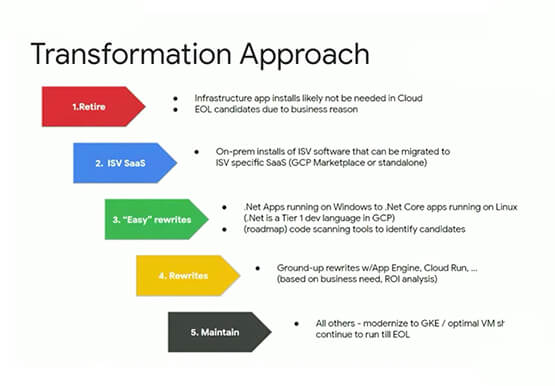

Modernize your Windows Workloads by Migrating them to Google Cloud
Google has plenty to offer when it comes to migrating and modernizing traditional enterprise Windows workloads to the cloud. Explore different approaches for re-hosting, modernizing, and transforming Windows applications, and the benefits of moving to Google Cloud. Learn from demos on some of the cutting-edge technologies that can offload some

The Fantastic Story of How BMG Enables a Micropayments Strategy So Music Artists Get Paid
The music industry is rapidly changing. Only 20 years ago, the availability of music and the infrastructure that was required to make an album a sales success were incredibly complex and expensive. With the decline of physical sales and a fundamental shift to digital, music streaming now accounts for more

Serverless for Startups, the Best Way to Succeed: Expert Says
As Google Cloud has become a choice for more startups, I’ve experienced an increase in founders asking how they should think about cloud services. Though each startup is different and requirements may vary across industries and regions, I’ve seen a few core best practices that help startups to succeed—as well as several

The Cloud-First Imperative To Accelerate Digital Transformation In Retail
In a study by Forrester Consulting of 60 business and technology decision makers and influencers from Indian retail organizations, it is found that 2 in 3 organizations are planning to increase their cloud spending by 5% or more in the next 12 months. According to the study, public cloud platforms
