






Building APIs To Delight Customers: An In-depth Guide for Indian Businesses
READ FULL INTRODOWNLOAD AGAIN6358
Of your peers have already downloaded this article
3:30 Minutes
The most insightful time you'll spend today!
Google Extends Support for Windows Server Containers on Anthos for Faster App Modernization and Consistent Dev Experience

5592
Of your peers have already read this article.
3:00 Minutes
The most insightful time you'll spend today!
Today, many applications in organizations’ data centers run on Windows Server. Modernizing these traditional Windows apps onto Kubernetes promises a host of benefits: a consistent platform across environments, better portability, scalability, availability, simplified management and speed of deployment, just to name a few. But how? Rewriting traditional .NET applications to run on Linux with .NET Core can be challenging and time-consuming. There is, however, a lower-toil, more developer friendly option.
Last year, we announced support for Windows Server containers running on Google Kubernetes Engine (GKE), our cloud-based managed Kubernetes service, which lets you take the advantage of containers without porting your apps to .NET core or rewriting them for Linux. Today, we’re going a step further with support for Windows Server containers on Anthos clusters on VMware in your on-premises environment. Now available in preview, you can consolidate all your Windows operations across on-prem and Google Cloud.
Bringing Windows Server support to our family of Kubernetes-based services—GKE running on Google Cloud, and Anthos everywhere—with the same experience, lets you modernize apps faster and achieve a consistent development and deployment experience across hybrid and cloud environments. Further, by running Windows and Linux workloads side by side, you get operational consistency and efficiency—no need to have multiple teams specializing in different tooling or platforms to manage different workloads. The single-pane-of-glass view and the ability to manage policies from a central control plane simplifies the management experience, while bin packing multiple Windows applications drives better resource utilization, leading to infrastructure and license savings.
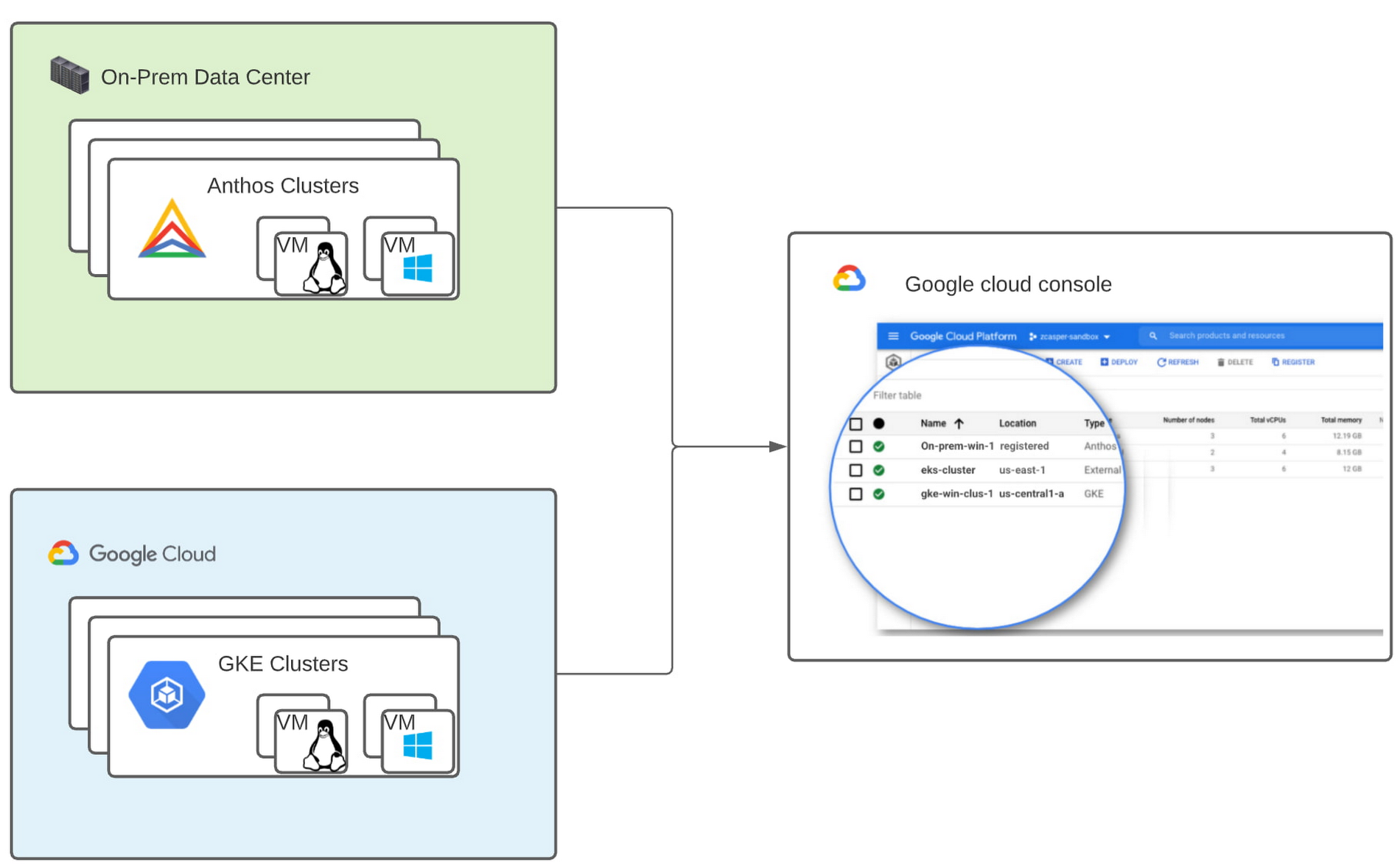
With all these benefits, it’s no surprise that customers such as Thales, a French multinational firm specializing in aerospace and security services, have been able to reap significant benefits by moving Windows applications to GKE.
“We moved our Windows applications from VMs to Windows containers on GKE and now have a unified mechanism for Linux and Windows-based application management, scaling, logging, and monitoring. Earlier, setting up these applications in VMs and configuring them for high availability used to take up to a week, and the applications were not easily scalable,” said Najam Siddiqui, Solutions Architect at Thales. “Now with GKE, the setup takes only a few minutes. GKE’s automatic scaling and built-in resiliency features make scaling and high-availability setup seamless. Also, manually maintaining the VMs and applying security patches used to be tedious, which is now handled by GKE.”
Let’s take a deeper look at the architecture that lets you run your Windows container-based workloads on-prem.
Windows Server running on-prem with Anthos
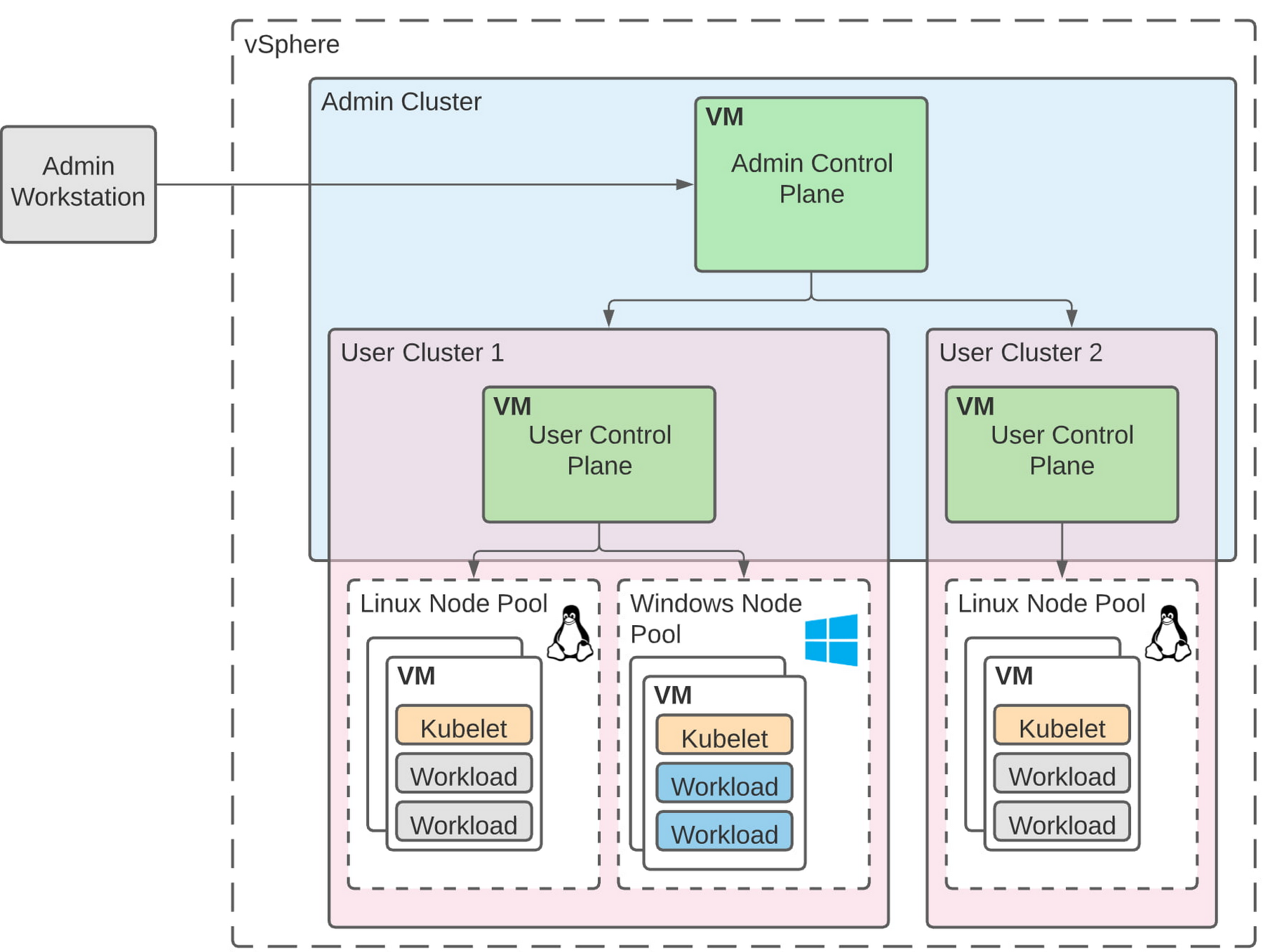
The diagram below illustrates the high-level architecture of running Windows container-based workloads in an on-prem GKE cluster with Anthos. Windows server node-pools can be added to an existing or new Anthos cluster. Kubelet and Kube-proxy run natively on Windows nodes, allowing you to run mixed Windows and Linux containers in the same cluster. The admin cluster and the user cluster control plane continue to be Linux-based, providing you a consistent orchestration experience and management ease across Windows and Linux workloads.
Get started today
When considering modernizing your on-prem Windows estate, we recommend running Windows Server containers on Anthos in your own data center. If you are new to Anthos, the Anthos getting started page and the Coursera course on Architecting Hybrid Cloud with Anthos are good places to start. You can also find detailed documentation on our website, and our partners are eager to help you with any questions related to the published solutions, as is the GCP sales team. And as always, please don’t hesitate to reach out to us at anthos-onprem-windows@google.com if you have any feedback or need help unblocking your use case.
New to Cloud Functions? Here’s What You Need to Learn

3277
Of your peers have already read this article.
1:00 Minutes
The most insightful time you'll spend today!
Cloud Functions is a fully managed event-driven serverless function-as-a-service (FaaS). It is a small piece of code that runs in response to an event. Because it is fully managed, developers can just write the code and deploy it without worrying about managing the servers or scaling up/down with traffic spikes. It is also fully integrated with Cloud Operations for observability and diagnosis. Cloud Functions is based on an open source FaaS framework which makes it easy to migrate and debug locally.
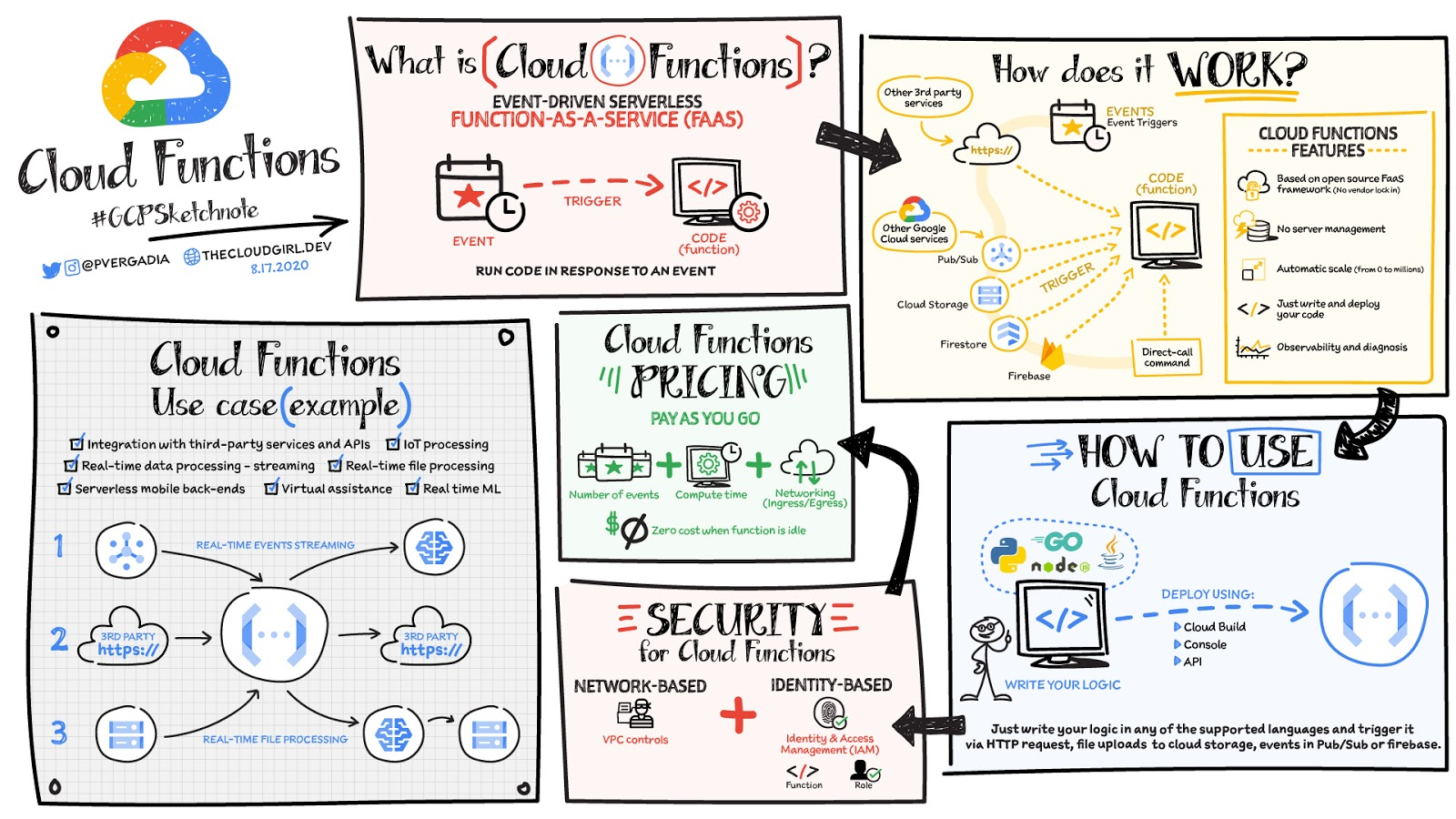
To use Cloud Functions, just write the logic in any of the supported languages (Go, Python, Java, Node.js, PHP, Ruby, .NET), deploy it using the console, API or Cloud SDK and then trigger it via HTTP(s) request from any service, for example: file uploads to Cloud Storage, events in Pub/Sub or Firebase, or even direct call via Command Line Interface CLI.
There is a generous free tier and the pricing is based on number of events, compute time, memory and ingress/egress requests and costs nothing if the function is idle. For security, using Identity and Access Management IAM you can define which services or personnel can access the function and using the VPC controls you can define network based access.
Cloud Functions use cases
Some Cloud Functions use cases include:
- Integration with third-party services and APIs
- Asynchronous workloads like lightweight ETL
- Lightweight APIs and webhooks
- IoT processing and update of the sensors/devices in the field
- Real-time file processing for use cases such as media transcoding or resizing as soon as the file is uploaded in Google Cloud Storage.
- Real-time ML solutions for use cases such as media translation or image recognition for files uploaded in GCS.
- Backend for chat applications and mobile apps.
Firebase Functions and Cloud Functions, are they different?
If you are a Firebase developer, you’d probably use Firebase Functions. Those are created from the Firebase dashboard / website. Both Cloud Functions and Firebase Functions can do the same things, they just have slightly different signatures and slightly different ways of deploying. Firebase Functions have a local emulator, which Cloud Functions uses the Functions Framework.
For a more in-depth look into Cloud Functions check out the documentation. Once you’ve got your Function up and running, check out some tips and tricks.https://www.youtube.com/embed/LTMChfWBHb0?enablejsapi=1&
For more #GCPSketchnote, follow the GitHub repo. For similar cloud content follow me on Twitter @pvergadia and keep an eye out on thecloudgirl.dev
Container Platforms on Google Cloud Maximize Developer Efficiency, Speed-up Time to Market and Eliminate IT Overhead!

3374
Of your peers have already read this article.
2:30 Minutes
The most insightful time you'll spend today!
Every tech company and growing startup faces pressure to make efficient use of technical talent. Increasingly, this means determining if and how the cloud can help this talent focus on things like product development instead of IT overhead. These challenges are the starting place for our new whitepaper “The future of infrastructure will be containerized,” which is informed by our work with tech companies and startups who’ve chosen Google Cloud across a range of industries, from healthcare and manufacturing to software, fintech and e-commerce.
For example, if your tech company or startup is in the cloud but spends lots of resources on custom tooling and maintenance, you’re almost certainly under-leveraging what the cloud can do. You might also be locking yourself into an architecture that won’t let you easily adapt or change things as your needs evolve.
The whitepaper examines these challenges to growth and explains how tech companies and startups can use managed container platforms in the cloud to maximize developer efficiency, accelerate time to market, and eliminate IT management that doesn’t help differentiate the business. In this blog post, we’ll explore one element of this discussion: infrastructure management. Be sure to check out the full whitepaper for all the details.
The case for containers and Kubernetes
Compared to previous virtualization technologies, containers are more lightweight, faster, more portable, and easier to manage—and a managed container platform like Kubernetes can extend these advantages even further. That’s why we’re seeing a massive shift to containers and Kubernetes.
Simply put, infrastructure and technical debt can slow down tech companies and startups. Traditional virtual machines (VMs) are neither simple to manage nor likely to maximize your workloads. Maximizing the cloud isn’t just about renting cheap resources—it’s about embracing modern, more efficient ways of operating that let businesses spend more time serving customers.
VMs virtualize at the hardware level and thus require higher degrees of management, less portability, and less consistent and efficient scaling. Containers, in contrast, virtualize further up the stack, at the OS level, meaning they contain the libraries and dependencies needed to run apps and services but are significantly more lightweight, easier to manage, and can accommodate modern operating models. VMs aren’t built for the speed at which today’s tech companies and startups need to move, but with a robust container orchestration like Kubernetes, startups can leverage proven patterns for running reliable, secure infrastructure at scale.
Kubernetes is open source and platform-agnostic, offering all the common tooling out of the box to secure and speed up each stage of the build-and-deploy life cycle. Everything is automated, with the complexity abstracted away—the vast majority of infrastructure-as-code is eliminated as the platform shifts to infrastructure-as-data, with users able to tell Kubernetes what they want rather than writing code to tell it what to do. In terms of both time saved in the present and flexibility preserved for the future, Kubernetes can be vastly more valuable than proprietary tech stacks or even a management-heavy implementation of VMs running in the cloud.
Kuberetes also lets tech companies and startups reduce management overhead according to their needs, with many different approaches available for different workloads:
- Kubernetes gives traditional workloads the benefits of a modern platform by letting organizations separate apps from VMs and put them in containers.
- Managed computing platforms turn cloud services into platforms-as-a-service, giving tech companies and startups the power and flexibility of containers and the convenience of serverless. There’s no server, no cluster configuration, and no maintenance, which means organizations can dramatically reduce overhead labor without compromising control.
- For workloads that don’t require much control over cluster configuration, tech companies and startups can use Google Kubernetes Engine (GKE) in Autopilot mode to provision clusters, while paying for only the workload, not the cluster. In this way, they can eliminate cluster administration while optimizing security and saving potentially substantial amounts of money.
- For more cloud-native applications, serverless options like Cloud Run, eliminate underlying infrastructure and serve as the end-to-end host for applications, data, and even analysis. A serverless platform lets organizations start running containers with minimal complexity in a fully-managed environment with security, performance, scalability, and best practices baked in.
Accelerating time to market while preserving future freedom
Tech company and startup leaders should also consider the value of the Kubernetes community and its surrounding ecosystem, as its stable innovation defines today’s industry standards and best practices. The technology benefits in terms of speed, complexity, and labor are clear when it comes to containers, but as an open-source platform with many active contributors, it is also an onramp to future architecture innovations. Being cutting-edge and developer-oriented, Kubernetes can also help organizations to attract top technical talent, in addition to letting them empower developers they already employ. And not to be neglected, because Kubernetes is open source, it offers transparency in proprietary solutions, limiting the risks of lockin. Top to bottom, it provides a framework for tech companies and startups to bring innovations to their customers, faster. To learn more, read the full whitepaper or visit the Google Cloud for startups and tech companies page.
Release of Go 1.18 is A New Milestone for Development of Secure Apps

3200
Of your peers have already read this article.
1:30 Minutes
The most insightful time you'll spend today!
On March 15th, the Go team announced Go 1.18 GA, the latest release of the Go programming language. The culmination of over a decade of design delivers the features our developers demanded: generics, fuzzing, and module workspaces. With this release, Go becomes the first major language to integrate fuzz testing into its core toolchain without using third-party support, further establishing Go as a preferred language for developing secure applications.
Go was created at Google in 2007, designed to help developers build fast, reliable, and secure software. Unlike traditional languages, Go was built for the modern multi-core computing world. Go has emerged as a modern language for developing cloud applications, services, and infrastructure. Today Go powers several of Google’s largest products, and is used by many customers to scale their businesses. Organizations big and small love Go and the community of Go developers, known as “gophers” has grown into a global network with over 2 million users worldwide.
Using the power of Go in the Cloud
When looking at the public repos, over 75% of CNCF projects including Kubernetes are written in Go and 10% of developers are writing in Go worldwide (as of May 2021). Google delivers high performance infrastructure to run key, cloud native, Open Source projects. Our modern cloud infrastructure is based on Kubernetes at its core and our strong support for Istio and Knative have formed the base of some of our leading services like Google Kubernetes Engine (GKE), our managed application platform with Anthos, Cloud Functions, and Cloud Run. Google uses Go extensively for a wide range of applications from our indexing platform that powers Google Search, to the server side optimizations that power Chrome’s 1B+ users, to the infrastructure on which Google cloud is built.
Release Highlights
With this new release of Go 1.18, Generics are the biggest change to Go since the language was created. Go developers told us that they feel that Go lacks critical features, with generics being the main missing piece. With Go 1.18, new and existing Go developers can take advantage of the productivity, performance, and maintenance benefits that generics can bring. We’ve already begun to see the new kinds of libraries and projects gophers are building with generics in its short beta period, and expect this creativity to grow as time goes on.
This Go release also brings native support for fuzzing. Fuzzing is a type of vulnerability testing that throws arbitrary data at a piece of software to expose unknown errors and is emerging as a common testing scheme in enterprise development. Go is now the first major language to provide fuzzing support with no third-party integrations necessary, allowing developers to start building secure software with minimal additional cost. Go’s innovative approach to fuzzing can provide not only security for the current code but also ongoing protection as code and dependencies evolve. With attacks on software becoming more common and complex, vulnerability detection can be a critical part of the enterprise development lifecycle, and Go’s fuzzing capabilities catch vulnerabilities earlier in the lifecycle.
Build securely using Go
At Google we are helping to make Open Source software secure. Open source software is a connective tissue for much of the online world. At Google, we’ve been working to raise awareness of the state of open source security and are committed to helping secure the software supply chain for organizations. Go has been designed to create secure applications, helping to minimize risk as much as possible. Go applications compile down to a single binary without local dependencies. It’s not uncommon to see an application built using only the standard library, or only a couple well-vetted Go dependencies. Go’s dependency management uses tamper-evident transparency log, with built in tooling that helps ensure your dependencies are what you can expect. Go has native encryption, which is used across much of the internet, including key components of Google. Go even supports distroless containers, where there are zero local dependencies to worry about. Google Cloud products like Cloud Build, for CI/CDand Artifact Registry, for container management, and have direct access to Go’s vulnerability database and can provide you instant warnings about security threats.
“At Google we are committed to helping to secure the online infrastructure and applications upon which the world depends. A critical aspect of this mission is being able to understand and verify the security of open source dependency chains. The 1.18 release of Go is an important step towards helping to ensure that developers are able to build secure applications, understand risk when vulnerabilities are discovered, and reduce the impact of cybersecurity attacks” said Eric Brewer, VP Infrastructure, Google Fellow
This launch is a significant milestone for Go that helps developers from around the world build more performant and secure applications that run on any infrastructure. For more information on this release and how to get started with Go, please visit.
Lending DocAI Shortens Borrowers’ Journey on Roostify

11810
Of your peers have already read this article.
3:00 Minutes
The most insightful time you'll spend today!
The home lending journey entails processing an immense number of documents daily from hundreds of thousands of borrowers. Currently, home lending document processing relies on some outdated digital models and a high dependency on manual labor, resulting in slow processing times and higher origination costs. Scaling a business that sorts through millions of documents daily, while increasing efficacy and accuracy, is no small feat. When it comes to applying for a mortgage loan, consumers expect a digital experience that’s as good as the in-person one. Roostify simplifies the home lending journey for lenders and their customers.
No time to spare: Overcoming document processing challenges with AI
Roostify provides enterprise cloud applications for mortgage and home lenders. In order to empower its customers to deliver a better, more personalized lending experience, they needed to automate and scale their in-house document parsing functionality.
As a key component of its document intelligence service, Roostify is leveraging Google Cloud’s Lending DocAI machine learning platform to automate processing documents required during a home loan application process, such as tax returns or bank statements with multi-language support. This partnership delivers data capture at scale, enabling Roostify customers to automatically identify document types from the uploaded file and to extract relevant entities such as wages, tax liabilities, names, and ID numbers for further processing, and make things move faster in the cumbersome lending process.
Roostify’s solutions leverage Google Cloud’s Lending DocAI, which is built on the recently announced Document AI platform, a unified console for document processing. Customers can easily create and customize all the specialized parsers (e.g., mortgage lending documents and tax returns parsers) on the platform without the need to perform additional data mapping or training. All Google Cloud’s specialized parsers are fine-tuned to achieve industry-leading accuracy, helping customers and partners confidently unlock insights from documents with machine learning. Learn more about the solution from the GA launch blog and the overview video.
Integrating Lending DocAI’s intelligent document processing capabilities into the Roostify platform means more innovation for their customers and tangible results: faster loan processing times, fewer document intake errors, and lower origination costs. Additional support in Google Lending DAI for other languages and more documents like global Know Your Customer (KYC) documents or payroll reports is in the near future.
Full integration of AI solutions
Working together with Roostify’s platform team, we were able to help them solve their document processing challenge through integration of various GCP products such as Lending DocAI (LDAI), Data Loss Prevention (DLP) for redacting sensitive data, BigQuery for data warehousing and analytics, and Firestore for API status. To make it very safe and secure, all data was encrypted end-to-end at Rest and in Transit. LDAI won’t require any training data to process. It is an easy plug and play API.
Here is a sneak peek in the high level deployment architecture for LDAI in Roostify environment:

Here are the steps for processing data:
- Receives document processing request from the client.
- API Function directs requests to the pre-processing service. For Async requests a processing ID is generated and returned to the caller.
- Pre-processing service sends the request for further processing (Long/short PDF conversion), calling other microservices and receives back the responses. Any error in the response received is then sent to the response processing service.
- If the response is synchronous, the pre-processing service directs it to the LDAI Invoker service.
- If the response is asynchronous, the pre-processing service feeds it into the Cloud Pub/Sub service.
- Cloud Pub/Sub service feeds the response back to the LDAI Invoker service.
- LDAI Invoker service routes the request to the Google LDAI API for classification if there are multiple pages in the document.
- Document will be split based on LDAI response and then saved in a GCS bucket for temporary storage.
- LDAI entity interface for single page processing and then LDAI Invoker sends LDAI results to LDAI Response Processing
- If a request is a synchronous request the LDAI Response Processor sends results to the API Function so that it can complete the synchronous call and respond to the rConnect caller.
- If the request is an asynchronous request the LDAI Response Processor will respond to the caller’s webhook and complete the transaction.
- Finally, Data stored in the GCP bucket will be deleted.
All the responses that come from the LDAI API can optionally feed into BigQuery via the Response Processor, after parsing it through Data Loss Prevention (DLP) API to redact the PII/sensitive information. Throughout the processing of both asynchronous and synchronous requests all transactions are logged using Cloud Logging. For asynchronous transactions, the state is maintained throughout the process using Cloud Firestore.
Roostify currently uses this technology to power two different solutions: Roostify Document Intelligence and Roostify Beyond™. Roostify Document Intelligence is a real-time document capture, classification, and data extraction solution built for home lenders. It ingests documents uploaded by borrowers and loan officers, identifies the relevant documents, and extracts and classifies key information. Roostify Document Intelligence is available as a standalone API service to any home lender with any digital lending infrastructure already in place.
Roostify Beyond™ is a robust suite of AI-powered solutions that enables home lenders to create intelligent experiences from start to close. It combines powerful data, insightful analytics, and meaningful visualization to streamline the underwriting process. Roostify Beyond™ is currently available only to Roostify customers as part of an Early Adopter program and will be rolled out to the market later this year.


Through this partnership, Roostify has enabled its customers to adopt a data-first approach to their home lending processes, which will lead to improved user experiences and significantly reduced loan processing times.
Fast track end-to-end deployment with Google Cloud AI Services (AIS)
Google AIS (Professional Services Organization), in collaboration with our partner Quantiphi, helped Roostify deploy this system into production and fast-tracked the development multifold to generate the final business value.
The partnership between Google Cloud and Roostify is just one of the latest examples of how we’re providing AI-powered solutions to solve business problems.
More Relevant Stories for Your Company

A Human Centered Design to Chart a Superior Customer Journey!
Banking, insurance and fintech companies strive to deliver superior customer experience. By adopting a human centered design for the digital customer journey, platform providers can drive monetization by focusing on interactions, behaviors and events!

Ensuring Reliability in a DevOps World: Insights from the 2022 State of DevOps Report
When a software change is deployed — after being designed, coded, tested, packaged, and tested some more — a journey comes to an end. At the same time, a new journey begins: your customer’s relationship with your service. It’s here, in the domain of operations, that abstract risks like launch



Lowe’s: Building a Centralized Price Management Solution
Watch how American retail company specializing in home improvement Lowe's used Google Cloud to build a centralized price management solution. The company's application development team leveraged Google Cloud to enable the improvement of their software development life cycle - from code development to CI/CD and monitoring.

Trimoz Technologies and Google Cloud-built Vaccination Appointment Scheduler Managed 365,000 Appointments Daily!
When public health officials in Quebec set out to provide COVID-19 vaccination services for their 8 million residents in February 2021, they needed an easy-to-use, scalable solution to schedule appointments online. To make it simple for Quebecers to register for vaccines, the goal was to use Clic Santé, a familiar
