





How the Telegraph is Reimagining Media with Google Cloud

10154
Of your peers have already read this article.
3:30 Minutes
The most insightful time you'll spend today!
Whether they’re reading the newspaper on the way to work, or catching up on the latest headlines on their smartphones, readers expect up-to-the-minute news wherever and whenever makes the most sense for them. As a result, media companies are increasingly looking for ways to improve, expand, and simplify their offerings, and they’re increasingly looking to the cloud to do it.
For more than 160 years The Telegraph has been counted on by readers across the United Kingdom and globally for award-winning news and journalism. An early adopter of cloud technology, it’s been a G Suite customer since 2008 and has already been using Google Cloud Platform to analyze digital behaviors to improve engagement and advertising performance since 2016.
Recently, The Telegraph announced it’s migrating fully to Google Cloud. By migrating all their production and pre-production services, they aim to deliver content faster, provide compelling experiences to readers, and reduce environmental impact.
“We are delighted to announce our newest collaboration with Google Cloud,” said Chris Taylor, Chief Information Officer, The Telegraph. “We have always worked closely with Google as they help us to provide our readers with great experiences on our digital products, collaboration software and internet scale through search. Their continued leadership in projects such as Kubernetes are enabling us to build flexible development environments that truly support DevOps.”
Powering the Digital Publishing Ecosystem
The Telegraph produces large volumes of digital content every day. It was imperative for them to find a cloud provider they could trust to support this ecosystem. By working with Google Cloud they have changed the way they see and engage with data: they can collect new information about their products every second and use that to continually hone their strategy. The Telegraph are placing more confidence and trust in the data captured about their content and now have one of the best available pieces of technology for capturing and analyzing the stories they publish in real-time.
Leveraging AI to support journalists
Time is critical when journalists are on a story, and The Telegraph wants to put important data in the hands of its journalists right when they need it. To do this, it will be using AutoML to classify content for journalists and make it more discoverable. For example, a reporter will be able to bring up relevant assets that link to their stories. It will also apply AutoML to classify Telegraph stock photos to help journalists attach compelling visual content to their stories faster.
Building compelling reader experiences with the help of APIs
Readers have an ever-increasing expectation of personalization. To meet this need, The Telegraph launched My Telegraph, currently live in beta, to offer registered readers personalized news experiences based on their interests or the particular journalists they want to follow. My Telegraph was developed on an API management platform provided by Google Cloud’s Apigee. You can learn more about how it’s applying API management to My Telegraph, in this blog post.
Working for environmental good
The Telegraph is the biggest selling quality newspaper in the UK, an accolade which requires it to print and distribute hundreds of thousands of copies each day. Optimal management of print production is important, and by using a combination of the cloud and machine learning, The Telegraph is better able to predict demand for physical newspapers, maximizing sales and minimizing waste. This makes great business sense for The Telegraph but also has great environmental benefit.
Google Cloud’s No-Cost Skill Badge: Up Your Generative AI Game

1171
Of your peers have already read this article.
1:30 Minutes
The most insightful time you'll spend today!
Generative AI is a rapidly expanding technology with a wide range of potential applications. Google Cloud Learning is thrilled to offer a new, no-cost Generative AI Fundamentals skill badge. This skill badge is designed for anyone eager to learn about the power of generative AI. No technical skills or prior knowledge required!
For those new to digital credentials, Google Cloud skill badges are digital credentials issued by Google Cloud in recognition of your knowledge of Google Cloud products and services. Individuals can earn skill badges on Google Cloud Skills Boost, and can share their skill badge to their social media profile and resume.
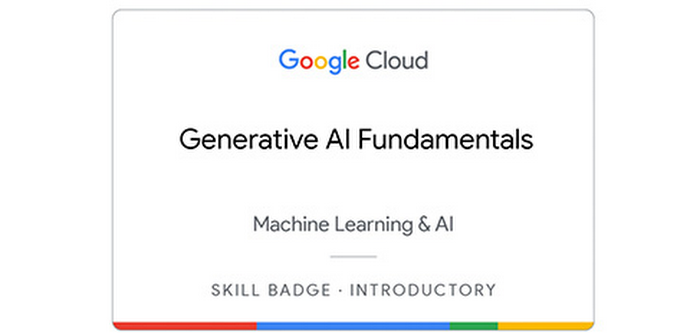
Watch the short videos in the generative AI courses and complete the final quiz to earn the Generative AI Fundamentals skill badge pictured below. In as little as 120 minutes, you will learn the basics of how generative AI works, how Google Cloud AI technology can be used by businesses and individuals, and how the principles of responsible AI lead to ethical decisions about the use of generative AI.
By earning the skill badge, you will demonstrate your understanding of foundational concepts in generative AI.
The topics covered in the courses include:
1. Introduction to Generative AI
- Explain how generative AI works
- Describe generative AI model types
- Describe generative AI applications
2. Introduction to Large Language Models
- Define large language models (LLMs)
- Describe LLM use cases
- Explain prompt tuning
- Describe Google’s generative AI development tools
3. Introduction to Responsible AI
- Identify the need for a responsible AI practice within an organization
- Recognize that decisions made at all stages of a project make an impact in Responsible AI
- Recognize that organizations can design an AI infrastructure to fit their own business needs and values
Earn the skill badge and show off your generative AI knowledge today! And for more content to help you stay up to date with generative AI, check out “The Prompt” and our generative AI primer for executives on Transform with Google Cloud.
Pay-as-you-go AI Management Platform Available on Google Cloud Marketplace

3075
Of your peers have already read this article.
2:30 Minutes
The most insightful time you'll spend today!
Editor’s note: Prevision.io has built the first ever pay-as-you-go AI management platform that simplifies the machine learning project lifecycle while offering powerful analytics capabilities. Now available exclusively on Google Cloud Marketplace, users can experiment, build, deploy, and manage AI projects in the cloud in weeks—without having extensive data science knowledge.
Similar to the momentum that cloud technology has had in the business world, AI and machine learning are quickly becoming essential to the enterprise. 86% of companies now view AI as a “mainstream technology,” and corporate AI adoption rose 50% in 2021 from the year prior for initiatives such as service-operations optimization and product enhancement. But for companies that don’t fall into the Fortune 500, initiating AI projects can come with several challenges, ranging from one-size-fits-all subscription models to skills gaps and resource-heavy monitoring requirements.
My team of data scientists saw a real need for software that could democratize machine learning innovation by removing these common barriers. We knew that features like automation could make building and deploying AI much more doable for other data scientists, as well as citizen data scientists. So, we launched Prevision.io, a first-of-its-kind dedicated AI management platform built on Google Cloud and now available exclusively on Google Cloud Marketplace.
As a Google Cloud Partner Advantage Member, we knew the benefits of an elastic infrastructure, full integration with BigQuery, and access to a large library of complementary tools, such as Kubeflow on Google Cloud. As a result, it’s easier for our users to improve upon their robust AI projects.
Set up in minutes, deploy a machine learning model in weeks
Users can start building and deploying models in Prevision.io immediately after subscribing through Google Cloud Marketplace. Instead of taking weeks to onboard and months to launch a real-world model into production, Prevision.io’s intuitive interface and powerful predictive analytics capability makes it possible to set up in minutes–and have models up and running in three to four weeks. Since we believe in cost-efficient scaling, our platform operates on a pay-as-you-go model with no long-term contracts, licensing, or per-user fees.
Simply connect Prevision.io with your data–whether it exists in buckets or in an SQL data source like BigQuery. No matter your data source, set up is quick. There are even tutorials to help if you’re using APIs. Follow this tutorial for step-by-step set up details in Google Cloud.
Once historical data is imported, you can start applying your own models inside Prevision.io, or use Prevision.io to build a bespoke model. There’s more good news: expenditures on Prevision.io’s platform are applied toward customers’ Google Cloud spend commitments.
Full lifecycle AI project management made easy
By automating the complexity of AI project management with a no-code approach, businesses do not have to add more data scientists to their teams, risk data drift or outdated models, spend hundreds of thousands on unused software, or massively expand IT budgets. By connecting BigQuery or other datastores to Prevision.io, you can launch high-performing machine learning projects and manage them across the entire lifecycle. With Prevision.io you can:
- Experiment with iteration and optimization to get an effective model into production from the start. Track performance and compare versions to identify the most reliable model. Because there is no infrastructure to manage, users can focus only on the project and see ROI sooner.
- Automate training and prediction tasks to improve collaboration, reduce time-consuming manual operations, and boost results. Users can implement automation across the production pipeline with built-in features like AutoML and a scheduler for recurring tasks. Retrain automations and integrate custom code to keep processes aligned and relevant.
- Deploy scalable working models securely and reliably in one-click. Tailor deployments using REST APIs or as a component to generate batch predictions. Create dashboards to share with stakeholders, and swiftly update your model without worrying about service interruptions or breakages.
- Monitor infrastructure and model behavior to understand resource utilization and how data changes over time—without requiring more of IT. Put an end to endless maintenance meetings with reliable, real-time monitoring applications around drift, data in-and-out, and prediction distribution. If an issue arises, Prevision.io provides detailed alerts and analysis to understand the root of a problem.
Any business can benefit
Regardless of industry or department, we’ve seen Prevision.io help businesses solve some of their biggest challenges. Utilities companies are relying on better forecasts of the energy consumption (gas or electricity).. Transportation companies have deployed machine learning models that can inform logistical operations based on fluctuating supply and demand. Doing more with data not only improves what a business can offer their customers but can also yield significant savings. Here are a few real-life examples:
La Poste: delivery data saves the day
Global delivery company La Poste was having trouble meeting customers’ demand for speed and visibility, and inaccurate estimated arrival times for packages was costing them money. The team wanted to put its tracking and tracing data to work, and turned to Prevision.io to select technical metrics, set up personalized machine learning models for delivery rounds of all personnel, and speed up the iteration and training process. After deploying its model in four weeks, La Poste achieved an 89% accuracy rate for delivery times and saw a 10x improvement in IT infrastructure and operational costs. And of course, happier customers who keep coming back.
BPCE: machine learning helps us help our clients
An arm of BPCE Group, the second largest banking group in France, was feeling the effects of the pandemic’s impact on customers. It needed a more efficient way of determining who would need what type of help—and when–to reduce the number of customers entering the collections process. Using its wealth of data to create and deploy a machine learning model in Prevision.io, the firm was able to rapidly identify the most at-risk customers and better understand the root causes behind potential debt default—some of which are easily fixable. As a result, the firm has seen a fifteen-fold increase in the sums they have been able to recover, and decreased the number of collection cases by 50%.
Pharmaceutical company: marketing medicine with MLOps
The marketing department at a healthcare company serving pharmacies was able to reduce customer churn and improve growth by using Prevision.io to compute market segmentation based on anticipated customer revenue. This helped the company determine the best way to engage with each pharmacy—and when. Being able to make strategic decisions based on automated predictions and more targeted data saved the company $1.3M Euros in two fiscal quarters.
See how AI project management and MLOps made easy can transform your business. Access Prevision.io on Google Cloud Marketplace and take advantage of the 14-day free trial.
The Power of Personalization: Ocado Retail’s Strategy to Boost Revenue and Lower Churn

1707
Of your peers have already read this article.
3:30 Minutes
The most insightful time you'll spend today!
Retailers are becoming more skilled at making individual customers feel heard and valued. This is a necessity given the fact that 66% of respondents to a McKinsey survey stated that they expect email marketing messages to be tailored to their needs. While marketing personalization expertise is growing, it’s still difficult to manage, especially at scale.
Ocado Retail, one of the world’s largest dedicated online grocery retailers, delivering to over 645,000 customers in the U.K., has made personalization integral to its success.
Let’s look at how Ocado retail worked with Google Cloud and partner Cognizant to develop a new data platform to power its personalization efforts from the ground up.
Unifying data for more holistic, powerful personalization
To achieve its goals of personalization at scale, Ocado Retail needed a central data warehouse that could turn all forms of merchandising, advertising, business, and customer intelligence data into actionable insights. It wanted a means to accelerate customer segment identification, as well as the ideation and launch of relevant campaigns.
“We standardized on Google Cloud, including BigQuery, as the foundation for our data platform because we knew it was the right solution for now and the future,” says Kieren Johnson, Head of IT at Ocado Retail. “We have an incredibly lean team and we needed a partner with exceptional expertise to help build an ambitious enterprise data warehouse to provide powerful insights. Cognizant was also the clear choice to help us get there.”
Cognizant worked closely with Ocado Retail to make sure its expertise in Google Cloud and other technologies aligned with Ocado Retail’s vision to drive more advanced personalization at higher scales using machine learning. The partner helped build the foundation on BigQuery, and then incorporated other Google Cloud tools such as Cloud Run, Vertex AI, and Vertex AI Natural Language to provide no-ops, all-code warehousing, and analytics capabilities.
Cognizant also took advantage of the Google Cloud Partner Success Services (PSS) program to ensure best practices were being followed throughout the project. PSS provided advisory services that guided Cognizant through the highly complex process of building the new data warehouse for Ocado Retail on Google Cloud.
Building the enterprise data platform in this way allows Ocado Retail to leverage the full power of cloud-based analytics while maintaining a lean team. It also allows the company to greatly scale up its personalization efforts.
Making customers feel valued at every touch
The work Ocado Retail has done with Google Cloud and Cognizant has positioned it to make its growing customer base feel valued, understood, and supported in every interaction. Before launching the project with Cognizant and Google Cloud, Ocado Retail was only able to run a couple of campaigns per week and knew it lacked optimal insight into each campaign’s efficacy.
“We now run 10 times the number of campaigns we used to with the help of the data platform Cognizant built on Google Cloud,” says Kieren. “We run multiple campaigns every day for different customer segments, and all of that increased activity is entirely driven by data insights. The positive impacts on our marketing and customer service performance have been clear. We’re now working to expand what we do.”
Ocado Retail has enjoyed solid growth since the new data platform went live, including a 13% rise in active customers during fiscal year 2022, and has also seen a reduction in churn. It attributed these improvements to being better able to tailor products and communications to specific customer preferences.
Throughout the project, Cognizant supported data clean up while maximizing the scalable, flexible, and future-proofed data analytics infrastructure offered by Google Cloud.
Increasing data-driven actions
Ocado Retail plans to provide more data-driven insights to its commercial suppliers through a product called Beet Insights. So far, Beet Insights offers suppliers with intelligence about how their products are performing on the shelves. The result has been improving the role data plays throughout the supply chain, from production to purchase and beyond.
“By putting real-time insights about costs, marketing spend, and supply-funded activities into the hands of our commercial team and buyers, we are better positioned to improve our profits,” says Kieren. “At the same time, building data analytics into every part of our business will allow us to build on our personalization efforts.”
From the project’s inception, Ocado Retail ensured that the platform would be scalable and dynamic. Now, it is working to feed more data sources and streams into the warehouse to accelerate time to insights. Ocado Retail believes this next step in the evolution of the platform will unlock even more opportunities to initiate high-impact programs that transform personalization and every customer interaction.
Learn more about what Google Cloud and partners like Cognizant can do for your customer intelligence and personalization.
IT Prediction: The Importance of Workload-Optimized, Ultra-Reliable Infrastructure in Today’s World

2545
Of your peers have already read this article.
2:30 Minutes
The most insightful time you'll spend today!
Editor’s note: This post is part of an ongoing series on IT predictions from Google Cloud experts. Check out the full list of our predictions on how IT will change in the coming years.
Prediction: By 2025, over half of cloud infrastructure decisions will be automated by AI and ML
Google’s infrastructure is designed with scale-out capabilities to support billions of people, powering services like Search, YouTube, and Gmail every day. To do that, we’ve had to pioneer global-scale computing and storage systems and shorten network latency and distance limitations with new innovations. Along the way, we’ve come to see cloud infrastructure as more than a simple commodity — it’s a source of inspiration and new capabilities.
But even as the demand on the industry’s cloud infrastructure continues to increase, there are simultaneously plateaus in the efficiency available from the underlying hardware. In the past, we saw annual performance gains of 30-40%, levels that often enabled a single infrastructure configuration to meet the needs of the vast majority of workloads. As these improvements have slowed and new workloads such as AI/ML and analytics have emerged, we have seen a corresponding explosion in the variety and capability of infrastructure. While empowering, the burden of picking the right combination of infrastructure components for a given workload still falls on an organization’s cloud architects.
But by 2025, we predict that the burden and complexity of infrastructure decision making will disappear through the power of AI and ML automation, which will automatically combine purpose-built infrastructure, prescriptive architectures, and an ecosystem to deliver a workload-optimized, ultra-reliable infrastructure. The focus for cloud architects will therefore be on enabling business logic and innovation, rather than how that logic maps to underlying infrastructure.
Already, we are making investments to turn this vision into reality, building custom silicon like the Infrastructure Processing Unit (IPU) for our new C3 VMs or a liquid-cooled board for the new tensor processing unit. The latter, the TPU v4 platform, is likely the world’s fastest, largest, and most efficient machine learning supercomputer. It can train large-scale workloads up to 80% faster and 50% cheaper than alternatives. Put another way, TPU v4 will nearly double the performance of critical ML and AI services at half the cost, unlocking new possibilities for what organizations can achieve when leveraging large-scale learning and inference for business services.

The TPUv4
These same IPUs and TPUs represent the foundation that will make it possible to automate cloud infrastructure decisions. They’ll be able to support the telemetry data and ML-based analytics for proactive infrastructure recommendations that will increase the performance and reliability of workloads.
Instead of determining hardware specifications and building the right infrastructure, you’ll only need to specify a workload. AI and ML will take over the burden and recommend, configure, and identify the best options based on your budgetary, performance, and scaling requirements. What is most exciting for us is how this will enable a much more rapid pace of service innovation, which is the primary end goal of great cloud infrastructure.

5307
Of your peers have already downloaded this article
7:30 Minutes
The most insightful time you'll spend today!
Sure, machine learning is becoming a business imperative, but how does it work in practice—and what are the benefits for IT managers?
That’s the subject of a new step-by-step guide to solving business and IT problems with artificial intelligence and ML, based on insights gathered by IDG Research Services.
Its publication comes at a time when technology departments face growing pressure to embrace these emerging technologies, yet many have questions about how to get started.
It has real-life examples such as the health services company that used ML to reduce support ticket-resolution time from 48 minutes to six.
In another section, a financial services VP explains that cloud-based ML services enable his company to avoid spending money on computing resources that sit idle.
The guide also includes concrete tips for new ML adopters. For example, a real-estate CIO recommends the use of third-party tools that rely on AI and ML technologies, while a financial services VP highlights the challenge and potential of incorporating unstructured data into ML initiatives.
Download the guide now!
More Relevant Stories for Your Company

Making Hybrid Work Human: Google Workspace and Economist Impact Survey
Google Workspace recently commissioned Economist Impact to complete a global survey (October 2021)* on the state of hybrid work, including its challenges and opportunities. We already knew that the pandemic had fundamentally changed the world of work, but the survey emphasizes the scale, reach, and longevity of those changes.. Over 75% of



Supercharge Marketing with Ready-Made, Centralized Smart Analytics
Your company has lots of valuable marketing data, but it’s spread across many systems and teams. That's a problem. In fact, only 13% of organisations feel like they're making the most out of their available customer data today. And the reason is that data--marketing and customer data--is spread across many

How Google Cloud Solutions Help Retail Firms to ABP(Always Be Pivoting)
For years, retailers have been told that they must embrace a litany of new technologies, trends, and imperatives like online shopping, mobile apps, omnichannel, and digital transformation. In search of growth and stability, retailers adopted many of these, only to realize that for every box they ticked, there was another



Google had Enough of Flooding in India. Here’s What It Did About It
Over the last century, floods have become the most common and deadly natural disaster on the planet. Many countries currently lack effective early warning systems and alerts. Today, 20 percent of flood fatalities occur in India. To help, Google sent a team to study the Ghaghara River, near Patna. “In
