






7997
Of your peers have already downloaded this article
20:30 Minutes
The most insightful time you'll spend today!
SEED: The 4 Areas of a Well-functioning and Responsible AI

4324
Of your peers have already read this article.
2:00 Minutes
The most insightful time you'll spend today!
The future of AI is better AI—designed with ethics and responsibility built in from the start. This means putting the brakes on AI-driven transformation until you have a well-functioning strategy and process in place to ensure your models deliver fair outcomes. Failing to recognize this imperative is a threat to your bottom line. The following post provides a simple framework to follow to keep your business on the right track as you place more trust in algorithms.
AI is inherently sociotechnical. AI systems represent the interconnectedness of humans and technology. They are designed to be used by and to inform humans within specific contexts, and the speed and scale of AI means that any lack of responsibility—such as bias, safety, privacy, scientific excellence etc—will also replicate at that same speed and scale. Without ethics and responsibility built in by design, AI systems lack the critical “inputs” or societal context that enable long term success.
Lawsuits stemming from AI systems that are biased towards certain groups are stacking up. In August 2020, IBM was forced to settle a lawsuit with the city of Los Angeles for misappropriating data it collected for its weather channel app. Health services company, Optum, is being investigated by regulators for creating an algorithm that allegedly recommended that doctors and nurses pay more attention to white patients than to sicker black patients. And Facebook, which granted Cambridge Analytica, a political firm, access to the personal data of more than 50 million people, is buried in legal work. Google has also run into its share of issues with algorithms making egregious mistakes.
While lawsuits are real, the foundational reason ethical AI is critical to your bottom line is trust. Without it, increasingly, consumers will ignore you and choose a brand they do trust. Research from Kantar, which runs one of the largest global brand equity studies (4 million consumers, 18,000 brands, across 50 markets), revealed that almost 9% of a brand’s equity is driven by corporate reputation, of which responsibility is a key attribute. Over the last decade, the importance of responsibility to consumers in relation to making brand choices has tripled.
The study stated brands perceived to be among the world’s most trusted and responsible shared three crucial factors that proved particularly important for building consumer trust and confidence, even when a brand might be new to a market. These are:
- Honesty and openness
- Respect and inclusion
- Identifying with and caring for customers
Brands that develop these associations more strongly tend to outperform their competitors in defending and growing their brand value.
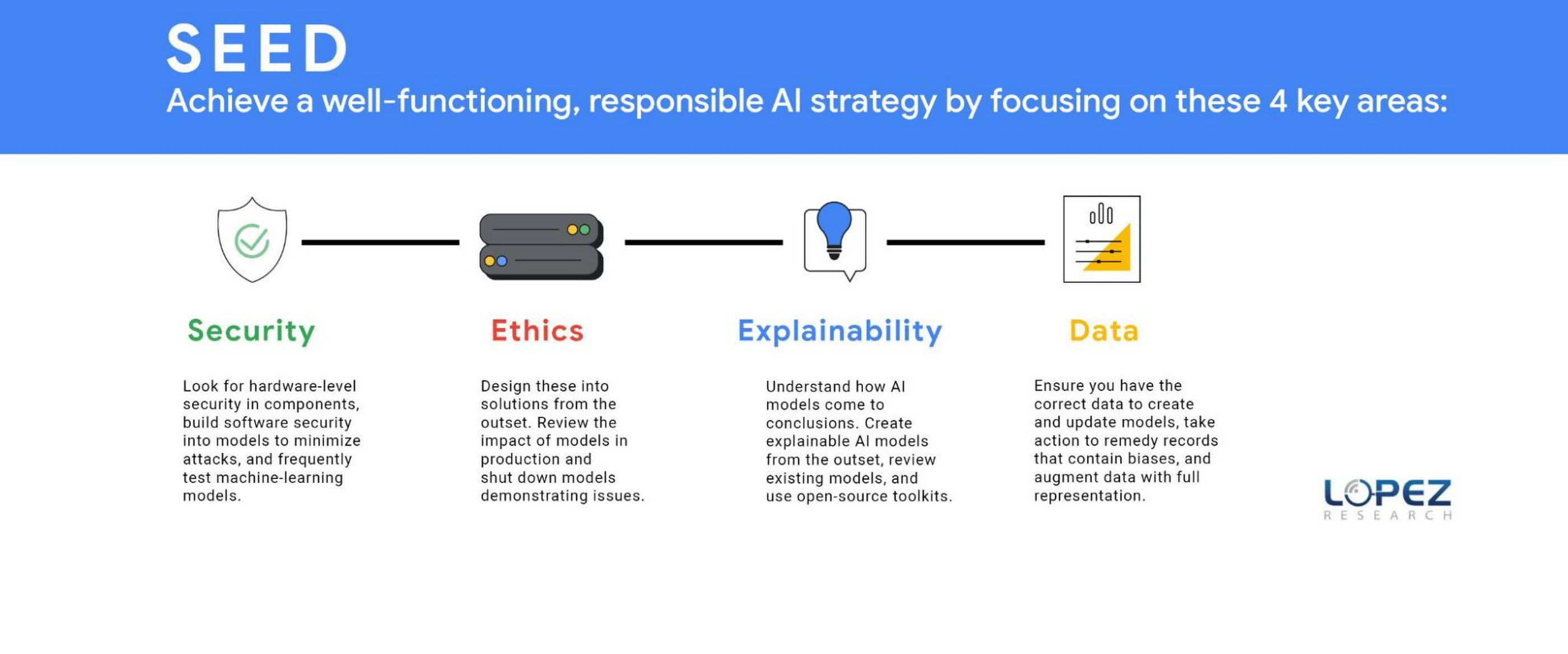
Technology and business leaders need to focus on four areas to accomplish a well-functioning ethical AI strategy. Lopez Research refers to this group of tasks as SEED, which stands for security, ethics, explainability, and data (SEED). Each of these topics could be an article in itself, but this post will define several essential components.
SECURITY (S)
It might not seem obvious, but a robust AI strategy requires an embedded security strategy. Companies should look for hardware-level security in components such as GPUs and CPUs. IT leaders should build software security into models to minimize attacks such as poisoning, evasion, deepfakes, backdoors, and model extraction. The threat of adversarial data poisoning attacks machine learning models by maliciously introducing inaccurate data designed to corrupt the model’s ability to be accurate. Another security threat is model extraction, also known as model cloning, where a hacker finds a way to either reconstruct a black-box machine learning model or extract the training data. The first line of defense against all security attacks is to design security at the outset, but the next best step is to frequently test models to ensure they are operating as planned. Business leaders, data science experts, and IT leaders must work together to regularly review the outcomes of AI models.
ETHICS (E)
Today, organizations must understand that ethics should be designed into the solution at its outset. The ethics process starts with defining the potential positive and negative outcomes of the model that your business is creating. Once the team has evaluated potential harmful effects, which means unpacking the systems, beliefs, power hierarchies and dynamics that interconnect with the technology, it’s your responsibility to eliminate or minimize the impact of these outcomes. It’s also critically important to review the impact of models in production and shut down models demonstrating issues. An example of this was the public beta release of the Tay chatbot that Microsoft deployed and rapidly shut down because it propagated negative biases.
Yet, many organizations aren’t taking this action. The FICO study revealed that 93% of companies said responsible AI was critical for success but only 33% of these companies were measuring AI model outputs to ensure these models were operating as expected (measuring for model drift). Another survey by Pew Research revealed that 68% believe that ethical principles focused primarily on the public good will not be employed in most AI systems by 2030.
Regulations may turn this tide, regardless of whether organizations plan to adopt an ethical AI framework. Laws governing the ethical use of data in AI are expected to be finalized as soon as 2022, such as the European Commission’s proposed legal framework for AI. Organizations that start with ethical use of AI in mind will be better positioned to deal with customer privacy concerns and regulatory compliance.
EXPLAINABILITY(E)
As models have become more sophisticated, it’s also become increasingly difficult to explain why a model created a specific outcome. In the FICO Responsible AI report, 65% of respondents could not explain how specific AI model decisions or predictions are made, and only 35% said their organization made an effort to use AI in a way that was transparent and accountable. However, it’s never been more important to clarify how AI models came to conclusions such as why a loan was denied, why a particular strategy should be implemented, and how AI selected a set of resumes to review for a position. The goal is to create an explainable AI model from the outset but many of today’s models lack this capability. Every business should review its existing models and use open-source toolkits that can be found on Github.com that support the interpretability and explainability of machine learning models.
Keep in mind that explainability isn’t one-size-fits-all. Different stakeholders need different types of information. Much of explainability to date has focused on “opening the black box” which gets equated to information that is only useful for other data scientists. That’s important, but it doesn’t help the line of business users whose workflows AI is integrated into, or end users who deserve information about how decisions are made; or policymakers who don’t have data science backgrounds, and so on.
DATA (D)
An equally important item in ethics is data. Ethics starts with ensuring you have the correct data to create and update models. Three main issues include representative data, inherent biases within existing data, and inaccurate data. A critical issue that most companies miss in creating models is that current data sets frequently lack full market representation. A recent Capgemini Research Institute report revealed that 65% of executives “were aware of the issue of discriminatory bias” with these systems.
Awareness is the first step, but organizations must take action to remedy this issue. Historical data may no longer serve a company’s current needs for model creation. Historical records may contain biases against certain groups. For example, historical criminal data records show an imbalance in ethnic groups’ incarceration, which would lead to model biases. Additionally, laws and societal norms also change. Certain groups were prosecuted for sexual preference in the past, but today this information would create an inaccurate model.
Companies have also discovered that using demographic data, a common practice in marketing, can also lead to model bias. For example, individuals that primarily used cash for transactions and others that lived in specific zip codes were at a disadvantage in banking models to determine creditworthiness. To minimize these issues, a company needs to augment its data with full representation in areas such as ethnicity, gender, age, behavioral and economic profiles.

Design AI models with a continuous feedback loop
Another, more prominent, yet tricky issue is data accuracy. As the adage says, garbage in, equals garbage out. The least appreciated but arguably the most essential component of the AI model lifecycle is ensuring the model has accurate data at all times. Inaccurate data from either poor data hygiene or data that was tampered with for security purposes can cause model failures. Organizations need to invest the time and resources to ensure they have the correct data. Data privacy is another key element that businesses must address, but the concepts of data privacy, sovereignty, and security are significant enough that we will come back to this in a separate article.
Overall, it’s clear that while we may have an abundance of data, it most likely doesn’t represent what we want to model for the future. A successful AI strategy is an ethical AI strategy that requires the organization to be thoughtful in its model creation by ensuring it has a broad representation of accurate data and testing the outcomes to ensure the models are secure and operating as expected.
Organizations that define an AI model lifecycle with a continuous feedback loop will reap the benefits of better intelligence. This will increasingly mean stronger, longer lasting trust with customers and staying on the right side of new laws and regulations.
Google Search Feature with Document AI Simplifies Document Extraction!

3017
Of your peers have already read this article.
1:30 Minutes
The most insightful time you'll spend today!
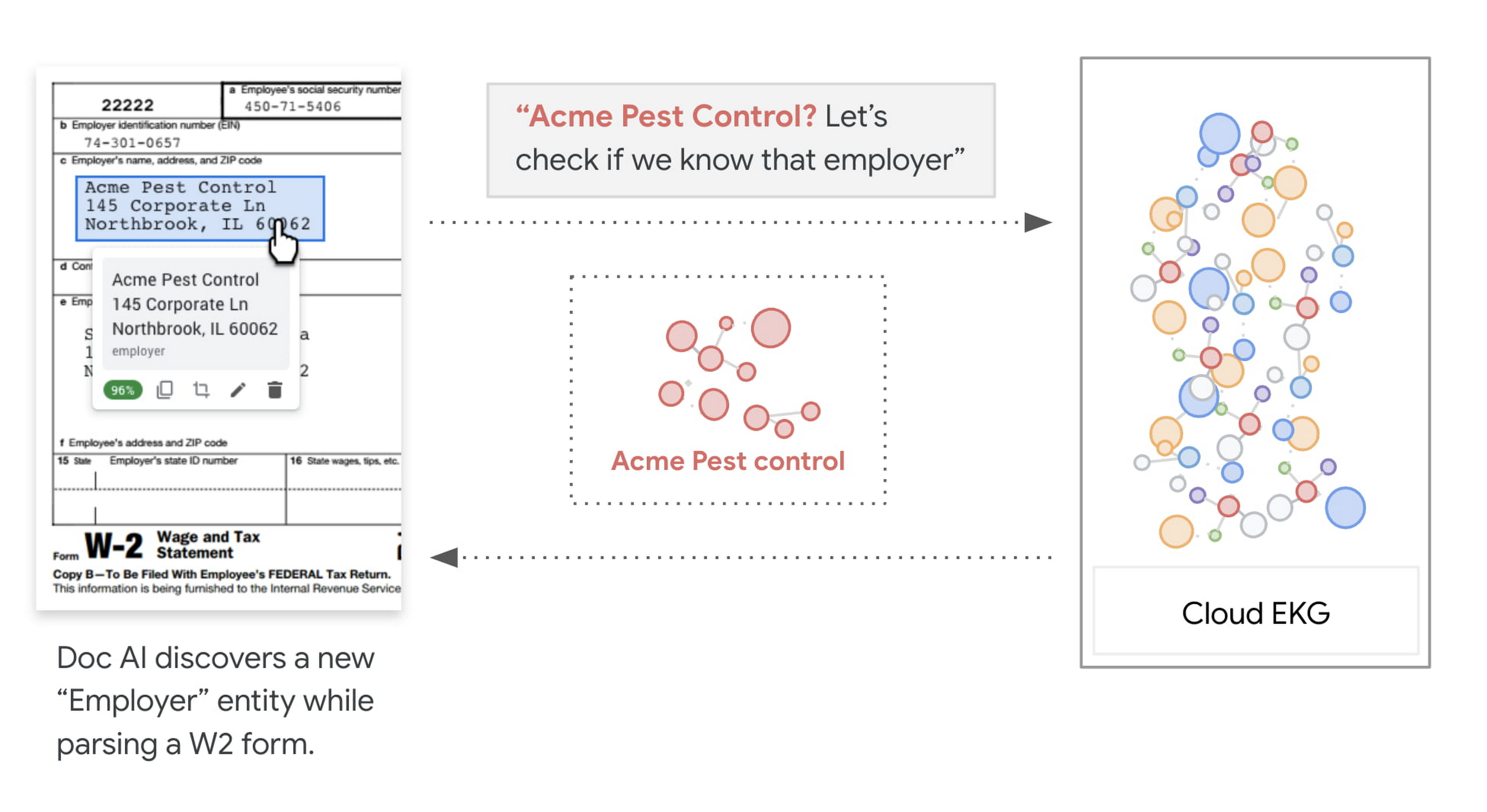
Google Cloud introduced Document AI to automate document processing and to streamline workflows with state-of-the-art machine learning models. With the deep neural networks, the models generalize the learning from seeing hundreds of thousands variations of the documents. But when information is missing or ambiguous on a document – like a missing address or entity name – a human may need to search for it…often on Google.
With Document AI, we are bringing the power of this “Google search” to help customers understand their documents. This means that the same Google knowledge graph technology that helps you find the name, address or phone number of your favorite restaurant can now enrich your document extraction with the right name, fully qualified address, and updated phone number.
Here is a sample payslip…

Imagine a bank employee entering this to capture a customer’s income to qualify them for a loan. When extracting information from this payslip, what employer name should she key in? She might take the time to go into Google and find the right correct legal entity name; or she might just guess and move on, potentially creating data reconciliation headaches down the line.
With Document AI, there is a better way. Our native integration with the knowledge graph means that we can deliver both the specific text from the payslip as well as Google’s best understanding of the actual name of the company that operates at this address. This is an important step to translate from “what has been said” on a document to “what does it mean”. By normalizing the value as you process millions of documents, you are improving accuracy and consistency at the beginning of the data processing workflow, making downstream integration, data analytics and business intelligence tasks at ease.
How EKG Enrichment Works
In a nutshell, Knowledge Graph is a knowledge base that uses a graph data model to integrate interlinked entities, including objects, events, processes or abstracted concepts. Google announced its Knowledge Graph in 2012 as a way to organize information from the Web and to enhance Search results. Different from Google Knowledge Graph, Cloud EKG (Enterprise Knowledge Graph) focuses on entities that are more relevant to enterprise customers, such as organization, product, people, locations, etc.
In EKG, every node is called an entity. Each entity in the graph represents an object, such as an organization. EKG aggregates all the information about a thing into a single entity, thus each entity represents a distinct and identifiable real world concept. The uniqueness of these entities in the graph is one of the reasons that make EKG useful. The edges between nodes are called relationships. When representing attributes, the relationships can be considered as properties, such as the name of a company, the price of a product, etc. When representing relationships, they connect entities in the graph, such as the CEO of a company, the seller of a product.

Entity linking, as its name suggests, is the task of assigning a unique identity to entities mentioned in text, images or videos. In the context of EKG, it connects the text mentions to entities in the graph. Under the hood, the recognition takes both the mention and its context information into consideration for linking to the best matching candidates in the graph.
Entity Enrichment, is essentially linking entities in EKG to documents, and using the attributes of linked entities to enrich the extracted information. The entity linking on documents is based on the understanding of both documents and the entities in the graph. First the document parser annotates entity mentions, which provides semantic meanings to the content of the document. Then Entity Linking selects a list of entities from EKG based on the types of these mentions, and matches to the best entity by comparing the attributes found in the document with the the relationships of the selected entities.
How to leverage the enrichment result
Knowledge graph enrichment is a built-in feature for Lending DocAI , Procurement DocAI and Contract DocAI today, and we are actively working on expanding it to cover more document types and parsers on the platform. To use the knowledge graph enriched values, look out for the entities fields under normalizedValue, returned by the API.
{entities: [{"textAnchor": {"content": "Google Singapore"},…."normalizedValue": {"text": "Google Asia Pacific, Singapore"}}]}
To learn more, check out the Document AI webpage, and EKG Enrichment page to see the list of supported parsers and fields.
Advance Your Cloud Career: Seven New No-Cost Generative AI Training Courses

1166
Of your peers have already read this article.
4:30 Minutes
The most insightful time you'll spend today!
Editor’s note: This blog has been updated since it originally published to reflect the total number of generative AI courses that have become available since the publish date.
An AI/ML (artificial intelligence/machine learning) career path can be a great specialty area within the cloud—and one of the most accessible! Because this area is constantly developing, most recently with the rise of generative AI, I want to share some recommendations to help you chart a sustainable career as AI/ML continues to evolve.
Generative AI falls under the overall category of AI and offers a new and exciting way of interacting with information, brands, and other people. Let’s talk about how these disciplines work together and about materials available to help you upskill in these areas.
To this end, we are happy to announce a new set of generative AI training content available at no cost. So, whether you are just getting started or already have a more advanced role, read on to find ways to help reach your desired position.
ML compared to AI
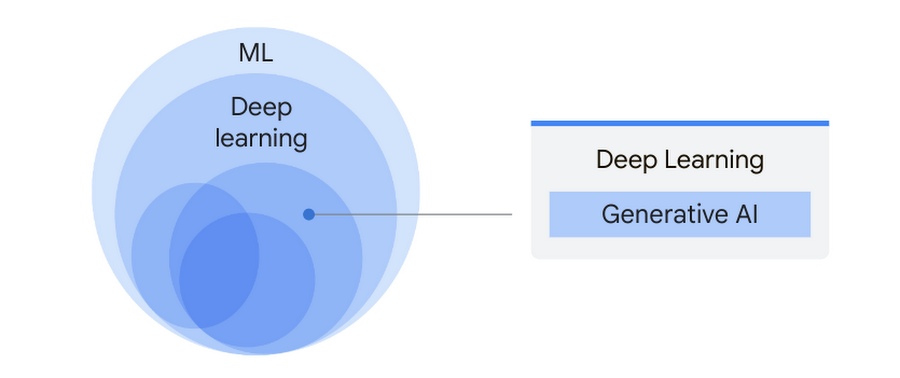
While the terms ML and AI are often used interchangeably, there are distinct differences. AI is an umbrella concept wherein machines are taught to perform tasks normally associated with human intelligence, such as decision-making and language interaction. ML is a subset of AI dedicated to taking data from the past and training algorithms to create models that can perform highly complex tasks without being explicitly programmed. It’s the basis for most forms of AI that people interact with, like virtual assistants, music recommendations, and chatbots.
Data engineers and ML engineers work with data scientists to get insights from data. They are needed to create software models and get clear results, and develop deployable applications. These skilled roles are needed in every industry!
Change the world for the better with generative AI
I recently wrote about four key pillars of technology trends expected in the next decade, including the role of AI/ML in the cloud environment as one of those pillars, and how you can bridge the skills gap and build your career.
Generative AI is a new type of ML that has made a lot of headlines recently. Research from CIO Dive finds that seven in 10 executives say their companies are investigating or exploring generative AI. Now is a great time to become an expert, while we are at the cusp of this technology becoming more widely adopted.
To get to generative AI, we need to talk first about deep learning. Deep learning is a subset of ML that uses artificial neural networks to process more complex patterns than traditional ML. Generative AI sits still further down the funnel, as a subset of deep learning that typically involves the Transformer architecture. Essentially, it’s a type of AI that can map long-range dependencies and patterns in large training sets, then use what it learns to produce new content, including text, imagery, audio, and synthetic data.
Generative AI relies on large models, such as large language models (LLMs) that can classify and generate text, answer questions, and summarize documents. For more detail about how this works, check out the video below from Google I/O 2023, which features great information from Dr. Gwendolyn Stripling, Artificial Intelligence Technical Curriculum Developer for Google Cloud.
How Google is offering generative AI
Here at Google, we’ve been heavily invested for decades in research and innovation aimed at helping businesses, governments, and developers maximize the potential of AI. Our vision is to empower builders, innovators, developers, and doers to use AI in unique, responsible, productive ways.
To deliver on this, we recently announced a variety of solutions to bring generative AI into our offerings, beginning with Generative AI support on Vertex AI and Gen App Builder.
Vertex AI is Google Cloud’s ML platform for training and deploying ML models and AI applications. With Generative AI support on Vertex AI, data science teams and developers can access foundation models from both Google and other sources, helping them to quickly build, customize, and deploy models for their own use cases.
As part of generative AI support on Vertex AI, Model Garden and Generative AI Studio are now in preview, including access to PaLM 2 for Text and Chat and Embeddings API for Text, while other features and services are available to select trusted testers. If you’d like early access to Google Cloud’s AI products, join the waitlist here.
We announced our latest PaLM model in production at I/O 2023: PaLM 2. Today, it powers more than 25 products! Additionally, we’ve fine-tuned PaLM 2 for specific use cases, including security and medical domains. You’ve probably also heard of Bard, our experiment for conversational AI, which is fully running on PaLM 2.
Our Gen App Builder aims to make customer, partner, and employee interactions more effective and helpful. With it, developers — even those with limited data science expertise — can quickly create bots, chat apps, digital assistants, custom search engines, and more. Gen App Builder even makes it possible to create some generative AI apps without any coding skills.
Now, let’s bring these products to life! Not sure exactly the use case or in need of a little inspiration? Check out this blog from Google Cloud CEO Thomas Kurian to see how customers and partners in the ecosystem are bringing ideas to life with generative AI. And watch this video to see generative AI in action!
Build your AI/ML skills and validate your knowledge to grow your career
There is a lot of excitement around generative AI—it’s truly a brand new path to consider for your AI/ML career! Check out my recommendations below for training options for AI/ML roles. These will help you gain critical skills as generative AI becomes more widely available.
*NEW* training materials, specific to generative AI technologies
Generative AI Learning Path – no cost training
- [Course] Introduction to Generative AI (1 day)
- [Course] Introduction to Large Language Models (1 day)
- [Course] Attention Mechanism (1 day)
- [Course] Transformer Models and BERT Model (1 day)
- [Course] Introduction to Image Generation (1 day)
- [Course] Create Image Captioning Models (1 day)
- [Course] Encoder-Decoder Architecture (1 day)
Additional AI/ML training – varying learning credits required to complete on Google Cloud Skills Boost
Introductory level
- [Course with completion badge] How Google Does Machine Learning (1 day)
- [Course with completion badge] MLOps: Getting Started (1 day)
- [Skill badge] Get started with TensorFlow on Google Cloud (8 hours)
- [Skill badge] Perform foundational ML, AI and data tasks in Google Cloud (7 hours)
- [Course with completion badge] Language, Speech, Text, and Translation with Google Cloud APIs (5 hours)
Intermediate/Multi-level
- [Learning Path] Machine Learning Engineer (Collection of 15 video courses and labs)
- [Skill badge] Build and Deploy Machine Learning Solutions on Vertex AI (1 day)
Advanced
- [Training + certification exam] Google Cloud Professional ML Engineer Certification (varied time)
- [Skill badge] Machine Learning with TensorFlow in Vertex AI (90 minutes)
- [Course with completion badge] Natural Language Processing in Google Cloud (1 day)
You can also catch up on hands-on demos in our most recent Cloud OnBoard: From Data to AI with BigQuery and Vertex AI. In it, we guide you through all steps of the data-to-AI solution.
Coming up on June 29, we are hosting Getting Started with Vertex Generative AI as part of Innovators Live. Register now!
I also encourage you to consider an Innovators Plus subscription. You get access to over 700 labs, skill badges and courses (including many that are specific to AI/ML), a certification exam voucher, and up to $1,000 in Google Cloud credits. You’ll also get access to live learning events and technical briefings with Google Cloud experts, plus 1:1 consultations (talk with us about your upcoming generative AI project!). It’s a $1,500 package for only $299. Learn more!
Discover Latest Resources on Google Cloud’s Datasets Solution

6329
Of your peers have already read this article.
3:00 Minutes
The most insightful time you'll spend today!
Editor’s note: With Google Cloud’s datasets solution, you can access an ever-expanding resource of the newest datasets to support and empower your analyses and ML models, as well as frequently updated best practices on how to get the most out of any of our datasets. We will be regularly updating this blog with new datasets and announcements, so be sure to bookmark this link and check back often.
August 2021
New dataset: Google Cloud Release Notes
- Looking for a new way to access Google Cloud Release Notes besides the docs, the XML feed, and Cloud Console? Check out the Google Cloud Release Notes dataset. With up-to-date release notes for all generally available Google Cloud products, this dataset allows you to use BigQuery to programmatically analyze release notes across all products, exploring security bulletin updates, fixes, changes, and the latest feature releases.
- Access the dataset

July 2021
Best practice: Use Google Trends data for common business needs
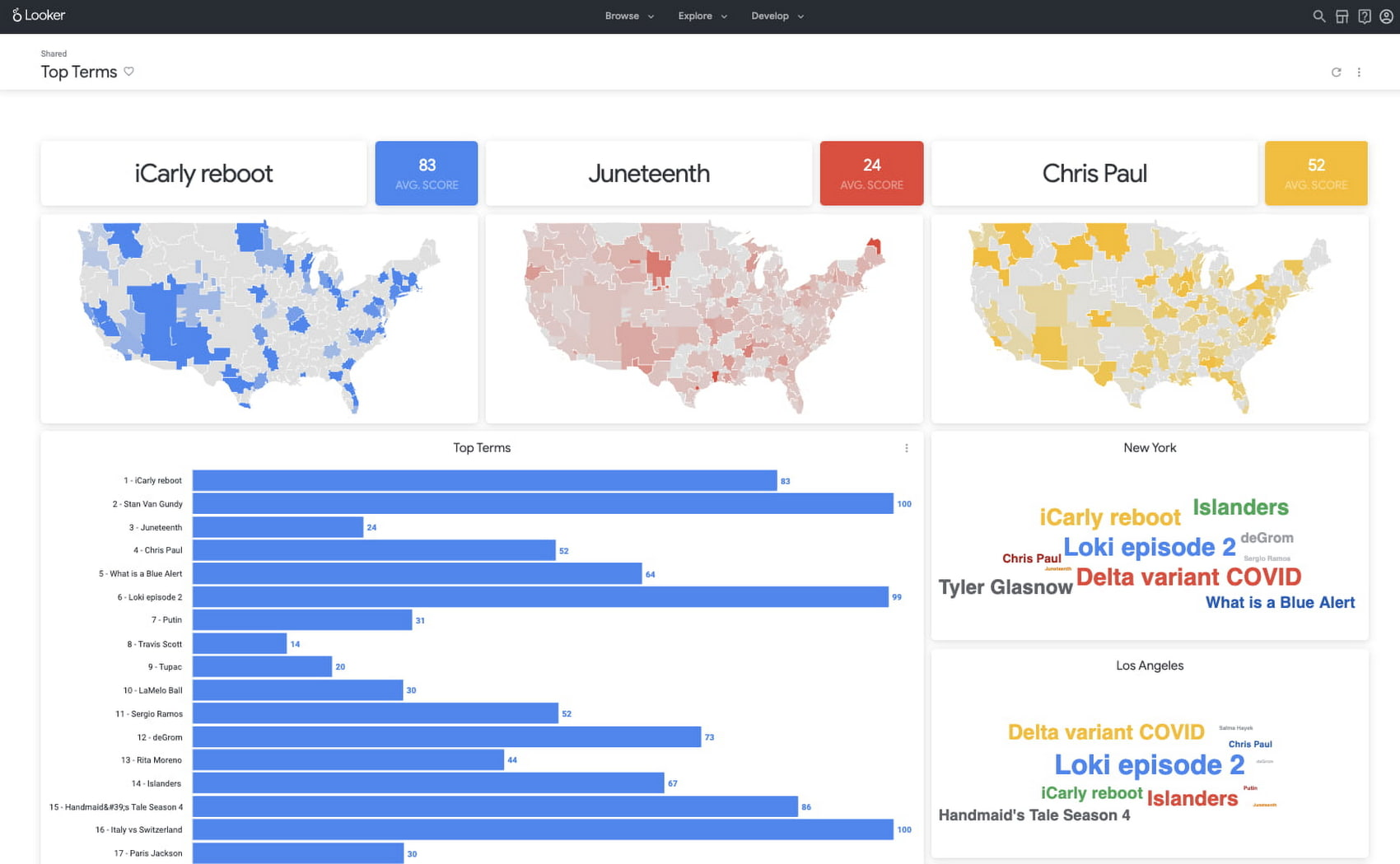
- The Google Trends dataset represents the first time we’re adding Google-owned Search data into Datasets for Google Cloud. The Trends data allows users to measure interest in a particular topic or search term across Google Search, from around the United States, down to the city-level. You can learn more about the dataset here, and check out the Looker dashboard here! These tables are super valuable in their own right, but when you blend them with other actionable data you can unlock whole new areas of opportunity for your team. To learn how to make informed decisions with Google Trends data, keep reading.
- Access the dataset
New dataset: COVID-19 Vaccination Search Insights
- With COVID-19 vaccinations being a topic of interest around the United States, this dataset shows aggregated, anonymized trends in searches related to COVID-19 vaccination and is intended to help public health officials design, target, and evaluate public education campaigns. Check out this interactive dashboard to explore searches for COVID-19 vaccination topics by region.
- Access the dataset

June 2021
New dataset: Google Diversity Annual Report 2021
- Since 2014, Google has disclosed data on the diversity of its workforce in an effort to bring candid transparency to the challenges technology companies like Google face in recruitment and retention of underrepresented communities. In an effort to make this data more accessible and useful, we’ve loaded it into BigQuery for the first time ever. To view Google’s Diversity Annual Report and learn more, check it out.
- Access the dataset
New dataset: Google Trends Top 25 Search terms
- The most popular and surging Google Search terms are now available in BigQuery as a public dataset. View the Top 25 and Top 25 rising queries from Google Trends from the past 30-days, including 5 years of historical data across the 210 Designated Market Areas (DMAs) in the US. Keep reading.
- Access the dataset
New dataset: COVID-19 Vaccination Access
- With metrics quantifying travel times to COVID-19 vaccination sites, this dataset is intended to help Public Health officials, researchers, and Healthcare Providers to identify areas with insufficient access, deploy interventions, and research these issues. Check out how this data is being used in a number of new tools.
- Access the dataset


Best practice: Leveraging BigQuery Public Boundaries datasets for geospatial analytics
- Geospatial data is a critical component for a comprehensive analytics strategy. Whether you are trying to visualize data using geospatial parameters or do deeper analysis or modeling on customer distribution or proximity, most organizations have some type of geospatial data they would like to use – whether it be customer zipcodes, store locations, or shipping addresses. However, converting geographic data into the correct format for analysis and aggregation at different levels can be difficult. In this post, we’ll walk through some examples of how you can leverage the Google Cloud platform alongside Google Cloud Public Datasets to perform robust analytics on geographic data. Keep reading.
- Access the dataset

Get the metadata and try BigQuery sandbox
When you’ve learned about many of our datasets and pre-built solutions from across Google, you may be ready to start querying them. Check out the full dataset directory and read all the metadata at g.co/cloud/marketplace-datasets, then dig into the data with our free-to-use BigQuery sandbox account, or $300 in credits with our Google Cloud free trial.
The Power of Personalization: Ocado Retail’s Strategy to Boost Revenue and Lower Churn

1720
Of your peers have already read this article.
3:30 Minutes
The most insightful time you'll spend today!
Retailers are becoming more skilled at making individual customers feel heard and valued. This is a necessity given the fact that 66% of respondents to a McKinsey survey stated that they expect email marketing messages to be tailored to their needs. While marketing personalization expertise is growing, it’s still difficult to manage, especially at scale.
Ocado Retail, one of the world’s largest dedicated online grocery retailers, delivering to over 645,000 customers in the U.K., has made personalization integral to its success.
Let’s look at how Ocado retail worked with Google Cloud and partner Cognizant to develop a new data platform to power its personalization efforts from the ground up.
Unifying data for more holistic, powerful personalization
To achieve its goals of personalization at scale, Ocado Retail needed a central data warehouse that could turn all forms of merchandising, advertising, business, and customer intelligence data into actionable insights. It wanted a means to accelerate customer segment identification, as well as the ideation and launch of relevant campaigns.
“We standardized on Google Cloud, including BigQuery, as the foundation for our data platform because we knew it was the right solution for now and the future,” says Kieren Johnson, Head of IT at Ocado Retail. “We have an incredibly lean team and we needed a partner with exceptional expertise to help build an ambitious enterprise data warehouse to provide powerful insights. Cognizant was also the clear choice to help us get there.”
Cognizant worked closely with Ocado Retail to make sure its expertise in Google Cloud and other technologies aligned with Ocado Retail’s vision to drive more advanced personalization at higher scales using machine learning. The partner helped build the foundation on BigQuery, and then incorporated other Google Cloud tools such as Cloud Run, Vertex AI, and Vertex AI Natural Language to provide no-ops, all-code warehousing, and analytics capabilities.
Cognizant also took advantage of the Google Cloud Partner Success Services (PSS) program to ensure best practices were being followed throughout the project. PSS provided advisory services that guided Cognizant through the highly complex process of building the new data warehouse for Ocado Retail on Google Cloud.
Building the enterprise data platform in this way allows Ocado Retail to leverage the full power of cloud-based analytics while maintaining a lean team. It also allows the company to greatly scale up its personalization efforts.
Making customers feel valued at every touch
The work Ocado Retail has done with Google Cloud and Cognizant has positioned it to make its growing customer base feel valued, understood, and supported in every interaction. Before launching the project with Cognizant and Google Cloud, Ocado Retail was only able to run a couple of campaigns per week and knew it lacked optimal insight into each campaign’s efficacy.
“We now run 10 times the number of campaigns we used to with the help of the data platform Cognizant built on Google Cloud,” says Kieren. “We run multiple campaigns every day for different customer segments, and all of that increased activity is entirely driven by data insights. The positive impacts on our marketing and customer service performance have been clear. We’re now working to expand what we do.”
Ocado Retail has enjoyed solid growth since the new data platform went live, including a 13% rise in active customers during fiscal year 2022, and has also seen a reduction in churn. It attributed these improvements to being better able to tailor products and communications to specific customer preferences.
Throughout the project, Cognizant supported data clean up while maximizing the scalable, flexible, and future-proofed data analytics infrastructure offered by Google Cloud.
Increasing data-driven actions
Ocado Retail plans to provide more data-driven insights to its commercial suppliers through a product called Beet Insights. So far, Beet Insights offers suppliers with intelligence about how their products are performing on the shelves. The result has been improving the role data plays throughout the supply chain, from production to purchase and beyond.
“By putting real-time insights about costs, marketing spend, and supply-funded activities into the hands of our commercial team and buyers, we are better positioned to improve our profits,” says Kieren. “At the same time, building data analytics into every part of our business will allow us to build on our personalization efforts.”
From the project’s inception, Ocado Retail ensured that the platform would be scalable and dynamic. Now, it is working to feed more data sources and streams into the warehouse to accelerate time to insights. Ocado Retail believes this next step in the evolution of the platform will unlock even more opportunities to initiate high-impact programs that transform personalization and every customer interaction.
Learn more about what Google Cloud and partners like Cognizant can do for your customer intelligence and personalization.
More Relevant Stories for Your Company

Google Cloud Named Leader of AI Infrastructure: Forrester Research
Forrester Research has named Google Cloud a Leader in The Forrester Wave™: AI Infrastructure, Q4 2021 report authored by Mike Gualtieri and Tracy Woo. In the report, Forrester evaluated dimensions of AI architecture, training, inference and management against a set of pre-defined criteria. Forrester’s analysis and recognition gives customers the confidence they

Apigee and Vision API: ICICI Prudential Life Insurance’s Journey of Speeding Document Processing
Google Cloud results Helps enable instant document approval with optical character recognition by Vision APIProcesses 100,000 documents in 20 minutes with automated document processing product Recognic, powered by Vision API and ApigeeHelps increase the number of applications processed by 30% within the same timeframe The insurance landscape in India has seen

Making Your Pictures Worth a Thousand Labels! (with Cloud Vision API)
In this post, I'll be showing some amazing ways the Vision API can extract meaning from your images - keep reading, or jump directly into a tutorial using Python, Node.js, Go, or Java! This tutorial can be completed at no cost within the Google Cloud Free Tier. They say a picture is worth a

An Expert’s Opinion on What Early-stage Startups Must Know
As lead for analytics and AI solutions at Google Cloud, my team works with startups building on Google Cloud. This puts us in the fortunate position to learn from founders and engineers about how early-stage startups’ investments can either constrain them or position them for success, even at the seed
