






3934
Of your peers have already downloaded this article
1:30 Minutes
The most insightful time you'll spend today!
What You Can Learn from ‘Up or Out’ Framework for Cloud Adoption
3229
Of your peers have already read this article.
1:30 Minutes
The most insightful time you'll spend today!
In times of significant disruption, organizations are faced with three choices: Retrench within legacy solutions, pause and do nothing while waiting for more data or different circumstances, or press ahead, potentially even accelerating to realize the desired outcome. In such an environment, it is critical to ensure you’re delivering the greatest possible impact to the business.
In Google Cloud’s Office of the CTO, or OCTO, we have the privilege of co-innovating with customers to explore what’s possible and how we can re-imagine and solve their most strategic challenges. These collaborative innovation engagements are often core to critical transformational projects, which often include the rehosting, evolution, and at times re-architecture of existing business solutions.
We are happy to offer this brand new white paper, where we have distilled the conversations we’ve had with CIOs, CTOs, and their technical staff into several frameworks that can help cut through the hype and the technical complexity, to help devise the strategy that empowers both the business and IT. We called one such framework “up or out.” (And we don’t mean some consulting firm’s hard-nosed career philosophy.)
One model that we found can help enterprises chart their cloud adoption journey delineates cloud migration along two axes—up and out, and we’ll cover this in much greater detail in the white paper itself.
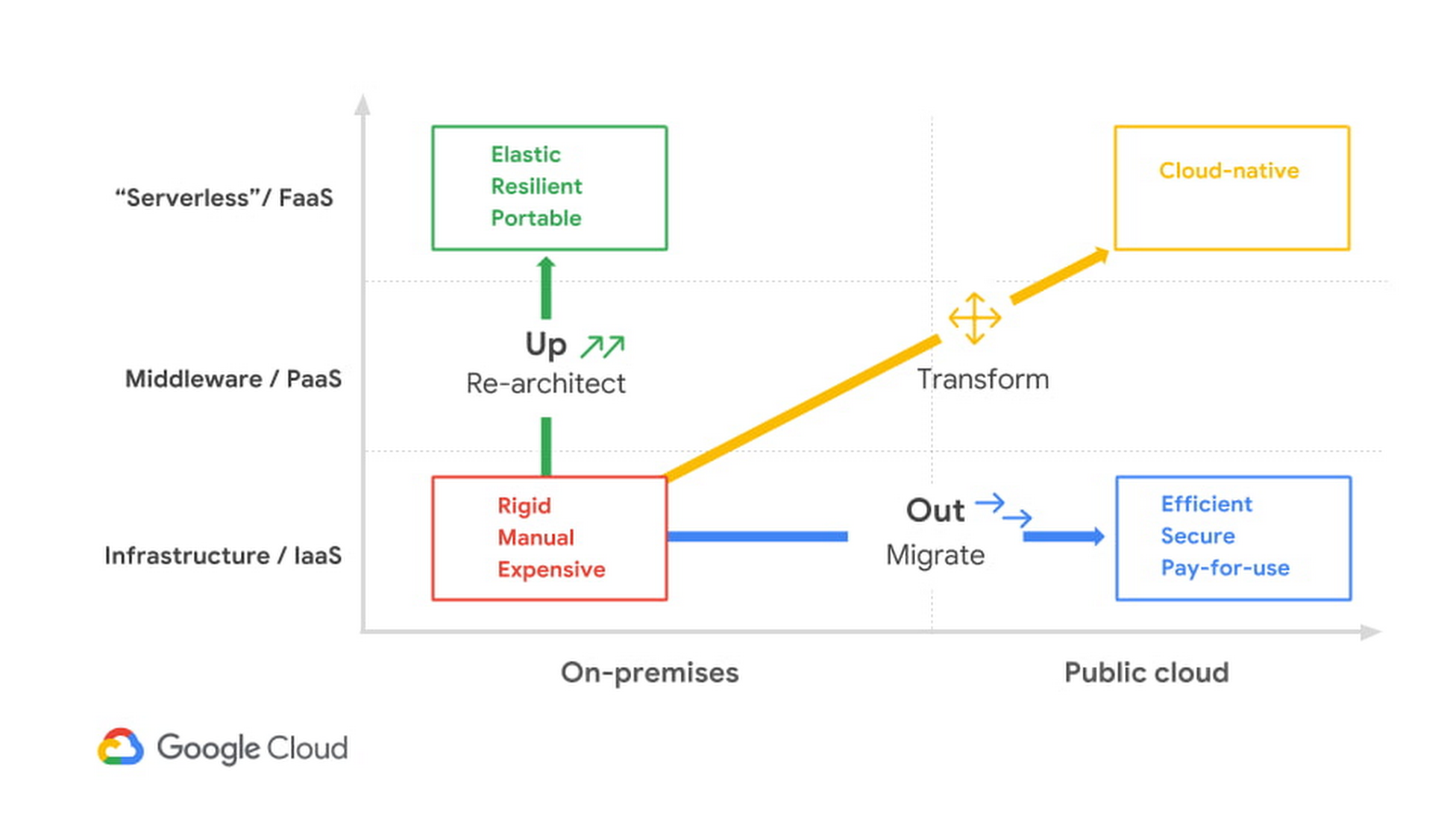
As you can see, there isn’t a single path to the cloud—not for individual enterprises and not even for individual applications. The up or out framework can help an IT organization and its leadership characterize how they can best benefit from migrating their services or workloads. The framework acts as a general pattern that highlights the continuum of approaches to explore, and you can learn all about it by downloading this detailed white paper.
Or, if you’re really ready to jump start your migration today, you can take advantage of our current offer by signing up for a free discovery and assessment.

5626
Of your peers have already downloaded this article
1:30 Minutes
The most insightful time you'll spend today!
Even before the current crisis, IT organizations saw pressure to be more agile and innovative. Customer demographics and expectations are changing. Competition is emerging faster and from unexpected sources. Business models are being reinvented. Digital technology was at the heart of many of these challenges, and its adoption was key to every company’s response.
As a result, CIOs face a series of urgent challenges:
- How can they raise system visibility and system control over operations that are more dispersed and changing than ever?
- How can they cut costs, yet create a more agile and responsive IT system?
- How can they do more with older data, even as they understand better the data from a market that is changing every week?
- How can they help people work faster, with a minimum of change management, or set the stage for growth, while preserving capital?
In many cases the answer is a step-by-step deployment of cloud computing technology, tailored to meet the most pressing needs first.
IBM Spectrum LSF and Google Collab: Leverage Google Cloud’s Scalability and Compute Engine Infrastructure

3573
Of your peers have already read this article.
3:00 Minutes
The most insightful time you'll spend today!
High Performance Computing (HPC) is prevalent today across many industries, including financial services, life sciences, higher education research, manufacturing, and energy. More and more businesses are deploying HPC workloads in the cloud to take advantage of its elasticity, scalability, and availability. Job schedulers are critical for HPC applications given the nature of these workloads that create, process, and tear down thousands, and sometimes millions, of vCPU and network resources with TB to PB of storage capacity. Job scheduling tools lead to improved operational efficiency and a degree of certainty that a particular HPC job, which can run for hours to weeks, will complete successfully.
IBM Spectrum LSF is used extensively in the manufacturing and semiconductor industry to manage Electronic Design Automation (EDA) workloads. Dynamically running workloads on-premises and in the cloud, also known as cloud bursting, is becoming a more common practice to address capacity and provisioning time constraints within data centers and enable enterprises to take advantage of virtually unlimited resources.
However, the challenge with cloud bursting is integrating and maintaining operational consistency across on-premises and cloud environments. IBM Spectrum LSF, in combination with Google Cloud, addresses this problem head on.
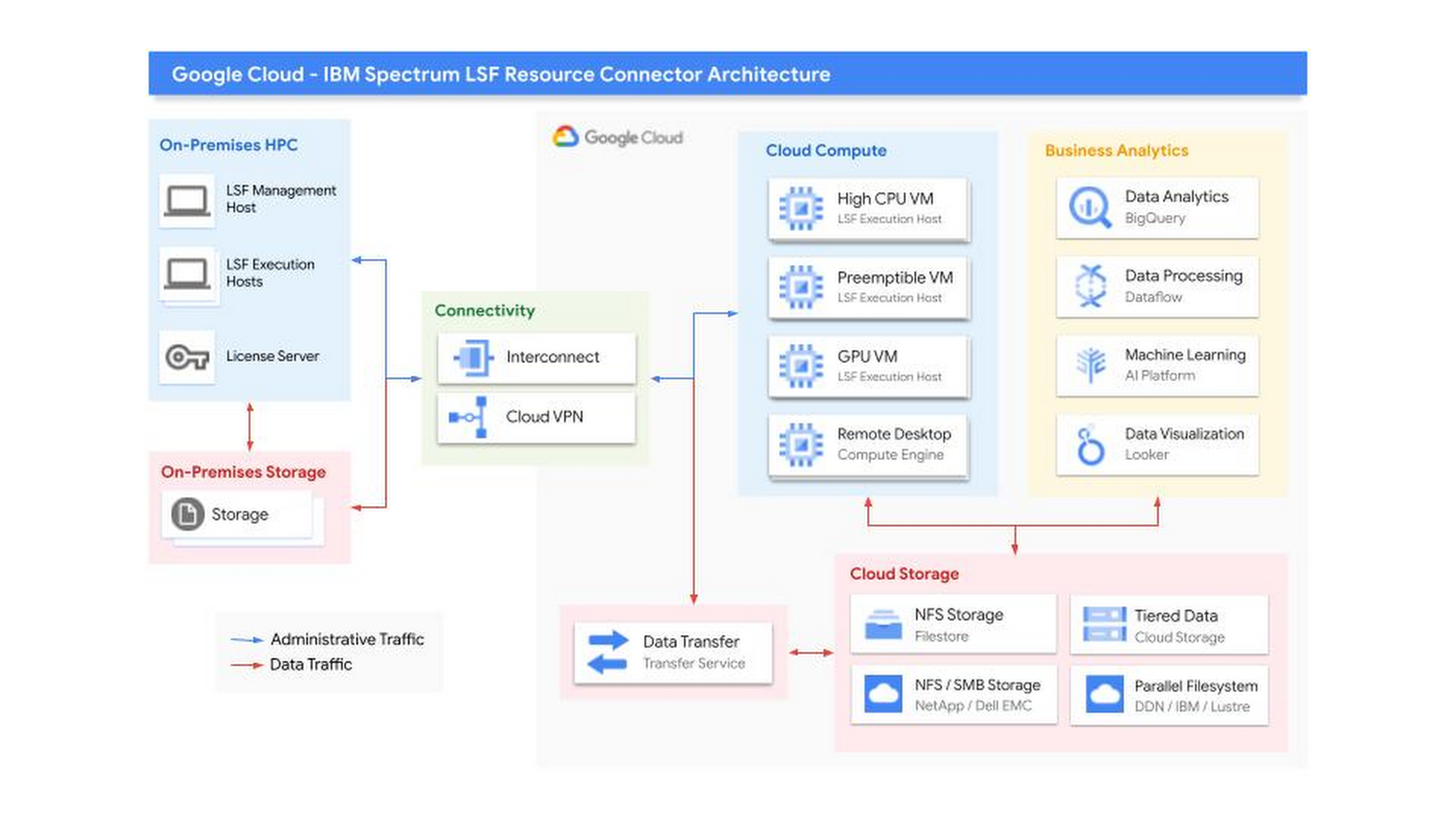
Google Cloud is excited to announce, in collaboration with IBM, enhanced capabilities to IBM Spectrum LSF that enables organizations to integrate their on-premises job scheduling scripts with resources deployed in Google Cloud. Customers are now able to fully leverage Google Cloud’s highly scalable and secure Compute Engine, networking and storage infrastructure.
The LSF-Google Cloud resource connector patch supports key Google Cloud differentiators including Local SSDs, GCE instance templates, Preemptible VMs, and more:
- Bulk API support– Deploy large fleets of VM instances in a matter of seconds.
- Instance Templates – Simplify VM configuration by creating reusable templates.
- All Machine Types – Supports all GCE VM families and machine types, including Custom Machine Types.
- GPUs – Attach up to 16 GPUs per instance, including the largest A2 instances with up to 16 NVIDIA A100 GPUs
- Preemptible VMs – Preemptible VMs are provisioned from excess Compute Engine capacity and is a significant way to save money on GCE resources.
- Local SSD – Attach up to 9TB of NVMe SSD per instance
- Hyperthreading – Supports the “threads-per-core” option in GCE, which allows per-VM hypervisor level Hyperthread configuration (when supported by Instance Templates)
- Images – Supports custom disk images, including full support for Windows, for all attached Persistent Disks
- Placement Policies – Control where the instances are physically located relative to each other within a zone for improved low-latency performance
- Labels – Supports GCE Labels, which can be used for management of firewall rules, tracking billing, etc
- Minimum CPU Platform – Supports the ability to specify a minimum CPU Platform for your Virtual Machines.
Getting Started
This improvement to the IBM LSF Resource Connector was developed by IBM in coordination with Google. Find out more about the new supported features and their operation in the official IBM Spectrum LSF Resource Connector Documentation. You can also find additional documentation and download the software in the IBM Spectrum Computing Community. If you have further questions, you can contact IBM, or Google Cloud Sales.
Special thanks to Annie Ma-Weaver, Mark Mims, and Wyatt Gorman for their contributions.
Google and NetApp Partnership Expansion to Ease Customers’ Cloud Migration

3666
Of your peers have already read this article.
3:00 Minutes
The most insightful time you'll spend today!
As organizations continue to evolve to meet the needs of their stakeholders, they are increasingly looking to adopt the cloud and digitally transform their business. Since our partnership with NetApp began in 2018, we’ve been focused on delivering the infrastructure, tools, and services to help customers on their cloud migration journey and benefit from their data to better serve their customers.
“Customers are looking to adopt flexible and scalable solutions that meet the needs of their business,” said Ronen Schwartz, SVP & GM, Cloud Volumes, NetApp. “Our long-standing partnership with Google Cloud continues to deliver innovative solutions for customers as they look to migrate and run their business critical applications in the cloud while unlocking the power of their data with industry-leading cloud services.”
Innovative, industry-first solutions have become the standard for our partnership. From the general availability of NetApp Cloud Volumes Service (CVS) for Google Cloud in 2019, to our collaboration on new architectures in 2020 with the release of the software-defined CVS powered by Google Kubernetes Engine (GKE), we continue to deliver first-of-its-kind enterprise file storage services together. In 2021, the pace of innovation has only increased—together, we delivered volume replication powered by SnapMirror, which efficiently copies volume data from one Google Cloud region to another for data consistency, development, testing, or disaster recovery.
We’ve also made our services available globally—you can now run Cloud Volumes ONTAP in all 28 Google Cloud regions, and CVS is now available in 19 regions, allowing you to access our services wherever you are around the globe. All of this is backed up by a 99.99% SLA for CVS, enabling high availability for your enterprise workloads.
Hundreds of customers including MailerLite, a leader in marketing automation, have benefitted from our joint services. MailerLite was looking to move millions of files to the cloud without disruption as they were facing availability, management, and maintenance challenges as their business scaled. By leveraging NetApp CVS on Google Cloud, MailerLite was able to migrate over 100 million files to Google Cloud in about an hour, removing their ongoing infrastructure overhead, saving developer hours, and eliminating the scalability limitations they previously experienced.
Expanding our partnership
Last week at Google Cloud Next ‘21, we announced we are expanding our strategic partnership in two ways to make it even easier for customers to migrate and run business critical applications on Google Cloud. First, NetApp will provide storage infrastructure for the newly announced Google Distributed Cloud Hosted, where data resides in customer-owned data centers and colocation facilities. This enables a safe and secure way to modernize an on-premises deployment while still meeting data security and privacy requirements.
Additionally, for customers looking to migrate their VMware workloads to Google Cloud, we announced preview access for NetApp Cloud Volumes as datastores for Google Cloud VMware Engine. By providing customers with the choice to scale compute and storage independently, customers can now reduce costs and complexity when migrating and running storage-bound workloads. This also allows customers to address regional disaster recovery use cases, making it easier and more cost-effective to move on-premises workloads into Google Cloud. To get started, you can sign up for preview access using the Registration for Preview Access form.
Looking forward
We’re excited for what’s to come with our partnership and committed to delivering value to customers across industries. Google Cloud is a Gold sponsor at this week’s NetApp Insight, and we invite you to join our spotlight session featuring Google Cloud and NetApp leaders. Additionally, we are leading multiple breakout sessions where you will hear from our product team on how you can accelerate cloud adoption with Google Cloud and NetApp. You can also learn more and get started today by visiting our NetApp on Google Cloud website.
3470
Of your peers have already watched this video.
25:00 Minutes
The most insightful time you'll spend today!
Modeling and Comparing Cloud Solutions, Costs, and Strategy
Sole-tenant nodes? VMaaS and CloudSimple? N1 vs N2 vs E2 instances? BYO Microsoft or Linux licenses? Understand how the choices available with Google Cloud can maximize your savings while expanding your migration scenarios.
Watch this webinar and learn how to assess your on-premises private cloud and compare your per-VM costs and complete solution against differing Google and third-party cloud solutions to find the best fit based on cost and features.
More Relevant Stories for Your Company

Three Benefits of VPC Network Peering for SAP Managed Apps
Over the past year, RISE with SAP has emerged as a valuable solution for SAP customers seeking a faster, simpler, and more affordable path to the cloud. RISE with SAP is a subscription-based offering that typically includes a number of fully managed cloud application options, including SAP S/4HANA Cloud and

Media CDN to Intelligently Deliver Streaming Experiences to Viewers around the World!
The digital media and entertainment industry is experiencing dramatic growth, as audiences migrate to online experiences and content providers seek to deliver new and innovative content. According to The Global Internet Phenomena Report, streaming video accounted for 53.7% of internet bandwidth traffic, up by 4.8% from a year ago. This

Customer Search Experience that Takes Advantage of Enterprise Edge Capabilities!
Every year at CES, people from around the world experience the latest and greatest that consumer tech has to offer. In 2021, CES will be in an all-digital format for the first time. So how can a virtual show like CES create immersive experiences for attendees tuning in remotely? That’s

Cloud Bigtable Helps Fraud-detection Company Meet Scalability Demands and Secure Customer Data
Editor’s note: Today we are hearing from Jono MacDougall , Principal Software Engineer at Ravelin. Ravelin delivers market-leading online fraud detection and payment acceptance solutions for online retailers. To help us meet the scaling, throughput, and latency demands of our growing roster of large-scale clients, we migrated to Google Cloud and its
