





Harnessing the Power of Data and AI to Transform Life Science Supply Chains

3984
Of your peers have already read this article.
3:30 Minutes
The most insightful time you'll spend today!
Global life science supply chains are lengthy and complex with many moving parts. One small disruption can create serious delays and affect your ability to deliver therapeutics for patients.
Supply chain disruptors
Over the last few years, healthcare organizations have encountered a range of obstacles, from both internal and external factors, that have resulted in supply networks failing to get drugs and medical devices to where they need to be on time. These obstacles include:
- Labor and supply shortages
- Rising material costs
- Raw material constraints
- Geo-political events
- Unpredictable weather
How do you overcome supply chain disruptors that are out of your control?
The intelligent healthcare supply chain
While many organizations have already implemented data-driven supply chains, organizations are still faced with the challenges of static, siloed, and different functional supply chain applications; limited data exchange with key trading partners across upstream and downstream operations; and the inability to effectively leverage relevant external data.
At Google Cloud, we believe the key to meaningful and effective change is a data-driven supply chain that allows you to achieve visibility, flexibility, and innovation.
Our solutions help you prepare for the unpredictable and enhance the value of your data. By unlocking AI-driven insights, you can strengthen distribution networks and optimize your workflows and supply chains to become more reliable, intelligent, and sustainable. Some of the business challenges we address include:
- Predicting demand with Vertex AI Forecast
- Visual inspection for quality and predictive maintenance with pre-built ML models
- Automating and optimizing pickup and delivery operations with Cloud Fleet Routing API
- Real time and holistic inventory visibility with Supply Chain Twin
Make sure you’re prepared for the unpredictable with real-time visibility over your distribution networks. Learn how you can harness the power of AI and analytics and gain actionable insights that enhance your supply chain.
4427
Of your peers have already watched this video.
28:30 Minutes
The most insightful time you'll spend today!
Data Leaders in 2021 and Beyond: How to Prepare
As technologies and workplace environments are quickly evolving, how people and businesses leverage data in their day-to-day workflow is also changing.
Data leaders are an emerging force navigating and charting pathways forward towards new horizons for how people and organizations experience data.
In this presentation, Pedro Arellano, Product Marketing Director, Looker, will cover three areas:
- Underline that the value of data within an organization is no longer up for debate. Everybody needs data, and everybody’s job has the potential to be improved with data.
- Three trends that will help put into context how we’ve arrived at this particular moment of such great potential for data.
- Why data leaders, almost regardless of their title, are now in a position to really influence the direction of organization like never before.
Learn what’s guiding the thinking of data leaders in 2021 and beyond.
3122
Of your peers have already watched this video.
23:30 Minutes
The most insightful time you'll spend today!
Pytorch at Scale on Cloud TPUs
Cloud TPU Pods are machine learning supercomputers that enable enterprises to train large machine learning models at a scale otherwise difficult or sometimes impossible.
They deliver business value through solving many machine learning problems including image search, neural architecture search and large-scale language models both for Google and Google Cloud customers.
However, until a few months ago TPU devices and pods were limited to Tensorflow models. Much awaited support for Pytorch was announced in Pytorch conference 2019.
In this session, Vaibhav Singh, ML Specialist, Cloud Customer Engineer, Google Cloud and Taylan Bilal, Software Engineer, Google Cloud demystify the art and science of training your Pytorch models on TPUs. They take you through a step-by-step walkthrough using an example, then explain how it works, and finally how to scale up Pytorch training with Cloud TPU Pods.
Sainsbury’s Uses AI to Figure Out How the World Eats

8998
Of your peers have already read this article.
4:45 Minutes
The most insightful time you'll spend today!
Retail will forever be an industry that must constantly reinvent itself in response to, and anticipation of, ever-changing consumer demands.
Digital transformation is fueling these changes and we’ve previously spoken about how businesses including Ulta Beauty and Kohl’s are taking advantage of Google Cloud to put data at the center of what they do and deliver the best possible shopping experience and product offerings for their customers.
Leveraging Google Cloud machine learning platform, Sainsbury is able to develop predictive analytics models to spot trends and adjust inventory, providing shoppers with a better experience.
Sainsbury’s, one of Britain’s best-known supermarkets, is another great example of a business transforming the way it engages with its customers with the cloud.
With over 150 years of service, Sainsbury’s vision is to be the most trusted retailer, where people love to work and shop. It makes customers’ lives easier, by offering great quality and service at fair prices.
The food industry and the way that customers shop is rapidly changing. From foodie hashtags on Instagram, to the latest cooking fads, customers want to stay connected to the latest trends and Sainsbury’s is empowering them do that.
To help Sainsbury’s achieve this goal, its Commercial and Technology teams, in partnership with Accenture, are building cutting-edge machine learning solutions on Google Cloud Platform (GCP) to provide new insights on what customers want and the trends driving their eating habits.
With the help of Google Cloud Platform, we are generating new insights into how the world eats and lives, to help us stay ahead of market trends and provide an even better shopping experience for our customers.
–Phil Jordan, Group CIO, Sainsbury’s
Sainsbury’s solution relies on data from multiple structured and unstructured sources. Using Google Cloud’s powerful cloud-based analytics tools to ingest, clean and classify that data, and a custom-built front-end interface for internal users to seamlessly navigate through a variety of filters and categories, Sainsbury’s is able to gain advanced insights in real time.
As a result, Sainsbury’s has been able to develop predictive analytics models to spot trends and adjust inventory, providing shoppers with a better experience.
Phil Jordan, Group CIO of Sainsbury’s believes this project will have a big impact.
“The grocery market continues to change rapidly. We know our customers want high quality at great value and that finding innovative and distinctive products is increasingly important to them. With the help of Google Cloud Platform, we are generating new insights into how the world eats and lives, to help us stay ahead of market trends and provide an even better shopping experience for our customers.”
This project is also a great example of the successes Google Cloud customers have when they work with the company’s partners.
“We’re delighted to partner with Google Cloud to help the Sainsbury’s Commercial team apply predictive analytics to the identification of new and emerging trends in grocery,” says Adrian Bertschinger, Managing Director for Retail, Accenture.
“The food sector is experiencing significant, rapid disruption, and this new, cloud-based insights platform will help Sainsbury’s identify trends much earlier and adapt their product assortment in a faster, more informed way—all for the benefit of customers.”
Whatever the next food or shopping trend may be, Sainsbury’s is looking to the cloud to help them stay a step ahead.
Digital Maturity in Higher Ed Tied to Improvements in Students’ Journey: Study

5149
Of your peers have already read this article.
3:00 Minutes
The most insightful time you'll spend today!
Why Higher Ed Needs to Go All-in on Digital
In the wake of the COVID-19 pandemic, the majority of students within the 18-24-year-old demographic now expect hybrid learning environments–even once we are beyond the pandemic. And a vast number of adult learners are seeking options that accommodate their work and family lives now that it’s clear that effective learning can indeed occur virtually. Implementing cloud technologies and achieving digital maturity within higher education will enable institutions to be innovative and responsive to evolving student preferences, while being prepared for future disruptions.
The state of digital maturity
In February and March 2021, Boston Consulting Group (BCG), in partnership with Google, surveyed U.S. higher education leaders on their views of the state of digital maturity in the higher education sector. This survey found that institutional and technology leaders strongly agreed that moving legacy IT systems to the cloud, centralizing and integrating data, and increasing the use of advanced analytics is necessary to make a successful digital transformation, and ultimately achieve digital maturity.
But what is digital maturity? Digital maturity—a measure of an organization’s ability to create value through digital delivery—focuses on three areas of technological advancement that drive large-scale innovation:
- Using cloud infrastructure
- Expanding access to data
- Using that data to improve processes through advanced analytics, such as Artificial Intelligence and Machine Learning (AI/ML)
Although university leaders agree on prioritizing digital maturity, more than 55% said they considered their schools to be “digital performers” or “digital leaders.” However, only 25% of tech leaders at these universities stated that their schools regularly use data analytics. As with corporations and governments, higher education institutions face barriers to technological innovation, such as:
- Competing priorities to meet step-change goals and decentralized decision making
- Budget constraints
- Cultural resistance to change
- Tech staff skillset gaps
Still, leaders understand that the way to overcome institutional inertia is with a strong, goal-oriented vision of what is best for the institution overall. Although only a handful of schools have reached digital maturity as we define it, others can learn a great deal from their examples. Here are the top takeaways from higher education leaders who successfully transformed their institutions:
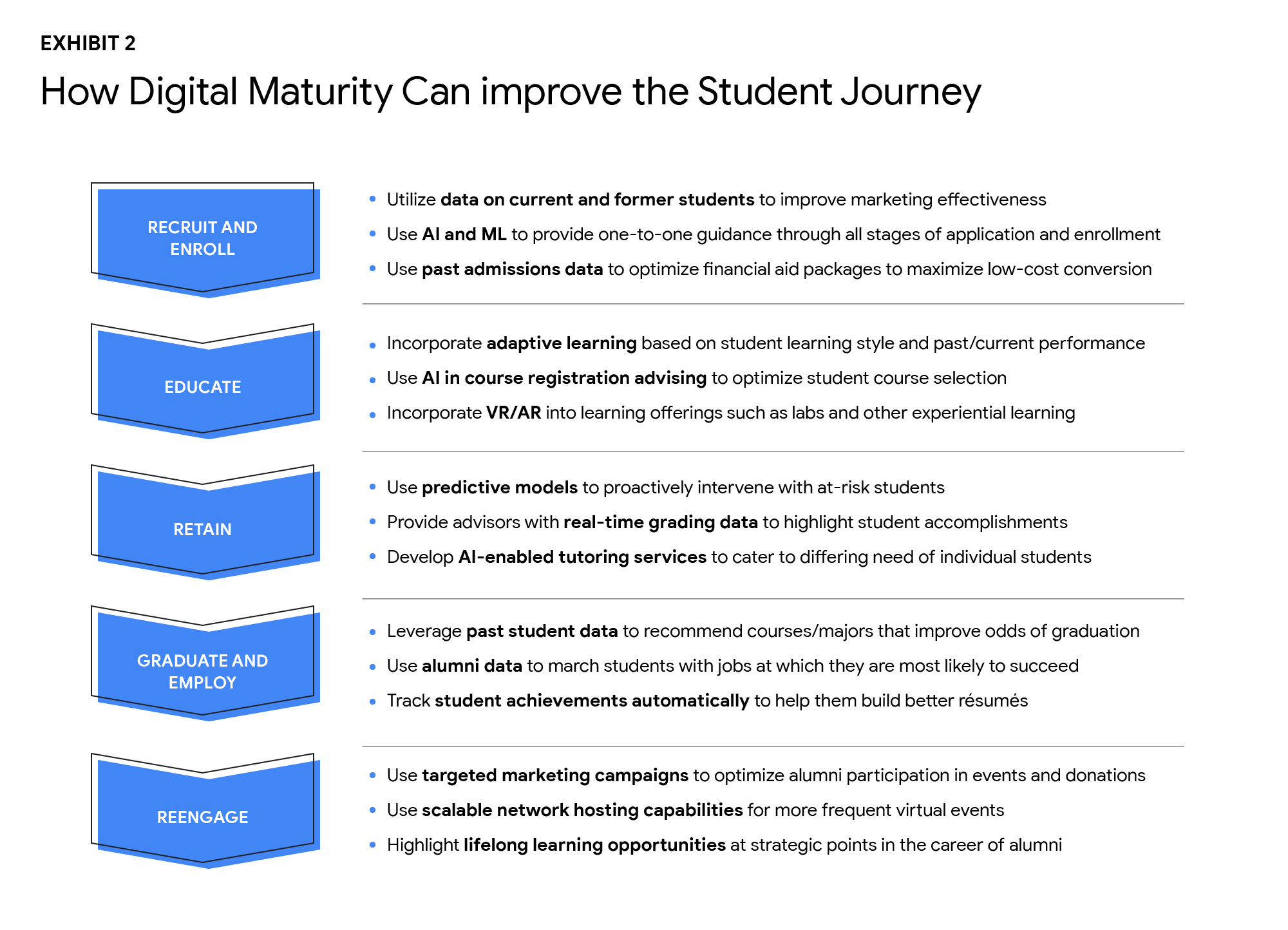
Digital solutions can improve the student journey in many ways
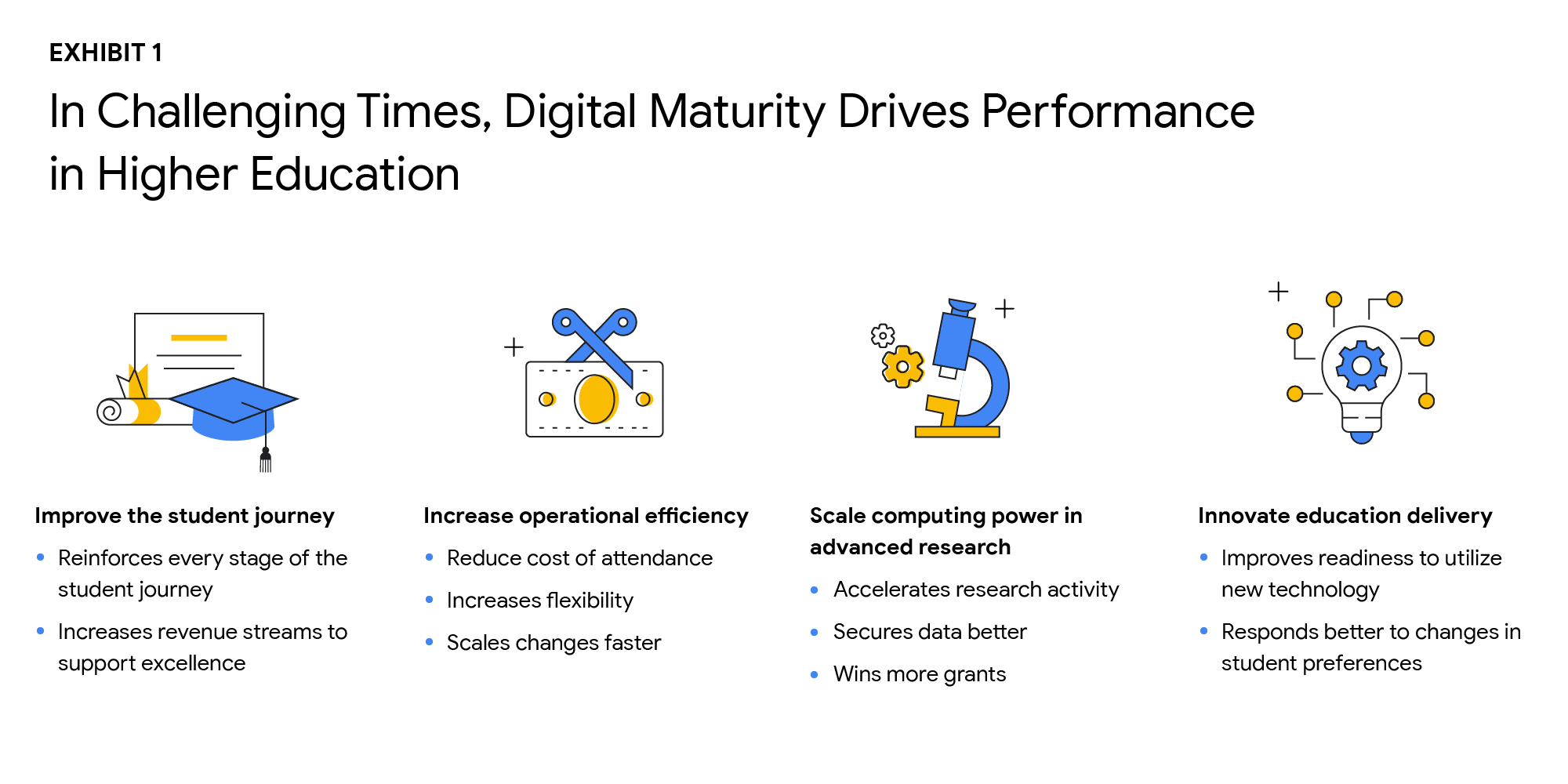
As digital capabilities hold the key to dealing effectively with declining enrollment and rising costs, higher ed leaders identified four goals that are critical to improving performance:
- Improve the student journey
- Increase operational efficiency
- Scale computing power in advanced research
- Innovate education delivery
The research found that technology investments can help enhance the student journey in the recruiting and retention of students, improving digital education delivery, government funding, and donations from alumni. Digital maturity can make institutions more agile and efficient in delivering education that aligns with the changing societal norms, evolving student preferences, and future disruptions. Survey participants shared that they plan to increase the use of the cloud by more than 50% over the next three years. By shifting legacy IT systems to the cloud, institutions can increase scalability, lower the cost of ownership, and improve operational agility, while offering a more secure, long-term data storage solution.
Cloud-native software-as-a-service (SaaS) solutions provide an excellent platform for centralizing data. However, institutions that attempt to “lift and shift” their legacy systems to the cloud may encounter challenges to achieving measurable improvements in data integration and cost reduction. Higher ed leaders must realize that centralizing data and transitioning to the cloud do not happen simultaneously.
Leaders who are able to articulate a strong vision and commitment will experience a more successful technology transformation. By linking their vision to specific needs, such as more effective recruiting, leaders will find their technology investments will have a more substantial return. University presidents should base their decisions about which systems to move, when, and how on desired performance outcomes.
Big visions become a reality with small steps. Small pilot projects are an excellent way to start the journey toward digital maturity. Small steps toward a significant transformation can reduce resistance to change, build positive momentum, and produce better student outcomes. Read the full report here. If you’d like to talk to a Google Cloud expert, get in touch.
The Future of Retail: Automated Customer Journeys Powered by Technology

3703
Of your peers have already read this article.
1:30 Minutes
The most insightful time you'll spend today!
Editor’s note: To kick off the new year and in preparation for NRF The Big Show, we invited partners from across our retail ecosystem to share stories, best practices, and tips and tricks on how they are helping retailers transform during a time that continues to see tremendous change. Please enjoy this entry from our partner.
If you put a pot of water on the stove, it doesn’t heat up instantly. It simmers slowly at first, eventually picking up steam to reach a rolling boil. The retail landscape is not so different. Capgemini’s research shows the sector has evolved over four generations, from the early days of fragmented outlets to omnichannel and customer-centric focuses, with a fifth generation on the horizon that promises to be centered on consumption.
- Generation 1: Fragmented outlets
- Generation 2: Chain concentration
- Generation 3: Omnichannel
- Generation 4: Consumer-centric
- Generation 5: Consumption-centric
Although incremental change allows companies to experiment and iterate during their digital journeys, the COVID-19 pandemic rapidly accelerated the evolution of online and contactless shopping. Evolution became a revolution, with most Consumer Product and Retail (CPR) companies still mastering the omnichannel generation of their digital transformation to create a seamless shopping experience. Companies that are more digitally mature are already aspiring to the consumer-centric phase, embracing opportunities made possible by technology such as personalization and automation.
What consumers want
Customers have more choices in how they shop and engage with brands. This has made it harder for brands to predict and anticipate needs across customer journeys. And that’s convincing some companies to innovate more quickly as consumer demand drives the need for speed and scale.
Think about your own online behavior. Say you’re shopping for an item and searching online for the closest store in your neighborhood. Google is likely your go-to for finding that information. Looking to troubleshoot an issue with a product or seek out a service? Again, you’ll likely hit up Google first, not even considering going directly to a brand’s website for answers.
Both scenarios point to a disconnect between virtual and physical worlds, a gap technology can bridge in numerous ways such as breaking down silos and integrating fragmented media channels. Interestingly, though, not everything will be centered online all the time. In our recent study on consumer behavior, The great consumer reset, Capgemini discovered 57 percent of shoppers plan to return to brick-and-mortar stores post-pandemic, which is basically unchanged from the 59 percent who often interacted with physical stores before.
But business as usual? Not even close. Consumers have come to expect a frictionless shopping experience (buy online, pick up in store) or an immersive one (products displayed online using augmented reality), and are not content to return to in-store lineups, empty shelves, or a one-size-fits-all approach. Moreover, customers want personalized interactions while ensuring their data and privacy are protected.
So the role of the store is changing. In fact, many online-only brands are opening brick-and-mortar establishments to drive customer experience. In our research on “smart stores,” we found the majority of consumers (66 percent) believe automation can improve their shopping experience by solving the challenges they face at retail stores.
From personalization to serendipity
Retailers must recognize that they have to win consumer trust and confidence. Many consumers believe retailers’ use of tech is focused on reducing costs rather than easing friction. And they’re right. That same Capgemini research found that only one-third (35 percent) of retailers consider “solving customer pain points” as the most important criteria when deciding which automation use cases to implement.
“Retailers are largely in the early stages of adopting automation, and that’s an opportunity to rethink how they’re using technology, not just to smooth out friction and engender consumer trust but to build unexpected consumer benefits,” says Neerav Vyas, Head of Customer First, Co-Chief Innovation Officer, Insights & Data, North America, Capgemini. “We’re trying to move towards this idea of delivering serendipitous experiences to bridge the physical and digital divide.”
The focus is not solely on shoppers seeking out a specific product. “When consumers are in an exploratory mood, retailers can recommend products and services customers didn’t even know they wanted,” says Vyas. For example, business teams that use personalization platforms as part of an integrated media strategy can optimize algorithms against outcomes such as improving conversion and driving engagement.
Vyas says the elevated experience from “personalization to serendipity” fosters trust in the ability of recommendation architectures to persuade and influence consumers’ choices in beneficial ways. A case in point: our research found that half (52 percent) of spending by millennials goes towards experience-related purchases. As always, the key is to meet consumers where they are. Even better, according to Vyas, is to anticipate and understand when signals like customer intent are changing.
How to create value throughout the customer journey
One solution companies can implement right now is an integrated media spend platform that incorporates reporting, planning, and strategy across the entire customer journey. This offers value throughout the customer journey by using technology to reduce friction along the way. Think of it as starting with the customer looking for a product (search and discovery), moving on to the purchase (omnichannel basket, “shoppable” screens) and pick up/delivery (QR code scan in store), and through to post-purchase engagement with the retailer (Google Contact Center AI).
Such a holistic approach also accelerates data acquisition, integration, and reporting using advanced analytics to break down silos and emphasize the importance of privacy and first-party data. This in turn guides end-to-end interventions across customer journeys that enable optimized media spend, empowers businesses to analyze their spend distribution, fine-tunes owned and paid tactics with agencies, and promotes stewardship to support audit efficacy.
A culture of experimentation
With this data-driven focus, CPRs can create a 360-degree perspective of the customer. That intelligence can be used to enhance and humanize automated shopping experiences by putting the customer in control, whether online, in store, or across company brands. Moreover, by using Google Cloud’s emerging technologies such as artificial intelligence (AI), we help companies accelerate value across the spectrum, from supply-chain optimization and customer innovation to consumer experience.
Building a culture of experimentation is a team effort. “It’s not ever just one person who had a big idea. It’s all incremental steps,” says Jennifer Marchand, Google Cloud COE Leader, Capgemini. “Finding the right use case and timing is everything.” Take Google Glass Enterprise, she continues. For greater consumer experience, it can enable in-store associates to better serve with hands-free checkout, customer personalization and recommendations, and special offers. At the same time, Computer Vision and Smart Shelves can help prioritize tasks for employees, notifying them of low stock or a spill in the store.
Marchand points out that companies and consumers alike might not be ready to fully adopt some technology like facial recognition, but since almost everyone has a smartphone these days, they can benefit from automation with ease. “What’s interesting,” she adds, “is the way Google thinks about these types of problems, solving them for the long term.”
The store of tomorrow
Imagine a truly frictionless shopping experience, where state-of-the-art computer vision and AI identifies the products you pick up, put back, and keep, allowing you to head home, completely bypassing the checkout, with a 99 percent accuracy rate and receipts sent directly to your mobile app. That utopian experience is already taking shape at CornerShop, Capgemini’s live experimental store in London, UK.
Jamie MacLoud, Transformation & Strategy Consultant at frog, part of Capgemini, describes the retail space, which runs on Google Cloud, as the store of tomorrow, and not the distant future. It’s an experiential space where retailers and brands can explore, develop, and test technological shopping innovations in real-time. The outcome is a clearer understanding of how digital innovation can enable new ways to progress the customer experience, improve in-store operations, and help consumers to rediscover the joy of in-person retail through new ways to shop and engage with brands.
“We build, test, and learn about store concepts of tomorrow that we believe could be implemented into actual stores in the next one to two years. Getting these experiences in front of real customers in the CornerShop allows us to generate tangible learnings that we can share with our clients and use to shape future store strategy” says MacLeod. CornerShop was opened to the public in two eight-week stints, which allowed real-time testing to see what technologies resonated with customers, which brands can adapt and scale. Frictionless checkout, not surprisingly, was a big win for customers, but the technology underpinning the “virtual try-on” of clothing was deemed more suitable for the store of the future.
So, unlike an innovation lab, CornerShop lets companies experiment risk free, speeding up the process from hypothesis to full-scale implementation. It’s also another step toward solving the challenges customers face, while delivering those serendipitous experiences that build brand loyalty and longevity.
Learn more about how Capgemini is partnering with Google Cloud to help retailers create next-generation shopping experiences today.
We would like to acknowledge Jamie MacLoud, Transformation & Strategy Consultant at frog, part of Capgemini and Neerav Vyas, Head of Customer First, Co-Chief Innovation Officer, Insights & Data, North America at Capgemini who supported with invaluable insights and subject matter expertise in the writing of this blog post.
More Relevant Stories for Your Company

Lufthansa: Wind Forecasting with Google Cloud ML Helps Increase On-time Flights
The magnitude and direction of wind significantly impacts airport operations, and Lufthansa Group Airlines are no exception. A particularly troublesome kind is called BISE: it is a cold, dry wind that blows from the northeast to southwest in Switzerland, through the Swiss Plateau. Its effects on flight schedules can be



How adidas’s Marketing Team Benefits from Google Cloud Marketing Platform
We live in a world where the consumer journey is no longer linear, making it difficult to know when to deliver a brand message or a product message. “We talk a lot about the consumer journey no longer being linear. It’s very difficult to know when the consumer is going

Quantum Metric Increases Business 10-fold
At Quantum Metric, we’re in the business of bringing our customers business insights that are based on customer experience data and analytics for mid-market and Fortune 500 companies. Our software, powered by big data, machine intelligence, and Google Cloud, helps our customers identify, quantify, prioritize and measure opportunities to improve



Signal Generation in the Investment Management Industry
Machine learning is seeing a lot of use cases in the financial sector. One of them is leverage AI to sift signal from noise and create insights or predictions that can give financial planners an edge. In this video, David Li, Head of Advanced Analytics, BlackRock and Colman Madden, Customer
