





The Power of Two: Best Practices for Mergers & Acquisitions on Google Cloud

3387
Of your peers have already read this article.
3:00 Minutes
The most insightful time you'll spend today!
Congratulations! Your company just acquired or merged with another organization, beginning an important new chapter in its history. But like with many business deals, the devil is in the details — particularly when it comes to integrating the two companies’ cloud domains and organizations. In this blog post, we look at how to approach mergers and acquisitions (M&A) from the perspective of Google Cloud. These are the best practices that your Google Cloud Technical Account Managers follow — or that we recommend you follow if you plan to perform the integration yourself.
Although there are various M&A scenarios, here are the two most common ones we will focus on:
- Both entities engaged in the M&A have some presence on Google Cloud and are looking for some level of integration
- Only one of the entities has a presence on Google Cloud, and is looking at best ways to work together
Depending on your situation, your approach to integrating the two companies will vary substantially.
When both companies have a Google Cloud presence
In the first scenario, let’s assume company A is acquiring company B. Prior to the M&A, both companies have their own Google Cloud Organizations — the top level structures in the Google Cloud resource hierarchy — and have one or more billing accounts associated with them. There are also various Folders and Projects below each Google Cloud Organization. In this scenario, here are the key questions to ask:
- How do you plan to integrate/consolidate two distinct Google Cloud Organizations?
- How do you plan to organize the billing structure?
- How do you handle Projects under the two Organizations?
- What is the identity management strategy for the two Organizations?
For each of these key questions, go ahead and formulate a detailed plan of action. If you have access to the Technical Account Manager service through Google Cloud Premium Support, you can reach out to them to further develop this plan.
Understanding Google Cloud Organizations
From an organizational integration standpoint, when each entity in an M&A has its own Google Cloud Organization, you have various options: no integration, partial, or full.
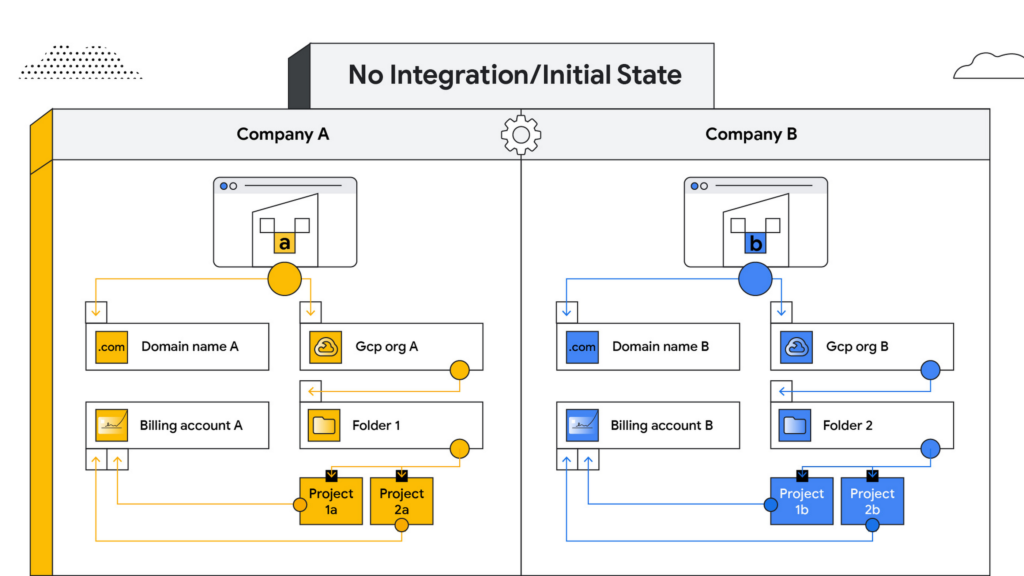
No integration – When company B operates as an independent entity from company A, no migration is required. One caveat is if company A has negotiated better pricing terms/discounts and support packages with Google Cloud. In that case, you can sign an affiliate addendum by working with your Google Cloud account team to help unlock the same benefits for company B.
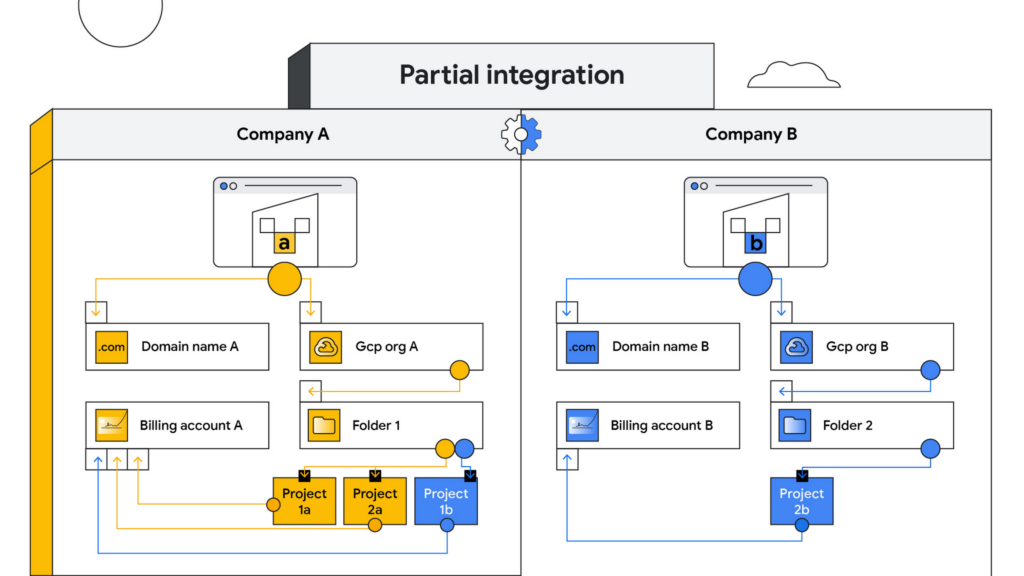
Partial integration – Some projects move over to company A from company B and others stay with Company B. There can be some shared access between the two companies and each of the organizations can continue to use their existing identity providers. This can be a self-serve or a paid services engagement with Google Cloud depending on the complexity of the two companies and how many project migrations need to take place between them.
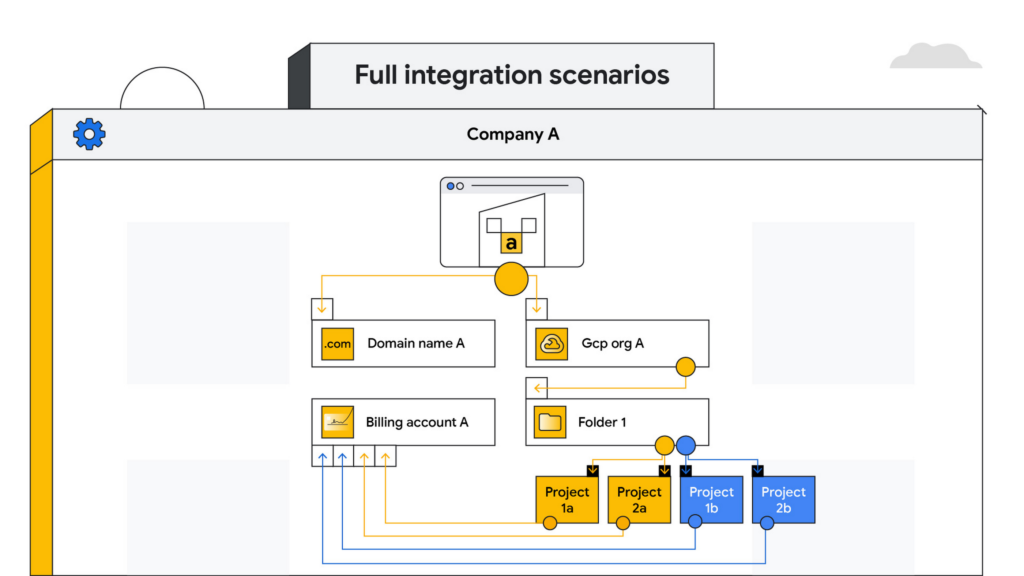
Full integration – Company B is fully incorporated into company A. This means you go through a full billing, Google Workspace identity and project migration from company B into company A. This can be a complex process and we highly recommend engaging your Google Cloud account teams to scope out a paid services engagement to go through this transition.
Planning your project migration
No matter what you want your end state to look like, project migration requires careful planning. Again, if you have an assigned Technical Account Manager, please reach out to them to ensure that you have a conversation around best practices before starting this migration.
If you’re taking a self-service approach, at a high level, we recommend leveraging the Resource Manager API to manage your project migrations. Do keep in mind that there are several prerequisites and required permissions documented here that need to be assigned before going down this path.
In addition, please be sure to read the billing and identity management considerations below to ensure that you are covering all of the bases associated with such a migration, as your choices can fundamentally alter your Google Cloud footprint.
Billing considerations
When deciding how to structure your Organizations and billing accounts, our recommendation is to always limit the number of Organization nodes and use the Folder structure to manage departments/teams within it. Creating additional Organization nodes is only advised in cases where you require a level of isolation for certain Projects from central administration for a specific business reason, for example, if the company being acquired already has their own Organization node and there is a business justification to let it operate as a standalone entity.
Warning: If you have multiple Organization nodes, be aware that you will not have central visibility across all your organizational resources, and that policy management across different Organization nodes can be cumbersome. You will also have to manage multiple Workspace accounts and manage identities across them, which can be difficult, especially when operating at scale.
From a billing account management perspective, our recommendation is to create one central billing account that lives within the Organization node with tags and labels incorporated for additional granularity. However, there are a few business cases which warrant the creation of additional billing accounts such as:
- You need to split charges for legal or accounting purposes
- Invoices are paid in multiple currencies
- You need to segregate usage to draw down on a Google Cloud promotional credit
- Subsidiaries need their own invoice
Keep in mind that committed-use and spend-based discounts and promotional credits cannot be shared across billing accounts and are provisioned on a per-billing-account basis. As such, more billing accounts can make it harder to leverage these discounts and credits.
Identity management
As you might expect, merging two entities has identity management implications. Cloud Identity is the solution leveraged by Google Cloud to help you manage your user and group identities. Even if the acquired company only uses the productivity products that are part of Google Workspace, the identities would still be managed by Cloud Identity.
Google Workspace considerations
To move large amounts of content into a Google Workspace domain, we recommend one of three options, depending on your end goal and data complexity:
- For general migrations: Leverage Google Workspace Migrate to move data into your Workspace domain from either another Workspace domain or a third-party productivity solution
- For manual migrations: Use the Export tool to move your organization’s data to a Cloud Storage archive so you can selectively download exported data by user and service
- For complex Google Workspace scenarios: Speak with your Google Cloud Technical Account Manager about the possibility of using a custom scoped engagement to merge two Google Workspace environments without business interruption
When only one company is on Google Cloud
Now, let’s consider the scenario where only company A has a presence on Google Cloud but company B does not. The approach you take to integrate the two organizations largely depends on your desired end state — full, partial or no integration.
If the plan is to eventually integrate company B into company A, your approach here will have a lot of similarities with the ‘full integration’ option mentioned above — just at a later point in time.
You may also run into a scenario where company B has a presence on an alternative cloud platform and you need to migrate resources into or out of Google Cloud. Again, similar to the partial integration option called out above, a paid engagement or a self-service exercise would be a good fit depending on the complexity of the desired end state.
Here to help
A merger or acquisition is an exciting milestone for any company, but one that needs to be managed carefully. Once you carefully review these considerations, develop a plan of action for your organization. You can also engage Google’s Professional Services for a paid engagement or Google’s Technical Account Management Service for a self-managed process to achieve the desired results.
If you are going through or considering going through M&A at your organization and have a different scenario than what we have discussed, please feel free to reach out to your account teams for guidance or contact us at https://cloud.google.com/contact.
LearningMate & Google Cloud Partnership to Aid Equitable Educational Opportunities

3447
Of your peers have already read this article.
1:30 Minutes
The most insightful time you'll spend today!
A “one size fits all” approach to education no longer works in today’s classrooms. Using cloud-based technologies, schools and educators can take a more personalized approach to education–one that suits each student’s unique learning style, abilities, and needs.
Taking the lead toward more equitable educational opportunities worldwide, education technology pioneer, LearningMate, is partnering with Google Cloud to offer intelligent, personalized learning via Google Cloud’s Student Success Services.
In a student survey by EDUCAUSE, a nonprofit association whose mission is to advance higher education through the use of information technology, nearly all respondents asked for more digital learning and study options. Given a list of educational material types, such as study guides and recorded lessons, 93 percent said they would like to have online access to at least two options and more than half (56 percent) chose seven or more.
The trend towards student choice challenges educators to reconsider how they teach and support learners. Students expect the same qualities in their lessons as they encounter in their other, non-school related digital experiences: personalization; user-friendliness; and engagement. Educators who are used to a more top-down education model can struggle to meet these new expectations.
Google Cloud created Student Success Services to help education institutions meet learners where they are—in the digital age. This suite of tools and services uses Google’s advanced artificial intelligence (AI) and analytic tools to:
- Engage with students via an AI-powered learning platform and interactive tutor
- Help educators and learners collaborate more effectively
- Provide current, actionable data on student progress
To bring our Student Success Services to more schools and organizations worldwide, we’re partnering with LearningMate — a global leader in digital learning infrastructure. LearningMate is a key go-to-market partner, helping schools design, launch, and maintain their own learning infrastructure. To start, LearningMate is adding Google’s AI-powered learning platform to its Frost platform, a popular content management for education.
As the education model continues to change and digital learning becomes the norm, disadvantaged students risk getting left behind. For these learners, the “digital divide” is very real, and stands to hinder them further–not only in school, but in society and the workplace in later life.
“The gap will only widen between those with digital advantages and those who struggle to gain access to devices and network necessities,” EDUCAUSE states. To meet all these challenges, schools need a diverse mix of tools, methods, and partnerships.
To help close the digital divide among students, digital tools need to be able to scale up or down so institutions and districts of any size and budget can use them. Google Cloud designed Student Success Services with this ability in mind. By offering these services, LearningMate aims to ensure that even schools with smaller teams and fewer resources can offer individualized learning experiences to their students.
With LearningMate and Google’s nearly 40 years of combined experience in education, this partnership aims to help educators better understand their students’ engagement, performance, and preferences. To learn more about Student Success Services and our collaboration with LearningMate, watch this session from our Government and Education Summit.
Towards The Next Wave of Google Cloud Infrastructure Innovation: New C3 VM and Hyperdisk
2803
Of your peers have already read this article.
3:00 Minutes
The most insightful time you'll spend today!
Meeting the rapidly growing demands of our customers’ high performance computing and data-intensive workloads requires deep innovation — at Google Cloud, we know we can’t rely on ever-faster CPUs alone, like Moore’s Law has enabled in the past. Customers can either optimize their workloads for a given platform, or we can offer them a platform that is optimized for their specific needs. At Google Cloud, we choose the latter.
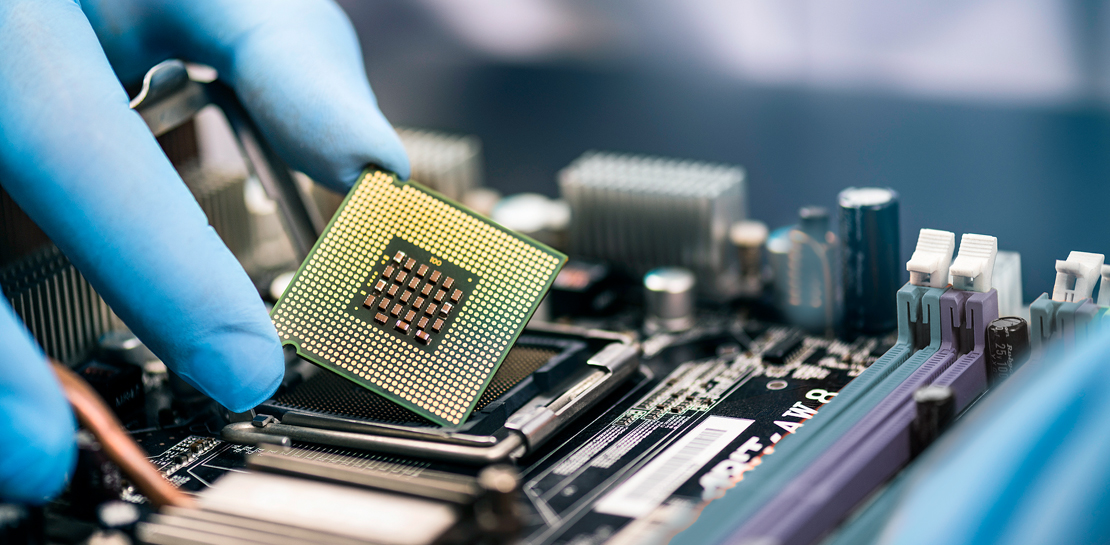
Today, we have an exciting new release resulting from these efforts: the new C3 machine series powered by the 4th Gen Intel Xeon Scalable processor and Google’s custom Intel Infrastructure Processing Unit (IPU). Along with the recently announced Hyperdisk block storage which offers 80% higher IOPS per vCPU for high-end database management system (DBMS) workloads when compared to other hyperscalers. C3 machine instances can deliver strong performance gains to enable high performance computing and data-intensive workloads. Customers such as Snap, for example, have seen approximately a 20% increase in performance for a key workload over the previous generation C2.
The C3 machine series is just the latest example of this architectural approach. For over two decades, Google has purpose-built and designed some of the world’s most efficient and scalable computing systems to meet the needs of our customers. We built the Tensor Processing Unit (TPU) to power real-time voice search, photo object recognition, and interactive language translation; unveiled Titan, a secure, low-power microcontroller to help ensure that every machine boots from a trusted state; and launched Video Coding Units (VCUs) to enable video distribution that addresses a range of formats and client requirements. We engineer golden paths from silicon to the console, using a combination of purpose-built infrastructure, prescriptive architectures, and an open ecosystem to deliver what we term workload-optimized infrastructure.
Getting to know the C3 machine series
The Compute Engine C3 machine series, now available in Private Preview, is the first VM in the public cloud with the 4th Gen Intel Xeon Scalable processor and with Google’s custom Intel IPU. C3 machine instances use offload hardware for more predictable and efficient compute, high-performance storage, and a programmable packet processing capability for low latency and accelerated, secure networking.
“We are pleased to have co-designed the first ASIC Infrastructure Processing Unit with Google Cloud, which has now launched in the new C3 machine series. A first of its kind in any public cloud, C3 VMs will run workloads on 4th Gen Intel Xeon Scalable processors while they free up programmable packet processing to the IPUs securely at line rates of 200Gb/s. This Intel and Google collaboration enables customers through infrastructure that is more secure, flexible, and performant.” – Nick McKeown, Senior Vice President, Intel Fellow and General Manager of Network and Edge Group
The System on a Chip hardware architecture introduced in C3 VMs can enable better security, isolation, and performance. In the future, this purpose-built architecture will also allow us to offer a richer product portfolio, such as support for native bare-metal instances.
Hyperdisk block storage and 200 Gbps networking
Block storage and VMs go hand in hand. Last month, we announced the Preview release of Hyperdisk, our next-generation block storage. The new architecture decouples compute instance sizing from storage performance to deliver 80% higher IOPS per vCPU than other leading hyperscale cloud provider. And compared with the previous generation C2, C3 VMs with Hyperdisk deliver 4x higher throughput and 10x higher IOPS. Now, you don’t have to choose expensive, larger compute instances just to get the storage performance you need for data workloads such as Hadoop and Microsoft SQL Server.
To enable high performance computing workloads, C3 VMs also feature 200 Gbps low-latency networking powered by our custom IPU, as well as line-rate encryption using the open source PSP protocol.
What our customers and partners are saying

“We were pleased to observe a 20% increase in performance over the current generation C2 VMs from Google Cloud in testing with one of our key workloads. These continued performance improvements enable better end user experience and application cost efficiency.” – Aaron Sheldon, Sr. Software Engineer, Snap Inc.

“Based on the initial performance data, running weather research and forecasting (WRF) on C3 clusters can deliver as much as 10x quicker time to results for about the same computational cost. This will significantly accelerate R&D for our customers in weather, environment, and engineering domains.” — Michael Wilde, CEO, Parallel Works Inc.

“In early testing with our flagship products, including Ansys Fluent, Mechanical and LS-DYNA, on the new Google Cloud C3 VM, we’re seeing up to 3x performance gains over C2 VMs due to higher memory bandwidth and lower network latency.” – Shane Emswiler, Senior Vice President of Products, Ansys
Where we are headed
With the exponential rise in the complexity of cloud infrastructure, we as an industry must turn to automation to manage these platforms efficiently at scale. Along with Infrastructure as Code, custom chips like the Titan, the TPU and the IPU, pave the way for a not-so-distant future where we’ll automate over half of all infrastructure decisions, configuring systems dynamically in response to usage patterns. At Google Cloud, we are committed to continuing our long history of hardware innovation with a focus on workload optimization and automation.
To learn more about C3 VMs and Hyperdisk, check out our session at NEXT ‘22, How Google Cloud optimizes infrastructure for your workloads. To request access to the C3 VMs or Hyperdisk, please reach out to your sales representative or account manager.
Accelerating business growth with a seamless migration to Google Cloud

3499
Of your peers have already read this article.
2:30 Minutes
The most insightful time you'll spend today!
In today’s hybrid office environments, it can be difficult to know where your most valuable, sensitive content is, who’s accessing it, and how people are using it. That’s why Egnyte focuses on making it simple for IT teams to manage and control a full spectrum of content risks, from accidental data deletion to privacy compliance.
I used to be an Egnyte customer before joining the team, so I’ve experienced first-hand the transformative effects that Egnyte can have on a company. Because data is fundamental to a company’s success, we take the trust of our 16,000 clients very seriously. There is no room for error with a cloud governance platform, which means that the technology providers we work with can’t fail either. That’s why we work with Google Cloud.
Since Egnyte was founded in 2007, we have delivered our services to clients 24/7. We do this by running our own data centers: two in the USA and one in Europe. But as the company continued its steady growth, owning and managing these data centers became unsustainable. There’s a tremendous amount of work that goes into managing everything that we need from a data center. Not only were we constantly building, maintaining, and paying for all this infrastructure, but we’d have to constantly expand our data centers to accommodate our business growth. This caused a never-ending pipeline issue because we had to predict how many businesses we were going to win over the next 12 to 18 months. What if we planned to grow the business by 20%, and ended up growing by 25% instead?
We knew that being limited to our own data centers was going to negatively impact our business, so we looked for alternatives. To gain scalability and introduce another layer of reliability to our business, we decided to collaborate with a reputable cloud provider who could reliably back up our data. We examined the offerings of every cloud provider, and found that in every category that we analyzed, Google was hands-down the winner.
One of these categories is the reach of the network. With its own transoceanic fiber with points of presence in all markets where we’re currently doing business as well as markets where we intend to do business one day, Google network is second to none. Another important criteria for us was flexibility in the product offering, so we could better consider the financial risks of this large-scale data migration. For a while, we needed to pay for both our new cloud infrastructure and our old on-premises one while they overlapped during the migration, but Google Cloud made it easier for us to plan for this.
By December 2021, we had completed our full migration to Google Cloud. This significant migration was completed gradually and without disrupting our services at any point. Our close collaboration with the Google Cloud team is one of the big reasons we completed this so successfully. Google Cloud was able to anticipate some of the problems we’d likely be facing and helped us overcome them along the way.
We were able to shut off our last data center in February 2022, and the beneficial changes to the business are already obvious. Capacity planning, which used to be our biggest challenge on-premises, is now a problem of the past. The ability to spin up new resources on Google Cloud means we no longer need to buy additional resources a year in advance and wait for them to be shipped.
Using Google Cloud means that we no longer rely on aging infrastructure, which is a very limiting factor when you’re developing and engineering a platform as complex as Egnyte. Our entire platform is now always operating on the latest storage, processing, network, and services available on Google Cloud.
Additionally, we have services embedded on our infrastructure such as Cloud SQL, Cloud Bigtable, BigQuery, Dataflow, Pub/Sub, and Memorystore for Redis, which means we no longer need to build services from scratch or shop, install, and build them into the product and company work flow. There’s a long list of Google Cloud services that have significantly simplified our processes and that now support our flagship products, Egnyte Collaborate and Secure and Govern.
Looking ahead, we’ll continue to take advantage of what Google Cloud has to offer. Our migration has impacted not only our business but also our clients. We can offer even higher reliability and faster scalability to our clients whenever they need our platform to protect and manage critical content on any cloud or any app, anywhere in the world. We look forward to seeing what’s next.
Intel-Google Collaboration Brings Edge Computing on Factory Floors: Hannover Messe 2022
3235
Of your peers have already read this article.
1:30 Minutes
The most insightful time you'll spend today!
The typical smart factory is said to produce around 5 petabytes of data per week. That’s equivalent to 5 million gigabytes, or roughly 20,000 smartphones.
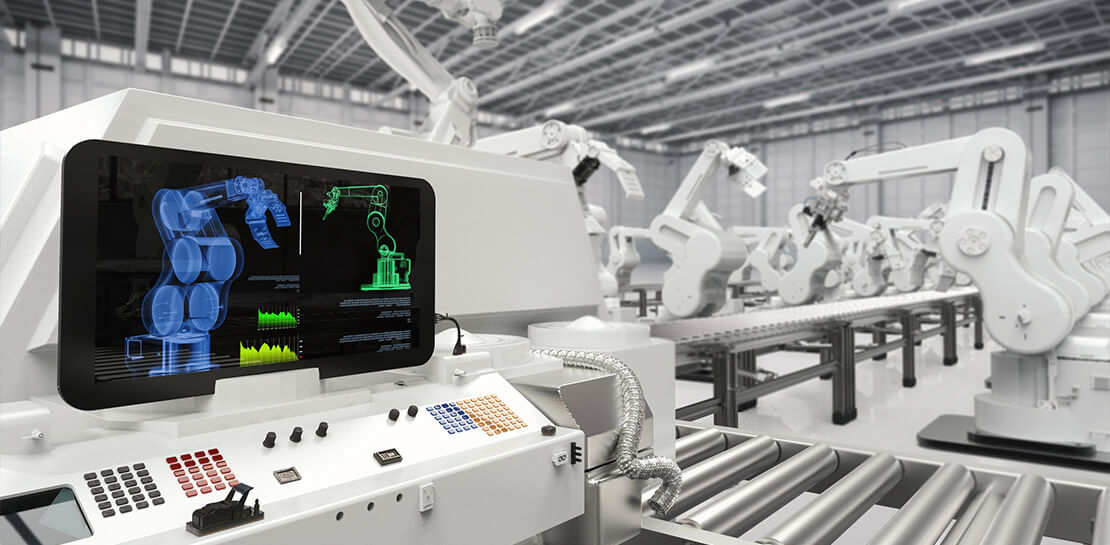
Managing such vast amounts of data in one facility, let alone a global organization, would be challenging enough. Doing so on the factory floor, in near-real-time, to drive insights, enhancements, and particularly safety, is a big dream for leading manufacturers. And for many, it’s becoming a reality, thanks to the possibilities unlocked with edge computing.
Edge computing brings computation, connectivity, and data closer to where the information is generated, enabling better data control, faster insights, and actions. Taking advantage of edge computing requires the hardware and software to collect, process, and analyze data locally to enable better decisions and improve operations.
At Hannover Messe 2022, Intel and Google Cloud will demonstrate a new technology implementation that combines the latest generation of Intel processors with Google Cloud’s data and AI expertise to optimize production operations from edge to cloud. This proof-of-concept project is powered by the Edge Insights for Industrial platform (EII), an industry-specific platform from Intel; and a pair of Google Cloud solutions: Anthos, Google Cloud’s managed applications platform, and the newly-launched Manufacturing Data Engine.
Edge computing exploits the untapped gold mine of data sitting on-site and is expected to grow rapidly. The Linux Foundation’s “2021 State of the Edge” predicts that by 2025, edge-related devices will produce roughly 90 zettabytes of data. Edge computing can help provide greater data privacy and security, and can accomodate the reduced bandwidth needs between local storage and the cloud.
Imagine a world in which the power of big data and AI-driven data analytics is available at the point where the data is gathered to inform, make, and implement decisions in near real-time.
This could be anywhere on the factory floor, from a welding station to a painting operation or more. Data would be collected by monitoring robotic welders, for example, and analyzed by industrial PCs (IPCs) located at the factory edge. These edge IPCs would detect when the welders are starting to go off spec, predicting increased defect rates even before they appear, and adding preventive maintenance to correct the errors without any direct intervention. Real time, predictive analytics using AI could substantially prevent defects before they happen. Or the same IPCs could use digital cameras for visual inspection to monitor and identify defects in real-time, allowing them to be addressed quickly.
Edge computing has powerful potential applications in assisting with data gathering, processing, storage and analysis in many manufacturing sectors, including automotive, semiconductor and electronics manufacturing, and consumer packaged goods. Whether modeling and analysis is done and stored locally or in the cloud, or is predictive, simultaneous, or lagged, technology providers are aligning to meet these needs. This is the new world of edge computing.
The joint Intel and Google Cloud proof of concept aims to extend the Google Cloud capabilities and solutions to the edge. Intel’s full breadth of industrial solutions, hardware and software, are coming together in this edge-ready solution, encompassing Google Cloud industry-leading tools. The concept shortens the time to insights, streamlining data analytics and AI at the edge.
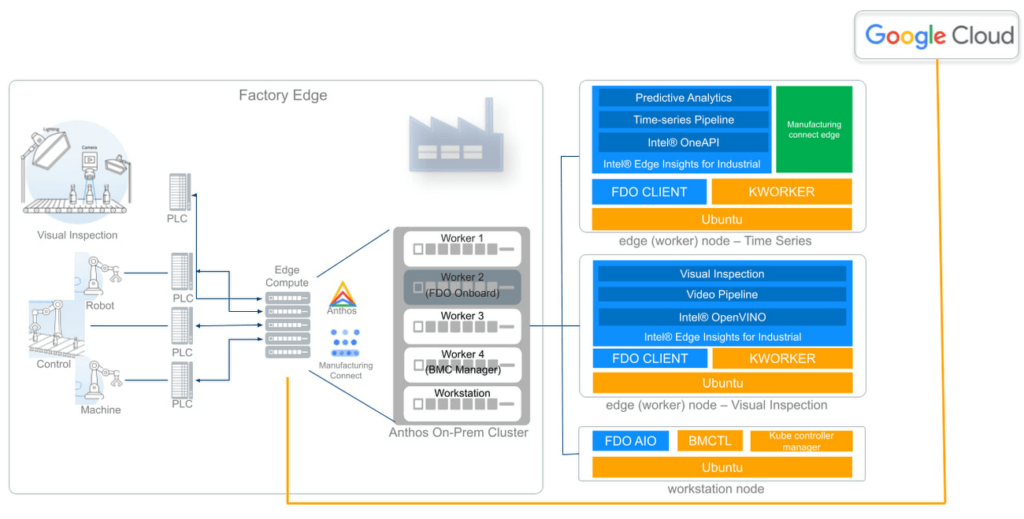
The Intel-Google Cloud proof of concept demonstrates how manufacturers can gather and analyze data from over 250 factory devices using Manufacturing Connect from Google Cloud, providing a powerful platform to run data ingestion and AI analytics at the edge.
In this demonstration in Hannover, Intel and Google Cloud show how manufacturers can capture time-series data from robotic welders to inspect welding quality and show how predictive analytics can benefit the factory operators. In addition, the video and image data is captured from a factory camera to show how visual inspection can highlight anomalies on plastic chips with model scoring. The demo also features zero-touch device onboarding using FIDO Device Onboard (FDO) to illustrate the ease with which additional computers could be added to the existing Anthos cluster.
By combining Google Cloud’s expertise in data, AI/ML and Intel’s Edge Insight’s for Industrial platform that was optimized to run on Google Anthos, manufacturers can run and manage their containerized applications at the edge, in on-premise data center, or in public clouds using an efficient and secure connection to the Manufacturing Data Engine from Google Cloud. It forges a complete edge-to-cloud solution.
Simplified device onboarding is available using Fido Device Onboard (FDO)—an open IoT protocol that brings fast, secure, and scalable zero-touch onboarding of new IoT devices to the edge. FDO allows factories to easily deploy automation and intelligence in their environment without introducing complexity into their OT infrastructure.
The Intel-Google Cloud implementation can analyze that data using localized Intel or third-party AI and machine learning algorithms. Applications can be layered on the Intel hardware and Anthos ecosystem, allowing customized data monitoring and ingestion, data management and storage, modeling, and analytics. This joint PoC facilitates and support improved decision making and operations, whether automated or triggered by the engineers on the front lines.
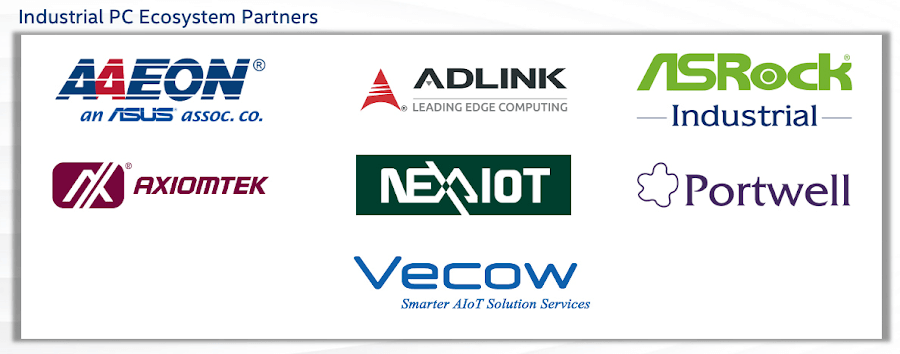
Intel collaborates with a vibrant ecosystem of leading hardware partners to develop solutions for the industrial market by using the latest generation of Intel processors. These processors can run data intensive workloads at the edge with ease.
Putting data and AI directly into the hands of manufacturing engineers can improve quality inspection loops, customer satisfaction, and ultimately the bottom line.
The new manufacturing solutions will be demonstrated in person for the first time at Hannover Messe 2022, May 30–June 2, 2022. Visit us at Stand E68, Hall 004, or schedule a meeting for an onsite demonstration with our experts.
Customer Search Experience that Takes Advantage of Enterprise Edge Capabilities!

3432
Of your peers have already read this article.
4:00 Minutes
The most insightful time you'll spend today!
Every year at CES, people from around the world experience the latest and greatest that consumer tech has to offer. In 2021, CES will be in an all-digital format for the first time.
So how can a virtual show like CES create immersive experiences for attendees tuning in remotely? That’s an interesting challenge for the cloud, and of course, every challenge presents an opportunity.
Google Cloud and 5G help enterprises deliver new experiences
Earlier in 2020, we announced our enterprise telecommunications strategy to deliver workloads to the network edge on Google Cloud, and during our SearchOn event last October, we announced how cloud streaming technology can power augmented reality (AR) in consumer search results.
Now, we’re merging the best of both worlds: Technology built for consumer search can take advantage of our enterprise edge capabilities. In light of the COVID-19 pandemic, this past year accelerated our support for enhanced consumer experiences across the board in novel ways. For example, we attempted to address questions such as how potential buyers can make a purchasing decision when they can’t see the product up close. This question becomes even more critical when considering a large purchase such as a new car.
That’s exactly what Fiat Chrysler Automobiles (FCA) and Google Cloud are working together to solve. As part of FCA’s Virtual Showroom CES event, you can experience the new innovative 2021 Jeep Wrangler 4xe by scanning a QR code with your phone. You can then see an Augmented Reality (AR) model of the Wrangler right in front of you—conveniently in your own driveway or in any open space. Check out what the car looks like from any angle, in different colors, and even step inside to see the interior with incredible details.
“As we continue our journey towards becoming a customer-centric mobility company, FCA is adopting emerging technologies that enable us to accelerate and deliver at the speed of our customers’ expectations,” said Mamatha Chamarthi, Chief Information Officer, FCA – North America and Asia Pacific. “Through our collaborative partnership with Google, we are able to expand our efforts to provide an immersive customer experience.”
Harnessing the power of edge with 5G
In order to create a mixed-reality experience with a 3D car model, computer-aided design (CAD)-based data sources that represent a 3D vehicle with highly detailed geometry, depth, texture, and lighting were used. High-fidelity models, such as cars with full interiors, often mean large files (GBs in size). Traditionally, depending on your connection, this can result in long waiting times as assets are downloaded onto your phone. In addition, while mobile phones are more powerful than the Apollo Guidance Computer, they are no match for the power we have in the cloud. We still want to bring these high end experiences to everyone, regardless of their respective device or geographical location.
We solve this problem by rendering the model in Google Cloud, then streaming it to the devices.
Specifically, the Cloud AR tech uses a combination of edge computing and AR technology to offload the computing power needed to display large 3D files, rendered by Unreal Engine, and stream them down to AR-enabled devices using Google’s Scene Viewer. Using powerful rendering servers with gaming console grade GPUs, memory, and processors located geographically near the user, we’re able to deliver a powerful but low friction, low latency experience. This rendering hardware allows us to load models with tens of millions of triangles and textures up to 4k, allowing the content we serve to be orders of magnitude larger than what’s served on mobile devices (i.e., on-device rendered assets). Doing so leverages high-speed 5G connectivity and streams directly from Google Cloud’s distributed edge, delivering a rich, photorealist immersive experience. Customers like FCA benefit from Google’s years of investment and expertise in streaming technology (have you tried playing Cyberpunk2077 on Stadia yet?). With the expansion of 5G networks, not only will streaming enable the experience for anyone anywhere, but it will also cut the wait time of downloading large assets required for detailed AR/VR experiences, ultimately providing instant gratification.
Applications and experiences are at the core of a winning edge proposition
We’re working to make these capabilities available to all enterprise customers to enable innovative use cases such as leveraging AR to help design teams collaborate, technicians perform machine diagnostics, creating next-generation, live video experiences for sports events, enabling new customer experiences across many industries, and supporting our customers in their digital transformation. Stay tuned!
To see the Jeep Wrangler 4xe come to life whether you’re attending CES or not, scan the QR code below, or check out the FCA CES website. Depending on your OS, device, and network strength, you will see either a photorealistic, cloud-streamed AR model or an on-device 3D car model, both of which can then be placed in your physical environment.
More Relevant Stories for Your Company

VM End-to-end: Series Transcript on Conversation on VMs and their Role to Cloud-native Future
VMs and their relevance to a cloud-native future: A conversation Last week, we published the first episode of VM End-to-End, a series of curated conversations between a “VM skeptic” and a “VM enthusiast”. Join Brian and Carter as they explore why VMs are some of Google’s most trusted and reliable offerings, and how

Making Weather Predictions Easy with Weather Research and Forecasting (WRF) Models on Google Cloud!
Weather forecasting and climate modeling are two of the world's most computationally complex and demanding tasks. Further, they’re extremely time-sensitive and in high demand — everyone from weekend travelers to large-scale industrial farming operators wants up-to-date weather predictions. To provide timely and meaningful predictions, weather forecasters usually rely on high

Datashare for Financial Services: Securing the Publishers and Consumers’ Access to Market Data
Access to the cloud has advanced the distribution and consumption of financial information on a global scale. In parallel, the global financial data landscape has been transformed by an influx of alternative data sources, including social media, meteorological data, satellite imagery, and other data. Exchanges and market data providers now

Giving Customers More Choice: Google Cloud’s New Product and Pricing Options
Over the past several years, Google Cloud has made significant investments in our infrastructure product portfolio. We launched new Tau T2D VMs, which deliver 42% better price-performance vs. other leading cloud providers. We upgraded Cloud Storage to offer more flexibility to support customers’ enterprise and analytics workloads, with dual-region buckets
