





7 Fantastic Ways Google Cloud VMWare Engine Stands Out from the Rest for Running VMWare Workloads in the Cloud!

3600
Of your peers have already read this article.
2:00 Minutes
The most insightful time you'll spend today!
Google Cloud VMware Engine delivers an enterprise-grade, cloud-native VMware experience that is built on Google Cloud’s highly performant and scalable infrastructure. By enabling a consistent VMware experience, the service allows customers to adopt Google Cloud rapidly, easily, and with minimal modifications to their vSphere workloads, bringing the best of VMware and Google Cloud together on one platform for a variety of use-cases. These include rapid data center exit, application lift and shift, disaster recovery, virtual desktop infrastructure, or modernization at your own pace.
Here are seven ways VMware Engine outshines alternatives for running your VMware workloads in the cloud, simplify your operations, and help you innovate faster:
- Dedicated 100Gbps east-west networking
Google Cloud VMware Engine nodes come with redundant switching and dedicated 100Gbps east-west networking with no oversubscription of bandwidth, unlike other options where there is generally oversubscription. This is especially important when it comes to running latency-sensitive workloads. - Four 9’s of availability in a single zone
The service offers 99.99% uptime SLA for a cluster in a single Zone with five to 16 nodes and FTT=2 or more without the need for stretched clusters, which is higher than the alternatives. Further, dedicated connectivity for core service functions such as vSAN and vMotion enables better solution stability and availability. This enables the service to support the needs of enterprise workloads that require high availability.
Note: “Cluster” means a deployment of three or more dedicated bare metal nodes running VMware ESXi and associated networking managed via management interfaces.
- Global networking without complex routing
Google Cloud VMware Engine networking is built based on Google Cloud’s powerful networking architecture. With simplified regional and global routing modes—which allow a VPC’s subnets to be deployed in any region where our service is available—you can architect global networks without the need or overhead of creating and connecting regional network designs. You get instant, direct Layer 3 access between them. In alternative cloud environments, you may have to configure special networking between regions, often requiring VPN-based tunnels over the WAN to enable global uniform network communication. This adds to the deployment and operational complexity, in addition to cost. - Integrated multi-VPC networking
Users often have application deployments in different VPC networks, such as separate dev/test and production environments or multiple administrative domains across business units. The service supports “many-to-many” access from VPC networks to Google Cloud VMware Engine networks with multi-VPC networking, allowing you to retain existing deployed architectures and extend them flexibly to your VMware environments. In addition, by providing multi-VPC networking, you can pool their VMware needs—say for QA and dev—to a smaller set of clusters, effectively reducing their costs.
For more information about the end-to-end networking capabilities and services available in Google Cloud VMware Engine, please refer to the Private Cloud Networking for Google Cloud VMware Engine whitepaper. Here, you’ll find details about network flows, configuration options, and the differentiated benefits of running your VMware workloads in Google Cloud.
- Unified, cloud-integrated model
Google Cloud VMware Engine is a fully managed Google first-party service, operated and supported by Google and its world-class team. With fully integrated identities, billing, and access control, you have a simpler end-to-end experience that is different from other services. You access Google Cloud VMware Engine service via the Google Cloud console, like any other Google Cloud service. You can also access other native Google Cloud services privately from your VMware private cloud running in Google Cloud VMware Engine over local connections. - Flexibility in third-party ecosystem compatibility
With Google Cloud VMware Engine, you can set up existing VMware on-premises third-party tools or products that require additional privileges by using a solution user account. This uniquely enables operational consistency, ensuring that the tools you have invested in and used over the years work on Google Cloud VMware Engine. Furthermore, in key areas such as vSAN data encryption, you have the choice of not only using Google Cloud Key Management Service (KMS)—which is turned on by default on vSAN datastores—but also external KMS providers such as HyTrust, Thales, and Fortanix. - Dense nodes with high storage:core and memory:core ratios and fast provisioning
Google Cloud VMware Engine nodes are dense. Each node is powered by Intel® Xeon® Scalable Processors and comes with 36 cores, 72 hyperthreaded cores, 768 GB memory, 19.2 TB NVMe data and 3.2 TB NVMe cache storage. This, along with oversubscription, leads to high consolidation ratios and compelling storage:core per dollar and memory:core per dollar. In addition, you can rapidly spin up these nodes in a VMware private cloud often in under an hour, enabling on-demand, VMware-consistent capacity in Google Cloud for your needs.
These are just a few examples of customer-centric innovation that set Google Cloud VMware Engine infrastructure apart. In addition, migrating to Google cloud can save you up to 38% in TCO. Get started by learning about Google Cloud VMware Engine and your options for migration, or talk to our sales team to join the customers who have embarked upon this journey.
The authors would like to thank the Google Cloud VMware Engine product team for their contributions on this blog.
How to Get Your Cloud Migration Journey Started Off on the Right Foot

3615
Of your peers have already read this article.
2:30 Minutes
The most insightful time you'll spend today!
When moving to the cloud, many organizations concentrate their focus on the change in technology, and overlook an area just as complex: cultural change.
At Google, we’ve spent years nurturing our culture and workforce to best operate in the cloud, and the Google Cloud Professional Services team leverages the lessons we’ve learned for the benefit of enterprise customers embarking on their own cloud journeys.
While it can be tempting to believe in a universally ‘correct’ strategy for change management, there is no one-size-fits-all answer. Every organization will have its own unique considerations. But with that said, there are some core strategies we’ve found to be relevant and useful across a broad range of businesses.
1. Define your purpose for moving to Cloud
While pockets of cloud use and experimentation can evolve independently and in parallel across an organization, it’s important to make some deliberate decisions before starting a larger migration. At this stage, we recommend having a detailed answer to two key questions to ensure a successful cloud migration:
- Where do you want to go? (Or “What’s your cloud vision?”)
- How do you plan to get there?
Start by having a conversation with leaders and those who will be key to the journey about how far you want to push your cloud vision. This alignment ensures everyone is on the same page—and will provide greater direction, allowing more deliberate action.
2. Find the change path which is right for you
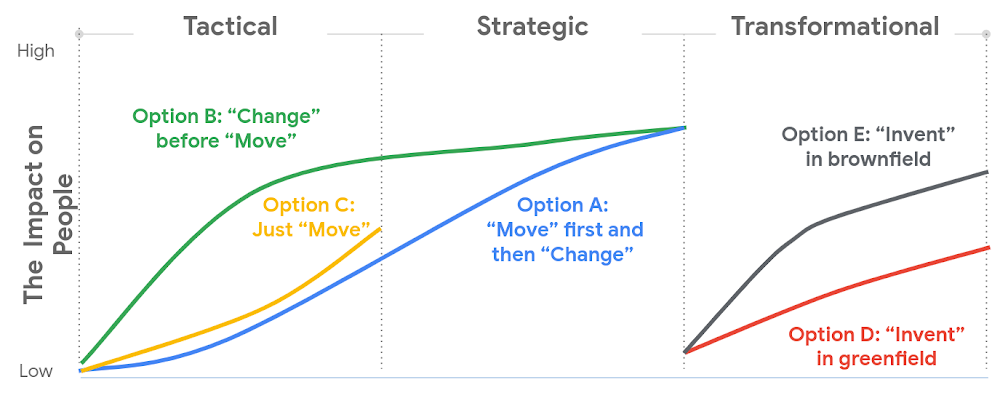
Whether a ‘lift and shift’ approach to the cloud is right for you, or a more transformative approach with a lot of re-architecting—the most important thing is to find the flavor of change which is appropriate to your context and level of ambition.This will both shape your key migration activities, but also the level of impact to be managed within your organization.
There are many ways to embark on a change journey for cloud migration (which one can find in the chart below). It is important to deeply understand the needs of your business and its people and determine what strategy makes the most sense.
3. Learn from best practices
Based on the lessons we’ve learned along our own journey, and the work we’ve done with customers, there are a number of recommendations we can share that can make a cloud migration more successful. We go into these in more detail in our new whitepaper, but below you can find the ones we think are most relevant:
- Share the vision—and measure, measure, measure. Once you’ve crystallised your cloud vision with leadership and key stakeholders, share that vision widely. Set success goals and communicate them to hold yourself accountable.
- Be clear about the capabilities you will need in the future—and where you’ll get them. For example, if your vision is to become a cloud-first, data and AI-led organization, ensuring you have the right data science skills and machine learning capabilities in your organization to achieve that vision becomes a critical step—be they home-grown or bought-in.
- Find the right balance between capabilities that should be under central control, and capabilities that should be decentralized, or agile. For example, should machine learning be something that sits centrally, or should it be spread across your organization? For every business, the solution will be a little different, and there’s no “one true answer.” There’ll be lots of different opinions about this, so the sooner the conversation starts, the better.
- Start thinking about the needed tech and non-tech skills now, and how you’ll fill the gaps. Building the tech skills will take time, and not everyone will feel comfortable with the future picture of collaboration, innovation, and agility.
To help businesses navigate their own cloud journeys, Google Cloud Professional Services has released a new whitepaper that can help guide organizations. “Managing Change in the Cloud” is closely aligned with the Google Cloud Adoption Framework and is a practical guide for organizations looking to maintain momentum in their cloud adoption. You can download the whitepaper here.

The Cloud-First Imperative to Accelerate Digital Transformation in BFSI
DOWNLOAD WHITEPAPER3391
Of your peers have already downloaded this article
1:30 Minutes
The most insightful time you'll spend today!
In a study of 60 business and technology decision makers and influencers from Indian BFSI organizations, conducted by Forrester Consulting, it is revealed that public cloud adoption in India is on the rise with 78% of the organizations intending to increase the number of secure or compliance-sensitive workloads in the cloud.
According to the study, public cloud platforms help BFSI organizations to:
- Improve customer experience
- Free up IT time to focus on core differentiators instead of commodity workloads
- Reduce reliance on legacy infrastructure
- Help to scale business faster and more easily
Download this infographic to understand why Indian BFSI organizations are adopting a cloud-first approach to accelerate digital transformation.
Transform Your Business: Comprehensive Cloud Services and Tailored Pricing Plans

1492
Of your peers have already read this article.
3:30 Minutes
The most insightful time you'll spend today!
As the saying goes, “it’s hard to make predictions, especially about the future.” Some organizations find it challenging to predict what cloud resources they’ll need in months or years ahead. Every organization is on its own unique cloud journey. To help, we’re developing new ways for customers to consume and pay for Google Cloud services. We’re doing this by removing barriers to entry, aligning cost to consumption and providing contractual and product flexibility. Read on to learn how we’re rolling out several new go-to-market programs across these key areas to help our customers purchase and consume Google Cloud services more easily.
Removing barriers to entry with Google Cloud Flex Agreements
Many customers choose multi-year commitments because they provide better line-of-sight into IT spend and budgeting. However, these commitments can create difficulty for those who don’t have clear visibility into their future cloud consumption needs. That’s why today we’re launching Flex Agreements, which enable customers to migrate their workloads to the cloud with no up-front commitments. As part of this new licensing option, Google Cloud customers still get access to unique incentives, such as monthly spend discounts1, committed use discounts, cloud credits, and access to professional services, based on monthly spend and workloads migrated to Google Cloud.
Flex Agreements are just one example of how we are removing barriers to help customers start using Google Cloud. In 2022, we launched the Innovators Plus annual subscription, which gives developers a curated toolkit to accelerate their expertise, including access to live and on-demand training through Google Cloud Skills Boost, Google Cloud credits, and more.
We also recently expanded trials for Google Cloud products. For example, the new Spanner free trial instance is good for 90 days, allowing developers to create Google Standard SQL or PostgreSQL databases, explore Spanner capabilities, and prototype applications—with no commitment or contract needed.
Contractual and feature flexibility
Contractual flexibility has always been one of our core principles. Committed Use Discounts (CUDs), for example, provide discounted prices in exchange for a commitment to use a minimum level of resources for a specified term. Last year, we introduced Flexible CUD, spend-based commitments that offer predictable and simple flat-rate discounts that apply across multiple virtual machine families and regions.
In addition to contractual flexibility, our customers also need the flexibility to choose features and functionality based on their stages of cloud adoption and the complexity of their business requirements. Therefore, over the next few quarters, we will launch new product pricing editions—Standard, Enterprise, and Enterprise Plus—in parts of our cloud portfolio. This new commercial packaging model will help give customers more choice and flexibility to optimize their cloud spend.
For customers running workloads such as those in regulated industries like banking and public sector, the higher-end Enterprise Plus tier will offer compute, storage, networking and analytics services with high availability, multi-region support, regional failover and disaster recovery, advanced security, and a broad range of regulatory compliance support. The Enterprise pricing tier will include a broad range of features designed for customers with workloads that demand a high level of scalability, flexibility, and reliability. The Standard pricing tier will offer cost-efficient and easy-to-use managed services that include all essential capabilities such as autoscaling to meet the core workload requirements of customers.
Align costs to consumption with autoscaling
At Google Cloud, a core requirement for the products we build is providing customers industry-leading capabilities to automatically scale (autoscale) services up and down to match capacity with real-time demand. Autoscaling improves uptime, reduces infrastructure costs, and removes the operational burden of managing resources.
Many Google Cloud products include autoscaling capabilities to help customers manage unplanned variations in demand. For example, Dataflow vertical and horizontal autoscaling, in combination with granular adaptive resource configuration (aka “right-fitting”), has resulted in up to 50% saving in infrastructure costs for streaming by automatically choosing the right number of instances required to run the jobs and dynamically re-allocating more or fewer instances during the runtime of jobs. Bigtable also provides native autoscaling capabilities, and Spanner’s autoscale is an open source tool that works across regional and multi-regional Spanner deployments.
Similarly, we added multiple features such as Cluster Autoscaler, Horizontal Pod Autoscaling, Vertical Pod Autoscaling, and Node Auto-Provisioning to GKE for elasticity and cost efficiency.
For L.L.Bean, the ability to quickly scale capacity to meet changing usage patterns (e.g., during the holidays), as well as to rapidly perform load tests to test capacity, are “night and day” with Google Cloud compared to L.L.Bean’s legacy on-premises IT system.
“We won’t have to pay for peak capacity to have it available during peak shopping times. We just scale capacity up or down as needed.” — Randy Dyer, Enterprise Architect, L.L.Bean
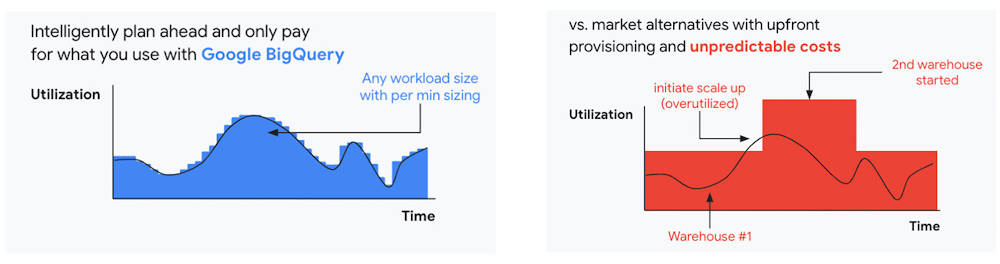
We are now taking these capabilities to the next level by enabling autoscaling in BigQuery at a more granular level so you never pay more than what you use. This allows you to provision additional capacity in smaller increments, so you never overprovision and overpay for underutilized capacity. BigQuery customers can now try the new BigQuery autoscaler (currently in public preview) in their Google Cloud console.
A commitment to flexibility and choice
At Google Cloud, we remain deeply committed to the success of our customers and partners, and we are uniquely positioned to help organizations transform their business. By providing you with more flexibility and choice in how to purchase our products, we are empowering you to be more efficient and resilient.
Join Google Data Cloud & AI Summit to hear the latest announcements around innovations in Google Data Cloud for databases, data analytics, business intelligence, and AI. Gain expert insights, new solutions, and strategies that can help you transform customer experiences with modern apps, boost revenue, and reduce costs.
1. Not available for customers buying through Partner Advantage.
Public Cloud’s Zero Trust Architecture Keeps Enterprise Data Safe

4635
Of your peers have already read this article.
5:00 Minutes
The most insightful time you'll spend today!
Over the past decade, cybersecurity has posed an increasing risk for organizations. In fact, cyber incidents topped the recent Allianz Risk Barometer for only the second time in the survey’s history. The challenges in combating these risks only continue to grow. Adversaries tend to be agile and are consistently looking for new ways to land within your digital environments. They also drive attack vectors that work, which means enterprise risk leaders are now forced to look for new ways of securing infrastructure and data.
Cloud comes of age in the modern day cybersecurity threat landscape
When cloud, in its various delivery models, was first introduced, it didn’t fit neatly into the security frameworks that had seemingly protected networks for many decades. Public cloud was the answer to ongoing IT challenges: scale, resources, security capabilities, and budget cycle limitations. Now, public cloud is meeting the increasing challenge of implementing cybersecurity controls and frameworks that are capable of protecting today’s global enterprise.
Cloud adoption – with all its scale and redistribution of longstanding security paradigms – is the optimal choice for infrastructure and security, particularly as organizations grapple with the need to engage in digital transformation. We assert that successful digital transformation is impossible without incorporating the use of the scale, security architecture, and resiliency of the cloud.
Consequently, cloud adoption becomes a necessary component of roadmap discussions and planning as your organization looks to reduce overall risk. Risk leaders and enterprise cybersecurity leaders must consider that moving data, digital processes, and priority workloads to the public cloud is a crucial step for meeting the current and future digital needs of the enterprise. Going forward, this digital transformation increasingly will include hybrid infrastructure environments composed of a combination of on-premises and cloud solutions.
Pinpointing where threats thrive
As digital environments become more complex within a given organization, proactively countering adversaries becomes all the more difficult. It’s harder to implement, scale, and adhere to existing security and control frameworks. It’s also increasingly challenging to apply framework guidance to new applications, build and support infrastructure within a secure foundation, and maintain good cyber hygiene through the digital lifecycle.
As reported by TechTarget, the 2020 hack of the SolarWinds Orion IT performance monitoring system is a prime example. It grabbed headlines “not because a single company was breached, but because it triggered a much larger software supply chain incident.” This vulnerability in popular, commercially available, and widely utilized software compromised the data, networks, and systems of thousands of companies when a routine software update turned out to be backdoor malware.
A close look at the root problems behind high-profile security breaches reveals that it’s a lack of agility and an inability to scale resources that prohibit the modern security organization’s ability to respond quickly enough to counter new challenges. Look even closer and you’ll often find an insufficient implementation of best practices and ineffective solutions, leaving an organization continually chasing the next tool or solution and scrambling to stay ahead of emerging threats.
While the cost to individual businesses is high, most organizations struggle with the needed skills and resources to rigorously maintain data security basics and ensure readiness for inevitable attacks. The previous sentence is especially true when you consider that maintaining an effective state of cybersecurity readiness is a costly practice that requires the continual development of expertise, the evaluation of new tools, and an ongoing element of vigilance.
Threat visibility is a big part of the problem. You can’t protect your company from what you can’t see. For individual enterprises – with critical data workloads housed in a combination of on-premises servers, a variety of endpoints, and both private and public cloud instances – staying ahead in the ongoing battle requires a new approach.
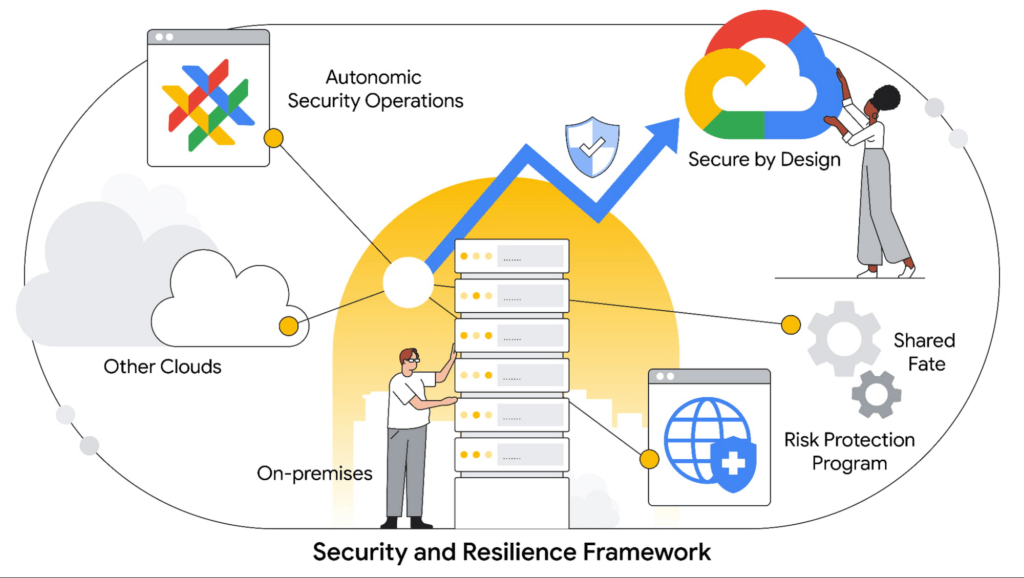
The identification of actionable alerts and other data contributes to a better overall state of readiness. Thought leadership and discussions related to Autonomic Security Operations provide a promising outlook for security organizations willing to lean into the changing technology landscape – a landscape that now benefits from leveraging automation and machine learning currently used in security stacks. Reducing the chance of introducing vulnerabilities or missing-critical alerts starts with ensuring full visibility into an increasingly expanding and complex environment.
The evolution of a shared responsibility to a shared fate
Industry megatrends are driving cloud adoption and with it a path to improved cybersecurity. Among these trends is the concept of shared fate as an evolution of the historical shared-responsibility model. Shared fate drives a flywheel of increasing trust which develops as more enterprises transition to the cloud. This compels an even higher security investment and a more vested interest from cloud service providers.
At Google Cloud, shared fate means we take an active stake in our customers’ security posture, offering capabilities and defaults that help ensure secure deployments and configurations in the public cloud. We also offer experience-based guidance on how to configure cloud workloads for security, and can assist with risk management, reduction, and transfer.
The Google Cloud Risk Protection Program represents the continuing evolution of the shared-fate model. The program offers a practical solution that provides the modern enterprise a snapshot comparison of its current security state against well-adopted cloud-security frameworks. It also give you an opportunity to explore cyber insurance designed to meet your needs from our partners Allianz and Munich Re.
When performed with diligence, cloud adoption can help increase your overall cybersecurity effectiveness. Using a hybrid approach – and steadily reducing which data assets remain on premises – can strengthen your overall security posture and reduce risks to the organization.
Cloud security and the ability to reduce risk
In comparison to the enterprise-by-enterprise security scramble to protect data and workloads in individual private clouds, global public cloud solutions like Google Cloud can be a force multiplier when adhering to established best practices. By that, we mean, quite literally, that you get more security at every touchpoint – from infrastructure and software to access and data security.
Strong security in the public cloud starts with the foundational pieces: the hardware and design elements. At Google, for example, we take a security-by-design approach within both the data center and purpose-built components themselves. Within Google Cloud, data is encrypted by default – both at rest and in transit. Google’s baseline security architecture adheres to the zero trust principles, meaning that every network, device, person, or service initially cannot be trusted.
Embarking on a zero trust architecture journey gives modern security practitioners the ability to methodically shut down traditional attack vectors. Zero trust also provides more granular visibility and control of rapidly expanding environments. The recent emphasis of its benefits, as the U.S. White House set forth through an executive order on increasing cybersecurity resilience, is an example of the wide-scale recognition by both government and industry on the benefits of this approach.
Since adopting a zero trust approach more than a decade ago, Google has achieved a recognizable level of maturity, reflected by our internal infrastructure and multiple enterprise offerings, enabling different aspects of the zero trust security journey.
Compliance and privacy drive critical elements of the cloud adoption cycle
Privacy frameworks, regulatory compliance, and data sovereignty are driving critical elements of the cloud adoption cycle. Cloud providers must ensure they have the necessary controls, attestations, and abilities to audit in order to provide organizations with the tools to preemptively satisfy regulatory and compliance mandates across the globe.
Now consistently expected to be part of a design feature that’s built into the cloud journey, it cannot simply be an add-on capability. The direction of this evolution promises to play more of a role in the future of cloud adoption, not less. Because this is an ongoing component of enterprise risk evaluation, your business must consider cloud providers that can partner on this critical aspect of the journey – and not leave you without the resources to respond to this growing critical need.
Building trust into your digital transformation journey
Digital transformation is difficult because the modern enterprise must build and design for both today and tomorrow. From a security perspective, the challenge has often been that security industry practitioners cannot always predict what the future will look like. That said, there are clear steps you can take to mitigate all-around risk throughout the process.
How you approach the cloud is, of course, integral to your journey, but it doesn’t need to be an all-or-nothing proposition. And although technology debt continues to persist with legacy systems, that doesn’t mean you shouldn’t begin to move forward.
Google Cloud enables you to modernize at your own pace and understand what’s realistic. We recommend you move what data you can to a more secure public cloud today, followed by a phased approach to move more in the months and years that follow. The key tenets of our approach to security in the public cloud include:
- The security-by-design posture of Google Cloud can help modern-day enterprises scale security capabilities and reduce risk with an architecture built on zero trust principles.
- The Google Cloud approach to security and resiliency includes a framework to help you protect against adverse cyber events by using our comprehensive suite of solutions.
- Google Cloud can help ensure your organization adheres to the requirements of a growing and increasingly complex regulatory and compliance environment.
- The ideal model of a future organization is one where cloud plays a major role in infrastructure design and architecture. Your organization should begin to view public cloud as an enabler of the business and a core component of digital transformation.
As you transition more data to the public cloud, it’s paramount that trust is ingrained in every step you take with your cloud service provider. Many service providers readily take on a shared responsibility with your organization when it comes to security. At Google, we take it several steps further with our shared fate model to help ensure data security in the public cloud. Your future and our’s are part of the same data security journey.
Google Cloud Celebrates Journey of 3 Inspiring Founders for the Asian Pacific American Heritage Month

8174
Of your peers have already read this article.
1:30 Minutes
The most insightful time you'll spend today!
May is Asian Pacific American Heritage Month —a time for us to come together to celebrate and remember the important people and history of Asian and Pacific Island heritage. This feature highlights three AAPI founders from the Google For Startups community.
Read on to learn how these three founders built their businesses, leverage Google tech, and suggestion they have for aspiring entrepreneurs.
CultivatePeople
Founder: Lola Han
Description: CultivatePeople’s compensation software, Kamsa, provides global market pay rate data and helps companies make data-driven salary decisions so they can attract and retain their most valuable asset: employees.
Why GCP: “CultivatePeople began using GCP when integrating SSO/SAML authentication after our SaaS product became a high priority. We were able to exceed our clients’ expectations and increase their level of trust in our platform’s capabilities. We’re currently investigating additional machine learning products, such as Cloud AutoML, that will allow us to quickly deliver exciting features.”
Note from the Founder: “I grew up with immigrant parents who value stability and are risk-averse. My parents discouraged me from starting my own company because they didn’t want to see me struggle financially or see my health suffer (due to stress). I felt strongly about what CultivatePeople could do, so I started the company as a sole founder in 2017 and watched it double in size year over year since. While the ones I love most may not have cheered me on initially, it was important for me to hang on to the encouraging words of former bosses, executives, and founders to keep me focused on my mission.
My advice for other AAPI founders is to be a “silent assassin” and believe in the mission and values of your organization. Always remember to stop along the way and:
1) Enjoy the journey by celebrating wins and giving yourself credit;
2) Follow your intuition—it’s (almost) always right;
3) Recognize and invest in your people regularly (ie. give increases more than once a year, if warranted);
4) Give regular words of affirmation to employees on even small achievements.”
Swit
Founder: Josh Lee and Max Lim
Description: Swit is a team collaboration platform that seamlessly combines team chat with task management by allowing teams to turn their conversations into trackable tasks and share tasks to chat with simple drag-and-drop functionality, ensuring everyone is on the same page and projects get done faster.
Why GCP: “Swit is a cross-category hybrid work tool for chat and tasks. This functionality requires more complicated and heavier architecture for performance. So, configuring and managing virtual machines was really challenging to scale up our systems, while handling occasional unexpected traffic surges and frequent updates. Eventually we divided our monolithic architecture into 35 microservices when we launched our official product. The migration to GKE took around one month, and it turned out to be well worth the effort—our systems became able to offer high scalability and enough resilience to keep its uptime no matter what happened. Now we’re operating 84 workloads and 252 microservices with high stability with remarkably low downtime – less than 0.00001%/year.”
Note from the Founder: “As an AAPI founder based in Silicon Valley, I feel proud of the work ethics and diligence fellow Korean American entrepreneurs and professionals have long demonstrated here. Especially with K-pop breaking into the mainstream, I feel even more proud of our culture that strives toward an absolute perfection molded through years of training and dedication. The mission-driven culture of Silicon Valley coupled with Google’s edging technology and creativity really helped us build a product that not only encompasses verticals but also transcends cultures. Swit is growing at an unprecedented rate, and we hope to join the long list of successful AAPI entrepreneurs here. Swit’s close network with the AAPI community wouldn’t have been possible without Google support. We are grateful for this collaborative environment, and we hope to become the next-generation ambassador for collaboration after Google.”
Check out more from Swit in their founder story.

WISY
Founder: Min Chen
Description: Wisy develops technology to bring digital efficiency into the physical world, supporting consumer products businesses and making them thrive in the new economy. All of us have a bad experience when we can’t find the product we want to buy. That is a $1.9T problem in the consumer-packaged goods industry that Wisy is solving with AI and analytics to help manufacturers and retailers sell more by reducing out-of-stocks and waste at a global scale.
Why GCP: “GCP has an intuitive, easy to use interface, was lower cost, and offered preemptible instances with flexible compute options. Some of the reasons why Wisy decided to use GCP include instance and payment configurability, privacy and traffic security, cost-efficiency, and Machine Learning.
Wisy has been able to advance quickly with product development, as well as collaborate better and iterate faster in the creation of our AI models, while reducing costs by 40%. At Wisy, we are solving a problem that affects everyone who shops at a store.“
Note from the Founder: “Two years ago, I moved to San Francisco to expand my second startup, Wisy. This is when I learned that my name ‘Min’ stands for ‘minority.’ I was born in China, raised in a Black community in Panama, received scholarships to attend both Carnegie Mellon and UC Berkeley. I worked for 20 years in several countries, but I have never felt so discriminated against due to my race, ethnicity, gender and age than during my time in Silicon Valley. However, this is also the place I learned that my diverse life experience is my competitive advantage. My background enables me to recruit and relate to people in different countries, create scalable and flexible products for multinational customers, and run global operations efficiently.
My recommendation to AAPI founders is to find strength in their multicultural background. Don’t hide what makes you unique, do not limit yourselves, and do not let others limit you. You will lose your edge when trading authenticity for validation. Be proud and own your story.”
If you want to learn more about how Google Cloud can help your startup, visit our Startup Program application page here and sign up for our monthly startup newsletter to get a peek at our community activities, digital events, special offers, and more.To learn more about how you can help #StopAsianHate during Asian Pacific American Heritage Month and beyond, visit their website here.
More Relevant Stories for Your Company

Start-up Paves Way for More Inclusive Clinical Research: Honoring Black Founders of Acclinate with Google Cloud
Editor’s note: February is Black History Month—a time for us to come together to celebrate the diverse set of experiences, perspectives and identities that make up the Black experience. Over the next few weeks, we will highlight Black-led startups and how they use Google Cloud to grow their businesses. Today’s

Evernote Ditches Private Cloud for Google Cloud and Improves Performance and Uptime
More than 200 million Evernote users now more securely store billions of notes and attachments—the equivalent of roughly 10 copies of every modern book ever published. The company’s private cloud was no longer enough to scale to support such a dynamic infrastructure, so Evernote migrated its service to Google Cloud

IDC Retail Insights: The Digital Pulse of Retail
Google partnered with IDC Retail Insights to conduct a survey of retailers across the globe to assess the state of transformation and develop an index of digital maturity. Learn more about the changes in digital resilience over the last year and the areas of innovation over the next 12 months.



Journey to Transformation and Modernization with Google’s Distributed Cloud
Google Cloud has been leading the way of helping businesses make most from their cloud investments to drive digital transformation through modern application platforms that cater to today's customer needs. Watch the video from the Next '21 to explore three areas where companies are supported by Google Cloud throughout their
