





Google’s New Climate Innovation Challenge to Fight Energy Crisis and Build Climate Resilience

3424
Of your peers have already read this article.
1:30 Minutes
The most insightful time you'll spend today!
At Google, we believe that when it comes to solving a problem as big and urgent as climate change, we get more done when we collaborate. From beekeepers in Germany to urban foresters in Los Angeles, we support the work of nonprofits, scientists, and organizations that are working to mitigate the impact of climate change globally, and increase communities’ resilience to its effects.
To this end, we are proud to launch the Climate Innovation Challenge, which will provide Google Cloud research credits to advance a better understanding of climate resilience and promising solutions to address urgent climate challenges. I’m excited about this launch. We need to get smarter about the inevitable impact of our changing climate and how it will reshape our lives, supply chains, and business. Sustainability is a business-critical agenda, and we need intelligent technologies, leadership, and collaboration to drive industry transformations and reach a net-zero world.
The innovation and scale required to solve the toughest climate challenges will come from technology. At Google Cloud, we’re working across industries to increase climate resilience, applying cloud technology to help solve key challenges in the fight against climate change. Nonprofits, scientists, and organizations will be key in developing new research and innovations that will help us better understand how we can accelerate action on climate.
Through the new program, individual climate researchers in higher education and not-for-profit research organizations can apply for Google Cloud credit grants of up to $100,000 to accelerate their projects with Google’s state-of-the-art, data analytics and artificial intelligence (AI) cloud services, from Google Earth Engine (EE) to Google Public Datasets like the one from the National Oceanographic and Atmospheric Administration (NOAA). We will work with specialist partners in environmental organizations, agriculture, and carbon reduction to help evaluate proposals and select participants. Our first partner is the National Science Foundation (NSF) AI Institute for Research on Trustworthy AI in Weather, Climate, and Coastal Oceanography (AI2ES). Alongside the cloud credits, we will also provide researchers with access to technical training and mentoring, to help jumpstart their work.
From idea to insight to impact
In 2021, researchers at 500 universities in 47 countries received Google Cloud research credit grants. Others received funding through the Google Cloud Research Innovators Program, which promotes collaboration among a global cohort of scientists and provides them with professional opportunities and technical expertise. Here are some of the Research Innovators who have already advanced their climate research with Google Cloud:
- At CalTech Tapio Schneider and his team built Climate Machine, a next-generation open-source Earth System Model that will integrate more earth and atmospheric data than ever before.
- At UCLA, Bo Zhou uses EE for remote sensor modeling to help bureaus of land management make conservation decisions.
- At the University of New England, James Brinkhoff conducts spatial and temporal analysis for agriculture crop modeling and water use with data from EE.
- At Natural Resources Canada (NRCan), Richard Fernandes is developing the LEAF toolbox to map and assess vegetation with satellite data from EE.
- At the University of Toronto, Yuhong He uses EE to map changes occurring in natural and managed ecosystems systems using remote sensing, machine learning, and ecosystem modelings.
- At UCLA, Henry Houskeeper uses machine learning with EE’s satellite imagery to automate detection of kelp forests.
- At the University of Hawaii at Manoa, Jonghyun Lee conducts numerical modeling for water resources with Google Colab.
- At Technical University in Dublin, Santos Fernández Noguerol runs functions to collect weather data from governmental agencies, then automatically stores them in Google Cloud Storage buckets for future spatial analysis.
- At the University of Colorado at Denver, Farnoush Banaei-Kashani conducts data science projects with applications for Intelligent Transportation and Earth Sciences.
To apply for a Climate Innovation Challenge grant, click here and include “Climate Innovation Challenge” as the first line of your proposal. We will announce additional focus areas, partnerships, and recipients throughout the year. Click here to learn more about Google Cloud sustainability.
Building Unique Customer Experiences with Speed & Scale: Sprinklr & Google Cloud

8240
Of your peers have already read this article.
2:00 Minutes
The most insightful time you'll spend today!
Enterprises are increasingly seeking out technologies that help them create unique experiences for customers with speed and at scale. At the same time, customers want flexibility when deciding where to manage their enterprise data, particularly when it comes to business-critical applications.
That’s why I’m thrilled that Sprinklr, the unified customer experience management (Unified-CXM) platform for modern enterprises, has partnered with Google Cloud to accelerate its go-to-market strategy and grow awareness among our joint customers. Sprinklr will work closely with our global salesforce, benefitting from our deep relationships with enterprises that have chosen to build on Google Cloud.
Akin to Google Cloud’s mission to accelerate every organization’s ability to digitally transform their business through data-powered innovation, Sprinklr’s primary objective is to empower the world’s largest and most loved brands to make their customers happier by listening, learning, and taking action through insights. With this strategic partnership now in place, Sprinklr and Google Cloud will go-to-market together with the end-customer as our sole focus.
Traditionally, brands have adopted point solutions to manage segments of the customer journey. In isolation, these may work — but they rarely work collaboratively, even when vendors build “Frankenstacks” of disconnected products. These solutions can’t deliver a 360° view of the customer, and often reinforce departmental silos. All of which creates point-solution chaos.
Sprinklr’s approach is fundamentally different and is the way out of the aforementioned point-solution chaos. As the first platform purpose-built for unified customer experience management (Unified-CXM) and trusted by the enterprise, Sprinklr’s industry-leading AI and powerful Care, Marketing, Research, and Engagement solutions enable the world’s top brands to learn about their customers, understand the marketplace, and reach, engage, and serve customers on all channels to drive business growth.
Sprinklr was built from the ground up as a platform-first solution, designed to evolve and grow with the rapid expansion of digital channels and applications. The results? Faster innovation. Stronger performance. And a future-proof strategy for customer engagement on an enterprise scale.
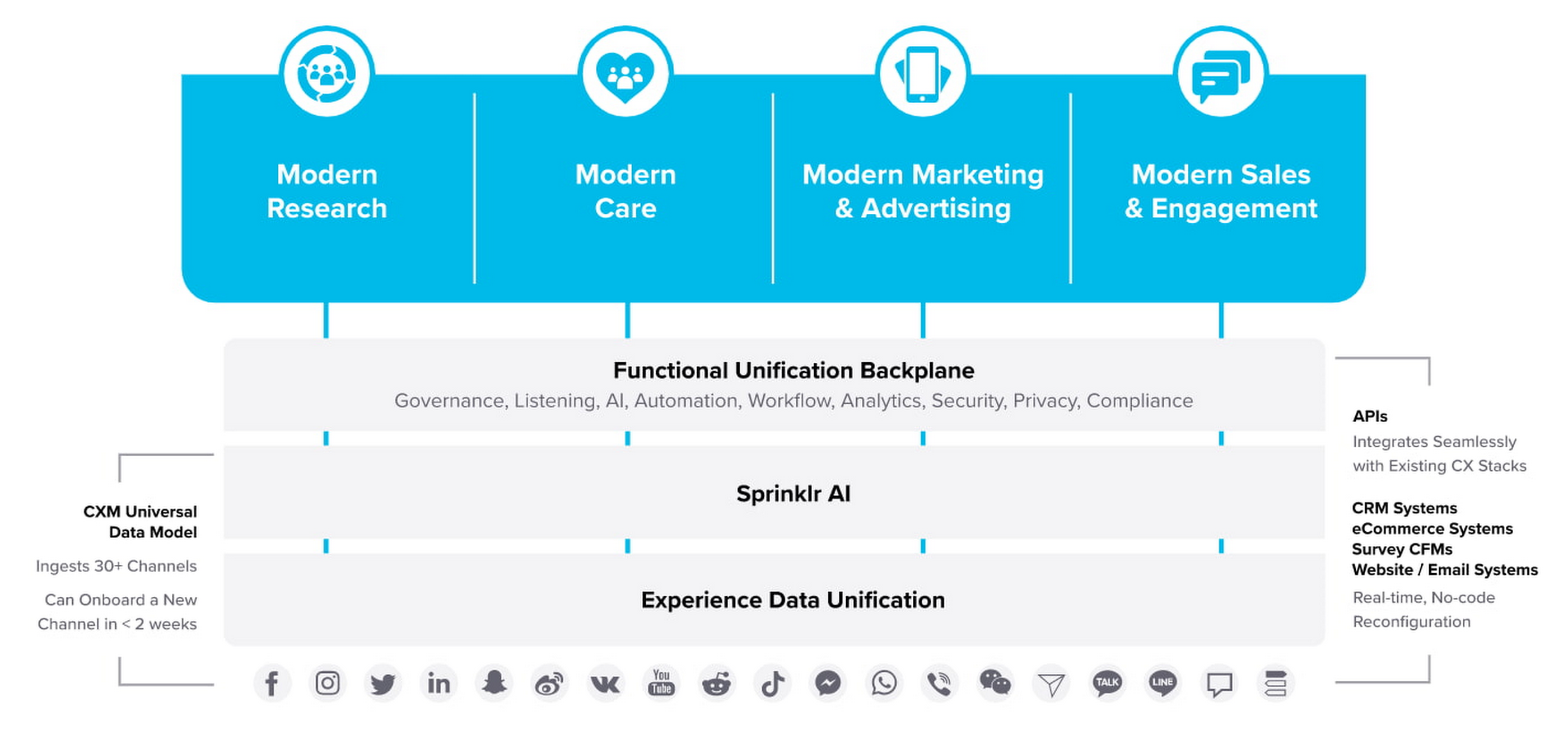
“Sprinklr works with large, global companies that want flexibility when deciding where to manage their enterprise data and consider our platform a business-critical application,” said Doug Balut, Senior Vice President of Global Alliances, Sprinklr. “Giving our customers the opportunity to manage Sprinklr on Google Cloud empowers them to create engaging customer experiences while maintaining the high security, scalability, and performance they need to run their business.”
To learn more about this exciting partnership and the challenges we jointly solve for customers, check out the recent conversation between Google Cloud’s VP of Marketing, Sarah Kennedy, and Sprinklr’s Chief Experience Officer, Grad Conn. Or read the press release on the partnership.
Google and Fervo Agreement to Shape-up Plans for 24/7 Carbon-free Energy by 2030

4816
Of your peers have already read this article.
1:30 Minutes
The most insightful time you'll spend today!
When Google announced our plan to go beyond purchasing renewable power for 100% of our energy usage and operate on 24/7 carbon-free energy by 2030, we noted that achieving this goal will require new transaction structures, advancements in clean energy policy, and innovative new technologies. Today, we’re pleased to announce that one of these new technologies—a first-of-its-kind, next-generation geothermal project—will soon begin adding carbon-free energy to the electric grid that serves our data centers and infrastructure throughout Nevada, including our Cloud region in Las Vegas.
Google and clean-energy startup Fervo have just signed the world’s first corporate agreement to develop a next-generation geothermal power project, which will provide an “always-on” carbon-free resource that can reduce our hourly reliance on fossil fuels. In 2022, Fervo will begin adding “firm” geothermal energy to the state’s electric grid system, where Google’s commitments already include one of the world’s largest corporate solar-plus-storage power purchase agreements.
Importantly, this collaboration also sets the stage for next-generation geothermal to play a role as a firm and flexible carbon-free energy source that can increasingly replace carbon-emitting fossil fuels—especially when aided by policies that expand and improve electricity markets; incentivize deployment of innovative technologies; and increase investments in clean energy research, development, and demonstration (RD&D).
Next-generation geothermal technology
Traditional geothermal already provides carbon-free baseload energy to a number of power grids. But because of cost and location constraints, it accounts for a very small percentage of global clean energy production.
That’s one reason this new approach is so exciting; by using advanced drilling, fiber-optic sensing, and analytics techniques, next-generation geothermal can unlock an entirely new class of resource. And the US Department of Energy has found that with advancements in policy, technology, and procurement, geothermal energy could provide up to 120 GW of firm, flexible generation capacity in the US by 2050.
As part of our agreement, Google is partnering with Fervo to develop AI and machine learning that could boost the productivity of next-generation geothermal and make it more effective at responding to demand, while also filling in the gaps left by variable renewable energy sources. Although this project is still in the early stages, it shows promise.
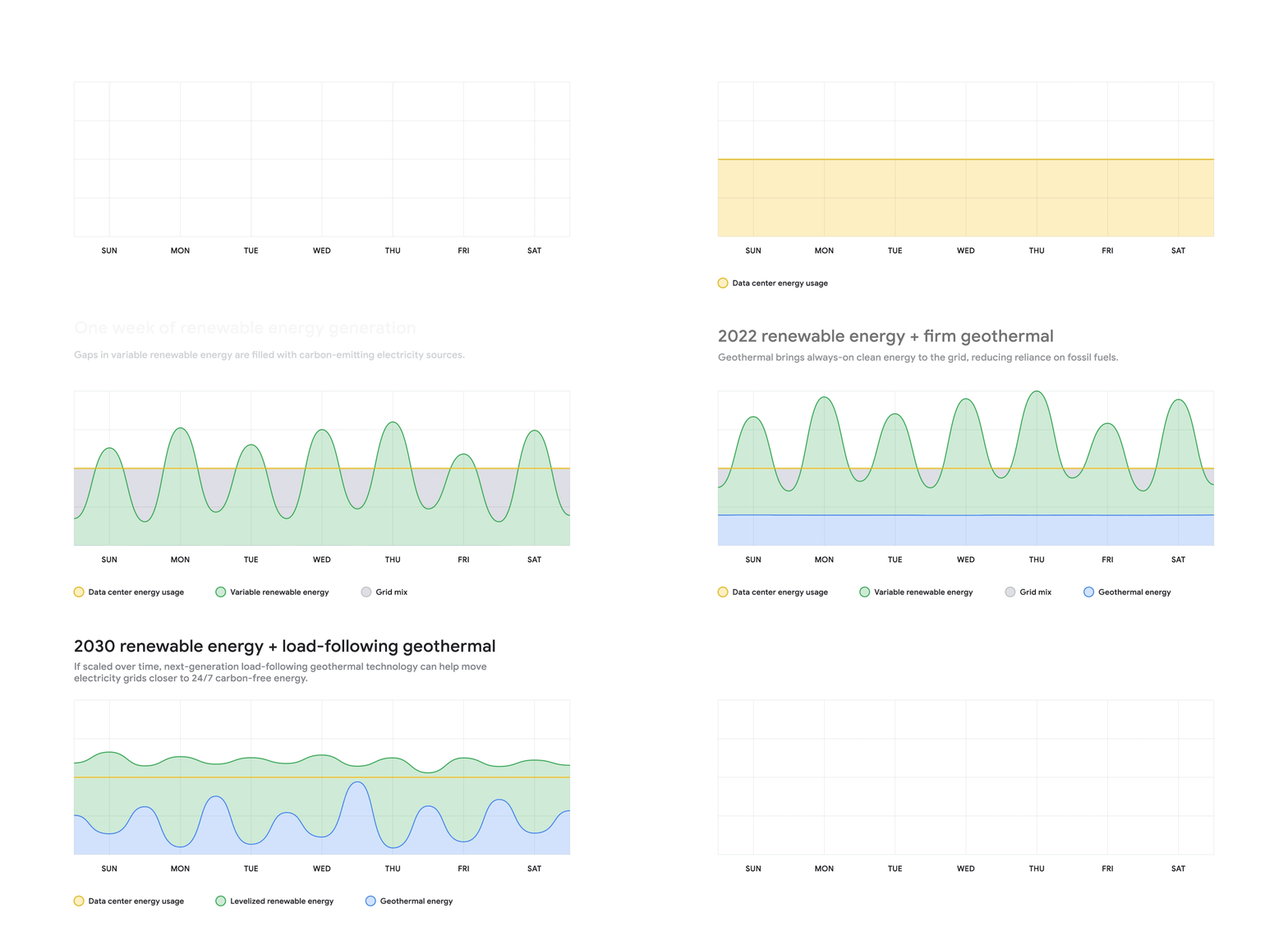
Using fiber-optic cables inside wells, Fervo can gather real-time data on flow, temperature, and performance of the geothermal resource. This data allows Fervo to identify precisely where the best resources exist, making it possible to control flow at various depths. Coupled with the AI and machine learning development outlined above, these capabilities can increase productivity and unlock flexible geothermal power in a range of new places.
This won’t be the first time that Google is applying software solutions to clean energy applications: we’ve just announced an update to our carbon-intelligent computing program that helps us reduce emissions associated with running applications at Google data centers. And other forms of AI and machine learning are currently being used to increase the value of wind energy.
Already this year, Google has taken significant strides toward sourcing 24/7 carbon-free energy for all our data centers, office campuses, and Cloud regions. On Earth Day, our CEO Sundar Pichai announced that for the first time, five of our global data center sites operated near or at 90% carbon-free energy in 2020.
Not only does this Fervo project bring our data centers in Nevada closer to round-the-clock clean energy, but it also acts as a proof-of-concept to show how firm clean energy sources such as next-generation geothermal could eventually help replace carbon-emitting power sources around the world.
Google Cloud Region in Columbus to Accelerate Ohioan Businesses and Tech Transformation

3216
Of your peers have already read this article.
1:30 Minutes
The most insightful time you'll spend today!
Digital tools such as cloud computing are fueling economic transformation across the US, including Ohio. Google continues to invest across cities and communities in Ohio, bringing over 200 jobs to the state, and helping provide $12.85 billion of economic activity for tens of thousands of Ohio businesses, nonprofits, publishers, creators and developers. To further accelerate the transformation of all Ohioan businesses and technologists, we’re thrilled to announce our newest Google Cloud region in Columbus, Ohio is open. The Columbus cloud region brings a second region to the Midwest, the 10th region to North America, and grows our global cloud region count to 33.
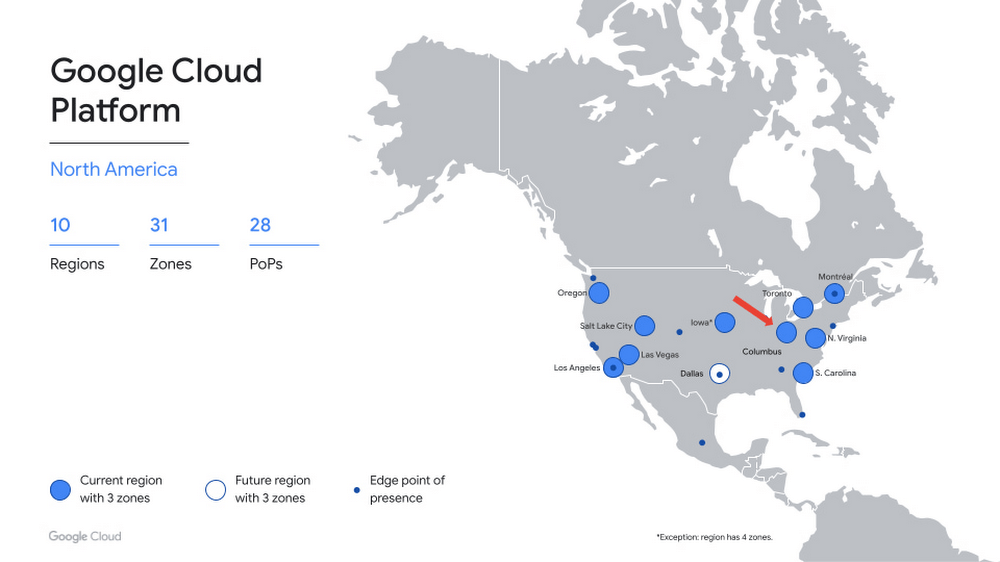
A region for the Buckeye State
Now open to Google Cloud customers, the Columbus region (us-east5) provides you with the speed and availability you need to innovate faster, build high-performing applications, and serve local customers — all on the cleanest cloud in the industry. Additionally, the region gives you added flexibility to distribute your workloads across the central, midwest, and eastern US.
The Columbus region offers immediate access to three zones, for high availability workloads, and our standard set of products, including Compute Engine, Google Kubernetes Engine, Cloud Storage, Persistent Disk, CloudSQL, and Cloud Identity. Our private backbone connects Columbus to our global network more quickly and securely. In addition, you can integrate your on-premises workloads with our new region using Cloud Interconnect. This means that Columbus-based customers can expand globally from their front door, and those based outside the region can more easily reach their users in the Midwest.
What customers are saying
Industries including retail, financial services, and IT are investing in Columbus. Organizations across these verticals have turned to the Google Cloud to innovate faster and help solve their most complex challenges
“As Wendy’s continues to innovate in new ways to create fast, frictionless, and fun interactions that redefine the way customers visit and enjoy our restaurants, our partnership with Google Cloud is a key enabler to delivering on our AI/ML and data analytics strategies. The proximity of the new Google Cloud region to Wendy’s headquarters provides the ability for us to move and scale quickly as business needs evolve. Additionally, Google Cloud’s investment in Columbus positions central Ohio as a true technology hub, which further boosts Wendy’s and other regional employers’ ability to recruit innovative talent,” said Kevin Vasconi, Chief Information Officer, Wendy’s.
“Huntington National Bank’s API Architecture is a central component to our growth and technology strategy. As our business segments grow from an offering and geographic perspective, we must evolve our technology to provide the optimal experience for our customers and our partners. Collaborating directly with Google Cloud on the build out of their cloud region in Central Ohio, provides the access our technology teams need to innovatively scale our infrastructure to meet the demands of our business with increased availability, lower latency, and greater resiliency,” said Geoff Preston, Chief Architect, Huntington National Bank.
“Google Cloud has been instrumental in our ability to scale and optimize data management and compute resources. We prioritize scale, elasticity and resilience in cloud services and Google Cloud delivers all three globally and locally. With Google Cloud security, we can efficiently process the quantities of application data required to accelerate alert detection and reduce response times for the critical infrastructure our customers depend on to enable the continuity of their vital applications.” said Sheryl Haislet, Chief Information Officer at Vertiv, a global provider of critical digital infrastructure and continuity systems headquartered in Columbus, Ohio, that leverages Google Cloud solutions to provide resilience for its operations and to better support customers.
“The addition of the new cloud region in Ohio continues to demonstrate Google Cloud’s commitment to the enterprise space and their presence in the region,” said Chris Delong, Chief Technology Officer, Designer Brands Inc. / DSW
What’s next
We are thrilled to welcome you to our new cloud region in Columbus, and eagerly await to see what you build with our platform. Register here for our Cloud Study Jam in June – an event for local developers to get hands-on training with Google Cloud. Stay tuned for more region announcements and launches this year, including our next U.S. region in Dallas, TX. And for more information, contact sales to get started with Google Cloud today.
City of San Jose Ensures Critical Services Reach Community Using AI Translation

5180
Of your peers have already read this article.
1:30 Minutes
The most insightful time you'll spend today!
San José is one of the most diverse U.S. cities, with residents speaking more than 100 languages. Several years ago, we set out to improve city community interactions through more equitable service management and delivery. This demanded a new approach to automating the intake of requests from a majority population whose first language is not English.
We first created the 311 portal and app, which was an important step as we effectively separated resident service requests from emergencies. The way we describe it to our citizens, you call 311 for a burning question, and 911 for a burning building. In the last fiscal year, San José 311 received nearly 210,000 contacts by phone and an additional 211,000 service requests through the SJ 311 app.
Through the portal and app, we gave citizens an omnichannel experience enabling them to interact with the city to request improvements, access useful information, and get emergency help when they need it.
In order to truly serve our diverse communities, we recognized language translation services would be required to offer truly equitable services to everyone. That’s when we started working closely with SpringML, Google Cloud, and other partners with involvement from our Mayor and City CIO.
Building public services with community engagement in mind
When we first rolled out the My San José website and mobile app, we used an out-of-the-box translation service that ended up not working. It had poor accuracy and did not meet our needs to provide all citizens with coherent services. After looking at many other options, we decided to partner with SpringML and Google Cloud to leverage the AutoML Translation with other technologies such as our virtual agent.
SpringML was selected through an open RFP process, and helped us to build and optimize our integrations, interfaces, and more between several systems, making the app and website more intuitive to manage. SpringML delivered the product we needed on time and up to specifications, and additional value came from the training sessions they provided to our team. This enabled us to understand everything we could do with AutoML and opened the door to other enhancements such as simplifying the vernacular used with our residents, making government access easier to navigate regardless of natural language spoken.
After establishing the My San José app’s translation capabilities using AutoML, SpringML also helped us incorporate Dialogflow virtual agents. Dialogflow also positions us to make modifications with our own staffing practices – something that has become increasingly important amid the frequent changes in service levels from COVID-19 response in the past year.
Responding to community needs
With the app up-and-running, our next step was to bring in community members to help with testing, improvements, and more. We wanted the app and the website to not just be something we provided to the community, but rather something they helped us build so they would readily adopt it.
Thanks to the greater accuracy of translation supported by Google Cloud services, we were able to leverage the expertise of a small pool of community members to evaluate translations. AutoML Translation and Glossary proved to be a powerful combination that pushed us closer to our goals.
Our primary targets were Spanish and Vietnamese translations. We are now seeing 90 percent accuracy in automated Spanish translations while Vietnamese translations continue to improve. We continue to work to simplify the language used in these services, which makes a big difference in terms of ensuring optimal language accessibility.
This work includes best serving our community members who primarily use phones to get in touch with us through 311 services. Using Google Cloud Contact Center AI, we have been able to effectively manage the calls we receive 24×7 and communicate with residents who speak Spanish as well as English. No matter which channel one of our residents choose to use to reach out, we can serve them efficiently.
A well-timed release
We’re proud of the work we’ve done. We’ve made many government services available to our community 24 hours a day, 7 days a week — accessible through many channels. Regardless of a person’s native language, the consistency of experiences enjoyed by everyone is improving every day thanks to AI. We’re also actively incorporating more language translation capabilities to better serve more people.
While we began this process several years ago, the recent integration of machine learning language translation with our customer relationship management system in late 2020 was very well-timed because we were able to incorporate this into our COVID-19 pandemic response.
We’re also beginning to work with other municipalities across the U.S. to share some of the lessons we’ve learned and success we’ve seen in hopes of furthering more equitable citizen services far beyond our City limits.
We are excited to continue working with SpringML, Google Cloud, and other partners to improve our city and the equity and quality of services that our residents enjoy.
Learn more about how you can work with a Google Cloud Partner here.
Expect 40 Percent Higher Price-performance than General Purpose VM with Google TAU VMs!

3270
Of your peers have already read this article.
3:00 Minutes
The most insightful time you'll spend today!
In November 2021, we announced the general availability of Tau VMs. Since then, Google Cloud’s Tau VMs with Google Kubernetes Engine (GKE) have unlocked value for many customers who are now using Tau VMs for their production workloads, such as: Ascend, who achieved over 125% higher performance; Nylas, who gained over 40% higher price-performance; and OpenX, who achieved 40% better price-performance while at the same time reducing their application latency by 62%.
T2D is the first instance type in the Tau VM family and is built on the latest 3rd generation AMD EPYCTM processors, offering 42% higher price-performance compared to general-purpose VMs from any of the leading public cloud vendors. Tau VMs offer a leading combination of performance, price, and full x86 compatibility, offering customers the lowest cost solution for scale-out workloads. Tau VMs are available in predefined shapes, with up to 60vCPUs per VM, 4GB of memory per vCPU, networking up to 32 Gbps and a slew of storage options including Standard, Balanced and Performance PD. Tau VMs are also available as Spot VMs, offering an over 60% discount compared to on-demand pricing.
For customers looking for advanced container orchestration, GKE delivers high levels of reliability, security, and scalability, and has supported Tau VMs since the day they became available on Google Cloud. Tau VMs are ideal for CPU-bound workloads such as web-serving with encryption, video encoding, compression/decompression, image processing and horizontally-scaled applications. Using Tau VMs along with GKE’s cost-optimization best practices can help lower your total cost of ownership. You can add Tau VMs to new or existing GKE clusters by specifying the Tau T2D machine type in your GKE node-pools through the Cloud console or by using –machine-type in gcloud.
Here is what some of our customers have to say about Tau VMs:

Ascend provides a unified analytics and data engineering platform, and chose Tau VMs along with GKE to run their data-intensive workload — primarily because of Tau’s absolute performance and price-performance advantage.
“Our core capability at Ascend is bringing together data ingestion, transformation, delivery, orchestration and observability into a single platform. To operate at scale and keep pace with our telemetry data production rates, high single-threaded performance is critical. With Google Cloud’s Tau VMs with Google Kubernetes Engine (GKE), we are able to achieve over 125% higher performance than previous generation families. This has completely changed our ability to query historical metrics. Where previously metric queries against historical data over ranges longer than a couple hours were difficult, we can now easily query data ranges of multiple weeks.” – Joe Stevens, Tech Lead – Infrastructure, Ascend.io

Nylas is a pioneer and leading provider of productivity infrastructure solutions for modern software. In the past year, Nylas has been using GKE in their journey to reinvent their architecture and provide their enterprise customers with a bi-directional universal email sync, security compliance with the highest enterprise standards, and industry-specific machine learning services.
“For our core application, Google’s Tau VMs with Google Kubernetes Engine delivers over 40% better price-performance than Amazon’s Graviton-based VMs. Further, Tau VMs maintain x86 compatibility and eliminate the need to maintain a separate stack for ARM. We are moving our workload from Amazon Web Services to Google Cloud to take advantage of these benefits.” – David Ting, SVP of Engineering, Nylas

OpenX operates an independent ad exchange. Operating 100% on Google Cloud has enabled OpenX to achieve improved performance, scalability, speed and global reach.
“At OpenX, our ad-exchange services over 200 billion requests every day. Getting the best combination of performance and price from the infrastructure is critically important for us. We use multiple Google Kubernetes Engine (GKE) clusters across geographic regions with autoscaling to power our ad-delivery components. Running Google Cloud’s Tau VMs with GKE has enabled over 40% better price-performance and 62% latency reduction for our application as compared to the prior generation family. We have made the move to Tau VMs for our application to take advantage of these benefits.” – Paul T.Ryan, CTO, OpenX
We are excited to see Tau VMs adding value for so many of our customers by enabling industry leading price-performance for a variety of workloads.
If you haven’t tried Tau VMs yet, give them a try today in our Iowa, Netherlands and Singapore regions and move your production workloads to Tau VMs. Tau VMs will be arriving in additional regions and zones in the coming weeks. You can provision GKE node pools based on Tau VMs and explore how you can take advantage of improved price-performance for your scale-out containerized workloads.
To get started, go to the Google Cloud Console, select Google Kubernetes Engine, and choose Tau T2D for your GKE nodes. To learn more about Tau VMs or other Compute Engine VM options, check out our machine types and our pricing pages.
More Relevant Stories for Your Company


Attention CFOs: How to Save Money on the Cloud
Cutting down on wastage, saving cost, and having a better control are some of the key priorities of organizations when it comes to the cloud. According to the 2018 State of the Cloud report by Rightscale, 35% of customer cloud spend is wasted, 58% of users cite cost savings as
Cloud Migration and Modernization is ‘Easier Done than Said’ with Google Cloud RAMP!
The reliance on cloud compute, storage and network has accelerated with the growing usage of digital products and services. To keep up with the customer demands and deliver digital solutions, many companies are struggling through their cloud migration and modernization journeys. But not anymore, says Google Cloud with the Rapid

Cloud Computing at Sea: Google Public Sector Boosts U.S. Navy Collaboration
With a global, always-on workforce, the U.S. Navy requires secure collaboration between teams across countries and time zones. This is especially relevant for the 50,000 U.S. Navy sailors deployed aboard approximately 100 ships at any given time, who need to connect with personnel at regional shipyards for everything from routine

Google Cloud Platform Gives Us 5x the Processing Power to Analyze Physician Performance at 75% Lower Cost
Patients about to undergo a healthcare procedure understandably want the best medical professionals they can get. But how can they know which doctors have had the most experience and the best outcomes with that particular procedure? How can they make an informed decision about which doctor to select when the
