





How Cloud Networks Enable CSPs to Deliver 5G

5121
Of your peers have already read this article.
3:00 Minutes
The most insightful time you'll spend today!
Communication services providers (CSPs) are experiencing a period of disruption. Overall revenue growth is decelerating and is projected to remain below 1 percent per year, following a trend that started even before the pandemic.1 At the same time, driven by the pandemic, data consumption in 2020 increased by 30 percent relative to 2019, with some operators even reporting increases of 60 percent.2
The combination of pressure on revenues with rising data traffic costs is forcing operators to innovate in three fundamental ways. First, operators are looking to establish new sources of revenue. Second, increased network utilization must be met with a reduction in network cost. And third, there is an opportunity to gain new customers by improving the customer experience.
Fortunately, 5G offers a path forward across each of these three areas. Concepts such as network slicing and private networks allow CSPs to offer differentiated network services to public sector and enterprise customers. The disaggregation of hardware and software allows new vendors with unique strengths to enter the market and to enable CSPs to build, deploy, and operate networks in fundamentally new ways. And the ability to place workloads at the edge permits CSPs to offer compelling experiences to consumers and businesses alike. In this blog, we will discuss how CSPs can create a solid foundation for their cloud networks.
Understanding telecommunications networks
First, it is useful to consider the way telecommunications networks were traditionally built. Initially, networks were built using physical network functions (PNFs) — appliances that used a tight combination of hardware and software to perform a specific function. PNFs offered the benefit of being purpose-built for a specific application, but they were inflexible and difficult to upgrade. As an example, deploying new features frequently required replacing the entire PNF, i.e., deploying a new hardware appliance.
The first step in improving deployment agility came with the concept of virtualized network functions (VNFs), software workloads designed to operate on commercial off-the-shelf (COTS) hardware. Rather than utilizing an integrated hardware and software appliance, VNFs disaggregated the hardware from the software. As such, it became possible to procure the hardware from one vendor and the software from another. It also became possible to separate the hardware and software upgrade cycles.
However, while VNFs offered advantages over PNFs, VNFs were still an intermediate step. First, they typically needed to be run within a virtual machine (VM), and as such required a hypervisor to interface between the host operating system (OS) and the guest OS inside the VM. The hypervisor consumed CPU cycles and added inefficiency. Second, the VNF itself was frequently designed as a monolithic function. This meant that while it was possible to upgrade the VNF separately from the hardware, such an upgrade, even for a feature that affected only a portion of the VNF, required deployment of the entire large VNF. This created risk and operational complexity, which in turn meant that upgrades were delayed just as they were with PNFs.
Creating the foundation for cloud networks
The trick to establishing your cloud based network resides in the challenge of moving from VNFs to containerized network functions (CNFs) — network functions organized as containers as a collection of small programs, each of which can be independently operated.
The concept of containers is not new. In fact, Google has been using containerized workloads for over 15 years. Kubernetes, which Google developed and open-sourced, is the world’s most popular container orchestration system, and is based on Borg, Google’s internal container management system.3 There are lots of benefits to using containers, but fundamentally, it frees developers from worrying about resource scheduling, interprocess communication, security, self-healing, load balancing, and many other tedious (but important!) tasks.
Consider just a couple examples of benefits that containerization brings to network functions. First, when upgrading the network function to implement new features, you no longer need to re-deploy the entire network function. Instead, you only need to re-deploy the containers that are affected by the upgrade. This improves developer velocity and reduces the risk of the upgrade because, rather than infrequent upgrades that each introduce substantial changes, you can now have frequent upgrades that each deploy small changes. Small changes are less risky because they are easier to understand and to roll back in case of anomaly. Incidentally, this also improves your security posture because it reduces the time between when a security vulnerability is discovered and when a patch is deployed.
Speaking of security, another example of the benefits that containerization brings to network functions is an automatic zero-trust security posture. In Kubernetes, the communication among microservices can be handled by a service mesh, which manages mundane aspects of inter-services communication such as retries in case of failure and providing observability into communication. It can also manage other essential aspects such as security. For example, Anthos Service Mesh, which is a fully-managed implementation of the open-source Istio service mesh (also co-developed by Google), includes the ability to authenticate and encrypt all communications using mutual TLS (mTLS) and to deploy fine-grained access control for each individual microservice.
Automation and orchestration for cloud networks
CNFs bring tremendous benefits, but they also bring challenges. In place of a relatively small number of network appliances, we now have a large number of containers, each of which requires configuration, management, and maintenance. In the past, many of these processes were accomplished using manual techniques, but this is impossible to accomplish economically and reliably at the scale required by CNFs.
Fortunately, there are cloud-native approaches to solving these challenges. First, consider the problem of autonomously deploying and maintaining CNFs. The ideal way is to use the concept of Configuration as Data. Unlike imperative techniques such as Infrastructure as Code, which provide a detailed description of a sequence of steps that need to be executed to achieve an objective, Configuration as Data is a declarative method whereby the user specifies the desired end state (i.e., the actual desired configuration) and relies on automated controllers to continuously drive the infrastructure to achieve that state. Kubernetes includes such automated controllers, and the great news is that this method can be used not just for infrastructure but also for the applications residing on top of it, including CNFs. This cloud-native technique frees you from the toil and associated risk of writing detailed configuration procedures, so you can focus on the business logic of your applications.
As another example, consider the problem of understanding your network performance, including anomaly detection, root cause analysis, and resolution. The cloud-native approach starts with creating a data platform where both infrastructure and CNF monitoring data can be ingested, regularized, processed, and stored. You can then correlate data sets against each other to detect anomalies, and with AI/ML techniques, you can even anticipate anomalies before they happen. AI/ML is likewise indispensable in gaining an understanding of why the anomaly is happening, i.e. performing root cause analysis, and automated closed-loop controllers can be developed to correct the problem, ideally before it even happens.
Architecting for the edge
The transition from VNFs to CNFs is a critical piece in addressing the challenge that CSPs face today, but it alone is not enough. CNFs need infrastructure to run on, and not all infrastructure is created equal.
Consider a typical 5G network. There are some functions, such as those associated with an access network, that need to be deployed at the edge. These functions require low latency, high throughput, or even a combination of the two. In 5G networks, examples of such functions include the radio unit (RU), distributed unit (DU), centralized unit (CU), and the user plane function (UPF). The first three are components of the radio access network (RAN), while the last is a component of the 5G core. At the same time, there are some other control plane functions such as the session management function (SMF) or the authentication and mobility management function (AMF) that do not have such tight latency and high throughput requirements and can thus be placed in a more centralized data center. Furthermore, consider an AI/ML use case where a particular model (perhaps for radio traffic steering) needs to run at the network edge because of its latency requirements. While the model itself needs to run at the edge, model training (i.e., generating the model coefficients) is frequently a compute-intensive exercise that is latency-insensitive and is thus more optimal to run in a public cloud region.
All of these use cases have one thing in common: they call for a hybrid deployment environment. Some applications must be deployed at the edge as close to the user as possible. Others can be deployed in a more centralized environment. Still others can be deployed in a public cloud region to take advantage of the large amount of compute and economies of scale available therein. Wouldn’t it be convenient — if not transformational — if you could use a single environment for deploying at the edge, in a private datacenter, and in public cloud, with a consistent set of security, lifecycle management, policy, and orchestration resources across all such locations? This is indeed what Google Distributed Cloud, enabled by Anthos, brings to the table.
With Google Distributed Cloud, you can architect a 5G network deployment such as the one shown below.

Business benefits of cloud networks
Beyond the technical benefits, consider the business benefits of such an architecture. First, by following the best practices of hardware and software disaggregation, it permits the CSP to procure the infrastructure and the network functions from different vendors, spurring competition among vendors. Second, each workload is placed in precisely the right location, enabling efficient utilization of hardware resources and offering compelling low-latency, high-throughput services to users. Third, because the architecture utilizes a common hybrid platform (Anthos), it makes it easy to move workloads across infrastructure locations. Fourth, the separation of workloads into microservices accelerates time-to-market when developing new features or applications, such as those enabling enterprise use cases. And finally, the container management platform supports the simultaneous deployment of both network functions and edge applications on the same infrastructure, allowing the operator to deploy new experiences such as AR/VR directly on bare metal as close to the user as possible.
The next generation cloud network is now
There is a lot more we could say, but perhaps the most important takeaway is that this architecture is not a future dream. It exists today, and Google is working with leading CSPs and network vendor partners to deploy it, helping them realize the promise of 5G to deliver new revenues, reduce operating costs, and enable new customer experiences.
To learn more, watch the video series on the cloudification of CSP networks.
Discover what’s happening at the edge: How CSPs Can Innovate at the Edge.
1.Statista, Forecast growth worldwide telecom services spending from 2019 to 2024
2 PricewaterhouseCoopers, Global entertainment and media outlook 2021-2025
3. Borg: The Predecessor to Kubernetes
Building a Stronger South Bend through Cloud Computing Education
3024
Of your peers have already read this article.
2:00 Minutes
The most insightful time you'll spend today!
The city of South Bend, Indiana has announced they are working with Google Cloud to connect 500 local job seekers with no-cost access to Google Cloud Skills Boost through Upskill SB. This initiative will train, upskill, and certify residents in cloud computing skills to create pathways to technical jobs.
As companies, nonprofits, and governments increasingly leverage cloud computing technology to strengthen their organizations, skilled cloud talent is in high demand both nationally, in Indiana, and in South Bend. According to Lightcast, there were 27,180 unique cloud roles open in the U.S. as of October 2022. Cloud skills are the most in-demand skill set by IT departments: more than one-third of tech learners said professionals with cloud skills are the most challenging to find.
“This partnership with Google Cloud will help residents get on a no-cost path to a cloud computing career at a time when the field is rapidly growing,” said Caleb Bauer, Executive Director of Community Investment for the City of South Bend. “This will help residents prepare to take the next step in their career with Google Cloud Skills Boost and will pave the way to build in-demand skills.”
Google Cloud Skills Boost is the destination for all Google Cloud learning and training opportunities. Local colleges and universities are also able to offer free access to Google Cloud Skills Boost for students through the Google Cloud Higher Education program. Students can request access to free online labs, quests, and courses. Faculty can take advantage of free Google Cloud Computing Foundations curriculum and coach their students to prepare for Google Cloud certifications.
“Google is proud to offer no-cost access to Google Cloud Skills Boost for jobseekers in South Bend,” said Alice Kamens, Workforce Development lead at Google Cloud. “Through this partnership, we’re advancing our work to ensure everyone has access to the technical training needed to pursue cloud computing careers.”
Those interested in learning more about the program or applying for Upskill SB should visit the Google Cloud page on Upskill SB. Scholarship recipients need access to a computer, hand-held device or smartphone and the internet.
3362
Of your peers have already watched this video.
2:00 Minutes
The most insightful time you'll spend today!
Twitter Charts #HybridCloud Journey With Google Cloud
Social media giant Twitter needs no introduction. The 24/7 live platform, which crunches massive volumes of data every second, was using its data centers for a lot of its infrastructure and used the cloud for some of what it does.
However, it needed ever more storage and compute resources and looked at the cloud. The task involved transferring an estimated 300-400 petabytes of data to the cloud.
So, Twitter embarked on a rigorous evaluation process to determine if that was even possible. It did in-depth analysis with many engineers over many months. Finally, the company went to Google and it became obvious that this was a high-performance, high-quality cloud. When Twitter aggregated the network differences, the savings from having more flexible resources, the resulting difference was dramatic.
As a result, Twitter was impressed with Google Cloud’s performance, the flexibility it offered in scaling both storage and compute independently, and the suite of products that Google provided.
See how this move enabled Twitter to separate compute and storage needs and merge enthusiastically into a hybrid cloud strategy for the future.
What’s Google Cloud Firestore Database and What are it’s Benefits for Business and Developers?
5955
Of your peers have already read this article.
2:30 Minutes
The most insightful time you'll spend today!
Cloud Firestore is a NoSQL document database that simplifies storing, syncing, and querying data for your mobile and web apps at global scale.
Cloud Firestore is a fast, fully managed, serverless, cloud-native NoSQL document database that simplifies storing, syncing, and querying data for your mobile, web, and IoT apps at global scale.
Its client libraries provide live synchronization and offline support, while its security features and integrations with Firebase and Google Cloud Platform (GCP) accelerate building truly serverless apps.
Here’s other stuff it’s good at:
Sync data across devices, on or offline
With Cloud Firestore, your applications can be updated in near real time when data on the back end changes. This is not only great for building collaborative multi-user mobile applications, but also means you can keep your data in sync with individual users who might want to use your app from multiple devices.
With Firebase Realtime Database, we felt we had built the best force-plate testing software on the market. Thanks to Cloud Firestore, in only two weeks, we built a system that’s significantly better and includes features we never thought possible to ship on Day 1.
Chris Wales, CTO, Hawkin Dynamics
Cloud Firestore has full offline support, so you can access and make changes to your data, and those changes will be synced to the cloud when the client comes back online. Built-in offline support leverages local cache to serve and store data, so your app remains responsive regardless of network latency or internet connectivity.
Simple and effortless
Cloud Firestore’s robust client libraries make it easy for you to update and receive new data while worrying less about establishing network connections or unforeseen race conditions. It can scale effortlessly as your app grows. Cloud Firestore allows you to run sophisticated queries against your data. This gives you more flexibility in the way you structure your data and can often mean that you have to do less filtering on the client, which keeps your network calls and data usage more efficient.
Enterprise-grade, scalable NoSQL
Cloud Firestore is a fast and fully managed NoSQL cloud database. It is built to scale and takes advantage of GCP’s powerful infrastructure, with automatic horizontal scaling in and out, in response to your application’s load. Security access controls for data are built in and enable you to handle data validation via a configuration language.
Lucent Bio: Boosting collaboration and sustainability with Google Workspace

4676
Of your peers have already read this article.
2:30 Minutes
The most insightful time you'll spend today!
From electrifying transportation to shifting the grid to renewable energy, environmental sustainability is one of the greatest challenges of our generation. A critical but often forgotten goal is the development of sustainable agricultural practices, especially given increasing water shortages and soil degradation around the world.
Lucent Bio was born to solve some of these threats to humanity’s ability to feed itself. It delivers crop nutrition solutions that accelerate the transition to sustainable agriculture. Lucent Bio developed novel technology for bioactive crop nutrition products, including its flagship product—Soileos®—which boosts nutrient density in crops, regenerates soil, avoids polluting agro-ecosystems, and enables the circular economy. Soileos is a plant-based product that is made by upcycling food processing co-products such as lentil and pea hulls into bioactive nutrients that then create the next harvest.
As a start-up, Lucent Bio has used Google Workspace since day one to drive collaboration, streamline operations, and scale. As an organization, it is also closely aligned with Google’s sustainability goals. Google is carbon-neutral for its operations and has made a public commitment with detailed plans to run on carbon-free energy by 2030, meaning clean power every hour of every day.
Google Workspace has been an invaluable resource to fuel collaboration between the engineers at the Lucent Bio pilot plant, the scientists at the research lab and greenhouse, and on-field agronomists as they conduct trials on Soileos across North America. Without the use of Google Workspace during the COVID 19 pandemic, Lucent Bio would not have been able to achieve their current scale.
“In just 18 months, Lucent Bio has been able to scale manufacturing from 1 kg to 1,000 kg of product per day. This year, we’re poised to take the next big step to 20,000 kg per day. During this scale-up process, we went through several iterations of improvements, resulting in a completely zero-waste manufacturing process—a hugely difficult but impressive achievement in line with our mission to accelerate the transformation of agriculture to sustainability. Every step of the way, Google Workspace has been an essential part of our innovation and growth strategy.”
Michael Riedijk, CEO Lucent Bio
Google Workspace runs on the cleanest cloud in the industry. It helps teams of all sizes, and across all industries, connect, create, and collaborate from anywhere. Workspace recently launched AI-generated summaries in Spaces, which help distributed teams stay focused while quickly catching up on chat messages they might have missed. Innovations like these keep the scientists at Lucent Bio collaborating as they build a more sustainable future for agriculture.
You can find more about Google’s commitment to sustainability here, including our goal to become not just carbon-neutral, but carbon-free by 2030, efforts to combat deforestation, and how we’re supporting clean energy.
What You Can Learn from ‘Up or Out’ Framework for Cloud Adoption
3225
Of your peers have already read this article.
1:30 Minutes
The most insightful time you'll spend today!
In times of significant disruption, organizations are faced with three choices: Retrench within legacy solutions, pause and do nothing while waiting for more data or different circumstances, or press ahead, potentially even accelerating to realize the desired outcome. In such an environment, it is critical to ensure you’re delivering the greatest possible impact to the business.
In Google Cloud’s Office of the CTO, or OCTO, we have the privilege of co-innovating with customers to explore what’s possible and how we can re-imagine and solve their most strategic challenges. These collaborative innovation engagements are often core to critical transformational projects, which often include the rehosting, evolution, and at times re-architecture of existing business solutions.
We are happy to offer this brand new white paper, where we have distilled the conversations we’ve had with CIOs, CTOs, and their technical staff into several frameworks that can help cut through the hype and the technical complexity, to help devise the strategy that empowers both the business and IT. We called one such framework “up or out.” (And we don’t mean some consulting firm’s hard-nosed career philosophy.)
One model that we found can help enterprises chart their cloud adoption journey delineates cloud migration along two axes—up and out, and we’ll cover this in much greater detail in the white paper itself.
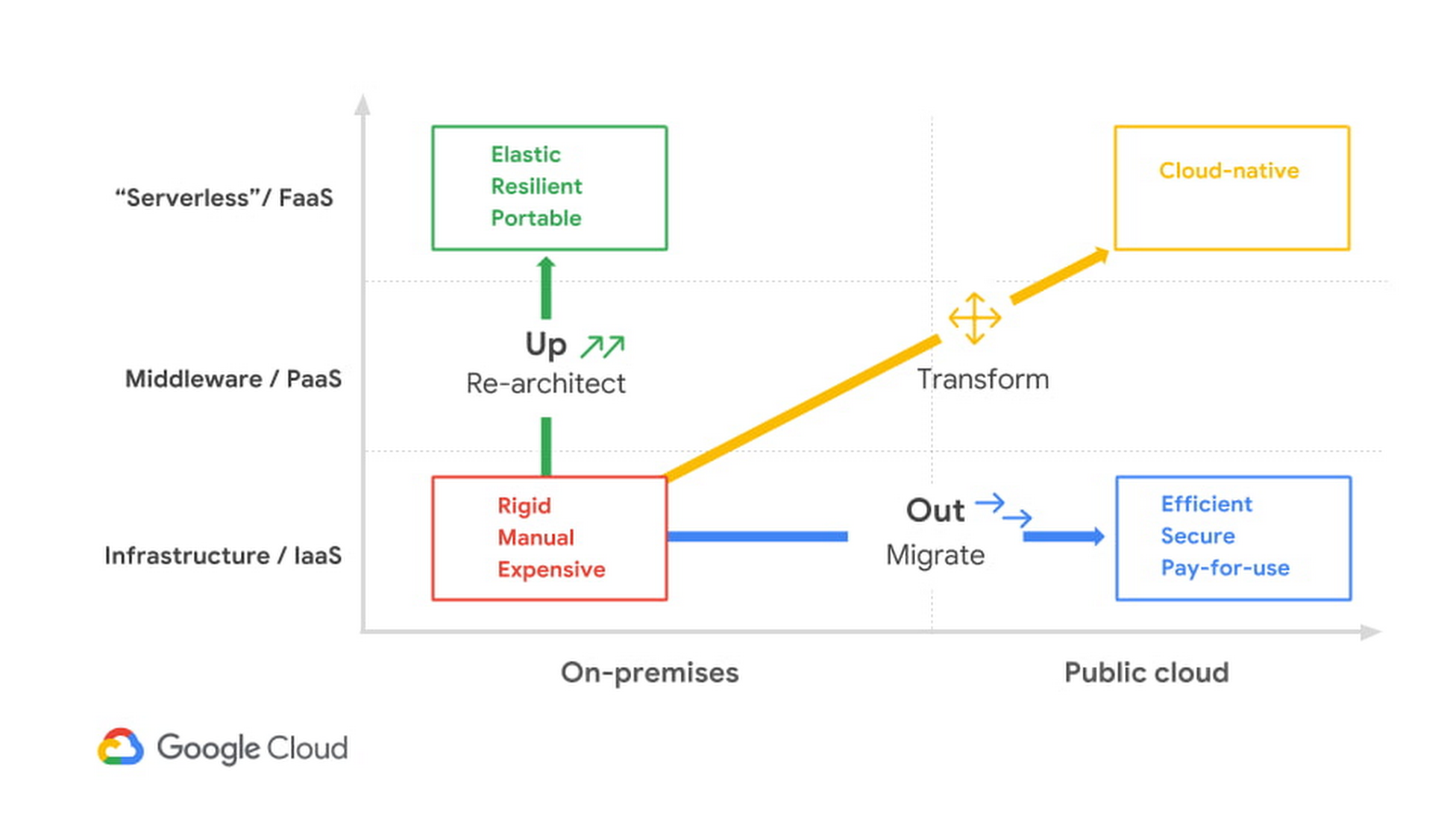
As you can see, there isn’t a single path to the cloud—not for individual enterprises and not even for individual applications. The up or out framework can help an IT organization and its leadership characterize how they can best benefit from migrating their services or workloads. The framework acts as a general pattern that highlights the continuum of approaches to explore, and you can learn all about it by downloading this detailed white paper.
Or, if you’re really ready to jump start your migration today, you can take advantage of our current offer by signing up for a free discovery and assessment.
More Relevant Stories for Your Company


How L&T Financial Services Processes 95% of Motorcycle Loans in Less Than Two Minutes
L&T Financial Services is one of the largest lenders in India. India’s demonetization policy in recent years has led to a shift from cash transactions to digital payments. In 2016, the government withdrew 500 and 1000 rupee notes from circulation and encouraged a heavily cash-based population to deposit their canceled notes
CFO Watch: Easily Control Your Cloud Costs with the Google Toolkit
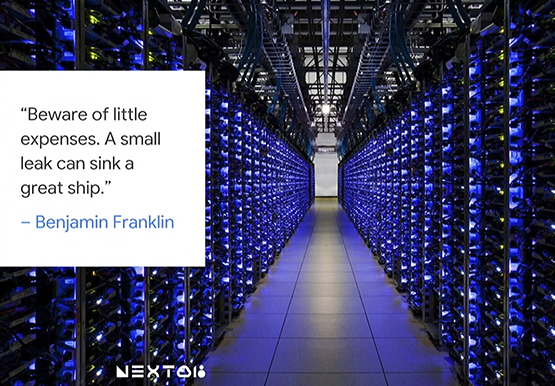
With businesses increasingly making the shift from on-premises to cloud, it’s more important than ever to put financial governance policies in place to control cloud costs. However, this is easier said than done as companies constantly struggle to control costs, which is evident from the fact that 35% of customer

Google Unveils Topaz, the New Subsea Cable Connecting Asia and Canada
There’s a new subsea cable in town: Topaz, the first-ever fiber cable to connect Canada and Asia. Once complete, Topaz will run from Vancouver to the small town of Port Alberni on the west coast of Vancouver Island in British Columbia, and across the Pacific Ocean to the prefectures of

Customer Voices: How Firms from Across Industries Leverage Google Cloud
From powering everyday operations and accelerating application innovation, to providing tools for specific business needs and executing on big ideas, to advancing the security of technology solutions, companies from across industries have leveraged Google Cloud for business benefits. Companies from across industries have turned to Google Cloud for transforming their
