





The Journey ahead for Google Cloud and SAP

3426
Of your peers have already read this article.
1:30 Minutes
The most insightful time you'll spend today!
The partnership between Google Cloud and SAP is entering a new chapter. Over the years, our close partnership with SAP and our mutual dedication to customers has inspired us to do some of our most unique and innovative work—such as building Fast Restart and Memory Poisoning Recovery capabilities for S/4HANA workloads, offering real-time access to our advanced machine learning (ML) capabilities, and developing integrations with the industry’s best cloud security and network infrastructure.
With an expanded, strategic partnership, we are capitalizing on one of the cloud’s most valuable benefits: enabling customer choice without driving up cost or complexity. Customers have shared that they appreciate what Google Cloud has done over the years to support their ability to choose—from our support for multi-cloud environments to our track record with open-source technologies like Kubernetes, to name a couple of examples.
“We chose Google Cloud to support our SAP implementation. Our decision had a lot to do with the relationship between Google Cloud and SAP and also for the applications and services that are offered by Google Cloud, like BigQuery, which are helping to enable data and analytics within our organization.”— Sam Moses, Vice President of Corporate Systems, The Home Depot
Now, we’re placing this same emphasis on customer choice, flexibility, and freedom to help SAP customers get greater ROI from their cloud investments in three ways:
- Execute seamless business transformations that deliver all of the benefits of modern, cloud-native applications and services—quickly, economically, and without disrupting day-to-day operations
- Migrate critical business systems to the cloud, in order to lock in OpEx savings and refocus their IT teams on strategic business technology initiatives
- Augment existing business systems with cloud capabilities in AI, ML, and analytics
The cornerstone of our expanded partnership is the RISE with SAP program—a comprehensive set of tools, technology, and expert support for a fast, predictable, cost-effective path to business transformation with SAP in the cloud. RISE is also designed to meet every SAP customer on their own terms, whether they’re undertaking an enterprise-wide cloud migration or pursuing an incremental or hybrid-cloud approach.
To support customers taking advantage of RISE with SAP, Google Cloud will work even more closely with SAP to accelerate customers’ cloud migrations and business process modernization across several key areas. This includes ensuring global availability of multiple SAP services and products—such as SAP Business Technology Platform and SAP HANA Cloud—on Google Cloud’s reliable, scalable infrastructure and high-speed network. Google Cloud is also committed to bringing SAP’s solution for RPA in manufacturing to the Google Cloud Marketplace to support business process modernization.
Additionally, integrating our AI, ML, and analytics capabilities with key SAP solutions will help companies augment their business systems with sophisticated capabilities and technologies so they can draw more value out of the data stored with them.
“We can deliver our 160 key business insights two or three orders of magnitude faster with BigQuery. When you think about our marketing campaigns and month-end finance processes, we’re talking about jobs that used to take five to eight hours to complete that are now running in seconds.”— Dan Semmens, Head of Data and AI, ATB Financial
Join us on the journey ahead
There’s so much more to come from SAP and Google Cloud. Learn more about our commitment to enabling digital transformation and hear more from customers about their SAP on Google Cloud deployments.
Google Cloud Infrastructure: What Changed in the Last One Year and What’s in the Future?
3475
Of your peers have already read this article.
3:00 Minutes
The most insightful time you'll spend today!
This past year brought both new challenges and successes for our customers around the world. We thought life was going to return to normal… and then it didn’t. Despite the uncertainty, it was exciting to see customers make huge transformations in when, where, and how they run their businesses, with cloud infrastructure as a major enabler.
According to IDC, “by 2024, 50% of organizations will use applications built on abstraction provided by managed services including cloud-native technologies to enable consistency in running in any and many locations.”1 Over the past year we were honored to work with so many of you to start to make this prediction a reality.
Let’s take a deeper look at where our infrastructure progressed in 2021, and where we’re headed in the new year.
Google Cloud is recognized by independent experts for its leadership
For the fourth consecutive year, Google Cloud was named a Leader in the Gartner Magic Quadrant for Cloud Infrastructure and Platform Services.
The Forrester Wave for AI infrastructure placed Google at the topmost position, a testament to Google’s investments in tomorrow’s AI-first world.
Google Cloud also won the HPC Wire Editor’s Choice award for the best use of HPC in the cloud.
We made it easier to migrate enterprise applications
To support enterprises in their transformation journeys we focused on expanding our support for enterprise applications in our cloud. The Home Depot just wrote about its successful migration of SAP to Google Cloud, highlighting how crucial it is to have good processes and strong partnerships. For other companies using SAP applications we also launched Filestore Enterprise, which delivers 99.99% regional availability backed by an SLA.
Our partner NetApp deepened its integration with Google Cloud to enable easier and faster Windows-based application migration, and provided flexible deployment options to modernize workloads. We also added new Network Connectivity Center partners to include companies like Cisco, Palo Alto Networks, and VMware, so as you migrate over time you can easily connect all your networking resources together in one place.
For those of you considering migration to cloud, Forrester dove deeper into the economics of migrating enterprise applications to cloud. (Spoiler alert: companies are finding major cost savings and performance benefits!) It’s so important to us that companies trust that their biggest, most complex applications will run smoothly and securely with us, and we’re pleased at the progress we’ve made toward supporting more enterprise applications this year.
We also made it easier for you to migrate VMware workloads to the cloud by expanding Google Cloud VMware Engine to 12 regions worldwide and enabling several new capabilities across networking, compliance, and scale. Customers such as Mitel and Carrefour migrated their VMware estates to Google Cloud to transform their applications with Google services to increase agility, save money (up to 45%) and reduce energy costs (about 35%) compared to running on-premises.
For High Performance Computing (HPC), we continued to add capabilities such as optimized VM images for HPC, enhanced integration with schedulers such as SchedMD, Slurm, and Altair PBSPro.
New cost and performance options
To further support customers doing high performance computing for things like real-time advertising, dynamic e-commerce, and gaming, we launched a new VM family: Tau VMs. Tau VMs offer 56% higher absolute performance and 42% higher price-performance compared to general-purpose VMs from any of the leading public cloud vendors. We are seeing companies such as Nylas switching from other cloud platforms to Google Cloud to make the most of Tau VMs.
That isn’t the only VM advancement we made. For customers with higher levels of fault tolerance and looking for greater cost efficiencies, we launched Spot VMs, which open up access to Google Cloud’s idle capacity so you can run your application at the lowest price possible. With Spot VMs, you save anywhere from 60-91% off the price of on-demand VMs.
We also launched more options for the highest performance ephemeral block storage — 6TB and 9TB Local SSDs, which offer greater IOPS per dollar when attached to general purpose N2 Compute Engine VMs.
Distributed cloud brings us closer to you
For years, the industry has been telling companies, “move to cloud!” but not all workloads can move to the public cloud immediately or entirely. Factors include industry- or region-specific compliance and data sovereignty needs, low latency or local data-processing requirements, or the need to run applications close to other services.
In October, we expanded our distributed cloud strategy and announced Google Distributed Cloud, a portfolio of fully managed hardware and software solutions that extend Google Cloud’s infrastructure and services to data centers and the edge. This is a major step forward in our ability to meet you where you are, in private data centers and at the edge, and we’re excited to see how this helps you as we move into 2022.
Data protection and security that never sleeps
This year we worked hard to help improve your data protection capabilities. We doubled down on our Actifio acquisition by launching several releases that deepened its integration with Google Cloud. For customers with containerized applications, we took a big step forward with the launch of Backup for GKE. We’re particularly excited about how this new option for GKE users allows you to more easily meet your service-level objectives, automate common backup and recovery tasks, and show reporting for compliance and audit purposes.
We also enhanced Cloud Storage with data protection features like custom region selection for dual-region buckets. Previously, Google Cloud assigned dual-region pairs for you to choose from. With this release, you can select your own region pairs that meet your regulatory or compliance requirements, or optimize your app performance. We also launched Turbo Replication for dual-region buckets, which replicates 100% of your data between regions in 15 minutes or less, backed by a Service Level Agreement, a first from a leading cloud provider.
Security is a key area of focus for us and we partnered with Palo Alto Networks to deliver their industry-leading Intrusion Detection System (IDS) solution natively on Google Cloud. With the recent Apache Log4j vulnerability, we automatically updated Cloud IDS to help detect exploit attempts and protect our customers’ environments quickly. We also integrated Cloud Armor with reCAPTCHA Enterprise to deliver a best-in-class bot and fraud management solution to prevent volumetric attacks. Cloud Armor is deployed with our Cloud Load Balancer and Cloud CDN, extending its security benefits at the network edge for traffic coming into Google Cloud.
We made it easier to build and manage applications
Developers want to focus on code, not configuring, managing or scaling infrastructure. To help, we worked on simplifying networking with new services such as Private Service Connect, which allows you to connect VPCs to applications and services securely without configuring all the network underlay. To make it easier to run workloads in hybrid environments, we introduced BYOIP so you don’t need to change your IP address, and we enhanced Cloud Load Balancer with advanced traffic management, regional and hybrid app delivery to load balance traffic between on-prem and cloud workloads. We also introduced IPv6, DNS policy manager, Cloud Domains, GKE Gateway Controller, eBPF data plane, and Service Directory, all with the goal of making networking easier for developers.
We continue to invest in visibility and observability for efficient day 2 operations. Network Intelligence Center now has dynamic reachability within the Connectivity Tests module, interconnect and VPN visualization in Network Topology, and the Firewall Insights module, which provides visibility into firewall rules to ensure they are being used appropriately and as intended.
And while not new this year, developers continue to tell us how much they love the ease of architecting storage using Cloud Storage. See how easy it is to configure a dual-region bucket. As a result, developers can treat a continent like a single bucket, dramatically simplifying the application programming model. Google Cloud is unique in offering this capability among major public cloud vendors.
We continue to be the most sustainable cloud for you
Another area Google has invested in deeply and that is becoming increasingly important to more organizations is sustainability. Many cloud providers have a vision for a sustainable future, and many aim to match their electricity consumption with 100% renewable energy by 2025 or 2030. We accomplished 100% renewable energy in 2017, which means we’re the only hyperscale cloud to do this today and on data centers that are twice as energy efficient as the average data center.
We also announced a number of new features like our new Carbon Footprint tool. Every Google Cloud user — that means you! — can see the gross carbon emissions associated with the services you use in Google Cloud. This means picking the data center that meets your sustainability goals, and reducing the overall emissions tied to your infrastructure and applications. And we have some pretty big goals for the future. For more, don’t miss our full sustainability recap.
A big thank you to our customers
While we were busy building out our infrastructure in 2021, we’d be nowhere without the partnership of our amazing customers. It’s hard to pick from all the exciting stories we heard this year, but here are just a few: Pega migrated its SAP applications to Google Cloud with zero downtime. Paypal exited its non-strategic data centers and achieved major cost savings. And Wix used our network to serve tens of millions of requests per day.
I’m proud to look back at how our cloud infrastructure has evolved this year to support each of our customers on their transformation journey. As we head into 2022 I’m excited to continue to partner with you to solve your most difficult challenges together.
Interested in hearing more about Google’s vision for the future? Listen to Thomas Kurian’s thoughts from Google Cloud Next ‘21.
1. IDC FutureScape: Worldwide Cloud 2022 Predictions
Google Cloud Launches Digital Assets Team to Power the Emerging Blockchain Space

3110
Of your peers have already read this article.
1:30 Minutes
The most insightful time you'll spend today!
Blockchain technology is yielding tremendous innovation and value creation for consumers and businesses around the world. As the technology becomes more mainstream, companies need scalable, secure, and sustainable infrastructure on which to grow their businesses and support their networks. We believe Google Cloud can play an important role in this evolution.
Building on our existing work with blockchain developers, exchanges, and other companies in this space, we are announcing today a new, dedicated Digital Assets Team within Google Cloud to support our customers’ needs in building, transacting, storing value, and deploying new products on blockchain-based platforms. This new team will enable our customers to accelerate their efforts in this emerging space and help underpin the blockchain ecosystems of tomorrow.
What We’re Doing Today (and Into the Future)
Blockchain and distributed-ledger-based companies like Hedera, Theta Labs, and Dapper Labs have already chosen to build on top of Google Cloud for scalability, flexibility, and security. Moving forward, Google Cloud’s Digital Assets Team will undertake a number of short- and long-term initiatives to support companies in the digital assets/blockchain ecosystem, including:
- Providing dedicated node hosting/remote procedure call (RPC) nodes for developers, allowing users to deploy blockchain validators on Google Cloud via a single click (“click to deploy”).
- Participating in node validation and on-chain governance with select partners.
- Helping developers and users host their nodes on the cleanest cloud in the industry, supporting their environmental, social, and governance initiatives.
- Supporting on-chain governance via participation from Google Cloud executives and senior engineers.
- Hosting several public BigQuery datasets on our Marketplace, including full blockchain transaction history for Bitcoin, Ethereum, Bitcoin Cash, Dash, Litecoin, Zcash, Theta, Hedera Hashgraph, Band Protocol, Polygon, XRP, and Dogecoin.
- Driving co-development and integration into Google’s robust partner ecosystem, including participating in the Google Cloud Marketplace.
- Embracing joint go-to-market initiatives with our ecosystem partners where Google Cloud can be the connective tissue between traditional enterprise and blockchain technologies.
As we build out our team, we’re also exploring opportunities in the future to enable Google Cloud customers to make and receive payments using cryptocurrencies.
Why Partner with Google Cloud
Our customers in this space—both traditional firms seeking to implement blockchain strategies and blockchain-native companies, such as exchanges, app providers, and decentralized platforms—are choosing Google Cloud for three key reasons:
- First, their businesses and their developer ecosystems can build on the industry’s cleanest cloud. Growing in a sustainable manner is top-of-mind for many businesses, but is particularly relevant in the blockchain space, where the ability to run and scale sustainably is critical. Google is carbon neutral today, and we’ve announced our goal to run on carbon-free energy, 24/7 at all of our data centers by 2030. We’ve also rolled out the ability for customers to choose a Google Cloud region in which to run based on carbon footprint data.
- Second, developers building on blockchain-based platforms can benefit from Google’s world-class developer platform. Google Cloud infrastructure ensures that developers can speed up the delivery of software and data on the blockchain, delivering fast access to applications for users.
- Third, Google Cloud technologies and services will ensure that blockchain-based companies can scale securely and reliably. Google can ensure that data, applications, games, or digital assets like NFTs will be delivered on a stable, secure, and trusted global network.
Google Cloud’s Approach to Blockchain and Digital Assets
Blockchains and digital assets are changing the way the world stores and moves its information —as well as value. As an infrastructure provider, Google Cloud views the evolution of blockchain technology and decentralized networks today as analogous to the rise of open source and the internet 10-15 years ago. Just as open source developments were integral to the early days of the internet, blockchain is yielding innovation and value creation for consumers and businesses. As the technology becomes more mainstream, companies will need scalable, secure infrastructure on which to grow their businesses and support their networks.
As such, we’re applying Google Cloud technology to the blockchain market with the following principles:
- Consistent with Google Cloud’s core business: We are specialists in data-powered innovation with leading infrastructure, industry solutions, and other cutting-edge technology. We pursue blockchain projects and partnerships that align with our mission and our expertise.
- User trust and governance: Blockchain networks raise novel questions concerning legal compliance and user privacy. We will maintain our commitment to our users through a robust focus on privacy and user trust, as well as an uncompromising focus on compliance with applicable laws.
- Network-agnostic: Google’s infrastructure will seek to preserve optionality of networks for the benefit of users.
We’re inspired by the work already done in the digital assets space by our customers, and we look forward to providing the infrastructure and technologies to support what’s possible with blockchain technologies in the future. If you’re eager to learn more about Google Cloud’s new Digital Assets Team, please reach out to your Google Cloud sales representative or partner manager.
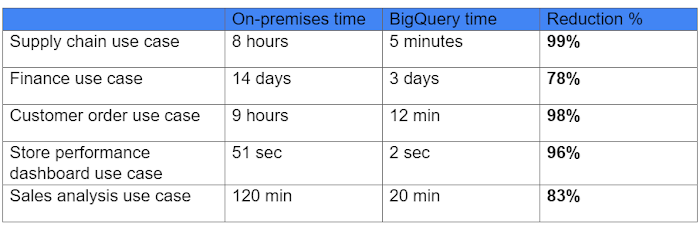
This Chart, from Home Depot, Dramatically Demonstrates the Power of a Cloud Data Warehouse
7619
Of your peers have already read this article.
2:30 Minutes
The most insightful time you'll spend today!
The Home Depot (THD) is the world’s largest home-improvement chain, growing to more than 2,200 stores and 700,000 products in four decades. Much of that success was driven through the analysis of data. This included developing sales forecasts, replenishing inventory through the supply chain network, and providing timely performance scorecards.
However, to compete in today’s business world, THD has taken this data-driven approach to an entirely new level of success on Google Cloud, providing capabilities not practical on legacy technologies.
The pressures of contemporary growth that drove much of the work are familiar to many businesses. In addition to everything it was doing, THD needed to better integrate the complexities in its related businesses, like tool rental and home services. It needed to better empower teams, including a fast-growing data analysis staff and store associates with mobile computing devices. It wanted to better use online commerce and artificial intelligence to meet customer needs, while maintaining better security.
Even before addressing these new challenges, THD’s existing on-premises data warehouse was under stress as more data was required for analytics and data analysts were utilizing the data with increasingly complex use cases. This drove rapid growth of the data warehouse, but also created constant challenges for the team in managing priorities, performance, and cost.
In order to add capacity to the environment, it was a major planning, architecture, and testing effort. In one case, adding on-premises capacity took six months of planning and a three-day service outage. Within a year, capacity was again scarce, impacting performance and ability to execute all the reporting and analytics workloads required. The capacity refresh cycles were shrinking, and the expecations for data were growing. There had to be a better way.
Still, THD did not take its move to the cloud lightly. A large-scale enterprise data warehouse migration involves tremendous effort among people, process, and technology. After careful consideration, THD chose Google Cloud’s BigQuery for its cloud enterprise data warehouse.
BigQuery, a scalable serverless data warehouse, was better on cost, infrastructure agility, and analytics capability, driving better insights with improved performance. There are no service interruptions when capacity is added, and that capacity can be added within a week (and soon same day). It doesn’t require complex system administration, and its standard SQL support means people can easily ramp up quickly. Valuable BigQuery products like Identity and Access Management meant THD could create many separate Google Cloud projects, while ensuring that different teams weren’t interfering with each other or accessing protected data.
THD also utilizes BigQuery’s flat-rate monthly pricing model that allows teams to budget their capacity based on need and provides billing predictability. The capacity not being used by a given project is available for enterprise use. This ensures no surprises when the monthly bill arrives and provides all analytical users access to significant computing power.
While THD’s legacy data warehouse contained 450 terabytes of data, the BigQuery enterprise data warehouse has over 15 petabytes. That means better decision-making by utilizing new datasets like website clickstream data and by analyzing additional years of data.
As for performance, look at this chart:
With the cloud EDW migration complete, and the legacy on-premises data warehouse retired, analysts now execute more complex and demanding workloads that they would not have been able to complete before, such as utilizing Datalab for orchestrating analytics through Python Notebooks, utilizing BigQuery ML for machine learning directly against the BigQuery data (no movement of large datasets), and AutoML to help determine the best model for predictions.
Additionally, engineers at THD have adapted BigQuery to monitor, analyze, and act on application performance data across all its stores and warehouses in real time, something that was not practical in the on-premises system.
With over 600 projects that THD now has on Google Cloud, the BigQuery story is just one of the many ways that Google Cloud is working with THD to deliver meaningful business results, every day.
Giving Customers More Choice: Google Cloud’s New Product and Pricing Options

3298
Of your peers have already read this article.
3:00 Minutes
The most insightful time you'll spend today!
Over the past several years, Google Cloud has made significant investments in our infrastructure product portfolio. We launched new Tau T2D VMs, which deliver 42% better price-performance vs. other leading cloud providers. We upgraded Cloud Storage to offer more flexibility to support customers’ enterprise and analytics workloads, with dual-region buckets and upcoming Turbo Replication. And we’ve delivered numerous improvements to our global network, including expansion to 29 cloud regions.
However, from conversations with customers, we’ve also learned we can do more to align our capabilities and pricing with their varied workloads. So, today, we are announcing we will adjust our infrastructure product and pricing structure to give customers more choice in how they pay for what they use alongside new, flexible SKUs with new product options and capabilities. These changes are designed to help ensure better product fit for our customers’ use cases across a wider array of workloads. They are also designed to better align with how other leading cloud providers charge for similar products, so customers can more easily compare services between leading cloud providers.
Some of these changes will provide new, lower-cost options and features for Google Cloud products. Other changes will raise prices on certain products. Ultimately, our goal is to provide more flexible pricing models and options for how customers are using our cloud services. Here’s an overview of what customers can expect:
Which services are changing? What new services are being introduced?
We are changing prices for some storage, compute, and networking products. The changes provide customers with new ways to optimize their spending based on workload type and size, or data portability needs, as well as reducing costs on some services. Specific changes include:
- Cloud Storage pricing changes for data mobility, including replication of data written to a dual- or multi-region storage bucket, and inter-region data access
- Introduction of a new lower-cost archive snapshot option for Persistent Disk (PD), so that compliance/archiving use cases are charged less than compute-intensive DevOps workloads
- New outbound data processing pricing for Cloud Load Balancing, in line with other leading cloud providers
- New pricing for Network Topology, which will include Performance Dashboard within Network Intelligence Center at no additional charge
Will customers’ bills increase? Decrease?
The impact of the pricing changes depends on customers’ use cases and usage. While some customers may see an increase in their bills, we’re also introducing new options for some services to better align with usage, which could lower some customers’ bills. In fact, many customers will be able to adapt their portfolios and usage to decrease costs. We’re working directly with customers to help them understand which changes may impact them.
When will the new prices go into effect?
Today, we sent customers a six-month notice on the price changes, which go into effect on October 1, 2022. Customers under existing commit contracts with a floating or fixed discount will not face any changes until renewal. Our goal is to help our customers manage any impact of these changes and allow time for them to adjust or modify their implementations.
What should customers do next?
There are a number of things customers can do to prepare for the changes:
- Read through the Mandatory Service Announcement (MSA) sent on March 14.
- Consider what actions, if any, they may want to take based on current storage, networking, and compute needs. Many of these changes may have simple choices associated with them.
- Consider using the Storage Transfer Service to select the right Cloud Storage bucket locations. Storage Transfer Service will be available free-of-cost for transfers within Cloud Storage, starting April 2 until the end of the year.
For those customers under contract, Google Cloud account representatives are available to discuss these changes. Please visit our pricing page and the links below for more details on our updates to storage, networking, and PD pricing, including information on how to modify your implementations if needed. If you do not have an account manager and still have questions please review our public FAQ, which will be updated regularly, as well as the resource links below.
Note: This pricing analysis is valid as of February 2022.
Resources:
How One Company Improved Security Significantly–Without Increasing Staff

6461
Of your peers have already read this article.
2:45 Minutes
The most insightful time you'll spend today!
Quanta Services is the leading specialty contractor with the largest and highly-skilled trained workforce in North America. It provides fully-integrated solutions for the electric power
pipeline industrial and telecommunications industries the company’s geographic footprint which includes North America Latin America and Australia.
It’s network of companies ensures world-class execution with local delivery and has over 40,000 employees.
“The exciting thing about Backstory is it allows us to land massive amounts of data from all of our different security tools and then Chronicle worries about how to correlate and aggregate this information for us. We can then focus on the highest priority threats.”
Richard Breaux, Manager Security Operations Quanta Services
Because Quanta Services’ customers provide energy and telecommunications to their customers, they have world-class cybersecurity requirements.
“We must ensure that Quanta leads the industry given the fact that our business is building the core infrastructure that powers people’s lives. It’s crucial that we meet their cybersecurity requirements,” says James Stinson, VP-IT, Quanta Services.
To support this goal Quanta implemented a number of security tools that generate terabytes of security telemetry. Over time, however, these systems generated an information overload for the company’s limited pool of qualified security resources.
“Our logging tools also couldn’t keep up with the rapidly growing information. With limited resources we need to focus our security analysts time on high quality work instead of digging through mountains of data,” says Stinson.
They achieve this by implementing Backstory and Chronicle, which is on Google Cloud.
“The exciting thing about Backstory is it allows us to land massive amounts of data from all of our different security tools and then Chronicle worries about how to correlate and aggregate this information for us. We can then focus on the highest priority threats,” says Richard Breaux, Manager Security Operations Quanta Services.
As a result, the company’s security team spends less time getting to the core information they need to address these incidents.
“What used to take us 15 minutes or more, we can now accomplish in seconds,” says Breaux.
More Relevant Stories for Your Company

Transforming Canadian Healthcare and Medical Research with Google Cloud
Is Cloud an option for Canadian Healthcare healthcare and medical research organizations? Yes, Canadian healthcare and medical research organizations are moving to the cloud. The cloud market is expected to grow in Canada significantly through 2027. There are several reasons why Canadian healthcare and medical research organizations are moving to

Takeaways from the Google Cloud Public Sector Summit on Prioritizing Tech Investments
Editor’s note: Today’s post highlights five takeaways from our session at the first ever Google Cloud Public Sector Summit. To watch the full session, check out All the Right Moves: Prioritizing Investments in Technology. Now more than ever, government agencies need to invest in digital services to fulfill their missions and better

Google Cloud is Every Retailer’s Most Trusted Cloud
Whether they were ready for it or not, the COVID-19 pandemic transformed many retailers into digital businesses. Retailers made huge investments into commerce technologies, customer experience tools, sales and fulfillment technology, and improving digital experiences to continue providing their goods and services to their customers. Now, more than a year



The Transformative Journeys of Financial Firms on Google Cloud: Watch Video
The reliance on cloud-based architectures, high performance computing, big data and more are accelerating in the banking, capital, insurance and financial services industries. Google Cloud had a strong role in transforming many businesses especially in the pandemic to smoothly transition into the digital space and understand their customers. Two years
