





A 100-year Old Business’ Digital Evolution with Apigee API Management

3865
Of your peers have already read this article.
3:00 Minutes
The most insightful time you'll spend today!
Editor’s note: James Fairweather, chief innovation officer at Pitney Bowes, has played a key role in modernizing the product offerings at this century-old global provider of innovative shipping solutions for businesses of all sizes. In today’s post, he discusses some key challenges the Pitney Bowes team overcame during its digital transformation, and some of the benefits it has enjoyed from building new digital competencies.
Pitney Bowes will celebrate its 100th birthday in April 2020. Over the past century, we’ve enjoyed great success in markets associated with shipping and mailing. Yet, as with so many established and successful enterprises, we faced slowing growth in the markets that served us so well for so long. While package growth was accelerating, the mail market was declining, creating opportunities and challenges.
To change our growth trajectory and “build a bridge” to Pitney Bowes’ second century, we needed to offer more value to our clients. We needed to move to growth markets, and that required new digital competencies. In 2015, we began a deliberate journey to transform our services, including shipping and location intelligence, for the digital world and make them available via the cloud. We learned a lot throughout this journey. In this post we’ll take a look at three things, in particular, that led to the success of this project—and will help future projects succeed, as well.
Setting expectations and realistic milestones
Organizations tend to undertake product development with a sense of optimism—and it’s often not particularly realistic. You set out thinking something will take a certain amount of time and that you will incur a specific cost, but estimates in technology and development may be optimistic, and costs almost always incrementally increase throughout the development process.
With a digital transformation effort, there’s an additional challenge: You aren’t really heading to a well-defined destination, so the path your team takes can be even more ambiguous. Digital transformation doesn’t have an end state. It’s a process of constant evolution.
For these reasons, and more, it’s important to set informed, realistic expectations—in schedule, in budget, in project scope. It’s also critical that you identify milestones along the way, and recognize and celebrate when you reach them.
When you’re working on a massive, multi-year corporate transformation, after all, it can be hard to recognize that every little action you take each week, everything you win day-to-day, is a part of your progress, your change. So, it’s really important, as a leader, to bring consistency and execution discipline—and be able to point to the progress being made and celebrate accomplishments.
We did our best to follow this advice during our digital transformation. Late 2015 was a critical time for Pitney Bowes as we laid out the technology strategy that would get us to the next century. We were aware of the potential hazards that could arise. You set the strategy, celebrate its publication as an accomplishment… and then nothing happens. To avoid this issue, we broke our strategy out into specific tactics supported by numerous smaller, interim goals. When we started putting big, green checkmarks next to each accomplished milestone, people started realizing that we were making real progress, and were serious about our execution.
One key milestone, for example, was implementing an API management platform. This comprised several granular goals: Selecting a partner, training a subset of our 1,100 team members on the platform, and rolling out our first offering that was built on top of that capability.
We knew that an API platform would be a key part of our digital transformation for three major reasons. First, we had acquired several companies, but their technologies were difficult to share for use cases across the organization. Every time a team needed to use our geocoding or geoprocessing capability, for example, they had to spin up a new environment. By building these capabilities as APIs across the organization, it made it easy to democratize their usage and speed up development.
Secondly, we were running a big enterprise business system platform transformation program and wanted our product teams to be able to consume data from our back-end business systems. This meant that we needed a solid catalog of all these services, so new members of the team could easily find and use them.
Finally, we had a couple of business units that wanted to go to market with APIs. They had a business strategy that entailed selling a service or value, with a vision to build a platform or ecosystem around these capabilities. An API platform (specifically, Google Cloud’s Apigee API management platform) is a huge accelerant in enabling all three of these objectives—it’s how you do this well.
Reusability and the Commerce Cloud
The Apigee platform and team helped us build a key offering that arose from our digital transformation: the Pitney Bowes Commerce Cloud. It’s a set of cloud-based solutions and APIs that are built on our assets and connect our new cloud solutions to our enterprise business systems, such as billing and package management.
Today, we have close to 200 APIs delivered from the Commerce Cloud in the areas of location intelligence, shipping, and global ecommerce. The Commerce Cloud isn’t just a success as a customer-facing platform, however. We often talk about whether our development teams themselves have leveraged its services when developing new products. These discussions help us understand whether a product team has thought through the digital capabilities we’ve already built, assessed which capabilities fits into its roadmap, and adopted the right technology, capabilities, and practices to align with our corporate digital transformation strategy.
Internal use of these shareable services shaves up to 70% off of our design cycles, because so many decisions are already made. Commerce Cloud adoption means you’ve gotten on the path internally, lowered the friction, and are aligned with the broader company digital transformation strategy.
Measuring success
We’re proud of what we’ve accomplished so far at Pitney Bowes. But pride only takes you so far. To determine a project’s success, you need to be able to measure it.
We do have some encouraging external measures: our percentage of revenue from new products climbed to roughly 20% of sales in 2018, compared to 5% back in 2012. And our Shipping APIs, which enable customers to integrate U.S. Postal Service capabilities into their own solutions, has gone from a standing start to an over $100 million business in a few years.
On top of those external results, our business has transformed. We’re no longer just participating in a one-time sale of a product, software, or services; we’re participating in transactions every day that drive client outcomes. The more you can improve the quality and effectiveness of those services, the more you and your client enjoy the benefits of the commercial relationship. That’s a very big business model transformation for Pitney Bowes.
We’ve also sped up our time to market and tightened our service-level agreements. But perhaps most importantly, we’ve developed and adopted a new set of internal processes and a mindset that helps us quickly adapt to changing market conditions. Again, digital transformation isn’t a destination. It’s really a set of processes that enable us to be nimble and keep building a bridge to Pitney Bowes’ future.
For more on the Pitney Bowes transformation, check out these videos and this case study.
Majority of Consumer Goods Shoppers in the U.S. will Not Compromise on Brand Principles: Google Commissioned Research

3097
Of your peers have already read this article.
1:30 Minutes
The most insightful time you'll spend today!
Editor’s note: This article first appeared in Consumer Goods Technology Magazine
Shifting work habits, more online shopping options, rising inflation, and stretched supply chains are just a few factors making it harder to discern what’s top-of-mind for shoppers today.
But we’re starting to get a clearer picture of what consumers say they value most right now. New Harris Poll research commissioned by Google Cloud reveals how U.S. shoppers are thinking about consumer goods brands in new ways—from apparel, electronics, and beauty products, to food and beverage.
While price unsurprisingly continues to be a major consideration in purchases, the average shopper is increasingly paying close attention to the values of consumer goods brands and how eco-friendly their products and practices are.
Shoppers want to buy from brands aligned with their values
COVID-19 drove people to reflect on their priorities, elevating concepts like community service, equity, and sustainability. A decade ago, most consumer goods companies would not have made these front-and-center, operational priorities. But today’s consumer not only wants savings and convenience, they also want that good feeling that comes from spending their money with a company that aligns with their values.
Our new research reveals that 82% of shoppers prefer a consumer brand’s values to align with their own, and they’ll vote with their wallet if they don’t feel a match. Three-quarters of shoppers reported parting ways with a brand over a conflict in values.
Even with their favorite consumer goods products, a majority of shoppers will not compromise on principles. If there’s a value mismatch, 39% of shoppers said they’d permanently boycott their favorite brand, and 24% would break ties at least temporarily. Most won’t be quiet about their concerns either: 28% of consumers that found their values at odds with a brand said they have shared their concerns with friends and family, and another 15% have shared their qualms on social media.
Consumer goods companies need to prioritize sustainability
A majority of today’s consumers (52%) are especially interested in supporting sustainable brands. They want to know how companies are managing their resources, specifically whether they are sourcing responsibly. These shoppers want to see meaningful, measurable efforts from CPG firms to save energy and reduce waste, like how Nuuly, URBN’s digital rental and resale business, has woven sustainability into its business operations, from its distribution centers to reusable packaging.
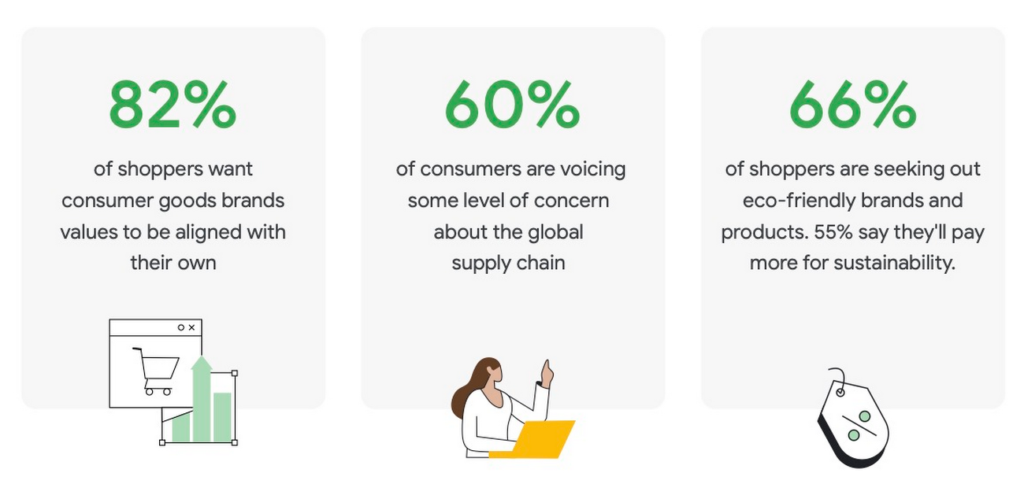
In fact, 66% of shoppers are now seeking out eco-friendly brands, with 55% saying they would pay more for more sustainable products. But these same shoppers are skeptical too: 72% think that companies and brands overstate their sustainability efforts. And they’re right to question brands’ practical application of their values. According to another Harris Poll survey recently commissioned by Google Cloud, 58% of executives polled across 16 countries admit that their organization has overstated its sustainability efforts.
Product availability is table stakes
A final point from the research: The global supply chain has stretched past its limits, and 60% of consumers are voicing some level of concern about it. At the end of the day, if a preferred brand isn’t actually on the shelves of a real or digital store, it doesn’t matter what the brand’s values or sustainability efforts are. A staggering 98% said they’d either buy from a different brand or search other stores or websites.
What’s a brand to do?
After more than 25 years working in the consumer goods industry in roles ranging from marketing and product development to business strategy and technology, at companies like Johnson & Johnson, Kimberly Clark, Carter’s, and now Google Cloud, I’ve seen successful brands do four things well when it comes to their values:
- Don’t be generic.
Your brand’s values need to be authentic, and they need to have teeth. But being too bold could run the risk of alienating some consumer segments. This is where technology can help. Personalizing your messages and outreach to specific shopper profiles is one way to ensure that your core values reach the right customers at the right time. - Make your values clear and consistent.
When focusing on which values to highlight with your consumers and the world, make sure they make sense for your brand and that you’ll stick to them over time. For example, it’s painfully obvious when a brand is being opportunistic and inserting itself into conversations around values like sustainability or social justice, when it doesn’t have a history of voicing those values. The key to clear and consistent messaging of values is balancing authenticity with relatability and the appropriate amount of promotion. - Develop sustainability practices and communicate their impact to everyday people.
How everyday people perceive a consumer goods brand’s sustainability initiatives is different from how an investor or general business audience does. Shoppers don’t read business sustainability plans or impact reports. To increase awareness of your brand’s sustainability efforts, consumers need to identify and interact with your brand and products directly. Some of my favorite examples are how I love that Google Maps gives me the choice of eco-friendly driving directions, and that I know I can buy low-waste, packaging-free cosmetics from a company like Lush. - Reward customer loyalty.
Shoppers have more choices than ever before, and supply chain woes are testing preferences even further. But when someone chooses a specific brand because they feel aligned with their values or like their eco-friendly products, that shopper doesn’t always get recognized or thanked. Implementing a rewards program or following-up with customers after their purchases is one way you can make loyal shoppers feel appreciated while creating a lasting relationship that extends as long as possible.
The Total Economic Impact of SAP on Google Cloud Gives Businesses a Transformation Accelerator: Forrester
DOWNLOAD WHITEPAPER3601
Of your peers have already downloaded this article
10:00 Minutes
The most insightful time you'll spend today!
By using Google Cloud, organizations can quickly and easily migrate their SAP applications and data to Google Cloud with minimal disruption to the business, reduce hardware and maintenance costs, and eliminate the complexities and risks of managing SAP applications on-premises. Because of Google Cloud’s pure-cloud infrastructure, organizations can host large instances in a pure-cloud environment, rather than relying on bare-metal servers as part of their public cloud strategies.
Google Cloud commissioned Forrester Consulting to conduct a Total Economic Impact™ (TEI) study and examine the potential return on investment (ROI) enterprises may realize by migrating and deploying SAP on Google Cloud. To better understand the benefits, costs, and risks associated with this investment, Forrester interviewed several customers with years of experience using SAP on Google Cloud and conducted a survey of customers who migrated SAP to Google Cloud, as well as customers who migrated SAP to a different public cloud.
After migrating their SAP infrastructure to Google Cloud, organizations found that they had more flexibility to spin up new SAP instances; reduced cost and effort to maintain SAP systems; and improved reliability, processing speeds, and uptime for SAP applications.
Download this Forrester report to find out the total economic impact of migrating your SAP workloads to Google Cloud.
Telus Ensures Workers’ Safety Using Edge and 5G

3200
Of your peers have already read this article.
1:30 Minutes
The most insightful time you'll spend today!
Editor’s note: In February 2021, Google Cloud and TELUS announced a 10-year strategic alliance to drive innovation of new services and solutions across data analytics, machine learning, and go-to-market strategies that support digital transformation within key industries, including communications technology, healthcare, agriculture, and connected home. By December 2021, TELUS had completed a pilot for a use case that leveraged Google Cloud AI and Machine Learning solutions and Telco Edge Anthos to increase safety in the workplace and save lives in manufacturing facilities. The use case leverages Multi-Access Edge Computing (MEC) to move the processing and management of traffic from a centralized cloud to the edge of TELUS’ 5G network, making it possible to deploy applications and process content closer to its customers, and thus yielding several benefits including better performance, security, and customization. Today, we invite Samer Geissah, Head of Technology Strategy and Architecture at TELUS, to share how the company is delivering on its promise to use this technology to drive meaningful change, starting with workers’ well-being.
Whenever a new technology buzzword comes along I think: what problems does this solve, and for whom is this going to make a real difference? That’s because at TELUS, we see innovation as a means to act on our social purpose to drive meaningful change, from modernizing healthcare and making our food supply more sustainable, to reducing our environmental footprint and connecting Canadians in need. Multi-Access Edge Computing (MEC) is a buzzword that offers an opportunity to do just this. That’s why we want to leverage cloud capabilities and optimize our network’s edge computing potential, tapping into our award-winning high-speed 5G connectivity to help solve some of industry’s most complex challenges.
The reason why this presents such a great opportunity is that companies across industries still rely on maintenance-heavy on-premises systems to manage core computing tasks. But, with cloud capabilities delivered at the edge of our 5G network, we open a new world of possibilities for them. For example, manufacturers who currently rely on IoT-enabled equipment in their facilities can deliver new experiences by running advanced AI-based visual inspections directly from 5G-enabled devices–all without the need for local processing power or extra on-site space. In fact, it’s this example that inspired our new use case, where our Connected Worker Safety solution can be applied across a range of business verticals to help improve safety, prevent injury, and save lives, demonstrating how the perfect combination of skilled people and digital technology can make the world a safer place.
Empowering intelligent decision making at the edge
Be it a farm, manufacturing facility, hospital, or a factory floor, workers should be able to work in environments where their health and safety are held as the highest priority. But how can employers ensure that their remote, frontline, and in-office employees are safe and healthy at all times? We’ve found the answer by combining Google Cloud AI/ML capabilities and Anthos as a platform for delivering workloads, with our network’s infrastructure.
Together with Google Cloud, we have been leveraging solutions with the power of MEC and 5G to develop a workers’ safety application in our Edmonton Data Center that enables on-premise video analytics cameras to screen manufacturing facilities and ensure compliance with safety requirements to operate heavy-duty machinery. The CCTV (closed-circuit television) cameras we used are cost-effective and easier to deploy than RTLS (real time location services) solutions that detect worker proximity and avoid collisions. This is a positive, proactive step to steadily improve workplace safety. For example, if a worker’s hand is close to a drill, that drill press will not bore holes in any surface until the video analytics camera detects that the worker’s hand has been removed from the safety zone area.
A few milliseconds could make all the difference when you are operating heavy equipment without guards in place. So, to power the solution’s predetermined actions with immediate response times, we worked with Accenture and hosted the application on an Anthos bare metal Google Cloud environment running on our TELUS multi-edge access computing.
Because all the conditions in our model are programmable, this solution can be replicated at scale across a variety of practical scenarios other than factory floors. The actions in response to the analysis are also programmable, which means companies can use this technology to look at workers’ conditions and decide the best course of action to educate, assist, and protect them. All this is done through a single pane of glass ecosystem, making it easy to customize this solution to meet various business needs.
Meanwhile, leveraging our existing global networks to process data and compute cycles at the edge eliminates the need to transport data to a central location for real-time computation. This means that we can offer this solution to partners while optimizing latency and lowering costs.
Powering blink-of-an-eye communication with Anthos
To put the importance of lowering speed into perspective, consider that the average latency of blinking your eye is about 300 milliseconds. From a safety point of view, preventative processes need to be much faster than that. For this use case, our machine learning models running on edge are currently processing data at a tenth of the time it takes for you to blink your eyes, and we’re aiming to lower that latency further to help build even safer systems.
Our plan is to deploy Anthos clusters on bare metal to our customers across Canada to take advantage of our existing enterprise infrastructure, making it possible for us to run our solution closer to partners and eventually enable just one millisecond of latency.
At that point, we’ll be able to power new use cases that require near real-time feedback, leaving absolutely no room for error. This could include remote surgery, platooning of fleets on autonomous vehicles, and many other cellular vehicle-to-everything (V2X) solutions that require high-speed communication for platform operators to manage remote edge fleets in far-away places.
Improving workers’ safety while enabling new sources of revenue
Although edge computing and 5G have been around for a while, we believe that use cases like this are only just starting to demonstrate the incredible speed of change and high potential that these models provide. The next step for us is to develop our workers’ safety solution and get it to market, making TELUS an early adopter of new 5G solutions at the edge that can help our business and industry partners make workplaces safer.
It’s a great win to be able to combine efforts with Google Cloud and reduce latency in a context where timing can impact and save lives, and I’m confident that workers’ safety is just the beginning of a series of industry challenges that we’ll address together.
Google Cloud’s Role in Minimizing Memory Errors Impact for SAP Customers
3748
Of your peers have already read this article.
2:00 Minutes
The most insightful time you'll spend today!
Every cloud system begins with high-quality hardware infrastructure. Sometimes, however, hardware breaks — and when it happens, our most important goal is to minimize the impact on our customers and their cloud workloads.
Memory errors are the most common type of hardware failure, and they’re also one of the most challenging in terms of their impact on production workloads and system reliability. That’s why we’re excited to share what Google Cloud has been doing to minimize the impact of memory errors. If your business runs SAP HANA in the cloud, this is an important innovation — one that Google Cloud is proud to deliver to our customers.
Memory errors: A big problem with a long history
First things first: Memory errors are a high priority because they happen often. And when they happen, the disruption can have far-reaching effects on your customers and your business.
In 2009, Google Cloud published the first major study on memory reliability. We found an average error rate of over 8% per year in DIMM modules installed in production systems. Given that each generation of DDR RAM packs more capacity into smaller packages, it’s safe to think that memory hardware has become less reliable since then.
Memory error impacts: They could be worse, but they’re far from good
What happens when a system detects a bad segment in a DIMM module? While data loss or corruption from memory errors is not common, some errors are correctable but some are not, potentially resulting in a critical system failure..
Modern CPUs are equipped with error-correcting memory features and are very good at correcting simple errors with ECC (Error Correction Code). The challenge is that most of the software that runs on a host system — whether it’s a hypervisor, a virtual machine, an operating system, a database or an application — will crash instantly when it encounters an uncorrectable memory error. In a cloud environment, this kind of crash can take down cached data and even data saved to a local SSD. The crashed applications will recover, but the process means several minutes of downtime. The more data you have, the longer this process will take.
Sometimes, that’s merely an inconvenience. Other times, it’s a very big deal. A Google Cloud customer running business-critical SAP applications and an in-memory HANA database might measure downtime costs well over $10,000 per minute in lost revenue and other direct impacts. Many HANA databases load into terabytes of memory, and it can take an hour or longer to get everything restarted and back to normal after a crash. For SAP HANA, a fast recovery with up to 10 minutes of downtime requires a redundant replica provisioned all the time, doubling the cost.
And statistically speaking, when a HANA instance occupies almost all of the memory on a host system, it’s also the most likely application to stumble across a memory error. You can see why this would be a problem.
The ‘victim neighbor’ VM challenge
There’s a final problem to consider when a memory error takes out production applications: what we call the “victim neighbor” issue.
In any cloud, a single physical host is a multi-tenant environment that might run dozens of VMs, potentially owned by dozens of different customers. A memory error won’t just crash the VM actually using the bad section, it will crash every VM running on the system. That’s a standard VM response to memory errors on a host system, and it will happen to any VM architecture available on the market today to avoid memory corruption.
Overall, this “victim neighbor” effect accounts for more than 90% of the VMs that get knocked down by a memory error on a physical server. That’s a huge blast radius for such a common problem.
A practical solution to memory-error impacts
You can see why managing this problem is a big deal for Google Cloud. While we know that some failures are inevitable, we have developed another way to tackle the problem. Google Cloud already maintains some unique and valuable tools, such as Live Migration, that help our customers minimize unplanned downtime.When we integrate these tools with recent work that leverages error-handling capabilities built into CPUs (courtesy of Intel) and into certain applications (in particular, SAP HANA), we get a solution that dramatically reduces downtime and disruptions related to memory errors — in many cases, to the point where customers won’t even know there was a problem.
The Google Cloud solution: Memory poisoning recovery
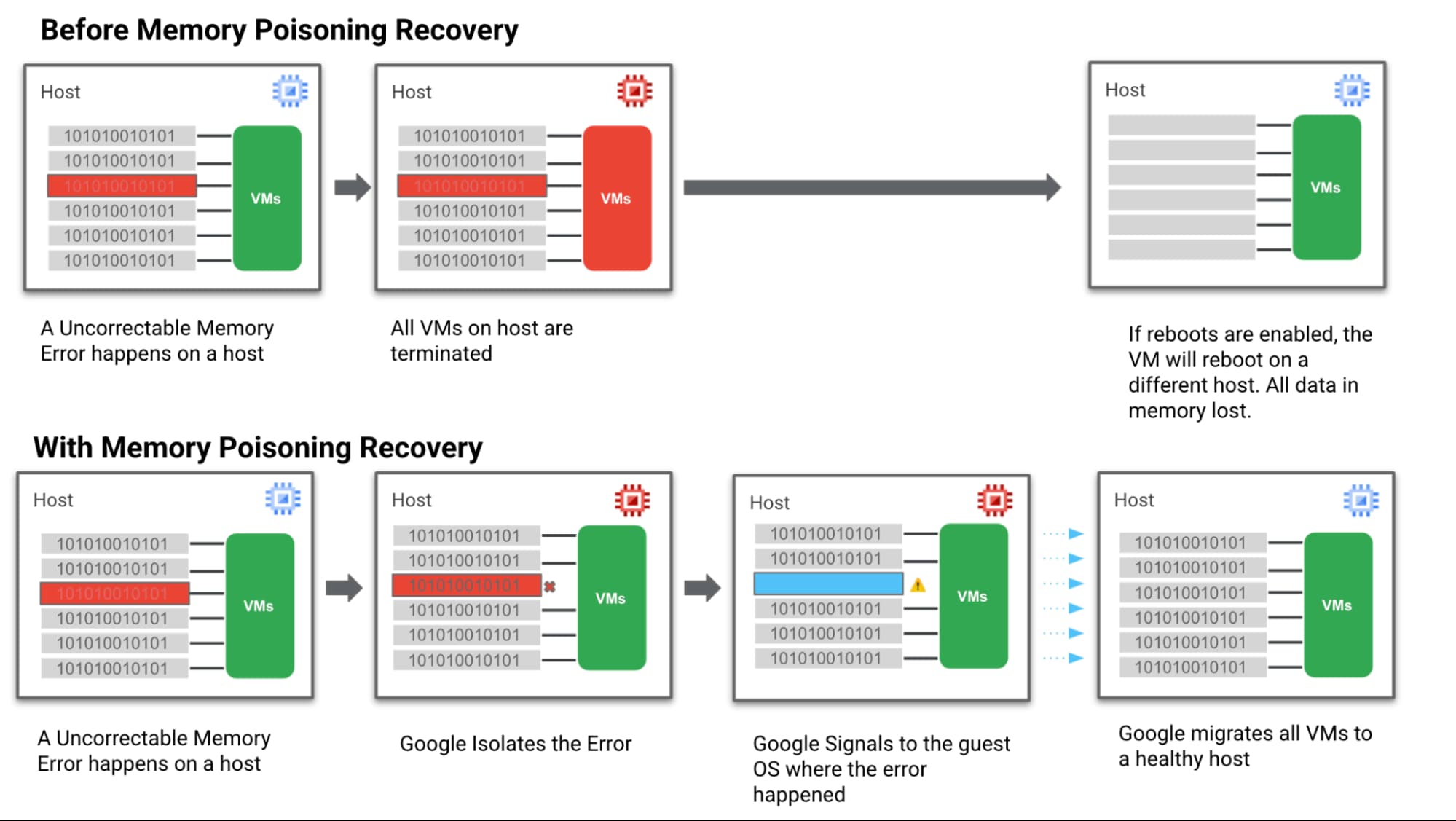
At a big picture level, we refer to our solution as Memory Poisoning Recovery (MPR). It combines some existing Google Cloud capabilities, some new capabilities, and some important third-party capabilities at the CPU (Intel) and application (SAP HANA) levels. MPR can be broken down into two main processes:
Memory Error Isolation
- Step 1: We hardened our VM technology to be more robust against memory errors. We intercept and analyse the memory error coming from the system. Then we flag the signaled region of a memory DIMM with an uncorrectable error as “poisoned”.
- Step 2: Then we trigger processes to keep track of these “poisoned” regions and the VMs they affect so they can’t affect data integrity.
Memory Error Recovery
- Step 3: Then we notify the Guest OS & the MCE-aware applications that a memory error has been recorded, in a manner that allows the applications to execute application relevant memory error handling.
- Step 4: At the same time we communicate with Google Cloud Live Migration to begin moving guest VMs off the affected host. This ensures customers are running on a healthy host which reduces the probability of more uncorrectable errors happening and avoids further downtime.
Below is a simple visual of how this all works:
How MPR makes life better for customers
Let’s look again at the different groups of Google Cloud customers involved in a memory error scenario and how we can help them achieve a happier ending after a crash — starting with the customer running the VM and application that actually triggered the memory error.
Customer Group: MCE-Aware SAP HANA with Fast Restart enabled on a VM directly affected by a memory error.
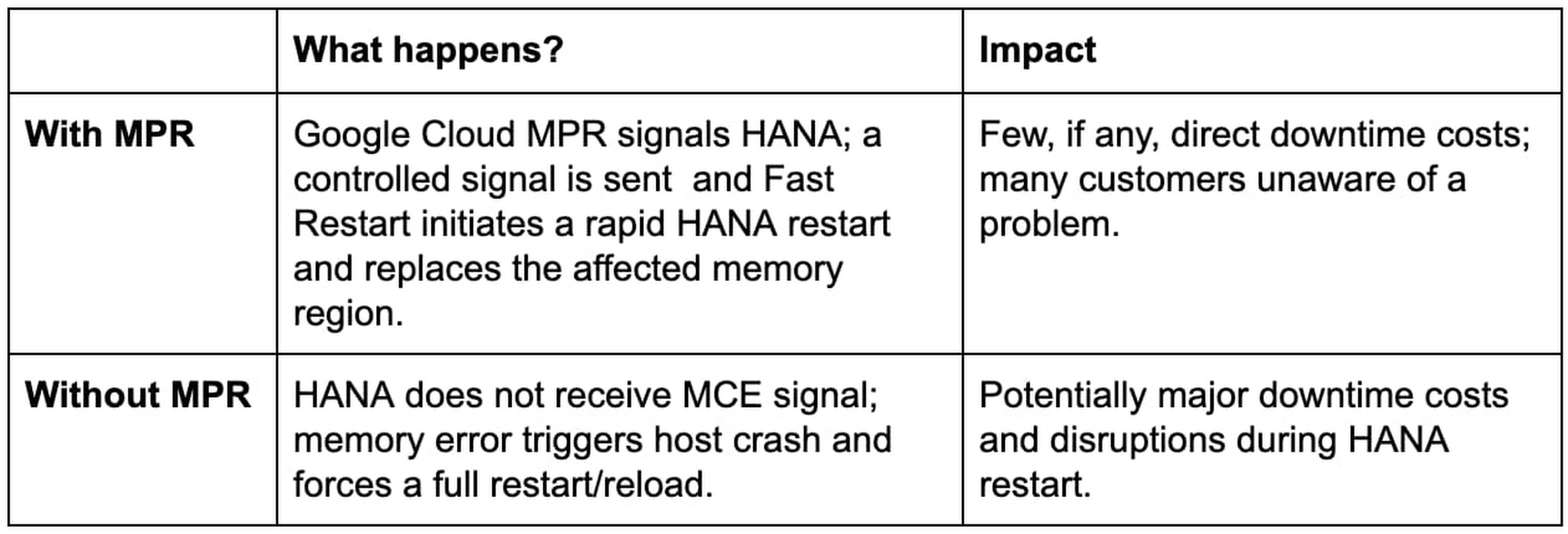
Customer Group: Customers running other, non MCE Aware applications on a VM directly affected by a memory error

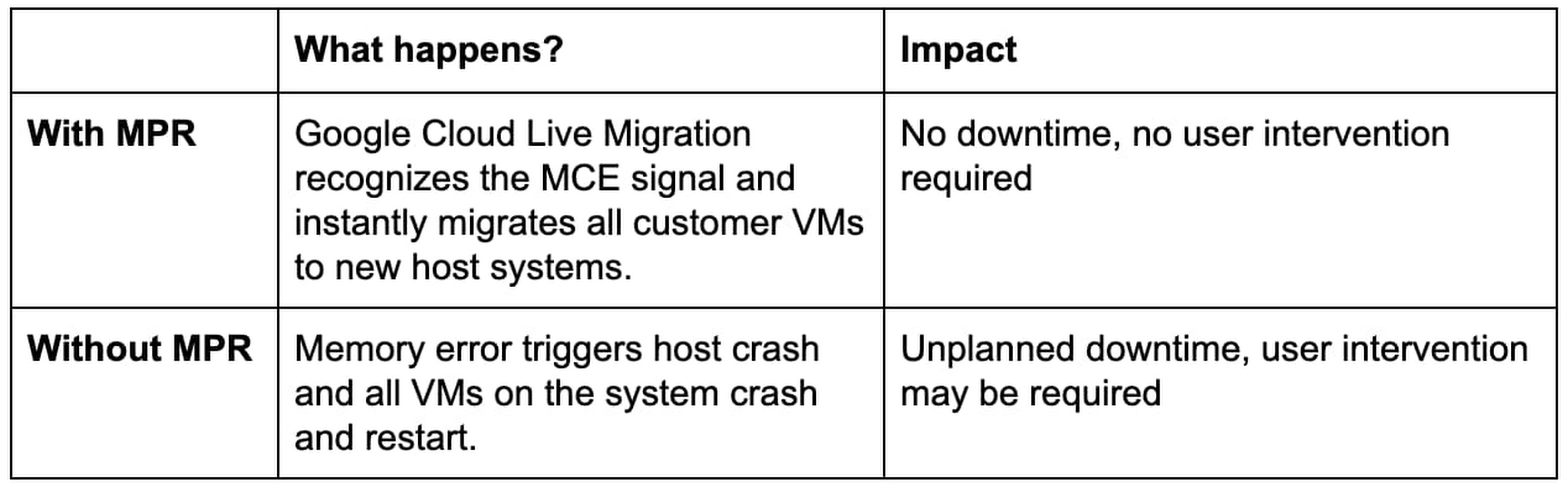
Next, our “victim neighbors” group probably won’t even know there was a problem with the host system. Google Cloud Live Migration will move them to a new host, instantly and automatically, and avoid the crash-and-restart scenario.
Customer Group: Customers running other, any application on a VM not directly affected by a memory error
Simple steps for taking advantage of MPR
Our MPR capabilities will be available on our Google Cloud memory-optimized Compute Engine second generation instances in Q4 of 2021. We’ll continue to roll out the capability during the months ahead to additional instances and look for new ways to work with applications that adopt a MCE Aware architecture.
Most customers in the “victim neighbor” category will not need to lift a finger to experience the benefits. By marrying our Live Migration feature to some awareness of those MCE signals, we ensure that it hears the alarm first and gets a critical head start on the migration process before issues begin with the guest VMs. Our customers land safely on a new host, and their applications keep running.
For our SAP customers running HANA, MPR is all about protecting against loss. Unplanned downtime for a HANA environment is incredibly expensive, the recovery process from a hard crash is extremely long, and the business disruptions can be truly damaging to the business. Thanks to MPR, all of that cost and worry can get compressed almost to nothing — with Fast Restart reducing what can be an hour or more of downtime to a matter of seconds.
But our SAP customers have to take a critical first step to claim these benefits. Fast Restart is a crucial piece of the MPR solution, and it is not enabled by default. Configuring your SAP HANA instance for Fast Restart involves changing a few configuration settings; the process is fast, easy, and doesn’t involve risk.
Finally, if you’re not running your workloads — SAP or otherwise — on Google Cloud, consider the benefits of running on a cloud that mitigates a hardware reliability issue affecting businesses of every size and industry. And consider the value of tools like Live Migration that already help Google Cloud customers improve uptime and reduce risk.
Hardware failures happen, and they probably always will. But we’re proving how valuable it can be to avoid the bad things that usually happen when memory failures occur. Right now, only Google Cloud has a practical solution to this very difficult problem.
Learn more about Fast Restart for SAP HANA, Live Migration and other key Google Cloud capabilities for your SAP environment.
2767
Of your peers have already downloaded this article
4:30 Minutes
The most insightful time you'll spend today!
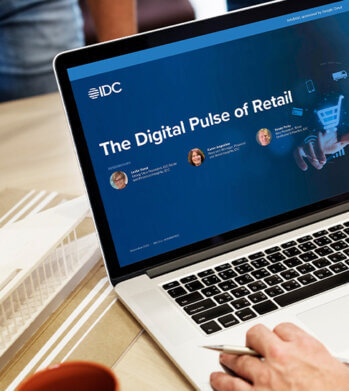
Google partnered with IDC Retail Insights to conduct a survey of retailers across the globe to assess the state of transformation and develop an index of digital maturity. Learn more about the changes in digital resilience over the last year and the areas of innovation over the next 12 months.
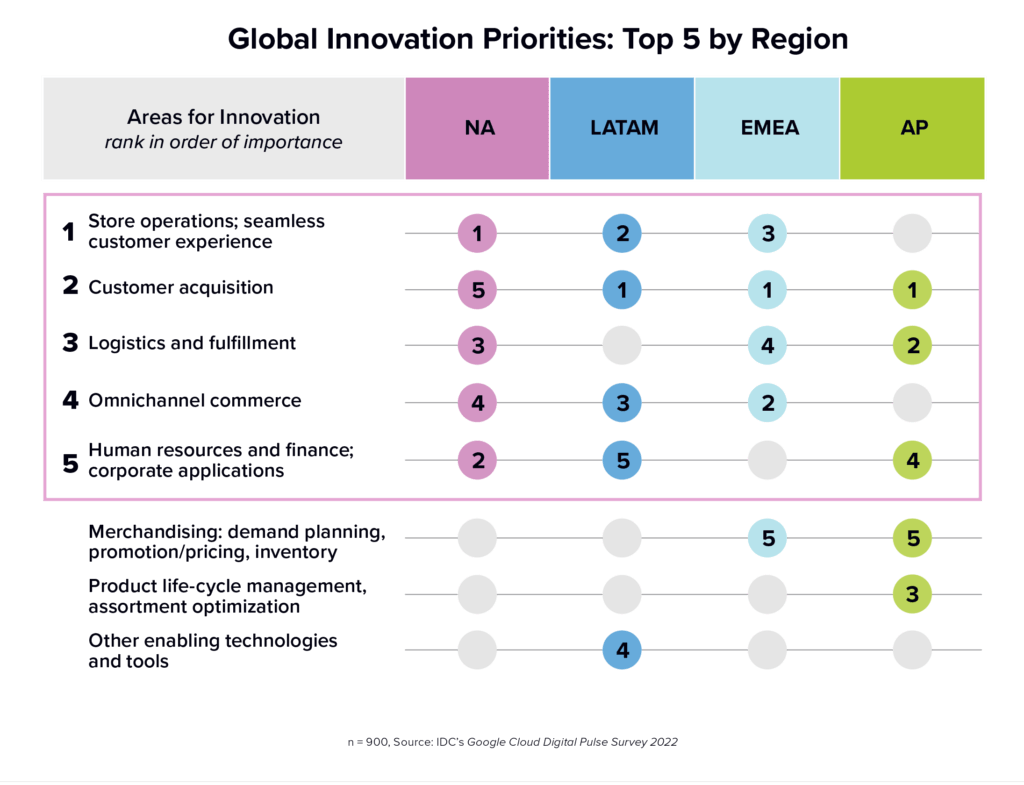
In this IDC Infobrief, you will learn:
- Where retailers stand on the path to digital resilience
- Top challenges retailers face with digitization and how that’s changed in the last 12 months
- Key areas for innovation and use cases among retailers at different stages of digital maturity
- How innovation can help organizations advance and respond evolving customer expectations
More Relevant Stories for Your Company

A Guide to Maximize Business Value with Cloud FinOps
Any organization that has made a significant investments in Paas or IaaS capabilities requires a FinOps (financial operations) strategy. It involves linking their cloud migration business cases with value metrics, creating detailed cost visibility dashboards and having an automated expense control to ensure value realization from the cloud transformation journey.

Indonesia moves towards advanced education with Cloud, ML & Mobile Development
Indonesia is leading the way for digital transformation in Southeast Asia. According to Google’s e-Conomy South East Asia report, the country’s 2030 Gross Merchandise Value - the value of online retailing to consumers - could be twice the value of the whole of Southeast Asia today. This growth means that

Titanium: A Robust Foundation for Workload-optimized Cloud Computing
Google Cloud is built on world-class technical infrastructure that supports services that are loved and relied on by billions of people across the globe: Google Search, YouTube, Gmail, Google Maps and more. A core tenet at Google Cloud is to leverage Google’s experience building and operating highly available and highly

Reducing Data Costs by 80% with Google Cloud: Inshorts’ Success in the Indian Mobile News Market
Across India, hundreds of millions of people turn to their smartphones for news that will enhance their lives and help them achieve their goals. According to Professor Rasmus Kleis Nielsen, Director of the Reuters Institute for the Study of Journalism: “The past few years have seen explosive growth in mobile
