





Google Cloud Accelerates Financial Organizations’ Journey towards Digital Transformation

10465
Of your peers have already read this article.
2:00 Minutes
The most insightful time you'll spend today!
When I reflect back on the past year and the pandemic, I’m struck by how the reliance on remote work and operations has changed the fundamentals of business forever. For the financial services industry, this rings particularly true. Many conversations I’m having right now with organizations revolve around embracing a transformation cloud, and thinking of cloud computing not just as an infrastructure decision, but also as the locus for transformation throughout the company.
Today, as we welcome the industry to our Financial Services Summit, we’ll demonstrate just how Google Cloud accelerates a financial organization’s digital transformation through app and infrastructure modernization, data democratization, people connections, and trusted transactions. We hope you’ll join us.
How we’re helping financial services firms build their transformation clouds
At Google Cloud, we continue to focus on areas where we can bring the best of our capabilities to banking, capital markets, insurance, and payments customers around the world. Our work with financial services industry customers has given us a deep understanding of the real-world, specific use cases that matter most to them. This groundwork led us to engineer products and solutions that are open and flexible, not ones that force them to rip out existing investments in ERP or other early IaaS cloud implementations.
It’s why we’ve engineered solutions such as Lending DocAI, Open Banking with Apigee, and Datashare for financial services to help transform the industry. These solutions were created with our customers’ security and compliance top-of-mind and are built at the intersection of user-optimized experience, technology, and sovereignty.
At their core, financial institutions want to drive growth, reduce costs, mitigate risk, stay compliant, and increase efficiency. As a result, when we partner with them on their transformation journeys, we consider three essential focus areas:
- Enabling the human experience and connected interactions
- Building an open and intelligent data foundation for better insights
- Providing the most trusted and secure cloud in the industry
Enabling humans and connected interactions
A company’s transformation is about more than technology; people and culture ultimately drive change. HSBC, for example, recognized its business users would benefit from guided answers to common questions around risk policy compliance, and turned to Google Cloud to leverage AI and machine learning bots to assist employees, ease the burden on policy experts, and improve the user experience. Using Dialogflow, a core component of Contact Center AI, HSBC was able to build a conversational platform that quickly and accurately addresses user needs at scale.
Another example is Equifax, which used Google Workspace to support collaboration not only internally between employees, but also externally with customers. Customers can use Google Cloud solutions for financial services to build these sorts of technology-enabled human interactions quickly and easily—supporting organizational change at scale.
Building an open and intelligent data foundation for smarter, faster insights
The real impact of Google Cloud solutions for financial services comes when the whole company has access to the right information at the right time, and can act more intelligently on that data. Our solutions help businesses safely leverage their data and get a complete 360-degree view of their customers’ information, which can often be scattered across multiple systems (CRM, lending, credit, etc.). This helps financial institutions improve the overall customer experience—and sometimes even develop new products quickly.
Indeed, all financial institutions are looking for ways to grow revenue and reduce expenses, and data can be a critical ingredient to doing both effectively. As daily transactions rise, so does the volume and complexity of data. But to implement new customer experience innovations (and new revenue streams), financial institutions must first capture data effectively. This is why AXA Switzerland, for example, uses real-time analytics on Google Cloud to gain cross-industry insights about future trends and customer preferences.
Financial services organizations also need the confidence of building on a platform that provides choice, flexibility, and agility to move fast. It’s why we have an open cloud approach that allows Google Cloud services to run in different physical locations such as on-premises, other public clouds, and the edge. Customers can also harness the power of data and AI through our open APIs, machine-learning services, and analytics engines on any major cloud platform. This is why companies like Macquarie Bank are taking advantage of Google Cloud’s open, hybrid architecture to modernize and empower its developers.
Compliant and secure to address risk and regulatory needs
As a highly regulated industry, financial services is focused on security and compliance, risk and regulations, and fraud detection and prevention. Google Cloud offers unique capabilities to earn customers’ trust as part of our continuing work to be the most trusted cloud in the industry. Google Cloud provides a secure foundation that you can verify and independently control. Our cloud technology reduces risk and data loss, because it is built on comprehensive zero-trust architecture. Finally, we offer a shared-fate model built on best practices in risk management via automation, guidance, and insurance. This is why customers like BBVA have confidence anywhere their systems may operate.
On the regulatory front, global legislators and regulators continue to focus on the stability of the industry that only a decade ago went through one of the biggest liquidity crises in history. With this oversight comes strong expectations of risk mitigation. Google Cloud offers a single, global set of controls, reviewed by financial institutions and regulators around the world, and verified in collaborative audits—making compliance simpler and less costly for our customers.
Finally, Google Cloud allows financial services firms to operate confidently with advanced security tools that help protect data, applications, and infrastructure, as well as their customers from fraudulent activity, spam, and abuse. We help protect your data against threats, using the same infrastructure and security services we use for our own operations, ensuring you never have to trade-off between ease of use and security. Google Cloud encrypts data at-rest and in-transit. And we now also offer the ability to encrypt data-in use, while it’s being processed for customer VM and container workloads.
Let us help you with your transformation cloud journey
We’ve seen leading financial services companies embrace Google Cloud to help them move beyond infrastructure toward the next phase of their cloud evolution. This is an era where no company is better positioned to lead than Google Cloud, and we’re excited to help you with your journey.
Learn more about Google Cloud for financial services.
Hike: Processing Analytics Queries 20X Faster with Google Cloud Platform

5582
Of your peers have already read this article.
2:30 Minutes
The most insightful time you'll spend today!
After a seamless migration to Google Cloud Platform with CloudCover and Google Cloud Professional Services, Hike has reduced its costs by 20% and processed analytics queries 20 times faster than with its previous cloud provider. The business is also using AI and machine learning to enhance the experience provided by a new sticker-based messaging app, Hike Sticker Chat.
India is a market of opportunity for businesses that provide messaging apps to consumers. With more than 1.3 billion people, the country is the second most populous in the world. However, global messaging app providers face a robust market challenge from Hike, a home-grown internet and technology startup. Launched in 2012, Hike provides innovative products such as Hike Messenger and more recently the AI- and machine-learning-enabled Hike Sticker Chat, a service that enables young people in the country to express themselves through digital stickers.
The business says it understands the people of India and communication like no one else, while its mission is to reduce individuals’ dependency on the keyboard. To do this, Hike is building one of the largest repositories of AI and machine-learning-enabled stickers for Hike Sticker Chat. This messaging platform is, according to Hike, the only product of its type that enables conversations through stickers covering more than 40 languages and local dialects.
Google Cloud Results
- Processes analytics queries 20X faster than previously
- Doubles compute throughput
- Uses Google Cloud Machine Learning Engine managed, distributed capabilities to train complex models on TensorFlow that provide delightful local sticker recommendations through Hike Sticker Chat
Founded by Kavin Bharti Mittal, the Delhi-based venture is backed by SoftBank, Tencent, Tiger Global, Foxconn, and Bharti. To date, Hike has raised $261 million in funding. In August 2016, Hike raised its Series D round of funding, led by Tencent and Foxconn, at a valuation of $1.4 billion. The business is one of the fastest Indian startups to achieve Unicorn status, doing so in less than four years.
Hike started operations on a multinational cloud service. However, as user numbers and usage grew, the business began exploring options to improve performance and stability, reduce costs, and cut administration loads. In particular, Hike wanted to reduce latency between cloud data centers.
Focus on product development
“We aimed to move away from a technology stack with single points of failure to a horizontally scaled, highly reliable, distributed systems and managed services environment that enabled us to focus on product development rather than operations,” says Aditya Gupta, Director, Engineering, Hike.
Hike then began exploring the opportunities presented by Google Cloud Platform. The business held a number of executive-level meetings with Google to understand the capabilities, roadmap, and track record of the cloud service. It then decided to proceed with a proof of concept with Google Cloud Premier Partner CloudCover.
The proof of concept revealed that when Cloud Load Balancing was operating, latency between the Google Cloud data center in Taiwan and Delhi, India, was less than the latency between the incumbent cloud provider’s data center and Delhi. Further, compute throughput was up to two times greater on Compute Engine than on the equivalent service, while Hike could complete more then 1 million connections on Compute Engine – up from 500,000 connections on the incumbent service.
Migrate to GCP
The success of the exercise prompted Hike to migrate its messaging app to Google Cloud Platform. “We chose Google Cloud Platform because of its very broad set of services and features,” explains Gupta. “In addition, Google’s innovation mindset and the richness of the partnership would allow us to be onboarded quickly to machine learning services such as Cloud Machine Learning Engine.”
The business called on Google Cloud Professional Services (Technical Account Management) to help ensure a seamless lift-and-shift migration over two months. Google Cloud Professional Services initially undertook a technical infrastructure kickoff to establish a foundation for architecture requirements such as identity and access management and security.
Google Cloud Professional Services team delivers smooth migration
Google Cloud Professional Services worked closely with Hike to map out and deliver the Google Cloud Platform architecture that would deliver the greatest value to the business. The Professional Services team also worked with Hike to resolve product and support queries quickly; provided project background for product and support teams; and organized project meetings and early adopter program access.
In addition, Professional Services team members worked on site at least once a week, coordinated external support during critical migration periods, and coordinated teams in five countries for a single, 17-hour migration marathon. Over 60 days, the business migrated 7,000 processor cores, running virtual machine instances used for messaging infrastructure and analytics, to Google Cloud Platform.
Throughout the exercise, Google Cloud Professional Services worked with CloudCover to educate the customers’ technology teams to achieve proficiency with Google Cloud Platform. The teams soon built up skills and knowledge of best practices and began applying them to the Google Cloud Platform environment.
The Hike Google Cloud Platform architecture comprises virtual machine instances running in Compute Engine; Cloud Storage for unified object storage; networking; a BigQuery analytics data warehouse; Cloud Dataflow to transform and enrich data; Cloud Load Balancing to distribute workloads to maximize efficiency; and Cloud Dataproc to run Hadoop clusters.
Hike is also stepping up its AI & machine learning capabilities. It uses Google Cloud Machine Learning Engine managed, distributed computing capabilities to train complex models on TensorFlow. This powers key use cases such as delightful local sticker recommendations on Hike Sticker Chat. Hike is also investing heavily on AI and machine learning research.
Hike has achieved a range of benefits from its Google Cloud Platform deployment. As well as reduced latency, improved compute throughput, and increased connection handling, Google Cloud Platform managed services have enabled the business to reduce the time and effort required to administer core infrastructure, with the saved resources allocated to improving its messaging product.
“Managed services are beginning to reduce our operational overheads,” says Gupta. “For example, managed instance groups and Cloud Load Balancing are reducing our instance count and costs, thereby reducing involvement from DevOps and developer teams.”
Google Cloud Platform 20% cheaper
Gupta and his team have calculated that running for three years on Google Cloud Platform will cost, including the cost of migration, 20 percent less than on its previous platform. BigQuery is processing queries 20 times faster than a similar service offered by the previous provider, while storing 125TB of data and streaming 1.5TB of data daily. Furthermore, Hike’s analytics pipeline costs 80 percent less than in its previous environment.
“Google Cloud Platform has played an important role in enabling us to continue to innovate and realize our mission of reducing dependency on the keyboard,” says Gupta.
5643
Of your peers have already downloaded this article
5:30 Minutes
The most insightful time you'll spend today!
Public cloud, big data, and AI technologies offer competitive advantages and cost savings for capital markets firms ready to make the transition. This paper discusses the three phases capital markets firms go through in transitioning to public cloud, and the workloads, benefits, and cultural changes that characterize the three phases:
Infrastructure Optimizers: The first step on the public cloud journey, where firms focus on migrating specific workloads to save costs.
Cautious Strategists: Firms build on the success of their first public cloud migrations, and begin to change the way they develop technology to increase cost savings and start taking advantage of capabilities only available on public cloud.
Transformative Innovators: Firms shift to a fully public cloud-enabled mentality, and fully leverage the flexibility and agility of the public cloud to build industry-changing solutions and attract top IT talent.
Additionally, we reveal the five things that capital markets innovators who have advanced to the transformation phase do well in their adoption of cloud, big data, and AI technologies across the front, middle, and back office functions.

3398
Of your peers have already downloaded this article
10:00 Minutes
The most insightful time you'll spend today!
Business Value of Google Cloud for SAP Environments examines the impact of how migrating SAP workloads, data, and applications to Google Cloud can benefit organizations. Through interviews with Google Cloud customers, IDC developed a Business Value model to show the clear value of running their SAP environments on Google Cloud.
In this IDC Business Value paper sponsored by Google Cloud, you’ll learn how organizations:
- Saw 46% lower cost of operations by running equivalent SAP environments on Google Cloud;
- Enabled IT infrastructure, database, and security teams to work 56% more efficiently and effectively;
- Minimized productivity and revenue losses by 98% associated with unplanned outages; and
- Achieved three-year benefits of $4.8 million per organization based on infrastructure cost savings, staff efficiencies, and employee productivity and revenue gains as described.
Download this white paper now to learn how moving your SAP environment to Google Cloud can give your company a competitive edge.
Google Cloud and Ericsson to Deliver 5G and Edge Cloud Solutions

3419
Of your peers have already read this article.
1:30 Minutes
The most insightful time you'll spend today!
Editor’s note: 5G is much more than a network—it’s a platform for innovation with the ability to provide immediate global scale and enable use cases that we haven’t even dreamed of yet. But to achieve this, industry players must come together to drive this growing ecosystem. Today, Erik Ekudden, CTO of Ericsson, and Bikash Koley, VP of Global Networking at Google Cloud, share their insights into the potential of edge and 5G.
Experts consider 2021 to be the year that serves as the inflection point between network readiness and 5G availability. However, communications service providers (CSPs) are still faced with the task of modernizing their networks, systems, and infrastructure to maximize the potential of 5G for themselves and for the enterprise customers they serve. As you weigh whether to tackle this challenge, let’s first examine what’s different about 5G and how CSPs can best leverage 5G and the edge together as an even stronger platform for innovation than just 5G alone.
With 5G, applications and mobile networks are no longer isolated
Let’s first address what 5G brings to the table. Faster speeds and lower latency are expected of course, and throughout the evolution from 2G to 3G to 4G, there’s been a step function in performance improvements with each of these. However, with every generation, applications and networks have been like ships passing in the night. Networks have been unaware of what the applications have been doing and applications have been guessing what the network was capable of.
What’s different this time around is that there is some real innovation happening with the development and rollout of 5G itself. The network is on a path to become more accessible via APIs so that applications can call on and consume what they need from the networks in a more programmable way. This sets us up for more open architectures and ecosystems.
5G leverages a more open architecture
One key difference with 5G as compared to prior generations is that it’s the most open and flexible network architecture the CSP industry has seen. This is thanks to its service-based approach and the decoupling of hardware and software components. CSPs are now running core network elements in the public cloud, private cloud, hybrid cloud, and even multi-cloud, which was unthinkable even five years ago.
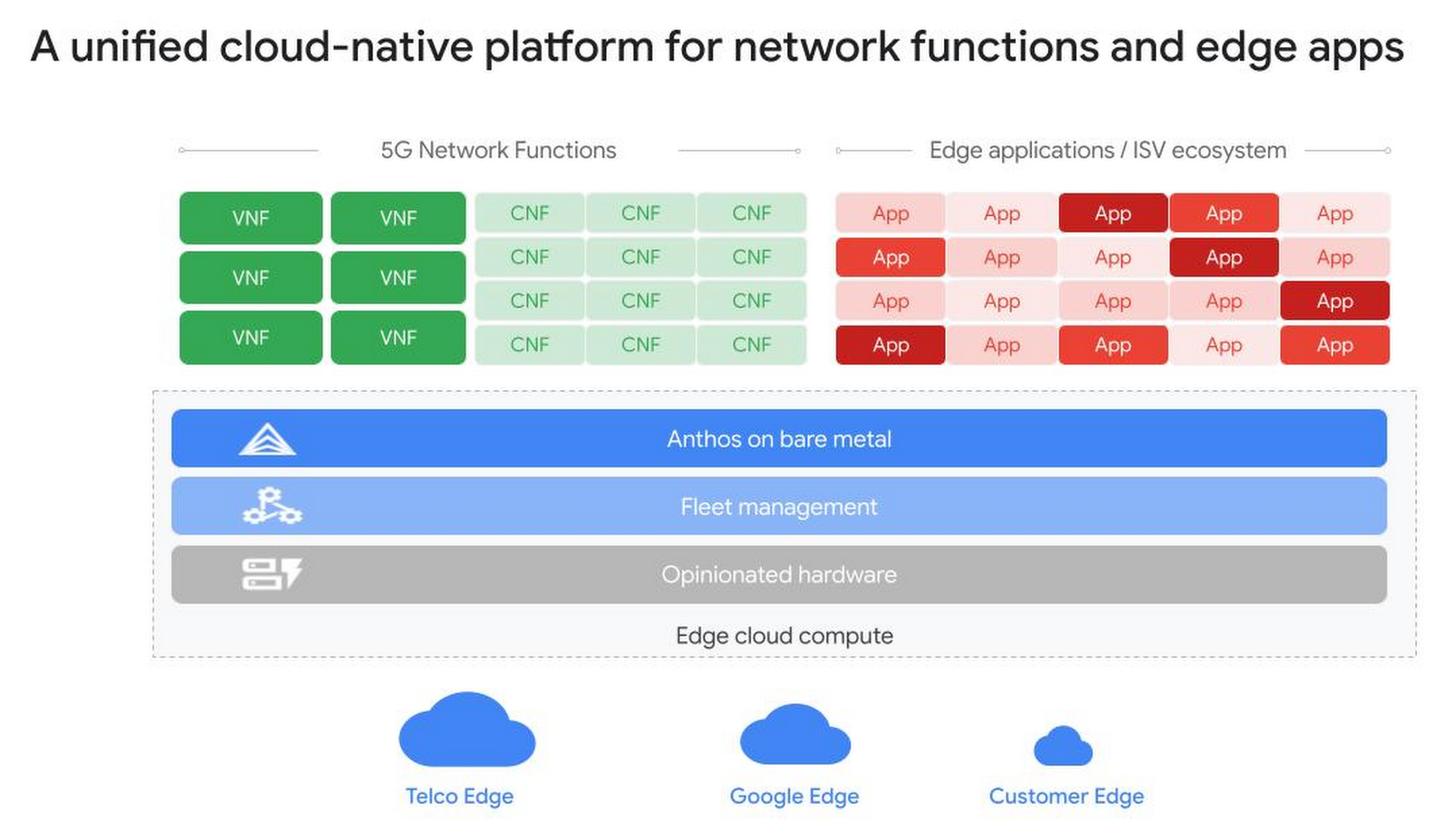
The flexibility of this more open architecture allows us to push the cloud to the edge while still being able to manage it from a single pane of glass. This is a huge leap forward from traditional networks, which have been domain-specific, managed in silos, and with slow service creation and delivery. Now, hyperscale cloud vendors and network equipment providers are offering solutions that help CSPs break down these silos to enable more flexible, automated networks with improved orchestration, visibility, and control across multi-vendor, multi-cloud and hyperscale cloud-provider environments. In addition, the separation of hardware and software provides a much more flexible and cost-effective way to upgrade from one network generation to the next.
To provide solutions that are relevant to enterprises, CSPs must offer capabilities beyond connectivity. Enterprise service orchestration, including exposure of network assets and network slicing, are foundational capabilities to provide value to the application ecosystem and be in control of the network and the delivered services.
Combining 5G and edge to help industries reimagine user experiences
This convergence of compute, storage and networking at the edge coming together for the first time will enable CSPs and enterprises to offer their customers completely reimagined user experiences. Consider, for example, how the automotive industry might enhance how customers shop for a car. As part of Fiat Chrysler Automobiles’ Virtual Showroom at the recent CES 2021 event, consumers were able to experience the innovative new 2021 Jeep Wrangler 4xe by scanning a QR code with their phones, and then see an Augmented Reality (AR) model of the Wrangler right in front of them—virtually placed on their own driveway or in any open space.
By rendering the model in Google Cloud, then streaming it to mobile devices, visitors could also see what the car looked like from any angle, in different colors, and even step inside to see the interior in incredible detail. That is the true digitization of an industry segment and highlights the device-to-network-to-edge-to-cloud application relationship and how it can impact the user experience.
A programmable network unlocks more application use cases
The programmability of the 5G network will truly enable application developers to utilize all the benefits of the underlying network. Programmability supports ease of use and enables CSPs, integrated software vendors (ISVs) and the ecosystem to have the right network-level APIs exposed so that applications can be optimized based on the network behavior and vice versa. Imagine, for instance, automatically pushing applications from a cloud region to the edge based on network latency and performance metrics.
Finally, 5G’s programmability is also about having the right tools available for developers to build and integrate applications on the network with zero-touch onboarding and validation. With this, we’ve come to the point where the network is now a “platform” for application innovation.
5G and edge will be all about the ecosystem
One thing is for certain: the shift to 5G will place tremendous focus on the ecosystem, and it needs to be an ecosystem that includes CSPs, public cloud providers, application developers and technology providers, all coming together to optimize the user experiences across industry applications. For instance, Google Cloud and Ericsson recently announced our partnership to deliver 5G and edge cloud solutions for CSPs and enterprise. In addition, Google Cloud is also teaming up with popular ISVs to deliver more than 200 edge applications from 30-plus partners, all running on our cloud.
With collaboration across ISVs, cloud providers and network equipment providers, we are enabling the rapid delivery and deployment of new vertical services and applications, leveraging capabilities like Anthos, artificial intelligence (AI), and machine learning (ML), as well as multi-vendor, multi-cloud and hyperscale cloud provider service orchestration and global edge networks such as those provided by Google and telecom service providers.
As members of the technology ecosystem, we talk about compute, storage and networking, but when it comes down to it, it’s about optimally placing these resources—whether in the cloud, at the provider core, at the edge or anywhere in between—to maximize the end-user experience. The openness and programmability of 5G lends itself to collaboration like never before. We predict that in 2022 and beyond, it will be all about the ecosystem coming together to leverage 5G and the edge to build innovations that we can’t yet imagine.
To learn more, watch the full Ericsson 5G Things CTO Focus fireside chat, where we discuss these topics and more.
Moving Flock Freight to Google Cloud for a more efficient, resilient and environmentally sustainable shipping supply chain
3144
Of your peers have already read this article.
3:30 Minutes
The most insightful time you'll spend today!
Commercial trucks often travel partially empty because many shippers don’t have enough cargo to fill an entire container or trailer. Although offering available space to other shippers helps minimize carbon emissions and reduce operating costs, most trucking companies can’t efficiently schedule, track, or deliver multiple freight loads.
Companies have always struggled to ship over-the-road freight efficiently. However,recent economic events have created an unprecedented logistics and transportation crisis that continues to disrupt supply chains, delay deliveries, and significantly raise the price of basic goods. Since some stores can’t keep their shelves fully stocked, many people across the country are finding it more difficult than ever to buy the things they need at an affordable price.
Although exacerbated by the pandemic, many of these supply chain issues have existed for decades. That’s why, in 2015, Flock Freight was started with the mission of reducing waste and inefficiency from the supply chain by reimagining the way freight moves. First to market with advanced algorithms that enable pooling shipments at scale, we create a new standard of service for shippers, increase revenue for carriers and reduce the impact of carbon emissions through shared truckload (STL) service.
Our technology helps lower prices compared to full truckload (FTL) by enabling shippers to only pay for the space they need—and maintain full control over pickup and delivery dates. Flock Freight also optimizes travel routes to speed up deliveries compared to traditional less than truckload (LTL), while eliminating unnecessary shipping hub transfers to minimize damage to cargo.
Today, thousands of shippers and trucking companies across the U.S. use Flock Freight to schedule shared truckloads, lower shipping costs, quickly deliver and track goods, and reduce their carbon footprint by up to 40%. Flock Freight further offsets carbon emissions by buying carbon credits for every FlockDirect™ guaranteed shared truckload shipment—at no extra cost to shippers.
Moving Flock Freight to Google Cloud
We founded Flock Freight with a small team based in southern California. We soon realized we needed a more scalable and affordable technology stack to support our rapidly growing platform and team. After joining the Google for Startups Cloud Program and consulting with dedicated Google startup experts, we decided to move all our data and applications to Google Cloud.
The highly secure-by-design infrastructure of Google Cloud now enables thousands of Flock Freight customers to move their freight faster, cheaper, and with less damage than traditional shipping methods. Specifically, we rely on Google Kubernetes Engine (GKE) to support the combinatorial optimization and machine learning (ML) algorithms and services that identify, pool, and schedule shared truckloads. We also leverage GKE to rapidly develop, deploy, and manage new applications and services.
In addition, we leverage Cloud SQL to automate database provisioning, storage capacity management, and other time-consuming tasks. Cloud SQL easily integrates with existing apps and Google Cloud services such as GKE and Pub/Sub. Lastly, we use Compute Engine to create and run virtual machines, optimize resource utilization, and lower computing costs by up to 91%. These cost savings allow us to shift more resources to R&D and rapidly develop new solutions and services for our customers.
Building a greener, more resilient, and responsive supply chain
The Google for Startups Cloud Program and dedicated Google startup experts were instrumental in helping us manage cloud infrastructure cost and maintaining very high SLAs, helping Flock Freight to focus on developing a comprehensive shipping platform that powers shared truckloads and drives positive industry change.
We especially want to highlight the Google Cloud research credits we relied on to launch Flock Freight and make rapid progress toward transforming the shipping industry. To this day, we continue to work with Google Cloud Managed Services partner DoiT International International to further scale and optimize operations on Google Cloud.
We’re proud of the results we’re delivering for our customers. For example, a home improvement importer now enjoys faster, safer, and easier shipping with 99.9% damage-free service and a 97.5% on-time delivery rate. A packaging supplier continues to maintain a 99% on-time delivery streak and decrease carbon emissions by 37%, while a mineral water company consistently reduces delivery expenses upwards of 50%.
Nationwide demand for shared truckloads continues to increase as the shipping industry works to lower costs and alleviate supply chain disruptions. With the Flock Freight platform, companies are building a more sustainable and resilient supply chain by efficiently combining multiple shipments into shared truckloads.
If you want to learn more about how Google Cloud can help your startup, visit our page here to get more information about our program, and sign up for our communications to get a look at our community activities, digital events, special offers, and more.
More Relevant Stories for Your Company

New Enterprise Capabilities and Changes to Cloud Spanner Reduces Cost of Running Workloads by 90 Percent
Customers love Cloud Spanner because it gives them the benefits of relational semantics and SQL while also delivering the scale and availability of non-relational databases. Many of these customers want to move even more of their work to Spanner, and have requested smaller instance sizes to support development, testing and

Manipal Group: Delivering High-Quality Patient Care with Google Cloud
One of India’s best-known healthcare brands, Manipal Group prides itself on clinical excellence and a patient-centric approach. From humble beginnings in 1953 as a single teaching hospital—the Kasturba Medical College—in a university town in Karnataka, India, Manipal Group has grown to a presence in seven cities in India and operations in Malaysia

How Do You Cut Costs and Improve Staff Productivity, and Business Visibility? Ascend Money Has an Answer
Hundreds of millions of residents of South East Asia have only limited access to banking and finance services. However, help is at hand. One of South East Asia's largest fintech businesses, Ascend Money is using digital technologies to realize its mission of enabling as many people as possible to access

How Google Cloud Helps SAP Admins Create Scalable, Secure Networks
SAP forms the critical backbone of thousands of enterprises, supporting critical business functions such as finance, supply chain, warehouse management, and more. Google Cloud provides a highly scalable and resilient infrastructure to run such workloads and offers tools, such as Smart Analytics and Machine Learning that can accelerate your organization’s digital transformation. In fact, a
