






TPUs Can Cut Deep Learning Costs by upto 80%—and Other Things You Didn’t Know About TPUs
READ FULL INTRODOWNLOAD AGAIN3522
Of your peers have already downloaded this article
6:15 Minutes
The most insightful time you'll spend today!
3133
Of your peers have already watched this video.
21:30 Minutes
The most insightful time you'll spend today!
Document AI
Most business transactions begin, involve, or end with a document. But working with documents can be tricky, as leaders across industries seeking digital transformation can attest to.
These enterprises face similar challenges as they seek to extract information from documents. The process can be costly, time consuming, and prone to errors with manual data entry.
Learn how to use machine learning to organize, process, and extract data within documents. Also, learn about some examples of how various customers have found success using Google Cloud Document AI.
In this video Sudheera Vanguri, Product Manager, Google Cloud AI, highlights new Document AI capabilities. She walks you through of the building blocks of Document AI and demonstrates the new UI. She also highlights specialized Document AI models pre-trained for invoice and healthcare document processing as well as shows customer examples and live demos.
Volkswagen + Google Cloud: Using Machine Learning to Drive Smarter with Energy Efficient Cars
2667
Of your peers have already read this article.
2:30 Minutes
The most insightful time you'll spend today!
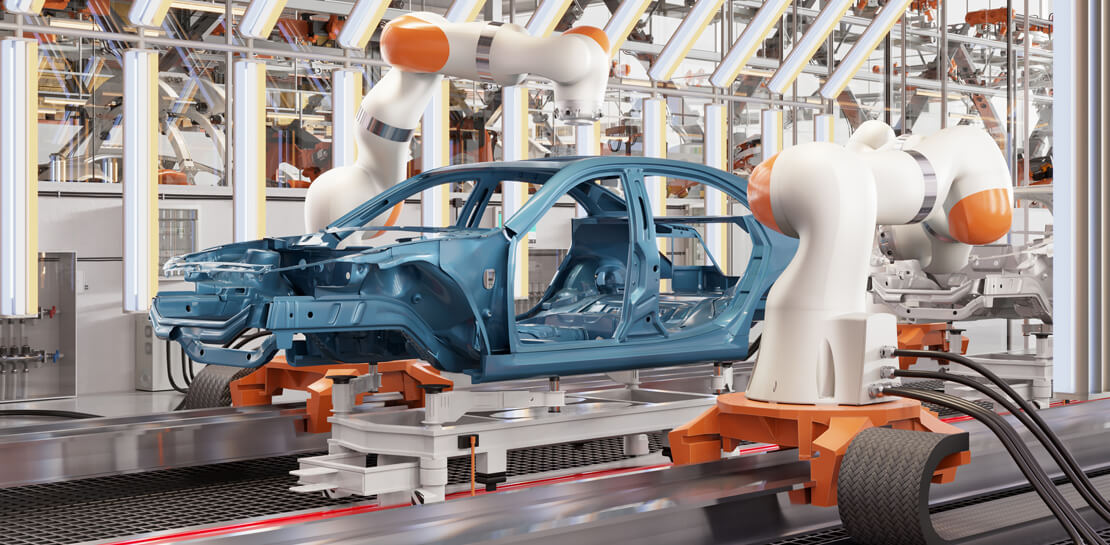
Volkswagen strives to design beautiful, performant, and energy efficient vehicles. This entails an iterative process where designers go through many design drafts, evaluating each, integrating the feedback, and refining.
For example, a vehicle’s drag coefficient—its resistance to air—is one of the most important factors of energy efficiency. Thus, getting estimates of the drag coefficient for several designs helps the designers experiment and converge toward more energy-efficient solutions. The cheaper and faster this feedback loop is, the more it enables the designers.
Unfortunately, estimating drag coefficient is an expensive and time-consuming operation that involves either a physical wind tunnel or a computationally intensive simulation. This can be a bottleneck in the feedback cycle.
For this reason, Volkswagen and Google Cloud decided to collaborate on a joint research project to investigate using machine learning (ML) to get fast and inexpensive estimates of the drag coefficient. In this post, we’ll explore the challenges and approaches undertaken in this project.
The core principles of the project were simple. First, we needed to collect a dataset of existing car designs and their respective drag coefficients. Then, we needed to create a representation of the various cars that would be suitable for ML. The next step was to train a deep learning model to predict the drag coefficient, and then, finally, we would use that model to efficiently estimate drag for any new design.
Representing three-dimensional car designs
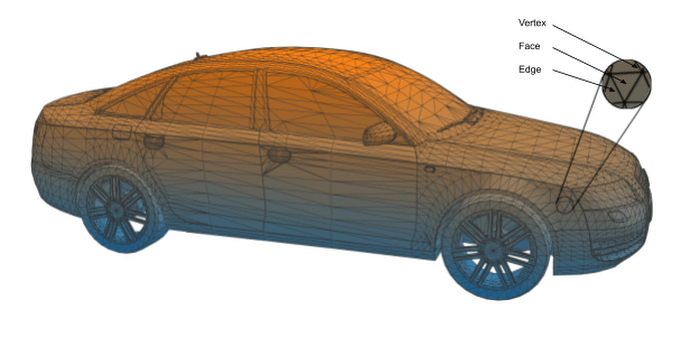
Design software recreates a physical object as a three-dimensional triangle mesh made up of three types of objects—faces, edges, and vertices. Figure 1, below, shows such a mesh for an Audi S6. Faces are flat surfaces, such as the window in a car door. An edge is where two faces meet (e.g., the side of the door), and a vertex is where two or more edges meet, such as the corner of the door.
Car bodies, however, come in all shapes and sizes. A Volkswagen Golf economy model is very different from a Tiguan SUV, and a single vehicle can have both large smooth surfaces as well as areas with delicately designed features. Consequently, there can be a huge variety from one polygonal mesh to the next.
ML models need consistent representation in order to form robust generalized rules. With such a dramatic variance between each polygonal mesh, the models would be compromised and the results could have huge margins of error.
We needed to find a way to create simple meshes that capture the shape of the car but are still suited for ML models.
Representing a car with digital shrink wrapping
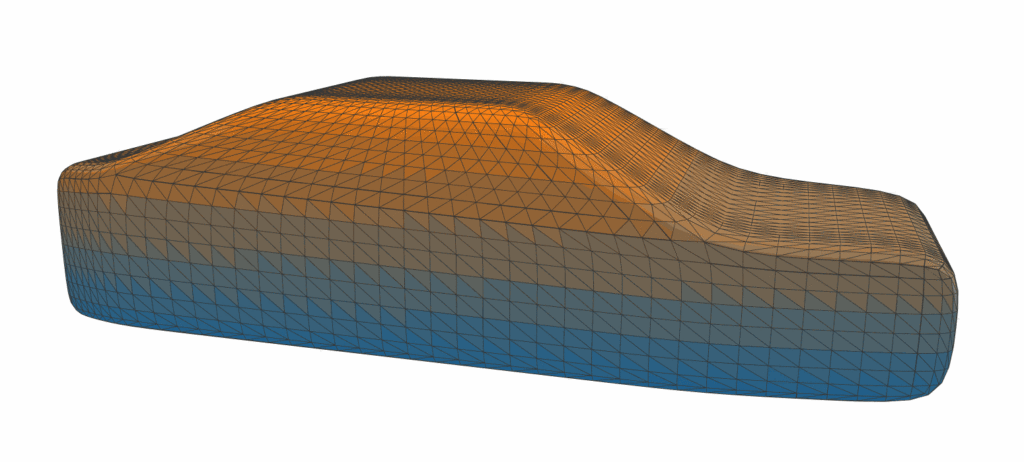
Rather than building a representation of each car from the ground up, we applied a “shrink wrapping” method for the 3D meshes. The principle is very similar to vacuum-sealing a cucumber. The cucumber is placed in a plastic bag and the air is then gradually removed until the bag fits tightly around it, capturing its shape.
Our approach works similarly: we start with a base mesh, a simple shape that corresponds to the plastic bag, and we deform it until it captures the shape of the target mesh. For our purposes, the base mesh is a simplified representation of a car and the target mesh is the particular car we are designing for at that moment. Such meshes can be defined, managed, and presented to ML models for training using the Tensorflow Graphics and trimesh libraries.
Our “shrink wrapping” method mainly works by iteratively minimizing a measure of distance (e.g., chamfer distance) between the two meshes. Additionally we can regularize our mesh to preserve certain qualities, like smoothness, in the resulting mesh. This iterative optimization is analogous to the vacuum pump, gradually shrinking and fitting the vertices of the mesh as closely as possible to the complex shape of the car. With shrink-wrapping, we are able to produce cleaner meshes that are more suitable to our estimation task. An example of such a procedure is shown in Figure 2.
How to train a model
Shrink-wrapping the 3D car designs was an important first step, but the work was far from over. Our next challenge was to build and test the machine learning algorithms.
We wanted our algorithms to estimate the drag coefficient as accurately and quickly as possible each time it looked at a new design. To do so, we had to train the ML models on existing data.
From publicly available datasets, we calculated the drag coefficients for 800 different car meshes, which we trained the models on. Then, we evaluated the trained models on a further 100 meshes, seeing how accurate their estimates were on new data.
As we worked through this training, we refined our approach. Initially, we tested models based on convolutional neural networks – similar to PointNet – that observed only the vertices, i.e., the fixed points in each mesh. But when we tested mesh-convolutional models – similar to FeastNet – we found a slightly different focus improved the accuracy of the estimates. Rather than focusing on vertices alone, these models looked at a mesh of vertices and how they relate to each other. These models placed each vertex in a richer context, leading to more accurate estimates when air-flow hit particularly subtle design features.
Working in parallel and at scale
To collaborate across time zones and two organizations, we’ve used the Google Cloud Vertex AI platform.
Vertex AI Workbench serves as a central hub to interact with other services and infrastructure on the Vertex AI platform. It enables quick experiments and preparation of training packages for resource-intensive ML model training jobs, all in a Python notebook environment for immediate execution of code. The notebook environments allow code-based interaction with other services on Google Cloud and ML tools such as Vertex AI Training and Vertex AI Pipelines.
The process of training a new model is a seamless one. First, a dataset is prepared and stored in Google Cloud Storage, usually with the help of Tensorflow Datasets. Then, for every ML model we want to test, we package and store the training code as a container image with Google Cloud Build and Container Registry. This ensures that every job is fully documented, including the provided parameters, training code package, logs from the training task, and resulting artifacts such as metrics and model files.
From there, we submit the model to the Vertex AI Training service, which provides easy access to large scale infrastructure and hardware accelerators, such as GPUs and TPUs, by simply defining resource needs when submitting a job. By using Vertex AI Training’s hyperparameter tuning feature, we can run experiments in parallel with multiple neural networks to find the right one for our purposes.
With Vertex AI Tensorboard, we can capture metrics and visualize the results of our experiments. These are readily available to anyone in the team, wherever they are in the world, for a wider discussion.
The first milestone
This joint research effort between Volkswagen and Google has produced promising results with the help of the Vertex AI platform. In this first milestone, the team was able to successfully bring recent AI research results a step closer to practical application for car design. This first iteration of the algorithm can produce a drag coefficient estimate with an average error of just 4%, within a second.
An average error of 4%, while not quite as accurate as a physical wind tunnel test, can be used to narrow a large selection of design candidates to a small shortlist. And given how quickly the estimates appear, we have made a substantial improvement on the existing methods that take days or weeks. With the algorithm that we have developed, designers can run more efficiency tests, submit more candidates, and iterate towards richer, more effective designs in just a small fraction of the time previously required.
Going forward, faster and more accurate estimates could even enable more automated searching for efficient designs, which would help both engineers and designers to hone in on the areas of the vehicle body where they could have the most impact. An important next step will be integrating the results into 3D design software to let designers benefit from the output and provide feedback.
As we continue, our focus is on improving the accuracy of the models. Firstly, we will build a larger, better quality dataset. Secondly, we will improve our shrink-wrapping algorithm to capture more details. Finally, we will enhance our existing models by experimenting with Vertex AI Neural Architecture Search to explore and experiment with different neural architecture options.
Moreover, we believe that our results for drag coefficient estimation is only a starting point for further exploration. There could potentially be numerous use cases in the space of physical simulations and assessments where cost and time savings could be achieved through ML-based estimators.
Acknowledgements
This work wouldn’t have been possible without the contributions from Volkswagen Data:Lab, Google Research, and Google Cloud. Thanks to Ahmed Ayyad, Dr. Andrii Kleshchonok, Dr. Daniel Weimer, Gülce Cesur, Henrik Bohlke, Andreas Müller from Volkswagen, Ameesh Makadia, Ph.D., and Carlos Esteves, Ph.D., from Google Research, and Daniel Holgate, Holger Speh, and Dr. Michael Menzel from Google Cloud.
5363
Of your peers have already watched this video.
44:30 Minutes
The most insightful time you'll spend today!
How Go-Jek, Indonesia’s First Billion-dollar Startup, Improved the Productivity of Data Scientists
Go-Jek, Indonesia’s first billion-dollar startup, has seen an incredible amount of growth in both users and data over the past two years. Many of the ride-hailing company’s services are backed by machine learning models hosted on Google Cloud Platform.
Models range from driver
But senior executives at Go-Jek realized something: One of their most important and expensive resources, data scientists, were spending far too much time cleaning data. That wasn’t part of their remit and resulted in a waste of time and money.
As a COO, this a major concern for any company undertaking a machine learning initiative. Data scientists are hard to come by and their salaries have been on the rise for the last few years. Yet according to some reports data scientists spend upto 80% of their time just preparing data—not creating models.
Watch how operational teams at Go-Jek combined the right Google tools and processes to improve the productivity of their data scientists.
3241
Of your peers have already watched this video.
38:09 Minutes
The most insightful time you'll spend today!
TensorFlow: The Show-and-Tell Data Scientists Have Been Asking For
TensorFlow is among the most popular, if not, the most popular deep learning libraries today. According to one ranking, “TensorFlow is at least two standard deviations above the mean on all calculated metrics.”
Watch as Lak Lakshmanan, Technical Lead, Machine Learning and Big Data, Google Cloud, walks through a development workflow that will make operationalization easier to execute, including the process of building a complete machine learning pipeline covering ingest, exploration, training, evaluation, deployment, and prediction.
He also talks about the need for distributed training. But what’s the benefit of distributed TensorFlow? Many machine learning frameworks can only handle “toy problems”, or problems that can be solved by input data that fits into memory. These are small data sets.
But to build effective machine learning you need big data, feature engineering, and model architectures. With large amounts of data batching and distribution are very important. That’s where distributed training comes in.

1291
Of your peers have already downloaded this article
4:30 Minutes
The most insightful time you'll spend today!
Google Cloud’s managed database services can help you innovate faster and reduce operational overhead. The migration tools and resources included in this whitepaper will help you plan your migration.
This whitepaper provides guidance on:
- Managing services for maximum compatibility with your workloads
- Leveraging services that are compatible with the most popular commercial and open source engines, such as MySQL, PostgreSQL, and Redis
- Using robust tools and services to make migrations simple, secure, and fast with minimal downtime
- Understanding the value of using Google Cloud’s managed database services
More Relevant Stories for Your Company

Start Delivering Business Results with the Three AI Agents
When it comes to the adoption of artificial intelligence (AI), we have reached a tipping point. Technologies that were once accessible to only a few are now broadly available. This has led to an explosion in AI investment. However, according to research firm McKinsey, for AI to make a sizable

Partnering with Google Cloud is the Key Behind Recent Healthcare Innovations
It’s simply amazing to witness how some of our systems integrators employ Google Cloud solutions to drive innovation in ways we at Google may never have considered—especially in healthcare. According to analyst firm MarketsandMarkets, the market for the Cloud in healthcare is projected to grow 43% between 2020 and 2025

Parent Company of Retail Luxury Brands Leverages Product Recommendation Algorithms and Integrated Client Platform to Entice Customers
Whether they meet customers online, offline, or in some combination, retailers share a big problem: How can they offer the right choices, when and how the customer wants, without overwhelming (and often losing) the buyer? More than anything, this is an information problem. As such, it's a good candidate for

Data to Business Outcomes with Google’s Data Analytics Design Pattern
Companies today are inundated with vast amounts of data from various sources. This overwhelming amount of data is meant to benefit the company, but often leaves data teams feeling overwhelmed, which can create data bottlenecks and result in a slow time to value. In fact, only twenty seven percent of
