





5332
Of your peers have already watched this video.
31:30 Minutes
The most insightful time you'll spend today!
Enhancing Collaboration with Sheets, Python, and Google Cloud
See how you can enhance collaboration within your organization using Google Sheets. Watch to learn about a new set of tools to create custom functions that tap into the power of Python and to expose functions in a standardized fashion throughout your organization.

3353
Of your peers have already downloaded this article
5:30 Minutes
The most insightful time you'll spend today!
ANZ Bank Trusts Apigee to Deliver Secure and Compliant API Strategy

3043
Of your peers have already read this article.
3:30 Minutes
The most insightful time you'll spend today!
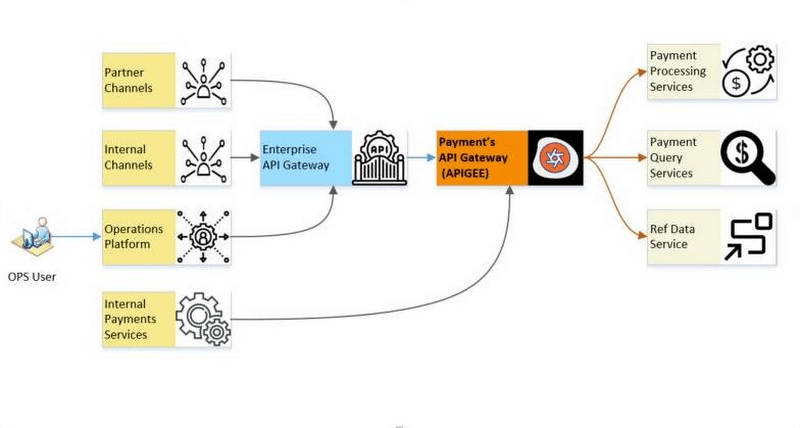
ANZ Bank is one of Australia’s top four banks and the largest bank in New Zealand by market capitalization. Headquartered in Melbourne, Victoria, we operate in more than 32 markets across Australia, New Zealand, Asia, Pacific, Europe, America and the Middle East. Our Payment team deals with all payment transaction types by providing highly secure, mission critical payment services to retail, institutional and international customers. The core payment platform is based on microservices architecture to support discreet payment processing requirements such as continuous volume growth, industry service level agreement (SLA) and complex payment orchestration and more. The API platform leverages APIs to perform specific business functions under the payment orchestration layer, which need to be resilient, scalable and heavy on security controls.
Simplifying our technology landscape
At ANZ, our mission is to improve the financial wellbeing and sustainability of our customers through reliable payment services. Over the past 12 months, we looked to simplify our technology landscape, to free up time so we could focus on implementing more customer-focused banking services. We needed an API management solution that would align to our API-first strategy, while also maintaining our high performance, security, and regulatory standards.
Specifically, the solution needed to:
- Simplify channel interactions with our platform;
- Improve developer experience and enable self-service;
- Ensure resilient fault tolerance;
- Improve our payment API security posture;
- Enable API-first digital enablement for both our internal and external payments customers;
- Have a scalable and transparent pricing model that ensured sustainable API programme growth.
Core focus on security and compliance
To meet our security and regulatory compliance standards an API solution would need to offer functionality including:
- Providing coarse-grained and fine-grained authorization and domain specific entitlements for API requests;
- Bundling APIs based on the nature of the channel;
- Integrating easily with established identity providers;
- Establishing patterns for connecting trusted upstream and downstream systems;
- Providing support for the industry standard OAuth 2.0 authorization protocol as per enterprise security standards.
We reviewed Apigee against other API management solutions and gateways, and determined it was the best fit for our needs. Not only did Apigee deliver on all our mission-critical requirements, but it also provided strong ease of use, feature-completeness and support for multiple coding languages.
Enabling smooth developer onboarding, processes and troubleshooting
Using Apigee has greatly improved developer onboarding and reduced the tedious steps involved in knowledge transfer and upskilling. The platform is easy for developers to use, and is backed by great documentation and video resources. These resources provide clear guidance about how to execute certain processes and troubleshoot as needed.
Overall, Apigee has delivered the features we need to manage the publication and consumption of APIs efficiently. We are now running eighteen APIs in production, including two APIs that enable payments through connection to our transaction database, and others that enable supporting services in the payment services platform team.
Our engineers and testers have found it easy to use the interface and Apigee API Management to deploy and test proxies. In addition, out of the box policies allow for fine-grained access control to handle and build proxies of varying degrees of complexity. These policies allow us to control security, manage traffic, mediate transformations and implement custom functionality via scripts.
We can now implement our fine-grained entitlement-based access control requirements, onboard new customers to the cloud and streamline payment channel onboarding. With Apigee, we are also integrating with other API management tools at the bank, in part to enable self-service for API providers and consumers by building a developer portal.
Thanks to Apigee, we are well positioned to adopt a decentralized API team model that will see different teams within payments and beyond create APIs, and ramp up to full production of our API-centric model in the near future. This is a key component of the bank’s broader cloud and API-first strategy that is designed to help ANZ become a more agile and adaptive technology organization. With the right components in place, can we help ANZ create opportunities and propositions that colleagues and customers love, ultimately helping ANZ realize its vision across Australia, New Zealand and international markets.
Transforming Media Industry: Three Strategies for Media Leaders to Leverage Generative AI

1531
Of your peers have already read this article.
3:30 Minutes
The most insightful time you'll spend today!
The digital era turned the traditional formula for media and entertainment success on its head, ushering in new technologies that have changed how content is produced, distributed, experienced, and monetized. Audiences have more choice, flexibility, and power over what they consume, and today’s media companies have to embrace ongoing transformation or risk falling behind – or becoming irrelevant.
A new wave of transformation is arriving with generative AI, a type of artificial intelligence that can interact with users in natural language and create novel data, ranging from story outlines, reports, and other text outputs to multimodal content like images, videos, and audio. Media and entertainment are inherently about content creation and creativity—so what does this new technology mean for the industry?
At Google Cloud, we see tremendous opportunity for creative industries, from more efficient creation methods to improved user experiences. Let’s explore.
AI for media with Google Cloud
Google Cloud has a long history with large language models (LLMs) and other generative AI technologies—from their influence over the years on products like Document AI, to recent announcements like Generative AI support in Vertex AI, which lets businesses access and tune generative AI foundation models, and Generative AI App Builder, which lets developers build chatbots and other generative apps in minutes.
We’ve helped our global media and entertainment customers with AI for personalization, search and recommendations, predictive analytics, and much more — and with generative AI now on the rise, we have some ideas to help media leaders, technologists, and creators think about and prepare to utilize powerful AI in their work.
Three lenses on innovation in media
The media and entertainment industry is increasingly diverse and complex, with companies spanning over-the-top (OTT) subscription streaming services, 24-hour linear channels, live broadcasts of sporting events, digital journalism, traditional publishing, short-form user-generated social video, and more. More and more, the boundaries between these segments of the media industry are blurring — but common to them all is the focus on providing compelling content in an engaging audience experience that can be directly or indirectly monetized.
With this in mind, we suggest media and entertainment companies look at the application of innovative technologies like generative AI through the following three lenses:
- Improving content creation, production, and management
- Enhancing and personalizing audience experiences
- Improving monetization
Improving content creation, production, and management
Generative AI democratizes many aspects of content creation, opening new ways to create written material, illustrations, sound effects, special effects, and more. Its recent maturation has been so rapid, some in the media industry have expressed concern that generative AI implies the end of creative professions. We think the opposite is more likely: just as photography, audio recordings, and computer generated images have enabled new modes of creativity, rather than making old ones obsolete, generative AI has the potential to both enable new forms of expression and enhance familiar ones.
For example, journalists could use generative AI to speed up research by helping them synthesize and analyze large volumes of information, or to help them create initial drafts or summaries of editorial content. Film and television producers could leverage the technology to accelerate the post-production editing process, with new AI-enabled interfaces for rapidly adjusting or enhancing scene details such as lighting and color. Broadcasters could use generative AI to make vast libraries of video footage searchable and accessible for use in telling more compelling stories. The potential use cases go on and on.
Far from undermining incredible creative professions, generative AI is poised to free writers, artists, editors, and many others from the tedious and mundane aspects of their work, empowering them to focus more of their time on creativity.
Enhancing and personalizing audience experiences
Every media organization in the world today faces the reality that for most consumers, switching costs are extremely low. This puts incredible pressure on these companies to invest in delivering low-friction and compelling audience experiences that help mitigate subscribers from churning and viewers from abandoning content experiences for competitive platforms.
Generative AI can help media companies engage and retain viewers, such as by enabling more powerful search and recommendations on their digital content platforms. With its increasingly multimodal capabilities extending from natural language to both audio and video content, generative AI is well-positioned to power more personalized audience experiences.
Consumers often complain about “the paradox of choice” or their inability to find something interesting to watch on streaming platforms that have incredibly vast libraries of content available on demand. Imagine a not-too-distant future wherein a consumer can simply ask the content platform they’re using to help them find a specific show to watch based on mood, specific types of scenes, combinations of actors, award nominations, or practically anything they can think to ask. And that’s just the tip of the iceberg — imagine generative AI’s potential to curate, assemble, and even create personalized content for a viewer to consume!
Improving monetization
As consumers’ content consumption further expands from traditional theatrical and linear television programming to include digital offerings across an array of platforms, devices, and content types, media companies face the challenge of maintaining and improving monetization. The conventional economics and approaches to advertising and subscription models are proving, in many cases, not to deliver sufficient ROI.
Generative AI has the potential to help media companies improve their monetization of audience experiences. As mentioned previously, enhanced personalization can play a role in mitigating churn, which in turn can help sustain and grow subscription and advertising revenues. Going beyond this, generative AI can be leveraged to drive even greater advertising revenues via more targeted, contextual, and personalized advertisements. Imagine both display and video advertisements that are generated on the fly to personalize product specifics, messaging, style, colors, and innumerable other characteristics to drive greater engagement and higher click-through rates (CTR), and thus higher advertising CPMs (cost per thousand impressions).
Coming up next
Generative AI presents a significant opportunity for media companies to fundamentally transform content creation, engagement, and monetization. Compelling services are already on the market — but there is far more to come.
Google Cloud continues to build on its deep experience and expertise with AI, and we are committed to working with the industry to develop compelling, accessible, trusted, and responsible AI solutions that will drive meaningful business outcomes. We are excited to create the future together with our global media customers and partners across the ecosystem. To learn more about this disruptive topic, read “Debunking five generative AI misconceptions” from Google Cloud vice president of AI & Business Solutions Phil Moyer, or explore our Trusted Tester Program for generative AI.
Cutting Costs and Accelerating Development with API Management

3509
Of your peers have already read this article.
3:00 Minutes
The most insightful time you'll spend today!
Google Cloud Results
- Reduced API management costs 34%
- Develops new features in days versus months
- Fixes issues quickly by writing code
- Manages 15B API calls per month without outages
Austin, Texas-based Bazaarvoice switched to Apigee for its API platform because of its competitive pricing and feature set. But another benefit soon became apparent to Bazaarvoice engineers: the ability to write code on the Apigee platform and “own our destiny,” says Kurtis White, Senior Development Manager in Research and Development for Bazaarvoice.
Bazaarvoice specializes in consumer-generated content marketing solutions that connect brands, retailers, and consumers. APIs do the heavy lifting in making those connections. For example, the Conversations API, the heart of the Bazaarvoice platform, lets the company’s retail clients aggregate and leverage users’ product reviews and ratings. With the Conversations API, API keys are passed along in each query string and enable Bazaarvoice customers to access the relevant customer data.
APIs are essential to the Bazaarvoice platform. During its early days the company didn’t use APIs, relying instead on direct communication links to connect its customers to what consumers were saying about them. “That approach just didn’t scale,” says White. “Without reliable APIs, it would be almost impossible for us to be in business today.”
Eight years ago, Bazaarvoice switched to APIs. From about 2013 to 2017, the company relied upon the same API management SaaS solutions provider. But the company was growing. The call volume that its APIs generated was expanding at a rapid pace, too—especially during the busy year-end shopping season. For example, in early October 2016, Bazaarvoice APIs generated nearly 9 billion calls, compared to about 12 billion calls in early December 2016.
Unfortunately, along with the pace of API calls, the costs associated with Bazaarvoice’s existing API solutions provider were also escalating—increasing 74% from early 2016 to early 2017. To keep rising expenses from stifling its own growth, and to continue offering its reliable, high-performing SaaS solution, the company’s IT team decided it was to time to find a different API solutions provider.
In April 2017, Bazaarvoice migrated to the Apigee API platform because of its feature set and, in particular, its competitive pricing. By switching to Apigee, Bazaarvoice reduced its API spend by 34%, White says.
A ticking clock
Migrating from its previous API provider to Apigee involved importing 66,000 API keys—an arduous task. Apigee engineers and business leaders worked directly with their Bazaarvoice counterparts to help ensure a successful transition. “Everyone at Apigee was very responsive to our needs,” White says. “If a problem came up, the Apigee team owned it and worked through it to give us a great experience.”
During the migration, there was a clock ticking in the background. Bazaarvoice wanted to shift 100% of its API calls to Apigee before the contract with its existing API provider came up for renewal. “I wasn’t sure we could make the deadline,” says White. “But we did, and I give a big credit to the Apigee technical team. They provided 24-hour support to our team. And once we went live, our platform was handling 15 billion API calls a month with no outages.”
Following the migration, Apigee support continues to “knock it out of the park,” he added. “Apigee is a great partner to have.”
Controlling destiny
The Bazaarvoice IT team didn’t specifically choose Apigee because of the ability to write code on the platform—but they quickly came to appreciate the feature.
“Our previous API provider was like a black box to us,” says White. “They had written some custom code for us that we depended upon. But we didn’t own that code. And if we needed changes, we had to pay them to do it for us.”
“Apigee allows us to write our own code that runs on the platform and looks at all of the API calls,” White continues. “We can put the code into a virtual control system. We can update it whenever we want to add a feature. Because of how important APIs are to our business, the ability to write code on Apigee lets us control our own destiny. It’s the Apigee number one benefit, in my opinion.” This also accelerates the time it takes Bazaarvoice to bring new features to market.
“Apigee gives us the flexibility to do things we wouldn’t have even tried before,” says White. “We can test new things easily, without getting locked into a service agreement with an external party. Before, it might have taken months to develop new product functionalities. Now it takes days.”
In addition, writing code on the Apigee platform enables the IT team to quickly address any problems that may arise. “If someone notices a problem, we can write the code to fix it right away,” White says.
“Because Apigee lets us iterate and fix problems quickly, our innovation has gone to the next level,” White added. “Before, if you had an idea, you’d wonder if you really wanted to invest $30,000 and three months in it. Probably not. Now, with Apigee, the investment is maybe one day and zero dollars.”
Experimentation pays off for Bazaarvoice and its customers. For example, during the 2017 holiday season, Bazaarvoice was able to give all its customers the capacity to handle twice the number of API calls.
“With our previous API solutions provider, it would have been such a long process to make that happen, it wouldn’t have been worth it,” says White. “But it was really easy to write the code in Apigee. Plus, we made our customers happy and kept them running smoothly during the peak holiday season—with little effort on our part.”
Personalization and monetization
Apigee has played a key role in enabling Bazaarvoice to develop new products, too. In March 2018, Bazaarvoice released a new personalization data product for its customers, built on top of an Apigee-powered API. The new product enables Bazaarvoice retail customers to recommend relevant products to their online shoppers. The products are personalized to the shoppers’ interests, based on their past behavior and what they’re shopping for.
Apigee is also serving as a strategic business advisor, helping Bazaarvoice determine the best way to price its offerings as its API call volumes continue to increase.
“We’re working with Apigee to build an industry-leading model for monetizing our APIs,” says White. “Apigee is the ideal advisor in this regard. We’re handling such large volume, the volume is continuing to grow, and Apigee enables us to power it.”

3943
Of your peers have already downloaded this article
2:20 Minutes
The most insightful time you'll spend today!
Web APIs use HTTP, by definition. In the early days of web APIs, people spent a lot of time and effort figuring out how to implement the features of previous-generation distributed technologies like CORBA and DCOM on top of HTTP. This led to technologies like SOAP and WSDL. Experience showed that these technologies were more complex, heavyweight, and brittle than was useful for most web APIs. The idea that replaced SOAP and WSDL was that you could use HTTP more directly with much less technology layered on top.
Most modern web APIs are much simpler than SOAP or WSDL APIs, but preserve some of the basic ideas of remote procedure call—which is not native to HTTP—implemented much more lightly on top of HTTP. These APIs have come to be known as RESTful APIs. Apigee allows developers to only use HTTP without additional concepts.
Here’s Why: When you design any interface, you should try to put yourself in the shoes of the user. As an API provider, you may work on a single API or a small group of APIs, but it is likely that your users deal with many more APIs than yours. This means that they probably come to your API with significant knowledge of basic HTTP technologies and standards, as well as other APIs. Because of this, there is a lot of value in adhering to standards and established conventions, rather than inventing your own.
Download the E-book to get deeper insights into how you can make your developers’ life easier.
More Relevant Stories for Your Company

New Visual Interface for Google Cloud’s Speech-to-Text API Makes API Easy to Use !
At Google Cloud, we’re committed to making artificial intelligence (AI) accessible to everyone and easier to harness for new use cases. That’s why we’re excited to announce the general availability of our intuitive, new visual user interface for Google Cloud’s Speech-to-Text (STT) API, right in Google Cloud Console, which makes the API

The Digital Transformation Journey
Aspiration is easy, but execution is hard. Few concepts illustrate this as well as digital transformations. Most businesses today are at some phase of their digital transformation journey. While some are evaluating strategies and solutions, many companies have already embarked on full-scale project implementations. However, one thing is clear. While




Uber’s Story of Scaling Their App with Millions of Concurrent Requests
Uber has millions of concurrent customers who use the platform to book rides and place food delivery orders, generating billions of database transactions per day. In just a click of a button, Uber captures users' intent which bases their fulfillment model to meet the customers' demand, and match it to

How to Decide Whether to Run a Database on Kubernetes
Today, more and more applications are being deployed in containers on Kubernetes—so much so that we’ve heard Kubernetes called the Linux of the cloud. Despite all that growth on the application layer, the data layer hasn’t gotten as much traction with containerization. That’s not surprising, since containerized workloads inherently have
