





Southwire Completes SAP Migration to Google Cloud as a First Step of its Tech Evolution

4934
Of your peers have already read this article.
1:30 Minutes
The most insightful time you'll spend today!
“Talk about tough times, right?”
That’s how Dan Stuart, Senior Vice President of IT Services at Southwire Company, refers to the months following a December 2019 ransomware event, and the COVID crisis that began in spring of 2020. Those events hit just as the company was preparing for an overhaul of their SAP environment. This comprehensive plan included three key elements. First, the company wanted to upgrade their SAP ECC environment to take advantage of the latest functionality available for this critical ERP system. Second, Southwire aimed to deploy SAP Business Warehouse on SAP HANA to accelerate vital reporting for all business users. Third, the company wanted to upgrade to the latest version of SAP Process Orchestration—an essential component that touches key manufacturing interfaces in all Southwire facilities.
Southwire had looked at multiple options for the upgrades, including remaining entirely on-premises, colocation, and full cloud migration. “Going to the cloud seemed a lot more compelling,” says Joe Schleupner, Southwire’s Senior Director of PMO & ITS planning and implementation. “We were going to the cloud eventually, so why take these intermediary steps? Let’s just get it done.”
After looking at several options, Southwire decided to migrate to Google Cloud. “We wanted to be on a platform for SAP that was flexible, scalable, and secure; that we could count on to get up and running quickly,” says Stuart. “We chose Google Cloud not only for those reasons, but also because we recognize that Google has other assets that we may be able to take advantage of down the line, such as technologies like artificial intelligence (AI).”
More stability, less worry
As one of the leading manufacturers of wire and cable used in the transmission and distribution of electricity, Southwire aids the delivery of power to millions of people worldwide. They have more than 30 manufacturing facilities across the United States running 24/7. Any downtime directly affects productivity and revenue. With help from Google Cloud and their implementation partner NIMBL, Southwire completed the SAP migration to Google Cloud over a planned maintenance weekend on July 4th.
The migration itself, while complex, went quickly and smoothly. “Just moving to the cloud was quite a feat because we were dealing with so much data, but in total the SAP system was down for only ~16 hours,” says Schleupner.
“As a project manager, I always felt that Google Cloud had my back” Schleupner says. The Process Orchestration (PO) migration was of particular concern, considering that it controlled all of Southwire’s manufacturing interfaces across the entire company. “Every critical piece of information that goes from SAP down to the manufacturing system goes through that system,” says Schleupner.
Even after migrating, Southwire discovered that making changes to the system was fast, easy, and resulted in no downtime. Normally, certain types of changes would have involved taking down SAP for at least an hour.
The Southwire team also appreciates the fact that the modern cloud architecture means spending less time on routine infrastructure maintenance. “It’s one less thing for me to worry about,” Stuart says, “I can focus on the business side of the house and move the technology and responsibilities to what we do within the Google Cloud Platform.”
What comes next?
While the cloud migration will increase stability, uptime, performance, and security, there is much more to come. Southwire is currently working on a disaster recovery implementation for their SAP environment on Google Cloud. Stuart and Schleupner are excited about where Google Cloud can further take Southwire. They are considering an SAP Hybris e-commerce implementation as well as connected factory and/or factory automation initiatives that can take advantage of artificial intelligence and machine learning.
To Stuart and Schleupner, the migration of Southwire’s SAP environment to Google Cloud, as important as it was, really represents the first step in the company’s tech evolution. Now that much of the heavy lifting is complete, Southwire’s digital transformation can begin in earnest. “There’s no shortage of areas where I think Google Cloud will come into play,” Stuart says, “and we intend to look at these things with an open mind to understand how we can leverage current investments to take our organization where we want to go.”
Learn more about Southwire’s SAP on Google Cloud deployment and how Google Cloud can transform the way you work with your SAP enterprise applications. Visit cloud.google.com/solutions/sap.
Simplify Your Modernization Journey from Windows

4270
Of your peers have already read this article.
1:30 Minutes
The most insightful time you'll spend today!
Microsoft and Windows on Google Cloud provides a first-class experience for Windows workloads. You can self-manage workloads or leverage managed services and use license-included images or bring your own licenses. Now, easily migrate, optimize, and modernize your Windows workloads for agility and scalability.
Start with migration
Migrate to increase IT agility and reduce on-premises footprint. Tools like Migrate for Compute and Migrate for Anthos can help migrate and upgrade.
Optimize license usage to reduce cost
Optimize VM usage. Managed SQL Server and Active Directory reduce total cost of ownership. Move .NET to .NET core. Move SQL Server to Linux.
Modernize to reduce single-vendor dependency
Create an open path to modernization—containerization of Windows server, cloud-native development, and multi-cloud readiness with Anthos.
Drive a strategy for migration, optimization, and modernization
Plan for the future while reducing your Microsoft licensing dependency. Get all you need to migrate, optimize, and modernize your legacy platform.
Bring your own licenses
In addition to on-demand licenses, Google Cloud provides you with flexibility for bringing your existing licenses and running them on Compute Engine. Use Sole-Tenant Nodes to run on dedicated hardware with configurable maintenance policies to support your on-premises licenses while maintaining workload uptime and security through host-level live migration.
License-included VM images
You can deploy your Windows applications (including SQL Server) on our fully tested images with bundled licenses on Compute Engine and take advantage of many benefits available to virtual machine instances such as reliable storage options, the speed of the Google network, and autoscaling.
Fully managed SQL Server and Active Directory
Use an easy-to-manage and compatible relational database service in the cloud to reduce operational overhead. Use a highly available, hardened service to manage authentication and authorization for your AD-dependent workloads, automate AD server maintenance and security configuration, and connect your on-premises AD domain to the cloud.
Windows on Kubernetes
Running your Windows Server containers on GKE can save you on licensing costs, as you can pack many Windows Server containers on each Windows node.
Intel-Google Collaboration Brings Edge Computing on Factory Floors: Hannover Messe 2022
3222
Of your peers have already read this article.
1:30 Minutes
The most insightful time you'll spend today!
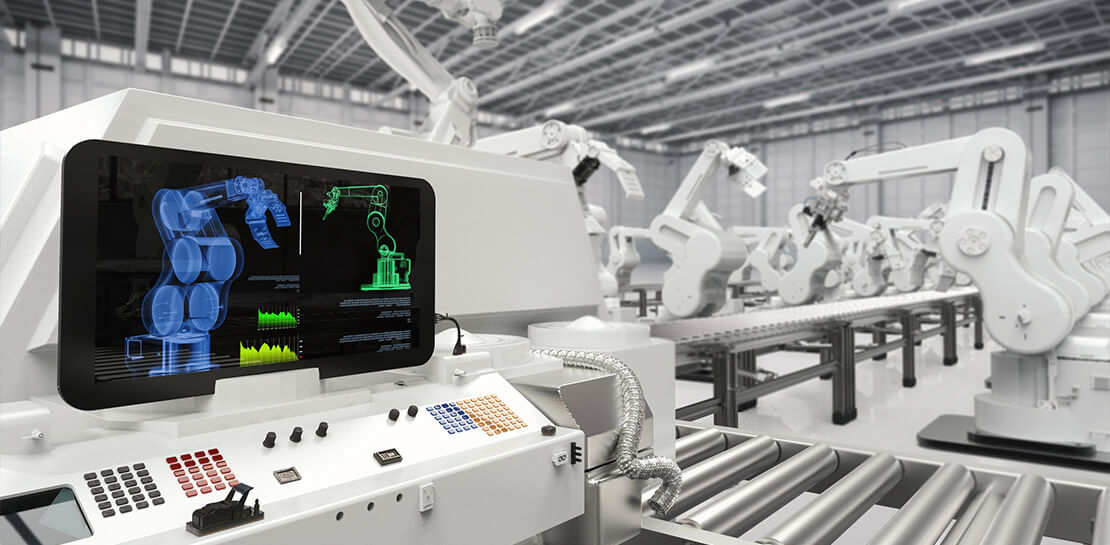
The typical smart factory is said to produce around 5 petabytes of data per week. That’s equivalent to 5 million gigabytes, or roughly 20,000 smartphones.
Managing such vast amounts of data in one facility, let alone a global organization, would be challenging enough. Doing so on the factory floor, in near-real-time, to drive insights, enhancements, and particularly safety, is a big dream for leading manufacturers. And for many, it’s becoming a reality, thanks to the possibilities unlocked with edge computing.
Edge computing brings computation, connectivity, and data closer to where the information is generated, enabling better data control, faster insights, and actions. Taking advantage of edge computing requires the hardware and software to collect, process, and analyze data locally to enable better decisions and improve operations.
At Hannover Messe 2022, Intel and Google Cloud will demonstrate a new technology implementation that combines the latest generation of Intel processors with Google Cloud’s data and AI expertise to optimize production operations from edge to cloud. This proof-of-concept project is powered by the Edge Insights for Industrial platform (EII), an industry-specific platform from Intel; and a pair of Google Cloud solutions: Anthos, Google Cloud’s managed applications platform, and the newly-launched Manufacturing Data Engine.
Edge computing exploits the untapped gold mine of data sitting on-site and is expected to grow rapidly. The Linux Foundation’s “2021 State of the Edge” predicts that by 2025, edge-related devices will produce roughly 90 zettabytes of data. Edge computing can help provide greater data privacy and security, and can accomodate the reduced bandwidth needs between local storage and the cloud.
Imagine a world in which the power of big data and AI-driven data analytics is available at the point where the data is gathered to inform, make, and implement decisions in near real-time.
This could be anywhere on the factory floor, from a welding station to a painting operation or more. Data would be collected by monitoring robotic welders, for example, and analyzed by industrial PCs (IPCs) located at the factory edge. These edge IPCs would detect when the welders are starting to go off spec, predicting increased defect rates even before they appear, and adding preventive maintenance to correct the errors without any direct intervention. Real time, predictive analytics using AI could substantially prevent defects before they happen. Or the same IPCs could use digital cameras for visual inspection to monitor and identify defects in real-time, allowing them to be addressed quickly.
Edge computing has powerful potential applications in assisting with data gathering, processing, storage and analysis in many manufacturing sectors, including automotive, semiconductor and electronics manufacturing, and consumer packaged goods. Whether modeling and analysis is done and stored locally or in the cloud, or is predictive, simultaneous, or lagged, technology providers are aligning to meet these needs. This is the new world of edge computing.
The joint Intel and Google Cloud proof of concept aims to extend the Google Cloud capabilities and solutions to the edge. Intel’s full breadth of industrial solutions, hardware and software, are coming together in this edge-ready solution, encompassing Google Cloud industry-leading tools. The concept shortens the time to insights, streamlining data analytics and AI at the edge.
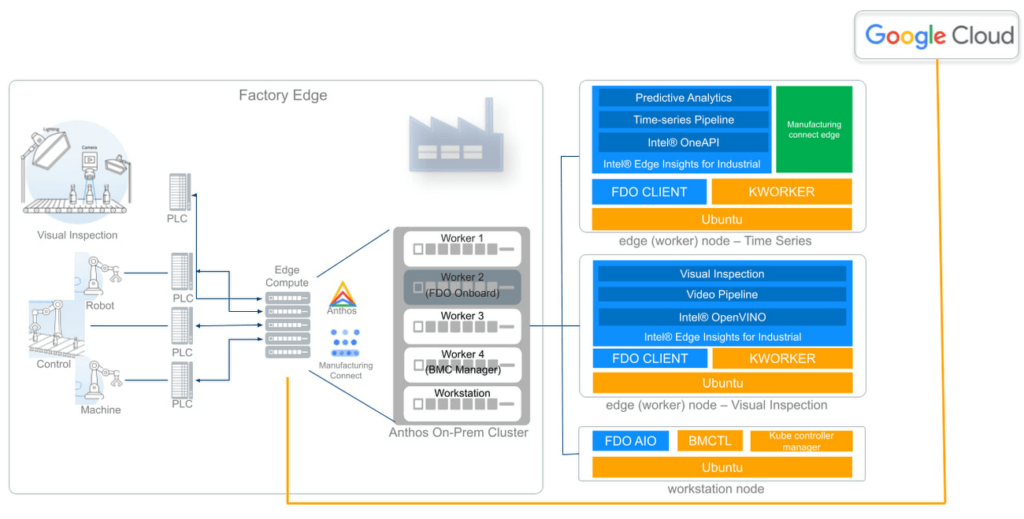
The Intel-Google Cloud proof of concept demonstrates how manufacturers can gather and analyze data from over 250 factory devices using Manufacturing Connect from Google Cloud, providing a powerful platform to run data ingestion and AI analytics at the edge.
In this demonstration in Hannover, Intel and Google Cloud show how manufacturers can capture time-series data from robotic welders to inspect welding quality and show how predictive analytics can benefit the factory operators. In addition, the video and image data is captured from a factory camera to show how visual inspection can highlight anomalies on plastic chips with model scoring. The demo also features zero-touch device onboarding using FIDO Device Onboard (FDO) to illustrate the ease with which additional computers could be added to the existing Anthos cluster.
By combining Google Cloud’s expertise in data, AI/ML and Intel’s Edge Insight’s for Industrial platform that was optimized to run on Google Anthos, manufacturers can run and manage their containerized applications at the edge, in on-premise data center, or in public clouds using an efficient and secure connection to the Manufacturing Data Engine from Google Cloud. It forges a complete edge-to-cloud solution.
Simplified device onboarding is available using Fido Device Onboard (FDO)—an open IoT protocol that brings fast, secure, and scalable zero-touch onboarding of new IoT devices to the edge. FDO allows factories to easily deploy automation and intelligence in their environment without introducing complexity into their OT infrastructure.
The Intel-Google Cloud implementation can analyze that data using localized Intel or third-party AI and machine learning algorithms. Applications can be layered on the Intel hardware and Anthos ecosystem, allowing customized data monitoring and ingestion, data management and storage, modeling, and analytics. This joint PoC facilitates and support improved decision making and operations, whether automated or triggered by the engineers on the front lines.
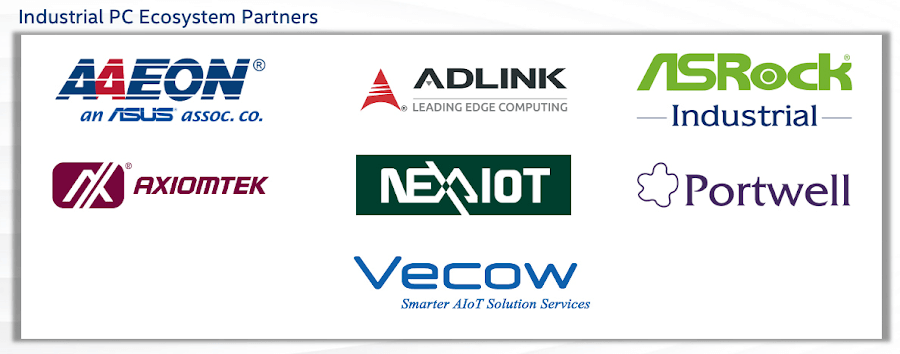
Intel collaborates with a vibrant ecosystem of leading hardware partners to develop solutions for the industrial market by using the latest generation of Intel processors. These processors can run data intensive workloads at the edge with ease.
Putting data and AI directly into the hands of manufacturing engineers can improve quality inspection loops, customer satisfaction, and ultimately the bottom line.
The new manufacturing solutions will be demonstrated in person for the first time at Hannover Messe 2022, May 30–June 2, 2022. Visit us at Stand E68, Hall 004, or schedule a meeting for an onsite demonstration with our experts.
Google’s New Climate Innovation Challenge to Fight Energy Crisis and Build Climate Resilience

3418
Of your peers have already read this article.
1:30 Minutes
The most insightful time you'll spend today!
At Google, we believe that when it comes to solving a problem as big and urgent as climate change, we get more done when we collaborate. From beekeepers in Germany to urban foresters in Los Angeles, we support the work of nonprofits, scientists, and organizations that are working to mitigate the impact of climate change globally, and increase communities’ resilience to its effects.
To this end, we are proud to launch the Climate Innovation Challenge, which will provide Google Cloud research credits to advance a better understanding of climate resilience and promising solutions to address urgent climate challenges. I’m excited about this launch. We need to get smarter about the inevitable impact of our changing climate and how it will reshape our lives, supply chains, and business. Sustainability is a business-critical agenda, and we need intelligent technologies, leadership, and collaboration to drive industry transformations and reach a net-zero world.
The innovation and scale required to solve the toughest climate challenges will come from technology. At Google Cloud, we’re working across industries to increase climate resilience, applying cloud technology to help solve key challenges in the fight against climate change. Nonprofits, scientists, and organizations will be key in developing new research and innovations that will help us better understand how we can accelerate action on climate.
Through the new program, individual climate researchers in higher education and not-for-profit research organizations can apply for Google Cloud credit grants of up to $100,000 to accelerate their projects with Google’s state-of-the-art, data analytics and artificial intelligence (AI) cloud services, from Google Earth Engine (EE) to Google Public Datasets like the one from the National Oceanographic and Atmospheric Administration (NOAA). We will work with specialist partners in environmental organizations, agriculture, and carbon reduction to help evaluate proposals and select participants. Our first partner is the National Science Foundation (NSF) AI Institute for Research on Trustworthy AI in Weather, Climate, and Coastal Oceanography (AI2ES). Alongside the cloud credits, we will also provide researchers with access to technical training and mentoring, to help jumpstart their work.
From idea to insight to impact
In 2021, researchers at 500 universities in 47 countries received Google Cloud research credit grants. Others received funding through the Google Cloud Research Innovators Program, which promotes collaboration among a global cohort of scientists and provides them with professional opportunities and technical expertise. Here are some of the Research Innovators who have already advanced their climate research with Google Cloud:
- At CalTech Tapio Schneider and his team built Climate Machine, a next-generation open-source Earth System Model that will integrate more earth and atmospheric data than ever before.
- At UCLA, Bo Zhou uses EE for remote sensor modeling to help bureaus of land management make conservation decisions.
- At the University of New England, James Brinkhoff conducts spatial and temporal analysis for agriculture crop modeling and water use with data from EE.
- At Natural Resources Canada (NRCan), Richard Fernandes is developing the LEAF toolbox to map and assess vegetation with satellite data from EE.
- At the University of Toronto, Yuhong He uses EE to map changes occurring in natural and managed ecosystems systems using remote sensing, machine learning, and ecosystem modelings.
- At UCLA, Henry Houskeeper uses machine learning with EE’s satellite imagery to automate detection of kelp forests.
- At the University of Hawaii at Manoa, Jonghyun Lee conducts numerical modeling for water resources with Google Colab.
- At Technical University in Dublin, Santos Fernández Noguerol runs functions to collect weather data from governmental agencies, then automatically stores them in Google Cloud Storage buckets for future spatial analysis.
- At the University of Colorado at Denver, Farnoush Banaei-Kashani conducts data science projects with applications for Intelligent Transportation and Earth Sciences.
To apply for a Climate Innovation Challenge grant, click here and include “Climate Innovation Challenge” as the first line of your proposal. We will announce additional focus areas, partnerships, and recipients throughout the year. Click here to learn more about Google Cloud sustainability.
5315
Of your peers have already watched this video.
1:30 Minutes
The most insightful time you'll spend today!
Why Enterprises Should Choose Google Cloud for their SAP Workloads
Change is a constant for SAP customers. Now more than ever, SAP customers need solutions that provide them business agility, rock solid availability and security and true economic value.
Learn how Google Cloud can guide your SAP journey to the cloud with simple and no cost migrations, powerful infrastructure and innovation technologies that you can take advantage of today.
Hear from SAP customers who have deployed on Google Cloud and the game changing results they are realizing.

5684
Of your peers have already downloaded this article
5:30 Minutes
The most insightful time you'll spend today!
Modernizing apps on the cloud isn’t an “all or nothing” decision. Businesses want the option to modernize on-premises or choose multi-cloud solutions that meet their needs. That’s why we created a new solution for running apps anywhere – simply, flexibly, and securely. Embracing open standards, Anthos lets you run your applications, unmodified, on existing on-prem hardware investments or in the public cloud. So that you write once and deploy anywhere.
Download this report and find out how to:
- Decouple infrastructure and applications with containers and Kubernetes
- Decouple cloud teams from one another so they can work independently
- Meet the challenges of microservice management using service mesh
- Implement a zero-trust security model to enforce more granular controls while maintaining a consistent user experience
More Relevant Stories for Your Company

How Lowe’s SRE Team Decreases Mean-time-to-recovery (MTTR)
Editor’s Note: In a previous blog, we discussed how home improvement retailer Lowe’s was able to increase the number of releases it supports by adopting Google’s Site Reliability Engineering (SRE) framework on Google Cloud. Lowe’s went from one release every two weeks to 20+ releases daily, helping meet its customer needs faster and

Macy’s Uses Google Cloud to Streamline Retail Operations
As retailers strive to meet the growing expectations of shoppers, they are turning to Google Cloud to transform their businesses and tackle opportunities in an increasingly challenging industry. From optimizing inventory management to increasing collaboration between employees across locations and roles, to helping build omnichannel experiences for their customers, we
Google Cloud Leads the Pack in Cloud Security: Forrester Research
As organizations continue to move workloads to public clouds, security professionals must protect the sensitive data and digital identities found in those workloads. Once wary of cloud adoption, many security professionals now believe that the native security capabilities of large public cloud platforms actually offer more affordable and superior security

How Google Classroom Helps State of Iowa Employees Serve the Public Better
Organizations are pressed with the need to engage, retain, and upskill employees with many positions staying fully or partially remote as the pandemic continues. The Center for Digital Government (CDG) reports that 74% of state and local governments believe they will continue hybrid operations for the long-term. This transition is
