





How APIs Helped PWC Open New Revenue Streams Using Existing Data

4688
Of your peers have already read this article.
5.17 Minutes
The most insightful time you'll spend today!
PwC, one of the “Big Four” accounting firms, is well-known for professional services structured around auditing, insurance, tax, legal, and traditional management consulting. In Australia, the PwC Innovation and Ventures group has taken the global lead in building new, technology-based, turnkey lines of business outside of PwC’s traditional service areas. Applying its insights and knowledge base to the company’s vast amounts of existing data, PwC has uncovered new revenue models, distinct from its traditional, labor-intensive services.
Traditionally, people at PwC connected to critical data in response to scheduled tasks or crises in order to provide independent advice, often after the fact, when there’s little runway to make considered business decisions. The company wanted to move beyond the status quo, where people connected to static data and where benchmarking, deeper insights, and alerts were often an afterthought. Expertise gained from analyzing data and drawing valuable insights often was limited to individuals—it didn’t scale. PwC aimed to leap forward technologically and build utility and value for its customers through the development of a vibrant API-based ecosystem.
Innovation From Down Under
Australia is helping to lead the way at PwC from a software and development perspective. Early on, the Innovation and Ventures group decided to collaborate with PwC New Zealand, which leads the world in cloud general ledger adoption. The group represents the first with over 20% of its customer companies keeping their general ledgers in the cloud (that figure is currently around 35%), and serves as an early example of what can be achieved with APIs based on cloud general ledger data.
Accessing proprietary data (most significantly general ledger data), transforming it, and connecting it to an ecosystem of partners and clients via APIs, has quickly proved a winning formula for PwC, in the form of its Next platform, which combines multiple cloud accounting tools and integrated cloud applications in an open platform. It also includes customizable dashboards that provide a holistic view of a client’s entire portfolio, including business trends, in real time.
“By our very nature, we’re a people and services business, evolving into a data business. The biggest help that Apigee has provided in this transformation is in helping us expose core, rich data so that our people who provide services today can actually demonstrate value in the market tomorrow.”
— Trent Lund, PwC Australia
In developing the firm’s first technology products, PwC Australia’s Head of Innovation and Ventures Trent Lund was adamant that as an accounting firm, PwC never spend a dollar building something that technology professionals had already done better. That credo led Lund to select Google’s Apigee as PwC’s platform of choice for developing productized APIs.
Cloud-first Strategy
Increasingly, the datasets PwC wants to connect with are from public sources and open APIs coming from cloud providers. The Apigee toolset is perfectly positioned for Lund’s team’s focus on data connectivity—especially now that Apigee is part of Google, Lund says.
“The Apigee integration into Google is really helpful for us because we can connect in with that same ecosystem. Our team is relatively small by global standards, so we really don’t have time to try and foster multiple technology relationships,” Lund says. “We need to have deep, trusted relationships where we can get a level of sharing now and into the future, and that’s what we get with Apigee.”
PwC Australia continues to innovate and build the platform, but rather than continuing to pay for development from its local innovation fund, the platform is now funded globally so that it can be accelerated and shared across four countries. Australia, New Zealand, the United Kingdom, and the United States are simultaneously guiding the platform’s requirements and features as PwC develops with an awareness of each country’s individual regulations.
For example, compliance with the European Union’s General Data Protection Regulation (GDPR) and China’s data residency rules would be far more complicated without a single technology partner like Apigee that experiences the same global challenges as part of Google, Lund says.
Rollouts Made Simple: Cloud Deploy’s Deploy Hooks

915
Of your peers have already read this article.
2:30 Minutes
The most insightful time you'll spend today!
Cloud Deploy is a fully managed continuous delivery platform that automates the delivery of your application. Recently, we’ve heard from users that they want Cloud Deploy to also perform self-defined pre- and post-deployment operations to reduce the amount of additional toil required for each rollout. Examples of such operations include database schema updates, application infrastructure deployment, and network configuration adjustment.
Today, we are pleased to announce the public preview availability of Cloud Deploy deploy hooks. With this launch, Cloud Deploy now offers an easy way to define and execute pre- and post-deployment operations as part of a rollout.
Deploy hooks
The ability to run user defined actions immediately before and after deployment is a powerful feature that allows DevOps organizations to build out complete CI/CD pipelines to meet their specific deployment needs.
With the introduction of deploy hooks in Cloud Deploy, you can now take advantage of this capability by configuring your delivery pipeline to include pre-deploy and post-deploy actions. These actions take advantage of the custom actions defined through Skaffold. When enabled, two new jobs — predeploy and postdeploy — will be performed when deploying a rollout into a target.
Deploy hooks are supported for all target types (GKE, Cloud Run, Anthos, and Multi-Target) and can be used with all deployment strategies, such as canary deployments.
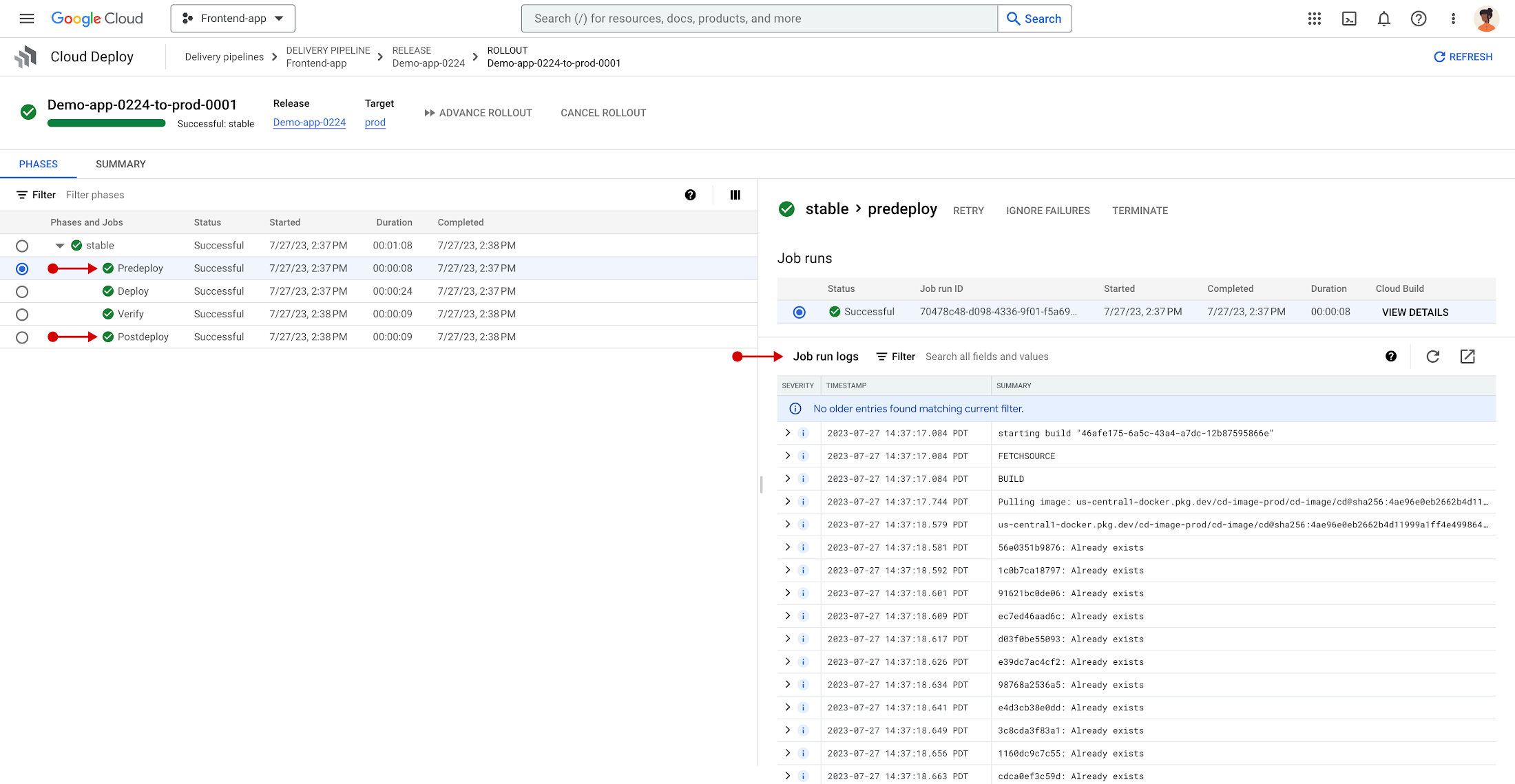
As enabled, deploy hooks can be used in a variety of ways, such as:
- Performing a database migration prior to deployment
- Performing infrastructure deployment prior to application deployment
- Interacting with third-party platforms post deployment, such as sending out an email or updating an open task tracker
Like other rollout jobs, Cloud Deploy provides the same observability and control for predeploy and postdeploy jobs. This includes the ability to view logs and perform control over individual jobs, such as retry, terminate, or ignore — all within the same rollout details interface.
Interested in exploring deploy hooks for yourself? Get started now with our quickstart and documentation!
The future
Comprehensive, easy-to-use, and cost-effective DevOps tools are key to building an efficient software delivery capability, and it’s our hope that Cloud Deploy will help you implement complete CI/CD pipelines. Stay tuned as we introduce exciting new capabilities and features to Cloud Deploy in the months to come.
In the meantime, check out the product page, documentation, quickstarts, and tutorials. Finally, If you have feedback on Cloud Deploy, you can join the conversation. We look forward to hearing from you!
How This Leading Trading Company Uses APIs to Build Fintech Apps Quickly and Cost-Effectively

4597
Of your peers have already read this article.
5:10 Minutes
The most insightful time you'll spend today!
Tradier uses the Apigee API management platform from Google to abstract the legacy complexities of capital markets so that developers can build FinTech applications in an agile, nimble, and quick fashion at minimal cost. The company embodies the evolution of what cloud technology can enable in the form of an API-first business delivered as a service.
The rise of API-powered FinTech
Historically, companies that wanted to build systems, applications, or services to interact with the stock market would have to build an entire brokerage operation from scratch. This would include data infrastructure, compliance infrastructure, and storage capabilities. It could take years and massive capital expense to accomplish everything that was required to be ready to serve customers.
Tradier provides this infrastructure as an API-based service so that the same companies can launch investor applications in as little as a few weeks. This democratized access means that FinTech innovation can come from anywhere, giving the same opportunities to create new products to everyone, from enterprise customers to startups.
“Financial markets are becoming fundamentally decentralized and unbundled,” says Dan Raju, co-founder, CEO, and chairman at Tradier. “The services that large legacy banks and brokerage firms used to offer are being supplanted by Tradier’s microservices and APIs, which power innovation.”
More than 200 companies use Tradier to develop and launch new products, or to add new features and functions that they traditionally would not have offered in existing products. With a large and diverse user base, Tradier faced the challenge of managing its partners in way that helps ensure it can grant credentials, track, monitor, and report in an efficient and equitable manner.
At the same time, the company recognized the inherent value of its partners for their power to leverage Tradier APIs to innovate. Tradier’s fundamental market disruption is the partner ecosystem, where the company is engaged along with its partners to deliver value to the entire ecosystem in the form of new products and services.
Embracing an API-powered ecosystem
Tradier has moved beyond providing great APIs toward engaging its ecosystem. If a customer wants a specific dataset, the company doesn’t automatically build a new product. Instead, Tradier looks to the ecosystem to build the product. With this approach, Tradier has taken its capabilities and multiplied them by hundreds.
“The fundamental difference between thinking about an API ecosystem versus an API product is the difference between being a participant who’s enabling innovation and not just a company delivering a set of technical capabilities,” Raju says.
Tradier takes an outside-in approach toward engaging its API ecosystem. Constantly listening to participants and helping to enable and empower them to create value is fundamental to the company’s business model. Rather than simply focusing on building new capabilities on its own, Tradier listens to what functionalities customers need and facilitates development. In many cases, the ecosystem generates the requested product organically rather than Tradier needing to do it.
“I love APIs because they allow you to empower others to create value. The concept of empowering others to create value along with you is what is the most satisfying, and the most fascinating, thing about APIs,” says Raju.
Delivering value at scale
Tradier handles between 500 million to 1 billion API calls and a billion dollars in transactions a month, and all of them run through the Apigee API management platform. Apigee’s last mile forms the single layer that manages Tradier’s infrastructure, including security, analytics, developer interactions, and execution. The company also uses Apigee to comply with an array of regulatory reporting, mandated by Tradier’s status as a FINRA (Financial Industry Regulatory Authority)-regulated entity.
“Apigee is integral to the Tradier offering. They have been great partners and have always collaborated and enabled us to innovate at a pace that helped Tradier attract developers and innovative companies. We see tremendous potential in the synergy of Apigee and Google as it brings to the market a vast extended capability set based on the Google Cloud Platform.”
Tradier is an API-centric ecosystem that delivers value to an entire set of players where the nucleus is the Apigee API management suite, which helps deliver, innovate, publish, manage, monitor, and secure the ecosystem on a day-to-day basis. Simplicity combined with product evangelism is the key to success in the API space, Raju says.
Tradier’s capabilities to innovate, iterate, and travel the journey with its customers, partners, and developers has yielded many rewards. The company’s long history of working with Apigee has enabled it to assemble a set of people and resources for creating engagement, as well as to create a winning set of APIs for delivering FinTech capabilities.
Considering the transformative future
Looking toward a future in which the financial services industry will experience ongoing disruption, Raju predicts that Tradier will continue to leverage APIs to lead the way.
“I think traditional banks are under attack. They are being replaced by a set of nimble, agile players that are offering a lot of new functionality to customers. This is forcing banks to think about how they can digitize their products through APIs so that they can provide the same functionalities as newer players.”
With companies like Tradier and others offering functionality that used to be in-house and exposing it outside, traditional brokerage firms are also being forced to rethink their model. Raju believes that this line of thinking also extends to the Blockchain.
“Exposing Blockchain-like capabilities through APIs is going to be a disruptive influence, and it will be critical for companies to think about how APIs, and more importantly Blockchain, can create value for us.”

3567
Of your peers have already downloaded this article
2:30 Minutes
The most insightful time you'll spend today!
After undergoing an agile transformation, ING realized it needed a standardized platform to support the work their developers were doing. “Our DevOps teams got empowered to be autonomous,” says Thijs Ebbers, Infrastructure Architect.
“It has benefits, you get all kinds of ideas. But a lot of teams are going to devise the same wheel. Teams started tinkering with Docker, Docker Swarm, Kubernetes, Mesos. Well, it’s not really useful for a company to have one hundred wheels, instead of one good wheel,” Ebbers added.
Using Kubernetes for container orchestration and Docker for containerization, the ING team began building an internal public cloud for its CI/CD pipeline and green-field applications. The pipeline, which has been built on Mesos Marathon, will be migrated onto Kubernetes.
The bank-account management app Yolt in the U.K. (and soon France and Italy) market already is live hosted on a Kubernetes framework. At least two greenfield projects currently on the Kubernetes framework will be going into production later this year. By the end of 2018, the company plans to have converted a number of APIs used in the banking customer experience to cloud-native APIs and host these on the Kubernetes-based platform.
“Cloud native technologies are helping our speed, from getting an application to test to acceptance to production,” says Infrastructure Architect Onno Van der Voort. “If you walk around ING now, you see all these DevOps teams, doing stand-ups, demoing. They try to get new functionality out there really fast.”
Find out how.
Google Launches Open Saves To Power Gaming Platforms Scale to User Demands

5485
Of your peers have already read this article.
1:30 Minutes
The most insightful time you'll spend today!
Many of today’s games are rich, immersive worlds that engage the audience in ways that make a gamer a part of a continuing storyline. To create these persistent experiences, numerous storage technologies are required to ensure game data can scale to the standards of gamers’ demands. Not only do game developers need to store different types of data—such as saves, inventory, patches, replays, and more—but they also must keep the storage system high-performing, available, scalable, and cost-effective.
Enter Open Saves, a brand-new, purpose-built single interface for multiple storage back ends that’s powered by Google Cloud and developed in partnership with 2K. Now, development teams can store game data without having to make the technical decisions on which storage solution to use, whether that’s Cloud Storage, Memorystore, or Firestore.
“Open Saves demonstrates our commitment to partnering with top developers on gaming solutions that require a combination of deep industry expertise and Google scale,” said Joe Garfola, Vice President of IT and Security at 2K. “We look forward to continued collaboration with Google Cloud.”
Game development teams can save game data against Open Saves without having to worry about the optimal back-end storage solution, while operations teams can focus on needed scalability and storage options. Here’s how it looks in practice:
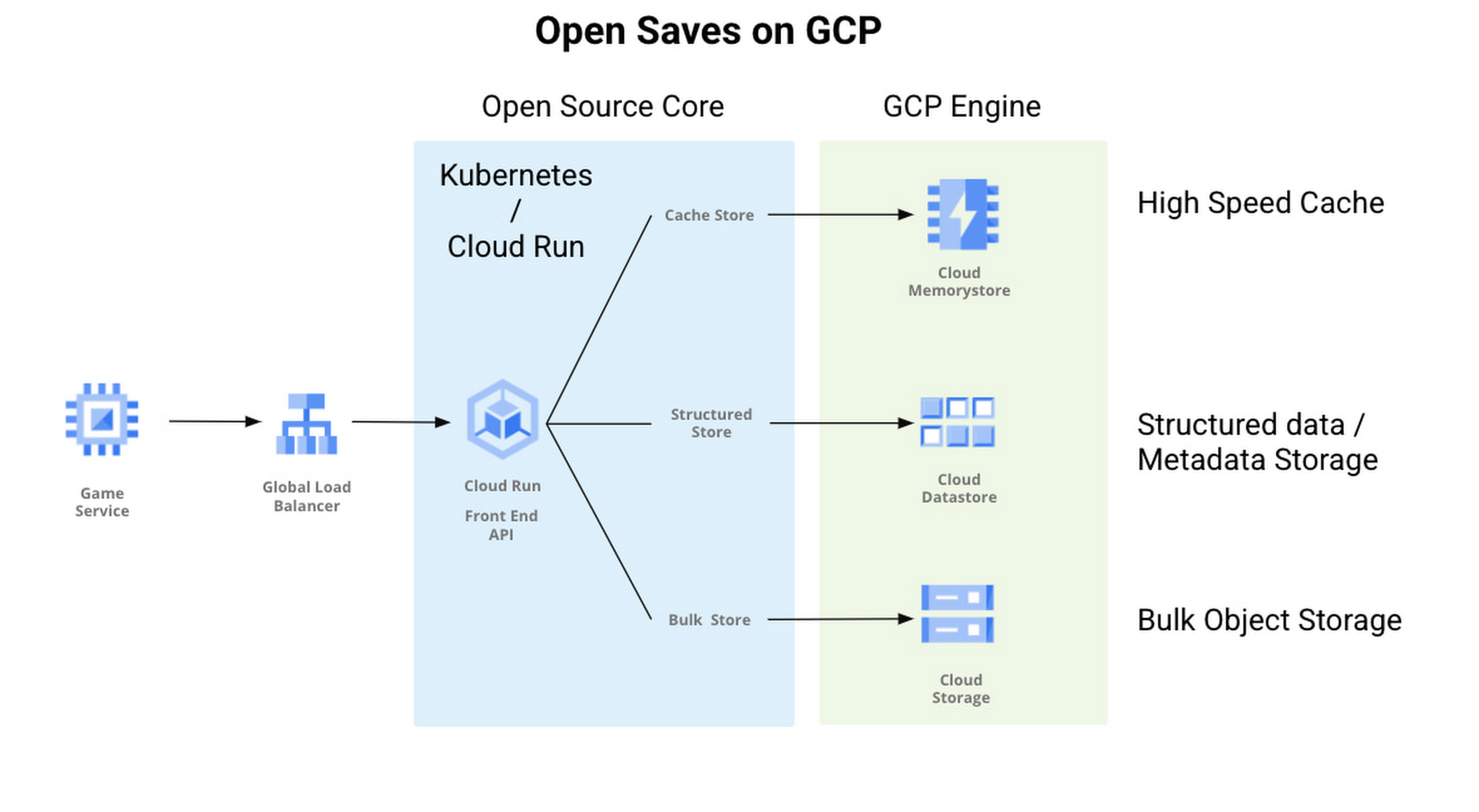
With Open Saves, game developers can run a cloud-native game storage system that is:
- Simple: Open Saves provides a unified, well-defined gRPC endpoint for all operations for metadata, structured, and unstructured objects.
- Fast: With a built-in caching system, Open Saves optimizes data placements based on access frequency and data size, all to achieve both low latency for smaller binary objects and high throughput for big objects.
- Scalable: The Open Saves API server can run on either Google Kubernetes Engine or Cloud Run. Both platforms can scale out to handle hundreds of thousands of requests per second. Open Saves also stores data in Firestore and Cloud Storage, and can handle hundreds of gigabytes of data and up to millions of requests per second.
Open Saves is designed with extensibility in mind, and can be integrated into any game—whether mobile or console, multiplayer or single player—running on any infrastructure, from on-prem to cloud or a hybrid. The server is written in Go, but you can use many programming languages and connect from client or server since the API is defined in gRPC.
Writing to and reading from Open Saves is as simple as the following code:
// To writerecord := &pb.Record{Key: uuid.New().String(),Tags: []string{"tag1", "tag2"},OwnerId: "owner",}createReq := &pb.CreateRecordRequest{StoreKey: storeKey,Record: record,}_, err := client.CreateRecord(ctx, createReq)if err != nil {t.Fatalf("CreateRecord failed: %v", err)}// To readgetReq := &pb.GetRecordRequest{StoreKey: storeKey, Key: recordKey}response, err := client.GetRecord(ctx, getReq)if err != nil {t.Errorf("GetRecord failed: %v", err)}
We are actively developing Open Saves in partnership with 2K Games, and would love for you to come join us on GitHub. There are a few ways to get involved:
- Install and deploy your Open Saves service
- Check out the API reference
- Read the development guide and start contributing
- Join the open-saves-discuss mailing list
Assuring Compliance in the Cloud: Paper by Google Cloud’s Office of the CISO

4904
Of your peers have already read this article.
1:30 Minutes
The most insightful time you'll spend today!
Cloud transformation and the adoption of modern DevOps technology presents both opportunities and challenges for IT compliance functions. With DevOps style application development, the feedback loop for developers and engineers is much tighter than with traditional application development pipelines, enabling speed and agility of application release cycles. While speedy CI/CD is a critical advantage of DevOps, it also shifts compliance left in the development timeline, and therefore puts pressure on the IT risk & compliance organization to modernize their approach to regulatory compliance as well. With the ongoing shift towards cloud technologies and DevOps, modernization of regulatory compliance is no longer optional for an IT compliance function
Compliance modernization is a broad mandate that spans the way the function is governed; the tools, technology, and analytics it uses; the number and nature of its connections to other parts of the business; verifiability and auditability of the controls’ evidence, the expectations assigned to it; and more.
Public cloud technology is becoming a core part of many industries today, and with this comes some potential risks such as cloud misconfigurations exposing intellectual property, loss of physical control of assets, skillset scarcity around cloud based security and compliance.
Given the constantly changing risk landscape, it is critical that regulations more closely align to address these risks. As regulations and risks evolve, the aim of a modern compliance function is to help an organization stay compliant as it goes through a digital transformation. As organizations go through digital transformation, IT compliance also needs to transform — via upgrading the technology stack, modifying the business processes and most importantly re-skilling people to become cloud aware.
Today we are releasing the new paper by Google Cloud’s Office of the CISO. In the paper we reveal a new approach for modernizing your compliance approach using modern approaches and Google Cloud toolsets. Your team can leverage the paper to add value to enterprises, both by charting a course to the safe use of cloud technology and by reducing risk through the use of the public cloud.
Read the paper “Assuring Compliance in the Cloud.”
Also, review these related resources:
- “Risk Governance of Digital Transformation in the Cloud“ paper
- “Making Compliance Cloud-native” (episode 14) with Zeal Somani
- Google Cloud Compliance resource center
- Our compliance blueprints: PCI DSS on GKE and GCP FedRAMP Blueprint
- Google Cloud security best practices center
More Relevant Stories for Your Company

Google Products Helps HMH’s Healthcare Staff Work from Anywhere Efficiently and Securely!
Hackensack Meridian Health (HMH) executive Mark Eimer explains how an ambitiously-timed rollout of a comprehensive suite of Google products helped the entire organization—from doctors to IT staff—achieve better security, cultivate a more equitable work environment, and ultimately, improve patient outcomes. How does a recently merged, 17-hospital healthcare system fast-track a platform migration




Swarovski’s Journey towards Online and Offline Conversion with Predictive Analytics
Luxury brand and leader in crystals and glass production, Swarovski has charmed customers with its exquisite collections for over 125 years. To understand their customers better and map their online behaviors, Swarovski had to overcome prediction hurdles as majority of the purchases are not frequent or habitual. They are mostly

The Digital Transformation Journey
Aspiration is easy, but execution is hard. Few concepts illustrate this as well as digital transformations. Most businesses today are at some phase of their digital transformation journey. While some are evaluating strategies and solutions, many companies have already embarked on full-scale project implementations. However, one thing is clear. While


Application Development with Kpt
Learn how to create and customize configuration packages with Kpt to build applications and adhere to configuration-as-data philosophy.
