





Harnessing the Power of Data and AI to Transform Life Science Supply Chains

3988
Of your peers have already read this article.
3:30 Minutes
The most insightful time you'll spend today!
Global life science supply chains are lengthy and complex with many moving parts. One small disruption can create serious delays and affect your ability to deliver therapeutics for patients.
Supply chain disruptors
Over the last few years, healthcare organizations have encountered a range of obstacles, from both internal and external factors, that have resulted in supply networks failing to get drugs and medical devices to where they need to be on time. These obstacles include:
- Labor and supply shortages
- Rising material costs
- Raw material constraints
- Geo-political events
- Unpredictable weather
How do you overcome supply chain disruptors that are out of your control?
The intelligent healthcare supply chain
While many organizations have already implemented data-driven supply chains, organizations are still faced with the challenges of static, siloed, and different functional supply chain applications; limited data exchange with key trading partners across upstream and downstream operations; and the inability to effectively leverage relevant external data.
At Google Cloud, we believe the key to meaningful and effective change is a data-driven supply chain that allows you to achieve visibility, flexibility, and innovation.
Our solutions help you prepare for the unpredictable and enhance the value of your data. By unlocking AI-driven insights, you can strengthen distribution networks and optimize your workflows and supply chains to become more reliable, intelligent, and sustainable. Some of the business challenges we address include:
- Predicting demand with Vertex AI Forecast
- Visual inspection for quality and predictive maintenance with pre-built ML models
- Automating and optimizing pickup and delivery operations with Cloud Fleet Routing API
- Real time and holistic inventory visibility with Supply Chain Twin
Make sure you’re prepared for the unpredictable with real-time visibility over your distribution networks. Learn how you can harness the power of AI and analytics and gain actionable insights that enhance your supply chain.
2923
Of your peers have already watched this video.
14:00 Minutes
The most insightful time you'll spend today!
Productionizing TensorFlow on Google Cloud with TensorFlow Enterprise
Machine learning is transforming every aspect of our lives and developers and enterprises are using ML to build impactful solutions that drive business value.
TensorFlow is one of the most widely used production-ready frameworks for machine learning and it’s open-sourced by Google so that everyone can take advantage of these powerful tools.
But if you are an enterprise trying to use ML there are some challenges you may face.
To address the needs of AI-enabled businesses, Google recently introduced TensorFlow Enterprise. It incorporates enterprise-grade support, cloud scale performance, and Google Cloud-managed services.
Watch Sandeep Gupta, Product Manager, TensorFlow, to learn how to get started and why the best way for businesses to experience TensorFlow is with TensorFlow Enterprise.
Generative AI Takes Center Stage at Google I/O Conference 2023

1194
Of your peers have already read this article.
7:00 Minutes
The most insightful time you'll spend today!
Over the past decade, artificial intelligence has evolved from experimental prototypes and early successes to mainstream enterprise use. And the recent advancements in generative AI have begun to change the way we create, connect, and collaborate. As Google CEO Sundar Pichai said in his keynote, every business and organization is thinking about how to drive transformation. That’s why we’re focused on making it easy and scalable for others to innovate with AI.
In March, we announced exciting new products that infuse generative AI into our Google Cloud offerings, empowering developers to responsibly build with enterprise-level safety, security, and privacy. They include Gen App Builder, which lets developers quickly and easily create generative chat and enterprise search applications, and Generative AI support in Vertex AI, which expands our machine learning development platform with access to foundation models from Google and others to quickly build, customize and deploy models. We also introduced our vision for Google Workspace, and delivered generative AI features to trusted testers in Gmail and Google Docs that help people write.
Last month we introduced Security AI Workbench, an industry-first extensible platform powered by our new LLM security model Sec-PaLM, which incorporates Google’s unique visibility into the evolving threat landscape and is fine-tuned for cybersecurity operations.
Today at Google I/O, we are excited to share the next steps not only in our own AI journey, but also those of our customers and partners as well. We’ve already seen a number of organizations begin to develop with and deploy our generative AI offerings. These organizations have been able to move their ideas from experimentation to enterprise-ready applications with the training models, security, compute infrastructure, and cost controls needed to provide their customers with transformative experiences. Our open ecosystem, which provides opportunities for every kind of partner, continues to grow as well. And we are also pleased to share new services and capabilities across Google Cloud and Workspace, including Duet AI—our AI-powered collaborator—to enable more users and developers to start seeing the impact AI can have on their organization.
Customers bringing ideas to life with generative AI
Leading companies in a variety of industries like eDreams ODIGEO, GitLab, Oxbotica, and more, are using our generative AI technologies to create engaging content, synthesize and organize information, automate business processes, and build amazing customer experiences. A few examples we showcased today include:
- Adore Me, a New York-based intimate apparel brand, is creating production-worthy copy with generative AI features in Docs and Gmail. This is accelerating projects and processes in ways that even surprised the company.
- Canva, the visual communication platform, uses Google Cloud’s rich generative AI capabilities in language translation to better support its non-English speaking users. Users can now easily translate presentations, posters, social media posts, and more into over a hundred languages. The company is also testing ways that Google’s PaLM technology can turn short video clips into longer, more compelling stories. The result will be a more seamless design experience while growing the Canva brand.
- Character.AI, a leading conversational AI platform, selected Google Cloud as its preferred cloud infrastructure provider because we offer the speed, security and flexibility required to meet the needs of its rapidly growing community of creators. We are enabling Character.AI to train and infer LLMs faster and more efficiently, and enhancing the customer experience by inspiring imagination, discovery, and understanding.
- Deutsche Bank is testing Google’s generative AI and large language models (LLMs) at scale to provide new insights to financial analysts, driving operational efficiencies and execution velocity. There is an opportunity to significantly reduce the time it takes to perform banking operations and financial analysts’ tasks, empowering employees by increasing their productivity while helping to safeguard customer data privacy, data integrity, and system security.
- Instacart is always looking for opportunities to adopt the latest technological innovations, and by joining the Workspace Labs program, they have access to the new features and can discover how generative AI will make an impact for their teams.
- Orange is exploring a next-generation contact center with Google Cloud. With customers in 26 countries, the global telecommunications firm is testing generative AI to transcribe the call, summarize the exchange between the customer and service representatives, and suggest possible follow up actions to the agent based on the discussion. This experiment has the potential to dramatically improve both the efficiency and quality of customer interactions. Orange is working closely with Google to help ensure data protection and make sure that systematic employee review of Generative AI output and transparency can be implemented.
- Replit is developing a collaborative software development platform powered by AI. Developers using Replit’s Ghostwriter coding AI already have 30% of their code written by generative AI today. With real-time debugging of the code output and context awareness of the program’s files, Ghostwriter frees up developers’ time for more challenging and creative aspects of programming.
- Uber is creating generative AI for customer-service chatbots and agent assist capabilities, which handle a range of common service issues with human-like interactions with the aim of achieving greater customer satisfaction and cost efficiency. Additionally, Uber is working on using our synthetic data systems (a technique for improving the quality of LLMs) in areas like product development, fraud detection, and employee productivity.
Wendy’s is working with Google Cloud on a groundbreaking AI solution, Wendy’s FreshAI, designed to revolutionize the quick service restaurant industry. The technology is transforming Wendy’s drive-thru food ordering experience with Google Cloud’s generative AI and LLMs—with the ability to discern the billions of possible order combinations on the Wendy’s menu. In June, Wendy’s plans to launch its first pilot of the technology in a Columbus, Ohio-area restaurant, before expanding to more drive-thru locations.
Partnering creates a strong ecosystem of real-world options for customers
At Google Cloud, we are dedicated to being the most open hyperscale cloud provider, and that includes our AI ecosystem. Today, we are excited to expand upon the partnerships announced earlier this year for every layer of the AI stack—chipmakers, companies building foundation models and AI platforms, technology partners enabling companies to develop and deploy machine learning (ML) models, app-builders solving customer use cases with generative AI, and global services and consulting firms that help enterprise customers implement all of this technology at scale.
We announced new or expanded partnerships with SaaS companies like Box, Dialpad, Jasper, Salesforce, and UKG; and consultancies including Accenture, BCG, Cognizant, Deloitte, and KPMG. Together with our previous announcements with companies like AI21 Labs, Aible, Anthropic, Anyscale, Bending Spoons, Cohere, Faraday, Glean, Gretel, Labelbox, Midjourney, Osmo, Replit, Snorkel AI, Tabnine, Weights & Biases, and many more, they provide the a wide range of options for businesses and governments looking to bring generative AI into their organizations.
Introducing new generative AI capabilities for Google Cloud
To help cloud users of all skill levels solve their everyday work challenges, we’re excited to announce Duet AI for Google Cloud, a new generative AI-powered collaborator. Duet AI serves as your expert pair programmer and assists cloud users with contextual code completion, offering suggestions tuned to your code base, generating entire functions in real-time, and assisting you with code reviews and inspections. It can fundamentally transform the way cloud users of all skill sets build new experiences and is embedded across Google Cloud interfaces—within the integrated development environment (IDE), Google Cloud Console, and even chat.
For developers looking to create generative AI applications more simply and efficiently, we are also introducing new foundation models and capabilities across our Google Cloud AI products. And to continue to enable and inspire more customers and partners, we are opening up generative AI support in Vertex AI and expanding access to many of these new innovations to more organizations.
- New foundation models are now available in Vertex AI. Codey, our code generation foundation model, helps accelerate software development with code generation, code completion, and code chat. Imagen, our text-to-image foundation model, lets customers generate and customize studio-grade images. And Chirp, our state-of-the-art speech model, allows customers to more deeply engage with their customers and constituents inclusively in their native languages with captioning and voice assistance. They can each be accessed via APIs, tuned through our intuitive Generative AI Studio, and feature enterprise-grade security and reliability, including encryption, access control, content moderation, and recitation capabilities that let organizations see the sources behind model outputs.
- Text Embeddings API is a new API endpoint that lets developers build recommendation engines, classifiers, question-answering systems, similarity matching, and other sophisticated applications based on semantic understanding of text or images.
- Reinforcement Learning from Human Feedback (RLHF) allows organizations to incorporate human feedback to deeply customize and improve model performance.
Underpinning all of these innovations is our AI-optimized infrastructure. We provide the widest choice of compute options among leading cloud providers and are excited to continue to build them out with the introduction of new A3 Virtual Machines based on NVIDIA’s H100 GPU. These VMs, alongside the recently announced G2 VMs, offer a comprehensive range of GPU power for training and serving AI models.
Extending generative AI across Google Workspace
Earlier this year, we shared our vision for bringing generative AI to Workspace, and gave many users early access to features that helped them write in Gmail and Google Docs. Today, we are excited to announce Duet AI for Google Workspace, which brings together our powerful generative AI features and lets users collaborate with AI so they can get more done every day. We’re delivering the following features to trusted testers via Workspace Labs:
- In Gmail, we’re adding the ability to draft responses that consider the context of your existing email thread—and making the experience available on mobile.
- In Google Slides and Meet, we’re enabling you to easily generate images from text descriptions. Custom images in slides can help bring your story to life, and in Meet they can be used to create custom backgrounds.
- In Google Sheets, we’re automating data classification and the creation of custom plans—helping you analyze and organize data faster than ever.
Moving the industry forward, responsibly
Customers continue to amaze us with their ideas and creativity, and we look forward to continuing to help them discover their own paths forward with generative AI. While the potential for impact on business is great, we remain committed to taking a responsible approach, guided by our AI Principles. As we gather more feedback from our customers and users, we will continue to bring new innovations to market, with a goal to enable organizations of every size and industry to increase efficiency, connect with customers in new ways, and unlock entirely new revenue streams.
How Google Cloud’s Scalable Data Storage and High Compute Resources Fuel Investment Research

6310
Of your peers have already read this article.
1:30 Minutes
The most insightful time you'll spend today!
Investment management is a heavily data-driven industry—portfolio managers and investment researchers require a large number of data sources to guide them in shaping their investment strategies.
New cloud capabilities and technologies enable investment managers to process data faster than ever before and iterate on ideas quickly to fuel innovation in the signal generation process and gain a competitive edge.
Using the cloud for investment research workflows makes it easier to onboard data from data providers, spin up large compute workloads in the midst of market volatility or during heavy research cycles, and manage complex machine learning or natural language workflows to gain market insights.
We hear from industry leaders that they’re exploring new ways to run investment research. “Differentiated investment strategies require new types of information sources, and new ways to process that information,” David Easthope, senior analyst, Market Structure and Technology, Greenwich Associates. “And that, of course, relies heavily on having access to reliable and scalable storage, computational, and AI / ML resources. More specifically, quantitative strategies can benefit from the computational platforms and embedded AI/ML capabilities the cloud can offer.”
Google Cloud gives investment managers essential components to work and operate faster as they bring their investment research workflows to the cloud. Here are the key highlights:
1. Simplify, speed up your data acquisition, discovery, and analytics
The foundation of any investment strategy starts with data—acquiring it, detecting patterns, and analyzing it for insights. Enabling data providers to easily share large datasets such as tick history within a high-performance analytics engine can greatly reduce the data engineering overhead when possible.
Once data is onboarded, you can tag business and technical metadata related to your datasets and provide portfolio managers the ability to discover these datasets via a search interface.
We further review analytics options for various scenarios, including aggregating massive datasets, creating dashboards, and incorporating streaming analytics workloads.
2. Take advantage of burst compute workloads
Data engineers and researchers require ready access to burst compute capabilities to perform backtesting, portfolio simulations and run risk calculations. Cloud works well for these workloads due to its elasticity, consumption-based models, and hardware evolution.
Many investment managers are shifting to a container-based strategy along with a Kubernetes-based scheduler for greater consistency, scaling and efficiency in environments with a large number of researchers. Cloud managed services and a rich suite of CI/CD tools can make this vision a reality while improving security and developer productivity.
3. Tackle machine learning (ML) and model deployment with the help from cloud
Quantitative researchers scour vast amounts of market and alternative data sources searching for signals and correlations, while ML engineers have the challenge of taking these signals and moving them to production.
Google Cloud empowers users to create and operationalize their models without wasting valuable time with a comprehensive set of MLOps tools.
In this paper, we explore multiple solutions for ML and model deployment. Those capabilities reduce the amount of time operationalizing ML models, so quants and data scientists have more time to devote to differentiating activities.
4. Get the data you need in less time with Natural Language and Document AI
Thousands of financial filings, news articles, and sell-side research reports are generated every day, and it’s difficult for humans alone to process this volume of information. These documents are often generated in many languages and the ability to do entity recognition, sentiment or syntactical analysis in those languages, or perhaps translate them into the language of the portfolio manager is of critical importance. Google Cloud provides these capabilities through pre-trained models, or allows you to train high-quality models with your own datasets.
Getting started
There are plenty of emerging technologies, tools, and approaches available to help investment managers today. At Google Cloud, we can help you access, organize, and utilize these essential components to make your research faster, reliable, and more valuable.
To learn more about these four keys to better investment research, check out our whitepaper for more.
How Public Sectors Leverage Google Cloud to Push the Envelop in Human Services and Labor

3118
Of your peers have already read this article.
2: 30 Minutes
The most insightful time you'll spend today!
The COVID-19 pandemic tested our nation’s public benefits system in unimaginable ways. With an unprecedented 60 million individuals turning to unemployment and social services to satisfy their basic needs, state and local governments were stretched to meet the demand.
But state and local government leaders have risen to the challenge of providing their constituents with critical services. They created and administered innovative solutions, complete with wholly original processes, and brought desperately needed employment, cash, food, and healthcare support to families in crisis. These public sector heroes raised the bar during this critical time and facilitated economic recovery for our local communities, making the impossible possible for its people.
When state and local government agencies partner with Google Cloud, they can reimagine how they deliver human services and labor services for their communities. All in a matter of weeks, instead of months or years.
Tools that solve for remote work and service delivery hurdles
Never before was there such a need for modern and accessible tools to allow a workforce to secure new jobs and operate remotely. The Virtual Career Center (VCC), built on Google Cloud, was designed with these needs in mind.
Google Workspace, including Google Meet, allows job seekers to schedule video meetings with career coaches, job recruiters, and potential employers. The Google Job Search API will enable them to explore career opportunities best suited to their skills and interests.
A thousand miles away, the Rhode Island Virtual Career Center was helping its job seekers by offering virtual meetings with career coaches, the ability to schedule meetings with prospective employers, and help on building effective resumes. Skipper, the CareerCompass RI Bot, an intelligent agent for careers, uses data and machine learning to facilitate potential new career paths and reskilling opportunities for Rhode Islanders.
In addition to enabling remote work, Google Workspace can support remote service delivery, a critical need for those involved in health and human services programs. Engaging with individuals and families is an essential component for more of these programs, including eligibility determination, assessment, and service delivery. The ability to engage directly with the public through virtual interviews, counseling sessions, telehealth, etc. improves access for those on both sides of the screen. Further, through Google Classroom, a component of Google Workspace for Education, foster and adoptive parents can obtain virtual training required for licensing.
Tools to expedite relief funds and employment assistance
As the number of people applying for unemployment assistance skyrocketed, so did the backlog of claims requiring review. The pandemic also saw a rise in fraudulent claims, which caused delays for families waiting on legitimate payments and resulted in unnecessary spending for government agencies. Realizing the magnitude of the challenge was beyond the agencies’ current resources, and they shifted their focus to machine learning.
To address the massive backlog of claims, SpringML partnered with Google Cloud to develop the Improper Payment Analytics solution that successfully leverages AI to help agencies identify fraudulent claims and avoid improper payments so aid can be prioritized for those who need it. Though such a tool would typically take months to develop, the team was able to launch it in just weeks, to the benefit of all stakeholders involved. Families awaiting legitimate payments received checks more quickly, and state and local governments saved millions in spending.
For instance, to address erroneous payments totaling $330 million to fraudulent applicants, the State of Ohio partnered with Google Cloud to utilize artificial intelligence and machine learning solutions to proactively identify and decline improper payment risks. As a result, the State avoided paying fraudulent claims and accelerated the payment of legitimate benefits to families facing financial hardship.
The New York State Department of Labor launched a streamlined unemployment application to allow residents to apply for pandemic unemployment assistance without the added burden of applying for unemployment insurance. Success was immediate, and the application backlog plummeted as New Yorkers got the financial aid they desperately needed. Illinois took a different approach, deploying Contact Center Artificial Intelligence (CCAI) to create virtual agents who assist with specialized calls 24/7, in multiple languages, providing turn-by-turn guidance in real-time. Conversations can be turned into insights through analytics and reporting tools that uncover key call drivers and customer sentiment. By solving for spikes in call volume, CCAI has helped process more than 1 million unemployment claims.
Automated data solutions bring immediate food and cash assistance resources
With millions out of work and out of school during the pandemic, food and cash assistance became a critical need. Applying for all of these benefits requires significant documentation that, in most cases, has historically been manually processed. Given the volume of people in need, this took a massive amount of human resources and time.
Using Document AI (DocAI), agencies can automate this highly manual process and speed up the delivery of critical benefits to individuals and families. DocAI extracts the key data, provides a confidence score in a single review pane for staff review, and automatically uploads that data to the case management system–significantly reducing manual processing. Today, these state and local government organizations turn to DocAI to eliminate the difficult paperwork application process to help meet the benefit needs of their residents now and tomorrow, as illustrated by both the Wisconsin Department of Workforce Development (DWD) and the State of Hawaii.
The Wisconsin DWD streamlined their paper unemployment insurance claims using DocAI by enabling DWD staff to receive critical data extracted from submitted applications and make decisions rapidly, saving time for both applicants and staff. The State of Hawaii also used DocAI to extract, interpret, and transport COVID-19 test result data of incoming travelers to Google Cloud instantly. As a result, Hawaii was able to welcome travelers and reopen its economy in the midst of the pandemic.
Partner with us
After making it through this very difficult period, agencies have emerged from the pandemic with stronger labor and health and human service delivery for their residents. State and local governments recognized the necessity of virtual engagement and expanded access to services to meet this critical moment, solving for work, cash, food and healthcare needs.
To learn more about Google Cloud for human services and labor, watch our video on the power of customer innovation or contact your Google Cloud sales representative. Let’s get solving together.
Quick Recap on Google Cloud: Latest News, Launches, Updates, Events and More

12942
Of your peers have already read this article.
2:00 Minutes
The most insightful time you'll spend today!
Want to know the latest from Google Cloud? Find it here in one handy location. Check back regularly for our newest updates, announcements, resources, events, learning opportunities, and more.
Tip: Not sure where to find what you’re looking for on the Google Cloud blog? Start here: Google Cloud blog 101: Full list of topics, links, and resources.
Week of May 24-May 28 2021
- Google Cloud for financial services: driving your transformation cloud journey–As we welcome the industry to our Financial Services Summit, we’re sharing more on how Google Cloud accelerates a financial organization’s digital transformation through app and infrastructure modernization, data democratization, people connections, and trusted transactions. Read more or watch the summit on demand.
- Introducing Datashare solution for financial services–We announced the general availability of Datashare for financial services, a new Google Cloud solution that brings together the entire capital markets ecosystem—data publishers and data consumers—to exchange market data securely and easily. Read more.
- Announcing Datastream in Preview–Datastream, a serverless change data capture (CDC) and replication service, allows enterprises to synchronize data across heterogeneous databases, storage systems, and applications reliably and with minimal latency to support real-time analytics, database replication, and event-driven architectures. Read more.
- Introducing Dataplex: An intelligent data fabric for analytics at scale–Dataplex provides a way to centrally manage, monitor, and govern your data across data lakes, data warehouses and data marts, and make this data securely accessible to a variety of analytics and data science tools. Read more.
- Announcing Dataflow Prime–Available in Preview in Q3 2021, Dataflow Prime is a new platform based on a serverless, no-ops, auto-tuning architecture built to bring unparalleled resource utilization and radical operational simplicity to big data processing. Dataflow Prime builds on Dataflow and brings new user benefits with innovations in resource utilization and distributed diagnostics. The new capabilities in Dataflow significantly reduce the time spent on infrastructure sizing and tuning tasks, as well as time spent diagnosing data freshness problems. Read more.
- Secure and scalable sharing for data and analytics with Analytics Hub–With Analytics Hub, available in Preview in Q3, organizations get a rich data ecosystem by publishing and subscribing to analytics-ready datasets; control and monitoring over how their data is being used; a self-service way to access valuable and trusted data assets; and an easy way to monetize their data assets without the overhead of building and managing the infrastructure. Read more.
- Cloud Spanner trims entry cost by 90%–Coming soon to Preview, granular instance sizing in Spanner lets organizations run workloads at as low as 1/10th the cost of regular instances, equating to approximately $65/month. Read more.
- Cloud Bigtable lifts SLA and adds new security features for regulated industries–Bigtable instances with a multi-cluster routing policy across 3 or more regions are now covered by a 99.999% monthly uptime percentage under the new SLA. In addition, new Data Access audit logs can help determine whether sensitive customer information has been accessed in the event of a security incident, and if so, when, and by whom. Read more.
- Build a no-code journaling app–In honor of Mental Health Awareness Month, Google Cloud’s no-code application development platform, AppSheet, demonstrates how you can build a journaling app complete with titles, time stamps, mood entries, and more. Learn how with this blog and video here.
- New features in Security Command Center—On May 24th, Security Command Center Premium launched the general availability of granular access controls at project- and folder-level and Center for Internet Security (CIS) 1.1 benchmarks for Google Cloud Platform Foundation. These new capabilities enable organizations to improve their security posture and efficiently manage risk for their Google Cloud environment. Learn more.
- Simplified API operations with AI–Google Cloud’s API management platform Apigee applies Google’s industry leading ML and AI to your API metadata. Understand how it works with anomaly detection here.
- This week: Data Cloud and Financial Services Summits–Our Google Cloud Summit series begins this week with the Data Cloud Summit on Wednesday May 26 (Global). At this half-day event, you’ll learn how leading companies like PayPal, Workday, Equifax, and many others are driving competitive differentiation using Google Cloud technologies to build their data clouds and transform data into value that drives innovation. The following day, Thursday May 27 (Global & EMEA) at the Financial Services Summit, discover how Google Cloud is helping financial institutions such as PayPal, Global Payments, HSBC, Credit Suisse, AXA Switzerland and more unlock new possibilities and accelerate business through innovation. Read more and explore the entire summit series.
- Announcing the Google for Games Developer Summit 2021 on July 12th-13th–With a surge of new gamers and an increase in time spent playing games in the last year, it’s more important than ever for game developers to delight and engage players. To help developers with this opportunity, the games teams at Google are back to announce the return of the Google for Games Developer Summit 2021 on July 12th-13th. Hear from experts across Google about new game solutions they’re building to make it easier for you to continue creating great games, connecting with players and scaling your business. Registration is free and open to all game developers. Register for the free online event at g.co/gamedevsummit to get more details in the coming weeks. We can’t wait to share our latest innovations with the developer community. Learn more.
More Relevant Stories for Your Company

Takeaways from Forrester’s Cloud Data Warehouse Q1 2021 Report
Cloud data warehouse (CDW) solutions have transformed the delivery of modern analytics and are known to have the capabilities to provision data warehouse of any size in a matter of minutes, autotune queries, scale resources including compute and storage on demand and auto-upgrade to the latest version. As the need

Poor Product Discovery Causes Shoppers’ Abandonment, Time to Augment ‘Search Experience’ with Google’s Retail Search!
How many times has a shopper searched for a product on a store’s website only to get results that aren’t relevant—or worse, provided no search results at all? While most ecommerce sites have search capabilities, few accomplish their ultimate goal: making it easy for customers to discover the products they


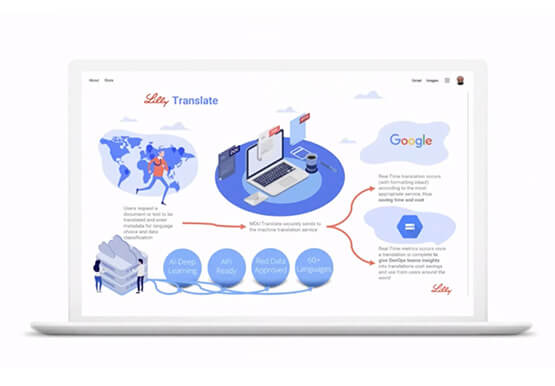

Eli Lilly’s Custom-built Translation Service Leverages Google’s Translation Engine
Eli Lilly leverages Google Cloud's machine translation to globalize content to serve their multilingual employees. Watch the video to learn how the healthcare company built an in-house solution powered by Google Cloud APIs to address the challenge of translating multilingual content at scale. Also explore Google's innovations and investments into

Best Practices for ML Engineering: 43 Rules from the World’s Best
To make great products: do machine learning like the great engineer you are, not like the great machine learning expert you aren’t. Most of the problems you will face are, in fact, engineering problems. Even with all the resources of a great machine learning expert, most of the gains come
