





Expert Takeaways on API Strategies from The State of API Economy 2021 Report

5738
Of your peers have already read this article.
8:00 Minutes
The most insightful time you'll spend today!
Did you know API traffic for Apigee customers increased 46% year-over-year, to 2.21 trillion calls, between 2019 and 2020? If you have more questions on APIs trends and their role in disrupting enterprises digitally, you can catch up on key take aways from the Google Cloud’s State of API Economy 2021 report and insights from Google’s experts on API-best practices.
Announcing reCAPTCHA Enterprise’s Mobile SDK to Help Protect iOS, Android apps

4206
Of your peers have already read this article.
2:30 Minutes
The most insightful time you'll spend today!
reCAPTCHA Enterprise is Google’s online fraud detection service that leverages more than a decade of experience defending the internet. reCAPTCHA Enterprise can be used to prevent fraud and attacks perpetrated by scripts, bot software, and humans. When installed inside a mobile app at the point of action, such as login, purchase, or account creation, reCAPTCHA Enterprise can block fake users and bots while allowing legitimate users to proceed.
To provide more complete coverage for native mobile iOS and Android applications, we’re announcing the general availability of the reCAPTCHA Enterprise Mobile SDK. Designed with digital-first and mobile-first organizations in mind, the new Mobile SDK fully integrates reCAPTCHA Enterprise’s frictionless experience on end-users’ mobile devices.
Why should I use the Mobile SDK?
Unlike most web applications, iOS and Android apps run on physical devices that can provide a wealth of device telemetry to help identify fraud and bot activity. By combining both device and network signals, the new mobile SDK can better protect native mobile applications from bot attacks while unlocking the full potential of reCAPTCHA Enterprise. It provides:
- Frictionless customer experience — no picking fire hydrants from a grid
- Easy integration to your native mobile app with support for popular frameworks like Cocoa Pods and Swift Package Manager
- A regularly-updated device threat model to help stay ahead of attack evolution
Protecting against fraud across all your channels
Customers will be able to leverage the new mobile SDK to implement native iOS and Android protection against the OWASP Top 10 automated attacks common on the internet, which include fraudulent account creation, financial hijacking, and credential stuffing. This is particularly important for mobile workforces and end users who use a mobile app to access products and services. Since mobile traffic surpasses web traffic in many industries, it’s even more important to implement a comprehensive mobile app protection strategy to protect against the most prevalent attacks.
Integrating the new Mobile SDK
If you’re interested in learning more about how to integrate the new Mobile SDK, check out the documentation for iOS and Android. Mobile and Web integrations leverage the same easy to understand pricing for Assessments, found here.
AI Features in Apigee X Helps Build and Manage APIs at Scale

5262
Of your peers have already read this article.
2:00 Minutes
The most insightful time you'll spend today!
APIs are the backbone of digital transformation. Via APIs, you can securely share data and functionality with developers both inside and outside of your organizational boundaries, letting you build applications faster, seamlessly connect and interact with partners, and drive new business revenue.
Because APIs encompass business-critical information, any downtime or performance degradation can lead to significant loss in revenue, customers, and brand value. Therefore, there’s mounting pressure on operations teams to ensure that APIs are always available and performing as expected. If the APIs go down, so too do the services that fuel customer experiences and on which the organization relies for collaboration and business processes.
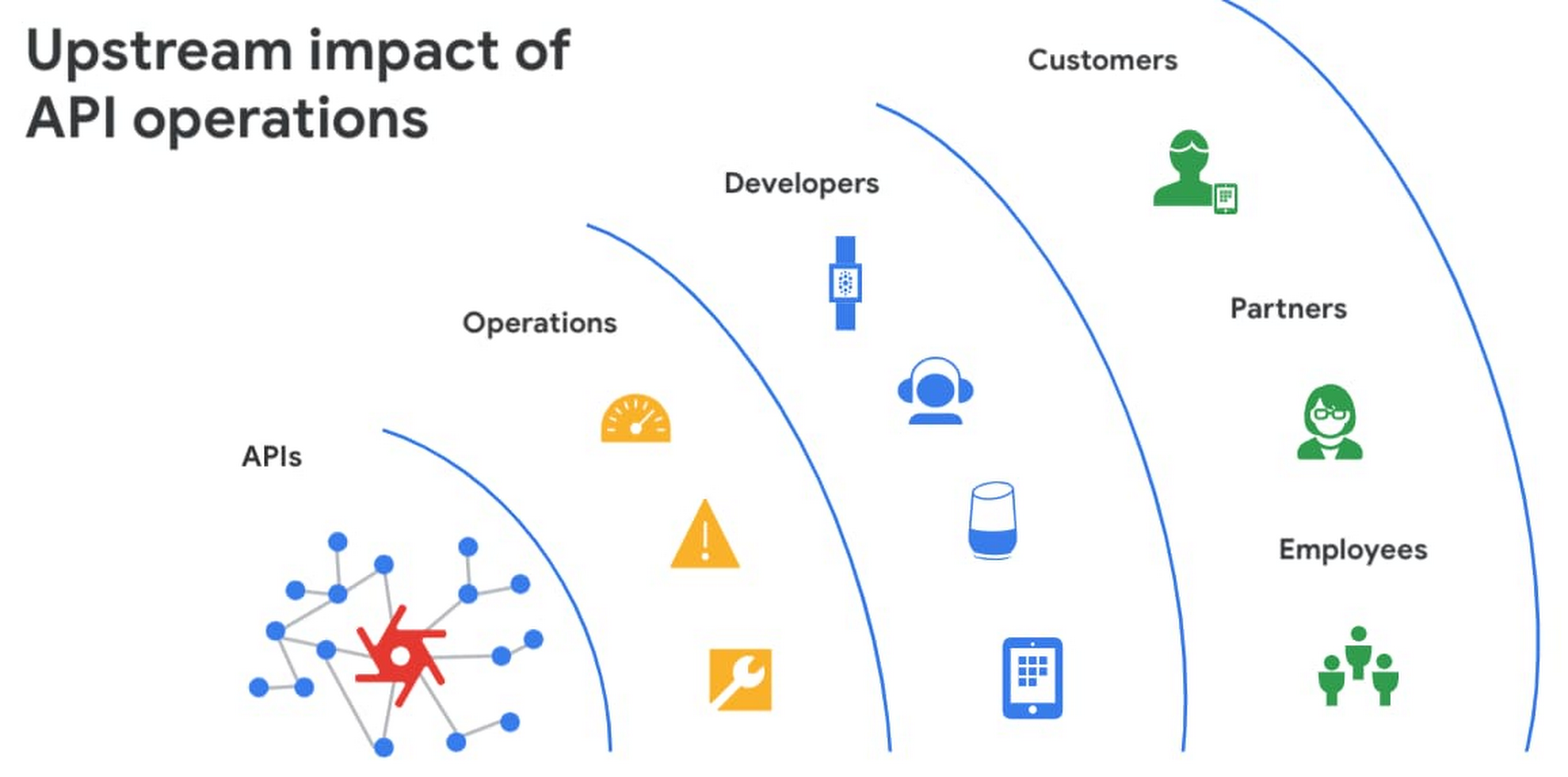
However, as you build and scale your API programs, it becomes practically impossible for API operators to manually monitor and manage all your APIs. To help, we brought the power of industry-leading AI and ML technologies to API operations via Apigee X, a major release of our API management platform. Apigee X seamlessly weaves together Google Cloud’s expertise in AI, security and networking to help you efficiently build and manage APIs at scale.
Put your API data into action
Apigee applies machine learning to your API metadata and provides you the required tools that simplify various aspects of API operations. A great example of AI for APIs is anomaly detection:
- AI-powered rules trigger alerts based on a set of predefined conditions that are determined by applying Google’s industry-leading machine learning models to your historical API data.
- Auto-thresholds adjust the monitoring criteria of your APIs and set them to pattern-based values.
- Reduce overhead results because operators don’t have to manually monitor anomalies or adjust the monitoring thresholds on APIs.
“By applying AI and ML models to our historical API data, these advanced features are able to alert us about scenarios we haven’t thought of. Such automation capabilities significantly reduce our upfront efforts. And from a security perspective, the actionable insights help us ensure that our proxies are exposed only over secure HTTPs ports and adhere to compliance requirements. We’re also able to closely monitor user activity and quickly pull out reports during audits.” – Adam Brancato, Sr. Manager, Global Technology and Security at Citrix

As our customers scale their API programs, they find it extremely useful to harness AI-powered capabilities. In our recent State of the API Economy 2021 report, we found a 230% increase in enterprises’ use of anomaly detection, bot protection, and security analytics features.

To learn more about Apigee X, and see AI and machine learning in action, check out this video, and to try Apigee X for free, click here.
5 Ways You Need to Know to Reduce Costs with Containers

3175
Of your peers have already read this article.
2:30 Minutes
The most insightful time you'll spend today!
“Cloud Wisdom Weekly: for tech companies and startups” is a new blog series we’re running this fall to answer common questions our tech and startup customers ask us about how to build apps faster, smarter, and cheaper. In this installment, Google Cloud Product Manager Rachel Tsao explores how to save on compute costs with modern container platforms.
Many tech companies and startups are built to operate under a certain degree of pressure and to efficiently manage costs and resources. These pressures have only increased with inflation, geopolitical shifts, and supply chain concerns, however, creating urgency for companies to find ways to preserve capital while increasing flexibility. The right approach to containers can be crucial to navigating these challenges.
In the last few years, development teams have shifted from virtual machines (VMs) to containers, drawn to the latter because they are faster, more lightweight, and easier to manage and automate. Containers also consume fewer resources than VMs, by leveraging shared operating systems. Perhaps most importantly, containers enable portability, letting developers put an application and all its dependencies into a single package that can run almost anywhere.
Containers are central to an organization’s agility, and in our conversations with customers about why they choose Google Cloud, we hear frequently that services like Google Kubernetes Engine (GKE) and Cloud Run help tech companies and startups to not only go to market quickly, but also save money. In this article, we’ll explore five ways to help your business quickly and easily reduce compute costs with containers.
5 ways to control compute costs with containers
Whether your company is an established player that is modernizing its business or a startup building its first product, managed containerized products can help you reduce costs, optimize development, and innovate. The following tips will help you to evaluate core features you should expect of container services and include specific advice for GKE and Cloud Run.
- Identify opportunities to reduce cluster administration
Most companies want to dedicate resources to innovation, not infrastructure curation. If your team has existing Kubernetes knowledge or runs workloads that need to leverage machine types or graphics processing units (GPUs), you may be able to simplify provisioning with GKE Autopilot. GKE Autopilot provisions and manages the cluster’s underlying infrastructure, all while you pay for only the workload, not 24/7 access to the underlying node-pool compute VMs. In this way, it can reduce cluster administration while saving you money and giving you hardened security best practices by default.
- Consider serverless to maximize developer productivity
Serverless platforms continue the theme of empowering your technical talent to focus on the most impactful work. Such platforms can promote productivity by abstracting away aspects of infrastructure creation, letting developers work on projects that drive the business while the platform provider oversees hardware and scalability, aspects of security, and more.
For a broad range of workloads that don’t need machine types or GPUs, going serverless with Cloud Run is a great option for building applications, APIs, internal services, and even real-time data pipelines. Analyst research supports that Cloud Run customers achieve faster deployments with less time spent monitoring services, resulting in reinvested productivity that lets these customers do more with fewer resources.
Designed with high scalability in mind, and an emphasis on the portability of containers, Cloud Run also supports a wide range of stateless workloads, including jobs that run to completion. Moreover, it lets you maximize the skills of your existing team, as it does not require cluster management, a Kubernetes skillset or prior infrastructure experience. Additionally, Cloud Run leverages the Knative spec and a container image as a deployment artifact, enabling an easy migration to GKE if your workload needs change.
With Cloud Run, gone are the days of infrastructure overprovisioning! The platform scales down to zero automatically, meaning your services always have the capacity to meet demand, but do not incur costs if there is no traffic.
- Save with committed use discounts
Committed use discounts provide discounted pricing in exchange for committing to a minimal level of usage in a region for a specified term. If you are able to reliably predict your resource needs, for instance, you can get a 17% discount for Cloud Run (for either one year or three years), and either a 20% discount (for one year) or a 45% discount (for three years) on GKE Autopilot.
- Leverage cost management features
Minimum and maximum instances are useful for ensuring your services are ready to receive requests but do not cause cost overages. For Google Cloud customers, best practices for cost management include building your container with Cloud Build, which offers pay-for-use pricing and can be more cost efficient than steady-state build farms.
Relatedly, if you choose to leverage serverless containers with Cloud Run, you can set minimum instances to avoid the lag (i.e., the cold start) when a new container instance is starting up from zero. Minimum instances are billed at one-tenth of the general Cloud Run cost. Likewise, if you are testing and want to avoid costs spiraling, you can set a maximum number of instances to ensure your containers do not scale beyond a certain threshold. These settings can be turned off anytime, resulting in no costs when your service is not processing traffic. To have better oversight of costs, you can also view built-in billing reports and set budget alerts on Cloud Billing.
- Match workload needs to pricing models
GKE Autopilot is great for running highly reliable workloads thanks to its Pod-level SLA. But if you have workloads that do not need a high level of reliability (e.g., fault tolerant batch workloads, dev/test clusters), you can leverage spot pricing to receive a discount of 60% to 91% compared to regularly-priced pods. Spot Pods run on spare Google Cloud compute capacity as long as resources are available. GKE will evict your Spot Pod with a grace period of 25 seconds during times of high resource demand, but you can automatically redeploy as soon as there is available capability. This can result in significant savings for workloads that are a fit.
Innovation requires balance
Put into practice, these tips can help you and your business to get the most out of containers while controlling management and resource costs. That said, it is worth noting that while managing cloud costs is important, the relationship between “cloud” and “cost” is often complex. If you are adopting cloud computing with only the primary goal of saving money, you may soon run into other challenges. Cloud services can save your business money in many ways, but they can also help you get the most value for your money. This balance between cost efficiency and absolute cost is important to keep in mind so that even in challenging economic landscapes, your tech company or startup can continue growing and innovating.
Beyond cost savings, many tech and startup companies are seeking improved business agility, which is the ability to deploy new products and features frequently and with high quality. With deployment best practices built into GKE Autopilot and Cloud Run, you can transform the way your team operates while maximizing productivity with every new deployment.
You can learn if your existing workloads are appropriate for containers with this fit assessment and these guides for migrating to containers. For new workloads, you can leverage these guides for GKE Autopilot and Cloud Run. And for more tips on cost optimization, check out our Architecture Framework for compute, containers, and serverless.
If you want to learn more about how Google Cloud can help your startup, visit our page here to get more information about our program and apply for our Google for Startups Cloud Program, and sign up for our communications to get a look at our community activities, digital events, special offers, and more.
Apigee Helps Bank BRI Rewrite its Digital Future and Achieve Financial Inclusion

6089
Of your peers have already read this article.
3:00 Minutes
The most insightful time you'll spend today!
About Bank BRI
Bank Rakyat Indonesia is one of the largest banks in Indonesia and is committed to increasing financial inclusions among un-banked Indonesians. Bank BRI specializes in using modern digital banking to facilitate microfinance lending across its network of over 10,000 branches and thousands of branchless agents.
Google Cloud Results
- Contributes $50M in revenue through the Apigee monetization feature
- Wins recognition for best digital bank in Indonesia from The Asian Banker in 2019
- Achieves ISO 27001 information security for open APIs, earning distinction as the only bank in ASEAN to receive certification to date
- Reduces partner onboarding from 6 months to under 1 hour with Apigee developer portal
Bank Rakyat Indonesia is making waves in Asia with its award-winning digital strategy. As a government-owned bank, Bank BRI is dedicated to changing the lives of its customers through accelerating financial inclusion across Indonesia. With an aggressive target of 84 percent of Indonesians participating in the banking system by 2022, Bank BRI is leapfrogging fintech competition thanks to its innovative digital strategy that has APIs at its core. By the end of 2019, Bank BRI expects to have reached a 70 percent financial inclusion rate among the country’s population, in part due to the adoption of the Cloud Apigee API Management Platform as the bank’s digital nucleus.
Transforming a legacy into a digital future
In the banking business, trust is essential, not only between the bank and its customers, but also between the bank and its partners. Recognizing that gaining and maintaining this trust would be key to customer and partner adoption of the new Bank BRI products and services, the bank decided to pursue ISO 27001 certification in 2018, becoming the first bank in ASEAN (the Association of Southeast Asian Nations) to become certified as information security compliant. Now the international community of partners and customers who use the bank’s APIs have yet another reason to place their trust Bank BRI.
“Apigee has become the central nervous system for all communications between the digital core banking, the microservices, the frontend, and the apps. Apigee has become our sun. Everything rotates around Apigee.”—Kaspar Situmorang, Executive Vice President, Bank Rakyat Indonesia
Kaspar Situmorang, Executive Vice President of Bank BRI, had the original vision for how the bank could transform itself into a fintech with digital technology and APIs. His team got started by implementing a web-native frontend over a new technology stack with Apigee as a second layer. This was a big change from the legacy technologies that existed when Situmorang joined the bank in 2017. Previously all of the bank’s products had their own public APIs, which were very difficult to manage, secure, and monetize.
Since deploying Apigee, it’s become much easier to manage the entire API lifecycle. Situmorang’s digital bank team of 15 uses the Apigee monetization and developer portal features while managing and securing APIs and conducting big data integrations. Apigee has become Bank BRI’s center of communications, handling all transactions between the bank and third parties.
Whereas previously it could take up to six months to onboard a new partner using host-to-host and VPN technology, now it takes less than an hour for partners to self-onboard using the Bank BRI Apigee developer portal. On the portal, partners can register, browse APIs, test in the sandbox, and go into production — all in less than an hour.
“Apigee has become the central nervous system for all communications between the digital core banking, the microservices, the frontend, and the apps. Apigee has become our sun. Everything rotates around Apigee,” says Situmorang.
Increasing financial inclusions
With more than 10,000 offices across Indonesia, Bank BRI has the largest network of any bank in ASEAN. The bank is also the biggest microfinance lender in the region. Though already present in even the most far-flung corners of Indonesia, Bank BRI is still working on increasing financial inclusion among un-banked Indonesians. With 56 million people that haven’t accessed banking services, Indonesia is in the bottom four countries for financial literacy in the world, along with Bangladesh, India, and China. It’s estimated that there is up to $8.3 billion in currency being held outside the banking system.
In order to reach this mostly rural, subset of the population, the bank launched Agent BRILink, a nationwide network of branchless agents. These agents can open new accounts, take deposits, pay out withdrawals, and process and disburse loans in under two minutes with the Pinang microfinance mobile app. To date, over 30,000 customers have received loans through Pinang. Handling its own risk-scoring and automatic payroll deductions for payments has translated into less risky and more profitable loans for Bank BRI.
“Customers download the app and scan their ID, capturing their credit score in just a few seconds. The digital offer letter says how much they’re approved for. They can then accept it, go to the approval screen, and do facial recognition. The money is disbursed immediately. GCP has transformed us into a fintech.”—Kaspar Situmorang, Executive Vice President, Bank Rakyat Indonesia
BRILink agents are bank customers who have been scored highly for reliability by the bank’s big data analyses and who maintain a minimum balance of around $800. Combining this data with the Google Maps API, Bank BRI is able to score all 75.5 million of its customers and identify which of them should be recruited as agents for underbanked areas. Since 2018, the bank has been able to appoint more than 200,000 branchless agents using the Agent BRILink app, eliminating the need for logistically challenging face-to-face meetings. This has resulted in an increase in loan volume from branchless business from $15 billion in 2017 to $26 billion in 2018.
To enable branchless agents to sign up new customers and provide banking services, all they need is a mobile phone and internet service. With many parts of rural Indonesia not covered by commercial 3G, Bank BRI has overcome this hurdle by operating its own satellite. With the connectivity the satellite guarantees, branchless agents can help customers obtain microfinancing and open new shops and businesses in all parts of the country. The satellite also provides internet service across the APAC region wherever the bank operates, from Sri Lanka to New Zealand. While it might seem unusual for a bank to operate a satellite, it’s reflective of Bank BRI’s commitment to reaching its financial inclusion targets and meeting its customers wherever they are.
“Pinang was created to win against fintechs trying to compete against us on speed, cost, and security,” says Situmorang. “The truth is that Indonesian regulators closed about 650 fintechs, mainly in the peer-to-peer lending space, because they were unsafe, too expensive, and very slow.”
Using APIs to create and monetize new products
Another way that Bank BRI is leveraging Google Cloud Platform solutions is through an innovative use of the Cloud Vision API, which enables the bank to integrate with the Indonesian government ID database. Identities of new customers — whether they’re coming in via a branch, a BRI Link Agent, or a mobile app — are automatically verified in seconds through facial recognition. With instant credit scoring and identity fraud concerns essentially eliminated, the bank can make more confident lending decisions.
“Monetization is very important to us. It enables us to define our pricing based on API calls and bill automatically based on usage. We’ve already recognized $50 million through the Apigee monetization feature.”—Kaspar Situmorang, Executive Vice President, Bank Rakyat Indonesia
“Customers download the app and scan their ID, capturing their credit score in just a few seconds,” explains Situmorang “The digital offer letter says how much they’re approved for. They can then accept it, go to the approval screen, and do facial recognition. The money is disbursed immediately. GCP has transformed us into a fintech.”
Bank BRI sees a bright digital future, in part thanks to the API product marketplace it’s creating to serve fintechs. With its digital technologies and massive customer base, the bank is sitting on a treasure trove of big data. Bank BRI already packages this data through more than 50 monetized open APIs for more than 70 ecosystem partners wanting to do credit scoring, business assessments, and risk management. Fintechs, insurance companies, and financial institutions don’t have the talent or the financial resources to do quality credit scoring and fraud detection on their own, so they are turning to Bank BRI.
“Monetization is very important to us. It enables us to define our pricing based on API calls and bill automatically based on usage. We’ve already recognized $50 million through the Apigee monetization feature,” says Situmorang.
Bank BRI is meeting and surpassing the goals it has set for itself for digitalization, increasing financial inclusion, and creating new revenue streams with APIs.
MerPay Platform Scales its Reach to Millions of Users using Cloud Spanner

5282
Of your peers have already read this article.
2:00 Minutes
The most insightful time you'll spend today!
Editor’s note: To launch a new mobile payment platform, Mercari needed a database solution strong on scalability, availability, and performance. Here’s how Cloud Spanner delivered those results.
E-commerce companies need to connect customers to their services securely, reliably, with zero downtime. When Mercari, Inc. launched a new mobile payment platform, we chose Cloud Spanner as part of our data portfolio, which provided us with easy scalability to handle millions of new users, a fully managed service that minimized overhead costs, and deep integration with other Google Cloud services.
Mercari, Inc., Japan’s largest C2C marketplace, launched its app in 2013, which allows 18.2million monthly users to easily and securely buy new and used items. Mercari expanded into the United States and in 2014 and launched Merpay, a mobile payment service that can be used through Mercari in Japan in 2017. With more than 85 million users, Merpay is now accepted at 1.8 million merchants and e-commerce sites in Japan, supporting payments via the DOCOMO ID contactless system and QR code.
Prioritizing availability and scalability
When we started building Merpay, we were looking for a new database. In the past, Mercari had used MySQL with bare metal hardware. Because of the amount of data, we required additional expertise to manage and maintain the hardware, software and MySQL implementation. Having built much of the microservices architecture for our Mercari app using Google Kubernetes Engine (GKE), it was natural to look at Google Cloud’s managed services when deciding upon our new database infrastructure for Merpay.
For the database, we were focusing especially on requirements around availability, scalability, and performance. To do a single payment transaction, there were multiple steps each with writes, requiring high-write-throughput and low-latency from the database. Needing a solution that would support reliable payment processing 24/7/365, we chose Spanner, which offers up to 99.999% availability with zero downtime for planned maintenance and schema changes.
We worked closely with Google Cloud’s Premium Support, Technical Account Management (TAM), and Strategic Cloud Engineer and Cloud Consultant teams to implement Spanner, including separating the payment processing— originally one of the functions in Mercari—as a microservice.
A nod to easier nodes and better scale
After launch, the number of Merpay users reached 2 million in only a few months. We had 45 Spanner nodes at the time of launch of Merpay and about 50 nodes four months later. Because we’d optimized the application side during those four months, we didn’t have to add many nodes to keep up with the growing traffic.
Whenever we needed to scale up the serving and storage resources in our instances, Spanner made it easy to increase nodes as needed in the Cloud Console. To optimize costs, it’s easy to add nodes during a marketing campaign and remove them afterward. Even if the traffic count is different from expected, we can change the number of nodes immediately. That’s one incredible convenience of Cloud Spanner.
Building powerful pipelines
Our data pipelines are used for KPI analytics, fraud detection, credit scoring, and customer support use cases. Because Cloud Spanner integrates so easily with other Google Cloud data services, the data in Spanner is easily accessible for analytics. From the Spanner database for each microservice, we create both batch and streaming data pipelines using Pub/Sub and Dataflow, as well as Apache Flink, and load the data into BigQuery and Google Cloud Storage. We’re able to quickly aggregate the data required for data platforms such as BigQuery and Cloud Storage. The original data is stored in Spanner and managed by microservices, but analysis through BigQuery is centrally managed by the Data Platform team. This team determines the confidentiality level of data and centrally manages BigQuery permissions using Terraform. By centrally managing data access permissions on the data platform rather than on individual microservices, we’re able to set appropriate security for individual users.
Our full data portfolio also includes Looker, which we use for product analysis, accounting analysis, test performance visualization, operation monitoring, development efficiency analysis, and HR analysis. We also use Dataproc, Cloud Composer, Data Catalog, and Data Studio. The Dataflow template created for the pipeline is also published as OSS.
With Spanner and other Google Cloud services, our Merpay platform is flexible, secure, scalable and highly available. As Spanner eliminates overhead, we can devote engineering resources to developing new tools and solutions for our customers. We’re looking ahead at providing cryptocurrency service, for example, and are now working on a project to migrate Mercari’s monolithic system that is still on premises entirely over to Google Cloud.
Read more about Mercari and Merpay. Or check out our recent blog: three reasons to consider Cloud Spanner for your next project.
More Relevant Stories for Your Company

APIs to Power the Future of Retail: Study Confirms
Today, retail customers have more digital-first, convenient ways of shopping than ever before. And APIs are one of the critical pieces of technology that have made this possible by giving retailers the ability to transform their systems and processes in an efficient and quick way. APIs have allowed retailers to

Anthos Makes Hybrid and Multi-Cloud Deployments Easy
Most enterprises have applications in disparate locations—in their own data centers, in multiple public clouds, and at the edge. These apps run on different proprietary technology stacks, which reduces developer velocity, wastes computing resources, and hinders scalability. How can you consistently secure and operate existing apps, while developing and deploying

A Guide to Accelerating Developer Productivity and Agility
Business needs for digital solutions have intensified the urgency for rapid application development and deployment. At the same time, widespread adoption of cloud computing has revolutionized the IT environment used by both enterprises and consumers. In addition, the acceleration of digital transformation has increased the availability of developer tools and

Google Announces Cloud Functions’ Native Integration with Secret Manager
Google Cloud Functions provides a simple and intuitive developer experience to execute code from Google Cloud, Firebase, Google Assistant, or any web, mobile, or backend application. Oftentimes that code needs secrets—like API keys, passwords, or certificates—to authenticate to or invoke upstream APIs and services. While Google Secret Manager is a fully-managed, secure, and
