





Cardinal Health Leads the Way in Healthcare App Modernization

2867
Of your peers have already read this article.
3:30 Minutes
The most insightful time you'll spend today!
Apps play a critical role in an ever-expanding range of healthcare services, as patients and providers increasingly expect streamlined, engaging digital experiences. This means that IT must become faster, more agile, and free from the constraints of everyday infrastructure management.
At Cardinal Health, we are continuously enhancing our technology to empower innovators across our organization as they strive to build connections across the continuum of care. Through our efforts, we have adopted a continuous integration and continuous delivery (CI/CD) pipeline that powers breakthroughs and drives innovation. Our CI/CID pipelines use a combination of Cloud Build for foundational elements, as well as our internal DevSecOps platform, NitroDX, to deploy our application workloads built on Google Cloud.
This CI/CD pipeline powered the development of our Pharmacy Marketing Advantage (PMA) Commerce, which was built from the ground up on Google Kubernetes Engine (GKE), to provide independent pharmacists with a digital platform that expands online shopping capabilities for patients by offering more than 11,000 over-the-counter products. We also replatformed our Order Express tool, which is a simple, reliable web ordering application for independent pharmacists, from on-prem to Google Compute Engine and GKE, which allowed us to shift from quarterly releases to weekly on-demand releases.
Our application teams work in close alignment with our product teams and handle everything from basic software updates to more advanced cloud-native app development. We place tremendous value on our ability to empower our application teams, and we invest in tools and technologies to make them as efficient and successful as possible.
As part of our efforts to optimize applications and deliver engaging digital experiences for our customers and their patients, we saw the value of rethinking our approach to storage and overall IT administration. Working with the NetApp Cloud Volume Service (CVS), a fully managed storage service, and Google Cloud, we fundamentally changed our IT capabilities.
Accelerating app development
As a cloud-first company, Cardinal Health has embraced a managed approach to IT provisioning in many areas. When we offload responsibilities like infrastructure maintenance, patching, and updates, we enable our developers to focus on continuous innovations that directly impact the quality of patient and provider experiences.
We’ve made measurable progress in automating our CI/CD pipelines to simplify provisioning Virtual Machines (VMs), managing firewall rules, launching Google Cloud projects, and more. Our NitroDx platform also significantly reduced development time from weeks to minutes, improving the software delivery process and accelerating digital transformation.
Google Cloud is our primary cloud services vendor and has removed much of the heavy lifting related to server provisioning, firmware patches, and similar tasks. We rely on a mix of Google Cloud services, including Compute Engine, GKE, BigQuery, and Vertex AI to deliver patient-centric solutions. We also work closely with partners like NetApp to improve our storage management at a much greater scale and more efficiently than we could do on our own.
By using a combination of NetApp and Google Cloud solutions, we’ve been able to decouple storage from our underlying infrastructure to make better use of our resources and accelerate app development. When running on-prem, shared storage proved to be a time and resource drain.
If an application needed shared storage in our legacy on-prem environment, we had to communicate the requirements to an engineer and create a change control. And even then, if all staff and funding were in place to support the change, it would take weeks to complete. This held up projects and delayed our time to market.
We quickly overcame this challenge with NetApp CVS. Through this tool, we can delegate permissions directly within a teams’ Google Cloud project, allowing them to administer their own shared volumes. This translates to on-demand shared storage without operational complexities or the need for dedicated teams to manage it.
We were an early adopter of NetApp CVS, and we’re happy to have made that decision. In addition to cost savings and faster time-to-market, we can now provide our staff with more professional development opportunities. The team members who made up the dedicated storage team now work across the cloud organization, focused on innovation and enablement rather than maintenance.
A stronger foundation for developers to stand on
We constantly work to fill gaps at any point in the developer experience. Containerizing our apps and deploying to GKE has been a major part of this process, driving efficiencies through consolidation and improving our processes to keep our operating systems patched, updated and maintained.
In the past, it was also difficult for us to get reproducible or CI/CD pipelines into our application spaces. Now, we make things easier for application teams as we can provide a CI/CD pipeline for the containers themselves, automating more of the underlying technology to keep developers moving forward.
As we shift more traditional virtual machine (VM) workloads into GKE and leverage NetApp CVS for shared storage, our developers can more easily plug into file-based services. This further accelerates app development and deployments and fuels a more easily managed, efficient CI/CD framework focused on value, not system maintenance.
Smart, data-driven decisions
We’ve been impressed by how quickly we can aggregate data, analyze it, and uncover insights with BigQuery, Vertex AI, and Dataproc — at a speed that would not have been possible without Google Cloud. Vertex AI pipelines helped us automate and standardize our ML operations so data scientists can focus on innovating code vs. managing deployments. This allowed us to make improvements in areas such as more accurately predicting market demand and providing more relevant product recommendations to our customers.
To date, Google Cloud has collaborated with us on many projects, giving us access to early-release products, listening to our needs, and applying our feedback to their product development. Likewise, NetApp continues to work closely with us to expand what is possible with NetApp CVS, particularly with the types of data we can store and the ability to manage it easily.
It’s an excellent partnership, and our work with Google Cloud and NetApp helps us redefine the possibilities of app modernization in healthcare. We can continue to push boundaries of speed, agility, and success of CI/CD pipelines. It’s exciting to see what we are accomplishing today and what we’ll do in the future to constantly improve our customer’s digital experience.
Learn how integrated solutions with NetApp on Google Cloud can help you unlock the full potential of your data.
New Visual Interface for Google Cloud’s Speech-to-Text API Makes API Easy to Use !

4672
Of your peers have already read this article.
2:00 Minutes
The most insightful time you'll spend today!
At Google Cloud, we’re committed to making artificial intelligence (AI) accessible to everyone and easier to harness for new use cases. That’s why we’re excited to announce the general availability of our intuitive, new visual user interface for Google Cloud’s Speech-to-Text (STT) API, right in Google Cloud Console, which makes the API much simpler and easier for developers to use.
The STT API lets developers convert speech into text by leveraging Google’s years of research in automatic speech recognition and transcription technology. As advancements in AI continue to bring speech to new interfaces and devices, the STT API helps developers add speech functionality to their applications in order to better meet consumer demands.
The STT API covers a wide variety of use cases, from dictation and short commands, to captioning and subtitles. Getting the most of STT, however, can be a complicated process. To achieve the highest accuracy on any AI use case requires careful testing and tuning.
Previously, developers building on the STT API had to do this work manually by carefully experimenting with our API. Just to get started, developers needed familiarity with GCP integration concepts and had to either build their own tools or manage various scripts and API calls to fully understand the API documentation. These actions required cumbersome and time-consuming effort and made measuring, customizing, and improving models even more difficult.
Today’s announcement significantly simplifies the process, facilitating iteration and integration of models into developers’ applications by letting developers perform every API function from within the Google Cloud Console. These tools will make it easier for developers to integrate the STT API with their products or services. This update also gives developers the ability to manage and quickly iterate on their STT model customizations with Model Adaptation.
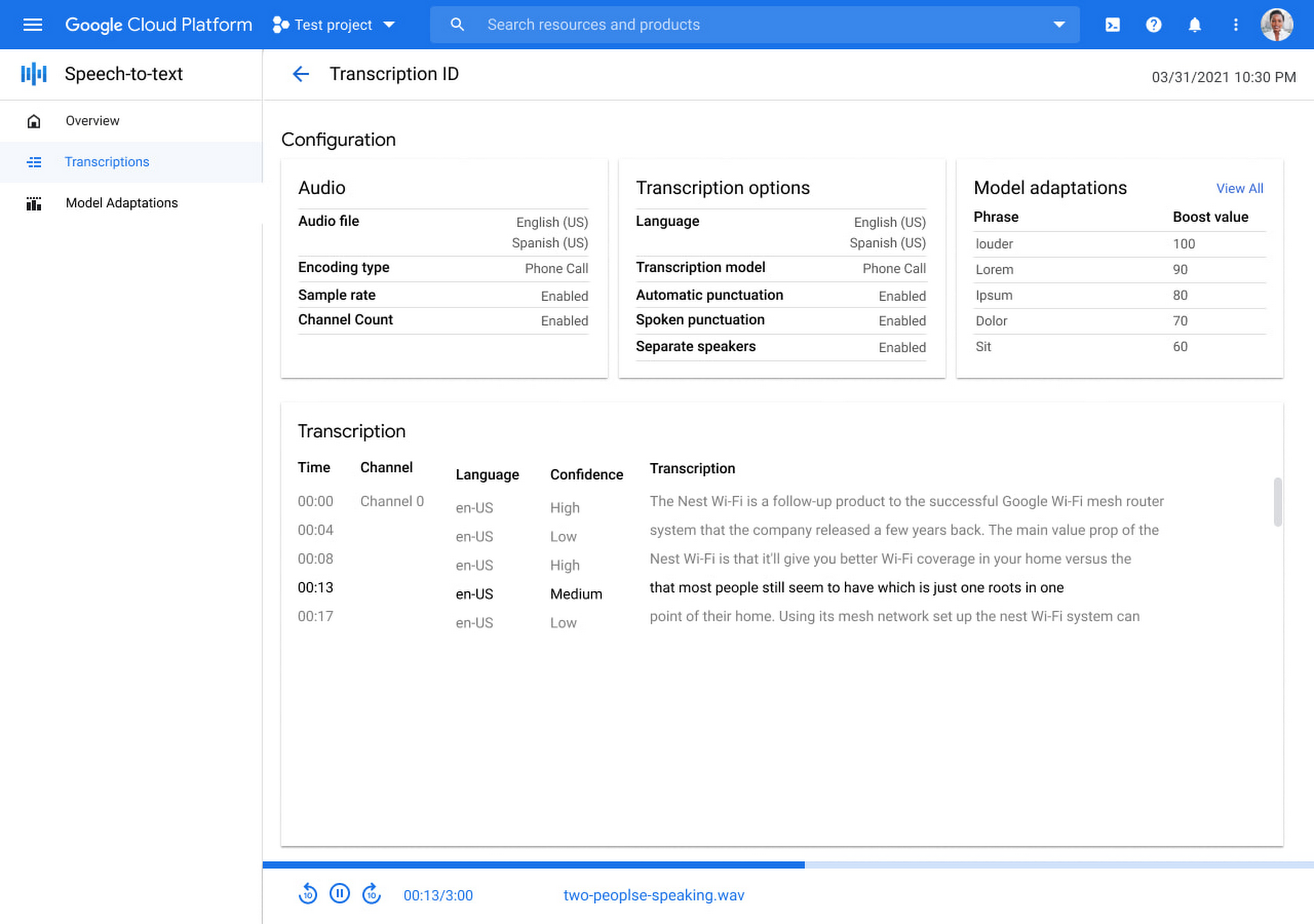
Model Adaptation allows developers to customize STT specifically for their domains or use cases. Developers can maintain lists of words and weights that will be applied to either every request or just single requests, depending on their needs. Model adaptations are reusable and composable, so once developers have seen good results in the STT Cloud Console, they can deploy to their entire solution.
The Speech-to-Text Cloud Console and Model Adaptation API is available now in all Google Cloud regions and languages and is accessible to all GCP users with no additional cost to that of the underlying API usage. The STT API supports over 70 languages in 120 different local variants. If you’re a developer looking for an easy to use, easy to integrate, and high-quality STT experience, sign up for our free trial and try our new interface on your own datasets today!

4189
Of your peers have already downloaded this article
10:47 Minutes
The most insightful time you'll spend today!
The rapid growth in mobile, big data, and cloud technologies has profoundly changed market dynamics in every industry, driving the convergence of the digital and physical worlds, and changing customer behaviour. It’s an evolution that IT organizations struggle to keep up with. To succeed, a new approach is required; one that enables agile and web-scale innovation so that IT can meet evolving business requirements while enabling existing systems to continue running reliably, efficiently, and securely.
There’s a way to enable the stability of enterprises’ operational systems of record while also fostering the speed and agility necessary to create powerful new applications and services that serve customers, partners, and employees in a digital economy that’s moving at blinding speed.
Whether you think about this as bimodal IT, two-speed IT, or traditional IT/agile IT, this new approach recognizes the value of both the back-end operational systems and the fast-changing world of user engagement. Read this eBook to explore how two-speed IT can usher a new approach that recognizes the value of both the back-end operational systems and the fast-changing world of user engagement.

3355
Of your peers have already downloaded this article
5:30 Minutes
The most insightful time you'll spend today!
3330
Of your peers have already watched this video.
21:10 Minutes
The most insightful time you'll spend today!
Guide: How to Accelerate App Development with Google Cloud
Cloud-native, Kubernetes, Serverless have been the hottest and most widely discussed topics given the velocity and agility benefits. Learn more about how you can leverage these modern app development practices to ship software faster, while reducing costs and improving security and compliance. Learn how Google Cloud lets you modernize existing applications at your own pace using these technologies. Regardless of where you are in your app modernization journey, join this session to learn how to improve the developer experience and deliver software faster.
Release of Go 1.18 is A New Milestone for Development of Secure Apps

3206
Of your peers have already read this article.
1:30 Minutes
The most insightful time you'll spend today!
On March 15th, the Go team announced Go 1.18 GA, the latest release of the Go programming language. The culmination of over a decade of design delivers the features our developers demanded: generics, fuzzing, and module workspaces. With this release, Go becomes the first major language to integrate fuzz testing into its core toolchain without using third-party support, further establishing Go as a preferred language for developing secure applications.
Go was created at Google in 2007, designed to help developers build fast, reliable, and secure software. Unlike traditional languages, Go was built for the modern multi-core computing world. Go has emerged as a modern language for developing cloud applications, services, and infrastructure. Today Go powers several of Google’s largest products, and is used by many customers to scale their businesses. Organizations big and small love Go and the community of Go developers, known as “gophers” has grown into a global network with over 2 million users worldwide.
Using the power of Go in the Cloud
When looking at the public repos, over 75% of CNCF projects including Kubernetes are written in Go and 10% of developers are writing in Go worldwide (as of May 2021). Google delivers high performance infrastructure to run key, cloud native, Open Source projects. Our modern cloud infrastructure is based on Kubernetes at its core and our strong support for Istio and Knative have formed the base of some of our leading services like Google Kubernetes Engine (GKE), our managed application platform with Anthos, Cloud Functions, and Cloud Run. Google uses Go extensively for a wide range of applications from our indexing platform that powers Google Search, to the server side optimizations that power Chrome’s 1B+ users, to the infrastructure on which Google cloud is built.
Release Highlights
With this new release of Go 1.18, Generics are the biggest change to Go since the language was created. Go developers told us that they feel that Go lacks critical features, with generics being the main missing piece. With Go 1.18, new and existing Go developers can take advantage of the productivity, performance, and maintenance benefits that generics can bring. We’ve already begun to see the new kinds of libraries and projects gophers are building with generics in its short beta period, and expect this creativity to grow as time goes on.
This Go release also brings native support for fuzzing. Fuzzing is a type of vulnerability testing that throws arbitrary data at a piece of software to expose unknown errors and is emerging as a common testing scheme in enterprise development. Go is now the first major language to provide fuzzing support with no third-party integrations necessary, allowing developers to start building secure software with minimal additional cost. Go’s innovative approach to fuzzing can provide not only security for the current code but also ongoing protection as code and dependencies evolve. With attacks on software becoming more common and complex, vulnerability detection can be a critical part of the enterprise development lifecycle, and Go’s fuzzing capabilities catch vulnerabilities earlier in the lifecycle.
Build securely using Go
At Google we are helping to make Open Source software secure. Open source software is a connective tissue for much of the online world. At Google, we’ve been working to raise awareness of the state of open source security and are committed to helping secure the software supply chain for organizations. Go has been designed to create secure applications, helping to minimize risk as much as possible. Go applications compile down to a single binary without local dependencies. It’s not uncommon to see an application built using only the standard library, or only a couple well-vetted Go dependencies. Go’s dependency management uses tamper-evident transparency log, with built in tooling that helps ensure your dependencies are what you can expect. Go has native encryption, which is used across much of the internet, including key components of Google. Go even supports distroless containers, where there are zero local dependencies to worry about. Google Cloud products like Cloud Build, for CI/CDand Artifact Registry, for container management, and have direct access to Go’s vulnerability database and can provide you instant warnings about security threats.
“At Google we are committed to helping to secure the online infrastructure and applications upon which the world depends. A critical aspect of this mission is being able to understand and verify the security of open source dependency chains. The 1.18 release of Go is an important step towards helping to ensure that developers are able to build secure applications, understand risk when vulnerabilities are discovered, and reduce the impact of cybersecurity attacks” said Eric Brewer, VP Infrastructure, Google Fellow
This launch is a significant milestone for Go that helps developers from around the world build more performant and secure applications that run on any infrastructure. For more information on this release and how to get started with Go, please visit.
More Relevant Stories for Your Company

Dataflow Guarantees 50+% Increase in Developer Productivity and Infrastructure Cost Savings: Read More
In our conversations with technology leaders about data-driven transformation using Google Data Cloud - industry’s leading unified data and AI solution - , one important topic is incorporating continuous intelligence to move from answering questions such as “What has happened? to questions like “What is happening?” and “What might happen?”.



Introduction to Cloud Shell Editor
Watch the video to understand how Google's Cloud Shell Editor and its powerful features-packed environment can streamline your development workflows.

5 Ways You Need to Know to Reduce Costs with Containers
“Cloud Wisdom Weekly: for tech companies and startups” is a new blog series we’re running this fall to answer common questions our tech and startup customers ask us about how to build apps faster, smarter, and cheaper. In this installment, Google Cloud Product Manager Rachel Tsao explores how to save

Enhancing Romi’s Conversations: The Role of BigQuery and LLMs
MIXI, Inc. (MIXI) is a social networking organization that provides a diverse range of services for friends and family to enjoy together, such as the social-media platform mixi, a mobile game called Monster Strike, and a family photo and video sharing service known as FamilyAlbum. One of our current projects
