





Melbourne Joins Google’s 26 Cloud Regions

5000
Of your peers have already read this article.
1:30 Minutes
The most insightful time you'll spend today!
We opened our Sydney cloud region in 2017 and, since then, we have continued to invest and expand across Australia and New Zealand to support the digital future of organizations of all sizes. In Australia, Google Cloud supports almost A$3.2 billion in annual gross benefits to businesses and consumers. This includes A$686 million to businesses using Google Workspace and Google Cloud Platform, another A$698 million to Google Cloud partners, and A$1.8 billion to consumers.1
For customers in Australia, New Zealand and across Asia Pacific, we’re excited to announce that our new Google Cloud region in Melbourne is now open. Designed to help businesses build highly available applications for their customers, the Melbourne region is our second Google Cloud region in Australia and 11th to open in Asia Pacific.
We’re celebrating the occasion with a digital event where federal minister for the Digital Economy, Jane Hume, and customers Australia Post, Trade Me, Bendigo and Adelaide Bank, The Australian Football League and Macquarie Bank will share their perspectives. Come join us!
A global network of regions
Melbourne joins the existing 26 Google Cloud regions connected via our high-performance network, helping customers better serve their users and customers throughout the globe. With this our second region in Australia, customers benefit from improved business continuity planning with distributed, secure infrastructure needed to meet IT and business requirements for disaster recovery, all the while maintaining data sovereignty in-country.

With this new region, Google Cloud customers operating in Australia and New Zealand will benefit from low latency and high performance of their cloud-based workloads and data. Designed for high availability, the region opens with three zones to protect against service disruptions, and offers a portfolio of key products, including Compute Engine, Google Kubernetes Engine, Cloud Bigtable, Cloud Spanner, and BigQuery.
We also continue to invest in expanding connectivity across the Australia and New Zealand region by working with partners to establish subsea cables and new Dedicated Cloud Interconnect locations and points of presence in major cities including Sydney, Melbourne, Perth, Canberra, Brisbane and Auckland.
Collectively, this will deliver geographically distributed and secure infrastructure to customers across Australia and New Zealand – which is especially important for those in regulated industries such as Financial Services and the Public Sector.
What customers and partners are saying
Navigating this past year has been a challenge for companies as they grapple with changing customers demands and greater economic uncertainty. Technology has played a critical role, and we’ve been fortunate to partner with and serve people, companies, and government institutions around the world to help them adapt. The Google Cloud region in Melbourne will help our customers adapt to new requirements, new opportunities and new ways of working.
“We moved to Google Cloud to improve the stability and resilience of our infrastructure and become more cloud-native as part of a digital transformation program that keeps the customer at the heart of our business. We welcome Google Cloud’s investment in ANZ and the opportunities the Google Cloud Melbourne region presents to improve Trade Me’s agility and performance. – Paolo Ragone, Chief Technology Officer, Trade Me
“We initially turned to Google Cloud to help us process parcels faster and gain deeper insights into our business and its processes. The relationship has continued to deliver benefits to our customers and our organization and we welcome Google Cloud’s opening of the Melbourne region as presenting even more opportunities for businesses to innovate and generate efficiencies.” – Munro Farmer, Chief Information Officer, Australia Post.
“We are well progressed with our multi-year strategy to grow and transform our organization to be Australia’s bank of choice. Google Cloud’s advanced data capabilities and renowned culture of innovation are strongly aligned to this strategy and will allow us to become even more innovative and agile in responding to our customers’ ever-changing needs. We were quick to run our workloads out of the Melbourne cloud region and we believe Google Cloud’s expanded investment in local infrastructure will further assist us on our business transformation journey.” – Andrew Cresp, Chief Information Officer, Bendigo and Adelaide Bank.
“We have a clear vision when it comes to innovating to deliver world-class service to our customers, and our partnership with Google Cloud is core to that strategy. The company’s continued investments in local infrastructure and technology present new opportunities for us as we advance our transformation journey in this digital-first era.” – Chris Smith, Vice President, Digital Service, Optus
Our global ecosystem of channel partners has expanded by more than 400% in the last two years, and we look forward to continuing our close relationships with partners in Australia and New Zealand as we help customers modernize, innovate, scale and grow.
“Australian companies are increasingly realising the benefits of their cloud investments and are now looking to transform their organisations at scale. We are excited about the potential and new value that the Google Melbourne Cloud region will bring to our clients as we continue to work together on delivering intelligent and innovative solutions to Australian organisations.” – Tara Brady, CEO of Accenture Australia and New Zealand
“Google Cloud has always been there for its customers for the long haul and the opening of the new Melbourne Cloud region is great news. This increased resilience and scale will empower companies of all sizes to be bold in accelerating their digital transformation plans.” – Tony Nicol, CEO of Servian
“We’re excited about the launch of the Melbourne Cloud region. It will cater to the needs of industries we work closely with including healthcare and financial services, and will further enhance how we jointly deliver on the compliance, privacy and security requirements of companies as they advance their digital transformation.” – Simon Poulton, CEO of Kasna
“The opening of the new Google Cloud region in Melbourne is fantastic news as it now enables DXC customers access to enhanced services for their mission critical application and data solutions across two regions within Australia. As our customers modernise their application estate, many are seeking dual region cloud services, and DXC is excited to partner with Google Cloud to deliver these services to customers in Australia and New Zealand.” – Tim Fraser, Google Practice Lead ANZ at DXC Technology
Helping customers build their transformation clouds
Google Cloud is here to support businesses, helping them get smarter with data, deploy faster, connect more easily with people and customers throughout the globe, and protect everything that matters to their businesses. The cloud region in Melbourne offers new technology and tools that can be a catalyst for this change. Click here to learn more about all our Google Cloud locations.
1. AlphaBeta, The Economic Impact of Google Cloud to Australia, July 2021

5496
Of your peers have already downloaded this article
1:30 Minutes
The most insightful time you'll spend today!
IDC recently examined the benefits of implementing BigQuery for SAP data. The findings reveal massive improvements to the SAP customers’ overall business results due to faster access to data insights, lower data warehouse operation cost, and increased productivity among the data warehouse and development teams. Download the report now!
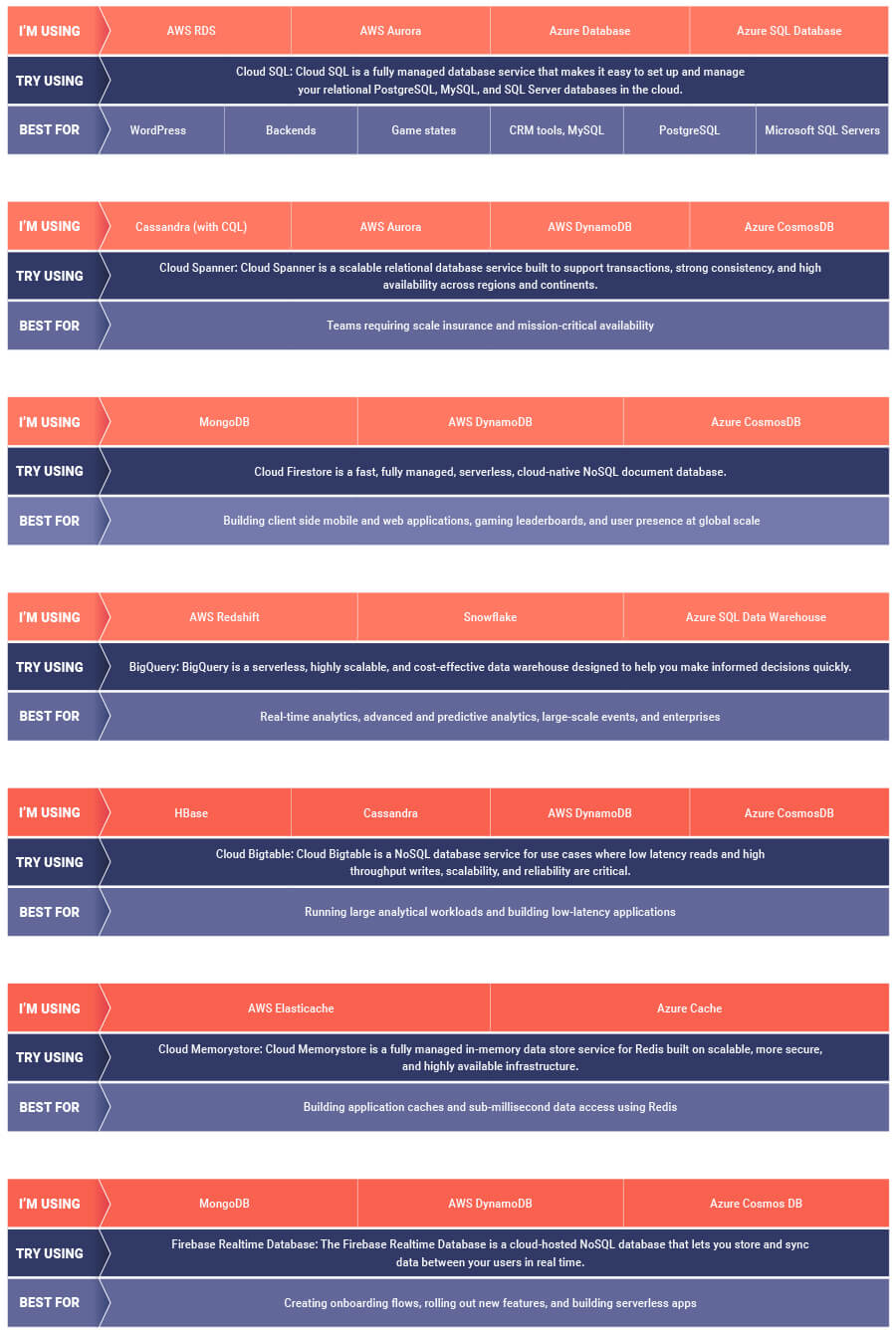
AWS to Google Cloud Translator: Which AWS Database Service Is Equal to Google Cloud Database?

6311
Of your peers have already read this article.
2:30 Minutes
The most insightful time you'll spend today!
There are multiple reasons a growing number of database administrators, enterprise architects, application developers and other technology practitioners are moving to Google Cloud’s various database services.
Some are being driven by missing features in offering from other providers such as AWS. In Gartner’s Magic Quadrant for Operational Database Management Systems, the research and advisory firm points out that, “AWS’s surveyed reference customers scored its overall product capabilities one standard deviation (STD) below the mean. Their responses identified missing features such as multiregion writes and autosharding.”
Others are moving to database services on Google Cloud Platform driven by a few benefits. According to Gartner, “Reference customers repeatedly commented on Google’s ease of use and implementation, reliability and integration (with other services and other systems). Reference customers scored Google a full STD above the mean for satisfaction with GCP’s pricing; it received the second-highest satisfaction score of any vendor in this Magic Quadrant.
If you are looking to leverage the power of Google Cloud database offerings—but were unsure of which database services comes closest to the service you are currently using, here’s a handy map to find your way.
IT Team Figures Out Easiest Way to Build Data Pipelines and Create ML Models

14082
Of your peers have already read this article.
5:15 Minutes
The most insightful time you'll spend today!
Building a strong brand in today’s hyper-competitive business environment takes vision. It also requires a flexible, easily managed approach to digital asset management (DAM), so marketing professionals and other stakeholders can easily share, store, track, and manipulate assets to build the brand.
Many of today’s leading companies, including JetBlue, Slack, TripAdvisor, Lyft, and HealthONE, rely on Brandfolder to deliver consistent, organized, and efficient brand experiences. Brandfolder provides an easy-to-use platform that can scale across an entire company with little end-user training, empowering customers to distribute digital assets wherever they are needed. Customers also gain much greater insight into how those assets are used, and how to use them more effectively in marketing campaigns and brand messaging.
“Google Cloud made it easy to build an ML platform to quickly iterate through different brand intelligence use cases and release data-driven product features into the Brandfolder platform.”
—Ajay Rajasekharan, Head of Data Science, Brandfolder
Brandfolder is constantly advancing its development efforts to introduce new data-driven features without complicating the user experience. Big data, artificial intelligence (AI), and machine learning (ML) are key to meeting customers’ unique business needs, and essential for Brandfolder to compete in the fast-moving DAM industry. To enhance these capabilities, Brandfolder sought a public cloud provider that could help it scale its data pipeline cost effectively while providing access to advanced AI technologies.
After graduating from the Techstars startup accelerator program in 2013, Brandfolder tried two other cloud providers before standardizing on Google Cloud Platform (GCP).
“We saw a difference with Google Cloud from the very beginning because the interactions felt like a strategic relationship,” says Jim Hanifen, Head of Product at Brandfolder. “Google gave us startup credits and a lot of face-to-face support, which we hadn’t experienced with other cloud providers. We decided to move our entire infrastructure to Google Cloud Platform.”
Building an ML platform for brand intelligence
After performing an initial lift-and-shift migration of virtual machines (VMs) onto Compute Engine, Brandfolder built an ML platform using GCP managed services to seamlessly deliver its data products. The platform leverages Cloud SQL, Cloud Storage as the data lake, Cloud Dataproc for cloud-native Apache Spark computing clusters, Cloud Composer as the batch job scheduler, Cloud Pub/Sub as the backbone data pipeline, Container Registry to store Docker images, and Google Kubernetes Engine (GKE) as the application orchestrator. Cloud Dataflow brings data into the data lake and into BigQuery for analysis.
“Google Cloud made it easy to build an ML platform to quickly iterate through different brand intelligence use cases and release data-driven product features into the Brandfolder platform,” says Ajay Rajasekharan, Head of Data Science at Brandfolder, who describes the architecture in a detailed blog. “We simply ingest raw application and event data on one end and output an ML service on the other.”
“Moving to Google Cloud Platform allows us to complete more sophisticated data analysis and ML models much faster, and at a much lower cost. We can create brand-specific ML models 12x faster and get them into production quickly to address our customers’ unique business needs.”
—Brett Nekolny, Head of Engineering, Brandfolder
For many general use cases, Brandfolder does not need to build custom ML models, and instead relies on pre-trained API models from GCP. For example, it uses Vision API and Video Intelligence API to auto-tag creative assets on import to enable fast, intuitive searches across images and videos. When more product- and brand-specific modeling is required to address unique customer use cases, Brandfolder builds and trains custom ML models using its GCP pipeline or Cloud AutoML, a suite of products built on Google transfer learning and neural architecture search technology. For example, if a Brandfolder customer makes different types of grills, Brandfolder can use AutoML Vision to train a model to recognize the different grills.
“Moving to Google Cloud Platform allows us to complete more sophisticated data analysis and ML models much faster, and at a much lower cost,” explains Brett Nekolny, Head of Engineering at Brandfolder. “We can create brand-specific ML models 12x faster and get them into production quickly to address our customers’ unique business needs.”
Industry-leading security and performance
Google Cloud’s security model helps Brandfolder give existing and prospective customers peace of mind that their data will be protected. Cloud Identity & Access Management (Cloud IAM) provides enterprise-grade access control, while Cloud Identity-Aware Proxy (Cloud IAP) enables remote users to work more securely without the hassles of a VPN client. GCP also isolates cloud resources into projects, making it easy to assign permissions and keep data and VMs organized and segregated.
“With Google Cloud, everything begins and ends with security, which makes things very easy for us,” says Jim. “If we’re under a security review, we can submit a Google security white paper. If a potential customer has security concerns, we tell them we are hosted on GCP, and those concerns go away.”
To give customers even better application performance for accessing their brand assets, Brandfolder uses Cloud Memorystore, an in-memory data store service for Redis, to cache data and provide sub-millisecond data access for production applications.
“It was much easier for us to use Cloud Memorystore versus running Redis on our compute instances,” says Brett. “The high availability, replication across zones, and automatic failover with no data loss are big for us.”
Global private network interconnects between Google Cloud and the Fastly content delivery network (CDN) dramatically reduce latency, allowing Brandfolder’s customers to deliver and update even very large creative assets quickly around the world.
“What’s beautiful about the relationship between Google and Fastly is that if one of our customers uploads a new version of an asset, we can propagate that out to Fastly, and the new version will automatically show up in all the places where it’s referenced,” says Brett.
“The ability to quickly solve problems with AI has a substantial impact on our revenue, and that’s more apparent every quarter. Few of our competitors are doing product- or brand-specific modeling because it takes a lot of time and resources. We overcame those hurdles with Google Cloud.”
—Jim Hanifen, Head of Product, Brandfolder
Improving employee and customer productivity
Brandfolder also uses Google solutions for real-time collaboration and productivity, using G Suite to connect employees with intuitive, cloud-based apps. Teams use Gmail, Calendar, Docs, Drive, Sheets, Slides, and Hangouts Meet every day to move the business forward. Many of Brandfolder’s customers are also G Suite users, and Brandfolder offers a plug-in that allows them to view their creative assets inside of Docs and pull images in as needed. Customers can also log into Brandfolder with their G Suite credentials, making the solution even easier to use.
“We’ve been using G Suite since the beginning, and it’s helped us collaborate efficiently to build a successful, growing company,” says Jim. “Our teams expect to have that kind of close collaboration, and everyone here enjoys the G Suite experience.”
Driving 99 percent annual business growth
With automated tagging and other innovative AI-based features, Brandfolder is helping customers locate and distribute assets faster. As a result, Brandfolder is building customer loyalty and increasing sales, growing its business by 99 percent year-over-year. Since moving to GCP, Brandfolder has been able to scale its analytics and data pipeline 50x without a corresponding increase in costs and has not had to expand its development team.
“The ability to quickly solve problems with AI has a substantial impact on our revenue, and that’s more apparent every quarter,” says Jim. “Few of our competitors are doing product- or brand-specific modeling because it takes a lot of time and resources. We overcame those hurdles with Google Cloud.”
6365
Of your peers have already watched this video.
2:15 Minutes
The most insightful time you'll spend today!
What’s Google Cloud Firestore Database and What are its Benefits for Business and Developers?
Cloud Firestore is a NoSQL document database that simplifies storing, syncing, and querying data for your mobile and web apps at global scale.
Cloud Firestore is a fast, fully managed, serverless, cloud-native NoSQL document database that simplifies storing, syncing, and querying data for your mobile, web, and IoT apps at global scale.
Its client libraries provide live synchronization and offline support, while its security features and integrations with Firebase and Google Cloud Platform (GCP) accelerate building truly serverless apps.
Here’s other stuff it’s good at:
Sync data across devices, on or offline
With Cloud Firestore, your applications can be updated in near real time when data on the back end changes. This is not only great for building collaborative multi-user mobile applications, but also means you can keep your data in sync with individual users who might want to use your app from multiple devices.
With Firebase Realtime Database, we felt we had built the best force-plate testing software on the market. Thanks to Cloud Firestore, in only two weeks, we built a system that’s significantly better and includes features we never thought possible to ship on Day 1.
Chris Wales, CTO, Hawkin Dynamics
Cloud Firestore has full offline support, so you can access and make changes to your data, and those changes will be synced to the cloud when the client comes back online. Built-in offline support leverages local cache to serve and store data, so your app remains responsive regardless of network latency or internet connectivity.
Simple and effortless
Cloud Firestore’s robust client libraries make it easy for you to update and receive new data while worrying less about establishing network connections or unforeseen race conditions. It can scale effortlessly as your app grows. Cloud Firestore allows you to run sophisticated queries against your data. This gives you more flexibility in the way you structure your data and can often mean that you have to do less filtering on the client, which keeps your network calls and data usage more efficient.
Enterprise-grade, scalable NoSQL
Cloud Firestore is a fast and fully managed NoSQL cloud database. It is built to scale and takes advantage of GCP’s powerful infrastructure, with automatic horizontal scaling in and out, in response to your application’s load. Security access controls for data are built in and enable you to handle data validation via a configuration language.
5533
Of your peers have already watched this video.
1:30 Minutes
The most insightful time you'll spend today!
Pega Systems Migrates SAP Servers to Google Cloud in Just 9 Weeks!
Pega Systems’ financial data on SAP environs were on a hosting platform that lacked agility. By moving nearly 30 SAP servers to Google Cloud in just 9 weeks, Pega Systems was able to unlock data and integrate BigQuery into SAP HANA to deliver personalization for clients and embark on an exciting journey with Google Cloud! Watch now.
More Relevant Stories for Your Company

Giving Customers More Choice: Google Cloud’s New Product and Pricing Options
Over the past several years, Google Cloud has made significant investments in our infrastructure product portfolio. We launched new Tau T2D VMs, which deliver 42% better price-performance vs. other leading cloud providers. We upgraded Cloud Storage to offer more flexibility to support customers’ enterprise and analytics workloads, with dual-region buckets

Israeli Government Chooses Google Cloud to Power its Cloud-based ‘Project Nimbus’
Google Cloud today announced that it has been selected by the Israeli government to provide public cloud services to help address the country’s challenges within the public sector, including in healthcare, transportation, and education. Following a thorough public tender process, Google Cloud was selected for this four-phase project known as
Recapping Google Cloud VMware Engine’s Latest Milestones
We’ve made several updates to Google Cloud VMware Engine in recent weeks—today’s post provides a recap of our latest milestones. Google Cloud VMware Engine delivers an enterprise-grade VMware stack running natively in Google Cloud. This cloud service is one of the fastest paths to the cloud for VMware workloads without making changes
Finding Your Favorite Google Cloud Product is Now Easy!
Welcome to a new way of exploring Google Cloud products. Finding your favorite products and discovering new ones requires a user interface that’s easy-to-use, clear, informative, and delightful. Google Cloud users have primarily used our side menu to navigate, but with almost one hundred products and growing, it’s safe to
