





ActivStat: Enhancing Live Sports Broadcast with Real-time Stats and Metrics

5095
Of your peers have already read this article.
2:00 Minutes
The most insightful time you'll spend today!
Millions of people annually view esports, as top players and teams compete in thrilling, fast-paced tests of reflexes, strategy, and teamwork. Fans are a diverse group, sharing a passion for action. A new, revolutionary project we’re working on with Call of Duty League just made that action a lot better.
ActivStat brings fans, players, and commentators the power of competitive statistics in real-time—stats that matter not only to the game at hand, but also for a full roster of competitors globally. Using ActivStat, live broadcasts will soon be enhanced with more depth and color-of-play while they’re happening, building excitement and adding to the overall experience.
Technically, ActivStat is an entirely new capability for esports. It’s a constantly updating catalog of statistics that is sourced, analyzed, updated, and delivered in an easy-to-consume way across global-scale computing systems, with a latency of milliseconds or seconds, rather than minutes or hours. By comparison, many of these stats today are available to fans after a day or more of processing.
Call of Duty League plans to begin rolling out ActivStat during the 2021 season. The initial rollout will include critical information like player and team standings and winning ratios across multiple aspects of virtual combat—including ultimately what these numbers mean for rankings. ActivStats are delivered both in raw statistics and via visualizations and graphics, providing commentators with fast access to the types of insights fans crave.
For engineers at both companies, building the service has been an epic success all its own. Due to a sponsorship with Call of Duty signed last February, our dedicated game engineering team quickly innovated a new solution incorporating high-speed networking, data pipelines from multiple cloud sources, and data warehousing to create a user-friendly dashboard. Real data was flowing into commentator dashboards by April.
Esports are more complex to cover in many ways than regular sports. Instead of a well-defined physical playing field (often a simple rectangular space), multiplayer games involve complex and sprawling virtual environments that can be the size of a large campus or airport with multiple levels and hidden locations.
Gameplay between competitors happens across many of these locations simultaneously. In addition, competitors also each choose their own configurations of equipment, known as “loadouts,” which can dramatically affect gameplay and strategy. All of this additional complexity in online gaming involves data that needs to be captured, analyzed, and communicated to the fans in insightful ways.
Two Google Cloud technology capabilities play central roles in the operations of ActivStat. BigQuery—a planet-scale data warehouse that can store and query petabytes of information in real time—is the foundation of the ActivStat platform for gathering and summarizing millisecond-level statistics. Looker, an intuitive analytic dashboard, surfaces those insights to commentators in an easy-to-use, real-time dashboard that enables the commentators to speak to compelling insights and statistics in sync with the gameplay as it is happening in the live broadcast.
While the initial release of ActivStat for this season of Call of Duty League provides compelling and powerful capabilities, it’s only the beginning of this Call of Duty League-Google Cloud co-innovation partnership. Our future vision is mapping gameplay hotspots on the field, and predicting where to place cameras with machine learning as the match evolves–enabling broadcast producers to build excitement for fans by always being in the middle of the best action. Call of Duty League and Google will also look to drive statistics and metrics directly into the broadcast feed.
The implications of the real-time statistical capabilities of ActivStat go beyond gaming and esports. Historically, gaming has been at the leading edge of what computer processing, computer graphics, wide-area networking, data analysis, and insight can do. The real-time data ingestion and output used in ActivStat could one day be useful powering live broadcasts in other types of sporting events, as well as blending live video feeds and data to support use cases in media & entertainment, healthcare, finance, manufacturing, and other verticals. We’re excited about the potential for this bold new solution and partnership between Call of Duty League and Google in esports and beyond.
To learn more about Call of Duty League-Google Cloud partnership, visit our press release.
Giving Customers More Choice: Google Cloud’s New Product and Pricing Options

3289
Of your peers have already read this article.
3:00 Minutes
The most insightful time you'll spend today!
Over the past several years, Google Cloud has made significant investments in our infrastructure product portfolio. We launched new Tau T2D VMs, which deliver 42% better price-performance vs. other leading cloud providers. We upgraded Cloud Storage to offer more flexibility to support customers’ enterprise and analytics workloads, with dual-region buckets and upcoming Turbo Replication. And we’ve delivered numerous improvements to our global network, including expansion to 29 cloud regions.
However, from conversations with customers, we’ve also learned we can do more to align our capabilities and pricing with their varied workloads. So, today, we are announcing we will adjust our infrastructure product and pricing structure to give customers more choice in how they pay for what they use alongside new, flexible SKUs with new product options and capabilities. These changes are designed to help ensure better product fit for our customers’ use cases across a wider array of workloads. They are also designed to better align with how other leading cloud providers charge for similar products, so customers can more easily compare services between leading cloud providers.
Some of these changes will provide new, lower-cost options and features for Google Cloud products. Other changes will raise prices on certain products. Ultimately, our goal is to provide more flexible pricing models and options for how customers are using our cloud services. Here’s an overview of what customers can expect:
Which services are changing? What new services are being introduced?
We are changing prices for some storage, compute, and networking products. The changes provide customers with new ways to optimize their spending based on workload type and size, or data portability needs, as well as reducing costs on some services. Specific changes include:
- Cloud Storage pricing changes for data mobility, including replication of data written to a dual- or multi-region storage bucket, and inter-region data access
- Introduction of a new lower-cost archive snapshot option for Persistent Disk (PD), so that compliance/archiving use cases are charged less than compute-intensive DevOps workloads
- New outbound data processing pricing for Cloud Load Balancing, in line with other leading cloud providers
- New pricing for Network Topology, which will include Performance Dashboard within Network Intelligence Center at no additional charge
Will customers’ bills increase? Decrease?
The impact of the pricing changes depends on customers’ use cases and usage. While some customers may see an increase in their bills, we’re also introducing new options for some services to better align with usage, which could lower some customers’ bills. In fact, many customers will be able to adapt their portfolios and usage to decrease costs. We’re working directly with customers to help them understand which changes may impact them.
When will the new prices go into effect?
Today, we sent customers a six-month notice on the price changes, which go into effect on October 1, 2022. Customers under existing commit contracts with a floating or fixed discount will not face any changes until renewal. Our goal is to help our customers manage any impact of these changes and allow time for them to adjust or modify their implementations.
What should customers do next?
There are a number of things customers can do to prepare for the changes:
- Read through the Mandatory Service Announcement (MSA) sent on March 14.
- Consider what actions, if any, they may want to take based on current storage, networking, and compute needs. Many of these changes may have simple choices associated with them.
- Consider using the Storage Transfer Service to select the right Cloud Storage bucket locations. Storage Transfer Service will be available free-of-cost for transfers within Cloud Storage, starting April 2 until the end of the year.
For those customers under contract, Google Cloud account representatives are available to discuss these changes. Please visit our pricing page and the links below for more details on our updates to storage, networking, and PD pricing, including information on how to modify your implementations if needed. If you do not have an account manager and still have questions please review our public FAQ, which will be updated regularly, as well as the resource links below.
Note: This pricing analysis is valid as of February 2022.
Resources:

4002
Of your peers have already downloaded this article
3:30 Minutes
The most insightful time you'll spend today!
Everything COOs need to know to make an informed decision
about migrating and modernizing their businesses’ core
technology estate to the cloud.
AgroStar: Small farms in India getting big help from the cloud

13228
Of your peers have already read this article.
3:30 Minutes
The most insightful time you'll spend today!
AgroStar has launched a cloud-based mobile app that is helping to boost crop yields and encourage best practices for small farmers in India. Launched as an on-premises ecommerce platform selling farm tools in 2008, the firm turned to Google Cloud Platform (GCP) to expand its offering. It now uses cloud-based analytics and is deploying ML models to provide timely advice in five languages on everything from seed optimization, crop rotation, and soil nutrition to pest control.
A 2018 survey underscored the demand for agricultural planning for Indian farmers. While farming remains a dominant sector in India, employing half of its labor force, 70 percent of small farmers – those cultivating fewer than three acres – said their crops are damaged by unforeseen weather and pests. An even higher number – 74 percent – say they lack access to farming-related information.
Widening that gap is the relative lack of access to new, higher yield seeds and improved soil analyses for small farmers, who must otherwise rely on traditional methods. “It could take a few years for innovative information to trickle down from universities to small, grassroots farmers,” says Pritesh Gudge, AgroStar Software Engineer. “Today, just by clicking through our Android application, farmers learn about new, effective farming practices and receive advice customized to their crop and soil.”
Connecting a million farmers in the cloud
Operating in the Indian states of Gujarat, Maharashtra, Rajasthan, Orissa, Bihar, and Karnataka, AgroStar is closing the knowledge gap with a full-service, cloud-based SaaS solution – the only one of its kind in India. It combines agronomy, data science, and analytics to help farmers by providing a variety of resources.
AgroStar has reached over a million farmers through its Android app, the AgroStar Agri-Doctor. The mobile client is available as a web-based or full-featured native app. Both provide access to the firm’s knowledge base hosted on GCP, a Q&A forum that connects farmers to each other to help understand and better solve problems and to learn about innovative practices and products. Farmers can also click through to follow local and national market trends that help forecast crop prices.
In addition to the self-service knowledge base, AgroStar provides access to agronomy experts who use cloud-based analytics tools and historical data to provide season-and locale-specific advice to each farmer. “We are now tracking thousands of calls in 5 languages each day,” says Pritesh.
The AgroStar app also provides links to purchase and then track the delivery of farm tools and supplies such as cultivators and fertilizers. An in-house platform manages fulfillment centers and a doorstep delivery network simplifies the supply chain while giving farmers what they need, when they need it. By procuring directly from the manufacturers and primary distributors of farm supplies, Agrostar is achieving cost savings, which it passes on to farmers.
Build fast, pivot faster
From the start, the human and environmental variables of farming in India, not to mention the volume of AgroStar’s few hundred thousand monthly active users, made a highly scalable cloud-based solution inevitable. Farmers rely on the firm’s Agri-Doctor app to provide advice in multiple languages on topics that range widely throughout three growing seasons, each with distinct crop nutrition and rotation cycles and farm implementation requirements.
“For farmers, the focus keeps changing every month, and every season,” says Pritesh. “To serve our growing community, we needed a platform that could process images at high volume, fulfill tools and seed orders across thousands of miles, and respond to multilingual queries. We quickly moved away from spreadsheets and server-based solutions – we needed to build fast and pivot faster.”
Ending late-night deployments
The firm’s first cloud experience was with an AWS solution. At the time, AWS was the only cloud provider in India, but AgroStar wanted to find a solution that was easier to use and offered better integration with Android devices. “Deployment and processing costs were very high, and the developer tools and documentation were not as intuitive as we needed,” says Pritesh.
When GCP service arrived in India in October 2017, AgroStar embarked on a platform re-implementation that made possible dramatic changes in the way it developed and deployed its solution. Using Google Kubernetes Engine (GKE) for crop advice management and Compute Engine for its production application services, the firm built the backend for the Agri-Doctor discussion forum in only three weeks. The platform’s microservice architecture is implemented in Python and Golang and deployed on GCP.
AgroStar began to realize significant efficiencies in its build, deploy, and test cycles. “We previously needed to work overnight to deploy to production,” says Pritesh. “Now using Google for Kubernetes containers and a rolling update strategy, we can deploy during the day without any problems or interruptions to service.”
The move to GCP streamlined AgroStar’s stack. “We were running 12 independent instances on AWS,” says Pritesh. “With Google Kubernetes Engine, we are deployed on a single cluster at a cost savings of $1,300 per month and growing.”
Improving customer response times by 85 percent
With a managed deployment capability, AgroStar can devote more time and resources to executing on its platform and Agri-Doctor app development plan. A strategic goal was managing customer response times as the firm grew its base. GCP has helped the firm meet that goal, achieving an 85 percent improvement in customer response times even as traffic grew significantly.
“With our on-premises solution, we could handle around 100 customers daily, which took 30 to 50 minutes for each customer,” says Pritesh. “We now handle thousands of customers daily, taking only 4 to 5 minutes for each one.”
AgroStar used Firebase to implement its Agri-Doctor app. A real-time cloud database, Firebase provides an API that enables the Agri-Doctor advice forum to be synchronized across all its far-flung mobile clients, effectively sharing knowledge base updates with one million users in near real time.
Using cloud tools to manage and monitor
Cloud Pub/Sub, Kafka, and Cloud Dataflow manage data ingestion and queueing of event and transaction data to the analytics layer. BigQuery fetches and persists data to Cloud Storage. Cloud SQL and dashboards powered by Tableau deliver farmer crop and soil profiles within minutes.
Cloud IAM helps AgroStar control access to all its cloud resources. And Stackdriver, the integrated logging aggregation capability for GCP, helps monitor and speed debugging on every tier of the AgroStar solution.
Machine learning to enhance yields
AgroStar is developing a variety of ML components to improve responsiveness and extend its platform offerings.
To speed up the diagnosis of and treatment for crop blight, AgroStar is building a deep learning pipeline using TensorFlow. The pipeline relies on GoogLeNet models that use multi-layered convolutional visual pattern recognition. It will assess uploaded images to support a disease-detection capability on the mobile app. Based on the commercially successful AI algorithms that automated postal code processing, GoogLeNet offers improved performance and computational efficiencies by using a creative layering technique that distinguishes them from older, sequential recognition engines.
To improve its customer search experience, AgroStar is developing an ML pipeline that shrinks fetch times by suggesting tags mapped to stored data. Processed using TPUs, Cloud Natural Language and Video AI, the tags provide a metadata layer that supports queries in any of the ten natural languages that AgroStar farmers can use.
The AgroStar search pipeline consists of Long Short-Term Memory (LSTM) models of Recurrent Neural Networks. Recurrent networks exhibit “memory” through iterative processing and are distinguished from feedforward networks by a feedback loop connected to their past decisions, ingesting their own outputs moment after moment as input.
Implementing a recommendation engine
The firm is also adapting the Random Forests TensorFlow AI model to develop a crop and product recommendation engine. The model is trained by consuming numerical (rainfall, humidity, water availability per acre) and categorical (soil type, water sources) parameters to suggest appropriate products by season, region, and locale.
To simplify the product suggestion experience, AgroStar developers are testing Cloud Dialogflow, the Google Cloud conversational interface, to build a chatbot capability into its mobile app. The bot will track a farmer’s crop schedules and answer simple questions by linking to the recommendation engine.
AgroStar is also extending its analytics platform with AI-powered sales planning and forecasting. Using linear regression models implemented in TensorFlow and powered by Cloud ML Engine, the capability will enhance supply chain logistics as the company scales its operations across India.
To provide a credit on-demand offering for a range of seed-to-harvest cycle products, AgroStar is attempting to use Vision API to create an AI model that will convert uploaded photos of customer application records into standard data formats. The firm’s credit policy features a grace period in which farmers begin paying back loans after harvested crops go to market.
A versatile and friendly development ecosystem
AgroStar credits the convivial tools and documentation that GCP offers and its incremental, pay-as-you-go pricing model for both the firm’s success and its ability to manage growth.
“What Google Cloud offers is extremely good documentation and extremely simple-to-use tools and interfaces across all services,” says Pritesh. “It helped us initially deploy our platform and at every scale that we have required since then, and its cost effectiveness enabled us to staff up to meet new feature milestones.”
Italian Utility Company Deploys its SAP Workloads on Google Cloud to Meet Sustainability Goals

3258
Of your peers have already read this article.
2:00 Minutes
The most insightful time you'll spend today!
With more than 2.5 million customers, Italian utility company A2A is committed to delivering electricity, gas, clean water, and waste collection every day. More recently, the company made another significant commitment: To incorporate the principles of the “circular economy” into its way of doing business — part of the UN 2030 Agenda’s Sustainable-Development Goals — all while also aiming to double its client base by 2030. Growing rapidly but sustainably requires operating as efficiently as possible at every level of the organization, from operating smart meters to generating accurate demand projections. That’s why A2A chose to deploy its SAP S/4HANA ERP and the SAP BW/4HANA data warehouse on Google Cloud.
Roadblocks to innovation
Instead of a linear consumption model that starts with raw materials and ends with use and disposal, the circular economy is a continuous cycle that emphasizes repair, recycling, and the creation of materials rather than their disposal. To take an example from A2A’s own success story: The company keeps 99.7 percent of collected waste out of landfills.1 Of the UN’s sustainability goals, A2A is committing to the three most relevant to its industries:
- Ensuring availability and sustainable management of water and sanitation for all
- Ensuring sustainable consumption and production patterns
- Protecting, restoring, and promoting sustainable use of terrestrial ecosystems
Achieving A2A’s sustainability and customer-first strategies requires high scalability, rapid data ingestion, and rich, accurate analytics. None of this could be reliably supported with the company’s legacy on-premises SAP and Data Warehouse, especially given A2A’s projected growth and the increasing complexity of the data landscape, including IoT deployments and energy market liberalization.
Provisioning data infrastructure was also slow and complex. Simply adding a new metric could require increasing capacity by an order of magnitude. And analytical and transactional data lived in siloes, which created a fragmented and out-of-date view of each customer across sales and customer support teams. A2A’s fragmented data also made it difficult to take proactive action when changing priorities or processes required shifting focus from one data source to another.
With a data warehouse that refreshed only once every 24 hours, simple processes such as responding to a customer calling because their power has been cut off due to an unpaid bill became cumbersome.
Scalability was also a concern. With the on-premises solution, A2A needed to define the budget for its data warehouse over a two-year timeframe, but the rollout of new electricity meters — each sending data every 10 minutes — across Italy made those data requirements hard to predict.
The move to the cloud: From monolith to microservices
The move has been a giant step forward in A2A’s goal of meeting its data-driven, customer-centric strategy. In deploying its SAP systems to Google Cloud, A2A can take advantage of a highly flexible hybrid environment and powerful data management and analytics. It can replicate data from Salesforce, SAP, and other systems in BigQuery, which operates as a data lake with Google Cloud SQL, connected directly to Google Analytics and Google Ads for data-driven customer service, decision-making, and marketing.
“From BigQuery we can feed relevant information directly to the people who need it. Our customer operators work on Salesforce, so we use an OData protocol to embed real-time data in that platform. Elsewhere, we present the information through a dashboard, or with a BI component delivering one-page reports.” —Vito Martino, Head of CRM, Marketing and Sales B2C & B2B, A2A
By running SAP on Google Cloud, A2A can also count on an infrastructure platform that provides:
- Scalability. The robust data architecture on Google Cloud adapts to shifting and increasing demands without compromising on speed or availability, so A2A doesn’t have to worry about over- or under-provisioning as the rollout of smart meters proceeds.
- Speed. The new A2A data solution refreshes every five minutes instead of 24 hours, so the company can respond to its customers’ needs without delays. Customer operators working in Salesforce now receive real-time data from Google BigQuery so that, when a customer calls, operators can see accurate information in seconds. They can now offer value-added services and sustainable options tailored to the customer’s needs, from energy consumption to their preferred method of communication.
- Availability. With microservices orchestrated by Google Kubernetes Engine, the team can update the solution through continuous integration and delivery (CI/CD), eliminating the need for downtime when changes are required.
- Security and control. The A2A IT team uses Google Kubernetes Engine to orchestrate clusters of instances on Google Compute Engine, with Google Cloud Load Balancing and backups on Google Cloud Persistent Disk. Google Cloud Anthos ensures operational consistency across on-premises and cloud platforms.
Ready to grow the sustainable way
By moving to Google Cloud — the industry’s cleanest cloud, with zero net emissions — A2A is ready to grow quickly while locking down the efficiency it will need to meet its ambitious sustainability goals. “To bring sustainable utilities to market, we need to be both responsive to our customers and responsive to the internal needs of A2A,” explains Davide Rizzo, Head of IT Governance and Strategy at A2A. “Understanding what customers need in detail means we can improve their services and reduce their environmental impact at the same time.”
Learn more about the ways Google Cloud can transform your organization’s SAP solutions with scalability, speed, and advanced analytics capabilities.
1. Circular Economy: one of the four founding pillars of A2A’s 2030 sustainability policy | Drupal
Ease Your Migration and Modernization Journey with Microsoft and Windows on Google Cloud Demo Center
8281
Of your peers have already read this article.
2:00 Minutes
The most insightful time you'll spend today!
If you’re looking to migrate and modernize your Microsoft and Windows workloads, Google Cloud is your premiere destination. No matter what migration strategy you’ve selected or what value you’re looking to achieve, with Google Cloud you’re able to:
- simplify your migration and modernization journey
- reduce your on-prem footprint and increase agility
- optimize license usage to reduce costs
- modernize to reduce single-vendor dependencies
- rely on enterprise-class support backed by Microsoft
Whether you’re looking to migrate applications running on Windows virtual machines, adopt Windows containers in Google Kubernetes Engine (GKE), convert SQL databases to Cloud SQL, or something else, Google Cloud offers you the first-class experience you need.
But we don’t want you to take our word for it. Try it out yourself with our new online Microsoft and Windows on Google Cloud Demo Center without any commitment or friction.
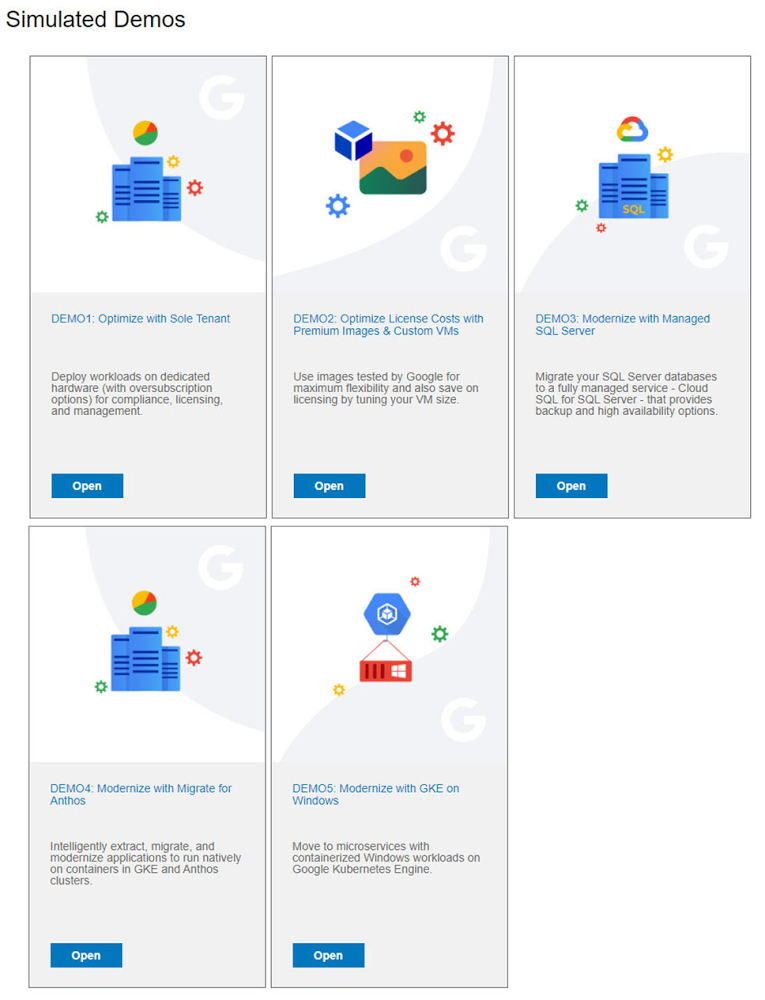
The demo center uses hands-on guided simulations to walk you through several scenarios for solving business critical challenges with Google Cloud’s Microsoft and Windows solutions. Because these are all simulated, you’ll see how it works without any deployment, configuration, or commitment. It’s a seamless way for you to see exactly how Google Cloud can help you.
Run dedicated hardware and optimize with sole tenant
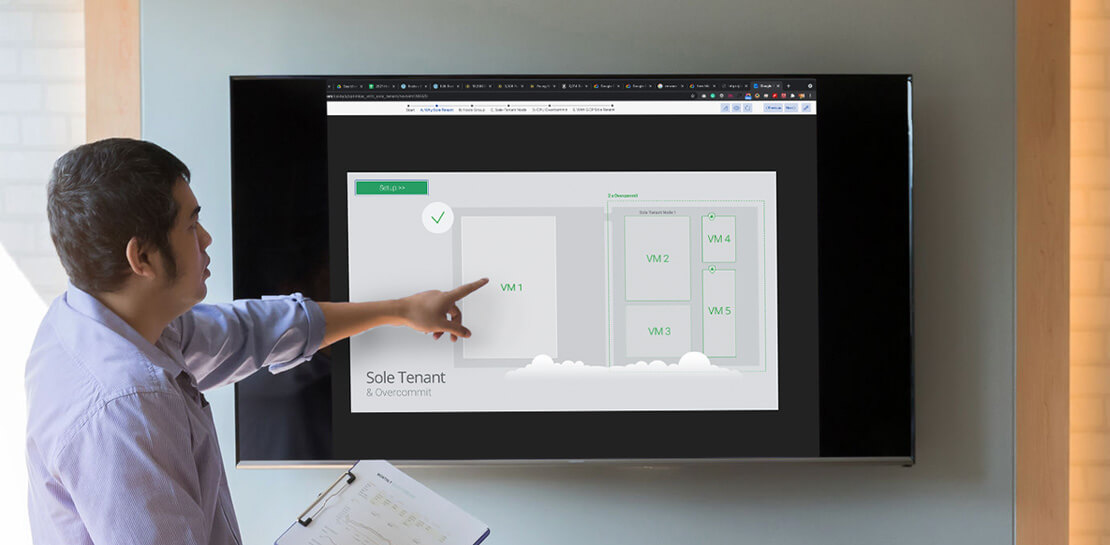
Sometimes you might want to run your workloads on dedicated hardware (with oversubscription options) for compliance, licensing, and management. Google Cloud provides sole-tenant nodes that allow you to easily deploy your virtual machines onto dedicated machines to avoid “noisy neighbor” issues, address regulatory or licensing constraints, and optimize inter-VM communications.
Plus, the CPU Overcommit option allows oversubscribing sole-tenant node resources by up to 2x, therefore helping save on per-physical core licensing for many licensed workloads like SQL Server.
Learn how to set up a sole tenant group and node.
Optimize license costs with premium images & custom VMs
One of the easiest ways to optimize your cloud experience with virtual machines (VM) is to pick the right VM image. Google Cloud provides premium license-included VM images that are thoroughly tested and optimized, including SQL Server options with pay-as-you-go licensing. These are great for workloads that don’t need to run all the time or when you do not have spare licenses for bring your own license (BYOL).
Explore some Windows & SQL images and learn how CPU/Memory options can help optimize deployment and save on licensing.
Modernize your databases with Managed SQL Server
Sometimes you need to manage your SQL Server instance to achieve certain business or operational goals. But more often, managing SQL Server deployments can be undifferentiated: backups, high-availability, updates, and patching are just some of the many things you have to take care of when going the do-it-yourself route. One way to modernize your database tier is to migrate to a managed service like Cloud SQL, which is a fully managed Relational Database service for SQL.
Explore the process of creating an instance in just a few clicks!
Extract apps from VMs and move to containers in GKE with Migrate for Anthos
Many Windows workloads running on virtual machines such as Internet Information Services (IIS) are ideal candidates for migrating to containers without major changes like rewriting or rearchitecting. However, doing this migration manually can be tedious, which is why Migrate for Anthos can help easily re-platform a .NET app running on IIS into a container-based app.
Simulate intelligently extracting, migrating, and modernizing applications to run natively on containers in GKE and Anthos clusters.
Move .NET applications to GKE on Windows without code changes
When you’re looking to go fully cloud native, you can leverage Windows containers in GKE without rewriting your .NET applications. Simply create clusters with Windows nodes and deploy containerized Windows workloads in a few clicks, even alongside Linux containers. These deployments reduce operational overhead with features such as auto-upgrade, auto-repair, and release channels.
Learn how easy it is to build a GKE cluster with a Windows node and deploy an app.
Now that you’ve gotten a feel for what’s available, go check out the Demo Center. You can also visit us at Windows and Microsoft on Google Cloud to learn more.
More Relevant Stories for Your Company

Vizrt’s Story of ‘Lift and Shift’ and Delivering Phenomenal Performance with Google Cloud
When moving software applications from on-premise hardware to the cloud, it often "just works," but it's never guaranteed. This is especially the case for applications that are hardware intensive. This blog post examines what happened when a media company took software for real-time video broadcasts into the cloud. We'll share

Google Cloud: Lowering Migration Risks for Indian Firms
A common perception is that migrating existing workloads to the public cloud—especially those with a lot of data—is complex, time consuming, and risky. But with the right planning, organizations can rapidly establish the right practices to accelerate migrations, lower risk, and succeed in the cloud.

Regulatory-induced Challenges Create Hurdles to Cloud Adoption for Financial Services Firms
The financial services industry is evolving at a rapid pace, with shifting consumer expectations, new technologies, and developing regulatory requirements. Financial services firms need the right technology to help them stay agile and prepare for the future. The cloud is a key point of leverage for firms looking to improve


Google’s Tau VMs Help Nylas Reach New Heights!
Nylas is a leading provider of scalable and secure communications data platform that powers business process and productivity automation and drive digital engagement for its customers that are fast-growing start-ups as well as large enterprises. The company approached Google Cloud with a complex challenge involving its legacy architecture that gave
