





Tau VMs Joins Google Cloud to Offer Cost-effective Performance of Scale-out Workloads

5605
Of your peers have already read this article.
2:00 Minutes
The most insightful time you'll spend today!
Scale-out workloads demand the best combination of performance and price to bring down the cost of delivering applications, all while providing an excellent user experience. We are excited to announce a new virtual machine (VM) family, Tau VMs, coming to Google Cloud. Tau VMs extend Compute Engine’s VM offerings with a new option optimized for cost-effective performance of scale-out workloads.
T2D, the first instance type in the Tau VM family, is based on 3rd Gen AMD EPYCTM processors and leapfrogs the VMs for scale-out workloads of any leading public cloud provider available today, both in terms of performance and workload total cost of ownership (TCO). The x86 compatibility provided by these AMD EPYC processor-based VMs gives you market-leading performance improvements and cost savings, without having to port your applications to a new processor architecture.
As illustrated below, Tau VMs offer 56% higher absolute performance and 42% higher price-performance (est. SPECrate2017_int_base) compared to general-purpose VMs from any of the leading public cloud vendors.
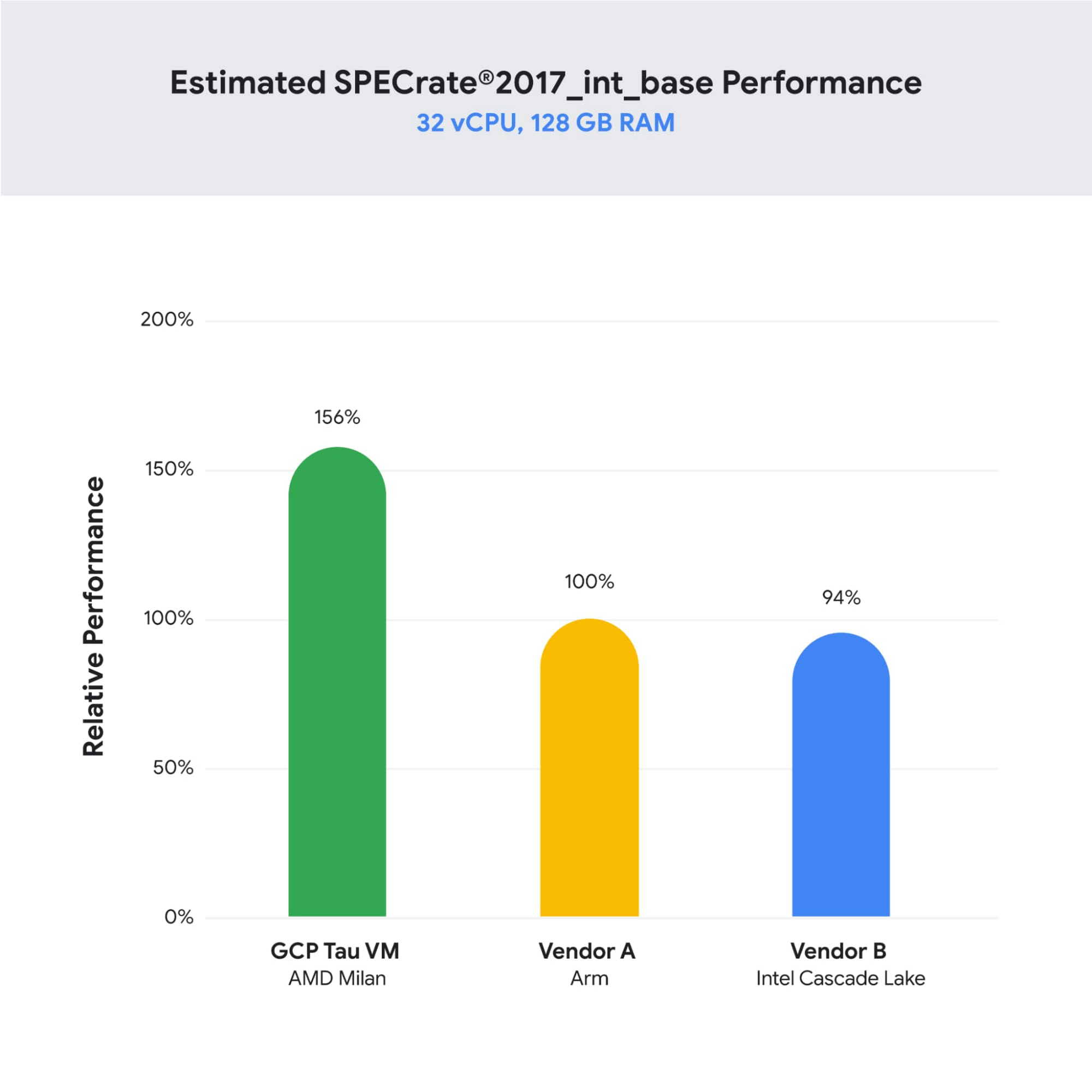
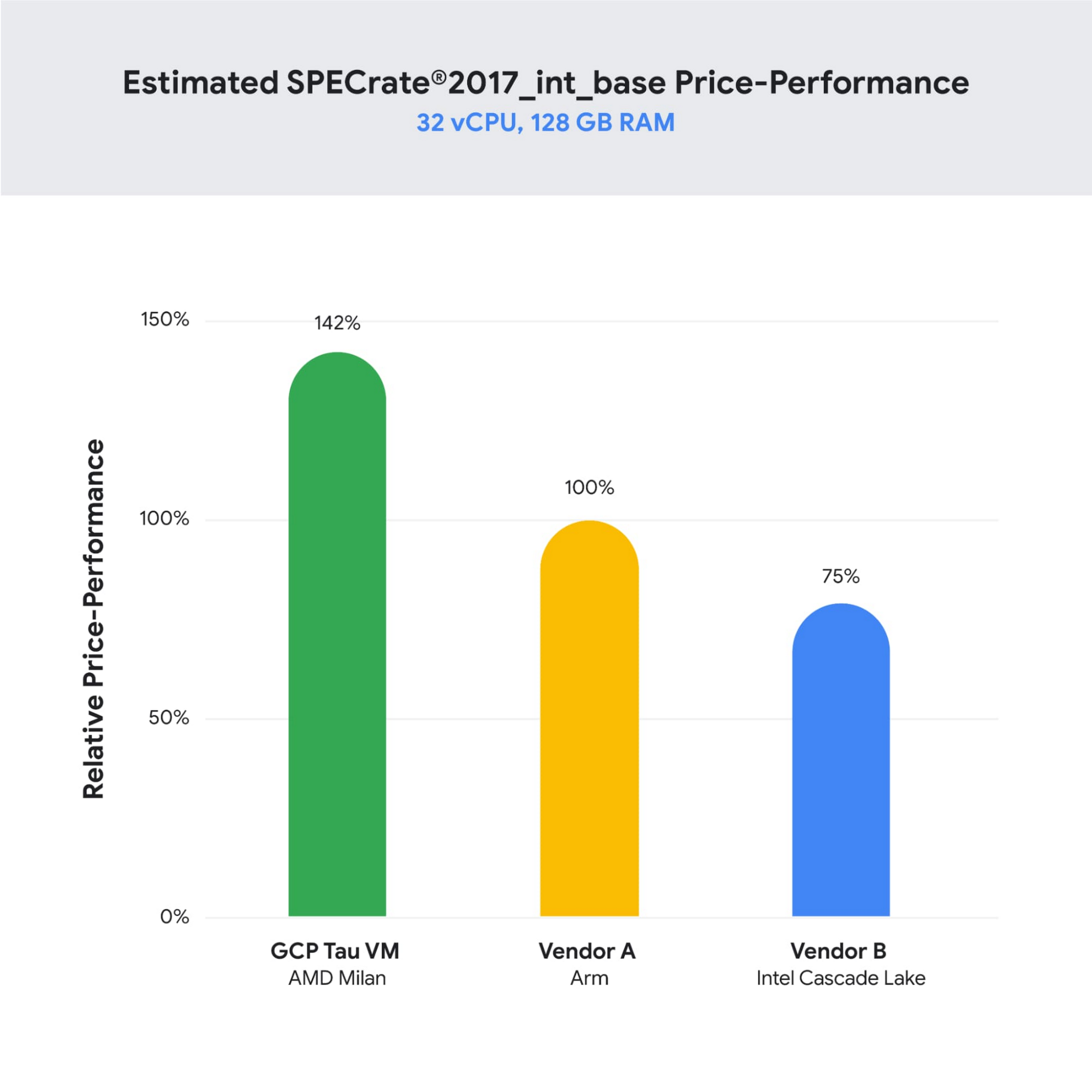
SPECrate is a trademark of the Standard Performance Evaluation Corporation. More information available at www.spec.org
What our customers and partners are saying
Snap
“At Snap, it is critical for our business to continue improving our scale-out compute infrastructure for key Snapchat capabilities like AR, Lenses, Spotlight and Maps,” said Cody Powell, Senior Engineering Manager, Snap Inc. “We were impressed when we tested Google Cloud’s new Tau VMs with Google Kubernetes Engine. While it’s early days, we believe we can gain double digits in infrastructure performance improvements for key workloads—enabling us to do more with less and invest even more in new features for our amazing Snapchat community.”
Twitter
“High performance at the right price point is a critical consideration as we work to serve the global public conversation,” said Nick Tornow, Platform Lead, Twitter. “We are excited by initial tests that show potential for double digit performance improvement. We are collaborating with Google Cloud to more deeply evaluate benefits on price and performance for specific compute workloads that we can realize through use of the new Tau VM family.”
DoiT
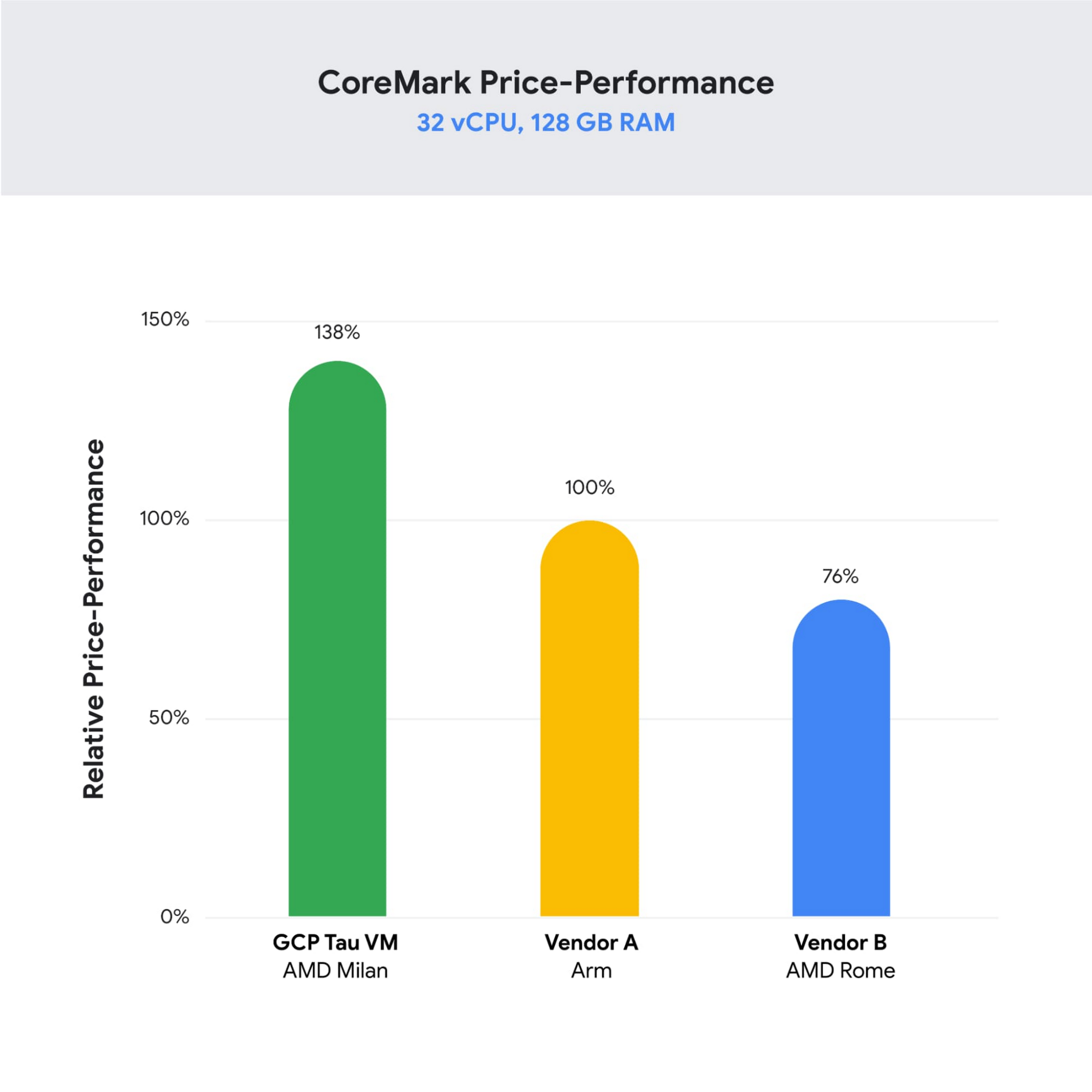
“DoiT partners with leading cloud vendors who are focused on growth and cost optimization,” said Yoav Toussia-Cohen, CEO, DoiT International. “In our preliminary testing of Google’s new Tau VMs with the Coremark benchmark, we were thrilled to see the incredible performance at 50% better than a comparable ARM-based offering from another leading public cloud. With Tau VMs, Google Cloud has set a new bar for price-performance, making the cloud even more accessible to digital-native companies. We are excited to bring Google’s Tau VMs to our joint customers.”
Designed for demanding scale-out workloads
Tau VMs bring the benefit of Google’s long-standing experience engineering platforms for scale-out workloads to our customers. They come in multiple predefined VM shapes, with up to 60vCPUs per VM, and 4GB of memory per vCPU. They offer up to 32 Gbps networking bandwidth and a wide range of network attached storage options, making Tau VMs ideal for scale-out workloads including web servers, containerized microservices, data-logging processing, media transcoding, and large-scale Java applications.
Google Kubernetes Engine support
Google Kubernetes Engine (GKE) is the de facto standard for organizations looking for advanced container orchestration, delivering the highest levels of reliability, security, and scalability. GKE supports Tau VMs on day 1, helping you optimize price-performance for your containerized workloads. You can add Tau VMs to your GKE clusters by specifying the T2D machine type in your GKE node-pools.
Pricing
Tau VMs will be priced to support significant TCO and price-performance improvements for your cloud applications. A 32vCPU VM with 128GB RAM will be priced at $1.3520 per hour for on-demand usage in us-central1.
Coming soon to a Google Cloud region near you
If you are interested in trying out T2D VMs when they become available in Q3 2021 please sign-up here.
Guide to Google’s Underwater Infrastructure
5659
Of your peers have already read this article.
1:00 Minutes
The most insightful time you'll spend today!
From data centers and cloud regions to subsea cables, Google is committed to connecting the world. Our investments in infrastructure aim to further improve our network—one of the world’s largest—which helps improve global connectivity, supporting users and Google Cloud customers. Our subsea cables play a starring role in this work, linking up cloud infrastructure that includes more than 100 network edge locations and over 7,500 edge caching nodes.
As it turns out, readers of this blog seem to find what happens under the sea just as fascinating as what’s going on in the cloud. Posts on our cables are consistently among our most popular, which is why we brought them together for you here so you can take a deeper dive (pun intended).
Here’s a list our most popular posts on our underwater infrastructure:
2021
- Hola, South America! Announcing the Firmina subsea cable
- This bears repeating: Introducing the Echo subsea cable
- The Dunant subsea cable, connecting the US and mainland Europe, is ready for service
2020
2019
- Introducing Equiano, a subsea cable from Portugal to South Africa
- A quick hop across the pond: Supercharging the Dunant subsea cable with SDM technology
- Curie subsea cable set to transmit to Chile, with a pit stop to Panama
2018
- Expanding our cloud network for a faster, more reliable experience between Australia and Southeast Asia
- Delivering increased connectivity with our first private trans-Atlantic subsea cable
2017
2016
- New undersea cable expands capacity for Google APAC customers and users
- Google Cloud customers run at the speed of light with new FASTER undersea pipe
- A journey to the bottom of the internet
Our cable systems provide the speed, capacity and reliability Google is known for worldwide, and at Google Cloud, our customers can make use of the same network infrastructure that powers Google’s own services. To learn more, you can view our network on a map, or read more about our network.
Google’s New Climate Innovation Challenge to Fight Energy Crisis and Build Climate Resilience

3416
Of your peers have already read this article.
1:30 Minutes
The most insightful time you'll spend today!
At Google, we believe that when it comes to solving a problem as big and urgent as climate change, we get more done when we collaborate. From beekeepers in Germany to urban foresters in Los Angeles, we support the work of nonprofits, scientists, and organizations that are working to mitigate the impact of climate change globally, and increase communities’ resilience to its effects.
To this end, we are proud to launch the Climate Innovation Challenge, which will provide Google Cloud research credits to advance a better understanding of climate resilience and promising solutions to address urgent climate challenges. I’m excited about this launch. We need to get smarter about the inevitable impact of our changing climate and how it will reshape our lives, supply chains, and business. Sustainability is a business-critical agenda, and we need intelligent technologies, leadership, and collaboration to drive industry transformations and reach a net-zero world.
The innovation and scale required to solve the toughest climate challenges will come from technology. At Google Cloud, we’re working across industries to increase climate resilience, applying cloud technology to help solve key challenges in the fight against climate change. Nonprofits, scientists, and organizations will be key in developing new research and innovations that will help us better understand how we can accelerate action on climate.
Through the new program, individual climate researchers in higher education and not-for-profit research organizations can apply for Google Cloud credit grants of up to $100,000 to accelerate their projects with Google’s state-of-the-art, data analytics and artificial intelligence (AI) cloud services, from Google Earth Engine (EE) to Google Public Datasets like the one from the National Oceanographic and Atmospheric Administration (NOAA). We will work with specialist partners in environmental organizations, agriculture, and carbon reduction to help evaluate proposals and select participants. Our first partner is the National Science Foundation (NSF) AI Institute for Research on Trustworthy AI in Weather, Climate, and Coastal Oceanography (AI2ES). Alongside the cloud credits, we will also provide researchers with access to technical training and mentoring, to help jumpstart their work.
From idea to insight to impact
In 2021, researchers at 500 universities in 47 countries received Google Cloud research credit grants. Others received funding through the Google Cloud Research Innovators Program, which promotes collaboration among a global cohort of scientists and provides them with professional opportunities and technical expertise. Here are some of the Research Innovators who have already advanced their climate research with Google Cloud:
- At CalTech Tapio Schneider and his team built Climate Machine, a next-generation open-source Earth System Model that will integrate more earth and atmospheric data than ever before.
- At UCLA, Bo Zhou uses EE for remote sensor modeling to help bureaus of land management make conservation decisions.
- At the University of New England, James Brinkhoff conducts spatial and temporal analysis for agriculture crop modeling and water use with data from EE.
- At Natural Resources Canada (NRCan), Richard Fernandes is developing the LEAF toolbox to map and assess vegetation with satellite data from EE.
- At the University of Toronto, Yuhong He uses EE to map changes occurring in natural and managed ecosystems systems using remote sensing, machine learning, and ecosystem modelings.
- At UCLA, Henry Houskeeper uses machine learning with EE’s satellite imagery to automate detection of kelp forests.
- At the University of Hawaii at Manoa, Jonghyun Lee conducts numerical modeling for water resources with Google Colab.
- At Technical University in Dublin, Santos Fernández Noguerol runs functions to collect weather data from governmental agencies, then automatically stores them in Google Cloud Storage buckets for future spatial analysis.
- At the University of Colorado at Denver, Farnoush Banaei-Kashani conducts data science projects with applications for Intelligent Transportation and Earth Sciences.
To apply for a Climate Innovation Challenge grant, click here and include “Climate Innovation Challenge” as the first line of your proposal. We will announce additional focus areas, partnerships, and recipients throughout the year. Click here to learn more about Google Cloud sustainability.
Google Cloud Launches Digital Assets Team to Power the Emerging Blockchain Space

3102
Of your peers have already read this article.
1:30 Minutes
The most insightful time you'll spend today!
Blockchain technology is yielding tremendous innovation and value creation for consumers and businesses around the world. As the technology becomes more mainstream, companies need scalable, secure, and sustainable infrastructure on which to grow their businesses and support their networks. We believe Google Cloud can play an important role in this evolution.
Building on our existing work with blockchain developers, exchanges, and other companies in this space, we are announcing today a new, dedicated Digital Assets Team within Google Cloud to support our customers’ needs in building, transacting, storing value, and deploying new products on blockchain-based platforms. This new team will enable our customers to accelerate their efforts in this emerging space and help underpin the blockchain ecosystems of tomorrow.
What We’re Doing Today (and Into the Future)
Blockchain and distributed-ledger-based companies like Hedera, Theta Labs, and Dapper Labs have already chosen to build on top of Google Cloud for scalability, flexibility, and security. Moving forward, Google Cloud’s Digital Assets Team will undertake a number of short- and long-term initiatives to support companies in the digital assets/blockchain ecosystem, including:
- Providing dedicated node hosting/remote procedure call (RPC) nodes for developers, allowing users to deploy blockchain validators on Google Cloud via a single click (“click to deploy”).
- Participating in node validation and on-chain governance with select partners.
- Helping developers and users host their nodes on the cleanest cloud in the industry, supporting their environmental, social, and governance initiatives.
- Supporting on-chain governance via participation from Google Cloud executives and senior engineers.
- Hosting several public BigQuery datasets on our Marketplace, including full blockchain transaction history for Bitcoin, Ethereum, Bitcoin Cash, Dash, Litecoin, Zcash, Theta, Hedera Hashgraph, Band Protocol, Polygon, XRP, and Dogecoin.
- Driving co-development and integration into Google’s robust partner ecosystem, including participating in the Google Cloud Marketplace.
- Embracing joint go-to-market initiatives with our ecosystem partners where Google Cloud can be the connective tissue between traditional enterprise and blockchain technologies.
As we build out our team, we’re also exploring opportunities in the future to enable Google Cloud customers to make and receive payments using cryptocurrencies.
Why Partner with Google Cloud
Our customers in this space—both traditional firms seeking to implement blockchain strategies and blockchain-native companies, such as exchanges, app providers, and decentralized platforms—are choosing Google Cloud for three key reasons:
- First, their businesses and their developer ecosystems can build on the industry’s cleanest cloud. Growing in a sustainable manner is top-of-mind for many businesses, but is particularly relevant in the blockchain space, where the ability to run and scale sustainably is critical. Google is carbon neutral today, and we’ve announced our goal to run on carbon-free energy, 24/7 at all of our data centers by 2030. We’ve also rolled out the ability for customers to choose a Google Cloud region in which to run based on carbon footprint data.
- Second, developers building on blockchain-based platforms can benefit from Google’s world-class developer platform. Google Cloud infrastructure ensures that developers can speed up the delivery of software and data on the blockchain, delivering fast access to applications for users.
- Third, Google Cloud technologies and services will ensure that blockchain-based companies can scale securely and reliably. Google can ensure that data, applications, games, or digital assets like NFTs will be delivered on a stable, secure, and trusted global network.
Google Cloud’s Approach to Blockchain and Digital Assets
Blockchains and digital assets are changing the way the world stores and moves its information —as well as value. As an infrastructure provider, Google Cloud views the evolution of blockchain technology and decentralized networks today as analogous to the rise of open source and the internet 10-15 years ago. Just as open source developments were integral to the early days of the internet, blockchain is yielding innovation and value creation for consumers and businesses. As the technology becomes more mainstream, companies will need scalable, secure infrastructure on which to grow their businesses and support their networks.
As such, we’re applying Google Cloud technology to the blockchain market with the following principles:
- Consistent with Google Cloud’s core business: We are specialists in data-powered innovation with leading infrastructure, industry solutions, and other cutting-edge technology. We pursue blockchain projects and partnerships that align with our mission and our expertise.
- User trust and governance: Blockchain networks raise novel questions concerning legal compliance and user privacy. We will maintain our commitment to our users through a robust focus on privacy and user trust, as well as an uncompromising focus on compliance with applicable laws.
- Network-agnostic: Google’s infrastructure will seek to preserve optionality of networks for the benefit of users.
We’re inspired by the work already done in the digital assets space by our customers, and we look forward to providing the infrastructure and technologies to support what’s possible with blockchain technologies in the future. If you’re eager to learn more about Google Cloud’s new Digital Assets Team, please reach out to your Google Cloud sales representative or partner manager.
Accelerating business growth with a seamless migration to Google Cloud

3494
Of your peers have already read this article.
2:30 Minutes
The most insightful time you'll spend today!
In today’s hybrid office environments, it can be difficult to know where your most valuable, sensitive content is, who’s accessing it, and how people are using it. That’s why Egnyte focuses on making it simple for IT teams to manage and control a full spectrum of content risks, from accidental data deletion to privacy compliance.
I used to be an Egnyte customer before joining the team, so I’ve experienced first-hand the transformative effects that Egnyte can have on a company. Because data is fundamental to a company’s success, we take the trust of our 16,000 clients very seriously. There is no room for error with a cloud governance platform, which means that the technology providers we work with can’t fail either. That’s why we work with Google Cloud.
Since Egnyte was founded in 2007, we have delivered our services to clients 24/7. We do this by running our own data centers: two in the USA and one in Europe. But as the company continued its steady growth, owning and managing these data centers became unsustainable. There’s a tremendous amount of work that goes into managing everything that we need from a data center. Not only were we constantly building, maintaining, and paying for all this infrastructure, but we’d have to constantly expand our data centers to accommodate our business growth. This caused a never-ending pipeline issue because we had to predict how many businesses we were going to win over the next 12 to 18 months. What if we planned to grow the business by 20%, and ended up growing by 25% instead?
We knew that being limited to our own data centers was going to negatively impact our business, so we looked for alternatives. To gain scalability and introduce another layer of reliability to our business, we decided to collaborate with a reputable cloud provider who could reliably back up our data. We examined the offerings of every cloud provider, and found that in every category that we analyzed, Google was hands-down the winner.
One of these categories is the reach of the network. With its own transoceanic fiber with points of presence in all markets where we’re currently doing business as well as markets where we intend to do business one day, Google network is second to none. Another important criteria for us was flexibility in the product offering, so we could better consider the financial risks of this large-scale data migration. For a while, we needed to pay for both our new cloud infrastructure and our old on-premises one while they overlapped during the migration, but Google Cloud made it easier for us to plan for this.
By December 2021, we had completed our full migration to Google Cloud. This significant migration was completed gradually and without disrupting our services at any point. Our close collaboration with the Google Cloud team is one of the big reasons we completed this so successfully. Google Cloud was able to anticipate some of the problems we’d likely be facing and helped us overcome them along the way.
We were able to shut off our last data center in February 2022, and the beneficial changes to the business are already obvious. Capacity planning, which used to be our biggest challenge on-premises, is now a problem of the past. The ability to spin up new resources on Google Cloud means we no longer need to buy additional resources a year in advance and wait for them to be shipped.
Using Google Cloud means that we no longer rely on aging infrastructure, which is a very limiting factor when you’re developing and engineering a platform as complex as Egnyte. Our entire platform is now always operating on the latest storage, processing, network, and services available on Google Cloud.
Additionally, we have services embedded on our infrastructure such as Cloud SQL, Cloud Bigtable, BigQuery, Dataflow, Pub/Sub, and Memorystore for Redis, which means we no longer need to build services from scratch or shop, install, and build them into the product and company work flow. There’s a long list of Google Cloud services that have significantly simplified our processes and that now support our flagship products, Egnyte Collaborate and Secure and Govern.
Looking ahead, we’ll continue to take advantage of what Google Cloud has to offer. Our migration has impacted not only our business but also our clients. We can offer even higher reliability and faster scalability to our clients whenever they need our platform to protect and manage critical content on any cloud or any app, anywhere in the world. We look forward to seeing what’s next.
Hike: Processing Analytics Queries 20X Faster with Google Cloud Platform

5572
Of your peers have already read this article.
2:30 Minutes
The most insightful time you'll spend today!
After a seamless migration to Google Cloud Platform with CloudCover and Google Cloud Professional Services, Hike has reduced its costs by 20% and processed analytics queries 20 times faster than with its previous cloud provider. The business is also using AI and machine learning to enhance the experience provided by a new sticker-based messaging app, Hike Sticker Chat.
India is a market of opportunity for businesses that provide messaging apps to consumers. With more than 1.3 billion people, the country is the second most populous in the world. However, global messaging app providers face a robust market challenge from Hike, a home-grown internet and technology startup. Launched in 2012, Hike provides innovative products such as Hike Messenger and more recently the AI- and machine-learning-enabled Hike Sticker Chat, a service that enables young people in the country to express themselves through digital stickers.
The business says it understands the people of India and communication like no one else, while its mission is to reduce individuals’ dependency on the keyboard. To do this, Hike is building one of the largest repositories of AI and machine-learning-enabled stickers for Hike Sticker Chat. This messaging platform is, according to Hike, the only product of its type that enables conversations through stickers covering more than 40 languages and local dialects.
Google Cloud Results
- Processes analytics queries 20X faster than previously
- Doubles compute throughput
- Uses Google Cloud Machine Learning Engine managed, distributed capabilities to train complex models on TensorFlow that provide delightful local sticker recommendations through Hike Sticker Chat
Founded by Kavin Bharti Mittal, the Delhi-based venture is backed by SoftBank, Tencent, Tiger Global, Foxconn, and Bharti. To date, Hike has raised $261 million in funding. In August 2016, Hike raised its Series D round of funding, led by Tencent and Foxconn, at a valuation of $1.4 billion. The business is one of the fastest Indian startups to achieve Unicorn status, doing so in less than four years.
Hike started operations on a multinational cloud service. However, as user numbers and usage grew, the business began exploring options to improve performance and stability, reduce costs, and cut administration loads. In particular, Hike wanted to reduce latency between cloud data centers.
Focus on product development
“We aimed to move away from a technology stack with single points of failure to a horizontally scaled, highly reliable, distributed systems and managed services environment that enabled us to focus on product development rather than operations,” says Aditya Gupta, Director, Engineering, Hike.
Hike then began exploring the opportunities presented by Google Cloud Platform. The business held a number of executive-level meetings with Google to understand the capabilities, roadmap, and track record of the cloud service. It then decided to proceed with a proof of concept with Google Cloud Premier Partner CloudCover.
The proof of concept revealed that when Cloud Load Balancing was operating, latency between the Google Cloud data center in Taiwan and Delhi, India, was less than the latency between the incumbent cloud provider’s data center and Delhi. Further, compute throughput was up to two times greater on Compute Engine than on the equivalent service, while Hike could complete more then 1 million connections on Compute Engine – up from 500,000 connections on the incumbent service.
Migrate to GCP
The success of the exercise prompted Hike to migrate its messaging app to Google Cloud Platform. “We chose Google Cloud Platform because of its very broad set of services and features,” explains Gupta. “In addition, Google’s innovation mindset and the richness of the partnership would allow us to be onboarded quickly to machine learning services such as Cloud Machine Learning Engine.”
The business called on Google Cloud Professional Services (Technical Account Management) to help ensure a seamless lift-and-shift migration over two months. Google Cloud Professional Services initially undertook a technical infrastructure kickoff to establish a foundation for architecture requirements such as identity and access management and security.
Google Cloud Professional Services team delivers smooth migration
Google Cloud Professional Services worked closely with Hike to map out and deliver the Google Cloud Platform architecture that would deliver the greatest value to the business. The Professional Services team also worked with Hike to resolve product and support queries quickly; provided project background for product and support teams; and organized project meetings and early adopter program access.
In addition, Professional Services team members worked on site at least once a week, coordinated external support during critical migration periods, and coordinated teams in five countries for a single, 17-hour migration marathon. Over 60 days, the business migrated 7,000 processor cores, running virtual machine instances used for messaging infrastructure and analytics, to Google Cloud Platform.
Throughout the exercise, Google Cloud Professional Services worked with CloudCover to educate the customers’ technology teams to achieve proficiency with Google Cloud Platform. The teams soon built up skills and knowledge of best practices and began applying them to the Google Cloud Platform environment.
The Hike Google Cloud Platform architecture comprises virtual machine instances running in Compute Engine; Cloud Storage for unified object storage; networking; a BigQuery analytics data warehouse; Cloud Dataflow to transform and enrich data; Cloud Load Balancing to distribute workloads to maximize efficiency; and Cloud Dataproc to run Hadoop clusters.
Hike is also stepping up its AI & machine learning capabilities. It uses Google Cloud Machine Learning Engine managed, distributed computing capabilities to train complex models on TensorFlow. This powers key use cases such as delightful local sticker recommendations on Hike Sticker Chat. Hike is also investing heavily on AI and machine learning research.
Hike has achieved a range of benefits from its Google Cloud Platform deployment. As well as reduced latency, improved compute throughput, and increased connection handling, Google Cloud Platform managed services have enabled the business to reduce the time and effort required to administer core infrastructure, with the saved resources allocated to improving its messaging product.
“Managed services are beginning to reduce our operational overheads,” says Gupta. “For example, managed instance groups and Cloud Load Balancing are reducing our instance count and costs, thereby reducing involvement from DevOps and developer teams.”
Google Cloud Platform 20% cheaper
Gupta and his team have calculated that running for three years on Google Cloud Platform will cost, including the cost of migration, 20 percent less than on its previous platform. BigQuery is processing queries 20 times faster than a similar service offered by the previous provider, while storing 125TB of data and streaming 1.5TB of data daily. Furthermore, Hike’s analytics pipeline costs 80 percent less than in its previous environment.
“Google Cloud Platform has played an important role in enabling us to continue to innovate and realize our mission of reducing dependency on the keyboard,” says Gupta.
More Relevant Stories for Your Company

BURGER KING Germany: Serving Up Marketing Insights and Supply Chain Visibility Easily
Do hamburgers really come from Hamburg? This may still be a matter of debate, but the popularity of American-style burger joints not just in Hamburg but all over Germany, is clear. Germany’s top two fast food companies are both burger chains. One of them is BURGER KING®, a global brand that welcomes more




Twitter Charts #HybridCloud Journey With Google Cloud
Social media giant Twitter needs no introduction. The 24/7 live platform, which crunches massive volumes of data every second, was using its data centers for a lot of its infrastructure and used the cloud for some of what it does. However, it needed ever more storage and compute resources and

2022 is a Big Year for the Gaming Industry!
Editor’s note: This post was originally published in TechPulse Belgium, where Jack Buser, Google Cloud’s Director of Game Industry Solutions, shared his trends for the industry this year. The year 2022 will hold many surprises (with a few already dropping!), but there's one near certainty: By this time next year there will

Canadian Bank’s SAP Workload Moved to BigQuery Helps Unlock New Business Opportunities
When ATB Financial decided to migrate its vast SAP landscape to the cloud, the primary goal was to focus on things that matter to customers as opposed to IT infrastructure. Based in Alberta, Canada, ATB Financial serves over 800,000 customers through hundreds of branches as well as digital banking options. To
