





AI Features in Apigee X Helps Build and Manage APIs at Scale

5259
Of your peers have already read this article.
2:00 Minutes
The most insightful time you'll spend today!
APIs are the backbone of digital transformation. Via APIs, you can securely share data and functionality with developers both inside and outside of your organizational boundaries, letting you build applications faster, seamlessly connect and interact with partners, and drive new business revenue.
Because APIs encompass business-critical information, any downtime or performance degradation can lead to significant loss in revenue, customers, and brand value. Therefore, there’s mounting pressure on operations teams to ensure that APIs are always available and performing as expected. If the APIs go down, so too do the services that fuel customer experiences and on which the organization relies for collaboration and business processes.
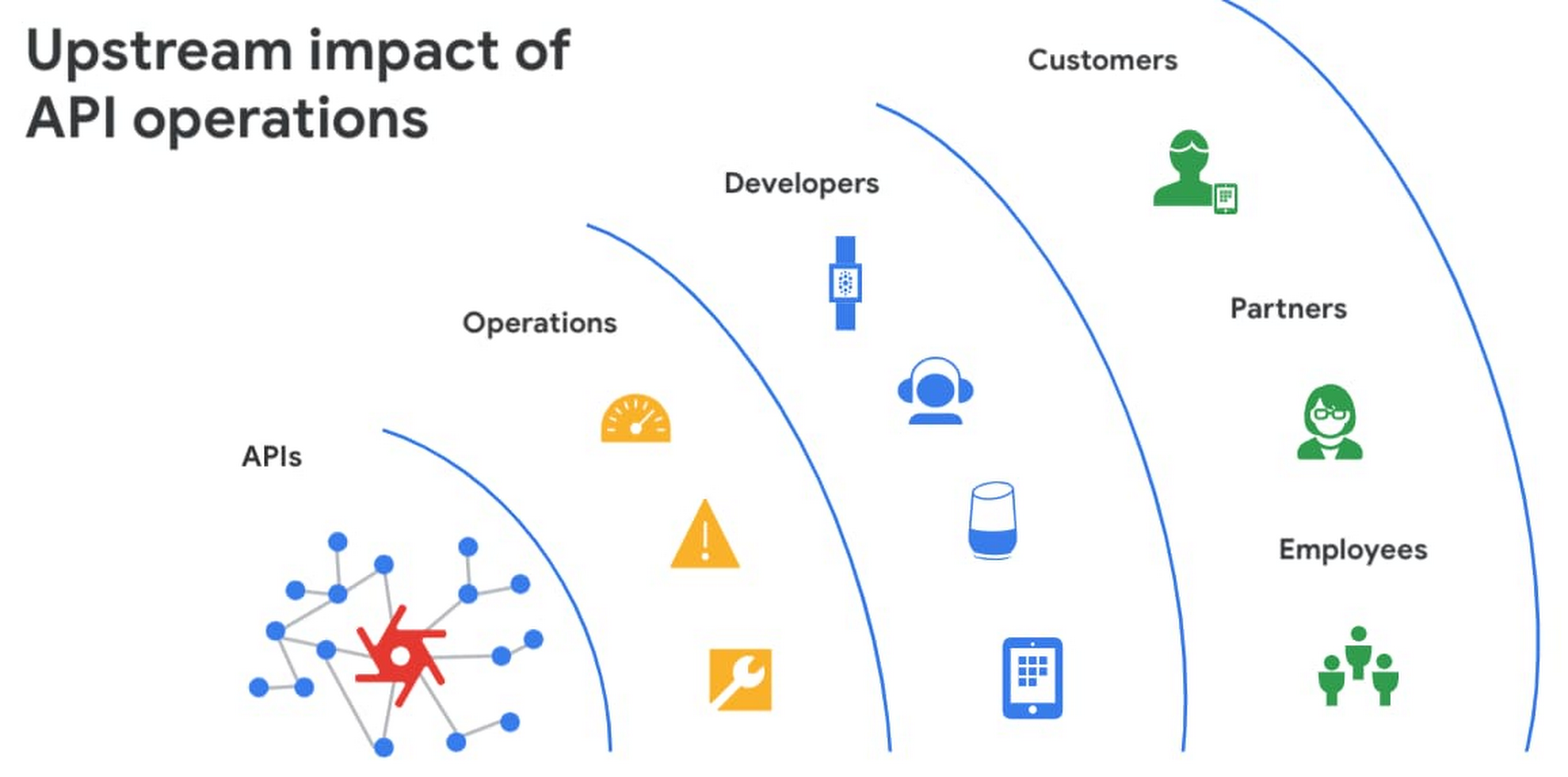
However, as you build and scale your API programs, it becomes practically impossible for API operators to manually monitor and manage all your APIs. To help, we brought the power of industry-leading AI and ML technologies to API operations via Apigee X, a major release of our API management platform. Apigee X seamlessly weaves together Google Cloud’s expertise in AI, security and networking to help you efficiently build and manage APIs at scale.
Put your API data into action
Apigee applies machine learning to your API metadata and provides you the required tools that simplify various aspects of API operations. A great example of AI for APIs is anomaly detection:
- AI-powered rules trigger alerts based on a set of predefined conditions that are determined by applying Google’s industry-leading machine learning models to your historical API data.
- Auto-thresholds adjust the monitoring criteria of your APIs and set them to pattern-based values.
- Reduce overhead results because operators don’t have to manually monitor anomalies or adjust the monitoring thresholds on APIs.
“By applying AI and ML models to our historical API data, these advanced features are able to alert us about scenarios we haven’t thought of. Such automation capabilities significantly reduce our upfront efforts. And from a security perspective, the actionable insights help us ensure that our proxies are exposed only over secure HTTPs ports and adhere to compliance requirements. We’re also able to closely monitor user activity and quickly pull out reports during audits.” – Adam Brancato, Sr. Manager, Global Technology and Security at Citrix

As our customers scale their API programs, they find it extremely useful to harness AI-powered capabilities. In our recent State of the API Economy 2021 report, we found a 230% increase in enterprises’ use of anomaly detection, bot protection, and security analytics features.

To learn more about Apigee X, and see AI and machine learning in action, check out this video, and to try Apigee X for free, click here.
BPAY: Uncovering New Business Opportunities with APIs

4018
Of your peers have already read this article.
3:15 Minutes
The most insightful time you'll spend today!
Editor’s note: Today we hear from Jon White and Angela Donohoe from BPAY Group. BPAY Group is best known for BPAY, the leading electronic bill payment system in Australia, handling one-third of the market. Learn how BPAY Group is positioning the organization for the future by using APIs to streamline workflows for existing customers and new businesses.
BPAY has been a leader in the bill payment industry in Australia for 22 years and provides a secure, fast, and convenient way to connect individuals, businesses, and banks to help people stay on top of their bills.
One of the reasons that BPAY is the preferred bill payment service for so many Australians is our commitment to human-centered design. We’re continuously talking with customers and looking at ways that we can deliver better experiences, products, and services, such as peer-to-peer payments. During these conversations, we noticed some ways that our processes were causing friction for existing or potential customers.
For example, we traditionally used a batch processing system to handle requests between billing companies and banks. But that could cause headaches for some customers, as an error in even one request could cause the whole batch to be rejected. Plus, many “neobanks” (new types of digital-only banks) wanted to work with real-time transactions instead of batch processes, which take longer to complete.
We realized that APIs had the potential to solve many of the challenges impacting customers while opening the doors for future product and business development. We developed a few customer-facing APIs and tested them in closed betas. This experiment went far better than we expected, and we realized that there was a huge appetite for APIs among our biller customers.
While we had developed many APIs for internal systems, developing APIs that were easy to consume by our customers was a new challenge. We needed to move away from our home-grown API development approach and make our API environment more powerful, versatile, and easier to use. The API experts at The Singularity worked with us to develop a strong API strategy. We decided that we would need to support our new strategy with a scalable API management platform.
After a rigorous search, we landed on the Apigee API Management Platform. Apigee was the only solution that met all our technology and business requirements. With Apigee, we have a solid foundation for APIs that will help us deliver more value for all customers.
Creating a custom development environment
BPAY is a trusted brand in Australia, so it was very important to us that we maintain our reputation for excellent customer experiences. When setting up our developer portal, we started with a closed pilot and used developer feedback to make the portal as convenient and simple to use as possible. The Apigee developer portal has many built-in features to help us customize experiences, and if we run into roadblocks, the Apigee team at Google listens and helps us create the custom experience we want.
The developer portal has already proven to be extremely popular. In its first month live, we registered 104 developers in the sandbox environment and 10 developers in the production environment. That was before we even started marketing our developer portal, so we expect those numbers to rise quickly.
Breaking new ground with APIs
We’ve already released four foundational APIs, with a goal of eventually releasing dozens. Our APIs are helping us create smoother experiences for customers. We mentioned that when processing a batch of payment files, one mistake could cause the entire batch to get rejected. Our APIs now enable businesses to validate all payment information before submitting a batch file, dramatically reducing the chances of errors. They can even use our APIs to automatically generate batch files in the right format for different banks.
While APIs improve service for current customers, they also open the doors for new areas of business. Buy now, pay later (BNPL) services, which enable customers to spread out payments across weeks or months, are already popular in retail spaces. After releasing our first APIs, we connected with two BNPL billing services. These companies use our APIs to validate customers’ bill payment information and then pay the bill in full on behalf of customers. This was a completely new use case for us, one that could not have been implemented without our APIs.
The payment service NoahPay also adopted our APIs to validate payment information and let customers pay bills using funds from their WeChat accounts. This is an exciting new market for us, as it’s one of the first examples of how we can connect to international digital wallets through our new APIs. It’s also a great way to introduce users of WeChat, a messaging app used by more than 1 billion people in China, to the BPAY brand.
Planning for the future of bill pay
We have big plans for APIs in the future, and Apigee helps make these plans a reality. We plan to establish a generous freemium monetization model that will allow customers to make up to 200,000 API calls for free each month with tiered payment plans above that. This will enable us to open the doors for smaller organizations while providing optimal support for larger businesses and banks that might need to make millions of calls. Having powerful end-to-end monetization features built in to Apigee means that we can process monetized transactions with ease.
Built-in reporting functionality will also help us make sure that we’re understanding the market’s need for APIs and always providing our customers with valuable services and support.
Apigee greatly streamlines creating self-service API environments. Even as we grow our business, our internal teams will be able to continue providing excellent customer service without needing extra staff to answer questions, help with integration support, and constantly check API security. APIs are the way of the future, and Apigee prepares us meet the challenges that come along with it.
Vodafone Turns to Google Maps Platform to Expand and Improve its Network

6385
Of your peers have already read this article.
1:30 Minutes
The most insightful time you'll spend today!
Vodafone India had a manual, labor-intensive process for determining network capabilities and reach. The company sent field operatives to every customer location to conduct a feasibility study. These feasibility studies help Vodafone determine whether they can provide connectivity and services to customers based on the infrastructure at that location.
Everyone from the IT team and end users to the field operatives doing the work recognized the need to adopt a new solution to automate the measurements. They needed a technology that was easy to use and maintain.
“Vodafone used to manually perform physical surveys for each feasibility, which is a time-consuming and labor-intensive process. Often, feasibility studies were delayed, and we missed out on opportunities to serve additional customers. With SmartFeasibility, we’ve increased our capacity 15 fold, which positively impacts our bottom line and allows us to provide better and smarter customer service.”
—Rajneesh Asthana, IT Planning and Delivery, Vodafone India
Partnering with Lepton Software (a leading global provider of location-based analytics solution) Vodafone introduced SmartFeasibility—a solution that changed the feasibility testing from a manual to an automated process. This involved a full Google geo platform solution – leveraging world class technology like maps, roads and directions.
Google Maps Platform Results
- Employees are able to access information faster with SmartFeasibility—they have data at their fingertips, rather than waiting for an employee to collect it
- Field operatives have increased their conversion rates by providing more accurate readings on feasibilities and closing more customer business
- Addresses are now easy to find with a click of a button. The Vodafone India team can search feasibilities that have been loaded into the database, so if there’s an issue or if they need to reference a past action, they have that information at their fingertips
- 2 day turnaround versus 5 before the solution was implemented
- 400+ new customers added per day
With the new solution, Vodafone India no longer needs field operatives to manually calculate these measurements. With Google Maps, users can search customers’ addresses, calculate the distance between Vodafone’s location and the customer’s location and research building data such as height.
The old system of having field operatives collect data was unreliable. With Google Maps Platform, the Vodafone India team knows that the measurements are accurate and reliable.

4014
Of your peers have already downloaded this article
4:20 Minutes
The most insightful time you'll spend today!
Modern web APIs allow businesses to build compelling experiences that generate, consume, and combine digital assets. They’ve become the foundation upon which digital business is built.
But the path to success can be unclear, rough, and challenging. The game has changed, after all, and this requires tossing out many of the rules by which you run your business.
You’re not alone. Other businesses have struggled down the path toward increased competitiveness, agility, and opportunity—and we, at Google Cloud, are privileged to partner with hundreds of customers across myriad industries as they gear up to go digital.
We’ve seen the successful decisions and strategies that have enabled companies to adapt to new digital realities. But we’ve also seen businesses make decisions that slowed, stymied, or, in some cases, reversed progress toward becoming an agile digital business.
There’s no one path to travel. There are many ways to make your business digital, but there are also many pitfalls. This is the survival guide to help navigate a smarter digital journey.
There’s one bit of advice we can offer above all else: GET STARTED. If you don’t take steps to adapt to the new competitive landscape and to your customers’ expectations, the very survival of your business is at risk.
Download the E-book to know more about the best and worst practices of how a business leads, measures, invests in, and executes an API initiative.
Speeding up migrations to Google Cloud with migVisor by EPAM

3089
Of your peers have already read this article.
2:30 Minutes
The most insightful time you'll spend today!
Application modernization is quickly becoming one of the pillars of successful digital transformation and cloud migration initiatives. Many organizations are becoming aware of the dramatic benefits that can be achieved by moving legacy, on-premises apps and databases into cloud native infrastructure and services, such as reduced Total Cost of Ownership (TCO), elimination of expensive commercial software licenses, and improved performance, scalability, security and availability.
The complexity of applications and databases to a cloud-centric architecture requires a rapid, accurate, and customized assessment of modernization potential and identification of challenges. Addressing business and functional drivers, TCO calculations, uncovering technological challenges and cross-platform incompatibilities, preparation of migration, and rollback plans can be essential to the success and outcome of the migration.
These cloud migration initiatives are often divided into three high-level phases:
- Discovery: identifying and cataloging the source inventory. Output is usually an inventory of source apps, databases, servers, networking, storage, etc. The discovery of existing assets within a data center is usually straightforward and can often be highly automated.
- Pre-migration readiness: the planning phase. This includes the analysis of the current portfolio of the databases and applications for migration readiness, determining the target architecture, identifying technological challenges or incompatibilities, calculating TCO, and preparing detailed migration plans.
- Migration execution: where the rubber hits the road. During this phase of the migration process, database schemas are actively converted, the application data access layer is refactored, data is replicated from source to target, often in real-time, and the application is deployed in its determined compute platform(s).
Successful evaluation and planning phase as part of the pre-migration readiness phase can bolster confidence in investment towards modernization. Skipping or inaccurately completing the pre-migration phase can lead to a costly and sub-optimal result. Relying on manual pre-migration assessments can lead to long migration timelines, reduced success rates and poor confidence in the post-migration state, increased risk and total migration cost.
Some of the commonly asked question during pre-migration include:
- How compatible are my source databases, which are often commercial and proprietary in nature, with their open-source cloud-native alternatives? For example, how compatible are my Oracle workloads and usage patterns with Cloud SQL for PostgreSQL?
- What’s my degree of vendor lock-in with my current technology stack? Are proprietary features and capabilities being used that are incompatible with open-source database technologies?
- How tightly-coupled are my applications with my current database engine technology? Can my applications be deployed as-is, refactored for cloud readiness with ease, or will it be a big undertaking?
- How much effort will my migration require? How expensive will it be? What will be my run-rate in Google Cloud post-migration and my ROI?
- Can we identify quick-win applications and databases to start with?
There is a direct association between the accuracy and speed of the pre-migration phase and the outcome of the migration itself. The faster and more accurately organizations complete the required pre-migration analysis, the more cost efficient and successful the migration itself will usually be.
EPAM Systems, Inc., a leader in digital transformation, worked with Google Cloud as a preferred partner to accelerate cloud migrations beginning with pre-migration assessments. Leveraging EPAM’s migVisor for Google Cloud—a unique pre-migration accelerator that automates the pre-migration process—and EPAM’s consulting and support services, organizations can quickly generate a cloud migration roadmap for rapid and systematic pre-migration analysis. This approach has resulted in the completion of thousands of database assessments for hundreds of customers.
migVisor is agentless, non-intrusive, and hosted in the EPAM cloud. migVisor seamlessly connects to your source databases and runs SQL queries to ascertain the database configuration, code, schema objects and infrastructure setup. Scanning of source databases is done rapidly and without interruption to production workloads.
migVisor prepares customers to land applications in Google Cloud and its managed suite of databases services and platforms such as Cloud SQL, bare metal hosting, Spanner and Cloud Bigtable. migVisor supports re-hosting (lift-and-shift), re-platforming, and re-factoring.
“EPAM’s recent application assessment update to its migration tooling system, migVisor, will bring a new level of transparency to the entire application and database modernization process”, said Dan Sandlin, Google Cloud Data GTM Director at Google Cloud. “This enables organizations to make the most of digital technologies and provides a clear IT ecosystem transformation that allows our customers to build a flexible foundation for future innovation.”
Previously, migVisor focused on assessments of the source databases and the compatibility of customers’ existing database portfolio with cloud-centric database technologies. Coming this quarter, migVisor adds support for application assessments, augmenting its existing and class-leading capabilities in the database space.
The addition of application modernization assessment functionality in migVisor, combined with EPAM’s certification and specialization in Google Cloud Data Management and hands-on engineering experience, strengthens EPAM’s position as a leader for large-scale digital transformation projects and migVisor as a trusted product for cloud migration assessments to Google Cloud customers. EPAM provides customers an end-to-end solution for faster and more cost-effective migrations. Assessments that used to take weeks can now be completed in mere days.
Within minutes of registering for an account, anyone can start using migVisor by EPAM to automatically assess applications and application code. Visit the migVisor page to learn more and sign up for your account.
Are Open Banking Regulations an Effective Entry into the API Economy?

4283
Of your peers have already read this article.
3:30 Minutes
The most insightful time you'll spend today!
With stated goals of increasing competition, innovation, and financial inclusion, bank regulators across the world are mandating that banks open their systems, enabling consumers to share their financial data with third parties.
One touted benefit of this sharing is that it may create digital banking ecosystems that offer consumers more services than ever, provide banking information and capabilities in more useful and convenient contexts, expand the market reach of ecosystem participants, and boost financial participation among the unbanked and underbanked.
These benefits involve requiring that banks produce application programming interfaces (APIs) to make data and functionality easy to share with partners in a standardized way and to give consumers control over the services with which their data is shared. Because APIs enable developers to leverage and reuse software for new services and digital experiences, including by combining APIs from multiple providers, tech pundits and commentators often refer to the “API economy” — that is, to digital ecosystems in which companies symbiotically share and combine their software to create richer offerings, to complement their proprietary strengths with offerings from other organizations, to share innovation across enterprises, and to expand into new sectors.
Rather than being able to access and act on financial data only through specific channels, for example, consumers in an Open Banking world would theoretically be able to use their money across a constantly-expanding array of apps and digital experiences. Likewise, rather than being confined to one bank’s specific digital services, consumers would be able to opt into a range of services, such as better loan matching or debt reduction advice, to help them do more with their money. Banks, meanwhile, would not have to create all aspects of digital experiences themselves but could rely on external partners, which they can add at unprecedented scale via APIs, to shoulder some of the burden of attracting and creating value for customers.
The envisioned disruption is sweeping, but key questions for bank leaders and bank investors remain, notably the extent to which the Open Banking movement will exert significant, durable impacts on market dynamics — and the extent to which Open Banking compliance constitutes an effective market entry into digital ecosystems and the celebrated benefits of the API economy.
Put simply, is complying with Open Banking regulations adequate to advance a bank’s digital strategy?
Building compliant APIs vs. entering the API economy
Individual regulators are fundamentally constrained in their ability to give banks detailed instructions on how to behave in digital ecosystems. Mandatory regulations can be originally conceived with only one or two business models in mind, not the many thousands of business models that could be partially or fully enabled by the API economy. Detailed rules and specifications may threaten the functionality of services, as regulatory interventions that give highly specific guidance may not be system- and business model-agnostic.
In terms of policy, the willingness of regulators to force banks to adopt APIs is highly significant, but because these regulatory interventions do not offer a meaningful and durable market entry roadmap for banks to follow, the regulations may be an initial catalyst to prompt financial market evolution rather than a natural and enduring end-state for business activity.
Aside from the constraints at the level of the individual bank regulator, there is limited consistency among Open Banking regulations across the globe. Europe’s PSD2 was the regulatory intervention that kicked off this global wave, but there are small but significant variations in the ripple of regulatory actions around the world.
In Australia, Open Banking is part of the Consumer Data Right, an initiative to give customers the right to access their data in a machine-readable form — a right the country does not confine to banking. In Singapore, the Monetary Authority of Singapore is pushing for a lightweight regulatory framework regime. Japan’s Amended Banking Act introduced a registration system for third party providers. Korea’s Financial Services Commission has launched a Fintech Open Platform. Mexico’s recent law to regulate financial technology institutions lays groundwork for an Open Banking regime. The Central Bank of Brazil is aiming to implement the relevant regulatory reforms by the end of 2019. For the largest, internationally diversified banks, these regional differences further complicate any effort to regard mere compliance with these interventions as an effective and coherent market entry strategy.
Despite these complexities and ambiguities, I’ve observed in my work consulting with financial institutions that some banks nevertheless treat Open Banking compliance projects as a means of market entry into the API economy. This mindset could be a costly mistake and may leave these banks at a significant competitive disadvantage as we continue to accelerate into the era of digital ecosystems. In addition to compliance, banks should view a commercial entry into a foreign country as a useful reference for entering the API economy.
Entering the API economy is like entering a foreign market
Banks executing a commercial entry into a foreign country will encounter cultural differences, whether in the form of language, ethnicity, religion, social networks, values or norms. When these cultural differences are large, market entry into a foreign market is more difficult.
The practical implications of administering new business activity in a foreign country also impact the level of difficulty. The physical distance between the home country and the foreign country has to be managed. Border hardness, time zones, and climate also impact the administrative challenges posed by the foreign country. Additionally, the market landscape is foreign. New countries can significantly differ in their natural, financial, and human resources. Staff sent to build up a new division in a new country will have to cope with different levels of market Infrastructure, information, and knowledge. Finally, the economics of entering a foreign country can be heavily influenced by historical and political factors such as a shared colonial history, common memberships of trading blocs, and shared currency zones.
These patterns of differences and similarities can likewise be observed when a bank tries to enter the API economy.
Like entry into a new territory, entry into the API economy may pose sharp cultural and operational differences for banks to grapple with. In this world of APIs and software ecosystems, an API provider’s commercial aim is to make third-parties the dominant force for innovation — that is, to securely share data and services with external contributors who build new connected experiences that generate value for the provider, much as ridesharing companies have generated value by leveraging APIs such as Google Maps. Enterprises focused on ecosystem development market their APIs as products for developers so that new innovation can emerge organically, without necessarily being pre-planned. Investment decisions in the API economy are driven by a desire to help preferred ecosystems to evolve fastest. All of this may be a very sharp change in culture for many banks that historically have sought to be the dominant innovator shaping customer experiences.
The established approach to innovation in banks is highly deliberate, aiming to match bank financial products to specific customer needs and to beat the financial product offerings of peer banks. Compared to modern digital ecosystems, these legacy banks’ resources for, scope of, and receptivity to innovation may be considerably constrained. Banks that actively treat the culture of the API economy as very foreign to their traditional corporate culture have a far greater chance of acknowledging these challenges and making a successful market entry into the API economy.
Many banks may also face challenges transitioning to ecosystem administration models. In traditional banking models, the C-suite commands and controls the bank staff that distributes products. Typically, very few external business partners are involved, and those that are have generally been deliberately, if not laboriously, selected. In contrast, the API economy requires the orchestration of very large numbers of third parties that add value to a bank’s innovation and distribution capabilities. Literally thousands of partners may access a bank’s APIs to build services atop banking data, extend a bank’s functionality or insert the bank’s APIs into new business contexts. In many ways, the whole point is that partnerships don’t have to occur in slow-moving, methodically planned formal partnerships but rather can be achieved at Internet scale while preserving control over and visibility into customer data. This shift in strategy is no small departure for many banks — so again, thinking of the endeavor as entry into a foreign market, rather than something that can be jumpstarted via regulations, is wise.
Crucially, the market landscape in the API economy is also very different from what legacy financial institutions are used to. Traditionally, banks have segmented the market into very large market segments (e.g. consumer banking, corporate banking, private banking etc.). In sharp contrast, the API economy sees partners working together to serve market micro-segments that would not be reachable and profitable by each individual enterprise working in isolation. Simply put, addressing all customer needs, from mainstream use cases to niche applications, is beyond the capabilities of any single enterprise and can generally only be achieved through ecosystems and partnerships. Because partners working together in the API economy seek to serve the customer through the customer’s preferred digital interface (which may be different than bank’s preferred digital interface), ecosystem partnerships represent a massive shift in marketing management, with major implications for a bank’s business architecture, technical architecture, governance, and risk management.
Additionally, in the API economy, pricing decisions are generally driven by a desire for ecosystem growth. Partners work together to extend the customization and value that customers experience when consuming services. By design, the intellectual property in an ecosystem becomes dispersed. Banks have traditionally sought to protect the exclusivity of their intellectual property, and they have often sought economic returns via cost-plus pricing and minimal customization of financial products. Just as with other aspects of the API economy, these ecosystem dynamics and economic relationships typically fall outside a bank’s status quo operations and strategies — more akin to entering a foreign market than to simply satisfying regulatory requirements.
The C-suite should be involved
To approach entry into the API economy as they would approach market entry into a foreign country, banks should consider focusing on a small number of products or segments. They should seek complementary partners who can help them adapt their skills to the API economy and extend the reach of their core differentiating strengths. Just like entry into a foreign market requires combining elements of the home country business model with new local elements, banks will have to transform to increase the effectiveness of their ecosystem participation.
Because an Open Banking compliance project involves regulators specifying the scope and schedule for mandatory APIs, the C-suite may feel relegated to the role of budget provider, which may tempt executives to delegate the sponsorship and steering of the project. Such delegation is not an option for a foreign market entry, where all decisions on scope, cost and timetable are strategic and entirely in the hands of the bank itself — and the C-suite should not consider it an option for entry into the API economy. Bank leaders need to be involved, as the organization likely will not be able to make the necessary strategic and operational transformations if the vision is not defined and driven from the top.
More Relevant Stories for Your Company




Leveraging Intelligent Behavior Detection to Protect User Sensitive APIs
Malicious actors are out there, and APIs are their new target. External threats could be attacking your APIs as you read this, and your business might not even know it. Attacks can come in the form of software applications that run automated tasks and they are everywhere. A growing percentage

Lower risk, greater return: Public sector organizations are focusing on multicloud adoption
Government organizations are starting to realize that no single cloud can meet their wide range of needs. According to the Nutanix 2022 Enterprise Cloud Index1, 75% of public sector organizations agree that multicloud is ideal, and more public sector organizations than average have adopted multicloud as a primary IT operating

Why America’s Leading Mortgage Technology Provider Runs its Business on Apigee
Black Knight is a leading provider of technology, data, and analytics to the mortgage industry, catering to both large and mid-tier banks in the United States. Over the past few decades, we tended to manage customer integrations on a case-by-case basis. Whenever a bank needed to connect with a Black Knight



API Management with Istio
Kubernetes can be a great orchestration platform for your microservices but these services can grow complex and difficult to manage. Istio simplifies the life of organizations contemplating a “microservices” approach, or who are simply deploying many services that communicate with each other. Istio creates a “service mesh” that routes traffic
