





Google Cloud Leads the Landscape for Unstructured Data Security Platform: Forrester

7046
Of your peers have already read this article.
1:30 Minutes
The most insightful time you'll spend today!
As organizations expand their use of cloud computing services, more of their sensitive data inevitably moves to and lives in the cloud. Much of this sensitive data is unstructured and can be challenging to secure. Despite this potential challenge, the usefulness of cloud for data storage and processing is too big for most organizations to ignore and has in turn led to data sprawl, where their sensitive data is spread over many resources, both in the cloud and on-premise. Addressing data sprawl requires solutions that can discover, manage, and secure sensitive data, especially unstructured data, as it spreads.
To help organizations confidently move their sensitive data to the cloud, Google Cloud works diligently to earn and maintain customer trust. Control and transparency are pillars of our approach to offering a trusted cloud. Therefore, we’ve been expanding our capabilities to act on unstructured data as sprawl increases.
Given the importance of these capabilities to our strategy, we are happy to announce today that Forrester Research has named Google Cloud a Leader in The Forrester Wave™: Unstructured Data Security Platforms, Q2 2021 report, and rated Google Cloud highest in the current offering category among the providers evaluated.
The report evaluates the 11 most significant providers with platform solutions to secure and protect unstructured data, spanning from cloud providers to data security-focused vendors. The report notes that “Google offers breadth and depth with built-in data security in the cloud. Google Cloud Platform, Google Workspace, and BeyondCorp Enterprise have underlying data security products and features for protecting customer data.”
Google Cloud tools focused on protecting unstructured data were developed and battle-tested internally at Google to alleviate some of our own data security challenges. This brings the best of Google security to the organizations utilizing Google Cloud and our security tools. The report highlights that “Google productizes capabilities originally developed to secure its own business, and brings a disciplined approach to product enhancements for enterprise requirements. It serves a wide range of enterprise and mid-market, with a focus on emphasizing data protection needs by industry. ”
Google Cloud’s data security strategy focuses on meeting customers wherever they are in their cloud migration journey. The report highlights that “Google further enables a Zero Trust approach with third-party integrations through its BeyondCorp Alliance of partners in device management, endpoint security and gateways.”
Google Cloud received the highest possible score in sixteen criteria, in total receiving the most 5 out of 5 ratings among all vendors assessed. These criteria include: Data Intelligence, Access Control, Deletion, Obfuscation-Scope, Obfuscation-Key Management, Deployment, Security and Risk, APIs and Integration, Data Security Platform Vision, Data Security Execution Roadmap, Performance, Planned Enhancements, Zero Trust Enabling Partner Ecosystem, Diversity, Equity and Inclusion, Installed Base, and Revenue.
Notably, Google Cloud received the highest possible score in the Obfuscation criteria. Obfuscation can help protect sensitive data, like personally identifiable information (PII), which is critical to many enterprise workflows. Cloud DLP helps customers inspect and mask this sensitive data with techniques like redaction, bucketing, and tokenization, which help strike the balance between risk and utility. This is especially crucial when dealing with unstructured or free-text workloads, in which it can be challenging to know what data to redact. More than 150 detectors combine to power Cloud DLP’s masking, which can be deployed in data migrations and business workloads like real-time data collection and processing. For Obfuscation specifically, the report mentioned that Google “takes a broad view of DLP, which includes in-line redaction of sensitive elements in unstructured data and DLP APIs that extend support to additional data types like images or other media.”
We are honored to be a Leader in The Forrester Wave™ Unstructured Data Security Platforms Q2 2021 report, and look forward to continuing to innovate and partner with you on ways to make your digital transformation journey safer as we work to become your most trusted Cloud.
A copy of the full report can be viewed here.
Latest Enhancements in reCAPTCHA Enterprise Helps Govts Sites Protect against Digital Frauds

2993
Of your peers have already read this article.
1:30 Minutes
The most insightful time you'll spend today!
Download our guidebook to learn how reCAPTCHA Enterprise can help strengthen your website security quickly.
Cyber threats on the rise
In 2021, the United States saw 40.5% of website attacks committed through “bad bots” on the internet, with 37.2% of government website traffic being bad bots, according to research by cybersecurity firm Imperva1. As cyber threats increase, government agencies need a way to safely let constituents access digital services. Google Cloud reCAPTCHA Enterprise protects websites by distinguishing between humans and bots. Full-scale implementation of reCAPTCHA Enterprise solution expands on bot detection to protect public sector websites from a broad range of digital fraud. Below are some highlights from our new reCAPTCHA Enterprise guidebook detailing functional enhancements and ways for government agencies to take advantage of enterprise capabilities.
Advanced website protection
reCAPTCHA Enterprise builds upon the existing reCAPTCHA API that has defended 5+ million websites for over a decade. It uses advanced risk analysis techniques to distinguish between humans and bots, protecting sites from spam and abuse as well as detecting other fraudulent activities, including credential stuffing, account takeovers (ATO), and automated account creation.
How it works
Detecting password leaks and credential breaches
With reCAPTCHA Enterprise’s password leak protection, agencies can conduct regular audits of user credentials, such as passwords, to detect leaks and breaches and prevent account takeovers (ATOs), as well as credential stuffing attacks.
UI challenge vs. frictionless
reCAPTCHA Enterprise returns a score, giving you the ability to take a number of actions, including requiring additional factors of authentication or throttling bots that may be scraping content. This functionality allows you to verify if an interaction is legitimate without any user interaction.
User-friendly migration
Google Cloud’s reCAPTCHA Enterprise offers a simple migration process in which your account is moved from the reCAPTCHA Admin to the Google Cloud Platform (GCP) after you create a project to migrate it to. Watch our 10-minute webinar to see how.
A cost-effective upgrade to a standard cybersecurity solution
Google reCAPTCHA Enterprise comes with 99.9%+ uptime, multi-factor authentication, and support for Android, iOS, and web applications. Our reCAPTCHA offering is structured in a way that allows you to fully control your investment and responsibly allocate taxpayer dollars.
reCAPTCHA Enterprise in action
Google Cloud’s reCAPTCHA protects against key automated attacks, including account creation, credential stuffing, cashing out, denial of inventory, and skewing. State governments have found success with using Google Cloud’s reCAPTCHA for cyber risk management. Wisconsin’s Workforce Development Agency used fraud detection and identification, including reCAPTCHA, to mitigate malicious bot logins on its external website, and several agencies in the Commonwealth of Pennsylvania have implemented reCAPTCHA to prevent bots from booking and reselling COVID-19 vaccine appointments.
Protecting public sector websites from bad actors can be challenging, especially with emerging threats from adversaries and extremist groups. Google Cloud’s reCAPTCHA Enterprise offers comprehensive website security solutions to successfully protect against cyber threats.
Download our reCAPTCHA Enterprise guidebook for a detailed look at how you can use reCAPTCHA Enterprise to strengthen your website security and implement the solution quickly and easily.
References:
5162
Of your peers have already watched this video.
14:00 Minutes
The most insightful time you'll spend today!
How Google Workspace Helps Manage, Govern and Protect Sensitive Data
The shift towards a hybrid work style and trends accelerated by the pandemic has resulted in data deluge. With companies and individuals sharing increasingly large volumes of information and collaborating with internal and external stakeholders, the need for innovations for higher security also escalates. View this video to learn how Google Workspace approaches security across content lifecycle from client-side encryption updates, data loss prevention, Google Vault, data regions, labels, and more!
Best Practices for Cost Optimization in the Cloud

5425
Of your peers have already read this article.
3:30 Minutes
The most insightful time you'll spend today!
When customers migrate to Google Cloud Platform (GCP), their first step is often to adopt Compute Engine, which makes it easy to procure and set up virtual machines (VMs) in the cloud that provide large amounts of computing power. Launched in 2012, Compute Engine offers multiple machine types, many innovative features, and is available in 20 regions and 61 zones!
Compute Engine’s predefined and custom machine types make it easy to choose VMs closest to your on-premises infrastructure, accelerating the workload migration process cost effectively. Cloud allows you the pricing advantage of ‘pay as you go’ and also provides significant savings as you use more compute with Sustained Use Discounts.
As Technical Account Managers, we work with large enterprise customers to analyze their monthly spend and recommend optimization opportunities. In this blog, we will share the top recommendations that we’ve developed based on our collective experience working with GCP customers.
Getting ready to save
Before you get started, be sure to familiarize yourself with the VM instance pricing page—required reading for anyone who needs to understand the Compute Engine billing model and resource-based pricing. In addition to those topics, you’ll also find information about the various Compute Engine machine types, committed use discounts and how to view your usage, among other things.
Another important step to gain visibility into your Compute Engine cost is using Billing reports in the Google Cloud Console and customizing your views based on filtering and grouping by projects, labels and more. From there you can export Compute Engine usage details to BigQuery for more granular analysis. This allows you to query the datastore to understand your project’s vCPU usage trends and how many vCPUs can be reclaimed. If you have defined thresholds for the number of cores per project, usage trends can help you spot anomalies and take proactive actions. These actions could be rightsizing the VMs or reclaiming idle VMs.
Now, with these things under your belt, let’s go over the five ways you can optimize your Compute Engine resources that we believe will give you the most immediate benefit.
1. Apply Compute Engine rightsizing recommendations
Compute Engine’s rightsizing recommendations feature provides machine type recommendations that are generated automatically based on system metrics gathered by Stackdriver Monitoring over the past eight days. Use these recommendations to resize your instance’s machine type to more efficiently use the instance’s resources. It also recommends custom machine types when appropropriate. Compute Engine makes viewing, resizing and other actions easier right from the Cloud Console as shown below.
Recently, we expanded Compute Engine rightsizing capabilities from just individual instances to managed instance groups as well. Check out the documentation for more details.
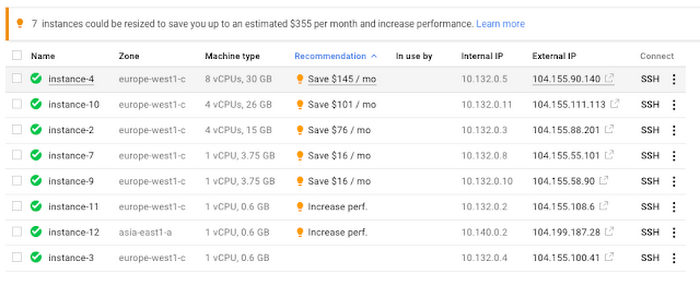
For more precise recommendations, you can install the Stackdriver Monitoring agent which collects additional disk, CPU, network, and process metrics from your VM instances to better estimate your resource requirements. You can also leverage the Recommender API for managing recommendations at scale.
2. Purchase Commitments
Our customers have diverse workloads running on Google Cloud with differing availability requirements. Many customers follow a 70/30 rule when it comes to managing their VM fleet—they have constant year-round usage of ~70%, and a seasonal burst of ~30% during holidays or special events.
If this sounds like you, you are probably provisioning resources for peak capacity. However, after migrating to Google Cloud, you can baseline your usage and take advantage of deeper discounts for Compute workloads. Committed Use Discounts are ideal if you have a predictable steady-state workload as you can purchase a one or three year commitment in exchange for a substantial discount on your VM usage.
We recently released a Committed Use Discount analysis report in the Cloud Console that helps you understand and analyze the effectiveness of the commitments you’ve purchased. In addition to this, large enterprise customers can work with their Technical Account Managers who can help manage their commitment purchases and work proactively with them to increase Committed Use Discount coverage and utilization to maximize their savings.
3. Automate cost optimizations
The best way to make sure that your team is always following cost-optimization best practices is to automate them, reducing manual intervention.
Automation is greatly simplified using a label—a key-value pair applied to various Google Cloud services. For example, you could label instances that only developers use during business hours with “env: development.” You could then use Cloud Scheduler to schedule a serverless Cloud Function to shut them down over the weekend or after business hours and then restart them when needed. Here is an architecture diagram and code samples that you can use to do this yourself.
Using Cloud Functions to automate the cleanup of other Compute Engine resources can also save you a lot of time and money. For example, customers often forget about unattached (orphaned) persistent disk, or unused IP addresses. These accrue costs, even if they are not attached to a virtual machine instance. VMs with the “deletion rule” option set to “keep disk” retain persistent disks even after the VM is deleted. That’s great if you need to save the data on that disk for a later time, but those orphaned persistent disks can add up quickly and are often forgotten! There is a Google Cloud Solutions article that describes the architecture and sample code for using Cloud Functions, Cloud Scheduler, and Stackdriver to automatically look for these orphaned disks, take a snapshot of them, and remove them. This solution can be used as a blueprint for other cost automations such as cleaning up unused IP addresses, or stopping idle VMs.
4. Use preemptible VMs
If you have workloads that are fault tolerant, like HPC, big data, media transcoding, CI/CD pipelines or stateless web applications, using preemptible VMs to batch-process them can provide massive cost savings. In fact, customer Descartes Labs reduced their analysis costs by more than 70% by using preemptible VMs to process satellite imagery and help businesses and governments predict global food supplies.
Preemptible VMs are short lived— they can only run a maximum of 24 hours, and they may be shut down before the 24 hour mark as well. A 30-second preemption notice is sent to the instance when a VM needs to be reclaimed, and you can use a shutdown script to clean up in that 30-second period. Be sure to fully review the full list of stipulations when considering preemptible VMs for your workload. All machine types are available as preemptible VMs, and you can launch one simply by adding “-preemptible” to the gcloud command line or selecting the option from the Cloud Console.
Using preemptible VMs in your architecture is a great way to scale compute at a discounted rate, but you need to be sure that the workload can handle the potential interruptions if the VM needs to be reclaimed. One way to handle this is to ensure your application is checkpointing as it processes data, i.e., that it’s writing to storage outside the VM itself, like Google Cloud Storage or a database. As an example, we have sample code for using a shutdown script to write a checkpoint file into a Cloud Storage bucket. For web applications behind a load balancer, consider using the 30-second preemption notice to drain connections to that VM so the traffic can be shifted to another VM. Some customers also choose to automate the shutdown of preemptible VMs on a rolling basis before the 24-hour period is over, to avoid having multiple VMs shut down at the same time if they were launched together.
5. Try autoscaling
Another great way to save on costs is to run only as much capacity as you need, when you need it. As we mentioned earlier, typically around 70% of capacity is needed for steady-state usage, but when you need extra capacity, it’s critical to have it available. In an on-prem environment, you need to purchase that extra capacity ahead of time. In the cloud, you can leverage autoscaling to automatically flex to increased capacity only when you need it.
Compute Engine managed instance groups are what give you this autoscaling capability in Google Cloud. You can scale up gracefully to handle an increase in traffic, and then automatically scale down again when the need for instances is lowered (downscaling). You can scale based on CPU utilization, HTTP load balancing capacity, or Stackdriver Monitoring metrics. This gives you the flexibility to scale based on what matters most to your application.
High costs do not compute
As we’ve shown above, there are many ways to optimize your Compute Engine costs. Monitoring your environment and understanding your usage patterns is key to understanding the best options to start with, taking the time to model your baseline costs up front. Then, there are a wide variety of strategies to implement depending on your workload and current operating model.
For more on cost management, check out our cost management video playlist. And for more tips and tricks on saving money on other GCP services, check out our blog posts on Cloud Storage, Networking and BigQuery cost optimization strategies. We have additional blog posts coming soon, so stay tuned!
Boost Security with Google’s reCAPTCHA Enterprise Fraud Prevention

1175
Of your peers have already read this article.
2:30 Minutes
The most insightful time you'll spend today!
Today, we are putting the power of Google’s insights and intelligence in the hands of risk, fraud, and security teams everywhere. We are pleased to announce the general availability of reCAPTCHA Enterprise Fraud Prevention, a new product that uses Google’s own fraud models, machine learning, and intelligence from protecting more than 6 million websites to help stop payment fraud.
reCAPTCHA Enterprise Fraud Prevention can help protect payment transactions by identifying targeted manual attacks and large-scale fraud attempts. It automatically trains fraud models based on behavior and transaction data to identify events that are likely fraudulent and could cause a dispute or chargeback if accepted.
When threat actors are identified and blocked on any site in the reCAPTCHA network, the intelligence is made available to help protect other organizations from those same attackers. Organizations can then use the scores to send the transaction for manual review or directly block suspicious transactions, drive increased trust in their legitimate transactions, reduce the amount of friction for good users, and reduce erroneous rejection rates.
“Being a safe and trusted place to give and receive help is our top priority. We are constantly innovating, refining and enhancing our fraud defenses and Google’s reCAPTCHA Enterprise Fraud Prevention adds another layer of industry-leading protection for our users. Combining Google’s rich security expertise with GoFundMe’s focus on fraud prevention is already showing promising results as we strive to keep our platform the safest place to give online,” said Matthew Murray, director of risk, GoFundMe.
According to data obtained from our customers using reCAPTCHA Enterprise Fraud Prevention in private Preview, the new solution can help drive comprehensive value for organizations by:
- Reducing fraud losses: Get behavior modeling (not just mouse movements), stop financial damage created by account takeovers (ATOs), and connect fraud and abuse intelligence across your site and application.
- Increasing legitimate sales: Fraud Prevention can help businesses increase their revenue by providing insights to understand who good users are, who may otherwise be caught in an overly aggressive, customer restrictive fraud model.*
These benefits are enabled for organizations by:
- Preventing advanced attacks: Stopping sophisticated attacks in an environment where attackers use cloud fraud infrastructure, and data leaks, virtual cards and VPN usage are on the rise
- Increasing trust in good transactions: Focus on good approval rates through a unique combination of supervised and unsupervised models
- Improving customer experience: By preventing fraudulent transactions with zero user friction, Fraud Prevention can help businesses protect legitimate users and increase customer retention
Our customers have used these new capabilities in preview in customer experiences that include online checkouts and payment transactions. Fraud Prevention has been used by merchants and payment processors to block millions of dollars in fraudulent transactions in a frictionless way.
reCAPTCHA Enterprise provides a comprehensive online fraud detection platform that helps prevent fraudulent, spammy, and abusive digital client activity across your web and application footprint. This platform includes Account Defender, which protects users from account takeovers (ATO), frictionless bot management capabilities, and password leak detection to identify compromised accounts. With an additional API call for Fraud Prevention, organizations can leverage a comprehensive solution to secure financial transactions along with core reCAPTCHA Enterprise capabilities.
To get started, organizations can install a score-based site key on each part of the payment user flow front end and send transaction data when a purchase occurs. This site key helps train site-specific fraud models and start returning fraud scores for each transaction.
Ready to put reCAPTCHA Enterprise Fraud Prevention to work? Contact our fraud specialists or your customer success CSM team and sign up with the free tier. You learn more about these new capabilities in reCAPTCHA Enterprise in our product documentation. You can also register for our webinar where our experts will be discussing this capability in great detail on June 1, 2023.
Coming up at our Security Summit on June 13-14, you can hear how reCAPTCHA Enterprise helped GoFundMe secure their donors from fraud. Sign up here for free Security Summit registration.
Cloud KMS with Cloud Storage: Better Performance for High-intensity Workloads

3274
Of your peers have already read this article.
2:30 Minutes
The most insightful time you'll spend today!
Encryption is critical for securing sensitive data while it is stored and transits the cloud. Today, Cloud Storage encrypts data server-side with standard Google-managed encryption keys by default, and can also encrypt data with customer-managed encryption keys that are stored and managed by Cloud Key Management Service (Cloud KMS).
While customers have been able to secure their data on Cloud Storage with Cloud KMS keys for some time, we are always updating our encryption offerings to deliver better performance, lower costs and more capabilities that support critical business workloads. In this post, we’ll discuss some of our latest developments in this space—in particular, performance improvements for high-intensity workloads and support for customer-managed encryption keys (CMEK) for object composition.
Why use Cloud KMS with Cloud Storage?
Cloud KMS enables you to centrally manage your keys in a fast and scalable way that helps to meet your security and compliance needs. Cloud KMS generates customer-managed encryption keys (CMEK) which act as an additional layer of protection on top of Google’s default encryption keys. You can set these keys on a Cloud Storage bucket as a default key, and can easily manage key rotation, replacement or disabling right within Cloud KMS.
In addition to software-based CMEKs, Cloud Storage also supports hardware-based CMEKs hosted in hardware security modules that are FIPS 140-2 Level 3 validated as part of our Cloud HSM service. These enable you to protect your most sensitive workloads without needing to manage HSM cluster operations yourself.
Improving KMS performance for high-intensity workloads
While Cloud HSM is often used to protect the most sensitive data for a customer, especially for those in healthcare and financial services industries, the default quota limits for cryptographic operations on Cloud HSM keys may cause performance bottlenecks for customers aiming to run high-intensity workloads when using Cloud Storage, such as analytics workloads on Hadoop.
We are making improvements to the Cloud KMS request behaviour on Cloud Storage that more effectively batches requests to Cloud KMS to reduce request bandwidth and drive down KMS billing. Identical Cloud KMS requests from Cloud Storage will be batched together for newly written objects and across all supported encryption modes in Cloud KMS, including software-backed customer-managed encryption keys. As a result of these changes, when you are using Cloud KMS you may notice faster encrypt, read and write operations for new data, deduplicated Cloud KMS audit logs and lower overall Cloud KMS charges. Customers running high-intensity workloads should see a significant reduction in throughput to KMS, leading to a reduction in KMS cryptographic operation billing costs for all types of KMS keys, as well as enabling customers to scale the throughput of their HSM-encrypted workloads.
Newly written objects encrypted with Cloud KMS will leverage these changes, whether they are encrypted using software-backed or HSM-backed CMEKs, and no configuration change is needed. If you are looking to use Cloud KMS with Cloud Storage, check out the Cloud KMS page to learn more, especially for setting up a hardware-backed HSM.
Supporting Cloud KMS for object composition
Object composition in Cloud Storage is widely used today for different types of applications, from stitching video segments together for a replay to uploading large datasets for analytics workloads. As more and more customers are leveraging Cloud Storage for these applications, we are expanding object composition capabilities to be flexible across different encryption modes.
Object composition is now supported for customer-managed encryption keys in addition to Google-managed encryption keys and customer-supplied encryption keys. This allows you to manage your own encryption keys while performing object composition for business-critical needs such as compiling sensitive financial datasets.
To compose objects that are encrypted with customer-managed encryption keys, specify the resource name of the Cloud KMS key for encrypting the composed object as a query parameter in the compose request. For the JSON API, construct the following HTTP request, while specifying the Cloud KMS key resource name for the query parameter kmsKeyName.
POST https://storage.googleapis.com/storage/v1/b/bucket/o/destinationObject/compose
For the XML API, specify the Cloud KMS key resource name for the request header x-goog-encryption-kms-key-name. You can also specify a Cloud KMS key when using gsutil to perform object composition. Check out our documentation to try out object composition, or to start composing objects encrypted with customer-managed encryption keys.
Get started with better encryption
Being deliberate about encryption is critical for securing your sensitive data on Cloud Storage. Whether you are composing objects or running analytics workloads, leveraging the latest encryption offerings will deliver faster performance, better security and improved workload scalability. We’re always evolving our encryption products to meet your needs and help you achieve your business goals. To get started with encryption on Cloud Storage, check out our documentation to learn more.
More Relevant Stories for Your Company

Strategic Consulting, Training & Implementation Guidelines with Public Sector PSO Helps Governments Stay Compliant
Did you know that by 2025, enterprise IT spending on public cloud computing will overtake traditional IT spending? In fact, 51% of IT spend in application software, infrastructure software, business process services, and system infrastructure will transition to the public cloud, compared to 41% in 20221.. As enterprises continue to

One Goal for Google: Get PQC Ready
The National Institute of Standards and Technology (NIST) on Tuesday announced the completion of the third round of the Post-Quantum Cryptography (PQC) standardization process, and we are pleased to share that a submission (SPHINCS+) with Google’s involvement was selected for standardization. Two submissions (Classic McEliece, BIKE) are being considered for the

Announcing reCAPTCHA Enterprise’s Mobile SDK to Help Protect iOS, Android apps
reCAPTCHA Enterprise is Google’s online fraud detection service that leverages more than a decade of experience defending the internet. reCAPTCHA Enterprise can be used to prevent fraud and attacks perpetrated by scripts, bot software, and humans. When installed inside a mobile app at the point of action, such as login,

Public Cloud’s Zero Trust Architecture Keeps Enterprise Data Safe
Over the past decade, cybersecurity has posed an increasing risk for organizations. In fact, cyber incidents topped the recent Allianz Risk Barometer for only the second time in the survey’s history. The challenges in combating these risks only continue to grow. Adversaries tend to be agile and are consistently looking
